L. Longo1,2, R. Rossi1, C. Niolu1,2, A. Siracusano1,2, G. Di Lorenzo1,2
1 Department of Systems Medicine, University of Rome Tor Vergata, Rome, Italy; 2 Psychiatry and Clinical Psychology Unit, Fondazione Policlinico Tor Vergata, Rome, Italy
A complex phenotype of suicidal behavior:
a case of post brain injury dissociative disorder
© Copyright by Pacini Editore Srl
OPEN ACCESS
Received: July 12, 2019 Accepted: July 15, 2019
Correspondence Giorgio Di Lorenzo, Department of Systems Medicine,
University of Rome Tor Vergata, via Montpellier 1, 00133 Rome, Italy • E-mail: [email protected].
Summary
We describe a case of a 54-year-old Caucasian woman with a complex phenotype for sui-cidal behavior after traumatic brain injury. At the admission patient had Bipolar Disorder, Post Traumatic Stress Disorder, Dissociative Identity Disorder, Conversion Disorder (with Psychogenic Non Epileptic Seizures) and a drug treatment for a post-traumatic epilepsy. Dur-ing a follow up period of 30 months, despite the symptomatological improvements due to psychopharmachological treatments (including also lithium) and psychoeducation treatment, the patient showed yet high risk of suicide and high levels of dissociation.
Key words
Suicide risk • Dissociation • Dissociative Identity Disorder • Traumatic Brain Injury • Psychogenic Non Epileptic Seizures • Epileptic Seizures • Post Traumatic Stress Disorder • Bipolar Disorder
Introduction
Annually, up to 50 million people experience a traumatic brain injury
(TBI) in worldwide 1. Individuals with a history of TBI have higher rates
suicidal ideation and behaviours than general population 2. People with
a history of TBI experience the development of several mental disor-ders increasing the suicide risk. TBI has been associated with a risk of
Bipolar Disorder (BD) 3 4, a mental illness in which a high risk of suicide
attempts is well estabilished 5. Post-Traumatic Stress Disorder (PTSD)
is frequently associated with suicidal ideation and suicide attempts 6. A
recent systematic review and meta-analysis of prevalence rates of PTSD after civilian traumatic brain injury reports that PTSD was present in 13.5% of patients with mild TBI and in 11.8% of those patients with a
moderate or severe TBI 7. Considering those studies including only
mo-tor vehicle accidents PTSD prevalence was higher ranging from 19.6 to
36% 7. Dissociative Identity Disorder (DID) is a chronic post-traumatic
condition 8 characterized by “disruption of identity characterized by two
or more distinct personality states” 9. Rates of attempted suicide range
from 61 to 72%, with 1 to 2.1% completing suicide among patients with
DID 10. Moreover, dissociation is a major mediator between early
trau-matic experiences and suicidal behavior 11. Different studies show the
co-occurrence of TBI and Psychogenic Non Epileptic Seizures (PNES)
varying between 16 and 83% 12. PNES can occur in isolation as a form
of dissociative disorder, or in association with various neurological and
psychiatric conditions such as epilepsy or PTSD 12. Suicide risk is higher
in epileptic patients 13 and in PNES patients 14 with no significant
differ-ence between two groups 14 15.
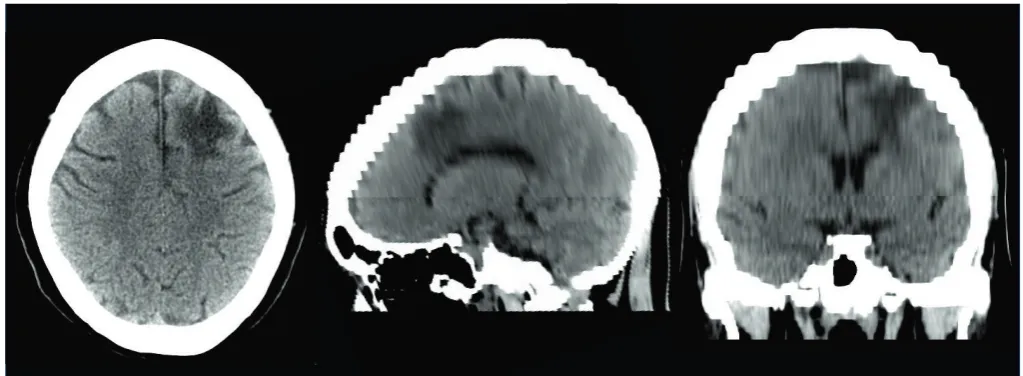
ing seizures; Computed Tomography (CT) imaging scan of head, see Figure 1), neurologists discharged the patient with a diagnosis of “Psychogenic Non Epileptic Seizures in post-traumatic epilepsy”, with a therapy consisting of lacosamide 400 mg, fenobarbital 50 mg, zonisamide 300 mg, citalopram 20 mg, clobazam 10 mg, quetiapine 50 mg, and levotiroxine 50 mcg; during hospitalization, the attempt to use valproic acid as an anti-epileptic drug was interrupted because it caused the patient’s hair loss. At discharge, the patient was referred to Day Hospital Ser-vice of our Psychiatry and Clinical Psychology Unit, where she performed, in addition to the standard clinical inter-view, a complete psychopathological and diagnostic as-sessment, composed by structured and semi-structured interviews as well as psychometric battery.
During the clinical interview (including also Dissociative Disorders Interview Schedule, DDSI), we evaluated the specific characteristics of the PNES and we recollected the traumatic history. PNES characteristics were: average duration of about 20 minutes, gradual onset and extinction, situational onset, presentation of crises with discontinu-ous and asynchrondiscontinu-ous shocks, pelvic thrust movements, absence of loss of urine and feces, possibility of external agents to modulate the crisis, fast post critical recovery. On several occasions during the clinical evaluations, A.T. presented PNES crises. After crises, we observed the presence of two other identities in the patient: one identity was a woman of 31 years old (before the road accident), who state that “I am single, I live with my mother ... I’m well, I’m happy, why I’m in the hospital?”; and another identity was a woman of 47 years old (age of road trauma), that was constantly crying, that reported things like “I’m sick, I’m so sick. My husband prefers to go to his dying mother rather than staying with me. I feel like I could die, I feel very bad”. When the dominant identity (host) returned, the
pa-Case report
A.T. is a 54-year-old Caucasian right-handed woman, mar-ried, with no children. A.T. sets the onset of her symptoms in 2011 (47 years old) after a road accident (the patient had a collision with a car while was driving on her mo-torcycle). From her clinical documentation, we learned that the patient reported: right clavicle fracture, left ankle fracture, cervical verticalization, displaced fracture of the right peroneal malleolus, and cerebral hemorrhage in the frontal right lobe with perilesional edema. For this reason, she was hospitalized for 20 days. A metal plate was used for displaced fracture of the right peroneal malleolus and for this reason the patient could not perform a Magnetic Resonance Imaging (MRI) scan. During the hospitaliza-tion, the patient reported several episodes of deperson-alization (“I was on the ceiling and I looked my body on the bed”). After the road accident, she presented a “treat-ment-resistant” epilepsy, accompanied by Psychogenic Non Epileptic Seizures (PNES), with a multiple frequency of these crises during the day (about 4/day).
From January 2012 to December 2016, A.T. had 8 ac-cesses to the emergency room (ER) of different hospitals for PNES characterized by: average duration of about 20 minutes, situational onset, presentation of crises with dis-continuous and asynchronous shocks, pelvic thrust move-ments, absence of loss of urine and feces.
In January 2017, A.T. was conducted to the ER of our University Hospital for a suicidal attempt with cuts to the wrists. At her arrival in the hospital, she presented a sub-continuous state of epileptic-type crises characterized by alterations of the state of consciousness along with repetitive, stereotyped motor behaviors. Due to the pro-longation of this epileptic-type state, she was hospitalized. After seven days of clinical observation and execution of instrumental investigations (resting EEG, video-EEG
(July 2019) was: lacosamide 400 mg; zonisamide 300 mg; carbolithium 1200 mg, quetiapine 400 mg, lorazepam 1.5 mg, levotiroxine 50 mcg.
At the follow-up of 30 months, the patient satisfied the criteria for the following DSM-5 diagnoses: Bipolar Dis-order subtype I (with actual Eutimic State), Post Trau-matic Stress Disorder and Other Type of Dissociative Disorder with Dissociative Trance. No criteria for sociative Identity Disorder (DID) and Conversion Dis-order (with Psychogenic Non Epileptic Seizures) were satisfied. At that time, A.T. reported a general improve-ment of her clinical conditions; moreover, her husband also confirmed a general, positive advancement in his wife’s functioning. Psychometric assessment confirmed symptomatologic improvements (Tab. I). As depicted in Figure 2, during the follow-up period of 30 months it was observed a decrease of mean duration (in min-utes) of dissociative crisis despite their monthly number remained high. Unfortunately, despite the reported and observed symptomatologic improvements, A.T. showed yet a high risk of suicide (see BHS score in Tab. I), as well as the patient showed high levels of dissociation (see DES and CADSS score in Tab. I). Consequently, we hypothesize that the patient’s high risk of suicide is associated with dissociation levels that remain high in follow-up.
Discussion
The present case illustrates a complex interaction be-tween environmental, biological and psychological fac-tors in the pathogenesis of suicidal behaviour. Following exposure to a motor vehicle accident, our patient de-veloped a complex psychiatric symptomatology such as mood disorder (Bipolar Disorder), trauma-related tient reported severe headaches and she had no memory
of the other identities. The host denied to suffer because her husband wasn’t going to visit her in the hospital saying “I was out of danger; his mother was dying”.
The psychometric battery included: Hamilton Depression Scale (HAM-D), Mania Rating Scale (MRS), Beck Depres-sion Inventory (BDI), Beck Hopelessness Scale (BHS), Clinician-Administered PTSD Scale (CAPS), Dissociative Experiences Scale (DES), Clinician-Administered Disso-ciative State Scale (CADSS). This psychometric assess-ment was administered at baseline and after 6, 12, 18, 24 and 30 months of follow-up. (see Table I for the scores). In the medical history, before the motor vehicle accident, the patient reported periods of sub-threshold depressive and hypomanic symptomatology; no psychotropic drug therapy or psychiatric hospitalization was described. A history of migraine was also reported. At baseline obser-vation, the patient had the criteria for the following DSM-5 diagnoses: Bipolar Disorder subtype I (with actual Mixed State), Post Traumatic Stress Disorder, Dissociative Iden-tity Disorder (DID) and Conversion Disorder (with Psycho-genic Non Epileptic Seizures).
A.T. refused psychotherapy treatment, so she was offered psychotropic medications (quetiapine 300 mg, lorazepam 2 mg; citalopram 20 mg and clobazam 10 mg were discon-tinued) and psychoeducation treatment. In March 2017, the patient attempted suicide by self-defenestration: she was stopped by her husband that unexpectedly returned home. Consequently, the patient was admitted in an acute psychiatric unit for 11 days. After the discharge, she did return in our Day Hospital Service: lithium treatment was gradually introduced (until 900 mg/die) and quetiapine was increased to 400 mg/die as well. Additionally, due to her continuous refusal to the psychotherapy, the patient continued psychoeducation treatment, with a gradual im-provement on insight of her clinical condition. In Novem-ber of the same year, A.T. reported suicidal ideation and planning, so she was recovered again in an acute psychi-atric unit for 10 days. A.T. returned again in our service: lithium was titrated up to 1200 mg/die and quetiapine until 500 mg/die; she also continued psychoeducation treat-ment, with gradual reduction of intensity and frequency of PNES crises, that were gradually replaced by episodes of trance. These episodes were characterized by: initial ste-reotyped hands movements, acute loss of consciousness and insensitivity to environmental stimuli, with a duration about 2-3 minutes. No other identities were observed or were referred by the husband throughout 2018 until the last follow-up assessment in July 2019. During the entire follow-up period, the patient continued refusing any type of psychotherapy treatment. In January 2019, based on neurologists’ indication, the patient suspended therapy with fenobarbital 50 mg, continuing taking lacosamide 400 mg and zonisamide 300 mg. The lastpharmacotherapy
TABLE I. Psychometric assessment at the baseline (T)) and during the follow-up period (T6 to T30).
T0 T6 T12 T18 T24 T30
HAM-D 27 16 9 12 6 10
MRS 18 12 8 4 2 4
BDI 52 46 36 35 26 24
STICSA-S 81 54 47 26 29 30
BHS 18 18 16 14 14 14
DES 90.35 59.85 66.07 71.42 74.07 59.5
CADSS 82 57 55 47 49 52
CAPS 99 92 76 65 63 59
ity switching 19. Furthermore, a dorsal-vagal activation
(‘system shutdown’) is characteristic of life-threatening situations with no chance to escape and the presence of a structured dissociative part is not so frequent. Con-sequently, we can hypothesize that at beginning our patient had dissociative emotional parts and a sympa-thetic activation and later she presented a dorso-vagal activation without structured dissociative parts.
Furthermore, dissociative behaviour may simply reflect behavioral disinhibition secondary to right frontal dam-age. Moreover, we also hypothesize that TBI and sub-sequent hospitalization might have been sufficient to trigger a complex behavioral response.
In the literature relatively few cases of DID after TBI are reported. For example, a dissociative behavior
af-ter right frontal TBI was found in a Vietnam Veaf-teran 20.
The study hypothesized that the structural focal lesion in the right superior prefrontal cortex (Brodmann area 6), causing a selective amnesia of the details of the TBI, acted together with the bilateral dysfunction of anteri-or paralimbic regions (anteri-orbitofrontal, anterianteri-or tempanteri-oral, and cingulate cortices) not only to favor the intrusion of memories related to previous traumatic experiences, but also to trigger dissociative flashbacks. The authors conclude that dysfunction of certain regions of the pre-frontal cortex and anterior temporal cortex involved with old episodic memories may play a role in the
occur-rence of dissociative flashbacks 20.
Similarly, a recent case report shows a transiently dis-sociation of identity in a 67 years old right-handed man with a left parietal lobe hematoma with mass effect and
an old lacunar infarct in the right frontal lobe 21. The
al-terations of personality gradually subsided after six to eight weeks and coincided with the resolution of the he-matoma. The authors hypothesized that a neurological insult to the left parietal brain can lead to a compensato-ry uninhibited activity of contralateral right parietal lobe. This can lead to retrieval of repressed traumatic, implicit episodic memory, streaming in to the consciousness
leading to the onset of Dissociative Identity Disorder 21.
It should be noted that suicidality has not been reported in the two clinical cases mentioned above.
ECT studies show two contrasting case report. In fact, a study shows a new onset of Dissociative Disorder Not Otherwise Specified (only one other identity) after
7 temporal right-sides Electroconvulsive Therapy 22 in
51 years old woman with bipolar disorder, hypothyroid-ism, migraine and history of anorexia nervosa admitted for depression and suicidal ideation. The study hypoth-esized that the fact that the ECT treatments were uni-lateral right-hemisphere may have contributed to the
patient’s presentation 22. In contrast, a recent case
re-port show treatment with ECT weekly for 2 years for a 39-years-old woman with DID, complex PTSD and Ma-disorder (PTSD), dissociative Ma-disorder (Dissociative
Identity Disorder), conversion disorder (Psychogenic Non Epileptic Seizures) and organic disorder (Epilep-tic Seizures). Each of these disorders is associated with a greater risk of suicide than the general popula-tion 5 6 10 13 14, such as for the TBI2. In particular AT’s
psy-chopathological picture at the beginning of our clinical observation was consistent with recent literature that shows crisis states in DID include self-mutilation,
flash-backs, non-epileptic seizures and suicide attempts 16.
After two months of observation, the patient attempted suicide and lithium was gradually inserted in pharmaco-therapy (until 1200 mg/die). During the follow up period (T6-T30) the patient reported symptomatological im-provements of all domains, except for dissociation and suicidal risk (see Table I). Consequently, we suppose that these two clinical features could be strongly related to each other.
In follow up period, the DES score declined from 90.35 to 59.5 and the CADSS score from 82 to 52. We hy-pothesized that this reduction could be caused by the transition from Dissociative Identity Disorder and Other Type of Dissociative Disorder with Dissociative Trance. This transition can be understood by integrating
Porg-es’ theory 17 with the theory of structural dissociation of
the personality, a trauma model that presents a unitary framework to understand diverse trauma-related
re-sponses 18. According to this theory, different parts of
personality (called dissociative emotional parts) are based on diverse defensive subsystems (fight/flight re-sponses) that remain rigidly blocked in traumatic expe-riences and can appear when the subject is facing
trau-matic issues 19. In complex dissociative disorders, these
responses are rooting dissociative parts with different levels of mental structure and autonomy and the activa-tion of dissociative parts may be clinically expressed in the more extreme dissociative cases, overt
0 5 10 15 20 25 30
1 2 3 4 5 6 7 8 9 10 11 12 13 14 15 16 17 18 19 20 21 22 23 24 25 26 27 28 29 30 number of crisis mean duration
jor Depressive Disorder-Congruent Psychotic Features and chronically suicidal behaviour contributed in some capacity to this patient’s personality integration 23.
Dissociative experiences are common across
differ-ent psychiatric disorders 24. A recent meta-analysis 25
showed that in comparison to non DD psychiatric pa-tients, DD patients were more likely to report a lifetime history of both suicide attempts (SA) and nonsuicidal self-injury (NSSI). SA and NSSI could represent an at-tempt to cope with dissociative symptoms or an ultimate
attempt to reach a dissociative state 25.
A.T. presented a PTSD. In 1 to 12% of people
experi-encing major psychological trauma 26, PTSD could be
presented as a complex and symptomatologically
het-erogenous clinical picture 27, dysregulating, from
molec-ular level (including neuroplasticity mechanisms 28) to
large brain networks 29, several biological functions.
De-spite a decrease in posttraumatic symptoms over time, at the follow-up of 30 months A.T. showed yet a moder-ate PTSD symptomatology (see CAPS score in Table I). Unfortunately, she refused, repeatedly, psychotherapy. The first line of PTSD treatment is a trauma focused psychotherapy such as Trauma-Focused Cognitive Be-havioral Therapy (TF-CBT) or Eye Movement
Desensi-tization and Reprocessing (EMDR) 30. Several studies
demonstrated EMDR clinical efficacy is determined by large and complex brain modifications of people
affect-ed by PTSD 31-34, including also those affected by TBI 35.
Unfortunately, she refused, repeatedly, psychotherapy.
We cannot exclude that A.T.’s clinical condition could have benefited from EMDR treatment, both for dissocia-tive symptoms both for suicidality, particularly for EMDR effect on limbic and associative cortex.
Despite the improvement of depressive symptoms over time, A.T. suicidality persisted (see BDI and BHS scores in Table I). This may be interpreted as a reduction of somatic depressive symptoms in spite of persistence of depressive ideation, associated to low personal
re-sources and coping strategies 36. We believe that in
A.T.’s clinical case a psychotherapy approach might determine a clinical improvement also through an im-provement of personal coping resources.
Another clinical issue arises from our clinical case: the presence of multiple diagnoses. Both at the beginning and after 30 follow-up months A.T. presented several DSM diagnoses with several psychopathological over-lapping areas. If this situation is a diagnostic distortion of our current diagnostic classification systems in Psy-chiatry is debating 37.
Results from this our clinical observation suggests that more structured researchers with accurate clinical as-sessment are needed in order to better understand the complex relation between dissociative experiences and suicidal behaviors, particularly in those patients with TBI.
Conflict of interest
The Authors declare to have no conflict of interest.
References
1 Maas AIR, Menon DK, Adelson PD, et al. Traumatic brain injury: integrated ap-proaches to improve prevention, clini-cal care, and research. Lancet Neurol 2017;16:987-1048.
2 Bahraini NH, Simpson GK, Brenner LA, et al. Suicidal ideation and behaviours after traumatic brain injury: a systematic review. Brain Impair 2013;14:92-112.
3 Drange OK, Vaaler AE, Morken G, et al.
Clinical characteristics of patients with bipolar disorder and premorbid traumatic brain injury: a cross-sectional study. Int J Bipolar Disord 2018;6:19.
4 Perry DC, Sturm VE, Peterson MJ, et al.
Association of traumatic brain injury with subsequent neurological and psychiatric disease: a meta-analysis. J Neurosurg 2016;124:511-26.
5 Tondo L, Pompili M, Forte A, et al. Suicide
attempts in bipolar disorders: comprehen-sive review of 101 reports. Acta Psychiat Scand 2016;133:174-86.
6 Pompili M, Sher L, Serafini G, et al.
Post-traumatic stress disorder and suicide risk
among Veterans: a literature review. J Nerv Ment Dis 2013;201:802-12.
7 Van Praag DLG, Cnossen M, Polinder S, et al. Posttraumatic stress disorder after civilian traumatic brain injury: a systematic review and meta-analysis of prevalence rates. J Neurotrauma 2019; Aug 2. [Epub ahead of print]
8 Dell PF. The long struggle to diagnose
Multiple Personality Disorder (MPD): MPD. In: Dell PF, O’Neil AJ, Eds. Dissocia-tion and the dissociative disorders: DSM-V and beyond. New York, NY: Routledge, Taylor & Francis Group 2009, pp. 383-402. 9 American Psychiatric Association.
Diag-nostic and statistical manual of mental dis-orders, 5th ed. Washington, DC: American Psychiatric Association Publishing 2013. 10 Brand B. Establishing safety with patients
with dissociative identity disorder. J Trau-ma Dissociation 2001;2:133-55.
11 Rossi R, Longo L, Fiore D, et al.
Dissocia-tion in stress-related disorders and self-harm: a review of the literature and a sys-tematic review of mediation models. Jour-nal of Psychopathology 2019;25:162-71.
12 Popkirov S, Carson AJ, Stone J. Scared
or scarred: could ‘dissociogenic’ lesions predispose to nonepileptic seizures after head trauma? Seizure 2018;58:127-32. 13 Christensen J, Vestergaard M, Mortensen
PB, et al. Epilepsy and risk of suicide: a population-based case-control study. Lancet Neurol 2007;6:693-8.
14 Guillen A, Curot J, Birmes PJ, et al. Suicidal
ideation and traumatic exposure should not be neglected in epileptic patients: a multi-dimensional comparison of the psychiatric profile of patients suffering from epilepsy and patients suffering from psychogenic nonepi-leptic seizures. Front Psychiatry 2019;10:303. 15 D’Alessio L, Giagante B, Oddo S, et al.
Psychiatric disorders in patients with psychogenic non-epileptic seizures, with and without comorbid epilepsy. Seizure 2006;15:333-9.
16 Dorahy MJ, Huntjens R Memory and
Ameri-can Psychiatric Publishing, Inc., 2007, pp. 55-75.
17 Porges SW. The polyvagal theory: new
insights into adaptive reactions of the autonomic nervous system. Cleve Clin J Med 2009;76:S86-90.
18 Van der Hart O, Nijenhuis E, Steele K.
The hauted self: structural dissociation and the treatment of chornic traumatiza-tion. New York, NY: W.W. Norton & Com-pany, 2006.
19 González A, Del Río-Casanova L, Justo-Alonso A. Integrating neurobiology of emotion regulation and trauma therapy: Reflections on EMDR therapy. Rev Neu-rosci 2017;28:431-40.
20 Berthier ML, Posada A, Puentes C.
Disso-ciative flashbacks after right frontal injury in a vietnam veteran with combat-related posttraumatic stress disorder. J Neu-ropsychiatry Clin Neurosci 2001;13:101-5. 21 Sreenivasa V, Mayur P. Dissociation of
identity following left parietal haematoma – a single case report. Australas Psychia-try 2019; Apr 16. [Epub ahead of print] 22 Zaidner E, Sewell RA, Murray E, et al.
New-onset dissociative disorder af-ter electroconvulsive therapy. J ECT 2010;26:238-41.
23 Webster KD, Michalowski S, Hranilovich TE. Multimodal treatment with ECT for identity integration in a patient with dis-sociative identity disorder, complex
post-traumatic stress disorder, and major depressive disorder: a rare case report. Front Psychiatry 2018;9:275.
24 Lyssenko L, Schmahl C, Bockhacker L, et al. Dissociation in psychiatric disorders: a meta-analysis of studies using the dis-sociative experiences scale. Am J Psy-chiatry 2018;175:37-46.
25 Calati R, Bensassi I, Courtet P. The link
between dissociation and both suicide at-tempts and non-suicidal self-injury: meta-analyses. Psychiatry Res 2017;251:103-14. 26 Shalev A, Liberzon I, Marmar C.
Post-traumatic stress disorder. N Engl J Med 2017;376:2459-69.
27 Yehuda R, Hoge CW, McFarlane AC, et al.
Post-traumatic stress disorder. Nat Rev Dis Primers 2015;1:15057.
28 Stratta P, Sanità P, Bonanni RL, et al.
Clini-cal correlates of plasma brain-derived neurotrophic factor in post-traumatic stress disorder spectrum after a natural disaster.
Psychiatry Res 2016;244:165-70.
29 Fenster RJ, Lebois LAM, Ressler KJ, et al.
Brain circuit dysfunction in post-traumatic stress disorder: from mouse to man. Nat Rev Neurosci 2018;19:535-51.
30 NICE guideline [NG116]. Post-traumatic
stress disorder. National Institute for Health and Care Excellence 2018 ( htt-ps://www.nice.org.uk/guidance/ng116/ chapter/Rationale-and-impact).
31 Pagani M, Di Lorenzo G, Verardo A, et
al. Neurobiological correlates of EMDR therapy. Riv Psichiatr 2012;47:16-8. 32 Pagani M, Di Lorenzo G, Verardo AR, et
al. Neurobiological correlates of EMDR monitoring – An EEG study. PLoS One 2012;7:e45753.
33 Pagani M, Di Lorenzo G, Monaco L, et al.
Neurobiological response to EMDR ther-apy in clients with different psychological traumas. Front Psychol 2015;6:1614. 34 Santarnecchi E, Bossini L, Vatti G, et
al. Psychological and brain connectiv-ity changes following trauma-focused CBT and EMDR treatment in single-episode PTSD patients. Front Psychol 2019;10:129.
35 Pagani M, Castelnuovo G, Daverio A, et al. Metabolic and electrophysiological changes associated to clinical improve-ment in two severely traumatized sub-jects treated with EMDR-A pilot study. Front Psychol 2018;9:475.
36 Rossetti MC, Tosone A, Stratta P, et al.
Different roles of resilience in depressive patients with history of suicide attempt and no history of suicide attempt. Braz J Psychiatry 2017;39:216-9.
37 Luciano M, Sampogna G, Del Vecchio V, et al. Critical evaluation of current di-agnostic classification systems in psy-chiatry: the case of DSM-5. Riv Psichiatr 2016;51:116-21.
How to cite this article: L. Longo, R. Rossi, C. Niolu, et al. A complex phenotype of suicidal behavior: a case of post brain injury dissociative disorder. Journal of Psychopathology 2019;25:172-7.