DEMOGRAPHIC RESEARCH
VOLUME 32, ARTICLE 17, PAGES 533
−
542
PUBLISHED 19 FEBRUARY 2015
http://www.demographic-research.org/Volumes/Vol32/17/ DOI: 10.4054/DemRes.2015.32.17
Descriptive Finding
Gendered disparities in Mexico-U.S. migration
by class, ethnicity, and geography
Erin R. Hamilton
©2015 Erin R. Hamilton.
This open-access work is published under the terms of the Creative Commons Attribution NonCommercial License 2.0 Germany, which permits use, reproduction & distribution in any medium for non-commercial purposes, provided the original author(s) and source are given credit.
1 Introduction 534
2 Data 534
3 Results 536
4 Discussion 539
Descriptive Finding
Gendered disparities in Mexico-U.S.
migration by class, ethnicity, and geography
Erin R. Hamilton1
Abstract
BACKGROUND
Men are more likely than women to migrate from Mexico to the United States. This disparity has been shown to vary by level of education, suggesting that gender may interact with other forms of social status to inform the relative risk of Mexico-U.S. migration for men and women.
OBJECTIVE
This study examines whether and how the gender disparity in migration from Mexico to the United States varies by class, ethnicity, and geography.
METHODS
Data from two waves of the Mexican Family Life Survey are used to estimate the rate of migration to the United States for men and women across class, ethnic, and geographic groups.
RESULTS
The gender disparity in Mexico-U.S. migration varies systematically by class, ethnicity, and geography. The gender disparity in migration is largest among those with the least education, with the least power in the workforce, in the most impoverished households, who both identify as indigenous and speak an indigenous language, and who live in the southern region of Mexico. It is smallest among those with the most education, in the least impoverished households, with the highest occupational status, who do not identify as indigenous, and who live in the northern regions of Mexico.
CONCLUSIONS
Social privilege equalizes the gender disparity in Mexico-U.S. migration and social disadvantage exacerbates it. This pattern may arise because social status allows women to overcome gendered constraints on mobility, or because the meaning of gender varies by social status.
1. Introduction
Despite increasing participation of women in migration from Mexico to the United States, men still predominate among Mexico-U.S. migrants (Riosmena and Massey 2012), a pattern that has inspired substantial research and debate (Cerrutti and Massey 2001; Curran and Rivero-Fuentes 2003; Donato 1993; Hondagneu-Sotelo 1994; Kanaiaupuni 2000). Scholars have argued that this gender disparity in migration is evidence that migration is gendered; that is, patterns of migration reflect gendered norms and understandings, which, in the case of Mexico-U.S. migration, result in the relatively constrained spatial mobility of women (Hondagneu-Sotelo 1994).
The gender disparity in migration masks substantial heterogeneity in the risk of migration among Mexican men and women (Donato 1993; Cerrutti and Massey 2001). This heterogeneity may be structured by gender, meaning that gender may interact with other forms of social status to pattern men’s and women’s relative risk of migration in systematic ways. For example, female migrants are more positively selected for education than are male migrants (Feliciano 2008; Kanaiaupuni 2000; Rendall and Parker 2013). As a result, the gender disparity in migration is largest among the least educated and smallest among those with the most education.
Like education, other forms of social status may also interact with gender to influence men’s and women’s relative risk of migration, but we lack studies of how the gender disparity in migration varies across social groups. Mahler and Pessar (2001) propose that scholars consider the “gendered geographies of power” that shape and constrain the relative mobility of women and men along power hierarchies created through economic, social, and geographic processes. In this paper, I examine how the gender disparity in Mexico-U.S. migration varies by class, ethnicity, and geography.
2. Data
individuals in 8,440 households; the MxFLS achieved a response rate of 96.7% among eligible, sampled households in the first wave (Rubalcava and Teruel 2008).
U.S. migrants in the MxFLS are individuals who migrated “permanently” to the United States between 2002 and 2005, with “permanent” migrations defined as those of a year or longer; specifically, the definition includes migrants who had been living in the United States or had plans to live there for at least a year at the time of the wave 2 survey, in 2005 (Teruel, Rubalcava, and Arenas 2012). Limiting to migrant trips of a year or longer means that temporary migrants who maintain a permanent residence in Mexico are not included. Research on circular migration and settlement suggests that men predominate among temporary Mexico-U.S. migrants to a greater extent than they do among longer-duration (or permanent) migrants (Massey 1986; Ibarraran and Lubotsky 2008). Excluding temporary migrants from this analysis should therefore produce smaller gender imbalances than would be observed in data including both temporary and longer-duration migrants. In wave 2, the MxFLS tracked U.S. migrants through multiple visits to origin households and through re-contact information obtained in Wave 1. The MxFLS re-interviewed 90% of the original sample in wave 2, including 91% of U.S. migrants. I limited the analysis to individuals aged 15 and older in 2002, who were asked the full set of individual questions. The analytic sample includes 23,750 people over age 15, 617 of whom (386 men and 231 women) were U.S. migrants in 2005.
I defined class in three ways: education, role in the labor force, and household poverty. Education is categorized by level of completed schooling at the time of the wave 1 survey, differentiating between no education, less than primary, primary completed, some or all years of lower secondary (i.e., secundaria), some or all years of upper secondary (i.e., preparatoria), and any post-secondary schooling. The latter category is too small to further disaggregate. I also conducted the analysis for education limiting to adults age 24 and older, and the results were consistent with those presented below.
Role in the labor force differentiates among those who are employed in the labor force according to the following categories constructed by the MxFLS: agricultural worker, unpaid worker in non-agricultural business, self-employed in non-agricultural business without paid employees, paid employee in non-agricultural business, and self-employed in non-agricultural business with paid employees, positions that reflect increasing control and power in the workforce.
minimum wage). These are the eight indicators of poverty in the Mexican Population Council’s Index of Marginality; the index used here was constructed from various MxFLS survey items.
In Mexico, the primary ethnic distinction is between indigenous and non-indigenous peoples, a basis of stratification in which non-indigenous-identified peoples are disadvantaged relative to the mestizo (mixed-race) majority. Ethnicity is measured by self-reports of indigenous identity and language, differentiating between three groups: those who identify as indigenous and speak an indigenous language, those who identify as indigenous but do not speak an indigenous language, and those who do not identify as indigenous.
Two measures of geography capture differences across Mexico in levels of development, culture, and spatial integration. In Mexico, regional disparities fall along a north-south axis, with the northern regions dominating economically and the south being relatively disadvantaged. Economic power and activity have also been concentrated in urban Mexico. The MxFLS sample is representative of five regions and of four rural-urban strata. The regions are the South-Southeast, which includes Oaxaca, Veracruz, and Yucatán; the Center, which includes the Federal District, México, Morelos, and Puebla; the Center-West, which includes Guanajuato, Jalisco, and Michoacán; the Northeast, which includes Coahuila, Durango, and Nuevo León; and the Northwest, which includes Baja California Sur, Sinaloa, and Sonora. The rural-urban strata are localities of fewer than 2,500 people, localities with between 2,500 and 15,000 people, localities with between 15,000 and 100,000 people, and localities of more than 100,000 people.
To analyze how the gendered disparity in migration varies by class, race, and geography, I estimated the rate of U.S. migration for men and women in each class, race, and geographic group, which is equal to the number of U.S. migrants in 2005 in each group expressed as a percent of the group population in 2002, and the gendered migration rate ratio, which is equal to the rate of U.S. migration for men divided by the rate of U.S. migration for women within each group.
The MxFLS sample design was implemented by the National Institute of Geography, Statistics and Information. All analyses are weighted using the household weights provided by MxFLS.
3. Results
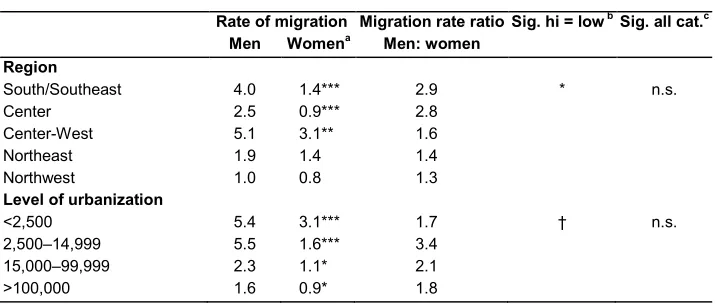
education, among whom men are 3.5 times more likely to migrate to the United States than women, and smallest among those with the highest level of education, among whom women are in fact more likely to migrate to the United States than men, and there is graded change at each level of education. A similar pattern occurs for role in the labor force, household poverty, ethnicity, and region: the gendered migration rate ratio is largest among the most disadvantaged and smallest among the least disadvantaged, and there is graded change across categories.
Table 1: The rate of migration for men and women, and the gendered migration rate ratio, by class, ethnicity, and geography
Rate of migration Migration rate ratio Sig. hi = low b Sig. all cat.c
Men Womena Men: women
All 3.2 1.5*** 2.1 n/a n/a
Education
None 1.4 0.4* 3.5 † n.s
Primary incomplete 2.9 1.0*** 2.9
Primary complete 3.9 1.7*** 2.3
Some lower secondary 4.8 2.2*** 2.2
Some upper secondary 2.8 1.9*** 1.5
Some college or higher 0.9 1.3 0.7
Role in labor force
Agricultural worker 6.3 0.6* 10.5 † ***
Unpaid worker 8.6 1.1*** 8.1
Self-employed 1.5 1.1 1.4
Remunerated worker 2.3 2.0 1.2
Business owner 1.4 1.3 1.1
Household poverty
Highest 7.4 2.4*** 3.1 n.s n.s.
High 5.1 2.4** 2.1
Medium 4.1 2.0** 2.1
Low 2.7 1.4*** 1.9
Lowest 1.9 1.1* 1.7
Ethnicity
Indigenous id and language 6.1 1.5*** 4.1 * n.s.
Indigenous id only 5.9 2.9 2.0
Table 1: (Continued)
Rate of migration Migration rate ratio Sig. hi = low b Sig. all cat.c
Men Womena Men: women
Region
South/Southeast 4.0 1.4*** 2.9 * n.s.
Center 2.5 0.9*** 2.8
Center-West 5.1 3.1** 1.6
Northeast 1.9 1.4 1.4
Northwest 1.0 0.8 1.3
Level of urbanization
<2,500 5.4 3.1*** 1.7 † n.s.
2,500–14,999 5.5 1.6*** 3.4
15,000–99,999 2.3 1.1* 2.1
>100,000 1.6 0.9* 1.8
Source: Mexican Family Life Survey
a. Significance indicates whether migration rates for men and women are significantly different within groups.
b. Significance indicates whether the gendered migration rate ratios for the groups with the smallest and largest values within each measure are different from each other.
c. Significance indicates whether the gendered migration rate ratios across all groups within a single measure are jointly significant.
† p<0.1, *p<0.05, **p<0.01, ***p<0.001
An exception occurs for level of urbanization: the disparity is smallest in the most rural places, where men are 70% more likely to migrate to the United States than women, a rate ratio slightly smaller than that for the most urban places.
Three additional points are worthy of note. First, there is no consistent relationship between U.S. migration and each of the six measures of social status. For example, rates of U.S. migration decline with social status in the case of household poverty and urbanization, but for education, the relationship is non-linear. A diverse set of processes relates these social characteristics to U.S. migration.
Second, in some cases the relationship between the measure of social status and U.S. migration is similar for men and women, but in others it is not. For example, U.S. migration relates similarly with education, household poverty, and region for men and women. However, across roles in the labor force there is hardly any variation among women, but substantial variation among men. In general, differences in the rate of U.S. migration across class, ethnic, and geographic groups are more pronounced among men than among women.
4. Discussion
Across five measures capturing class, ethnic, and geographic inequalities in Mexico, a pattern is revealed whereby social privilege equalizes the gender disparity in Mexico-U.S. migration and social disadvantage exacerbates it. The gender disparity in Mexico-U.S. migration is largest among those with the least education, with the least power in the workforce, in the most impoverished households, who both identify as indigenous and speak an indigenous language, and who live in the southern region of Mexico. It is smallest among those with the most education, in the least impoverished households, with the most occupational status, who do not identify as indigenous, and who live in the northern regions of Mexico. An exception to this pattern is by level of urbanization, an issue to which I return below.
Scholarship on gender and migration offers several explanations for this pattern. First, labor market discrimination against women in Mexico may lead women with higher levels of education or other forms of status to perceive relatively greater returns to their human capital in the U.S. labor market than highly educated men do (Kanaiaupuni 2000). However, studies finding that the majority of female migrants are family-based (Cerrutti and Massey 2003) and that a large portion of Mexican immigrant women in the U.S. are not employed (Feliciano 2008) suggest something else is at work.
A second explanation is that gendered constraints on mobility demand greater resources and risk-taking of migrant women than of migrant men (Feliciano 2008). The traditional patriarchal family model constrains women’s mobility by defining women’s domain to the home and by insisting on family involvement to ensure the morality of women who migrate (Malkin 2004). The meaning of migration is also gendered, symbolizing an act of masculinity and affirming men’s roles as workers and providers, and thereby presenting substantial ideological barriers to women’s migration (Boehm 2008; Broughton 2008). Women with greater social status in other forms – be it education, role in the labor force, etc. – may be better able to overcome gendered constraints on mobility than are women who are not similarly advantaged. This does not imply that women with more social status are more likely to migrate than women with less social status. The social forces generating migration out of Mexico are relevant to both men and women (Cerrutti and Massey 2001). What this means is that women with greater social power are able to better approximate the rate of U.S. migration among men within social groups, given rationales for and costs of migration specific to those groups.
ideology itself interacts with other forms of social status and advantage or disadvantage, such that the meaning of gender, and its implications for the relatively mobility of women and men, vary with other forms of social status. For example, Peña (1991) has argued that exaggerated machismo in folklore among working-class Mexican men is a response to severe economic exploitation and cultural subordination of the Mexican working class. To the extent that the ideological discourse that Peña reveals translates to greater domination of women within the working class, it may result in the relatively constrained mobility of women with lower levels of education. By the same token, relatively more gender-egalitarian practices may facilitate class mobility, insofar as households rely on women’s work to achieve middle-class status (Hondagneu-Sotelo 1994); as a result, middle-class women may be relatively less constrained by gender ideology. From this perspective, women with greater social, ethnic, or geographic power do not overcome patriarchal constraints; rather, they face fewer constraints to begin with.
The fact that the gender disparity is similar in rural and urban places is surprising, given that rural places are economically and socially disadvantaged relative to urban Mexico. This exception may reflect the importance of social resources, specifically migrant networks. The greater historic prevalence of migration in rural places (Durand, Massey, and Zenteno 2001) may enable rural women’s migration through greater access to migrant networks. Supplementary analyses revealed that men’s and women’s rates of U.S. migration are nearly equivalent in rural places in the Northwest and Center-West regions of Mexico, which have longer histories of U.S. migration than other regions in Mexico, and that the expected pattern of greater gender disparity in rural places as compared to urban places is present in the other three regions.
References
Boehm, D.A. (2008). “Now I am a man and a woman!” Gendered moves and migrations in a transnational Mexican community. Latin American Perspectives
35(1): 16–30. doi:10.1177/0094582X07310843.
Broughton, C. (2008). Migration as engendered practice: Mexican men, masculinity, and northward migration. Gender & Society 22(5): 568–589. doi:10.1177/08912 43208321275.
Cerrutti, M. and Massey, D.S. (2001). On the auspices of female migration from Mexico to the United States. Demography 38(2): 187–200. doi:10.1353/dem. 2001.0013.
Curran, S.R. and Rivero-Fuentes, E. (2003). Engendering migrant networks: The case of Mexican migration. Demography 40(2): 289–307. doi:10.1353/dem.2003. 0011.
Donato, K.M. (1993). Current trends and patterns of female migration: Evidence from Mexico. International Migration Review 27(4): 748–771. doi:10.2307/2546911. Durand, J., Massey, D.S., and Zenteno, R.M. (2001). Mexican Immigration to the
United States: Continuities and Changes. Latin American Research Review
36(1): 107–127.
Feliciano, C. (2008). Gendered Selectivity: U.S. Mexican Immigrants and Mexican Nonmigrants, 1960–2000. Latin American Research Review 43(1): 139–160. doi:10.1353/lar.2008.0009.
Hondagneu-Sotelo, P. (1994). Gendered transitions: Mexican experiences of immigration. Berkeley, CA: University of California Press.
Ibarraran, P. and Lubotsky, D. (2007). Mexican immigration and self-selection: New evidence from the 2000 Mexican census. In: Borjas, G.J. (ed.). Mexican immigration to the United States. Chicago, IL: National Bureau of Economic Research: 159–192. doi:10.7208/chicago/9780226066684.003.0006.
Kanaiaupuni, S.M. (2000). Reframing the migration question: An analysis of men, women, and gender in Mexico. Social Forces 78(4): 1311–1347. doi:10.1093/sf/ 78.4.1311.
Malkin, V. (2004). “We go to get ahead”: Gender and status in two Mexican migrant communities. Latin American Perspectives 31(5): 75–99. doi:10.1177/0094582X 04268402.
Massey, D.S. (1986). The settlement process among Mexican migrants to the United States. American Sociological Review 51(5): 670–684. doi:10.2307/2095492. Peña, M. (1991). Class, gender, and machismo: The “treacherous-woman” folklore of
Mexican male workers. Gender & Society 5(1): 30–46. doi:10.1177/0891243910 05001003.
Rendall, M. and Parker, S. (2013). Two decades of negative educational selectivity of Mexican migrants to the United States. College Park, MD: Maryland Population Research Center (MPRC working paper PWP-MPRC-2013-008).
Riosmena, F. and Massey, D. S. (2012). Pathways to El Norte: Origins, destinations, and characteristics of Mexican migrants to the United States. International Migration Review 46(1): 3–36. doi:10.1111/j.1747-7379.2012.00879.x.
Rubalcava, L. and Teruel, G. (2008). User’s guide: Mexican Family Life Survey [electronic resource]. Mexico City: Mexican Family Life Survey. [http://www. ennvih-mxfls.org/]