DOES PUBLIC INFORMATION ACQUISITON LEVEL THE PLAYING FIELD OR WIDEN THE GAP? AN ANALYSIS OF LOCAL AND NON-LOCAL INVESTORS
Travis A. Dyer
A dissertation submitted to the faculty at the University of North Carolina at Chapel Hill in partial fulfillment of the requirements for the degree of Doctor of Philosophy in the Accounting
Department in the Kenan-Flagler Business School.
Chapel Hill 2018
Approved By:
Mark Lang
Alon Brav
Robert Bushman
Eva Labro
ABSTRACT
Travis A. Dyer: Does Public Information Acquisition Level the Playing Field or Widen the Gap? An Analysis of Local and Non-Local Investors
(Under the direction of Mark Lang)
While prior studies have speculated that local investors have an information advantage as
a result of private information, I examine whether local investors generate an information
advantage through their use of public information. Using novel data on professional investors’ requests for financial information from the SEC, I document that investors acquire more
financial information for their local investments, and that local investors are more timely at
acquiring newly released disclosures. Consistent with public information being more valuable to
local investors, I find that investors make more profitable trading decisions in local stocks when
they also acquire public financial information. Lastly, I find that investors’ preference to
over-weight local stocks in their investment portfolio (“Local Bias”) is increasing in the amount of
public information acquired. These results suggest that the use of public information may widen
ACKNOWLEDGEMENTS
I wish to thank members of my dissertation committee, Alon Brav, Robert Bushman, Eva
Labro, and Wayne Landsman for their helpful suggestions, and especially Mark Lang (chairman)
for his mentorship and insights. I have also benefited from the helpful comments of Andrew
Belnap, Michael Drake, Dimas Pena Romera, Lorien Stice-Lawrence, Donny Zhao, conference
participants at the 2017 BYU Accounting Research Symposium, and workshop participants at
TABLE OF CONTENTS
LIST OF TABLES……….vii
LIST OF FIGURES...viii
LIST OF ABBREVIATIONS……….ix
CHAPTER 1: INTRODUCTION………1
CHAPTER 2: DEVELOPMENT OF HYPOTHESES………..10
CHAPTER 3: DATA AND EMPIRICAL DESIGN……….14
Sample Construction and Characteristics………..14
Research Design and Variable Construction……….16
CHAPTER 4: RESULTS AND ROBUSTNESS………...22
Tests of H1: Proximity and Public Information Acquisition……….22
Main Analysis………22
Exogenous Shock to Investor Proximity………24
Tests of H2: Value of Information Acquisition for Local and Non-local Investors...26
Enhanced Timeliness……….26
Improved Decision Making………...27
Tests of H3: “Local Bias” and Information Acquisition………...28
Robustness of Empirical Results………...28
Investment Level Control………..28
Familiarity Bias……….29
Information Asymmetry………30
Non-Professional Investors………31
Alternative Measure of Proximity….………32
CHAPTER 5: CONCLUSION.……….33
APPENDIX 1: VARIABLE DEFINITIONS AND MEASUREMENT.………..36
REFERENCES……….……….38
FIGURES...……….……….………...…...41
LIST OF TABLES
Table 1 – Professional Investor Descriptive Statistics………...42
Table 2 – Descriptive Statistics of Primary Sample………..43
Table 3 – Relation between Public Information Acquisition and Investors’ Proximity to Investment……….44
Table 4 – Relation between Public Information Acquisition and Investors’ Proximity to Investment by Information Type Requested……….45
Table 5 – Cross-Sectional Variation in the Relation between Public Information Acquisition and Investors’ Proximity to Investment: Relationship Age………...46
Table 6 – Relation between Public Information Acquisition and Investors’ Proximity to Investment Using Changes in Firm Headquarters………47
Table 7 – Relation between the Delay in Public Information Retrieval and Investors’ Proximity to Investment………48
Table 8 – Descriptive Statistics for the 13(f) Sample………....49
Table 9 – Public Information Acquisition and Informed Trading……….50
Table 10 – Relation between Local Bias and Public Information Acquisition………..51
Table 11 – Main Findings Controlling for the Level of Investment………..52
Table 12 – Firm-Level Information Asymmetry and Local Research………...53
LIST OF FIGURES
Figure 1A – United States Zip Codes with Professional Investors using EDGAR………...41
LIST OF ABBREVIATIONS
EDGAR Electronic Data Gathering, Analysis, and Retrieval system
IRS Internal Revenue Service
PIA Public Information Acquisition
CHAPTER 1: INTRODUCTION
Many claim that investors have a private information advantage in local stocks, which
causes them to tilt their allocation of invested wealth towards geographically proximate
investments (French and Poterba, 1991; Coval and Moskowitz, 1999; Coval and Moskowitz,
2001; Cooper et al. 2012). But what is the role of public information for local and non-local investors? On one hand, public information might substitute for private information advantages
and therefore be used as an equalizer to reduce the private information advantages of local
investors. On the other hand, if public and private information act as complements, then local
investors might use public information to widen their information advantage. In this study, I examine public information acquired by professional investors to see (1) if investors acquire
more public information for local or non-local investments, (2) if public information is more
valuable to local or non-local investors, and (3) if public information acquisition mitigates or moderates investors’ preference to over-weight local stocks in their investment portfolio (i.e., “Local Bias”).1
In this study, I construct and utilize a direct measure of professional investor information
acquisition. Until recently, research on investor information retrieval has been quite challenging
to study directly (Drake et al, 2015; Drake et al, 2016; Lee et al. 2015; Loughran and McDonald,
2015). With the release of EDGAR log files by the Security and Exchange Commission (SEC),
the barriers to this stream of literature have been removed. EDGAR is a large repository of all
public financial information provided to and maintained by the SEC. The EDGAR log files
contain each request received by the EDGAR system, documenting a partially masked IP address
performing the request, the timing of request, and the filing requested.
Using ARIN WhoWas reports, I am able to unmask the identity of IP addresses that
download documents from EDGAR and directly link specific professional investor institutions to
their information requests on EDGAR. This process not only allows me to know where the
investor is located, but also allows me to link in other investor-level data, such as investors’
public 13(f) holdings. This process results in linking approximately 9,810 professional investors
to EDGAR download data. The most research-active professional investor companies in my
sample include companies such as JP Morgan and Citi Group. The most frequent locations of
professional investors include New York City and Chicago.
The richness of the underlying data provides this study the opportunity to implement a
unique and robust research design. In its simplest form, the data is a record of an investor’s
request for firm information. The same investor can request information for multiple firms, and
the same firm can have multiple investors requesting information. Because of this feature, I can
include an investor-time fixed effect, which controls for the average research activity by an
investor in a given period of time. Additionally, I can include a firm-time fixed effect, which
controls for the average research for a firm in a given period of time. The combination of these
effects controls for attributes such as an investor’s location, skill, risk appetite, and resources, as
well as a firm’s size, visibility, risk, and performance in that period of time. The remaining
such, the scope of alternative explanations for observing a proximity effect on information
retrieval drastically narrows.
Using this research design and sample of professional investors, I find evidence that
investors tend to download more information from EDGAR for proximate investments.2 For
example, each calendar quarter investors access 20.16% more kilobytes of information if they
are within 100 kilometers of the investment.3 Additionally, this positive relation is quite
pervasive. It exists for multiple proxies of information acquisition. It persists across all major
form types filed with the SEC, including both annual and quarterly reports, as well as material
disclosures (i.e., 8-Ks). The local effect also persists throughout the entire investment
relationship. I also find that research by local investors tends to be particularly concentrated
around informational events. This evidence suggests that investors obtain more public
information for local investments and is consistent with investors choosing to use public
information to widen their information advantage, rather than to mitigate their information
disadvantages.
One concern with the prior analyses is that an investor’s choice to acquire information
about a firm is endogenous to their choice to follow the firm. To address this concern, I perform
an analysis using plausibly exogenous variation in investor proximity. To obtain this variation I
use a sample of firms who chose to relocate their firm headquarters. Prior work suggests that
firm headquarter locations are determined based on strategic business decisions related to lower
taxes, lower employee wages, and better airport facilities (Strauss-Kahn and Vives, 2009). I
2 A candidate correlated omitted variable is the level of investment in a stock. Investors might research more for stocks that make up a greater proportion of their portfolio. This is important since research confirms investors hold larger portfolio positions in local stocks (i.e., “Local Bias”). In robustness tests, I control for the level of investment and find similar results.
believe that it is unlikely that the decision of where to relocate a firm’s headquarters is made by
executives based on the preferences of investors for proximity.4 In this setting, if investors who
exogenously become local request more information about the firm after the headquarter change, then proximity, rather than firm selection, is the dominant factor affecting their information
acquisition decisions. With this sample of firms, I find evidence consistent with proximity to
investments leading to increased information acquisition by professional investors.
I next explore the value of the observed asymmetric public information acquisition. Prior
work surrounding local investors’ trading profitability more generally is mixed with some
finding that investors are more profitable in local investments and others the opposite (Coval and
Moskowitz, 2001; Ivkovic and Weisbenner, 2005; Massa and Simonov, 2006; Seasholes, 2010;
Bernile et al. 2016). One could argue that asymmetric information might exist, but that it does not provide actionable value to investors’ portfolios. As such, I measure the value of public information for local investors in two ways: (1) enhanced speed of acquisition, and (2) enhanced portfolio decision-making. First, obtaining public information in advance of other investors is often valuable. For example, investors achieve trading profits through the advance access to consumer reports (Mullins et al., 2013). If local investors obtain public information more quickly than their non-local counterparts, then they have the opportunity to make use of the information more rapidly than the average investor. This speed advantage might even discourage non-local investors from performing as much stock research in the first place. I provide evidence that investors tend to acquire public information more rapidly for local investments. Looking at the two days following the release of SEC filings, I find that investors arrive at the public filing of their local investments approximately 30 minutes sooner than that of their non-local investments.
Looking at only the 60 minutes following the release, I also find that local investors still have a time advantage. Since investors have autonomy over when they access the new disclosures, these tests provide investors’ revealed preference for timeliness. As such, the findings suggest
investors value timeliness of information retrieval more for local stocks.
Second, a more direct measure of value is the potential benefit of public information for improving portfolio allocation decisions. I explore this possibility by linking professional investors’ research on EDGAR with their 13(f) portfolio holdings data. With this data, I first confirm that more research about a stock improves investors’ portfolio choices. I find that share purchases are more positively related to future returns when institutional investors perform research about a stock. Specifically, future returns tend to be 27 basis points higher (lower) when share purchases (sales) are coupled with public information research. More importantly, I find that the benefit of stock research for portfolio decisions is approximately 54 basis points larger for local stocks. This evidence suggests that public information is, on average, more valuable to local investors.
I conclude the paper by looking at the relation between “Local Bias” and public
information acquisition. A large stream of literature suggests that asymmetric private information
between local and non-local investors is a driving force behind investors’ preference to tilt their
portfolios toward local stocks, a phenomenon which prior research has dubbed “Local Bias.” If
public information is a contributing force to investors’ “Local Bias,” then an investor’s “Local
Bias” should vary with the amount of public information acquired about the stock. Alternatively,
if “Local Bias” is the result of a non-information-based force, then “Local Bias” should be
unrelated to an investor’s information acquisition. Using the sample of 13(f) institutional
acquired about the stock. This suggests that a contributing force to investors’ “Local Bias” is the
amount of public information acquired and is consistent with information asymmetries
motivating investors to allocate more wealth toward local investments.
This paper is motivated on four fronts. First, one of the regulatory objectives of the Securities and Exchange Commission (SEC) is to “level the playing field” among investors through public financial disclosure (SEC, 2000). Put into context, the SEC’s objective is to equalize the information sets available to investors. According to the SEC, the primary purpose for providing public filings on EDGAR is to “increase the efficiency and fairness of the
securities market” (SEC, 2010). This paper explores which investors benefit most from public disclosures and whether investors choose to acquire public information in a manner consistent with either equalizing or diverging information sets across investors.
Second, there is a large disagreement among academics about whether local investors have asymmetric information. Some contend that local investors have valuable private
information (Ivkovic and Weisbenner, 2005; Massa and Simonov, 2006), while others contend
no such information seems to exist (Seasholes, 2010) or largely disappeared at the turn of the
century (Bernile et al., 2016). Additionally, other streams of research attribute “Local Bias” to behavioral rather than information-based explanations (Coopers et al., 2012). I speak to this ongoing debate by observing the public information sets of investors and examining whether information asymmetries exist.
Third, Cooper et al. (2012) suggests that researchers should attempt to identify the source of local investors’ information advantage, should it exist.Recent theoretical work by Van
assumptions, investors will acquire more public information for local stocks if they are endowed with a small local information advantage. My paper explores this possibility by investigating whether investors acquire more public information for local or non-local stocks.
Fourth, “Local Bias” is an economically large phenomenon. Prior work on “Local Bias”
finds that the typical US household allocated 30% of their portfolio to local stocks even though
those same stocks make up only 12% of the total US market on average (Seasholes and Zhu,
2010). This 18% gap in US investor diversification equates to approximately $1.12 trillion or
6.4% of GDP in the year 2014.5 Other research finds that “Local Bias” also exists for mutual
fund investors (Coval and Moskowitz, 1999; Bernile et al. 2016). “Home Bias,” the international equivalent to “Local Bias,” is also quite large. According to Investment Company Institute
(2015), only 25% of US equity mutual fund assets were in equity funds focused on foreign
markets in 2014, with foreign markets encompassing 55% of the world market (Ferri et al.,
2013). Therefore, understanding the extent to which public information acquisition mitigates or
moderates investors’ “Local Bias” is economically important.
This paper contributes to the budding literature on information retrieval. Prior research in
this area studies the determinants and consequences of information retrieval at the firm level
(Drake et al., 2015; Drake et al., 2016), the filing level (Lee et al., 2015; Loughran and
McDonald, 2015), and the geographic level (Mondria et al., 2010; Drake et al., 2017). My study
builds upon this literature by disaggregating information retrieval to the investor level. To my
knowledge, this study provides the first direct test of how proximity between investors and firms
relates to public information retrieval.
More generally, this paper speaks to a broad literature on portfolio choice and
profitability. Prior academic research provides convincing evidence that investors tilt their
portfolio toward geographically proximate investments (Cooper et al., 2012) and suggests this
might be related to asymmetric private information advantage. This study provides input-based
evidence that local and non-local investors create asymmetric information sets using public
information. Furthermore, this study builds on prior research that documents increased
profitability of investors in local stocks (Coval and Moskowitz, 2001; Ivkovic and Weisbenner,
2005; Giannini et al., 2015; Bernile et al., 2015) and provides evidence consistent with public
information being one channel through which this advantage occurs.
This paper also contributes new insights into how investors gain their local information
advantage. Prior research using Twitter and stock message boards suggests that local investors
have more information about local investments. Giannini et al. (2015) finds that the content in
Twitter posts are more predictive of future stock performance when written by local users.
Huang et al. (2012) finds that message board users in China post more about local stocks. This
study complements these findings and suggests that one channel through which local investors
increase their information advantage is the acquisition of public information.
While I have attempted to mitigate potential concerns, the results are subject to caveats.
First, causal inferences need to be appropriately caveated. Even though the research design
choices and other robustness tests mitigate several omitted-variable biases and reverse causality
concerns, it is possible that alternative explanations persist. Second, while I perform several data
screens and robustness tests to increase confidence that my analyses capture actual investors,
statements. Nonetheless, this analysis provides novel information on the impetus of public
information acquisition.
In the next section, I discuss relevant literature and present my primary hypotheses. In
Section 3, I discuss the data and methodology. I provide both empirical results and robustness
CHAPTER 2: DEVELOPMENT OF HYPOTHESES
Prior academic literature often speculates that local investors have a private information
advantage over non-local investors. However, the role of public information for local and non-local investors has received little attention. The relation between public and private information
in this setting is not obvious. One possibility is that local private information may act as a
substitute for publicly available information. Accordingly, the incentive to acquire public
information on local stocks would be mitigated by local private information. The concept of
public and private information acting as substitutes is quite common. An example of this is found
in a recent study of IRS public information acquisition. Bozanic et al. (2017) finds that the IRS’s
incentive to acquire public information from EDGAR decreased after they obtained access to
private tax information. Furthermore, the SEC catch phrase “level playing field” asserts a
substitutive nature between public and private information.
Studies on “Local Bias” in particular have made the argument of substitutes. Lewis
(1999) highlights a main counterargument to observing information asymmetries between local
and non-local investors by writing, “Greater uncertainty about foreign returns may induce the
investor to pay more attention to the data.” This reasoning is built on the premise that public and
private information are substitutes. In recent theoretical work, Van Nieuwerburgh and Veldkamp
(2009) investigate investors’ decision to acquire public information. They model investors
endowed with a small initial local advantage and find that, given equal access to local and
non-local information (i.e., public information), a constraint on information acquisition, and a fixed
cannot change their portfolio return, they prefer to acquire information that reduces the most
portfolio risk (i.e., information for non-local investments).
The second possibility is that public and private information act as complements.
Accordingly, the incentive to acquire public information about local stocks would be greater with
local private information. Mosaic theory, for example, suggests that the combination of
non-material private information with public information creates an information mosaic that is more
valuable than the sum of the individual parts. Prior research has documented that under certain
circumstances, public information may act complementary to private information. Research
studying public disclosure of earnings has observed increases in intra-day spreads, consistent
with a complementarity between public and private information (Lee et al., 1993). Van
Nieuwerburgh and Veldkamp (2009) predicts that when investors have the joint decision to
acquire public information as well as make portfolio investment choices they choose to acquire
more information about local investments. In this setting, prices reveal the average investor’s
knowledge. Learning about local assets sacrifices excess returns, since both local and
non-local investors have knowledge of future payouts. If investors instead learn about non-local assets,
prices will only reflect as much information as the average investor knows. As the authors put it,
“Investors profit more from knowing information others do not know.”
Whether public information is a substitute or complement to local private information is
an empirical question. Given the preceding discussion, I formulate the following hypothesis in
the null form:
I next investigate the value of public information to local and non-local investors. Prior
research surrounding local investors’ trading profitability has found that local investors make
either more profitable trading decisions (Coval and Moskowitz, 2001; Ivkovic and Weisbenner,
2005; Massa and Simonov, 2006), less profitable trading decisions (Seasholes, 2010) or that the
profitability has decreased at the turn of the century (Bernile et al. 2016). Based on the conflicting results, one question is whether the asymmetric public information provides
actionable value to an investor’s portfolio. If public information is a complement [substitute] to local private information, then public information for local [non-local] investments should be
more valuable to investors. However, if public information is stale or irrelevant for portfolio
holdings purposes, then there may be no value to asymmetric information acquisition. Stated in
the null form:
H2: The value of public information is unrelated to an investor’s proximity to the investment.
I lastly explore the relation between “Local Bias” in invested wealth and public
information acquisition. Prior academic literature finds that both mutual fund managers and
individual investors exhibit “Local Bias” in equity portfolios (Coval and Moskowitz, 1999;
Coval and Moskowitz, 2001; Ivkovic and Weisbenner, 2005; Massa and Simonov, 2006;
Seasholes and Zhu, 2010). However, there is much debate on why this behavior exists (Cooper et
al., 2012). A major theory on the topic is asymmetric private information advantages (Coval and
Moskowitz, 1999; Coval and Moskowitz, 2001), but other explanations include relative wealth
hedging (Massa and Simonov, 2006), transaction costs (Choe et al., 2005), familiarity
(Huberman, 2001), loyalty (Cohen, 2009), patriotism (Morse and Shive, 2011), and
advantages from the other theories is the presence of private information held only by local
investors.
If public information is used more by non-local investors (i.e., substitutes for private
information), then it should mitigate “Local Bias” under the asymmetric information advantage
theory. Alternatively, if public information is used more by local investors (i.e., complements
private information), then it should further increase “Local Bias.” The later explanation is
consistent with Van Nieuwerburgh and Veldkamp (2009), which predicts that the use of public
information increases “Local Bias.” In contrast, if “Local Bias” is driven a non-information
based explanation, then acquired public information should be unrelated to investors’ “Local
Bias.” Stated in the null form:
CHAPTER 3: DATA AND EMPIRICAL DESIGN
3.1 Sample Construction and Characteristics
I use EDGAR log files to capture information acquisition by investors. Critical to my
study, EDGAR log files retain the masked IP address, the filing acquired, and the time of each
information request. Similar to prior studies which use EDGAR log files, I exclude (1)
self-identified web crawlers, (2) IP addresses that make more than 1,000 requests in a day, (3) IP
addresses that request filings for more than 100 firms in a day, (4) server codes of 300 or greater
(e.g., URL not found), and (5) information requests of index files and images (Drake et al., 2015;
Lee et al., 2015; Loughran and McDonald, 2015).
I next match masked IP addresses requesting EDGAR filings with IP address ownership
data from ARIN WhoWas reports.6 WhoWas reports are similar to the more common WhoIs
reports, but instead provide historical ownership information for IP addresses rather than just the
current ownership information. If the entire IP address block is owned by an entity in a given
period, I assign that entity’s name to the IP address in question.7 I identify investors from these
names by manually categorizing the 4,000 most used names in my sample. For the remaining
names, I use keywords associated with investment advisors identified in the initial 4,000 names.8
6 Given the limitations on ARIN WhoWas requests, I limit requests to IP address blocks with more than 10 observations in my sample.
7 Since the last octet of IP addresses provided in the SEC log files are scrambled (e.g., 12.25.278.ajc), I refer to an “IP address block” as the range of possible IP addresses (e.g., 12.25.278.0 through 12.25.278.255).
8 These key words include variations of the words: Asset Management, Bank, Broker, Capital, Causality,
For the entirety of my analyses, I use the resulting sample of IP addresses categorized as
investors and refer to these investors as professional investors.9 The sample of EDGAR data
employed in this study ranges from the first quarter of 2003 to the first quarter of 2015. Table 1
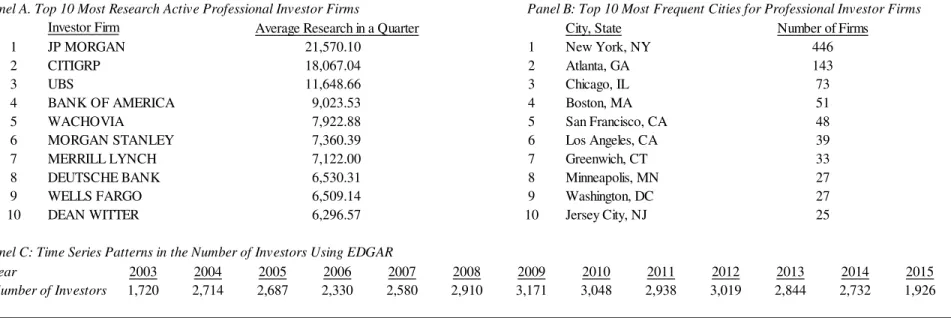
Panel A reports the top 10 most research active professional investor companies. As to be
expected, this list includes companies such as JP Morgan, Morgan Stanley, and Wells Fargo.
Table 1 Panel C reports the time-series variation in the number of professional investors
identified using EDGAR. In general, the number of professional investors using EDGAR has
remained relatively constant over the sample period.
I obtain location data from two sources. Investor location data is obtained from
IP2Location, which links zip codes to specific IP addresses.10,11 To obtain the zip code location
of the firm whose information is being acquired, I use the header information from SEC 10-K
and 10-Q filings. Specifically, I used the zip code used for the business address. If zip code data
is missing or changes over the sample period, I exclude these investors and firms from the main
sample.12 As such, for the main analyses, proximity between firms and investors is time
invariant. Following prior literature (Coval and Moskowitz, 1999), I exclude zip codes from
Alaska, Hawaii, and all US territories.
Table 1 Panel B reports the top 10 most frequent cities for professional investor firms. I
find that New York, Atlanta, and Chicago are very common cities for professional investors.
This list generally aligns with priors on cities with strong financial centers. Figure 1A illustrates
9 In later robustness tests, I used non-professional investor IP addresses in EDGAR and reach similar conclusions. 10 I use IP2LOCATION-LITE-DB9 available at http://lite.ip2location.com.
11 Since EDGAR masks the last octet of IP address in the publicly available log files, there are instances where it cannot be determined which zip code to assign a given IP address. I remove these IP addresses from my sample.
the geographic distribution of professional investor EDGAR users across the United States. From
this figure, we observe that the use of EDGAR seems to be spread across the United States,
suggesting that EDGAR use has not been confined to just a few large cities. This is reassuring, as
variation in professional investor location is vital to testing the relation between information
acquisition and proximity to investment. Figure 1B illustrates the geographic distribution of
company headquarters in my sample across the United States. Both investor location and
company headquarters location tend to be found in or near large cities, but are relatively spread
across the United States.
3.2 Research Design and Variable Construction
A major strength of this study is the research design implemented throughout each of the
analyses, which capitalizes on the available counterfactual or benchmark groups using a variety
of fixed effects. Since investors research multiple investments at any given point in time, an ideal
benchmark for an investor’s research behavior for a local firm is the same investor’s research
behavior for a distant firm during the same time period. Using a within investor-time analysis
strengthens identification by removing possible correlated omitted variable biases relating to
fixed investor attributes in that time-period (i.e., investor location, investor type, investor risk
appetite, investor resources, investor wealth, etc.). In tandem with an investor-time analysis, I
also incorporate a firm-time benchmark, which controls for fixed firm characteristics in that time
period (i.e., firm size, firm risk, firm visibility, firm performance, the amount of information
available for request, etc.). The combination of within investor-time and within firm-time
analyses increases internal validity by removing a host of alternative explanations in each of the
analyses. What remains after incorporating these two fixed effect structures is variation
Following the approach recommended in Gormley and Matsa (2014), each of the
empirical designs uses a high-dimensional fixed effects structure.13 To test whether investors
consume more or less public information for local investments (H1) I use the following research design:
, , = ∙ , + , + , + , , ( 1 )
PIA representsthe amount of public information acquisition by investor i about firm j in period t
and Local is an indicator if the investor is local to the investment. Coefficients αi,t andαj,t
represent the investor-time andfirm-time fixed effects, respectively. H1 is rejected in favor of the alternative hypothesis if α1 is significantly different from zero. If α1 is also positive [negative]
then the results would be consistent with public and private information acting as complements
[substitutes].
I measure the amount of public information acquired by investors (PIA) using four measures. The first is the total kilobyte size of files requested for the first time (SumSize). This is intended to capture the amount of new information an investor is acquiring during the quarter.
The logic behind this measure is that the amount of information in a filing is likely related to the
number of kilobytes in the filing. The second and third measures are the number of files
requested for the first time (InitialDownloads) and the number of files requested for a second time or more (Redownloads). Each of these variables are measured over calendar quarters and are logged to reduce the influence of outliers.14,15 The fourth measure is the principal component
13 Gormley and Matsa (2014) recommends fixed effects over adding means of dependent variables as controls. They further recommend certain Stata functions when faced with high-dimensional fixed effects. This paper uses reghdfe. Additional information is available on their website: http://finance.wharton.upenn.edu/~tgormley/papers/fe.html.
14 The volume of EDGAR requests is such that evaluating inferences on a quarterly basis, instead of a weekly or daily basis, makes estimation more computationally feasible.
of the previous three measures (Factor).16 For all of the above information acquisition variables, interim periods where professional investors do not acquire any information about a company
they follow are categorized as zero.17Local is an indicator variable set to one if the geodesic distance between the investor zip code and the firm headquarters zip code (i.e., as the crow flies)
is less than 100 kilometers (Coval and Moskowitz, 2001).18 All continuous variables are
winsorized at the 1 and 99 percent level by quarter. Standard errors are clustered by investor and
firm.
I test the value of public information for local and non-local investors (H2) using two approaches. The first approach focuses on the timing of information acquisition. An enhanced
speed in acquiring information affords investors the ability to make more timely trading
decisions on new information. In other words, speed is valuable to investors. If investors tend to
acquire filings more rapidly for local or non-local firms, then investors’ have the opportunity to
act more quickly on information for local or non-local firms. For this analysis, I look at
professional investor requests on EDGAR in either the two days and one hour following the
release of public filings on EDGAR. Similar to equation (1), I evaluate the timing of information
retrieval using the following research design:
, , = ∙ , + , + , + , , ( 2 )
Where Retrieval Delay is measured as the difference in minutes between the investor’s retrieval time of the filing and the time at which the filing was released. Since the exact time of day that
16 I retain only one factor from this analysis based on tests of eigenvalues being greater than one, the scree plot, and a parallel analysis.
17 I categorize investors as following a firm if they search for a firm’s financial information in two or more calendar quarters. Conclusions are similar in sign, significance, and magnitude if observations with information acquisition of zero are excluded.
the filings were released is unknown, I use the timing of the first acquirer as a proxy. If δ1 is
significantly different from zero, then this suggests that investors value the timeliness of public
disclosure access differently for local and non-local investments.
The second method I employ to test H2 is a more direct measure of value and focuses on investors’ trading profitably. Prior literature suggests that investors are more informed about a
stock if their buy decisions are more positively correlated with future returns (Maffett, 2012). I
expand this structure in two steps. First, I investigate whether buy decisions are more informed
when coupled with public information acquisition. As such, I interact this relation with public
information acquisition. Second, to test if public information is more valuable for local or
non-local investors (H2), I further interact the relation with an indicator for local investments. The culminating research design is as follows:
, +1 = !1∙ , + !2∙ , −1+ !3∙ % ℎ ',(, + !4∙ ,(
+ !5∙ + ℎ,(, + !6∙ ,(∙ + ℎ,(, + !7∙ ,(∙ % ℎ ',(,
+ !8∙ + ℎ,(, ∙ % ℎ ',(, + !9∙ + ℎ,(, ∙ ,(∙ % ℎ ',(,
+ !, + 0, 1
( 3 )
Return is the quarterly firm stock return adjusted by the value-weighted market return. Buyhold
is an indicator if the investor's quarter end shares were greater than or equal to the previous
quarter. Search is an indicator if the institutional investor searched for firm information on EDGAR during the quarter.19,20 The main coefficient of interest is β9. If β9 is positive and
significant, then EDGAR research is more informative to local investors’ portfolio decisions than
19 I do not include firm-time fixed effects because of perfect correlation with the dependent variable. In robustness tests, I find that results are similar using a firm fixed effect.
non-local investors. To test this, I manually match EDGAR professional investors to their 13(f)
portfolio holdings on Thomson Reuters. I link EDGAR names to Thomson Reuters’ names using
two steps. First, I look through each candidate name match based on high name similarity.
Second, I manually search through Thomson Reuters’ names for common firms on EDGAR that
do not match in the previous step.21 This results in matching 609 institutions to the EDGAR
research data. In instances where an institutional investor has multiple locations searching on
EDGAR (i.e., multiple branches), I assign the most frequent location to that institutional
investor.22
For the same sample of professional investors with 13(f) holdings, I investigate if “Local
Bias” is related to the amount of public information acquired (H3):
%, , = 2 ∙ , + 23 ∙ , , + 24∙ , ∙ , , + , + , + , , ( 4 )
Where PB is one of two measures of portfolio bias as of the end of the calendar quarter. The first
measure, PB1, is the difference between the investor’s portfolio weight in stock i and the market portfolio weight in stock i. PB2 is the log of the investor’s portfolio weight in stock i divided by the market portfolio weight in stock i (Cooper et al. 2012). If γ2 and γ3 are insignificantly
different from zero, then γ1 represents the previously documented “Local Bias” in portfolio
holdings. If γ3 is positive and significant, then “Local Bias”is larger when investors acquire
public information, consistent with public information acting as a contributing force to “Local
Bias” (Van Nieuwerburgh and Veldkamp, 2009).
The above specifications result in the formulation of three distinct samples. The first
sample, which I label the Primary Sample, is associated with testingequation (1). The second
CHAPTER 4: RESULTS AND ROBUSTNESS
4.1 Tests of Hypothesis 1 – Proximity and Public Information Acquisition 4.1.1 Main Analysis
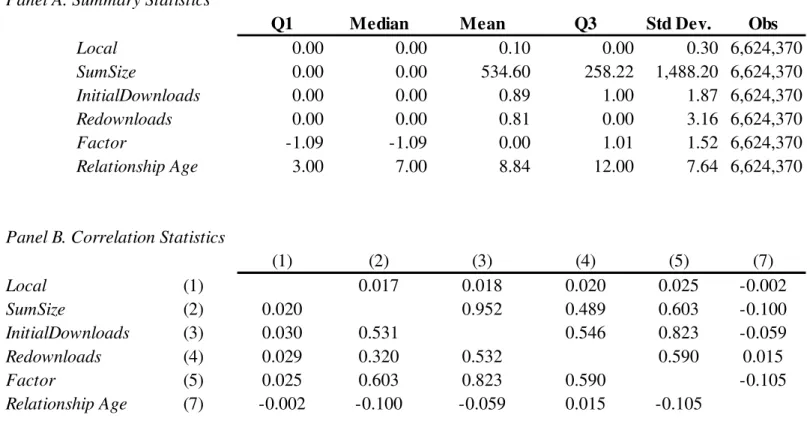
Table 2 presents the descriptive statistics for the Primary Sample. The sample has
6,624,370 investor-firm quarters. In about 10 percent of these observations, the investor is within
100 kilometers of the firm. The mean number of kilobytes requested each quarter for a firm was
about 535. For perspective, the median byte size for form 10-K in the sample is 225 kilobytes.
The average number of files downloaded for the first time in a quarter by an EDGAR user for a
specific company is 0.89, with 0.81 redownloaded files. The correlations presented in Panel B of
Table 2 provide initial evidence that Local tends to be positively related to measures of information acquisition, suggesting that the closer an investor is to an investment, the more
information they acquire about that investment.
Table 3 presents results from estimating equation (1) for each of the measures of public
information acquisition.Consistent with the correlations, Local is positively related to public information acquisition. In other words, the same investor, with both a local and non-local
investment, prefers to acquire more information about local investments. On average, investors
tend to acquire 20.16% more kilobytes of information, 5.83% more previously unseen files, and
redownload 7.36% more files if they are within 100 kilometers of the investment. Using the
mean value of the total bytes acquired each quarter (SumSize) from Table 2, this suggests that being proximate to an investment results in about 107 additional kilobytes of information being
about 6 more material disclosures (i.e., 8-Ks) for one company every quarter or about 5 more
annual reports (i.e., 10-Ks) over the lifetime of the investor-firm relationship.23 These results are
consistent with predictions that investors will acquire more public information for local
investments (Van Nieuwerburgh and Veldkamp, 2009).24 In untabulated analyses, I find that the
research by local investors tends to be particularly concentrated around informational events,
which is consistent with their increased research being information and trade-based.
To investigate how pervasive investors’ preferences are to acquire more local
information, I look at cross-sectional variation in investor behavior based on the filing type being
requested. It is possible that proximity is only related to increased acquisition of certain company
filings, such as annual or quarterly reports. I explore this possibility by looking at investors that
acquired at least some information during the quarter. Table 4 presents estimates of Equation (1)
using InitialDownloads for groups of filings provided to the SEC. Forms are categorized into one of the following seven form categories: (1) Annual Reports, (2) Quarterly Reports, (3) IPO
Reports, (4) Material Disclosures, (5) Insider Trading Reports, (6) Proxy Statements, or (7)
Other Forms.25 The first noteworthy result is that acquisition of information for each type of
information is positively related to an investor’s proximity to investment. Interestingly, the
relation between proximity and information acquisition is the smallest for annual and quarterly
reports. The relation between proximity and public information acquisition seems to be strongest
23 The median 8-K and 10-K byte size in the sample is about 18 and 225 kilobytes respectively.
24 Van Nieuwerburgh and Veldkamp (2009) characterizes investors’ information acquisition choice in their proposition two. In addition to predicting that investors will learn more about local investments, this proposition highlights that investors have incentives to learn about (1) larger risk factors, and (2) risk factors for which the average investor is uncertain. In untabulated analyses, I find evidence consistent with these additional predictions. Specifically, investors acquire more public information for larger and more volatile investments.
25 The specific forms associated with each category is as follows: (1) 10-Ks, (2) 10-Qs, (3) S1s, (4) 8-Ks, (5) Forms 4, 5, 6, (6) DEF Forms, or (7) Other. For more detail on each form category, please refer to
amongst material disclosures and insider trading reports. Being local to an investment is related
to increased information acquisition of material disclosures and insider trading reports by 6.71%
and 10.42%, respectively. This evidence suggests that the relation between proximity to
investment and information acquisition permeates across information types, but that there is
variation in the strength of the relation between information types. Additionally, if local
investors do have an information advantage, it seems that it is likely to be derived from their
increased use of material news and insider trading information.
I perform a second cross-sectional split based on the length of the investor-firm
relationship in Table 5. One concern is that local investors’ preference for additional public
information might be transient and only exist at the onset of the investor-firm relationship. If
asymmetric information acquisition does not persist, then this would be generally inconsistent
with local investors having a consistent information advantage. In contrast to this concern,
results in Table 5 suggest that investors’ preferences are actually increasing throughout the
investor-firm relationship. Across all four measures of information acquisition, I find that a
longer investor-firm relationship increases investors’ preference to acquire more public
information for local stocks. This finding is consistent with the view that investors obtain private
information through strong and established relationships and community ties to local firms (e.g.,
Coval and Moskowitz, 2001).
4.1.2 Exogenous Shock to Investor Proximity:
Deciding to use EDGAR as a source for firm information and selecting firms to follow
are both choices made by investors. It is possible that professional investors using EDGAR are
not a representative sample of the investor population or that other reasons lead an investor to
variables could result in observing a positive relation between investor proximity and
information acquisition. To address these concerns, I exploit plausibly exogenous variation in
investor proximity to a firm resulting from changes in firm headquarter location after investors select to follow a firm.
According to extant academic research (Strauss-Kahn and Vives, 2009), firms decide to
move headquarter locations based on strategic incentives regarding lower taxes, lower employee
wages, and better airport facilities. It seems reasonable to assume that any given investor’s
preference for proximity is immaterial in executives’ decision criteria to move a firm’s
headquarters and the location selected. This assumption is reinforced by the fact that firm
investors are geographically spread across the country, with each investor possibly vying for
proximity to the firm.
To implement this research design, I identify changes in firm headquarter locations using
changes in the zip code of a firm’s business address listed on their annual and quarterly filings. I
only select firms who change zip code locations once during my sample period and who move
more than 100 kilometers away from their initial location. I further exclude firms for which the
zip code switches back and forth between two locations. With this set of firms, I structure a
simple difference-in-differences research design, where previously untreated (i.e., non-local)
investors are arguably “randomly” treated with proximity.
Table 6 presents the findings of this difference-in-differences research design using the
eight quarters before and after firms move headquarters. I further include investor-firm fixed
effects, which controls for fixed biases and incentives that may have motivated an investor to
follow and research about a firm. The combination of these fixed effects, along with firm-time
(Post) and being treated with proximity (Treat). Table 6 shows that for each of the proxies for public information acquisition, being treated with proximity results in increased information
acquisition, relative to professional investors who remained untreated. 26 Collectively, these tests
add further evidence that, irrespective of endogenous selection, proximity to investment
increases investors’ likelihood of acquiring public information (H1).
4.2 Test of Hypothesis 2 - Value of Information Acquisition for Local vs Non-local Investors:
The prior analyses suggest that investors prefer local information and that their
preference is consistent with them having a private information advantage in local stocks. I next
test whether public information is more valuable to local or non-local investors using two
approaches: (1) enhanced timeliness tests and (2) improved portfolio decision-making tests.
4.2.1 Enhanced Timeliness of Access:
Using the Delay Sample, I investigate whether investors acquire local or non-local information more rapidly. The average delay in information retrieval by professional investors
over the two-day period after the release of the filing is 7.57 hours. The average delay in
information retrieval over a 60-minute period is around 6.7 minutes. Table 7 presents results for
investors that acquire information in a 48-hour period as well as a 60-minute period following
the release of the filing. I find evidence that over a 48-hour period, the same investor arrives
about 30 minutes more rapidly to local information compared to non-local information. Over a
60-minute period, I find that investors acquire local information about 1 minute more rapidly
than non-local information. For the average investor in the 60-minute window this time
advantage equates to approximately a 12.7% reduction from the average. These results suggest
that investors derive value from local information.
One concern with this analysis is that west coast investors might be asleep when east
coast disclosures are made, or alternatively east coast investors are no longer working when west
coast disclosures are made. If this is the case, then a time-zone effect might explain the above
findings. The analysis focusing on the hour following the disclosure release helps mitigate this
concern, but to more fully rule out a mechanical relation, I perform an additional robustness
check. In untabulated analyses, I find similar results when only focusing on disclosures made
between the hours of 11:00 am and 5:00 pm EST. These hours of disclosure represent the period
of time where both east coast and west coast investors are awake and likely working. As such,
the enhanced timeliness of local investors in acquiring newly released disclosures does not seem
to be coming from a mechanical time-zone effect.
4.2.2 Improved Decision Making:
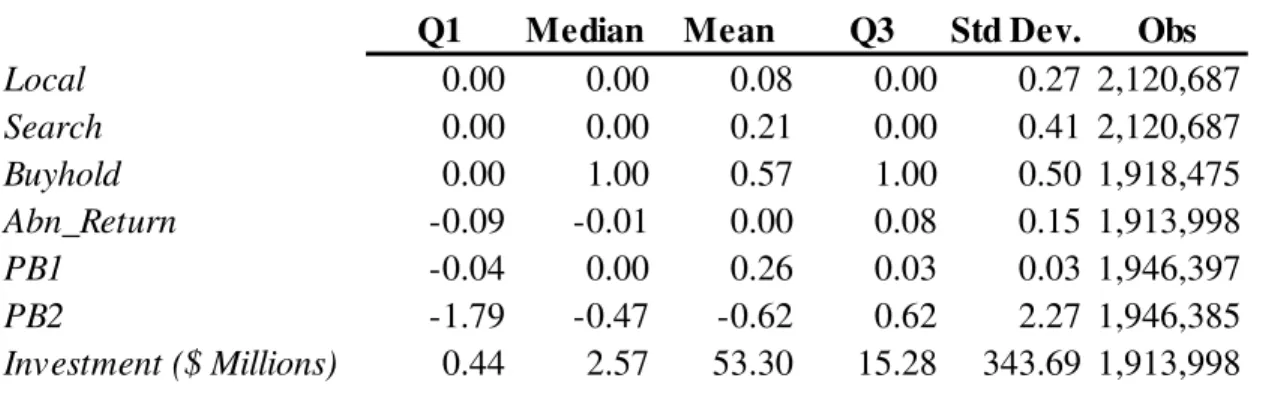
Using the 13(f) Sample, I test whether the value of public information varies by investors’ proximity to investment. Table 8 presents descriptive statistics on this sample. The median
investment in a firm by institutional investors in this sample is $2.6 million. On average
institutional investors perform EDGAR research for approximately 21% of their invested stocks.
Roughly 8% of investments are local to institutional investors. Table 9 presents tests on
improved decision-making. In columns (1) and (3) we see that research on EDGAR is associated
with increased decision-making ability for institutional investors. Specifically, institutions’ buy
and sell decisions tend to be approximately 27 basis points more profitable when coupled with
firms is incrementally more informative relative to non-local firms. We can interpret column (4)
results as the same investor deriving more portfolio value from researching local stocks than
non-local stocks, with the order of magnitude being approximately 54 basis points. The
combination of these results and the timeliness results suggest that investors value public
information more for local investments.
4.3 Test of Hypothesis 3 – “Local Bias” and Public Information Acquisition:
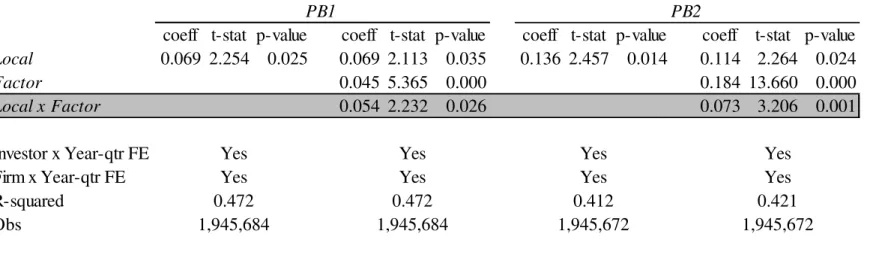
I next test whether “Local Bias” is related to the amount of public information acquired.
Table 10 helps us better understand the forces involved. The first noteworthy result in Table 10
is that, across both proxies for portfolio bias, investors exhibit “Local Bias.” At the individual
stock level, local stocks tend to be 0.069% larger in investors’ portfolios relative to the market
portfolio. Secondly, we see that investors’ “Local Bias” is increasing in the amount of public
information acquired, consistent with public information being a contributing force to “Local
Bias.” In terms of magnitude, a one standard deviation increase in public information acquisition
(Factor) is associated with a 0.054% increase in “Local Bias.” In untabulated robustness tests, I find that altering the empirical design yields similar results. Specifically, including the lagged
level of bias produces similar results. Additionally, including an investor-firm fixed effect, which
forces variation to exist intertemporally for the investor-firm pair, yields similar results. These
results corroborate the theory in Van Nieuwerburgh and Veldkamp (2009) which predicts that
public information acquisition plays a contributing role in investors’ “Local Bias.”
4.4 Robustness of Empirical Results: 4.4.1 Investment Level Control:
One concern with some of the preceding analyses is whether the results are being driven
words, investors research more for stocks that make up a larger portion of their portfolio. To
address this concern, I use the 13(f) Sample and estimate equations (1), (2), (3), and (4) including the level of investment as an additional control variable. Table 11 presents the coefficients of
interest from each of the equations after including the level of past investment. Corroborating the
initial concern, I find that the amount previously invested by the institutional investor is
positively related to public information acquisition. Of greater importance for this paper,
investors’ preference to acquire local information is still positive and significant (H1). Furthermore, controlling for the amount previously invested does not change inferences
regarding local information being more valuable for portfolio decision (H2). Lastly, the relation between portfolio bias and public information acquisition is unaffected (H3).
4.4.2 Familiarity Bias:
Familiarity bias is a behavioral bias of wanting to own investments with which an
investor is familiar (Huberman, 2001). Importantly, it does not represent an information
advantage in local stocks. A potential concern is whether familiarity bias or a prior private
information advantage is the driving force behind the documented findings. In an attempt to
address this concern, I highlight five points. First, the data represents research by an investor for
a firm and therefore suggests that the investor is already familiar with the investment opportunity
being researched (i.e., they know it exists). Second, to the extent that familiarity is a firm fixed
effect, similar to visibility, the research design controls for this type of variation. Third, in
looking at the first quarter an investor researched on EDGAR for a firm, arguably a time of
similar familiarity for local and non-local investments, I find that investors still research more for
local investments. Fourth, prior robustness tests that control for past investment should
investment.” Fifth, since familiarity bias is unrelated to information advantages it would not
explain why public information for local stocks is more valuable to investors’ portfolio
decisions. Collectively, these arguments suggest the evidence in this paper is more consistent
with prior private information advantages motivating investors to acquire additional public
information.
4.4.2 Controlling for Relative Wealth Hedging:
Some of the documented findings are consistent with relative wealth hedging as well as
asymmetric information advantages.27 Using a model, Garcia and Strobl (2011) concludes if
agents have incentives to “catch up with the Joneses,” then agents will herd on acquiring the
same information. To the extent that local stocks hedge relative wealth concerns, this theory
suggests that investors will acquire more information about proximate investments. If this were
the driving force behind the documented asymmetric public information acquisition, then there
should be an increased incentive for investors to acquire local information if neighboring
investors also acquire local firm information (i.e., herding on information). In untabulated
analyses, I find that herding is unrelated to the documented local effect. Specifically, investors’
preference to acquire more public information for local investments is not increasing in the
amount of other proximate investors searching for the same firm.
4.4.3 Information Asymmetry:
The main analyses find that investors acquire more public information for local
investments and that public information tends to be more valuable to local investors. In
combination, this suggests that having additional local investors requesting public information
should expand firm-level information asymmetries. I look at firm-level information asymmetry
on public disclosures dates to confirm this line of reasoning. Using disclosure dates on EDGAR,
I evaluate if having local investors access the disclosed filing increases firm-level information
asymmetry. Since firms often make multiple disclosures in a calendar quarter, I use a firm-time
fixed effect to control for fixed firm-level information environment attributes. Table 12 presents
the findings of this analysis. In columns (1) through (4), I find that information asymmetry is
higher when local investors access the public filing. Column (2) includes stock turnover and
stock return to control for attributes specific to the news event that may attract more local
investors. Columns (3) and (4) include disclosure type fixed effects to further control for the
nature of the news being disclosed. Across each of these specifications, I find consistent
evidence that having local investors access a disclosed filing tends to be associated with
increased firm-level information asymmetry.28
4.4.4 Non-Professional Investors:
I explore the generalizability of results to non-professional investors. It’s possible that
other investor groups behave contrary to the consistently documented behavior. For example,
retail investors might have investment objectives or risk tolerances that are different from
professional investors. These differences could alter preferences to acquire more public
information for local or non-local firms. It is also possible that non-professional investors tend to
receive a different amount or type of private local information, which may also manifest in
changes in information acquisition behavior. I attempt to address this element of generalizability
through the use of non-professional investors’ search on EDGAR. Non-professional investors are
all EDGAR users who do not own the IP address from which they are searching, and instead
receive an IP address through an Internet Service Provider. These investors are more likely to be
retail investors, but could also capture smaller-sized professional investors or even non-investor
financial statement users. I use this sample of investors in untabulated analyses. I find that these
EDGAR users continue to exhibit a preference to acquire more public information for local
investments.
4.4.5 Alternative Measure of Proximity:
The entire set of analyses pivot around the geodesic proximity between investors and
investments (i.e. as a crow flies). This focus is important given the literature on “Local Bias.” I
step back from this focus temporarily to explore whether information acquisition behavior
responds similarly to variation in the travel time between investors and firms. This measure is
based on the time it takes to travel between two locations and is an indicator set to one if the
duration of the optimal travel itinerary is less than or equal to two hours (Short Travel). This measure comes from prior literature that uses estimates of travel time by car and plane between
locations and selects the optimal travel pattern in a given period of time (Giroud, 2013; Bernstein
et al., 2016).29 In addition to proximity, this measure also captures elements of economic
distance. Travel time between two locations encompasses the economic cost of monitoring a firm
as well as the cost of maintaining firm relationships. Table 12 presents empirical findings for
equation (1) as it relates to this measure of proximity. Similar to prior results, public information
acquisition is increasing in proximity.
CHAPTER 5: CONCLUSION
It is often posited that investors have a private information advantage in local stocks,
which causes them to overweight local stocks in their investment portfolio (i.e., “Local Bias”). I
investigate the role of public information for local and non-local investor. This paper asks the following three questions: First, do investors mitigate their information disadvantage by
acquiring more public information for non-local stocks (i.e., level the playing field) or do they
maximize their information advantage by acquiring more public information for local stocks
(i.e., widen the gap)? Second, does the value of public information vary by an investor’s proximity to investment? Third, does public information consumption mitigate or moderate investors’ “Local Bias?”
The body of evidence in this study suggests that investors use public information to
widen their local information advantage. Using a novel dataset of professional investors’
requests on EDGAR, a repository for all publicly filed financial disclosures with the SEC, I find
that investors choose to acquire more information for local investments. For example, each
quarter investors access 20.16% more kilobytes of information if they are within 100 kilometers
of the investment. For the average investor in this sample, being proximate to an investment is
roughly equivalent to requesting about 6 additional material disclosures (i.e., 8-K’s) for that
company in one quarter. These inferences are robust to variations in research design, sample
selection, and measurement. For a sample of non-local investors, I show that when investors are
exogenously “treated” with proximity because of changes in firm headquarter location, they
I next show that public information is more valuable to local investors using two
approaches. First, I show that in both the two days and one hour following the release of public
information, investors tend to acquire local information more rapidly than non-local information.
This enhanced speed may afford investors the opportunity to act on the information more rapidly
and suggests that investors value the timeliness of public information more for local than
non-local investments. As a second test of value, I show that non-local investors’ share purchase decisions
are more positively correlated with future returns when coupled with public information
acquisition. In tandem, these findings suggest that public information is more valuable to local
investors.
I lastly test whether “Local Bias” in stock ownership varies with the amount of public
information acquired. If public information acquisition is a contributing force, then additional
public information should enhance investors’ “Local Bias.” Consistent with prior literature, I
show that the institutional investors in my sample exhibit “Local Bias.” More importantly, I find
that investors’ “Local Bias” is increasing in the amount of public information acquired about
local firms. This evidence corroborates prior findings that “Local Bias” is related to information
asymmetries, and further suggests that public information plays a contributing role.
Admittedly, these analyses are subject to important caveats. While the documented
findings are quite robust, it is possible that these relations are not generalizable to investors who
do not use EDGAR as a source for firm information. Additionally, omitted variable bias
concerns may persist, so long as those explanations are unrelated to investor or firm attributes.
While acknowledging these concerns and caveats, this paper provides consistent results that
tends to be more valuable to local investors, and that public information enhances investors’
“Local Bias.”
In closing, I anticipate the identification and use of professional investor requests for
financial information to be valuable to future research initiatives. I expect future work
investigating information acquisition at the investor level to be very fruitful given the
combination of granular investor data on information retrieval and the importance of
APPENDIX 1: VARIABLE DEFINITIONS AND MEASUREMENT
Variable Description
Abn_Return The quarterly firm stock return adjusted by the value-weighted market return.
Buyhold An indicator if the institutional investor's quarter end shares were greater than or equal to the previous quarter end shares.
Factor The principal component of InitialDownloads, SumSize, and Redownloads.
Illiquidity
The natural log of the Amihud price impact of trade measured on the release date of the EDGAR filing (Amihud, 2002). The price impact of trade is calculated as the absolute value of the firm stock return divided by the volume of dollars traded.
InitialDownloads The number of files downloaded for the first time by that investor.
Local
An indicator if the geodesic distance in miles between the
investor’s IP address location and the firm’s headquarters (i.e. as the crow flies) is less than or equal to 100 miles.
Local Investors An indicator for the EDGAR filing being accessed by a local professional investor on the release date.
PB1 The difference between investor portfolio weight in stock i and the market portfolio weight for stock i times 100.
PB2 The log of the investor portfolio weight in stock idivided by the market portfolio weight in stock i.
Redownloads The number of files redownloaded (i.e. requested for the second time or more).
Relationship Age Length of monitoring, in quarters, of the firm by the investor.
Retrieval Delay
The difference in minutes between the investors retrieval time of the filing and the time at which the filing was released. Since the exact time of day in which the filing was released is unknown, the time of the first viewer is used as a proxy.
Return The firm stock return on the release date of the EDGAR filing.
Search An indicator if the institutional investor searched for firm information on EDGAR during the quarter.
Short Travel
An indicator if the number of minutes needed to optimally travel between the investor’s IP address location and the firm’s headquarters (Giroud, 2013) is less than two hours.
SumSize The aggregate kilobyte size for all files downloaded for the first time.