Copyright © 2013 CTTS.IN, All right reserved
A Study on ICT Literacy and Internet Use Pattern among
College Library Users of Barak Valley, South Assam,
North East India
Dr. Manoj Kumar Sinha Associate Professor and Head,
Department of Library and Information Science, Assam University(A Central University), Silchar.
E-mail: [email protected]
Sudip Bhattacharjee PhD Research Scholar,
Department of Library and Information Science, Assam University, (A Central University), Silchar
E-mail: [email protected]
Sucheta Bhattacharjee PhD Research Scholar,
Department of Library and Information Science, Assam University, (A Central University), Silchar
E-mail: [email protected]
Abstract - The present study was carried out for the purpose of knowing the present status of ICT awareness, extent of Internet Literacy and Internet Use Patterns among the College Library Users of Barak Valley, South Assam. The sample of the study (college library users) comprises of mainly undergraduate students, faculty members, research scholars, and Staff working in ten selected colleges under the study where the penetration of Computer and Internet is very low and the college library users are not very much comfortable using computers . For the present study, survey method has been adopted using mainly questionnaire as a tool for data collection. In some cases, the researchers conducted interview of the participants to ascertain the data collected through questionnaire. The self designed questionnaire comprising of 25 questions was prepared and distributed amongst the randomly selected samples of college library users which comprises of undergraduate students (UG students) ,faculty members, research scholars, and college Staff. The filled up questionnaires was collected from the respondents for the data analysis and interpretations. On the basis of filled in questionnaire, the collected data have been tabulated and analysed using SPSS and MS-Excel software. For data analysis percentage technique was adopted.
The present work was carried out on college libraries users of Barak Valley, South Assam. Therefore the
present investigation is delimited to the college library users of ten selected colleges which are affiliated to Assam University, Silchar. The questionnaire was administered to the four hundred (400) randomly selected samples and the responses were received from the 304 number of respondents. The same study may be carried out on the larger section of population covering other colleges and universities of North Eastern Region of India to get more generalized and authentic findings. The findings of the present study may be taken as the preliminary findings from a small pilot study.
The paper discusses the status of ICT Literacy, Internet awareness and Internet Use Pattern among the college library users who search information for the day to day class room teaching –learning, competitive examinations, higher studies and research which are available in various formats including e-resources by the end users
Key Words – ICT Literacy, Internet Use Pattern, College Libraries- Barak Valley, South Assam, Assam University, Silchar.
1. INTRODUCTION
Copyright © 2013 CTTS.IN, All right reserved gateway and global digital library. In the day context, all
types of libraries are not only providing printed resources to their library users rather they provide printed, electronic as well as other Internet resources like e-books and databases for fulfilling the day to day academic and research requirements of the library users [1].
1.1 Information Literacy/ ICT Literacy / Internet Literacy
The United States National Forum on Information Literacy defines information literacy as " ... the ability to know when there is a need for information, to be able to identify, locate, evaluate, and effectively use that information for the issue or problem at hand." [2] [3] Other definitions incorporate aspects of "skepticism, judgement, free thinking, questioning, and understanding..." [4] or incorporate competencies that an informed citizen of an information society ought to possess to participate intelligently and actively in that society.
A number of efforts have been made to better define the concept and its relationship to other skills and forms of literacy. Although other educational goals, including traditional literacy, computer literacy, library skills, and critical thinking skills, are related to information literacy and important foundations for its development, information literacy itself is emerging as a distinct skill set and a necessary key to one's social and economic well-being in an increasingly complex information society [5].
1.2 India is now World’s Third Largest Internet User after U.S., China [6]
According to the Global Digital Measurement and Analytics Firm comScore the three-fourths of its online population is under 35. The report further inform that India has bypassed Japan to become the world’s third largest Internet user after China and the United States, and its users are significantly younger than those of other emerging economies. India now has nearly 74 million Internet users, a 31 per cent increase over March 2012, the report says. The numbers are lower than other recent estimates, possibly reflecting comScore’s methodology that only factors in PC and laptop-based Internet usage.
The Telecom Regulatory Authority of India (TRAI) pegged the number of Internet subscribers in India at 164.81 million as of March 31, 2013, with seven out of eight accessing the Internet from their mobile phones.
The comScore report, on the other hand, puts mobile and tabled-based Internet traffic at just 14% of the total. Nilotpal Chakravarti, spokesperson of the Internet and Mobile Association of India told The Hindu on Thursday (22 August 2013) that “Mobile phone based Internet usage is a key component of Indian Internet usage, and I’d say the recent growth is being driven by mobile
Internet usage,” In addition, many Netizens were using dongles to access the Internet.
Three-fourths of India’s online population is under 35 as against just over half worldwide, the comScore report, India Digital Future in Focus 2013, says, possibly reflecting India’s more recent improvements in literacy. Men under 35 and women between 35 and 44 are heavier users. But women account for less than 40 per cent of all Indian users, a far lower sex ratio than that of other countries.
A quarter of time spent online is on social media, the comScore report says, and another 23 per cent on email. Whereas Google sites have the most unique visitors, Net users spend the most time on Facebook, which is at second place as far as unique visitors are concerned. Yahoo, Microsoft and Wikimedia sites follow in unique visitor numbers. Among social media sites, Linkedin and Twitter are the next most popular, while Orkut is in decline. Google is by far the most popular search engine, accounting for 90 per cent of all searches in India.
Online retail is on the rise, with domestic retail sites being the most popular, the report notes. For online travel websites too, domestic websites are the most popular, the Indian Railways’ website being by far the most popular destination. Yahoo is also the most popular site for news.
The locus of online dominance has moved steadily towards Asia, which now accounts for 41% of all Internet users; from having 66% of all users in 1996, the United States now accounts for just 13%. China has the world’s biggest online presence; Its Internet users outnumber Indians by a ratio of 5: 1. Brazil’s Internet presence grew faster than India’s over the last year [6].
1.3 Mobile Internet Users in India [7] [8] [9]
As per the Your Story Team (January 3, 2013) India will have 130.6 million mobile Internet users by March 2014 according to the Mobile Internet Report by Internet and Mobile Association of India [IAMAI] and IMRB. In December 2012, this number was 87.1 Million mobile Internet users.
Copyright © 2013 CTTS.IN, All right reserved Fig- 1: Internet Users and Future Estimate of Active
Mobile Internet Users ( in Million) ( Source : IMRB Estimate)
According to the report, it is expected that by the end of December 2012, there will be around 87 million mobile internet users in India. This number is expected to double to nearly 164 million by end of March 2015. The report clearly shows that Internet access on mobile is on the rise, but still in percentage terms, it is one of the lowest. This fact was also attested by Mary Meeker’s landmark Internet Trends report, which showed that only 4 percent Indians have Smart phones, yet we rank 5th in the world when it comes to number of smart phones used (Fig-1).
1.4 Average Monthly Bill for Mobile Internet Users
The report further finds that an average monthly bill of a user who access Internet on mobile devices is Rs. 460. Of which, the user spends Rs. 198 towards Internet expenses. This is a very healthy trend as it shows willingness of the users to spend nearly 40 percent of the bill towards Internet access. The rest is spent on voice services (Fig-2)
Fig-2: Average Monthly Mobile Expenses (Source: I-Cube 2012)
1.5 Average Phone Cost
The average mobile phone cost that accessed internet was Rs. 8250. This clearly shows that high-end mobile phones aka smart phones are mostly used to access internet. In India, even today 90% of the mobile phones sold are below Rs. 5000 (Fig-3).
Fig-3 : Average Cost of Mobile Phone (Source: I-Cube 2012)
Internet and Mobile Association of India yesterday released interesting statistics on Mobile Internet usage in India. According to their I-Cube Mobile internet
survey conducted in 35 cities, out of about 900 odd
mobile users in India 78.7 million users accessed internet through their mobile devices, which includes tablets, mobile phones and laptops with USB dongles.
According to the IAMAI report, out of 78.7 million mobile internet users, 15 million users only accessed sites owned by mobile operators. Also, 2.7 million users used mobile internet connection using USB dongles. So, in reality, in strictest sense, about 61 million users could be termed as the real mobile Internet users in India.
While the Internet usage was primarily to send and receive emails and social networking activities, many use their phones to watch online videos and download apps, which is an encouraging sign for mobile content developers. Email, social networking services (SNS) and messengers have high usage among mobile Internet user. Accessing online videos, games or reading online news are done approximately 2-6 times a week. While online games are accessed by nearly 50% of the Mobile Internet users, less than 30% of users read online news and watch online videos (Fig-4).
Copyright © 2013 CTTS.IN, All right reserved The present study aims to examine the status of ICT and
Internet Literacy, Internet Use Pattern among the College Library Users of Barak Valley, South Assam. The study has focused on the preference of time, amount of time spent for Internet use , preference of search engine to access web resources, and usage of other Internet tools and services. The problems faced by the college library users for accessing to the Internet resources and suggestions put forwarded by them have also been highlighted. This study is based on the research work carried out for the dissertation on the topic Information Seeking Behaviour and Internet use pattern among the college library users of Barak Valley.
1.6 Statement of the Problem
The penetration of Internet has been increasing in recent years as many Internet Service Providers company have started providing Internet Services through External Modem / USB Modem/ Dongle by Broadband or Dial up connectivity to Desktop, Laptop and even through mobile. BSNL, Airtel, Aircel , Reliance , Vodaphone , Tata Indicom etc have started giving Internet Services on mobile phone also as pre-paid and post –paid connectivity.
The colleges have been provided with access to the E-Resources under N-LIST programme by the INFLIBNET Centre, Gandhinagar. The college libraries which are not having Internet connectivity would not be able to avail the facilities of E-Resources. Therefore, all the college libraries have started developing adequate ICT Infrastructure and taken Internet connectivity either through BSNL Broadband or other Internet Service Providers. Owning to the availability of computer (PC/ Laptop) , on affordable cost, the faculty members, research scholars , and students have started procuring PC/ Laptop and also getting Internet connectivity either pre-paid or post paid. But still some section of library users who cannot afford to have their own PC / Laptop at their home and they have to depend mainly on the college libraries or Internet café for accessing to the Internet. As the e-resources from N-LIST Programme are mainly available through the IP address of college libraries, so the library users need to visit the college libraries for accessing to E-resources and other facilities available at INFLIBNET Centres’ website (http://www.infibnet.ac.in ).
During the study period, it was observed that in some college libraries many problems such as lack of Internet connectivity, lack of awareness of Internet facilities, e-resources, lack of imparting proper user orientation programme and lack of uninterrupted power supply. It has also been observed that the Internet facilities and e-resources which have been made available at the college library users have not been optimally utilized and resources are being wasted. In order to have proper utilization of Internet and e-resources by the college
library users and problems faced by them while accessing to the Internet at college libraries, the present study has been conceived. The main objectives of the study are to examine the status of ICT literacy and Internet Use Pattern among the College Library Users of Barak Valley, South Assam. It also aims to find out the ground reality and to assess a number of problems which users encountered while accessing to the Internet facilities and to suggest ways and means for the optimum utilization of Internet facilities, E-resources etc. by the college library users.
1.7 Significance of the Study
The present study has been undertaken with a view to know the status of ICT literacy and Internet Use pattern amongst the college library users of Barak Valley, South Assam which would help the college library authority to identify the problems faced by the college library users while accessing to the Internet and try to implement the suggestions put forwarded by the library users for the improvement of library services. This study would also reveals the status of ICT literacy level amongst the college library users and what types of awareness programmes needs to be organised for the library users to make them utilized the Internet Resources available in college libraries under N-LIST Programme and other open access web resources available across the disciplines.
1.8 Objectives of the Study
The main objectives of the present study are :
To Ascertain the status of ICT Literacy among the college library users;
To examine the preferred time, preferred place and amount of time spent for Internet use; To find out the purpose of using Internet by the
college library users;
To determine the usefulness of Internet by the college library users;
To examine the preference of Internet Service Providers and preference of search engine for information search;
To examines the various problems faced by the college library users while accessing to the Internet ; and
To suggest the appropriate steps to college library authorities to improve the Internet Services for their end users.
1.9 Scope and Delimitation of the Study
Copyright © 2013 CTTS.IN, All right reserved respondents from following colleges have participated in
the study:
1. Gurucharan College, Silchar 2. Karimganj College, Karimganj 3. Sri Kishan Sarda College, Hilakandi 4. Cachar College,Silchar
5. Rabindra Sadan Girls College, Karimganj 6. Womens College , Silchar
7. N.C. College, Badarpur, Hailakandi 8. Radhamadhav College, Silchar 9. Lala Rural College, Lala, Hailakandi 10. M.C. Das College, Sonai , Cachar
The present study has been delimited to the library users of only ten selected College Libraries of Barak Valley, South Assam that are affiliated to the Assam University, Silchar.
2. REVIEW OF LITERATURE
Under the review of literature for the present study, the primary and secondary sources of literature have been consulted. Some journal articles and theses have also been consulted.
2.1 Review of International Studies
Laite [10] made a survey on 406 graduate and undergraduate students in his work and found that most of the undergraduate respondents (57.60 %) used the Internet 1-2 times per week and remaining 37.10 % respondents used Internet 1-2 times on daily basis. Whereas 54.70 % graduate student respondents used Internet 2 times per week and 37.70 % used Internet 1-2 times on daily basis. The important findings revealed that the most of the respondents (100.0 %) used e-mail service.
Mostofa [11] made a study on Internet access and use among business students in Darul Ihsan University which is a pioneer private university of Bangladesh using questionnaire as data collection tool. In his study he distributed 162 questionnaire 137 completed questionnaire were returned. The survey findings reveal the high percentage of Internet users belong to student’s category who uses Internet for educational purposes. The study showed that the Interne access point is mainly the university where Internet is provided. The study reveals that Google and Yahoo! Search engines are found to be more widely used than other search engines. The slow access speed of the Internet is a major problem while accessing to the Internet and the respondents suggested to university authority to provide more computers with latest configuration.
Adekunmisi, Ajala and Iyoro [12] carried out a study on Internet Access and usage by undergraduate students of Olabisi Onabanjo University , Nigeria on 200 undergraduate students of the institutions using questionnaire as a data collection tool. The survey
findings reveal that majority of Internet users access Internet from the cyber café and paying money from their own pocket despite the fact that all the cyber café are located near university. The study also revealed that majority of the respondents were Internet literate with 37.50 % respondents using Internet on weekly basis which is followed by 32.50 % respondents who are browsing the Internet on daily basis and 17.0 percent respondents on monthly basis, whereas only 13.0 % use Internet on fortnightly basis. It was also found that most used Internet facilities are e-mails, webpage , search engines and chatting facilities for communication (with friends , families, lovers, colleagues, and teachers), academic activities like doing assignment, research and preparation for examination ; and also for searching of information and knowledge. The paper also highlights the benefits of Internet use and the various problems while accessing to the Internet. The paper also made some suggestions and recommendations in respect of making available Internet facility at university library; departments should be connected with Internet facilities; Internet awareness training for library users; more number of computers should be procured and installed for Internet access; charges of Internet access should be nominal ; subscription of higher bandwidth Internet connectivity and the sites providing entertainment and pornographies should be restricted in the campus to check the misuse of the Internet terminals in undesirable activities by the students and other library users.
2.2 Review of National Studies
Previously many studies have been carried out in recent years in India on use of Internet in university library (Mishra and Satyanarayana,) [13]; Internet and its use in SJCE (Kumbar and Shirun,)[14]; Internet usage by students and faculty members of Kuvempu University (Birader, Rajashekhar, and Sampat Kumar,) [15]; Use of Internet by the Students of Bidhan Chandra Krishi Viswavidyalaya (West Bengal) (Das and Basu,) [16] ; and Use of Internet among the Research Scholars of the Faculty of Science, University of Allahabad (Devender Kumar and Shukla) [17].
Singh [18] in his study on use of Internet by the librarians in Malaysia which reveals that majority of the respondents (90.0%) are nascent Internet users and they mainly use Internet for academic and library work related purposes.
Bavakutty and Salih [19] conducted a study at Calicut University, which showed that students, research scholars and teachers used the Internet for the purpose of study, research and teaching.
Copyright © 2013 CTTS.IN, All right reserved that the researchers used Internet mainly for conducting
literature search.
Ali [21] conducted a study on Internet use at Aligarh Muslim University, India. The study showed that more than 50 percent of the respondents were satisfied with the amount of time given for Internet access but dissatisfied with the lack of staff support and non-availability of reservation system for Internet access in AMU Central Library. The majority of respondents were also unhappy with the number of Internet access points which were made available for the library users.
Chnadran [22] made a study on the use of Internet resources and services in S.V. University, Tirupathi which revealed that more than 56.0 % respondents used the Internet to access information for academic purposes. The study also showed that majority of respondents used Internet web and e-mail services.
Kaur [23] conducted a study on the use of Internet facility at Guru Nanak Dev University, Amritsar which revealed that all respondents (100.0 %) used Internet to send e-mail whereas 82.0 % respondents used Internet for web browsing. More than 60 percent of the respondents used the Internet for searching primary sources of information, 38 .0 % for secondary sources and only 15.0 % used Internet facilities for consulting OPAC/ Web OPAC.
Sinha [24] conducted a preliminary study on the scenario of Internet use pattern of Assam University Community and Local population of Barak Valley and in this study he described the usefulness and advantage of Internet in day-to-day life, impact of Internet on the library and information services etc. and explained the need of Internet use in Barak Valley by user. He also described very effectively why short term training programme should be arranged for spreading the knowledge, tools, services, and products of Internet for the user.
In another study conducted at India by Rajeev Kumar and Kaur [25] on use of Internet by the teachers and students of Engineering colleges of Punjab , Haryana and Himachal Pradesh showed that majority of the respondents (1243= 77.5 %) felt that the Internet cannot replace the library services as both are sources of information but advocated the use of Internet as the best tool for providing more effective, useful and more desired information in less possible time whereas only 143 (22.5 % ) respondents argued that Internet can replace the library as it is easier to locate desired information through the Internet .
Mahajan [26] carried out a study on Internet use by the researchers in Punjab University, Chandigarh and explained the importance of Internet as for the academic community which transformed the present day society
into a knowledge society. The respondents consider the Internet as the most valuable computer technology and services available to the society.
Kaur and Manhas [27] conducted a survey on the use of Internet services and resources in the Engineering Colleges of Punjab and Haryana States of India. The survey was made using questionnaire as a data collection tool which has been supplemented by follow –up interviews with the Internet users to ascertain the responses. The response rate was 80.0 percent. Study revealed that all the respondents make frequent use of Internet at colleges and home. The finding showed that majority of respondents (65.6 %) access the Internet from office or their work place. More than 70.0 % respondents use Internet for educational and research purposes. Google and Yahoo Search engines are popular among the respondents than other search engines. More than 70 percent respondents feel that the Internet is useful, informative, easy to use, inexpensive and time saving.
Nazim [28] carried out his study at Aligarh Muslim University on the Information Searching Behaviour of Internet users to determine the extent to which Internet users are aware and make use of the Internet resources and services. The study examines the Internet Searching Behaviour of the Internet users using questionnaire and interview as data collection tool. In this study 489 questionnaires were distributed to the selected sample drawn from the eight faculties and 405 valid questionnaires were collected. The data were analysed pertaining to the personal background of the Internet users, Internet Information Searching Behaviour, use of Internet resources and services, quality of Internet resources , problems for the Internet access and need for imparting training for Internet literacy. The study revealed that the majority of respondents used Internet since five years. The academic staff spent more time on Internet than the students and research scholars. The Online databases and e-journals are the preferred information sources among the Internet users. E-mail, WWW and search engines have been recognized as important Internet services among the respondents. About 60.0 percent respondents believed that the availability of good quality of information on the Internet made it a useful tool for education and research. The researchers identified some of the problems like slow speed, lack of training, and information overload which were the important factors affecting the usage of Internet. Further the researcher has made a recommendations to improve the use of Internet , including a well-planned Internet Literacy Programme and preparation of subject gateways.
Copyright © 2013 CTTS.IN, All right reserved similar trends of finding towards awareness of ICT and
Internet and utilization of E-Resources available under UGC-INFONET Programme.
Rao [30] in his study on the Internet Use in Academic Library discusses the advantages of the Internet and its impact upon academic libraries. The practical application of e-mail, Internet and other electronic media has been also described in brief and need of more application of ICT / computers in libraries has been emphasized.
Rahman and Ali [31] conducted a study on the access and utilization of the Internet based library services available to the faculty members of Z.H. College of Engineering and Technology, Aligarh Muslim University.
Sinha [1] conducted a study to know the extent of Internet Literacy among the University Library Users in Assam University library. The sample size of this study includes 319 respondents which includes teachers, research scholars and students. The results show that the younger generation has accepted the Internet as a means for accessing to the relevant information for academic and research works, whereas the elderly people are still comfortable with traditional resources who are using printed resources available in library, but the volume of frequent usage of e-resources among the users have been found to be at optimum level. The results also described very effectively how a rapid change in information seeking behavior and use of Internet for On-line access of E-resources have become the vital part of various information needs.
A number of studies have been conducted on Information Resources on the Internet for Higher Education and Research [32] ; Use of E-Resources by IT Professionals ( Gireesh and Rajashekara )[33] ; Use of Information Resources by the Researchers in the University Libraries in Karnataka (Gowda and Shivalingaiah) [34]; Use and Impact of Digital Resources (Mendhe ,Taksande, and Taksande) [35] ; Use and Usage Statistics of Electronic Resources at Central Library , Tezpur University (Mishra and Gohain,) [36].
From the review of literature on the use of Internet, awareness of ICT and Internet, Usage of off-line and on-line e-resources (CD-ROM Databases and E-Journals ) , it has been found that most of the study have been carried out in Northern India (Rajiv Kumar and Amritpal Kaur [37] ; (Rao) [30] and (Singson and Leeladharan) [38].
But no substantial studies have been made on the ICT awareness, Internet Literacy Skills and Internet Use Patterns of College Library Users of Barak Valley, South Assam except few studies conducted by Sinha [24] on Internet Use pattern of the academic community and local population of Barak Valley ; another study on
Information Communication Technology (ICT) and Internet Awareness amongst the College and University Teachers (Sinha) [39] ; ICT and Internet Awareness amongst the participants of Workshop on Basic Science Research (Sinha) [29] and Internet Usage (Borthakur, Das and Gohain) [40], no comprehensive and substantial studies have been carried out on the ICT literacy and Internet use patterns of College Library users of Barak Valley, South Assam. Therefore in the present study an attempt has been taken to study the ICT Literacy and Internet use patterns amongst the College Library Users of Barak Valley, South Assam.
3.0 RESEARCH
METHODOLOGY
AND
RESEARCH DESIGN
For the present study the survey method of research study was used using questionnaire as a main data collection tool which was supplemented by the interview of the respondents and librarians in some cases to ascertain the responses collected through the questionnaire. The colleges were selected on the basis of the availability of adequate number of reading materials, ICT infrastructure and Internet connectivity.
The random sampling technique was used for selection of sample for the study. The sample was drawn from the undergraduate students, faculty, staff and research scholars (mainly teachers working in the colleges on regular or part time basis and perusing research at Assam University, Silchar). Questionnaire was distributed to around four hundred (400) randomly selected samples which were drawn from the ten selected colleges of South Assam.
The filled –in questionnaires were received from the respondents and data have been coded, tabulated and analyzed. The results have been shown in Tabular or Graphical format. For the data analysis, only percentage technique has been adopted. As the investigators have approached the library users personally, response rate is significantly high.
4.0 DATA ANALYSIS AND MAJOR FINDING
On the basis of filled up Questionnaire the data has been analyzed and tabulated. All the results have been shows in tabular and/ or graphical representation.4.1 Distribution of Questionnaire to the Respondent and Responses Received
Altogether 400 questionnaires have been distributed amongst the randomly selected college library users of ten selected colleges which are affiliated under Assam University, Silchar.
Copyright © 2013 CTTS.IN, All right reserved Questionnaire No. of
Respondents
Percentage (%) Questionnaire
Received
304 76
Response Not received
96 24
Total Distributed
400 100
(Source: Primary Data )
Table-1 shows that the questionnaire was distributed to 400 respondents. Out of which 304 (76%) respondents have returned the filled up questionnaire whereas 96 (24%) respondents have not returned the questionnaire. Therefore the response rate is 76% which is comparatively a good response.
4.2 College Wise Distribution and Receipt of Questionnaire
In the present study 400 respondents from ten colleges of South Assam which are affiliated to Assam University, Silchar have been selected. It was decided to distribute 40 questionnaires to each college. Accordingly 400 questionnaires (40 questionnaires to each college) were distributed and college wise responses have been shown in Table-2.
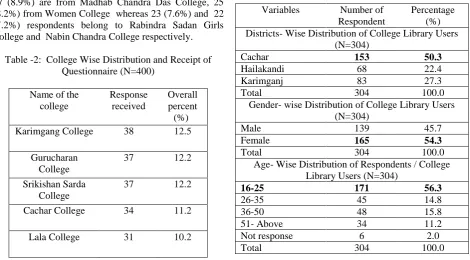
It is evident from the Table -2 that out of 304 respondents the maximum responses (38=12.5%) was received from the respondents of Karimgang College which is followed by 37 (12.2%) respondents each from Gurucharan College and Srikishan Sarda College whereas 34 (11.2%) respondents are from Cachar College, 31 (10.2%) respondents are from Lala College, 30 (9.9%) respondents are from Radhamadhab College, 27 (8.9%) are from Madhab Chandra Das College, 25 (8.2%) from Women College whereas 23 (7.6%) and 22 (7.2%) respondents belong to Rabindra Sadan Girls College and Nabin Chandra College respectively.
Table -2: College Wise Distribution and Receipt of Questionnaire (N=400)
Name of the college
Response received
Overall percent
(%)
Karimgang College 38 12.5
Gurucharan College
37 12.2
Srikishan Sarda College
37 12.2
Cachar College 34 11.2
Lala College 31 10.2
Radhamadhab College
30 9.9
Madhab Chandra Das College
27 8.9
Women College 25 8.2
Rabindra Sadan Girls College
23 7.6
Nabin Chandra College
22 7.2
Total/ Overall Percent
304 100.0
(Source: Primary Data )
4.3 Personal Background of the Respondents The present study was carried out on the College Library Users who are residing in the three districts of South Assam viz., Cachar, Hailakandi and Karimganj. Survey finding shows that out of 304 respondents 153 (50.3%) respondents belong to Cachar district which is maximum and followed by 83 (27.3%) respondents from Karimgang district whereas minimum 68 (22.4%) respondents hail from Hailakandi district.
From the Table-3, it is also evident that out of 304 respondents, 139 (45.7 %) of respondents ae male whereas 165 (54.3%) respondents are female which shows that in the present study female respondents have participated in more number than that of its male counterpart.
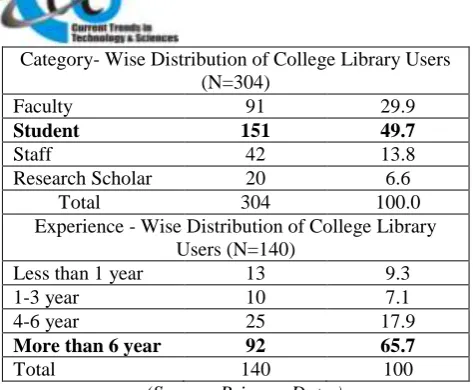
Table -3: Personal Background/ Characteristics of the Respondents (N=304)
Variables Number of Respondent
Percentage (%) Districts- Wise Distribution of College Library Users
(N=304)
Cachar 153 50.3
Hailakandi 68 22.4
Karimganj 83 27.3
Total 304 100.0
Gender- wise Distribution of College Library Users (N=304)
Male 139 45.7
Female 165 54.3
Total 304 100.0
Age- Wise Distribution of Respondents / College Library Users (N=304)
16-25 171 56.3
26-35 45 14.8
36-50 48 15.8
51- Above 34 11.2
Not response 6 2.0
Copyright © 2013 CTTS.IN, All right reserved Category- Wise Distribution of College Library Users
(N=304)
Faculty 91 29.9
Student 151 49.7
Staff 42 13.8
Research Scholar 20 6.6
Total 304 100.0
Experience - Wise Distribution of College Library Users (N=140)
Less than 1 year 13 9.3
1-3 year 10 7.1
4-6 year 25 17.9
More than 6 year 92 65.7
Total 140 100
(Source: Primary Data )
Survey result also indicated that in age-wise distribution of 304 respondents/ College Library Users which reveals that 171 respondents (56.3%) belong to (16-25) years age group which is followed by 48 respondents (15.8 %) who belong to (36-50) years age group, 45 respondents (14.8 %) belong to (26-35) years age group, whereas 34 respondents (11.2 %) belong to (51-onwards) years age group. Only 6 (2.0 %) respondents have not responded. The survey findings suggested that more number of undergraduate students have actively participated in the present survey.
It also shows that out of 304 respondents, 151 (49.7 %) belong to undergraduate college students , which is followed by faculty members (91=29.9 %) and staff members (42= 13.8% ) whereas 20(6.6 %) respondents are research scholars who are mainly part time guest faculty members pursuing Ph.D. from Assam University. A survey finding reveals that a maximum of about 49.7 % respondents undergraduate students which is followed by faculty members (29.9 %).
Only teachers, staffs and research scholars/ guest faculty members are included to give response for Experience and the undergraduate students are excluded. The Table 8 shows that out of 140 respondents which comprises of faculty, staff and research scholars most of the respondents 92 (30.3%) are having working experience more than 6 years which is followed by 25 (17.9%) respondents having working experience of 4-6 years whereas 13 (9.3%) and 10 (7.1%) respondents having working experience of less than 1 year and 13 years respectively which indicates that majority of respondents are having more than six years of working experience in these colleges.
4.4 Library Visit Pattern of College Library Users The frequency of library visits by library users is shown in the Table-4. The result shows that the library visits pattern of the college library users which indicates that the most of the respondents 122 (36.8%) visit library on
daily basis which is followed by 89 (29.3%) respondents who visit library on bi-weekly basis whereas 54 (17.8%) and 26 (8.6%) respondents visit on monthly basis and on weekly basis respectively whereas 16 (5.3%) respondents do not visit library on regular basis and only 7 (2.3%) respondents visit library on fortnightly basis.
Table -4: Library Visit Pattern of College Library Users (N=304)
Library Visit Pattern
No. of Respondents
Percent (%)
Daily 112 36.8
Weekly 54 17.8
Bi-weekly 89 29.3
Fortnightly 7 2.3
Monthly 26 8.6
Not Regularly/ Often
16 5.3
Total 304 100.0
(Source: Primary Data )
4.5 Ranking of Purpose of Library Visit
The college library users used to visit college libraries or other public/ academic/ special libraries to meet their different academic information needs. The respondents were asked to rank the option into 1-5 scale and multiple responses were allowed.
Table -5: Ranking of Purpose of Library Visit by Respondents (N= 304 each)
Purpose of Library Visit Frequency ( Percent )
Rank
Keep up-to-date on the area/ subject of interests
136 (44.7%) 1
Preaparing for
competitive Examinations
86 (28.3%) 2
Academic Assignment 74 (24.2%) 3
Career Development and Growth
73 (24.1%) 4
Entertainment / Light Reading Materials / Newspaper/
Newsmagazines etc.
106(34.9%) 5
(Source: Primary Data)
(Respondents are allowed for giving multiple responses)
Copyright © 2013 CTTS.IN, All right reserved displaced in Table-5. It is evident from this result that
maximum number of library users visit the college and other libraries to keep themselves up-to-date in the areas / subject of interest whereas purpose for visiting libraries for reading newspapers, magazines , entertainment and spending leisure hours has been given less importance by the respondents.
4.6 ICT and Internet Literacy / Awareness
Table -6: ICT and Internet Literacy/ Awareness of Respondents (N=304)
ICT and Internet Literacy
Frequency Percent
Yes 256 84.2
No 48 15.8
Total 304 100.0
(Source: Primary Data )
It has been established fact that Internet serves as an important tool in the world for searching information. Internet facility would help users to know various developments and searching techniques for accessing the desired information.
To know awareness on Internet respondents have been asked to answer for questions related to Internet usage. The Table -8 shows that majority of respondents (256 = 30.9%) are ICT and Internet Literate whereas only 48 (15.8%) respondents are not aware of ICT and Internet facility.
4.7 Extent of Internet Literacy
The respondents who are aware of Internet further question was asked to know how much they rate themselves as Internet Literate.
Table 7: Extent of ICT and Internet Literacy / Awareness of Respondents (N=256) Extent of ICT
and Internet Literacy
Frequency Percent
Novice 131 51
Intermediate 110 43
Expert 15 6
Total 256 100.0
(Source: Primary Data )
Table-7 shows that out of 256 (82.4 %) of respondents who are ICT and Internet literate, 131 (51%) respondents are novice and 110 (43%) respondents feel they are intermediate whereas only 15 (6%) respondents are claimed themselves as an expert in using ICT and Internet. This result may be due to the problems faced by the respondents in accessing to e-resources through Internet and which might be due to non-availability of
sufficient computers and Internet connectivity in the college libraries.
4.8 Frequency of Internet Usage
The survey result as shown in Table-8 shows that most of the respondents 79 (26 %) access Internet on weekly basis whereas 58 (19.1 %) respondents access Internet on monthly basis.
Table -8: Frequency of Internet usage (N=304)
Frequency of Internet usage
Frequency Percent
Daily 49 16.1
Weekly 79 26.0
Bi-weekly 13 4.3
Fortnightly 55 18.1
Monthly 58 19.1
Not Regularly 50 16.4
Total 304 100.0
(Source: Primary Data )
Moreover, 55 (18.1%) respondents access Internet on fortnightly basis which is followed by the users who are not using Internet regularly (50=16.4 %) and on daily basis (49 =16.1 %) whereas a small number of respondents (13=4.3%) access to Internet on bi-weekly basis. Therefore it can be concluded that the maximum number of respondents prefer to access Internet on weekly and monthly basis.
4.9 Information Use Pattern on Internet by College Library Users
In order to know the rating of using Internet these respondents were asked to respond to this question. The Table-9 shows that the majority of the respondent 191 (63.1%) search information through search engine (Google) and placed at 1st rank which is followed by 110 (36.1%) respondents who access information by popular and known websites/ sources and placed at the 2nd rank, discussion with colleagues (53 = 17.4%) is placed at the 3rd rank. Hence from the Table- 22 it has been observed that the respondent search information on Internet using Internet Explorer browser which is most popular searching behavior of library users.
Table -9: Ranking Information Use Pattern of the College Library Users (N=304 each)
Information Use Pattern
Percentage Rank
Through search engine (Google)
192 (63.1%)
1
By Searching popular and Known Web Sites
110 (36.1%)
2
Discussion with Colleagues
53 (17.4%)
Copyright © 2013 CTTS.IN, All right reserved Takes help from Library
Staff
48 (15.7%)
4
Evaluating Website Information
45 (14.8%)
5
(Source: Primary Data ) (Allowed for Multiple Responses)
4.10 Difficulties faced in access to Use of Library Information/ Resources
In order to understand the real problems faced by the college library users, they were asked to give their opinion in respect to problems they face.
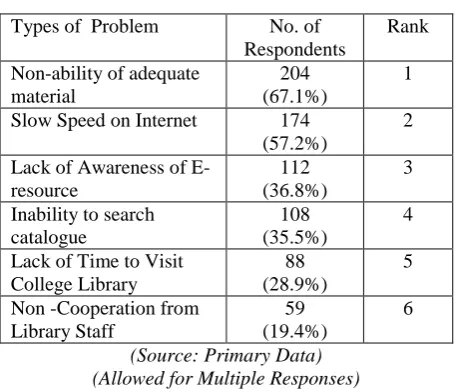
On the basis of their feedback , the finding has been shown in Table-10 which reveals that the majority of the respondent 204 (67.1%) face difficulty for non-availability of adequate reading materials and is placed at 1st rank which is followed by slow speed on Internet (174= 57.2%) and placed at the 2nd rank , lack of awareness of e-resource ( 112= 36.8%) is placed at the 3rd rank whereas lack of time to visit the library (108= 35.5%) and inability to search catalogue (88= 28.9%) and non cooperation from staff (59= 19.4%) are placed at the 4th, 5th and 6th ranks respectively.From the study, it is concluded that the college library users face difficulties in accessing and use of information owing to many factors
Table -10: Problems faced by the respondents in Using Internet / Access Information (N=304 each)
Types of Problem No. of Respondents
Rank
Non-ability of adequate material
204 (67.1%)
1
Slow Speed on Internet 174 (57.2%)
2
Lack of Awareness of E-resource
112 (36.8%)
3
Inability to search catalogue
108 (35.5%)
4
Lack of Time to Visit College Library
88 (28.9%)
5
Non -Cooperation from Library Staff
59 (19.4%)
6
(Source: Primary Data) (Allowed for Multiple Responses)
4.11 Suggestion for Better Usage of Library Services by College Library Users
To improve the library services or to overcome difficulties faced by the college library users, suggestions were invited from the respondents. For each suggestion the respondents were asked to rank their opinion from 1 to 5 ranks as per their perception.
Table -11: Suggestions Improve Library Services and Usage (N=304 each)
Suggestions Rank Percentage
Develop Adequate
Collection of Reading Materials
1 190
(62.5%)
To Organized E-resources/ Internet Training Program
2 156
(51.3%) To Provide More no. Of
Computers to each department
3 121
(39.8%)
Ensure Regular Power Supply/ UPS Backup
4 97
(31.9%) To Start CAS and SDI
service
5 67
(22.1%) (Source: Primary Data) (Allowed for Multiple
Responses)
The suggestions put forwarded by the respondents with ranks have been tabulated and shown in Table-11 , which reveals that the majority of the respondents 190 (62.5%) suggest to develop adequate collection of reading materials including e-resources and change in collection development policy, and is placed at 1st rank which is followed by organizing e-resources/ Internet Training Program by the College Library (156= 51.3%) and placed at the 2nd rank whereas provision of more numbers of computers to each department (121 39.8%), regular power supply (97=31.9%) and to provide CAS and SDI service( 67= 22.1%) are placed at the 3rd , 4th and 5th rank respectively.
5.0 DISCUSSIONS
Sinha [24] carried out a study on the scenario of Internet use pattern of Assam University Community and Local population of Barak valley. In this study he described the usefulness and advantage of Internet in day-to-day life, impact of Internet on the library and information services etc. Whereas in the present study
Most of Internet literate respondents (84.2% ) are using Internet for accessing to the electronic resources which shows increase in trend of Internet use;
They search information directly through search engine for their information seeking purpose; Most of the (79%) respondents accessing
Internet on the weekly basis;
Majority (51%) respondents feel they are novice on using Internet.
Copyright © 2013 CTTS.IN, All right reserved Library Users in Assam University library. The sample
size of this study includes 319 respondents which includes teachers, research scholars and students. The results show that approximately 49% of faculty members and students from various disciplines browse Information by using search engines, 48% of faculty members and students use the Internet 2-3 times in a weak, more than 52% faculty members and students use Internet for education. The study showed that the use of the Internet has created a great impact upon users of Assam University Central Library in their research and development works. The rapid developments in information communication technology have facilitated the convergence of new electronic devices and formats. A rapid change in information seeking behaviour and use of Internet for On-line access of E-resources has become the vital part of various information needs.
6.0 SUGGESTIONS AND RECOMMENDATIONS
The followings are few suggestions and recommendations for the ICT literacy and Internet use pattern of college library users of Barak Valley of South Assam: Adequate ICT infrastructural facilities should be developed in the various academic departments, library, hostels for the effective utilization of Internet and E-resources;
There is an urgent need to modernize all the college libraries as early as possible for the providing Internet Access to the college library users; ;
ICT trained and skilled library professionals / staff should be recruited for the betterment of the library services including Internet based services; More Computers/Terminals with latest
configurations should be made available in the library so that the users can use Internet, e-resources and e-journals and other useful services of the Internet effectively;
The frequently power failure is one of the major problem in the college libraries. So the users are facing lots of problem in accessing to Internet and e-resources. To maintain their interest towards e-resources the colleges must ensure adequate and continuous uninterrupted power supply;
More fund should be made available to the college libraries to develop adequate library collection of printed as well as e-resouces ; The more number of professionally qualified
library professionals should be appointed in the colleges and senior library professionals should be encouraged to attened the training programme, workshop , seminar and conferences to keep themselves up-to-date;
Library staffs who are not aware of using Internet and e-resourses should be given training;
Regular ICT and Internet Awareness / Training Programme should be organised to make the college library users more ICT and Internet Literate so that tthey may utilise the e-resources / web resources available under N-LIST Programme in the colleges nad also extensively utilise open access web resources.
College Library should design a ICT Literacy Module to train the library users for searching information from the library and also from the Internet resources which should be a part of Library Orientation Programme for the students, teachers etc.
7.0 CONCLUSION
The study showed that the use of the Internet has created a great impact upon College library users for their academic, classroom teaching, assignments and research. It is clear from the study that the younger generation has accepted the Internet as a means for accessing to the relevant information for academic and research works, whereas the elderly people are still conversent with traditional resources who are using printed resources available in library, but the volume of frequent usage of e-resources among the users have been found to be optimum level.
A rapid change in information seeking behaviour and use of Internet for On-line access of E-resources have become the vital part of various information needs.This study helps to improve the facilities and services related to facility of providing ICT and Internet Literacy Programme for access to various Internet resources/ On-line access / Web-Resources. If proper training is imparted to the college library users, the performance of all libray users will be improved for making them ICT and Internet Literate for effectively accessing to Internet/ Web Resources for their academic and reseach work.
Copyright © 2013 CTTS.IN, All right reserved knowledge on their respective subjects and for academic
assignments.
A majority of the students found that limited access to computers being the problem to use e-resources and indicated their willingness to get trained to learn more about using the Internet and e-resources. They also faced problem due to slow speed on Internet. The college library users generally search information through search engine and by popularity to website. Some of them also take help from their friend, teacher or library staff. While suggesting solution majority of the library users suggests building adequate collection development policy and e-resources/ Internet training program. They also suggest more numbers of terminals to each department so that they can access online resource from their department itself. In order to access online resource they further suggest regular power supply is also one of importance factor. Moreover they also suggest providing CAS and SDI service.
The college library should play a pivotal role in facilitating the students in the use of Internet and e-resources and other library and information services. The college library should organize the awareness programmes and seminars to educate the students on seeking information from various sources and to maximize the use of library resources and services. As there will be growing dependence on the Internet by the students for their information needs, the college library should strive to have the facilities and resources required.
This study helps to improve the facilities and services related to facility of providing ICT and Internet Literacy Programme for access to various Internet resources/ On-line access / Web-Resources. If proper training is imparted to the college library users , the performance of the Undergraduate students, research scholars and college teachers of Barak Valley of South Assam in particular and Assam / N E Region general will be improved for making them ICT and Internet Literate for effectively accessing to Internet/ Web Resources for their academic and reseach work.
ACKNOWLEDGEMENT
The authors are thankful to Prof. Somnath Dasgupta, Hon’ble Vice-Chancellor for his encouragement and support. Thanks are also due to Prof. Sumansh Dutta , Dean , Swami Vivekananda School of Library Sciences, Assam University, Silchar for his valuable suggestions and coperation . The authors are also thankful to all the respondents for returning filled –in questionniare instantly .
REFERENCE
[1] Sinha, Manoj Kumar, Internet literacy skills and internet usage patterns to access e-resources by Assam university library users: an evaluative study, International Research Journal of Library, Information and Archival Studies, 2 (1) (2012) pp.10-26.
[2] "What is the NFIL?". National Forum on Information Literacy. Retrieved October 25, 2012.
[3] "Presidential Committee on Information Literacy: Final Report". January 10, 1989. Retrieved October 25, 2012.
[4] Gillmor, Dan. "Mediactive". Retrieved February 2, 2013.
[5] Carol Collier Kulthau (Dec 1987). "Information Skills for an Information Society: A Review of Research". ERIC. Retrieved October 28, 2012. [6] The Hindu . NEW DELHI, August 24,
2013India is now world’s third largest Internet
user after U.S., China
(http://www.thehindu.com/sci- tech/technology/internet/india-is-now-worlds-
third-largest-internet-user-after-us-china/article5053115.ece). (Visited on September 10, 2013).
[7] http://yourstory.in/2013/01/india-to-have-130-million-mobile-internet-users-by-march-2014/ (Visited on September 10, 2013)
[8] Mobile Internet Statistics in India [Report] http://trak.in/tags/business/2013/01/03/mobile-internet-usage-statistics-india-report/ (Visited on September 10, 2013).
[9] Malhotra, Silky . 09-09-2013. India has 55.48 cr actual mobile users: India Mobile Landscape 2013 survey
( http://www.thinkdigit.com/Mobiles- PDAs/India-has-5548-cr-actual-mobile-users_17532.html ).
(Visited on September 10, 2013).
[10] Laite, Berkley, “ Internet use survey: analysis (
Available online at
http://www.ship.edu/῀6hl/survey/. (Accessed on 11/09/2013).
[11] Mostofa, S. K. Mamun, “Internet access and use among business students of a private university of Bangladesh: a survey “Annals of Library and Information Studies , Vol. 58, March 2011, pp 79-86 (Accessed on 11/09/2013).
[12] Adekunmisi, Sowemimo Ronkke; Ajala, EmmanuelBabatunde and Iyoro, Abiodun Olaide , “ Internet Access and usage by undergraduate students : a case study of Olabisi Onabanjo University , Nigeria ” Library Philosophy and Practice (e-journal) , Paper 848 .
http://digitalcommons.unl.edu/libphilprac/848
Copyright © 2013 CTTS.IN, All right reserved [13] Mishra, Jyothi, Satayanarayana NR, “Use of
Internet in university library: a study”. ILA Bulletin, 37(4) (2001) ,pp.132-134.
[14] Kumbar, Malinath, Shirun, Siddaya, “Internet and its use in SJCE : A Case Study”. SRELS: Journal of Information Management, 40(2) (2003) pp.160-176.
[15] Biradar BS, Rajashekhar GR, Sampath, Kumar, “A Study of Internet Usage by Students and faculties in Kuvempu University”, Library Herald, Vol.44 No.4 (2004) ,pp.283-294. [16 ] Das A, Basu D., “ Use of Internet by the
Students of Bidhan Chandra Krishi Viswavidyalaya (West Bengal): A Survey”. In: Library/ Information Users in Digital Era (Eds: Amitabha Chatterjee et al.,).XXVII All India IASLIC Conference, (2009) Pp.39-47.
[17] Devender K, Shukla, Sanjay K, “Use of Internet among the Research Scholars of the Faculty of Science, University of Allahabad: A Case Study” . In: Library/ Information Users in Digital Era (Eds: Amitabha Chatterjee et al.,).XXVII All India IASLIC Conference, (2009) Pp.246-253.
[18] Singh , D., “The use of Internet among Malaysian librarians” , Malaysian Journal of Library and Information Sciences , Vol. 3 No. 2, (1998), pp.1-10.
[19] Bavakutty, M and Salih , Muhamad, T.K. “ Internet service in Calicut University”, Conference on Academic Libraries in the Internet Era. Ahmedabad, India : Proceedings of the 6th National Convention on Academic Libraries in the Internet Era. (1999). pp 37-44. [20] Mahajan , S.G. and Patil, K., “Internet : Its use
in university libraries”, In: National Convention on Academic Libraries in the Internet Era, orgnaised by IFLIBNET, Ahmedabad, 18-20 February, (1999) Pp.483-488
[21] Ali, N.P.M. “ Internet and its use in Aligarh Muslim University: a survey”. In Conference of Information Services in a Networked Environment in India , INFLIBNET , 18-20 December , (2000), Pp.78-82.
[22] Chandran, D. “ Use of Internet resources and services in S.V. University, Tirupathi Environment”, In Conference on Information Services in Networked Environment in India , INFLIBNET, 18-20 December ,(2000), Pp.124-127.
[23] Kaur, Amritpal, “Internet facilities at Guru Nanak Dev University: a survey. In XIX IASLIC Seminar Proceedings, Bhopal, IASLIC, (2000), Pp.119-124.
[24] Sinha, Manoj Kumar, Studies on the Scenario of Internet Use Pattern of Assam University Community and Local Population of Barak
Valley: A Survey, PLANNER (2004) Pp.210-225.
[25] Rajeev Kumar and Kaur, Amritpal, “ Internet Use by teachers and students in Engineering Colleges of Punjab, Hayana and Himachal Pradesh States of India : an analysis” Electronic Journal of Academic and Special Librarianship , Vol.7 No.1(Spring), 2006. Available online at
http://www.southernlibbrarianship.icaap.org/con tent/v07n01/Kumar_r01.htm. (Accessed on 11/09/2013)
[26] Mahajan, P., “ Internet use by researcher : a study of Punjab University, Chandigarh. Library Philosophy and Practice, Vol.8 No.2 (2000), pp 1-4.
[27] Kaur, A and Manhas, R. , “ Use of Internet services and resources in he Engineering colleges of Punjab and Haryana( India): a study, The International Information and Library Review, Vol.40 , ( 2008), pp 10-20.
[28] Nazim, M., “ Information searching behavior in the Internet age : a user study of Aligarh Muslim University”, The International Information and Library Review , Vol.40 (2008), pp.73-81. [29] Sinha, Manoj Kumar, “A Study on ICT and
Internet Awareness amongst the Research Scholars and University Teachers: A Case Study”, INFOLIB, Vol.2 No. 1-4 (2009), pp.8-18.
[30] Rao, K. Tatam, “Internet Use in Academic Libraries: A Case Study of Sri Sathya Sai University”. PLANNER (2004), Pp.210-225 [31] Rahman, Wahidur and Ali , Amjad, “Utilisation
of Internet –Based Library and Information Services by the Faculty Members of Engineering Colleges of Aligarh Muslim University, Aligarh: A Case Study”, PLANNER (2010) ,Pp.36-44.
[32] Parekh, Harsha, “Information Resources on the Internet for Higher Education and Research”. Library Herald, Vol. 37 No. 2, (1999), pp.21-21.
[33] Gireesh, Rajashekaran, “Use of E-Resources by IT Professionals: A Case Study of Cognizant Technology Solutions Pvt. Ltd”. In: Library/ Information Users in Digital Era (Eds: Amitabha Chatterjee et al.).XXVII All India IASLIC Conference, (2009),Pp.287-295. [34] Gowda, Basappa, Shivalingaiah D., “Use of
Information Resources by the Researchers in the University Libraries inKarnataka: A Survey”. In: Library/ Information Users in Digital Era (Eds: Amitabha Chatterjee et al.).XXVII All India IASLIC Conference, (2009) ,Pp.296- 308. [35] Mendhe, Ravindra , Taksande, Pratibah and
Copyright © 2013 CTTS.IN, All right reserved In: Library/ Information Users in Digital Era
(Eds: Amitabha Chatterjee et al., ).XXVII All India IASLIC Conference/ 26-29 December, 2009/ KIIT Bhubaneswar/ N0.48/(2009), Pp. 239-245.
[36] Mishra, R.N. and Gohain , Rashmi Rekha. 2010. “Use and Usage Statistics of Electronic Resources at Central Library , Tezpur University: A Case Study”. In: Re-engineering of Library and Information Services at Digital Era: Proceedings of 7th Convention PLANNER-2010, 18-20 February PLANNER-2010, (Eds: Jagdish Arora et. al., ) INFLIBNET Centre, Ahmadabad, Pp. 183-205.
[37] Rajeev Kumar and Ampritpal Kaur, “Use of Internet by Teachers and Students in Shaheed Bhagat Singh College of Engineering and Technology: A Case Study”. Journal of Library and Information Science. Vol.29 No. 1&2, (2004), pp.81-94.
[38] Singson, Mangkhollen and Leeladharan, M. “Use of Scholarly Resources among Research Scholars in Pondicherry University. In: Re-engineering of Library and Information Services at Digital Era: Proceedings of 7th Convention PLANNER-2010, 18-20 February 2010, (Eds: Jagdish Arora et. al., ) INFLIBNET Centre, Ahmadabad , (2010), Pp.116-124.
[39] Sinha, Manoj Kumar, “Information Communication Technology (ICT) and Internet Awareness amongst the College and University Teachers”. In: From Automation to Transformation. 6th International CALIBER-2008, University of Allahabad, Allahabad, Feb 28, 29 & March 1, 2008, INFLIBNET Centre, Ahmedabad, (2008). Pp165- 175.
[40] Borthakur, Jyothika, Das, Rumi and Gohain, Anjan. ,“UGC-INFONET : It’s Availabilityand Use in Universities of Assam . In: Re-engineering of Library and Information Services at Digital Era: Proceedings of 7th Convention PLANNER-2010, 18-20 February 2010, (Eds: Jagdish Arora et. al., ) INFLIBNET Centre, Ahmadabad , (2010), Pp. 102-108.
[41] Singh, Devendra and Joshi, Manoj K, “ Exploring gender differences in internet
preferences of university
students”. In: conference proceeding of libraries, archives and museums on user
empowerment through digital
technologies/edited by ICLAM-2011, (2011) 112-118.
Web Site Visited : http://www.inflibnet.ac.in
AUTHOR’S PROFILE
DR.MANOJ KUMAR SINHA
Dr. Manoj Kumar Sinha (b.1965) did Graduation, Post – Graduation and Ph.D. Degree in Zoology, Library and Information Science from T.M. Bhagalpur University, Bhagalpur. Besides this, he has acquired B. Ed. Degree from Annamalai University in 1995 and also did Post-Graduate Diploma in Higher Education from IGNOU, New Delhi in 2002. At present he has been working as Associate Professor in the Department of Library and Information Science, Assam University, Silchar and he has been appointed as the Head of the Department w. e. f December 11, 2009. Prior to this he served the Assam University, Silchar as Assistant University Librarian from January 30, 1997 to January 30, 2003 and Assistant University Librarian (Sr. Scale) from January 31,2003 to November 18, 2009 and as Reader, Department of Library and Information Science from November 19, 2009 to November 18,2012. Before joining Assam University, Silchar , he served as Librarian in Jawahar Navodaya Vidyalaya, Gorakhpur (Navodaya Vidyalaya Samiti, Lucknow Region, Dept of Education, and Ministry of HRD, Govt. of India) from February 15, 1993 to January 28, 1997. Before coming to library profession, he worked as JRF and SRF in Life Sciences under the CSIR Sponsored Research Project entitled “Ecology and Phytochemistry of Biocidal Plants of Santhal Parganas, Bihar” at University Department of Botany, T.M. Bhagalpur University, Bhagalpur.
He has published about 119 research papers and articles in the areas of Botany, Zoology, Environmental Sciences, and Library & Information Sciences. He has keen interest in learning new skills in Information & Communication Technology. His areas of interest are Traditional Librarianship, Academic Library System, Public Library System, HRD issues, Users Study and Users Education, User Empowerment through ICT, Quality Management, Knowledge Management, Library Automation and Networking, Digital Library, e-learning, etc. He is life member of ILA, IASLIC, UPLA, SIS, MANLIBNET, JILA, AGLIS, Assam Library Association, FBAI, and actively associated with research and academic work. He is Member of Board of Post-Graduate Studies in Library and Information Science, Member , School Board of School of Information Sciences; Member , Swami Vivekananda School of Library Sciences (Feb 2011) ; Member of Academic Council; Assam University Court since December 2009.His biography has been included in many Biographical Directory of National and International importance. He has been associated with few journals as a Member of Editorial Board.
Copyright © 2013 CTTS.IN, All right reserved has wide experience in organizing events like Book Fair and
Exhibition and also organised PLANNER-2005, Seminar on Digital Library Management (2008), Librarians Day and Organising Orientation Programme for Fresher’ regularly since 1997 on behalf of Assam University Library. Recently he has successfully organised National Seminar on Collection Development (NSCD-2011) in collaboration with Central Reference Library, Kolkata (Ministry of Culture, Govt. of India. He has been actively participating contributing and presenting Invited / Contributed Research Papers in National and International Seminar/ Conferences, attended several Training Programmes and Workshops pertaining to ICT Application in Library and Information Services. Besides this he has honour of Chairing Technical Sessions in many Seminars and also acted as Rapporteurs, Rapporteur General in Seminars and Conferences.
SUDIP BHATTACHARJEE : (b. 1984-) Passed MLISc from Assam University, Silchar in 2012. Besides this, he has acquired B.Sc. and PGDCA. He has attended few national and international seminar and conferences. He also has published 05 papers in his credit. He also worked in IIAT, Silchar. At present he is perusing Ph.D. from the Department of Library and Information Science, Assam University, Silchar.
SUCHETA BHATTACHARJEE : Passed MLISc from Assam