ISSN: 1137-3601 (print), 1988-3064 (on-line) ©IBERAMIA and the authors
INTELIGENCIA ARTIFICIAL
http://journal.iberamia.org/
A
robust
multi-agent
Negotiation
for
advanced
Image
Segmentation: Design and Implementation
Hanane Allioui[1], Mohamed Sadgal[2], Aziz Elfazziki[3]
Computer science Department, Faculty of Sciences Semlalia, Cadi Ayyad University, Marrakech, Morocco
Abstract It is generally accepted that segmentation is a critical problem that influences subsequent tasks during image processing. Often, the proposed approaches provide effectiveness for a limited type of images with a significant lack of a global solution. The difficulty of segmentation lies in the complexity of providing a global solution with acceptable accuracy within a reasonable time. To overcome this problem, some solutions combined several methods. This paper presents a method for segmenting 2D/3D images by merging regions and solving problems encountered during the process using a multi-agent system (MAS). We are using the strengths of MAS by opting for a compromise that satisfies segmentation by agents’ acts. Regions with high similarity are merged immediately, while others with low similarity are ignored. The remaining ones, with ambiguous similarity, are solved in a coalition by negotiation. In our system, the agents make decisions according to the utility functions adopting the Pareto optimal in Game theory. Unlike hierarchical merging methods, MAS performs a hypothetical merger planning then negotiates the agreements' subsets to merge all regions at once.
Keywords: Image segmentation, Region merging, Multi-Agent System, Game Theory, Coalition, Negotiation.
1
Introduction
Image segmentation indicates the partitioning process of an image into regions of interest by following a set of given criteria. This is concerning the different characteristics of the image such as colour or texture [1]. Image segmentation is applied in many applications such as object recognition [2, 3], target tracking [4], content-based image processing [5] and medical image processing [6, 7, 8]. Generally, the segmentation is about producing numerous partitions(segments) having homogeneous characteristics, then group the significant parts. Many studies and works related to image segmentation, utilized region concept as a significant pre-processing stage. The region is an image concept that is simple and more resistant to noise in segmentation algorithms [9].
The main purpose of region techniques is to join regions having the same homogeneity criteria. However, these approaches don’t have a strong determination of the natural limits of the objects due to their less satisfactory results concerning the preservation of the global properties. For that, cooperative segmentation provides an additional advantage, combining several methods or algorithms, to achieve reliable results in less time. Otherwise, cooperation remains an important property of multi-agent systems, it involves the collaboration assumptions, negotiation plans, and resolution conflicts strategies. MAS [10, 11], have proved better results, as they take into account the characteristics of the entities in the image.
The objective of this paper is to implement a cooperative image segmentation algorithm, based on the concept of region merging, where similar neighboring regions are merged according to a novel process. After being placed on regions, the agents can decide the merger under some constraints that satisfy similarity predicates. Principally, we are interested in the use of MAS in the 2D/3D region segmentation. This proposal aims to apply several principles among the model agents (communication, coordination, negotiation, and cooperation), whose objective is building efficient segmentation. Adopting cooperation between segmentation techniques improves the quality and reliability of analyzes and possible decisions [12].
neighboring structure according to the region adjacency (RAG) [16, 17]. Each agent proposes a merging plan (set of merging regions) which is transmitted to all its neighbors. Next, the closer neighbor evaluates the received plans and decides to accept or reject the hole plans or a specific plans' subset. The retained subset of all proposed plans will be the compromise between all neighbors. Our experimental results indicate the effectiveness of the proposed algorithm.
This paper will be organized in the following sections: In section II, we specify the related works about cooperative segmentation. In section III, we explain the adopted segmentation modalities. In section IV, we present the general resolution approach. In section V, we clarify the experimental results. Finally, in section VI, we provide a conclusion of our paper.
2
Related works
2.1
About region segmentation techniques
In the field of image segmentation, region-based approaches normally apply various protocols. For instance, region growing [18] is based on the seed points to establish similar neighboring grouping pixels [19]. Splitting and merging techniques are wildly used in the image segmentation [20]. The principle of “region segmentation” is based on the combination of the regions Ri in a way to form an image I=U Ri with i = {1,2,3, ..., n}. If there is no
match between the two regions, then no merging action is possible. In image segmentation, many techniques have been used such as superpixel, region growing, region splitting and merging [21]. Whereas, the region growing technique is based on the growing of seed points in order to acquire several homogeneous regions [22]. However, its major drawback is the difficulty to select the appropriate initial seed automatically, and, to deal with the noises and regions with holes form [23]. Region merging aims to join sub-regions together to produce a meaningful merge.
Most methods use over-segmentation results to determine the initial regions. After that, according to a certain criterion, the segmentation is carried out by merging the similar neighboring regions. Whereas segmentation is achieved by making local decisions, some techniques have been shown effectiveness [24, 25]. In region merging techniques, the objective is to merge regions that meet a homogeneity criterion. In previous works, there are region-based fusion algorithms based on statistical properties [24, 26, 27], graph properties [28, 29, 30] or spatiotemporal similarity [25].
Through decades, several leading works of cooperative segmentation have been made. The cooperation of edge\ region-based [31, 32], self-organizing maps (SOMs) \ fuzzy C-means (FCM) [33], watershed \ region merging [34], regions\contours [35] …The main advantage of these cooperative imaging methods is to provide results with a high-quality level. In fact, each method represents a set of limits. For that, combining methods, techniques, or even tasks have been subject to different scientific works to reinforce the systems, and to ensure a good quality of the proposed solutions. For instance, Authors in [36] proposed an active contour model using hybrid region information. That allowed them to ensure better detection of small structures than the traditional models based on the length of a feature's boundaries. In [37] authors were able to extract significant regions using two steps (K-means clustering and region growing).
Later, authors in [38] presented an approach to improve the segmentation of brain MRI images based on convolutional neural networks (CNN) [39] by optimizing the loss function during training. In the same sense, Lei Bi et al., a stacked of Fully Convolutional Networks (FCN) [40] architecture with multi-channel learning to separate the characteristics of the region of interests, belonging to the background of those who do not, to be able to integrate these channels in final segmentation results. Definitely, rather than sequentially exploiting multiple approaches to improve segmentation, it can be more interesting to run multiple segmentation methods or tasks simultaneously. The whole issue of cooperative segmentation lies in the definition of modes of a combination of different sources of information and their use.
2.2
About Game theory
The Game theory is a challenging formalism that aims to study the planned, real or subsequently justified agents’ behavior in antagonism situations (opposition), and to highlight optimal strategies [41]. This theory is based on the concept of a game defined by a set of players (agents), regarding all possible strategies for each player, also the specifications of players’ gain for each combination of strategies [42]. In order to organize these concepts, several types of games were set:
Finished and infinite games.
Synchronous and asynchronous games. Zero-sum games and non-zero-sum games.
Comprehensive information games and perfect information games.
As a base of a game, an agent can make decisions and take action. For an agent, the strategy defines a complete plan of possible actions during the game. One of the most useful strategies is Nash equilibrium which is a strategy defined by John Nash [43]. It ensures a steady situation, during the players' interactions. If none of them has the interest to change its strategy, the game becomes stable. That means that no player can change its strategy without weakening his own position [44]. Theoretically, it is a combination of strategies to satisfy each player i.
In a cooperative environment, each agent acts to respond to system needs. However, there is no alternative strategy that improves all the earnings of the agents simultaneously. This can only take place by a Pareto optimal [45]. The optimality of Pareto is considered as an efficiency concept. Thus, no state will be optimized, at least one player can get more gains without the other player. There are many examples of Nash equilibria that are not optimal. A result is optimal if no result allows at least one player to be better without the players losing more.
2.3
Image segmentation and game theory
Historically, few works were interested in the correspondence between game theory and image segmentation. One of the possible reasons is game theory grounding as a principle of economic needs satisfaction. Whereas, the first published work is that of A. Chakraborty et al. [46, 47]. In this section, we will mention several works in this area. Initially, Chakraborty presented an original and remarkable work [46]. It is based on a solid mathematical model integrating game theory with image segmentation by cooperation between the edge detector (active contour) and the Region detector using Markov Random Fields. We consider this work as a reference for our method. Years later, E. Cassel et al. [48] proposed a modified and simplified implementation of Chakraborty et al [46]. This simplification involves the removal of the "Prior Information on Shape to Segment" in the edge detector equation. The authors opted for the "growing region" as a region detector and for the morphological operation "for closure" of the edge detector.
Even in [49] authors proposed an approach to iris and pupil segmentation based on the work of Chakraborty et al [46]. However, this approach is particularly suited to this particular area of application. For this, they integrated the pre-treatment and post-treatment phases in their procedure. In this work, the methods "Growing Region" and "Levels" were used. Later, the works of [50], consist of two individual segmentation approaches (edge-based segmentation only). The authors proposed a supervised algorithm based on game theory and dynamic programming for pulmonary field segmentation, while Kallel et al. presented a game-based approach to simultaneously restore and segment noisy images [51]. Lastly, authors in [52] presented a Polarimetric synthetic aperture radar image classification which is an important and continually developing issue in the automatic analysis of remote sensing data. The regions or over-segments are merged into clusters using a game theory-based approach. In the repetitive game, the region merging problem is conducted by an iterative figure/ground separation.
3
The proposed approach
3.1
Merging region using Superpixels/Supervoxels
Superpixel has become ubiquitous in image processing to group pixels into meaningful regions (Superpixels) [53]. In fact, fast pixel grouping allows fast region merging in order to offer trustworthy segmentation results. Superpixels, introduced in [54], have become an essential part of vision researches. In general, the methods producing Superpixels can be collected into a group based on graphs [55, 56] of pixels (Fig 1), such as Slic [57] and Mean Shift, and evolution of curves, such as Turbopixels [58] and seeds.
Fig. 1. Region partition and the corresponding region adjacency graph (RAG)
Merging techniques have been the subject of different researches. Previously, the authors explained in [61, 62, 63] that an image can be partitioned, so a set of unconnected regions would be merged to satisfy the similarity conditions. As well in [64], the merge predicate considers the minimum weighting edge between two regions to measure the difference between them. The team of [65] presented an iterative algorithm that considers all similar regions, as well as the gradient image and the edge map [66]. Likewise, [67, 68] proposed a fusion of neighbouring regions following a predicate. Also, the fusion predicate is obtained from the statistical concentration inequalities based on different properties contained in the region. Our initial motivation to use the merging criteria was born out of a pragmatic research methodology: overcome the regions merging deficiencies to obtain objects with more precision.
3.1.1 The merging decision
Selecting the similarity definition between adjacent regions Ri and Rj is an important step, it enables making
decisions and obtaining an optimal segmentation result. This similarity can be defined based on the correlation between features or, on some distance definitions. We call the similarity function ‘S’ so Sij denotes the similarity
value between Ri and Rj. Since specifying the threshold value, with tidy precision, remain a difficult task, we
assume that a surrounding margin exists around this threshold in case of uncertain decision. For these cases, we define an uncertainty interval, depending on the application domain, limited by two thresholds: a low threshold T1
and a high threshold T2. Fig. 2 illustrates this process.
Fig. 2. The merging interval actions We define the region merging decision strategy (Fig.2):
The merging Decision
In case, the Similarity value is in the interval:] T1, T2[ all the merging suggestions are considered as uncertain.
3.1.2 The merging problem
Two questions must be resolved with the above decision: How to choose the thresholds T1 and T2?
How to continue the merging process for the remaining regions?
The thresholds (T1 and T2) depends on the nature of images and the features used in the Similarity definition.
Statistical analyses can be made on some datasets of segmented images (PASCAL VOC [69], BSD500 [70], ...) allow the thresholds’ estimation. The implication of Experts of the application domain and images’ nature is required to validate the estimation. To continue the merging process, it is necessary to associate all neighbours of a Region and a complement to the defined Utility to refine the decision. For this propose, we consider regions as players (agents) in game theory that can evaluate the merging decision with its adjacency regions but the decisions of all its neighbours too.
3.2
Formulation of the problem using game theory
3.2.1 Game formulation
In Game Theory, the game is a formal model that usually includes a set of players (agents) and different actions or strategies available for each of them. There is a reward for each agent according to the combination of strategies. This approach has been used in computer vision, including clustering [71, 72, 73]. In a cooperative game, agents can cooperate in a predetermined way. A simple form of cooperation allows agents to form coalitions. By acting together in a coalition, agents can enhance their rewards against what they could have achieved by playing according to their personal interests. The problem is to implement a practical coalition structure in order to optimize the overall gain.
a. Basic concepts
In our context, the nodes in the graph (RAG) are replaced by autonomous and dynamic agents. As well, links of the adjacency graph are replaced by acquaintance relations between agents. An acquaintance between two agents means that they are neighbours in the image. This organization represents the region information which is in the image at a particular resolution.
Moreover, regions are characterized by a set of features f1, ..., fp. These features are based on: statistic features: Means, Variances, Histograms, etc.
geometric features: Shapes, Boundaries, etc.
Topological features: Betting numbers (adjacency properties), etc.
Each player (agent) Ai is situated in a Region Ri with information as feature values: vi1, …, vip. Respectively,
an agent Ai has two possible actions: merge (a1) or not-merge (a2). To calculate the payoffs or rewards, we
consider a utility Function U which depends on features. This utility can be formulated as a combination of mutual motivations like similarity and individual motivation. For instance, for two agents, the payoffs could be illustrated as follows:
Aj
a1 a2
Ai a1 (ui11, uj11) (ui12, uj12)
a2 (ui21, uj21) (ui22, uj22)
Where: uikk’ is the U value (payoff) for the agent Ai using action ak and the other Agent using the action ak’ A situation (ai
k*, ajk’*) is Nash equilibrium if: uikk*’ uik*k*’ k {1,2} and ujk*k’ ujk*k*’ k’{1,2}. A situation (ai
kp, ajk’p) is Pareto optimal if any other situation can only increase an agent pay-off but
reduce other agents’ pay-offs.
b. Example of two situations: Pareto and Nash equilibrium Aj
a1 a2
Ai a1 (2, 2) (4, 1)
(a2, a2) is a Pareto optimal but not a Nash equilibrium (a1, a1) is a Nash equilibrium but with no optimal payoffs
In general, the Nash equilibrium situation doesn’t guarantee the optimal payoffs for agents. In cooperative games, the Pareto situation is preferred.
For merging decisions, we use Thresholds C1 and C2 on utility (based on similarity thresholds T1 and T2 with
the same term).
3.2.2 The particularity of the utility function
The utility is the policy that prescribes the fact of acting (or not) to maximize the gain of the system agents [74, 75]. Its principle is that the contribution to the general utility determines the value of an action. Thus, the utility evaluates an action (or a rule) only according to its consequences. The utility is the value that an agent gets from the performed actions within the system. Otherwise, a utility function is a representation to define agent preferences for suitable actions beyond the value of the explicit consequences of those actions. In other words, the utility is the measure an agent gets from some chosen actions. To model the utility in a cooperative game, it is necessary to use certain indices:
The satisfaction rate of constraints relating to the agent, Personal satisfaction rate,
Satisfaction neighborhood rate, Total satisfaction rate
3.3
Resolution by coalition
3.3.1 Overview of the multi-agent proposed system
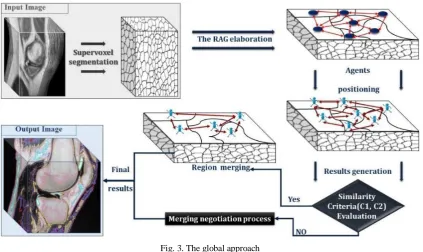
An appropriate way to practice a cooperative game is to use the architecture of a multi-agent system. This architecture offers the implementation of shared knowledge, individual skills, and timely action choices. In our proposed agent-based approach, agents are cooperatively organized to work directly on individual pixels or directly on voxels. In the global approach (Fig. 3), we assume that a homogeneous segment can be specified using a cooperative principle based on MAS strengths.
Fig. 3. The global approach
Knowledge and uncertainties integration: the agents provide an attractive abstraction to encapsulate local and intelligent processing. MAS (Multi-Agent System) architectures can be used to organize complex system information which involves several operational and/or descriptive knowledge.
Local cooperation can be carried out by agents who propagate new constraints locally and information to their neighbors.
Local adaptations: agents can adapt their behaviors locally according to the context of the image, prior knowledge or any extracted information.
Once placed in a region, the agent launches an investigation to find the adjacent neighbours in order to determine its merging decisions. The decision may vary depending on the following situations: 1) allowed merging, 2) unapproved merging, 3) the merging can occur only with cooperation and negotiation.
3.3.2 General Resolution approach
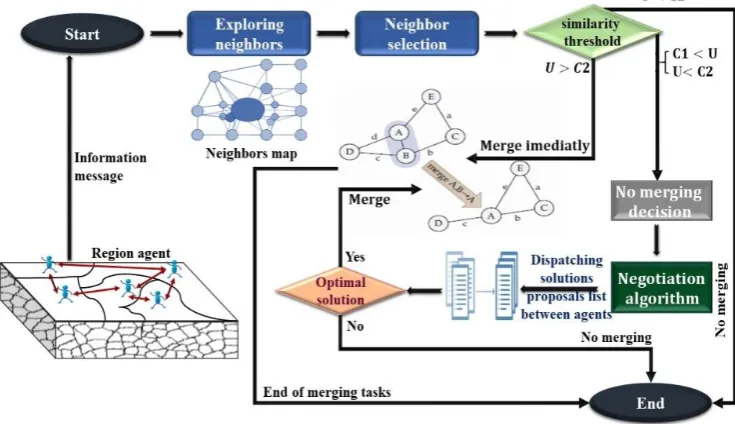
The connection of the adjacent regions of the RAG leads to the connection of adjacent agents. This indicates that each node of the RAG is examined during the merging process. In fact, in each region, an agent, who perceives his neighbours, is located. The agent’s actions can vary during the evolution of his tasks:
keep his area (R), no merge is possible
carry out a merge (M) simply or by negotiation (Mn)
The utility function, considered here, quantifies the desire for a merger with a neighbour for an agent. Thus, uij
expresses the desire of the agent Ai to merge with the agent Aj. This utility is based on the similarity of the
features of the two regions. Let Ni the set of neighbours of the agent Ai. Each agent Ai forms a coalition with its
neighbours in Ni to maximize the number of regions to merge. Then, Ai calculates its utilities with its neighbours,
orders them in a list Li {(Aj, uij) / AjNi} according to decreasing utility and then asks the list Lj of each Aj in Ni.
Finally, Ai constitutes 3 sets:
1- Set of solutions where the merger is possible: Lia= {(Aj, uij)/ AjNi, uij > C2 and uji > C2}
2- Set of solutions where the merger is probable: Lip= {(Aj, uij)/ AjNi, uij or uji < C2 and uii or uji > C1}
3- Set of solutions where the merger is impossible: Lir= {(Aj, uij)/ AjNi, uij < C1 and uji < C1}
Taking a decision concerning the merger could be accomplished in two steps: 1) Step 1:
Ai accepts to merge the regions Ri and Rj for Aj / (Aj, uij) Lia after validation of agents Ai and Aj in a
Pareto situation.
Ai rejects the merger of the regions Ri and Rj for Aj / (Aj, uij) Lir.
2) Step 2:
Ai negotiates the merger of Regions Ri and Rj Aj / (Aj, uij) Lip.
In this case, the agent Ai must revise its utilities at the level of the list Lip in the sense of strengthening his
desires or not. To confirm his decision, the agent Ai first forms a group Gi (a Lip subset) as a set of possible merger
solutions according to its new utilities, then checks its neighbors for validation. According to the optimal Pareto situations, the agent and the neighbours seek a compromise to validate (positive reassessment) the group Gi or a
part of the group. The negotiation procedure is that the agent Ai sends the group to one of his neighbours (choice
to be discussed), the neighbour re-evaluates the solutions and constitutes a new solutions’ subgroup that he decides to keep, then it chooses, in turn, new neighbour (among the remaining ones in Ni) and sends him the
subgroup and so on. Solutions that remain after the last visited neighbour will be taken into account.
To carry out an image segmentation, distinct regions have to be merged. Generally, a "good qualified" merger must satisfy the following criteria:
● All pixels have to be assigned to regions, ● Every pixel has to belong to only one region, ● Each region represents an associated set of pixels,
● Every region must be homogeneous according to a given predicate,
Fig. 4. The proposed approach for region merging process
a. Coalition
The coalition represents a grouping of cooperative agents for the common goal achievement [76]. For this reason, a function called “utility” is associated with different agents forming the coalition. Thus, we seek to model the relations between the different entities. With the utility function, the cooperation problem could be solved in a centralized way according to mathematical models and using the multi-criterion techniques [77]. Our proposal aims to form a coalition of agents that can be included in a segmentation task.
b. Negotiation importance
For an agent, the definition of negotiation must include all the acts to carry on, communication rules, and the resolution of conflicts. Negotiation remains an essential arrangement of interactions managed by a group of agents to reach a mutual agreement according to specific beliefs, goals or plans. Each agent maintains a preference list of the collaborating neighbours. Some elements must be defined to build a model of negotiation by a multi-agent system, for instance, in [78] three fundamental components were identified:
1. Negotiation Protocol collects the rules for organizing negotiation, communication, conversation and decision-making between agents [79]. Since we have adopted a restrictive number of negotiation protocols in our MAS, it is suitable to describe the answers that agents can use.
2. Negotiation Object represents, in our case, all the interactions on which a compromise must be found. The object can contain only one problem (such as merging), while it can cover different problems (conflicts, merging problem, deadlines, penalties, communication rules, etc.).
3. Decision Strategy defines the process approved by the negotiating agents. During the negotiation, each agent develops and exchanges arguments to defend its position or to change it to reach another region. For those who are dissatisfied, or who have not received an agreement simply through the utility test with merger criteria C1 and C2, they will form a coalition with agents with the same constraints.
c. Resolution Procedure
The power to negotiate is a fundamental property of an agents’ status. Negotiating allow getting optimal solution who is beneficial for the agent and the wholesale system. For that the resolution procedure contains four essential stages:
2. Sorting the received solutions: The adopted principle is the Pareto optimum. So, each suggestion merging solution received by an agent is then reevaluated (in sense of pay-off) and could be accepted or rejected. Consequently, the agent updates the list and sort it according to his preference.
3. Transmission of the solution: The group of solutions is transmitted between the negotiating agents.Once a group of solutions is identified as being a compromise between the courant agent and the earliest agents. The transmission stops if the courant group is empty.
4. End of negotiation: Agents can check all the received solutions,filter them,approve or reject them.If the last group is not empty the agents adopt the proposed merge suggestions.
d. Practical example
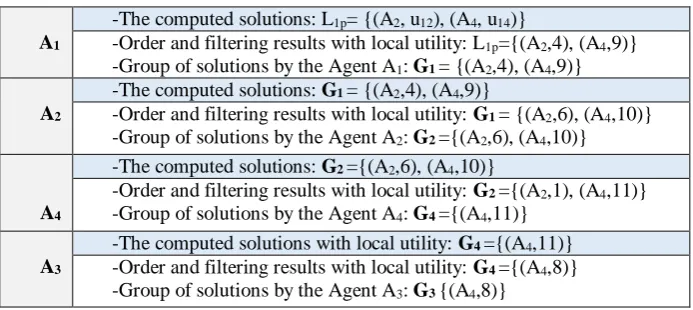
In Figure (Fig.5) an example of adjacent agents is shown to explain the transitions to validate a group of solutions and obtain a final compromise. Clearly, it is also a process of exchanges. Studying the case of a neighbourhood composed of 4 agents negotiating the possibilities of merger (green colour). Let Coa the Coalition containing the agents A1, A2, A3, and A4. we denote uij the calculated utilities considering its neighbours. The list for A1:
L1p= {(A2, u12), (A4, u14)}. The proposed merging solutions are in G1= {(A2, u’12), (A4, u’14)} with new utility
values. Let’s study the negotiation between first agents:
Fig. 5. Example of adjacent agents
If the agent A1 starts the negotiation process with G1 the relative proposed solutions to merge with agents A2
and A4 after being filtered by new merging criteria.
Table. 1. Example of the possible solutions groups exchange by agents
A1
-The computed solutions: L1p= {(A2, u12), (A4, u14)}
-Order and filtering results with local utility: L1p={(A2,4), (A4,9)}
-Group of solutions by the Agent A1: G1= {(A2,4), (A4,9)}
A2
-The computed solutions: G1= {(A2,4), (A4,9)}
-Order and filtering results with local utility: G1= {(A2,6), (A4,10)}
-Group of solutions by the Agent A2: G2={(A2,6), (A4,10)}
A4
-The computed solutions: G2={(A2,6), (A4,10)}
-Order and filtering results with local utility: G2={(A2,1), (A4,11)}
-Group of solutions by the Agent A4: G4={(A4,11)}
A3
-The computed solutions with local utility: G4={(A4,11)}
-Order and filtering results with local utility: G4={(A4,8)}
-Group of solutions by the Agent A3: G3{(A4,8)}
Table. 1 represents the group transfer between these agents. The possible proposed solutions are exchanged through the agent communication to obtain a possible common compromise which is the Pareto optimum. The agent A1 initiates the negotiation. It sorts all the acceptable solutions in the group G. A1 then sends it to the next agent A2. The group G1 contains all the acceptable merging solutions for the agent A1 because they correspond to
a situation as or more satisfactory than its initial reference situation. In the same way, the A2 agent also looks for
its first acceptable solutions, he has its own solutions that can evaluate, and agent A1’s ones so he has to make an
order for these solutions in order to form his own group G2 that can send to the following agents which would process on the same way. At the end of this negotiation, all agents (A1, A2, A3, A4) have a compromise for (A4,8)
so they agree with the merge of R1 and R4 regions. The figure Fig.6 explains the group transfer between agents A1
Fig. 6. Graph representing the possible lists of utilities sent by agents
The common objective of cooperating agents is to find a satisfactory solution for all. This example illustrates a small part of the negotiation exchanges between agents in our system.
4
Experimental Results
In this section, we evaluate the proposed architecture by applying the previous steps in python programming and testing different images. To evaluate the quality of a compromise, we introduce here different metrics. Furthermore, our proposed approach for region merging is based on two stages:
● Stage 1: the mechanism of merging is based on similarities according to the threshold criteria C1
and C2, then the region map update.
● Stage 2: Since we have a new graph after the region map update, we can use a cooperative approach to negotiate the optimal solution.
4.1
Stage 1: the basic mechanism of the merging process
4.1.1 Determination of similarity criteria
The measurement of the similarity between the pixels along the regions defines the proposed criteria. The choice of these threshold criteria C1 and C2 requires specific knowledge and must be done with caution. In this stage, the
merging Criteria are the quantitative variables: C1= 0.06 and C2=0.824. For similarities less than C1, the merge is
rejected, for these greater than C2 merge accepted, and for utilities between C1 and C2, there is a problem to take
the accurate decision. In this case, the region map is updated, a second RAG is obtained after the completed region merging, and the second stage is needed to find the appropriate fusion solution.
4.1.2 RAG construction
One of the strong points of (RAGs) is the spatial view of the image [80]. In fact, the RAG allows us to have a simple view of the connectivity figuring on the image. In order to test the robustness of our method, we carried out experimental data from the Patient Contributed Image Repository [81] We opted for these variant medical MRI images to have the opportunity to compare the results obtained by segmenting images of different cases:
Table 2. The tested datasets specifications
Medical datasets Number of slices Type
Knee 124 MR
Shoulder 69 MR
Heart 237 CT
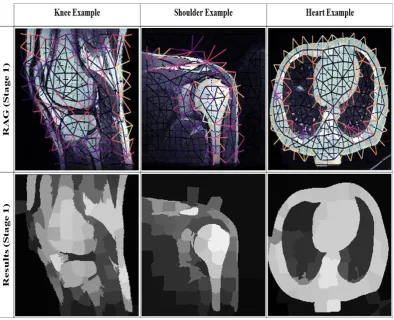
After testing these datasets, different quantitative and qualitative results were obtained. For that, to simplify the presentation of visual results of each of the three datasets, we have chosen randomly a slice then we compared the progression of merging during the execution of our method.
Fig. 7. Stage 1 results crossing the three different datasets
To understand the results of this step, the graph of the chosen examples is displayed in Fig. 7(RAGs-stage1). We can notice easily that the RAGs in this stage contain a huge number of start regions to be segmented. The main idea of our approach is to obtain leading results by merging the numerous regions we have at the beginning. It is quite remarkable, in Fig. 7(results-stage1), there are many resulting regions even more than the observed objects on the studied slices. At this point, we notice the necessity to move to the second stage which is based on a multi-agent system rather than the work of a single agent.
4.1.3 The expression of the used Similarity
The similarity between adjacent regions Ri and Rj can be calculated using weights on RAG arcs and variance
measures. Thus, the weights are defined as follow:
(1)
Where i and j are two adjacent nodes (regions) of the graph, hi and hj are the histograms of Ri and Rj, dist (i, j)
is the distance function between the two neighbouring regions, and β is the free integer parameter referring the Euclidean distance.
We can form the similarity Sij by using a linear combination as follows:
Sij = Vij + Wij (2)
Where:
4.1.4 The Merging Task:
Since the two criteria, C1 and C2 need to be checked in order to decide the merge possibility. All the nodes’
similarities of the RAG are calculated and stored for each graph layer. Accordingly, an iterative task can be managed regarding the following merging rules:
If Sij > C2: the merge is accepted, If Sij < C1: the merge is rejected, Otherwise: no-decision.
The last situation (no decision) can lead to a loss of data from the regions and very possible to the confusion of detection of the good segments. Consequently, for the remaining regions without decision, we adopt MAS decisions by negotiation in stage 2.
4.2
Stage 2: the optimal solution negotiation
4.2.1 MAS adopted architecture
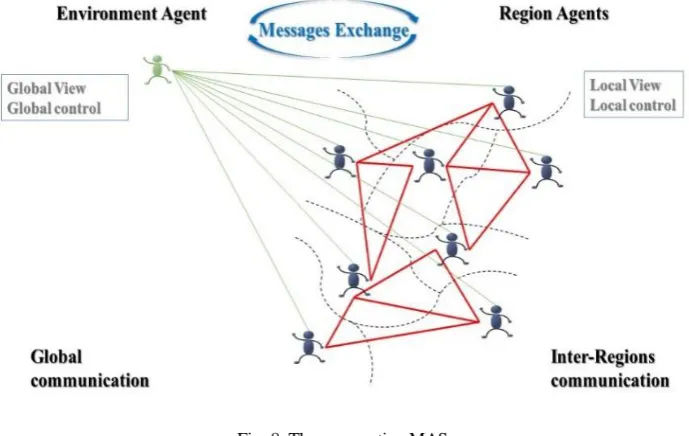
We suggest a merging negotiation framework based on the Multi-Agent System (MAS). This MAS (Fig. 8) consists of heterogeneous types of agents implementing different functionalities in the environment (image). Our system is based on agent applications in compliance with the specifications [83] for an inter-operable intelligent region merging system. FIPA offers, in addition to an agent, a communication language, a specification of the essential agents for the system management, the used ontologies, the behaviour of the agents in the different situations, as well as the compatibility with the platforms of MAS implementation including [84] in Java and [85] in python. The system ontology includes knowledge about the image segmentation, region merging, and game theory concepts. Functional agents can belong to two types: The environment agent and the region agents.
Fig. 8. The cooperative MAS
During this stage, agents’ society relies on the Environment Agent and the Region Agents who can exchange and develop the shared information.
a. Environment agent
Request update of the list (): allows to rank a list of agents' proposals, which can be updated after each negotiation.
Request a negotiation (): Triggers a negotiation, so that agents can cooperate and negotiate messages to reach a compromise to resolve the faced problem.
Approve a merger (): Allows the approval of merger proposals after validation of the results of the negotiation process.
Like all other agents, the environment agent exchanges the messages either to inform others about system changes, the most remaining ones are:
The initialization of Region agent: The environment agent is in charge of positioning the region agents in the image to be processed and, their initialization to work so agents are listening for new messages. The end of negotiation lists construction to a region agent: A negotiation list is formed by the positioned
agents.
The end of negotiation: After agent negotiations, the obtained results are transferred to the environment agent to be approved.
b. Region agent behavior
The region agent is a local actor that performs tasks serving the merge process such as communicating with other region agents, satisfying similarity criteria, and negotiating tasks. These agents are cooperating to improve the merging situation in the system by resolving potential conflicts through communication processes, agent knowledge, and mutual negotiation decisions. In this context each one of the agents has functions allowing it to manage its tasks:
Do update (): update the list of negotiations.
Do negotiation (): contribute in a negotiation, by exchanging messages to reach an optimal solution Provide merging results (): Send the obtained results to the environment agent so he can approve them or
not according to other agents’ results.
Having its own skills, and having access to necessary ontologies, the region agent must communicate through messages to inform others about his progression in the system:
Behaviors ordering: Some functions need a special behavior from the agent or its neighbors.
Behaviors execution: after defining the action to proceed the agent informs others about the reaction that he will execute.
Messages handling: the agent must check his messages to be informed about any changes.
4.2.2 The adopted agent utility
Utility [82, 75] is the policy that prescribes the fact of acting (or not) to maximize the gain of the system agents. Its principle is that the contribution to the general utility determines the value of an action. Thus, the utility evaluates an action (or a rule) only according to its consequences. The utility is the value that an agent gets from the performed actions within the system. As mentioned in section 3.3.2, The utility Uij expresses the desire of the
Region agent Ai to merge with the Region agent Aj. We calculate this utility using the similarity defined above (Sij
in (2)) and agent preferences depending on local information.
Uij =Sij *Nbvi(Lpi-Lpj)/Eij (3)
Where:
● Sij: the similarity computed using the equation (2)
● The Nbvi denotes the number of neighbouring regions for the region Ri ● Eij is the distance average of the two regions Ri and Rj
● Lpi and Lpj are respectively the iso-segments describing the distance ranges between the two regions Ri
and Rj
4.2.3 The obtained merging results
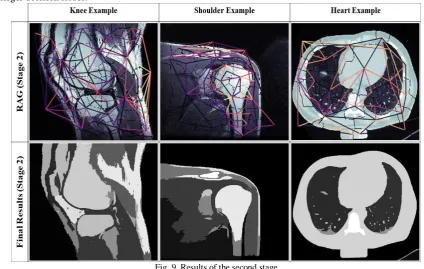
system (Final results in Fig. 9). In our approach, agents interact to accomplish the common objectives and resolve the merger decision issues.
Fig. 9. Results of the second stage
5
Discussion
In the previous sections, we presented our proposed method to resolve a region merging problem. In this section, we discuss the obtained results. Thanks to the multi-agent architecture better fusion quality results were found. Our approach is based on both concepts: agent’s negotiation and similarity criteria. Indeed, to evaluate the obtained results we performed several tests. First, the RAGs of the final results as shown in (Fig.10) ensure that we had a tiny number of regions comparing with the RAGs of the first stage.
Fig. 10. RAG of the final result indicating fewer regions compared to the starting RAG
In order to show the effectiveness of the proposed method, we evaluated different medical datasets containing Knee, shoulder and heart images. In this part, we quantitatively compare the results with those proven by other methods. First, we tested the results of various methods (including ours) to evaluate their pertinence. Secondly, we classed and compared the methods’ outcomes. Finally, we infer the method that offers better results. For that, we used the SSIM [86, 87], F-Measure [88, 89], Dice [90, 91, 92], sensitivity [93], specificity [94] and Jaccard [95, 96, 97] indices:
● SSIM: Structural SIMilarity was developed to measure the visual quality of an image compared to a reference. The idea of SSIM is to measure the similarity of structure between the two images.
● F-measure: Quality index for the results of an image processing that combines the two indices of recall and precision.
● Dice: measures the similarity of the found objects by calculating the size of the overlap of the two segments according to the total size of the two objects.
● Sensitivity: measure the proportion of real positive pixels correctly identified.
● Specificity: refers to the ability of the test to correctly detect pixels that meet the same similarity criteria. ● Jaccard: Measure adopted to evaluate the similarity of a given set. More precisely, it is the ratio between
the size of their intersection and the size of their union.
Considering the theoretical properties of possible segmentation approaches into a practical system, our objective in this paper is to present an optimal region-merging approach. However, the efficiency of the proposed method is compared with other methods of image segmentation: Region growing [18], MAS for s Markov random fields (MRF) segmentation [98], and Nash-game approach [51]. To accomplish these tests, the different datasets were tested with the same measures. We chose to test different paradigms to compare the effectiveness of the obtained results by our approach.
Table. 3. The results from methods comparison in segmentation of Knee images dataset
Methods SSIM% F-measure% Dice % Sensitivity % Specificity% Jaccard %
Region growing 74,03 78,56 70,89 67,85 71,46 76,25
MRF segmentation 69,47 77,86 76,10 67;11 74,32 80,76
Nash-game approach 76,46 80,99 73,32 70,28 73,89 78,68
The proposed approach 88,78 90,78 86,25 84,86 87,34 92,29
Table. 4. The results from methods comparison in segmentation of shoulder images dataset
Methods SSIM% F-measure% Dice % Sensitivity % Specificity% Jaccard %
Region growing 78,67 75,57 75,67 75,59 67,12 76,10
MRF segmentation 67,69 75,73 69,23 66,85 71,83 75,06
Nash-game approach 81,10 78,01 78,23 78,02 69,55 78,53
Table. 5. The results from methods comparison in segmentation of heart images dataset
Methods SSIM% F-measure% Dice % Sensitivity % Specificity% Jaccard %
Region growing 67,23 68,05 70,48 69,83 67,77 71,12
MRF segmentation 65,60 67,73 63,46 65,21 62,67 75,06
Nash-game approach 74,55 75,90 77,30 74,17 71,00 78,23
The proposed approach 88,69 89,73 91,07 87,91 81,66 89,00
To evaluate the effectiveness of the tested methods, we used the same datasets which are open to the scientific researchers on (PCIR) [99], then we carried out a numerical analysis of the qualitative and quantitative results. In particular, we found that segmentation methods based on region growing, and Markov random fields (MRF) provide modest results comparing to other approaches.
Relevant conclusions can be drawn from Tables (3,4 and 5) which compare the results of our proposed approach with the other methods. The table shows a high overall rating and the results from our approach show comparable performances. The other methods obviously have varied performances depending on the tested cases and the features of the images. The results show the validity of our method based on the cooperative MAS for region merging. Indeed, we realized that the performance is always proportional to the calculated utility.
By examining the segmented images, we could notice variable efficiency values from one slice to another, because the high or low slices can have intensities or can contain objects very different from those existing in the middle. Although the comparisons with the obtained segmentation results show evidence that our cooperative MAS produces more efficient segmentation. We noticed that our results became more relevant when we improved the utility in (3). To achieve this, we added another criterion α which is Levine and Nazif intra-region uniformity criterion [100]. This criterion calculates the sum of the contrasts of the regions weighted by their surface So, formula 3 would be updated as follows:
Uij =α*Sij +Nbvi*(Lpj-Lpi)/Eij (4)
This allowed us to have the outcomes presented in Table 6:
Table .6. Results of the proposed approach after utility changes for the studied datasets
Methods SSIM% F-measure% Dice % Sensitivity % Specificity% Jaccard %
Knee dataset 91,31 93,27 88,78 87,19 89,77 94,72 Shoulder dataset 92,43 93,89 92,82 91,32 87,91 92,64 Heart dataset 91,11 92,15 93,01 90,33 84,49 91,47 The performance of our method has been increased, as shown in table 6, thanks to the cooperative work of the MAS. However, to obtain homogeneous regions, we need an imaging expert in order to fix the criteria of the merge. Yet, according to our tests, it is a promising idea to start directly through the negotiation stage without leading two successive stages. This can be done by placing the multi-agent system on the image, each agent will progress by calculating its utility function U and communicating its results to the environment agent. Then the environment agent will test each utility according to the similarity criteria C1 and C2 to make a merging decision. After this step, we found that the stronger the utility function, the higher the efficiency of the system. By improving the utility function, we also show that the method can easily be extended by integrating other particularities to improve its performance.
solution. Second, the size of the proposed prototype and the number of the exchanged messages during the negotiation slow down the execution. But this problem was overcome by adopting lighter agent architectures with certain tasks parallelization. Moreover, it’s crystal clear that the number of the negotiated regions is often smaller than the first Superpixels/Supervoxels outcome thanks to agents’ work. Finally, the non-compromise case can affect some real mergers, for that, the agent payoffs (utility) must be carefully chosen to improve the quality of the obtained results.
6
Conclusion
This article proposes a new cooperative segmentation considering the exchanged information by the system agents based on the Pareto optimal to improve the performances and to reduce the calculation cost of the MAS. Our studies address the issues of image segmentation to produce a generalized approach. We defined a relevant approach that leads to pertinent results. We believe it is an opportunity to perceive the effective functioning of leading principles of game theory and MAS cooperation. Thus, these principles are adopted in a concrete situation of image segmentation using region merging techniques. The purpose of our study was to study the different combinations of image segmentation techniques. In our case, the adopted principle was the Pareto Optimum which favours the optimum gain.
We have studied and proved that a well-defined approach based on a cooperative Multi-Agent System can improve the continuity of the researches in medical image segmentation. We have also examined that the agents' behaviour can influence the results significantly. Since conflicts can occur while agents are executing their tasks the negotiation remains an important operation to ensure the effectiveness of the segmentation system. Consequently, the main difficulty we faced was the specification of consistent merge criteria. In order to accomplish a satisfactory segmentation, we believe image experts' opinions would help in eliminating ambiguities in all the criteria.
The results have shown that the proposed method is effective and robust in the cooperative segmentation of medical datasets. Eventually, our method offers competitive results with machine learning algorithms that are subject to current trends in image processing.
References
[1] S.Kannan, Vairaprakash Gurusamy, and G.Nalini. Review on image segmentation techniques. The Regional Telecommunications Independent Review Committee (RTIRC), 2014.
[2] Andrew E. Johnson, and Martial Hebert. Using Spin Images for Efficient Object Recognition in Cluttered 3D Scenes. IEEE Transactions on Pattern Analysis & Machine Intelligence, 21(05) : 433-449, 1999.
[3] Yan Yan, Elisa Ricci, Gaowen Liu, and Nicu Sebe. Egocentric Daily Activity Recognition via Multitask Clustering. IEEE Transactions on Image Processing, 24(10): 2984 - 2995, 2015.
[4] Anton Milan, Konrad Schindler, and Stefan Roth. Multi-Target Tracking by Discrete-Continuous Energy Minimization. IEEE Transactions on Pattern Analysis and Machine Intelligence, 38(10): 2054 - 2068, 2016. [5] Zhihua Xia, Neal N.Xiong, Athanasios V.Vasilakos, and XingmingSun. EPCBIR: An efficient and
privacy-preserving content-based image retrieval scheme in cloud computing. Information Sciences, 387: 195-204, 2017.
[6] Thomas M. Lehmann, Claudia Gonner, and Klaus Spitzer. Survey: Interpolation methods in medical image processing. IEEE Transactions on Medical Imaging, 18(11), 1999.
[7] Erik Smistad, Thomas L.Falch, Mohammad Mehdi Bozorgi, Anne C.Elster, and Frank Lindseth. Medical image segmentation on GPUs – A comprehensive review. Medical Image Analysis, 20(1): 1-18, 2015.
[8] Song Zhu, Lidan Wang, and Shukai Duan. Memristive pulse coupled neural network with applications in medical image processing. Neurocomputing, 227: 149-157, 2017.
[9] Ming Cheng, Niloy J. Mitra, Xiaolei Huang, Philip H. S. Torr, and Shi-Min Hu. Global Contrast Based Salient Region Detection. IEEE Transactions on Pattern Analysis and Machine Intelligence, 37(3): 569 - 582, 2015. [10] Jacques Ferber. Multi-Agent System: An Introduction to Distributed Artificial Intelligence. Harlow:
Addison Wesley Longman, ISBN 0-201-36048-9, 1999.
[11] Alvaro L. Bustamante, José M. Molina, and Miguel A. Patricio. A practical approach for active camera coordination based on a fusion-driven multi-agent system. International Journal of Systems Science, 45(4), 2014.
[13] Camerer and Colin F. Progress in Behavioral Game Theory. Journal of economic perspectives, 11(4): 167-188, 1997.
[14] D. Ary A.Samsura, Erwinvan der Krabben, and A.M.A.van Deemen. A game theory approach to the analysis of land and property development processes. Land Use Policy, 27(2): 564-578, 2010.
[15] Ilhan K. Geckil and Patrick L. Anderson. Applied Game Theory and Strategic Behavior. Chapman and Hall/CRC, DOI: https://doi.org/10.1201/9781584888444, 2016.
[16] Joanna Jaworek-Korjakowska and Pawel Kleczek. Region Adjacency Graph Approach for Acral Melanocytic Lesion Segmentation. Applied Sciences, 8(9), 1430; doi.org/10.3390/app8091430, 2018.
[17] Bindita Chaudhuri, Begüm Demir, Lorenzo Bruzzone, and Subhasis Chaudhuri. Region-Based Retrieval of Remote Sensing Images Using an Unsupervised Graph-Theoretic Approach. IEEE Geoscience and Remote Sensing Letters, 13(7): 987 - 991, 2016.
[18] Xiaoqi Lu, Jianshuai Wu, Xiaoying Ren, Baohua Zhang, and Yinhui Li. The study and application of the improved region growing algorithm for liver segmentation. Optik, 125(9): 2142-2147, 2014.
[19] CH Wei, SY Chen, and X Liu. Mammogram retrieval on similar mass lesions. Computer methods and programs in biomedicine, 106(3): 234-248, 2012.
[20] Szénási and Sándor. Distributed Region Growing Algorithm for Medical Image Segmentation. International Journal of Circuits, Systems, and Signal Processing, 8: 173-181, 2014.
[21] Dilpreet Kaur and Yadwinder Kaur. Various Image Segmentation Techniques: A Review. International Journal of Computer Science and Mobile Computing, 3(5): 809-814. 2014.
[22] Adams R and Bischof L. Seeded region growing[J]. Pattern Analysis and Machine Intelligence. IEEE Transactions on, 16(6): 641-647, 1994.
[23] R Rouhi, M Jafari, S Kasaei, and P Keshavarzian. Benign and malignant breast tumors classification based on region growing and CNN. Expert Systems with Applications, 42: 990–1002, 2015.
[24] R Nock and F Nielsen. Statistic region merging. IEEE Transactions on Pattern Analysis and Machine Intelligence, 26: 1452-1458, 2004.
[25] Ning J, L Zhang, D Zhang, and C Wu. Interactive Image Segmentation by Maximal Similarity-based Region Merging. Pattern Recognition, 43: 445-456, 2010.
[26] F Calderero and F Marques. Region merging techniques using information theory statistical measures. IEEE Transactions on Image Processing, 19(6): 1567-1586, 2010.
[27] F. Calderero and F. Marques. General region merging approaches based on information theory statistical measures. The 15th IEEE International Conference on Image Processing (ICIP), 3016-3019, 2008.
[28] Y Shu, GA Bilodeau, and F Cheriet. Segmentation of laparoscopic images: integrating graph-based segmentation and multistage region merging. The 2nd Canadian Conference on Computer and Robot Vision, 2005.
[29] H Liu, Q Guo, M Xu, and I Shen. Fast image segmentation using region merging with a k-Nearest Neighbor graph. In IEEE Conference on Cybernetics and Intelligent Systems, 179-184, 2008.
[30] B Peng, L Zhang, and J Yang. Iterated Graph Cuts for Image Segmentation. In Asian Conference on Computer Vision, 2009.
[31] Youssef El Merabet, Cyril Meurie, Yassine Ruichek, Abderrahmane Sbihi, and Raja Touahni. Building Roof Segmentation from Aerial Images Using a Line-and Region-Based Watershed Segmentation Technique. Sensors, 15(2): 3172-3203, 2015.
[32] Sebari, I. and He, D. Les approches de segmentation d'image par coopération régions-contours. Revue Télédétec, 7: 499–506. 2007.
[33] Awad M and Nasri A. Satellite image segmentation using Self- Organizing Maps and Fuzzy C-Means. Proceedings of the 2009 IEEE International Symposium on Signal Processing and Information Technology (ISSPIT), Ajman, UAE, 398–402. 2009.
[34] Chen Q, Zhou C, Luo J, and Ming D. Fast Segmentation of High-Resolution Satellite Images Using Watershed Transform Combined with an Efficient Region Merging Approach. Proceedings of the International Workshop on Combinatorial Image Analysis, 621–630, December 2004.
[35] Y Cherfa, Assia Jaillard, A Cherfa , and Y Kabir. Segmentation coopérative d’images RMN cérébrales : Application à la caractérisation des accidents vasculaires cérébraux. Journées d’études sur l’imagerie médicale JETIM Blida, 2004.
[36] Yitian Zhao, Lavdie Rada, Ke Chen, Simon P. Harding, and Yalin Zheng. Automated Vessel Segmentation Using Infinite Perimeter Active Contour Model with Hybrid Region Information with Application to Retinal Images. IEEE Transactions on Medical Imaging, 34(9): 1797 - 1807, 2015.
[38] Pim Moeskops, Mitko Veta, Maxime W. Lafarge, Koen A. J. Eppenhof, and Josien P. W. Pluim. Adversarial Training and Dilated Convolutions for Brain MRI Segmentation. Deep Learning in Medical Image Analysis and Multimodal Learning for Clinical Decision Support. DLMIA 2017, ML-CDS 2017. Lecture Notes in Computer Science, vol 10553. Springer, 2017.
[39] Matthew D Zeiler and Rob Fergus. Visualizing and Understanding Convolutional Networks. In ECCV 2014: Computer Vision: 818-833, 2014.
[40] Fausto Milletari, Nassir Navab, and Seyed-Ahmad Ahmadi. V-Net: Fully Convolutional Neural Networks for Volumetric Medical Image Segmentation. In The Fourth International Conference on 3D Vision (3DV), DOI: 10.1109/3DV.2016.79, 2016.
[41] Thisse and Jacques-François. Théorie des jeux: une introduction. Techno-Science.net. http://www.autzones.com/din6000/textes/semaine04/Thisse%20(2002)%20-%20Jeux.pdf, 2003.
[42] Chaib-draa, B. Chapitre 1: Introduction à la Théorie des Jeux. Laval University, Computer Science &
Software Engineering (CSSE) Department, Canada.
http://www.damas.ift.ulaval.ca/~coursMAS/ComplementsH10/Intro-TJ.pdf. 2008.
[43] Nash, John F. Equilibrium Points in n-Person Games. Proceedings of the National Academy of Sciences of the United States of America, 36(1): 48-49, 1950.
[44] Sankardas Roy, Charles Ellis, Sajjan Shiva, Dipankar Dasgupta, Vivek Shandilya, and Qishi Wu. A Survey of Game Theory as Applied to Network Security. In the 43rd Hawaii International Conference on System Sciences, 2010.
[45] E Semsar-Kazerooni and K Khorasani. Multi-agent team cooperation: A game theory approach. Automatica, 45(10): 2205-2213, 2009.
[46] Chakraborty Amit and James S Duncan. Integration of boundary finding and region-based segmentation using game theory. XIVth International Conference on Information Processing in Medical Imaging, 189-200, 1995.
[47] Chakraborty A and Duncan JS. Game-theoretic integration for image segmentation. IEEE Transaction on Pattern Analysis and Machine Intelligence, 12-30, 1999.
[48] Elizabeth Cassell, Sumanth Kolar, and Alex Yakushev. Using Game Theory for Image Segmentation. http://www.angelfire.com/electronic2/cacho/machine-vision/ImSeg.pdf, 2007.
[49] Roy K, Suen Ching Y, and Bhattacharya P. Segmentation of Unideal Iris Images Using Game Theory. ICPR: 2844-2847, 2010.
[50] Ibragimov B, Vrtovec T, Likar B, and Pernus F. Segmentation of lung fields by game theory and dynamic programming. In the 4th International Workshop on Pulmonary Image Analysis, PIA 2011: 101-111, 2011.
[51] Kallel, Aboulaich R, Habbal A, and Moakher M. A Nash-game approach to joint image restoration and segmentation. Applied Mathematical Modelling, 38, (11–12): 3038-3053, 2014.
[52] Hossein Aghababaee and Mahmod Reza Sahebi. Game-Theoretic Classification of Polarimetric SAR images. European Journal of Remote Sensing, 48: 33-48, 2015.
[53] R. Achanta, A. Shaji, K. Smith, A. Lucchi, P. Fua, and S. Susstrunk. Slic superpixels compared to state-of-the-art superpixel methods. IEEE Trans. Pattern Analysis and Machine Intelligence, 34(11): 2274–2282. 2012.
[54] X Ren and J Malik. Learning a classification model for segmentation. Proceedings Ninth IEEE International Conference on Computer Vision, DOI: 10.1109/ICCV.2003.1238308, 2003.
[55] Felzenszwalb P and Huttenlocher D. Efficient graph-based image segmentation, IJCV, 59(2), 2004. [56] Liu MY, Tuzel O, Ramalingam S, and Chellappa R. Entropy rate superpixel segmentation. In CVPR,
2011.
[57] R Achanta, A Shaji, K Smith, A Lucchi, P Fua, and S S¨usstrunk. SLIC superpixels compared to state-of-the-art superpixel methods. IEEE TPAMI, 2012.
[58] A Levinshtein, A Stere, K Kutulakos, D Fleet, S. Dickinson, and K. Siddiqi. Turbopixels: Fast superpixels using geometric flows. IEEE TPAMI, 31(12), 2009.
[59] Fan Fana, Yong Ma, Chang Li, Xiaoguang Mei, Jun Huang, and Jiayi Ma. Hyperspectral image denoising with superpixel segmentation and low-rank representation. Information Sciences: 397–398, 2017. [60] A. Trémeau and P Colantoni. Regions adjacency graph applied to color image segmentation. IEEE
Transactions on Image Processing. 9: 735-744, 2000.
[61] WX Kang, QQ Yang, and RR Liang. The Comparative Research on Image Segmentation Algorithms. IEEE Conference on ETCS: 703-707, 2009.
[63] M Silveira, JC Nascimento, JS Marques, ARS Marcal, T Mendonca, S Yamauchi, J Maeda, and JRozeira. Comparison of segmentation methods for melanoma diagnosis in dermoscopy images. IEEE Journal of Selected Topics in Signal Processing, 3: 35-45, 2009.
[64] P Felzenszwalb and D Huttenlocher. Efficient Graph-Based Image Segmentation. International Journal of Computer Vision 59(2): 167-181, 2004.
[65] Costas Panagiotakis, Ilias Grinias, and Georgios Tziritas. Natural Image Segmentation based on Tree Equipartition, Bayesian Flooding and Region Merging. IEEE Transactions on Image Processing, 20(8):2276 -2287, 2011.
[66] Peng Bo, Zhang Lei, and Zhang David. Automatic Image Segmentation by Dynamic Region Merging. IEEE Transactions on Image Processing, 20(12): 3592 - 3605, 2011.
[67] Nock R and F Nielsen. Statistical region merging. IEEE Transactions on Pattern Analysis and Machine Intelligence, 26(11): 1452–1458, 2004.
[68] Nock R and Nielsen F. Fast Graph Segmentation Based on Statistical Aggregation Phenomena. MVA: 150-153, 2007.
[69] Pascal VOC Dataset. 2010. https://pjreddie.com/projects/pascal-voc-dataset-mirror/.
[70] The Berkeley Segmentation Dataset and Benchmark. BSDS500.
https://www2.eecs.berkeley.edu/Research/Projects/CS/vision/bsds/.2007.
[71] Torsello A, Bulo SR, and Pelillo M. Grouping with asymmetric affinities: A game-theoretic perspective. IEEE Computer Society Conference on Computer Vision and Pattern Recognition, DOI: 10.1109/CVPR.2006.130, 2006.
[72] Albarelli A, Bulo SR, Torsello A, and Pelillo M. Matching as a non-cooperative game. In The IEEE 12th International Conference Computer Vision, DOI: 10.1109/ICCV.2009.5459312. 2009.
[73] Albarelli A, Rodolà E, and Torsello A. Imposing Semi-Local geometric constraints for accurate correspondences selection in structure from motion: A Game-Theoretic Perspective. International Journal of Computer Vision, 97 (1): 36-53, 2012.
[74] Edward Hagen and Peter Hammerstein. Game theory and human evolution: A critique of some recent interpretations of experimental games. Theoretical Population Biology, 69: 339–348, 2006.
[75] Beibei Wang, Yongle Wu, and Ray Liu. Game theory for cognitive radio networks: An overview. Computer Networks, 54(14-6): 2537-2561, 2010.
[76] Onn Shehory and Sarit Kraus. Methods for Task Allocation via Agent Coalition Formation. Artificial Intelligence Journal, 101(1–2): 165-200, 1998.
[77] Roy B and Bouyssou D. Multicriterion Assistance with the Decision: Methods and Case. Edition Economica, 1993.
[78] Jennings NR, Faratin P, Lomuscio AR, Parsons S, Wooldridge M, and Sierra C. Automated negotiation: Prospective customers methods and challenges. Intl Newspaper of Group Decision and Negotiation, 10 (2): 199-215, 2001.
[79] Sarit Kraus. Automated Negotiation and Decision Making in Multiagent Environments, ACAI 2001: Multi-Agent Systems and Applications: 150-172, 2001.
[80] Raimondo Schettini. A segmentation algorithm for color images. Pattern Recognition Letters, 14(6): 499-506, 1993.
[81] PCIR. 2016. http://www.pcir.org/index.html.
[82] Edward H Hagen and Peter Hammerstein. Game theory and human evolution: A critique of some recent interpretations of experimental games. Theoretical Population Biology, 69(3); 339-348, 2006.
[83] FIPA. Foundation for Intelligent Physical Agents. 1999. http://www.fipa.org.
[84] JADE. Java Agent DEvelopment Framework. 2000. http://sharon.cselt.it/projects/jade.
[85] Spade. Smart Python Agent Development Environment. 2012. https://pypi.org/project/SPADE/.
[86] Mi Zengzhen. Image quality assessment in multiband DCT domain based on SSIM. Optik, 125(21): 6470-6473, 2014.
[87] Pinghua Zhao, Yanwei Liu, Jinxia Liu, Antonios Argyriou, and Song Ci. SSIM-based error-resilient cross-layer optimization for wireless video streaming. Signal Processing: Image Communication, 40: 36-51, 2016.
[89] N. Lazarevic-McManus, J.R. Renno, D. Makris, and G.A. Jones. An object-based comparative methodology for motion detection based on the F-Measure. Computer Vision and Image Understanding, 111(1): 74-85, 2008.
[90] Zou KH, Warfield SK, Bharatha A, Tempany CM, Kaus MR, Haker SJ, Wells WM 3rd, Jolesz FA, and Kikinis R. Statistical validation of image segmentation quality based on a spatial overlap index. Acad Radiol, 11(2): 178-89, 2004.
[91] Klein S, van der Heide UA, Raaymakers BW, Kotte ANTJ, Staring M, and Pluim JPW. Segmentation of the prostate in MR images by atlas matching. ISBI, Arlington, VA: 1300–3, 2007.
[92] Al-Faris AQ, Ngah UK, Isa NAM, and Shuaib IL. MRI breast skin-line segmentation and removal using integration method of level set active contour and morphological thinning algorithms. J Med Sci, 2013. [93] Loong TW. Understanding sensitivity and specificity with the right side of the brain. BMJ, 327 (7417):
716–9, 2003.
[94] Altman DG and Bland JM. Diagnostic tests 1: Sensitivity and specificity. BMJ. 308 (6943): 1552, 1994. [95] Keyvan K, Mohammad Javad D, Kamran K, Mohammad Sadegh H, and Kafshgari S. Comparison
evaluation of three brain MRI segmentation methods in software tools. Biomedical Engineering (ICBME): 1– 4, 2010.
[96] Reddy AR, Prasad EV, and Reddy LSS. Abnormality detection of brain MR image segmentation using iterative conditional mode algorithm. Int J Appl Inform Syst, 5(2): a56–66, 2013.
[97] Reddy AR, Prasad EV, and Reddy LSS. Comparative analysis of brain tumor detection using different segmentation techniques. Int J Comput Appl, 82(14):14–28, 2013.
[98] Kamal E.Melkemi, Mohamed Batouche, and Sebti Foufou. A multiagent system approach for image segmentation using genetic algorithms and extremal optimization heuristics. Pattern Recognition Letters, 27(11): 1230-1238, 2006.
[99] 2016. http://www.pcir.org/index.html.