http://cjm.asm.md
http://dx.doi.org/10.19261/cjm.2019.616
© Chemistry Journal of Moldova
RECENT STUDIES OF (+)-3-CARENE TRANSFORMATIONS
WITH THE RETENTION OF THE NATIVE FRAMEWORK
Serghei Curlat
Institute of Chemistry, 3, Academiei str., Chisinau MD-2028, Republic of Moldova e-mail: [email protected]; phone (+373 22) 73 97 54; fax (+373 22) 73 99 54
Abstract. This review presents last decade and some past especially relevant studies in the field of (+)-3-carene synthetic transformations. The paper discusses exclusively the transformations of (+)-3-carene, proceeding with the retention of the native bicyclic carbon skeleton. The data concerning the features of epoxidation and oxidation reactions of (+)-3-carene, the synthesis of sulphur- and selenium-containing derivatives and their use in asymmetric synthesis are given. It also describes methods for producing amino derivatives of (+)-3-carene, substituted heterocycles based on it, reactions for the preparation of aziridines, azido-alcohols and azidoamines, as well as chiral phosphites as bidentate ligands.
Keywords: (+)-3-carene, epoxidation, sulphide, aminoalcohol, azidoalcohol, aziridine.
Received: 23 July 2019/ Revised final: 09 September 2019/ Accepted: 15 September 2019
List of abbreviations:
NBS N-bromosuccinylamide DMSO dimethylsulphoxide DBU diazobicycloundecene
Py pyridine
m-CPBA m-chloroperbenzoic acid DCM dichloromethane DMF N,N-dimethylformamide THF tetrahydrofuran
cat. catalyst atm. atmosphere DABCO diazobicyclooctane MS molecular sieves CAT chloroamide-T hydrate
PTAB phenyltrimethylammonium tribromide ee enantiomeric excess
acac acetylacetone
Introduction
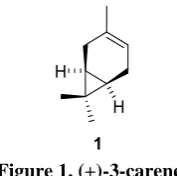
Plant metabolites extracts remain promising and interesting for medicine as evidenced by recent studies [1-8]. Thus, one of the main components of conifers’ turpentine – (+)-3-carene or (1S,6R )-3,7,7-trimethylbicyclo[4.1.0]hept-3-ene 1 (Figure 1), has been discovered to have a positive effect on bone mineralization with reduction of devastating effects of osteoporosis [9]. Moreover, as an acetylcholinesterase inhibitor, it has also been proposed for the treatment of Alzheimer disease [10,11].
One of the promising areas of creation of new chemical compounds, including drugs, is the transformation of plant metabolites,
which allows them to enhance or change their original properties [12,13].
Figure 1. (+)-3-carene.
In the last decade, the number of papers dedicated to the study of reactions proceeding with the preservation or modification of the natural carbon skeleton of 1 has increased [14]. Examples of the construction of bicyclo[4.1.0]heptanes in cycloaddition reactions and cycloisomerization of aliphatic compounds are also described, however, in some cases, the obtained products represent racemic mixtures [15-17].
The literature on the directed synthesis of optically active derivatives of 3,7,7-trimethylbicyclo[4.1.0]heptane was previously summarized [14,18,19]. Data on skeletal rearrangements of substances that occur
The review of the chemical transformations of 1 begins with an analysis of the work on the synthesis of monosubstituted caranes. Next, methods for obtaining of disubstituted caranes are discussed. Moreover, different transformations of mono- and disubstituted caranes into derivatives with different cycle size and heteroatoms will be presented.
Background
Monosubstituted caranes and their
transformation pathways
α-3,4-Epoxycarane 2 and β -3,4-epoxycarane 3 (Figure 2) are saturated three-membered heterocyclic compounds that contain an oxygen atom in the cycle and have long attracted the attention of researchers as useful building blocks in organic synthesis [14]. In this regard, the development of selective methods for the preparation of isomeric oxides 2 and 3 still remains relevant.
Figure 2. 3,4-Epoxycaranes.
Compound 2 is synthesized using peroxycarboxylic acids that attack the double bond of 1 from the less obstructed side, opposite to the gem-dimethyl group, giving predominantly isomer 2 [14,23,24].
An example of monoterpene 1 oxidation with a mixture of sodium periodate and dehydrocholic acid sodium salt in aqueous acetonitrile at room temperature is described in the literature [25].
In the case of oxidation with H2O2
catalysed by transition metals, the formation of epoxides is also observed. As a first example, the system polyoxometalate/Mn(III) porphyrin in combination with ammonium acetate can be
mentioned [26]. The authors found that metalloporphyrin is the most active catalyst that is protected from degradation by polyoxanions.
Monoterpene 1 oxidation process using a catalytic system: 60% hydrogen peroxide (1.3 eq.), Na2WO4 (0.04 eq.) with PhP(O)(OH)2
(0.02 eq.) in the catalytic system, [Me(n-C8H17)3N] HSO4 (0.04 eq.) and NaOH
(0.04 eq.) at room temperature for 12 hours resulted epoxide 2 with 87% yield [27].
The reactivity of methyltrioxorhenium in the epoxidation of olefins is associated with the presence of Lewis bases such as
p-methoxyaniline, 2-aminomethylpyridine and
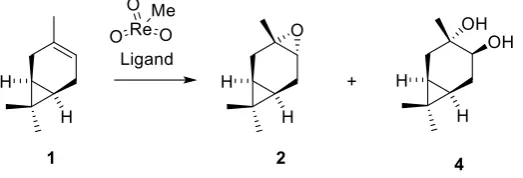
trans-diaminocyclohane as ligands, a large excess of which is required to achieve high yields and selectivity of the process carried out in a CH2Cl2/CH3CN with a 35% hydrogen peroxide
solution (Scheme 1) [28].
Along with epoxide 2, the formation of diol
4 was also observed in a 1:1 ratio with a total yield of 93%.
In order to eliminate this disadvantage, microencapsulation has been implemented. Microencapsulated Lewis base adducts of methyltrioxorhenium with nitrogen- containing ligands (2-aminomethylpyridine, 1,2-diaminocyclohexane) have been shown to be more effective. In the case of 4-methoxyaniline, the selectivity of the formation of substances 2
and 4 increased (amounted to 58% and 29%), while with the use of 2-aminomethylpyridine, the yield increased to 91% and 3%, respectively. During the transition to 1,2-diaminocyclohexane, an exclusive formation of α-3,4-epoxycarane 2
was observed (yield up to 98%).
Another group of researchers proposed an aqueous system of H2O2/tert-butyl
acetate/ dimethyldecylammonium WO4/
dimethyloctylammonium H2PO4/
dimethyloctylammonium HPO4 for epoxidation
of 1 [29]. As in the case of [28], the formation of the epoxide 2 mixture with diol 4 is detected in the ratio of 9:1.
A similar result was recorded using the catalytic system Na2WO4·2H2O,
[(n-C8H17)3-NCH3] HSO4, and a 30%
H2O2/phosphate buffer (obtained by mixing 0.1 M
H3PO4 solution in H2O2 and 0.1 M NaH2PO4
solution in H2O2, in a ratio of 7:3) / Na2SO4 [30].
The oxidation system [PO4{WO(O2)2}4]3/
imidazole/30% H2O2/aqueous acetonitrile [31]
showed even lower selectivity (85%). It has been established that a mixture of Na2WO4,
[Me(n-C8H17)3N]HSO4, and PhP(O)(OH)2
catalyzes epoxidation of 1 by H2O2 with the
involvement of 0.3 equivalent of Na2SO4 [32].
The formation of product 4 during the epoxidation reaction with 35% aqueous H2O2
catalyzed by methyltrioxorenium was avoided by adding 1-methylimidazole to the reaction mixture [33]. The yield of the target epoxide 2 was 94%. The formation of 2 with a 79% yield was observed in the case of use of a mixture of ionic liquid [Emmim]PF6/H2O2/CuCl complex with
Schiff base (salicylic aldehyde with 2-hydrazinylpyridine) as oxidant [34]. The formation of 100% pure epoxide 2 with 88% conversion of the starting 1 within 24 hours was detected under microwave irradiation of the mixture of tris(pyrazolyl)methane molybdenum tricarbonyl complex with an excess of tert-butyl hydroperoxide in a solution of 1,2-dichloroethane at a temperature of 50°C [35]. A similar ratio of the reaction product and the conversion of the starting olefin using hexafluoroacetone as a catalyst and a solution of 60% H2O2 in
1,1,1,3,3,3-hexafluoroisopropanol was observed by the authors of another work [36]. In conclusion, it should be mentioned that under production conditions 1 is oxidized to 2 (yield 93%) by pinane hydroperoxide in the presence of molybdenum catalysts [37].
We also presented protocols for exclusive formation of α-oxide 2 via reusability of the catalytic system using nano-powder alumina as a heterogeneous catalyst and hydrogen peroxide as an oxidant [38]. As far as the oxidation reaction is concerned, employment of hydrogen peroxide as the oxidant agent offers several advantages: it is relatively cheap and environmentally friendly, since water is obtained as a by-product.
(+)-3-Carene is converted to the α-oxide 2 with selectivity up to 98%, if an 8-10% solution of hydrogen peroxide in ethyl acetate and nano-powder alumina (2-4 nm) is present [39].
Bromonium electrophile, generated from bromosuccinimide, first attacks the olefin 1 from the less difficult to access side, after which the anti-nucleophilic attack of water passes to the more difficult side of the molecule. Cocker, W. et al. used this model to establish the stereochemistry of β-3,4-epoxycarane 3, which was synthesized via bromohydrin 5 with a total yield of 70% in two stages (Scheme 2) [40].
The formation of oxide 3 in trace amounts (4%) was observed during the oxidation of 1 with H2O2 catalysed by
[Ni0.63Al0.37(OH)2](NO3-)0.27(WO42-)0.05·0.66H2O,
while the main product was 5. It was shown that 99% pure of the isomer 3 was isolated when treating the latter bromohydrin with NaOEt, but the authors did not indicate the total yield of the target product.
Olefin 1 can be converted in 73% yield to
β-3,4-epoxycarane 3 under the conditions of the one-pot method by successively adding NBS and DBU to a solution of substance 1 in DMSO [41].
A scheme has been developed for the conversion of caranol 6 to diselenide 8 through tosylate 7 (Scheme 3) [42].
Low-temperature alkylation (-26°C) of selenol 9 with isomeric 3-chloroprop-1-enyl benzenes using n-BuLi as a base made it possible to synthesize selenides 10 and 12 with a yield of 68% and 69%, respectively. The latter upon oxidation with meta-chloroperbenzoic acid with low selectivity gave allyl alcohol 11 of the same enantiomeric series.
Synthesis of selenides 14-17 can be also carried out starting with alcohol 6 (Scheme 4). This approach included the initial formation of chloride 13. It should be noted that similarly to the previous synthesis of alcohol 11 the enantioselectivity was low. At the same time, enantio-enriched linalools 18 can be obtained in two stages from selenol 15 by the oxidation of intermediated selenides 19 and 20
with m-CPBA (Scheme 5).
Synthesis of another type of selenides carried out from diselenide 14 involving formation of bromide, followed by anion metathesis, through triflate 21 interaction with
o-allylphenol in dichloromethane/methanole at
-78℃ gave a mixture of selenides 21, 22 in an approximately equal ratio (Scheme 6) [43]. During cyclization, an approximately equal mixture of diastereomeric selenides 22
was formed.
Scheme 3. Synthesis of optically active selenides [42].
Scheme 4. Synthesis of isomeric selenides [42].
Among the discussed substances, ether 23, synthesized by the interaction of selenol 9 with trityl chloride [44], should also be noted (Scheme 7).
The tosylate 7 is a key starting compound for the one-pot synthesis of tellurides 24, 25 by interaction with tellurium/NaBH4 in EtOH/DMF
(Scheme 8) [45]. The synthesized substances are quite stable and could be isolated through column chromatography.
Another type of symmetrically constructed substance of the carane series is N,N'-bis(caranyl) ethylenediamine 28 that could be synthesized in two stages from amine 26 (Scheme 9)[46].
Diamine 28 was obtained by the reduction of diamide 27 by borohydride, which was used as
an inducer of chirality in nitro-aldol condensation (Scheme 10).
The main products of the reaction of aldehyde 29 with nitromethane was alcohol 30, the yield and enantiomeric purity of which depends on the nature of the aldehyde and is presented in the Table 1. The highest enantioselectivity was registered in the case of (S)-1-nitropropan-2-ol formation.
The synthesis of a diastereomeric mixture of caranones 31, 32 under non-catalysed conditions by the oxidation of olefin 1 using N2O
was reported by Tkachev, A.V. et al. (Scheme 11) [47]. The authors also noted low conversion (up to 20%) and the formation of skeletal rearrangement products.
Scheme 6. Synthesis of selenides 21, 22 [43].
Scheme 7. Preparation of ether 23 [44].
Scheme 9. Synthesis of symmetrical diamine [46].
Scheme 10. Nitro-aldol condensation of aldehydes with nitromethane [46].
Scheme 11. Synthesis of the diastereomeric mixture of caranones [47].
Scheme 12. Hydrogenation of caranol 6 [48].
Table 1 Yield and enantiomeric purity of nitro-aldol condensation adducts 30.
No Radical Yield (%) ee (%)
1 Ph- 64 65
2 o-MeO-C6H4- 59 61
3 m-MeO-C6H4- 44 65
4 p-MeO-C6H4- 74 67
5 p-Cl-C6H4- 62 65
6 p-Br-C6H4- 58 69
7 p-F-C6H4- 76 79
8 1-Naphtyl- 65 71
9 p-NO2-C6H4- 76 70
10 Cyclohexyl- 79 69
11 Butyl- 84 77
The successive conversion of alcohol 6 to ketones 31, 33 took place during the hydrogenation on the surface of the catalyst Cu / MgO, Cu / ZnO, Ni / Cr2O3 (Scheme 12) [48].
Aldehyde 34 synthesized according to scheme 13 and the corresponding acetals 35, 36
have been proposed as fragrances for the perfume industry (Scheme 13) [49,50].
The available starting compound for the preparation of sulphur containing caranes 37-40 is tosylate 7 (Scheme 14) [51,52]. Thiol 39 under the action of sodium hydride gave disulphide 40
in a moderate yield.
Sulphides 37, 38, 40 were used for the synthesis of optically active stilbene oxide (Scheme 15).
The yield, isomeric composition, and enantiomeric purity of the stilbene oxide are presented in Table 2.
The synthesis of imidazoles 41-43 is based on the interaction of tosylate 7 with an alkaline solution of 2-sulphonyl-1H-imidazole, 1-methyl-2-sulphanil-1H-imidazole or 2-sulphanil-1H -benzimidazole, respectively (Scheme 16). It is possible to increase the yield of the substance 43
to 68% using a mixture of cesium carbonate and tetrabutylammonium iodide. Optimum conditions for diastereoselective oxidation of sulphides
41-43 to substances 44-46 were proposed.
The oxidation of thiol 39 by chlorine dioxide followed by hydrolysis results in the formation of sulphonic acid 47 in good yield (Scheme 17) [53].
Synthesis of allyl alcohol 48 by the isomerization of epoxide 2 was reported (Scheme 18) [54]. The overall yield of the epoxide 2 → allylic alcohol 48 → aldehyde 49 → alcohol 50 scheme was 72%.
Scheme 13. Synthesis of acetals [49,50].
Scheme 14. Synthesis of sulphur-containing caranes [51,52].
Scheme 15. Synthesis of the optically active stilbene oxide [51].
Table 2 The yield and enantiomeric purity of stilbene oxide.
No Sulphide Yield (%) Ratio cis/trans ee trans (%)
1 37 13 55/45 44 (S,S)
2 38 53 3/97 8 (S,S)
Scheme 16. Synthesis of caranyl sulphonyl imidazoles [52].
Scheme 17. Synthesis of caranesulphonic acid [53].
4-Substituted 2-carens are widely used for the synthesis of optically active 1,3-disubstituted 2,2-dimethylcyclopropanes [14,55], including the precursors of practically important insecticides [55-63]. Known methods for producing (+)-4α-acetyl-2-carene 51, (+)-4α -hydroxymethyl-2-carene 52 and (+)-4α-acetoxymethyl-2-carene
53 include heating of 1 with ZnCl2 in Ac2O
solution, or with paraform in AcOH solution, respectively (Scheme 19) [64-66]. Transitions from 51, 52 to epimers 54 and 55 were also described [64,67].
On the other hand, in the last decade there has been a significant increase in interest for the use of ionic liquids in organic synthesis, including the example of synthesis of 1 derivatives using ionic liquids 56-58 (Scheme 20) [68].
It was established that keeping the equimolar mixture of 1, Ac2O and 6% mol of the
imidazole salts 56-58 at 50°C contributes to the Kondakov reaction (see Table 3).
The catalytic effect of molten salts of imidazole is probably associated with the initial formation of an acyl ion from Ac2O with
the participation of the nitrile group associated with the anion.
The carbocation formed by attaching the acyl carbocation to the double bond of monoterpene 1 is stabilized by elimination of the proton with the regeneration of the double bond. The predominant formation of isomer 51 is associated with the directing effect of the 2,2-dimethylcyclopropane fragment present. Carrying out the reaction in the molten salt 56
leads to a double reduction of time with a slight increase in the yield of the final product and with the same degree (50%) of the conversion of the original 1. It has been established that carrying out the reaction in the molten salt 57 or 58 along with the target reaction is accompanied by opening of 2,2-dimethylcyclopropan fragment, which ultimately leads to a complex mixture of products. Attempts of hydroxymethylation of 1
with paraform in the melt of the discussed salts and by addition of a catalytic amount of ZnCl2 to
the reaction mixture were unsuccessful.
It was found that only in the case of molten salt 57, the addition of a stoichiometric amount of AcOH to the reaction mixture contributed to the Prins reaction.
Scheme 19. Synthesis of 4-substituted 2-carenes [64-66].
Scheme 20. Synthesis of 4-acetyl 2-carenes [68].
Table 3 Reaction conditions and yields of acylation reaction products.
Products Ionic liquid Ionic liquid quantity Yield (%) Time (hours)
51, 52
56 6 % mol 33 49
alloy 37 25
57 6 % mol 38 46
58 6 % mol 29 48
N
N
PF6
-NC
N
N
Br
-NC
N N
BF4
The α-hydroxyl carbocation produced by binding a proton to formaldehyde reacts with an olefin 1 to produce a β-hydroxycarbocation, which is stabilized by eliminating a proton with regeneration of the double bond. From a stereochemical point of view, the reaction proceeds as trans-addition, which in combination with the shielding effect of the gem-dimethyl group leads to selective hydroxymethylation. The ratio of epimers 52 and 55 was 9:1 (Scheme 21). The products of 51 reduction are proposed as intermediates in approaches to chiral blocks for the construction of epothilone carboanalogs [69]. However, the configuration of the emerging asymmetric center has not been established, and, moreover, the authors failed to separate diastereomers 59, 60. This is all the more important when it comes to obtaining carbon analogs of substances with a taxolon-like mechanism of action.
The literature describes the synthesis of alcohols 59, 60 by borohydride reduction of ketone 51 (Scheme 22) [70]. It was found that the
R-isomer 59 is easily separated from the S-isomer
60 by crystallization from hexane. Carrying out the reaction of borohydride reduction in a
water-dioxane solution results in 85% yield of the mixture of epimers 59:60= 3:2. In parallel, it was found that replacing solvents with MeOH and lowering the reaction temperature to -15°С does not reduce the overall yield of diastereomers and increases the epimer content of 59 to 60%.
The method of transesterification of acetoacetic ester, as applied to alcohol 59, gave ester 61 (yield 51%). It is possible to increase the yield of the latter to 98% under Et3N catalyzed
condensation of alcohol 59 with diketene. Replacement of the acetoacetic ester with 4-chloroacetoacetic ester under conditions similar to the synthesis of ester 61 made it possible to prepare α-chloroketone 62 with 43% yield. Alcohol 59 interacts with 2,2-dimethyl-4,6-dioxo-1,3-dioxane giving malonic acid monoester 63
with a yield of 51%.
Nitrogen-containing substances and aminated derivatives of natural compounds take an increasingly significant place in the list of substances with practically important properties. For example, the enantiomerically pure anti-tuberculosis drug (+)-ethambutol contains (2R )-1-oxomethyl-2-aminopropyl fragment [71].
Scheme 21. Synthesis of substituted 2-carenes [69].
A convenient and gentle method of introducing this fragment into the (+)-4α -acetyl-2-carene 51 molecule was the reaction with monoethanolamine in the presence of NaBH3CN
as shown in the Scheme 23.
The reaction product 64 is a mixture (9:1) of epimers at the C1 atom of the side chain. A monobromoacetic acid tert-butyl ester was used to construct the aminoacetic acid fragment of compound 65.
The α-activated acid ester 61 has found application in the synthesis of spiro-heterocyclic compounds 66, 67 [72]. The condensation of substance 61 catalyzed by DABCO with isatin and malononitrile gives an equal mixture of diastereomeric spirans of structures 66
and 67 (Scheme 24).
Disubstituted caranes and their transformation pathways
It was previously reported that the reaction of chlorosulphonyl isocyanate with (+)-3-carene 1
takes place with the formation of β-lactam 68
[73,74]. In the development of the approach to optically active lactam functionalized ionic liquids, the synthesis of 68 was repeated (Scheme 25) [75].
Instead of the expected product with a melting point of 108-111℃, substance 69 was isolated with a melting point of 66-67℃. Sequential treatment of sulphonyl chloride 69
with Et3N and H2O led to substance 68, the
reaction of which with trifluoroacetic acid gave salt 70.
Scheme 23. Synthesis of aminated (+)-4α-acetyl-2-carene derivatives [71].
Scheme 24. Synthesis of spiro-heterocyclic compounds [72].
The β-lactam 68 was transformed in three steps into the amino alcohol 71, which, with 3,5-di-tert-butyl-2-hydroxybenzaldehyde, gave the Schiff base 72 [76,77]. By the combination of VO(acac)2 - ligand 72 - N-ethyl-N,N
-diisopropylamine - 86% solution of cumene hydroperoxide was performed the asymmetric synthesis of (S)-omeprazole by oxidation of its prochiral sulphide.
The transformation of olefin 1 to disulphide
75 included the preliminary formation of
cis-aziridine 73 (Scheme 26) [78].
The regio- and stereoselectivity of the reaction of the aziridine cycle opening of 73 under the action of benzyltriethylammonium tetrathiomolybdate has been established.
Another type of disulphides of the carane series was synthesized via nitrosyl chloride 76
(Scheme 27) [79].
Dimer 76 interacts with NaSCH2CH2SNa(i)
or KSCH2CH2CH2SK(ii) with the formation of
ketoxime 77 (yield 85%) or 79 (yield 60%), respectively. It was shown that cyclization of the
77 under the action of dicyclohexyl-18-crown-6 - 50% aqueous KOH system under the conditions
of interfacial catalysis gives macrocycles 78, whereas for the formation of 80 the use of the combination of tetrabutylammonium hydroxide and 50% aq. NaOH was proved to be the most efficient, but the yields did not exceed 10-30%.
Nitrosyl chloride 76, when treated with acetone cyanhydrin is converted to ketoxime 81
(Scheme 28) [80].
Functionalized ketoximes 82-85 were synthesized from dimer 76 and ethylacetic, aminopropionic, aminohexanoic and anthranilic esters, respectively [81]. The interaction of compound 76 with 1H-imidazole or benzotriazole gives 86 or 87 respectively (Scheme 29) [82]. Aminoketoximes 88, 89 can be synthesized by the interaction of dimer 76 with ammonia and dimethylamine, respectively (Scheme 30) [83,84]. Dimethylaminoketoxime 89 is transformed into ether 90 by interaction with epichlorohydrin (yield 64%). The opening of the oxirane cycle 90
with aminohexane, morpholine, piperazine, and ketoxime 88 takes place with the formation of an inseparable mixture of alcohols 91-94, the yield of which did not exceed 52%.
Scheme 26. Synthesis of β-sulphonamidodisulphides [78].
Scheme 28. Amino acid synthesis [80,81].
The microwave irradiation of epoxide
2
with sodium thiolates resulted in the
formation of
β
-hydroxysulphides
95
-
99
with
high yields (75-95%) (Scheme 31) [85].
The method of obtaining azidoselenide 100
has been published also (Scheme 32) [86]. The reaction proceeds regioselectively according to the Markovnikov rule with the formation of a
trans-diaxial product. The opening of the oxide 2
with sodium azide in the presence of ammonium chloride [87] occurs with lower selectivity (Scheme 33). It was possible to increase the yield of azide 102 to 65% when carrying out the
reaction in aqueous acetic acid [88]. The regioselectivity of the reaction can be explained by the initial protonation of the oxide cycle, which leads to the formation of a positive charge on the tertiary carbon atom. As a consequence, a more substituted α-carbon atom is subjected to the nucleophilic attack by the azide ion with the formation of compound 102. The opening of aziridine 103 with sodium azide catalysed by cerium chloride was highly selective, but the total yield of aminoazides 104, 105 did not exceed 37%.
Scheme 31. Synthesis of β-hydroxysulphides of the carane series [85].
Scheme 32. Synthesis of β-azidoselenide of the carane series [86].
Synthesis of aminoalkylated aziridines
103a-k has been performed via cyclization of
azidoalcohol 102 with participation of Ph3P, with
a following condensation of aziridine 103 with formaline and the secondary amines (Scheme 34) [88].
It has been detected that the cytotoxicity of the aminoalkylated derivatives of aziridine with heterorganic substituents increases at transition from the five-membered pyrrolidine cycle to the six-membered piperidine cycle and is reduced at substitution of the piperidinic to morpholinic cycle or increased at transition to morpholinic cycle. The lowest toxicity has been detected for the aziridine 103 and azide 102 [88].
An equal mixture of isomeric azides 106,
107 was synthesized based on epoxide 3 [87]. The latter azides are transformed into aziridine 108
with triphenylphosphine. However, a difference in reactivity has been observed: in the case of azido-alcohol 106, the formation of aziridine took place at room temperature, whereas the conversion of azido-alcohol 107 to the desired product required long-term boiling in 1,4-dioxane. It should be noted that the reaction was diastereoselective since isomeric azido alcohols gave the same product, which at interaction with sodium azide in the presence of cerium chloride gave a mixture of substances 109, 110 (Scheme 35).
Scheme 34. Synthesis of aminoalkylated aziridines [88].
The opening of the epoxide 2 with diphenyldiselenide in MeOH led to
β-hydroxyphenylselenide 112 (Scheme 36) [89]. By varying the selenium source, and conditions it is possible to synthesize selenide 111
or diselenide 113 in good yields. A similar approach applied for epoxide 3 allowed the authors of the cited paper to synthesize selenides with structures 114-116 (Scheme 37).
The reaction of the interaction of oxide 3
with diphenyldiselenide proceeds more smoothly as compared with 2 (yield 84% and 56%, respectively). It should be noted that in the case of products 114, 116, the yields are 11% lower and 23% lower than those of similarly constructed substances 111 and 113.
The interaction of epoxide 117 with amines gave a series of secondary and tertiary aminodiols (Scheme 38) [90].
N-Benzylaminodiol 118c was prepared by reacting benzylamine with oxide 117 in the same way as tertiary aminodiols 118a, 118b, 118d-g,
while N-methyl derivative 119a and primary amine 119b were synthesized under standard hydrogenation conditions of the corresponding
N-benzyl derivatives 118a, 118c. Formalin reacts with secondary amines in high yields to form 1,3-oxazines 120a-d.
Unlike the precursors 118c, 118f, 118g,
119a, oxazines 120a-d exhibited high induction (77-97% of it) in the reaction of asymmetric addition of diethylzinc to aldehydes.
The method of synthesis of hydroxyamide
121 is based on the catalyzed OsO4 interaction of 1 with chloramine T in aqueous tert-butanol (Scheme 39) [91].
Low-temperature treatment of
p-toluenesulphonylamide 121 with sodium in ammonia with a yield of 72% gives hydroxyamine 122.
Azido alcohols 101, 102 [87] under the action of LiAlH4 in the ether are reduced to
trans-amino alcohols 123, 124 (Scheme 40) [92].
Scheme 36. Synthesis of β-hydroxyselenides [89].
Scheme 38. Synthesis of β-hydroxyamine [90].
Scheme 39. Synthesis of cis-hydroxyamine 122 [91].
The same group of researchers described the synthesis of another pair of trans-amino alcohols 125, 126 based on azido-alcohols 106,
107 (Scheme 41).
Isatins 127a,b have been the favoured template not only for the spectrum of biological activities, but also with respect to the development of methodologies.
It is relevant to mention the synthetic approach employing organocatalyst 122, prepared from 1 and used for the subsequent enantioselective synthesis of (R)-convolutamydine A 128a (Scheme 42) that is a member of the oxindole subfamily, which exhibits a potent inhibitory activity on the differentiation of HL-60 human leukaemia cells.
It has been determined that water produces a moderate influence on the selectivity of the cross-aldol condensation of the 4,6-dibromoisatine 127а with acetone catalysed by cis-aminoalcohol 122 [93]. The synthesized amino alcohols 125-126 were investigated as catalysts for the asymmetric cross-aldol condensation of isatin with acetone, the yield and
enantiomeric purity of the reaction product are presented in the Table 4.
The reaction product with participation of isatine 127a and catalysed by amino alcohol 126
was a racemic mixture 128b (yield 74%), while the regioisomer 125 exhibited asymmetric induction up to 49% ee. A similar pattern was observed when using another pair of inductors. In the case of substance 123, in which the amino group is at the tertiary carbon atom, the highest enantioselectivity has been registered, whereas with catalyst 124 the enantioselectivity did not exceed 5%.
The success in creating of highly efficient metal complex catalysts depends almost entirely on the correct choice of the chiral ligand, and the effectiveness of the latter is largely dependent on the right selection of the initial chiral synthon. This is completely true for optically active phosphorus-containing compounds that largely determine the modern view on catalysed asymmetric synthesis.
The use of chiral phosphorus-containing inductors based on 1 has been proposed [94].
Scheme 41. Transformations of oxide 2 into trans-amino alcohols [92].
Table 4 Reaction time, yield and enantiomeric purity of 3-hydroxy-3- (2-oxopropyl) indolin-2-one.
Entry Catalyst Product Water additive (mol %) Time (hours) Yield (%) ee (%)
1 122 128a 0 36 44 51(S)
2 122 128a 100 48 23 13(R)
3 123 128b 0 50 95 77(R)
4 124 128b 0 100 60 5(S)
5 125 128b 0 96 95 49(R)
6 126 128b 0 120 74 0
Scheme 43. Synthesis of P* - chiral phosphites [94].
Phosphorylation of diol 129 yielded
P*-chiral phosphites 130a, 130b (Scheme 43). Synthesis of phosphite 130a proceeds with high selectivity (95% of the main diastereomer). It should be noted that amidophosphite 130b is formed as a single stereoisomer. New phosphites were tested in enantioselective Pd-catalysed allyl sulphonation with TolSO2Na, alkylation with
dimethyl malonate and amination with pyrrolidine (E)-1,3-diphenyl allylacetate. Regardless of the nature of the ligands and the ligand : Pd ratio, low optical yields were recorded, while the conversion level increased to 71% in the case of the phosphite 130b / [Pd(allyl)Cl]2 catalytic system at
a ratio of 1:2. One approach to increasing the asymmetric activity of the ligand could be the use of the corresponding P,N-bidentate compounds with additional C* stereocenters in the peripheral nitrogen-containing group. For this purpose, oxazolinophosphite 131 was obtained using amidophosphite 130b.
Compound 131 with respect to [Pd(allyl)Cl]2 acts as a typical P,N-bidentate
ligand, forming a chelate cationic complex, for which a high chiral induction of up to 90% is established at a conversion of 67% in the allylic amination reaction. In this case, the R-enantiomer is formed, whereas the previous catalytic systems based on ligands 130a, 130b led to the formation of a predominantly S-enantiomer. The use of the
catalytic system based on oxazolinophosphite 131
and pyrrolidine as a nucleophile in allyl amination of (E)-1,3-diphenyl allylacetate led to an increase in the optical yield up to 91% at 100% conversion of (E)-1,3-diphenyl allylacetate.
Conclusions
The presented review has summarized scientific achievements in the field of (+)-3-carene synthetic transformations. The functionalization of (+)-3-carene leads to products with 3,7,7-trimethylbicyclo[4.1.0]heptane skeleton. However, a number of syntheses include many steps that lead to the appearance of a large number of by-products, and, therefore, a low yield of the target product.
new methods of selective synthesis of 3,7,7-trimethylbicyclo[4.1.0]heptanes, research of reactions with their participation and formation of new nitrogen-containing derivatives as well as application of water as catalyst, remain an important and prospective challenge.
Acknowledgments
Author expresses gratitude to Professor Fliur Macaev for supervision in writing of the present paper.
Author also acknowledges the financial support provided by the National Agency for Research and Development of the Republic of Moldova under project no. 15.817.02.17A.
References
1. Ashour, M.L.; Wink, M. Genus Bupleurum: a review of its phytochemistry, pharmacology and modes of action. Journal of Pharmacy and Pharmacology, 2011, 63(3), pp. 305-321. DOI: https://doi.org/10.1111/j.2042-7158.2010.01170.x 2. Cavaleiro, C.; Pinto, E.; Goncalves, M.J.;
Salgueiro,L. Antifungal activity of Juniperus essential oils against dermatophyte, Aspergillus and Candida strains. Journal of Applied Microbiology, 2006, 100(6), pp. 1333-1338. DOI: https://doi.org/10.1111/j.1365-2672.2006.02862.x 3. Dorman, H.J.D.; Deans, S.G. Antimicrobial agents
from plants: antibacterial activity of plant volatile oils. Journal of Applied Microbiology, 2000, 88(2), pp. 308-316. DOI:
https://doi.org/10.1046/j.1365-2672.2000.00969.x
4. Araujo, E.C.C.; Silveira, E.R.; Lima, M.A.S.; Neto, M.A.; De Andrade, I.L.; Lima, M.A.A.; Santiago, G.M.P.; Mesquita, A.L.M. Insecticidal activity and chemical composition of volatile oils from Hyptis martiusii Benth. Journal of Agricultural and Food Chemistry, 2003, 51(13), pp. 3760-3762.
DOI: https://doi.org/10.1021/jf021074s
5. Orchard, A.; Sandasi, M.; Kamatou, G.; Viljoen, A.; Van Vuuren, S. The in vitro antimicrobial activity and chemometric modelling of 59 commercial essential oils against pathogens of dermatological relevance. Chemistry & Biodiversity, 2017, 14(1), pp. e1600218. DOI: https://doi.org/10.1002/cbdv.201600218 6. De Rapper, S.; Van Vuuren, S.F.; Kamatou, G.P.P.;
Viljoen, A.M.; Dagne, E. The additive and synergistic antimicrobial effects of select frankincense and myrrh oils - a combination from the pharaonic pharmacopoeia. Letters in Applied Microbiology, 2012, 54(4), pp. 352-358. DOI: https://doi.org/10.1111/j.1472-765X.2012.03216.x 7. Satou, T.; Matsuura, M.; Takahashi, M.;
Umezu, T.; Hayashi, S.; Sadamoto, K.; Koike, K. Anxiolytic-like effect of essential oil extracted from Abies sachalinensis. Flavour and Fragrance Journal, 2011, 26(6), pp. 416-420.
DOI: https://doi.org/10.1002/ffj.2075
8. Znati, M.; Filali, I.; Jabrane, A.; Casanova, J.; Bouajila, J.; Ben Jannet, H. Chemical composition and in vitro evaluation of antimicrobial, antioxidant and antigerminative properties of the seed oil from the tunisian endemic Ferula tunetana Pomel ex BATT. Chemistry & Biodiversity, 2017, 14(1), pp. e1600116.
DOI: https://doi.org/10.1002/cbdv.201600116 9. Jeong, J.G.; Kim, Y.S.; Min, Y.K.; Kim, S.H. Low
concentration of 3-carene stimulates the differentiation of mouse osteoblastic MC3T3-E1 subclone 4 cells. Phytotherapy Research, 2008, 22(1), pp. 18-22.
DOI: https://doi.org/10.1002/ptr.2247
10.Pinho, B.R.; Ferreres, F.; Valentao, P.; Andrade, P.B. Nature as a source of metabolites with cholinesterase-inhibitory activity: an approach to Alzheimer’s disease treatment. Journal of Pharmacy and Pharmacology, 2013, 65(12), pp. 1681-1700.
DOI: https://doi.org/10.1111/jphp.12081
11.Miyazawa, M.; Yamafuji, C. Inhibition of acetylcholinesterase activity by bicyclic monoterpenoids. Journal of Agricicultural and Food Chemistry, 2005, 53(5), pp. 1765-1768.
DOI: https://doi.org/10.1021/jf040019b
12.Balcerzak, L.; Lipok, J.; Strub, D.; Lochynski, S. Biotransformations of monoterpenes by photoautotrophic micro-organisms. Journal of Applied Microbiology, 2014, 117(6), pp. 1523-1536.
DOI: https://doi.org/10.1111/jam.12632
13.Schwab, W.; Fuchs, C.; Huang, F.-C. Transformation of terpenes into fine chemicals. European Journal of Lipid Science and Technology, 2013, 115(1), pp. 3-8.
DOI: https://doi.org/10.1002/ejlt.201200157
14.Macaev, F. Natural α-Pinenes, Carvones, 2- and 3-Carenes as Source of Enantio-Pure Compounds. Chisinau: Printing House of Academy of Sciences of Moldova, 2011. 236 p.
15.Furstner, A.; Hannen, P. Carene terpenoids by gold-catalyzed cycloisomerization reactions. Chemical Communication, 2004, 22, pp. 2546-2547.
DOI: 10.1039/B412354A
16.Hines, J.M.; Eason, J.J.; Siebert, M.R. One lump or two? A plurality of pathways in gold(III)-catalyzed cyclization transforming propargyl acetates to a carene-like bicyclo[4.1.0]heptane. Organometallics, 2017, 36(4), pp. 920-926. DOI: https://doi.org/10.1021/acs.organomet.6b00946 17.Domınguez-Perez, B.; Ferrer, E.; Figueredo, M.;
Marechal, J.D.; Balzarini, J.; Alibes, R.; Busque, F. Synthesis of novel nucleoside analogues built on a bicyclo[4.1.0]heptane scaffold. The Journal of Organic Chemistry, 2015, 80(19), pp. 9495-9505. DOI: https://doi.org/10.1021/acs.joc.5b01413 18.Bets, L.; Vlad, L.; Macaev, F. The reactions of
(+)-2- and (+)-3-carenes with the retention of the bicyclic framework. Chemistry Journal Moldova,
2010, 5(2), pp. 6-23. DOI:
19.Mallat, T., Baiker, A. Reactions in ‘‘sacrificial’’ solvents. Catalysis Science & Technology, 2011, 1(9), pp. 1572-1583.
DOI: 10.1039/C1CY00207D
20.Chuiko, V.A.; Vyglazov, O.G. Skeletal rearrangements of monoterpenoids of the carane series. Russian Chemical Review, 2003, 72(1), pp. 49-67. DOI: https://doi.org/10.1070/ RC2003v072n01ABEH000735
21.Salakhutdinov, N.F.; Barkhash, V.A. Reactivity of terpenes and their analogues in an 'organised medium'. Russian Chemical Review, 1997, 66(4), pp. 343-362. DOI: https://doi.org/10.1070/ RC1997v066n04ABEH000254
22.Rodionov, V.N.; Kozlikovsky, Ya.B.; Andrushchenko, V.A. Synthesis of 2,4-(3-isopropyl propano) -2-methylchroman. Russian Journal of Organic Chemistry, 1991, 27, pp. 2627-2631 (in Russian). http://sciencejournals.ru/journal/orgkhim/ 23.Dutka, V.S.; Makitra, R.G.; Dutka, Yu.V.;
Pal’chikova, E.Ya.; Matsyuk, N.V. Effect of solvents on the rate of epoxidation of α-pinene and Δ3-carene with peroxydecanoic acid. Russian
Journal of General Chemistry, 2014, 84(2), pp. 298-303.
DOI: https://doi.org/10.1134/S107036321402025X 24.Cabaj, J.E.; Lukesh, J.M.; Pariza, R.J.;
Zizelman, P.M. Large-scale preparation of (+)-p-menth-2-ene-1,8-diol, a key intermediate in the synthesis of Δ9-tetrahydrocannabinol. Organic
Process Research & Development, 2009, 13(2), pp. 358-361.
DOI: https://doi.org/10.1021/op8002272
25.Bortolini, O.; Fantin, G.; Fogagnolo, M. A simple and efficient oxidation procedure for the synthesis of acid-sensitive epoxides. Synthesis, 2009, 7, pp. 1123-1126.
DOI: 10.1055/s-0028-1087999
26.Santos, I.C.M.S.; Simoes, M.M.Q.; Pereira, M.M.M.S.; Martins, R.R.L.; Neves, M.G.P.M.S.; Cavaleiro, J.A.S.; Cavaliero, A.M.V. Oxidation of monoterpenes with hydrogen peroxide catalysed by Keggin-type tungstoborates. Journal of Molecular Catalysis A: Chemical, 2003, 195(1-2), pp. 253-262. DOI: https://doi.org/10.1016/S1381-1169(02)00582-4 27.Kon, Y.; Hachiya, H.; Ono, Y.; Matsumoto, T.;
Sato, K. An effective synthesis of acid-sensitive epoxides via oxidation of terpenes and styrenes using hydrogen peroxide under organic solvent-free conditions. Synthesis, 2011, 7, pp. 1092-1098. DOI: 10.1055/s-0030-1258467
28.Saladino, R.; Andreoni, A.; Neri, V.; Crestini, C. A novel and efficient catalytic epoxidation of olefins and monoterpenes with microencapsulated Lewis base adducts of methyltrioxorhenium. Tetrahedron, 2005, 61(5), pp. 1069-1075.
DOI: https://doi.org/10.1016/j.tet.2004.11.065 29.Fressancourt-Collinet, M.; Hong, B.; Leclercq, L.;
Alsters, P.L.; Aubry, J.-M.; Nardello-Rataj, V. Acidic three-liquid-phase microemulsion systems based on balanced catalytic surfactant for
epoxidation and sulfide oxidation under mild conditions. Advanced Synthesis & Catalysis, 2013, 355(2-3), pp. 409-420.
DOI: https://doi.org/10.1002/adsc.201200514 30.Grigoropoulou, G.; Clark, J.H. A catalytic,
environmentally benign method for the epoxidation of unsaturated terpenes with hydrogen peroxide. Tetrahedron Letters, 2006, 47(26), pp. 4461-4463. DOI: https://doi.org/10.1016/j.tetlet.2006.04.047 31.Kamata, K.; Sugahara, K.; Ishimoto,R.; Nojima, S.;
Okazaki, M.; Matsumoto, T.; Mizuno, N. Highly selective epoxidation of cycloaliphatic alkenes with aqueous hydrogen peroxide catalyzed by [PO4{WO(O2)2}4]3-/Imidazole. ChemCatChem,
2014, 6(8), pp. 2327-2332.
DOI: https://doi.org/10.1002/cctc.201402268 32.Hachiya, H.; Kon, Y.; Ono, Y.; Takumi, K.;
Sasagawa, N.; Ezaki, Y.; Sato,K. Unique salt effect on the high yield synthesis of acid-labile terpene oxides using hydrogen peroxide under acidic aqueous conditions. Synlett, 2011, 19, pp. 2819-2822.
DOI: 10.1055/s-0031-1289860
33.Yamazaki, S. An effective procedure for the synthesis of acid-sensitive epoxides: Use of 1-methylimidazole as the additive on methyltrioxorhenium-catalyzed epoxidation of alkenes with hydrogen peroxide. Organic & Biomolecular Chemistry, 2010, 8(10), pp. 2377-2385.
DOI: 10.1039/B926575A
34.Dileep, R.; Rudresha, B.J. An ionic liquid immobilized copper complex for catalytic epoxidation. RSC Advances, 2015, 5(81), pp. 65870-65873.
DOI: 10.1039/C5RA12175B
35.Gomes, A.C.; Neves, P.; Figueiredo, S.; Fernandes, J.A.; Valente, A.A.; Almeida Paz, F.A.; Pillinger, M.; Lopes, A.D.; Gonçalves, I.S. Tris(pyrazolyl)methane molybdenum tricarbonyl complexes as catalyst precursors for olefin epoxidation. Journal of Molecular Catalysis A: Chemical, 2013, 370, pp. 64-74.
DOI: https://doi.org/10.1016/j.molcata.2012.12.010 36.Van Vliet, M.C.A.; Arends, I.W.C.E.;
Sheldon, R.A. Hexafluoroacetone in hexafluoro-2-propanol: a highly active medium for epoxidation with aqueous hydrogen peroxide. Synlett, 2001, 8, pp. 1305-1307.
DOI: 10.1055/s-2001-16037
37.Rajan, V.P.; Bannore, S.N.; Subbarao, H.N.; Dev, S. Ligand effect in epoxidations by hydroperoxides using molybdenum catalyst: epoxidation of 3-carene. Tetrahedron, 1984, 40(6), pp. 983-990. DOI: https://doi.org/10.1016/S0040-4020(01)91235-9
38.Macaev, F.; Curlat, S.; Logina, L. Heterogeneous catalyst for the epoxidation of (+)-3-carene. MD Patent, 2015, no. 4364.
Conference „Lviv chemichal readings - 2015”. Liviv, 2015, pp. 19.
40.Cocker, W.; Grayson, D.H. A convenient preparation of (−)-β-3,4-epoxycarane. Tetrahedron Letters, 1969, 10(51), pp. 4451-4452. DOI: https://doi.org/10.1016/S0040-4039(01)88721-9 41.Majetich, G.; Shimkus, J.; Li, Y. Epoxidation of
olefins by β-bromoalkoxydimethylsulfonium ylides. Tetrahedron Letters, 2010, 51(52), pp. 6830-6834. DOI: https://doi.org/10.1016/j.tetlet.2010.10.068 42.Scianowski, J.; Rafalski, J.; Banach, A.;
Czaplewska, J.; Komoszyńska, A. Synthesis and reactions of the optically active selenols derived from monoterpenes. Tetrahedron: Asymmetry, 2013, 24(18), pp. 1089-1096.
DOI: https://doi.org/10.1016/j.tetasy.2013.07.018 43.Rafinski, Z.; Ścianowski, J.; Wojtczak, A.
Asymmetric selenocyclization with the use of dialkyl monoterpene diselenides. Tetrahedron: Asymmetry, 2008, 19(2), pp. 223-230.
DOI: https://doi.org/10.1016/j.tetasy.2007.11.032 44.Skowronek, P.; Ścianowski, J.; Pacuła, A.J.;
Gawroński, J. Chirality transfer through sulfur or selenium to chiral propellers. RSC Advances, 2015, 5(85), pp. 69441-69444.
DOI: 10.1039/C5RA14072B
45.Scianowski, J.; Pacuła, A.J.; Wojtczak, A. New and efficient methodology for the synthesis of chiral mono- and ditellurides. Tetrahedron: Asymmetry, 2015, 26(7), pp. 400-403.
DOI: https://doi.org/10.1016/j.tetasy.2015.03.004 46.Malhotra, S.V.; Brown, H.C. C2-symmetric
N,N-bis(terpenyl) ethylenediamines - synthesis and application in the enantioselective nitroaldol reaction. RSC Advances, 2014, 4(27), pp. 14264-14269.
DOI: 10.1039/C4RA00193A
47.Romanenko, E.P.; Starokon´, E.V.; Panov, G.I.; Tkachev, A.V. Liquid_phase noncatalytic oxidation of monoterpenoids with nitrous oxide. Russian Chemical Bulletin, International Edition, 2007, 56(6), pp. 1239-1243.
DOI: https://doi.org/10.1007/s11172-007-0187-9 48.Kalechits, G.V.; Kozlov, N.G. Synthesis of
2,5,5-trimethylcycloheptanone. Chemistry of Natural Compounds, 2007, 43(1), pp. 63-65. DOI: https://doi.org/10.1007/s10600-007-0033-1 49.da Silva, J.G.; Barros, H.J.V.; Balanta, A.;
Bolanos, A.; Novoa, M.L.; Reyes, M.; Contreras, R.; Bayón, J.C.; Gusevskaya, E.V.; dos Santos, E.N. Rhodium catalyzed hydroformylation of monoterpenes containing a sterically encumbered trisubstituted endocyclic double bond under mild conditions. Applied Catalysis A: General, 2007, 326(2), pp. 219-226.
DOI: https://doi.org/10.1016/j.apcata.2007.04.014 50.de Freitas, M.C.; Vieira, C.G.; dos Santos, E.N.;
Gusevskaya, E.V. Synthesis of fragrance compounds from biorenewables: tandem hydroformylation–acetalization of bicyclic monoterpenes. ChemCatChem, 2013, 5(7), pp. 1884-1890.
DOI: https://doi.org/10.1002/cctc.201200948 51.Banach, A.; Ścianowski, J.; Ozimek, P. The use of
sulfides derived from carane, p-menthane, pinane, and bornane in the synthesis of optically active epoxides. Phosphorus, Sulfur, and Silicon and the Related Elements, 2013, 189(2), pp. 274-284. DOI: https://doi.org/10.1080/10426507.2013.819867 52.Demakova, M.Y.; Sudarikov, D.V.;
Rubtsova, S.A.; Frolova, L.L.; Popov, A.V.; Slepukhin, P.A.; Kuchin, A.V. Synthesis and asymmetric oxidation of (caranylsulfanyl)-1H -imidazoles. Helvetica Chimica Acta, 2012, 95(6), pp. 940-950.
DOI: https://doi.org/10.1002/hlca.201100484 53.Grebyonkina, O.N.; Lezina, O.M.; Izmest’ev, E.S.;
Sudarikov, D.V.; Pestova, S.V.; Rubtsova, S.A.; Kutchin A.V. Synthesis of new monoterpene sulfonic acids and their derivatives. Russian Journal of Organic Chemistry, 2017, 53(6), pp. 860-868. DOI: https://doi.org/10.1134/S1070428017060082 54.Frackowiak, B.; Ochalik, K.; Białonska, A.;
Ciunik, Z.; Wawrzenczyk, C.; Lochynski, S. Stereochemistry of terpene derivatives. Part 5: Synthesis of chiral lactones fused to a carane system-insect feeding deterrents. Tetrahedron: Asymmetry, 2006, 17(1), pp. 124-129.
DOI: https://doi.org/10.1016/j.tetasy.2005.11.025 55.Macaev, F.Z.; Malkov, A.V. Use of monoterpenes,
3-carene and 2-carene, as synthons in the stereoselective synthesis of 2,2-dimethyl-1,3-disubstituted cyclopropanes. Tetrahedron, 2006, 62(1), pp. 9-29.
DOI: https://doi.org/10.1016/j.tet.2005.09.001 56.Makaev, F.Z. Efficient synthesis of methyl
(+)-(1S,3R)-(2,2-dimethoxycarbonylethyl)-
2,2-dimethylcyclopropane-1carboxylate from (+)-4-acetyl-2-carene. Russian Chemical Bulletin, 2000, 49(8), pp. 1473-1474.
DOI: https://doi.org/10.1007%2FBF02495101 57.Tolstikov, G.A.; Galin, F.Z.; Makaev, F.Z.
Synthesis of 1S-cis-2,2-dimethylcyclopropane carboxylic acid derivatives of a new type. Russian Journal of Organic Chemistry, 1989, 25, pp. 875-876. (in Russian).
http://sciencejournals.ru/list-issues/orgkhim/ 58.Tolstikov, G.A.; Galin, F.Z.; Ignatyuk, V.K.;
Makaev, F.Z New synthesis of 1S-cis -2,2-dimethyl-3-formylcyclopropanecarboxylic acid from (+)-3-carene. Russian Journal of Organic Chemistry, 1989, 25, pp. 1337-1338. (in Russian). 59.Tolstikov, G.A.; Makaev, F.Z.; Galin, F.Z.;
Ignatyuk, V.K. A new synthesis of caronaldehyde from (+)-4-acetyl-2-carene. Bulletin of the Academy of Sciences of the USSR, Division of chemical science, 1989, 38(11), pp. 2438-2438. DOI: https://doi.org/10.1007/BF01168112
60.Panasenko, A.A.; Halilov, L.M.; Fatyhov, A.A.; Sultanova, V.S.; Makaev, F.Z.; Galin, F.Z.; Tolstikov, G.A. Spectra 13С biologically active
pyrethroid series. Chemistry of Natural Compounds, 1989, 2, pp. 266-272. (in Russian). 61.Tolstikov, G.A.; Galin, F.Z.; Makaev, F.Z.;
Ignatyuk, V.K. Synthesis of 1R-cis-2,2-dimethyl-3- (2,2-dibromovinyl) cyclopropane-carboxylic acid from (+)-3-carene. Russian Journal of Organic Chemistry, 1989, 25, pp. 2633-2634 (in Russian). 62.Makaev, F.Z.; Sultanova, V.S.; Galin, F.Z.;
Ignatyuk, V.K.; Tolstikov, G.A.; Davletov, R.G. Synthesis of 3-phenoxybenzyl esters of 1S-cis -2,2-dimethylcyclopropanecarboxylic acid with a heterocyclic fragment. Russian Journal of Organic Chemistry, 1990, 26, pp. 1671-1678. (in Russian). 63.Tolstikov, G.A.; Galin, F.Z.; Makaev, F.Z.;
Ignatyuk, V.K.; Abdrahimova, S.A.; Yulmuhametova, N.; Halilov, L.M.; Sultanova, V.S. The synthons of the acidic components of the pyrethroids derived from (+)-4-acetoxymethyl-2-carene. Russian Journal of Organic Chemistry, 1991, 27, pp. 335-340. (in Russian).
64.Kropp, P.J.; Hecker, D.C.; Flant, T.J. Stereochemistry of electrophilic substitution of (+)-3-carene: Prins and Friedel-Crafts-acetylation reactions. Tetrahedron, 1968, 24(3), pp. 1385-1395. DOI: https://doi.org/10.1016/0040-4020(68) 88090-1
65.Ohloff, G.; Farnow, H.; Philipp, W. The familiar homologous alcohols of the terpene and sesquiterpene series x1. Synthesis of (+)-3-hydroxymethyl-Δ4-carene. Justus Liebigs
Annalen der Chemie, 1958, 613(1), pp. 43-55. (in German).
DOI: https://doi.org/10.1002/jlac.19586130105 66.Muhlstadt, M.; Richter, P. About Friedel - Crafts
electrophilic substitutions on Δ3 carene. Chemische
Berichte, 1967, 100(6), pp. 1892-1897. (in German).
DOI: https://doi.org/10.1002/cber.19671000615 67.Makaev, F.Z.; Galin, F.Z.; Tolstikov, G.A.
Synthesis of enantiomeric cis-homocaronic acids from (+)-3-carene. Russian Chemical Bulletin, 1995, 44(2), pp. 305-309.
DOI:https://doi.org/10.1007/BF00702141
68.Macaev, F.; Gavrilov, K.; Munteanu, V.; Styngach, E.; Vlad, L.; Bets, L.; Pogrebnoi, S.; Barba, A. Synthesis of 4-substituted 2-carenes in novel imidazolinium ionic liquids. Chemistry of Natural Compounds, 2007, 43(2), pp. 136-139. DOI: https://doi.org/10.1007/s10600-007-0063-8 69.Akbutina, F.A.; Sadretdinov, I.F.; Kuznecov, O.M.;
Vasil'eva, Е.V.; Miftahov, M.S. Approaches to the carbon-analogs of epothilones from 3-carene. Russian Journal of Organic Chemistry, 2003, 39, pp. 75-81. (in Russian).
DOI: https://doi.org/10.1023/A:1023442612661 70.Makaev, F.; Bets, L.; Vlad, L.; Pogrebnoi, S.;
Barba, A.; Besolov, A.; Malinovskii, S.; Lyubodarskii, R. Stereoselective synthesis of new (+)-1-{(1R,3R,6S
)-4,7,7-trimethylbicyclo[4.1.0]hept-4-en-3-yl}ethan-1-one
derivatives. Russian Journal of Organic Chemistry, 2006, 42(6), pp. 849-854.
DOI: https://doi.org/10.1134/S1070428006060066 71.Krylov, Y.F. Encyclopedia of drugs. Moscow:
RLS, 2001, 505 p. (in Russian).
72.Macaev, F.Z.; Sucman, N.S.; Pogrebnoi, S.I.; Logina, L.P.; Barba, A.N. Initial synthesis of diastereomeric pyran spirooxoindolinones based on (-)-carvone and (+)-3-carene. Chemistry of Natural Compounds, 2014, 50(1), pp. 103-108.
DOI: https://doi.org/10.1007/s10600-014-0877-0 73.Sasaki, T.; Eguchi, S.; Yamada, H. Reactions of
isoprenoids. XVIII. Reactions of chlorosulfonyl isocyanate with bicyclic monoterpene olefins. Novel isomerization of 1-chlorosulfonyl-2-azetidinone. The Journal of Organic Chemistry, 1973, 38(4), pp. 679-686.
DOI: https://doi.org/10.1021/jo00944a014
74.Gyonfalvi, S.; Szakonyi, Z.; Fulop, F. Synthesis and transformation of novel cyclic β-amino acid derivatives from (+)-3-carene. Tetrahedron: Asymmetry, 2003, 14(24), pp. 3965-3972.
DOI: https://doi.org/10.1016/j.tetasy.2003.10.001 75.Macaev, F.Z.; Vlad, L.A.; Bets, L.P.;
Malinovskii, S.T.; Gavrilov, K.N.; Gdanets, M. Addition products of chlorosulfonylisocyanate to (+)-3-carene and -pinene enantiomers. Chemistry of Natural Compounds, 2010, 46(4), pp. 528-533. DOI: https://doi.org/10.1007/s10600-010-9669-3 76.Koneva, E.A.; Volcho, K.P.; Korchagina, D.V.;
Salakhutdinov, N.F.; Tolstikov, A.G. Synthesis of new chiral schiff bases from (+)-3-carene and their use in asymmetric oxidation of sulfides catalyzed by metal complexes. Russian Journal of Organic Chemistry, 2009, 45(6), pp. 815-824.
DOI: https://doi.org/10.1134/S1070428009060037 77.Koneva, E.A.; Khomenko, T.M.;
Kurbakova, S.Yu.; Komarova, N.I.; Korchagina, D.V.; Volcho, K.P.; Salakhutdinov, N.F.; Tolstikov, A.G.; Tolstikov, G.A. Synthesis of optically active omeprazole by catalysis with vanadyl complexes with chiral Schiff bases. Russian Chemical Bulletin, International Edition, 2008, 57(8), pp. 1680-1685.
DOI: https://doi.org/10.1007/s11172-008-0221-6 78.Sureshkumar, D.; Gunasundari, T.; Ganesh, V.;
Chandrasekaran, S. Regio- and stereospecific synthesis of β-sulfonamidodisulfides and β-sulfonamidosulfides from aziridines using tetrathiomolybdate as a sulfur transfer reagent. The Journal of Organic Chemistry, 2007, 72, pp. 2106-2117.
DOI: https://doi.org/10.1021/jo0624389
79.Gorshkov, N.B.; Agafontsev, A.M.; Tkachev, A.V. Synthesis of terpenoid bis-α-sulfanyl oximes and macrocycles on their basis. Russian Chemical Bulletin, International Edition, 2010, 59(7), pp. 1467-1471.
DOI: https://doi.org/10.1007/s11172-010-0264-3 80.Bizyaev, S.N.; Gatilov, Yu.V.; Tkachev, A.V.
structures of 3-cyanocaran-4-one oxime, 2-cyanopinan-3-one oxime and 1-cyano-p -menth-8-en-2-one oxime. Mendeleev Communications,
2015, 25(2), pp. 93-95. DOI:
https://doi.org/10.1016/j.mencom.2015.03.003 81.Marenin, K.S.; Agafontsev, A.M.; Tkachev, A.V.
Synthesis of chiral multifunctional N-terpene-containing amino acid derivatives based on simplest achiral amino acids and natural monoterpenes. Russian Chemical Bulletin, International Edition, 2014, 63(3), pp. 759-764.
DOI: https://doi.org/10.1007/s11172-014-0504-z 82.Bizyaev, S.N.; Tkachev, A.V. Reactions of
3-carene, limonene, and α-pinene nitrosochlorides with imidazole, benzotriazole, and indole. Russian Chemical Bulletin, International Edition, 2012, 61(3), pp. 589-595.
DOI: https://doi.org/10.1007/s11172-012-0085-7 83.Shumilova, T.A.; Agafontsev, A.M.; Tkachev, A.V.
Synthesis of glycidyl ethers derived from terpene α-amino oximes and β-substituted alcohols on their basis. Russian Chemical Bulletin, International Edition, 2015, 64(1), pp. 99-106.
DOI: https://doi.org/10.1007/s11172-015-0827-4 84.Agafontsev, A.M.; Tkachev, A.V. Sulfuric
acid-promoted rearrangement of 3-(N -acylamino)-substituted caran-4-one oximes. Russian Chemical Bulletin, International Edition, 2005, 54(8), pp. 1892-1899.
DOI: https://doi.org/10.1007/s11172-006-0055-z 85.Agafontsev, A.M.; Gorshkov, N.B.; Tkachev, A.V.
Efficient synthesis of β-hydroxy sulfides by microwave-promoted ring opening in (+)-3-carene trans-epoxide with sodium thiolates. Mendeleev Communications, 2011, 21(4), pp. 192-193. DOI: https://doi.org/10.1016/j.mencom.2011.07.006 86.Tiecco, M.; Testaferri, L.; Santi, C.; Tomassini, C.;
Santoro, S.; Marini, F.; Bagnoli, L.; Temperini, A. Synthesis of enantiomerically pure β-azidoselenides starting from natural terpenes. Tetrahedron, 2007, 63(50), pp. 12373-12378.
DOI: https://doi.org/10.1016/j.tet.2007.09.047 87.Cimarelli, C.; Fratoni, D.; Palmieri, G. Synthesis of
new enantiopure trans-3,4-diaminocaranes from (+)-3-carene. Tetrahedron: Asymmetry, 2011, 22(5), pp. 603-608.
DOI: https://doi.org/10.1016/j.tetasy.2011.02.027 88.Curlat, S.N.; Barba, A.N.; Boldesku, V.V.;
Pannecouque, C.; Macaev, F.Z. Synthesis of aminoalkylated aziridines from (+)-3-carene. Chemistry of Natural Compounds, 2019, 55(2), pp. 269-274.
DOI: https://doi.org/10.1007/s10600-019-02664-0 89.Scianowski, J.; Rafinski, Z.; Wojtczak, A.;
Burczynski, K. Syntheses and reactions of terpene β-hydroxyselenides and β-hydroxydiselenides. Tetrahedron: Asymmetry, 2009, 20(24), pp. 2871-2879.
DOI: https://doi.org/10.1016/j.tetasy.2009.12.001 90.Szakonyi, Z.; Csillag, K.; Fülöp, F. Stereoselective
synthesis of carane-based aminodiols as chiral ligands for the catalytic addition of diethylzinc to aldehydes. Tetrahedron: Asymmetry, 2011, 22(9), pp. 1021-1027.
DOI: https://doi.org/10.1016/j.tetasy.2011.06.013 91.Łaczkowski, K.Z.; Kmieciak, A.; Kozakiewicz, A.
Stereoselective synthesis of new monoterpene β-amino alcohols. Tetrahedron: Asymmetry, 2009, 20(13), pp. 1487-1492.
DOI: https://doi.org/10.1016/j.tetasy.2009.06.007 92.Banina, O.A.; Sudarikov, D.V.; Nigmatov, A.G.;
Frolova, L.L.; Slepukhin, P.A.; Zlotin, S.G.; Kutchin, A.V. Carane amino alcohols as organocatalysts in asymmetric aldol reaction of isatin with acetone. Russian Chemical Bulletin, International Edition, 2017, 66(2), pp. 293-296. DOI: https://doi.org/10.1007/s11172-017-1730-y 93.Wei, S.; Schmid, B.; Macaev, F.Z.; Curlat, S.N.;
Malkov, A.V.; Tsogoeva, S.B. One-pot synthesis of (R)-convolutamydine A involving in situ chiral organocatalyst formation. Asymmetric Catalysis, 2015, 2(1), pp. 40-45.
DOI: 10.2478/asorg-2014-0002
94.Benetsky, E.B.; Zheglov, S.V.; Grishina, T.B.; Macaev, F.Z.; Bet, L.P.; Davankov, V.A.; Gavrilov, K.N. Various P*-chiral phosphite-type ligands: their synthesis, stereochemistry and use in Pd-catalysed allylation. Tetrahedron Letters, 2007, 48(47), pp. 8326-8330.