Copyright © 2012 IJECCE, All right reserved
Designing a Model for Developing Students' Needs Skills
of High Schools for Using Virtual Learning
Shafiepour Motlagh, Farhad, Phd
Department of Educational administration, Mahallat Branch,Islamic Azad University, Mahallat, Iran [email protected]
Abbas Pour, Jalil. MA
Department of Curriculum Development, Meymeh Branch, Islamic Azad University, Meymeh, Iran
Abstract – The main purpose of the present research is designing a model for developing students' Needs skills of high schools for using Virtual Learning. The Methodology of research is correlation. The general hypothesis, there are relationship between the Five skill needed for virtual student (availability, openness, communication, cooperation, flexibility) and students' efficiency learning in the virtual schools. The population of the study includes the whole of the virtual high Schools ' teachers of Iran (2011-2012). The statistical samples were randomly selected. Two questionnaires were used in this research. Questionnaire prepared by researcher based on the findings of Rena M Palloff and Keith Pratt and questionnaire prepared by researcher about using IT in the Learning. The reliability of two questionnaires were estimated 0/84 and 0/92. The total results show that there are positive relationships between students' efficiency learning in the virtual schools with students' motivation of learning, availability, openness, communication, cooperation , flexibility. Also there are there are positive relationship between students' motivation of learning with availability, openness, communication, cooperation, flexibility. The CFA shows that the measurement model fit the data very well with a goodness of fit index (AGFI) of 0/96 and adjusted goodness of fit index (GFI) of 0/95 and a chi-square (203.21) (p<0/001).It concluded that the adjusted model developing students' needs skills for using IT in the Learning.
Keywords–Online education, virtual student, Higher Schools, Online Learning, students' needs.
I. I
NTRODUCTIONAs you know, the students' efficiency learning in the virtual school is required to factors that influence on it. Many educators appreciate the importance of factors that influence it. The increased availability of technology, including the Internet, allows the faculty to develop web-based modules which can help the students enhance their learning. Online learning—also known as electronically delivered learning or e-learning—is one of the most important and potentially significant new instructional approaches available for supporting the improvement of teaching and learning in America's K-12 schools today(Blomeyer, Robert,2004)[1]. According to a recent report of the National Association of State Boards of Education, "E-learning will improve American education in valuable ways and should be universally implemented as soon as possible”. A growing body of evidence supports the conclusion that when e-learning is deployed with identical attention to the enabling details that characterize high quality face-to-face instruction, it can effectively complement, enhance, and expand educational options available for K-12 students. In cases where e-learning is appropriately deployed, educators can generally anticipate student academic performance that is at
least equivalent to traditional classroom instruction (Cavanaugh etal, 2004) [2]. Access to online learning systems in public education has shown dramatic growth with support from the Technology Literacy Challenge Fund and the Federal Communications Commission's E-Rate program. According to the most recent report from the National Center for Education Statistics, 98 percent of U.S. public schools were connected to the Internet in fall 2000 (Cattagni & Farris, 2001)[3]. Investments in computers, Internet access, technology professional development, technical support, and content development have allowed elementary and secondary teachers and students to experience the benefits of using these powerful new learning technologies. The deployment and diffusion of online courses in K-12 schools and postsecondary institutions is becoming an almost irresistible force. Accordingly, it is now important to give careful, systematic consideration to details that will have lasting impacts on the U.S. educational system. Such consideration must be given to all aspects of e-learning and online education that may affect the quality, efficiency, equity, and educational choices available to all American students— regardless of age, race, religion, or socioeconomic standing— "any time, any place, any path, any pace" (Rossett, A. (2002) [4]. The study conducted by Harlak (2008), showed that availability had a positive attitude in students and there are five main reasons behind the growth in online learning: access, efficiency, stability, cost, and technology [5]. Thus, this research tends to test this hypothesis:
H
1: There is direct relationship between availability
and students' efficiency learning in the virtual schools.
more iterative learning. Thus, this research tends to test this hypothesis:
H
2: There is direct relationship between openness and
students' efficiency learning in the virtual schools.
When you need to make an important announcement to students, it is necessary think about which tools you must use. Interactivity and communication are key factors in student achievements and satisfaction (Moore, 2007[8]; Mahle, 2007[9]; Wanstreet, 2006[10]; Bruck, 2005[11]; Salmon, 2002[12]).Communication is a vital tool for any types of education, but it assume critical value in online learning. Instructors need to be cognizant of incorporating a significant amount of interactivity into their courses (Mahle, 2007). Typically, the quality of online course outcomes can be affected by the quality of the interactions in class (Norton & Hathaway, 2008)[13]. Therefore, learning through discussion or conversation is a fundamental part of teaching and learning, particularly in higher schools (Maurino, 2007)[14]. Thus, this research tends to test this hypothesis:
H
3:
There
is
direct
relationship
between
communication and students' efficiency learning in the
virtual schools.
According to researches conducted, cooperation teaching method has some advantages including raising the power of expression and raising the power to comment and because this method is subset of exploratory method, it enjoys all of their advantages such as strengthening students' intellectual ability, increasing internal motivation, and bringing up creative and capable people( Hamedikhah,1998)[15]. Learning through cooperative teaching method improves students' academic performance and helps them use their own knowledge effectively and slightly remove their learning defects in the first session and learn the subject better. The time spent in cooperative learning is half of traditional learning and due to savings in time. There and opportunity to implement reform education and bug fixes in the classroom. Therefore, cooperative learning context makes the authority of teachers clear in accordance with which they balance between meaningful educational activities and students' guided group activities to create cooperation (Rauf, 1999)[16]. In this regard, using traditional, old and repetitive methods has shown a lower performance compared with new and innovative teaching methods. Importance and necessity of education and the real value of using active teaching methods is known to the planners and those involved in education all over the world.
Thus, this research tends to test this hypothesis:
H
4: There is direct relationship between cooperation
and students' efficiency learning in the virtual schools
Going with the flow of an online course, not being rattledwith everyone involved developing that level of understanding and being willing to take on the responsibility involved with the creation of the learning community as a result is critical to its formation ( Collison, 2000)[18]. The ability to see humor in text and to laugh at ourselves online is another measure of flexibility (Mayes, 2001) [19]. The creation of a warm, inviting course environment includes the use of humor. The issue online is that humorous comments maybe misinterpreted due to the absence of virtual cues, consequently, cares in the wording of a humorous comment. The use of emoticons( or text symbols that convey emotion, examples of which can be found in the toolkit, or bracketing the emotion involved, can help recipients of the message understand the intent (Palloff, Pratt, 2003)[20]. Thus, this research tends to test this hypothesis:
H
5: There is direct relationship between flexibility and
students' efficiency learning in the virtual schools.
II. M
ETHODOLOGYWe used structural equation modeling (SEM) to empirically examine the relationships among variables in our study such as availability, openness, communication, cooperation, flexibility. The statistical sample was randomly selected (n=100). The data gathering instruments were tree questionnaires (Questionnaire of factors of efficiency learning (α=0/95), and questionnaire of students' motivation of learning (α=0/93) and questionnaire of efficiency learning in Virtual Schools (α= /091) that all of them are structured by researcher). Based on procedures reported in the literature (Palloff & Pratt,1999; Cattagni & farris,2001; salmon, 2002; Palloff & Pratt, 2003; Cavanaugh etal ,2004;; Bruck, 2005
;Wanstreet,2006; Maurino,2007; moore,2007; Mahle,2007;
Copyright © 2012 IJECCE, All right reserved
III. R
ESULTTable 1: Shows descriptive indicators and correlation among the variables of the research
As you see, there are positive relationship between students' efficiency learning in the virtual schools with students' motivation of learning(r=0.342), availability (r=0.230), openness (r = 0.378), communication (r=0.281), cooperation (r=0.357), flexibility (r=0.459). Also there are there are positive relationship between students' motivation of learning with availability (0.531), openness (0.672), communication (0.367), cooperation (0.543), flexibility (0.370).
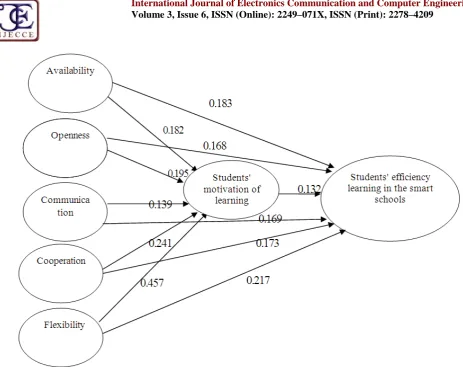
Fig.1. A conceptual framework for analyzing the relationship between, availability, openness, communication, cooperation, flexibility with students' efficiency learning in the virtual school
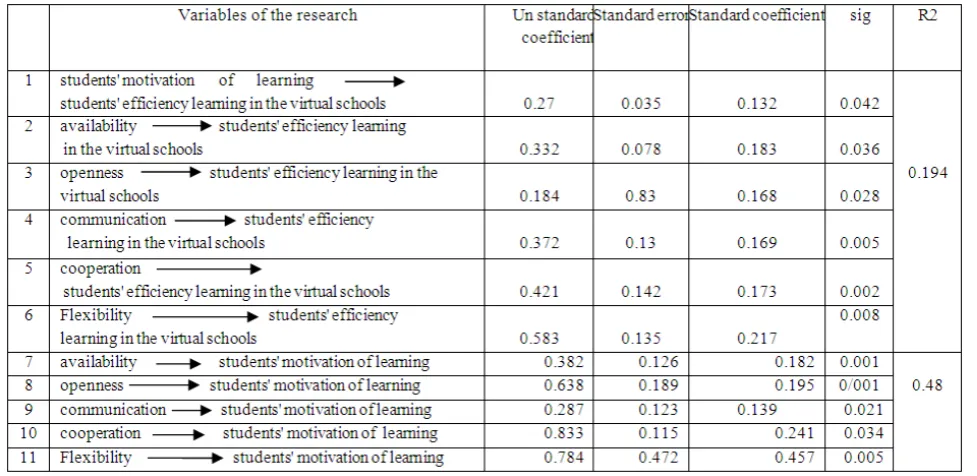
Table 2: Shows the direct effects and indirect effects of variables for final model on students' efficiency learning in the virtual schools
Copyright © 2012 IJECCE, All right reserved the students must consider to availability , cooperation, and
flexibility. One of the biggest advantages of openness is the messiness of the process. It allows for the unexpected good and bad, to pop into a learning scenario. Learning through cooperative teaching method improves students' academic performance and helps them use their own knowledge effectively and slightly remove their learning defects in the first session and learn the subject better. The CFA shows that the measurement model fit the data very well with a goodness of fit index(AGFI) of 0/9 and adjusted goodness of fit index(GFI) of 0/96 and a chi-square ( 203.21) (p<0/001).
R
EFERENCES[1] Blomeyer, Robert, “Virtual Schools and E-Learning in K-12
Environments”, ,2004,Emerging Policy and Practice.
[2] Cavanaugh, Cathy; Gillan, Kathy Jo; Kromrey, Jeff; Hess, Melinda;
and Blomeyer, Robert, “The Effects of Distance Education on K–12 Student Outcomes: A Meta-Analysis”. Naperville, IL: Learning
Point Associates. Retrieved October 18, 2004, from http://www.ncrel.org/tech/distance/k12distance.pdf.
[3] Cattagni, A., & Farris, E, “ Internet access in U.S. public schools and
classrooms: 1994-2000”. (National Center for Education Statistics
Publication No. 2001, Retrieved August 1, 2001, from http://nces.ed.gov/pubsearch/pubsinfo.asp?pubid=2001071 . [4] Rossett, A, “Waking in the night and thinking about e-learning”,
2002, In A. Rossett (Ed.), The ASTD e-learning handbook (pp. 3-18). New York: McGraw-Hill.
[5] Harlak. H, Gemalmaz .Z, A, Gurel. FS, Dereboy. C, Ertekin. K ,
“Communication Skills training: Effects on Attitudes toward
Communication Skills and Emopathic Tendency” , Education for
Healt, Volume 21,Issue 2, 2008.
[6] Gartner, John, “States rethinking virtual school. Wired. Retrieved February “ , 2004, 19, 2009, from
http://www.wired.com/politics/law/news/2004/04/62889.
[7] Marley, P. & Forster, S,” Doyle o.k.’s aid for virtual schools. Milwaukee Journal Sentinel”,Retrieved April 9, 2008, from
http://www.jsonline.com/news/education/29527704.html
[8] Moore, M. (Ed.), “Handbook of distance education” ,2007, (2nd ed.)
Mahwah, NJ: Lawrence Erlbaum.
[9] Mahle,Marlene, ,” Interactivity in Distance Education”, 2007,
Research Liberary.Volum 4,Issue 1.
[10] Wanstreet, C. E,” Interaction in Online Environments”, Quarterly Review of Distance Education, 2006, 7(4),399-411.
[11] Bruck,P. A, , “ Micro learning as Strategic research field: An invitation to collaborate”, (Introductory Note).Micro learning:
Emerging concepts, practices and technologies after e-learning, proceedings of Micro learning, 2005.
[12] Salmon, G , “ E-tivities: the key to active only learning. Sterling”
,VA : Stylus Publishing Inc. 2002.
[13] Norton, P., & Hathaway, D,” Exploring two teacher education online
learning designs: A classroom or one of many?”, Journal of Research
on Technology and Education,2008, 40(4), 475-495.
[14] Maurino,P.S,” Looking for Critical thinking in Online threaded discussion”, Journal of Educational technology system, 2007,35(3).
[15] Hamedikhah, A, “Evaluation of teachers using active teaching methods comparing the results of their academic performance in
elementary science teaching Tehran”, 1998 ,Msc, thesis.
[16] Rauf, A,” Teacher to Teach”, Amirkabir Publication,Tehran, 1999.
[17] Palloff, R. M., & Pratt, K, “Building learning communities in
cyberspace”, 1999, San Francisco: Jossey-Bass.
[18] Collison,G. , Elbaum,B. ,Haavind, S. , & Tinker, R , Facilitating Online Learning: Effective Strategies for moderators, Madison,2000, WI:Atwood.
[19] Mayes,T , “ Learning teaching technology and learning relationship”,
2001, In J. Stephenson(Ed.), teaching and learning online: Pedagogies for new technologies. London, England: Kogan Page. [20] Palloff, R. , Pratt, K, “The Virtual Student: A Profile and guide to