S T U D Y P R O T O C O L
Open Access
Effect of augmenting cholinergic function
on gait and balance
Martina Mancini
1*, Brett W. Fling
1, Anne Gendreau
1, Jodi Lapidus
2, Fay B. Horak
1,3, Kathy Chung
1and John G. Nutt
1Abstract
Background:Impaired mobility and falls are clinically important complications of Parkinson’s disease (PD) and a major detractor from quality of life for which there are limited therapies. Pathological, neuroimaging and clinical evidence suggest that degeneration of cholinergic systems may contribute to impairments of balance and gait in PD. The proposed trial will examine the effects of augmentation of the cholinergic system on balance and gait. Design:The study is a single-site, proof of concept, randomized, double-blind, cross-over trial in patients with PD. Each treatment period will be 6 weeks with a 6-week washout between treatments for a total of 18 weeks for each subject. Donepezil in 2.5 mg capsules or identical appearing placebo capsules will be increased from two per day (5 mg) to four capsules (10 mg) after 3 weeks, if tolerated. Subjects will have idiopathic Parkinson’s disease, Hoehn and Yahr stages 2 to 4. We anticipate recruiting up to 100 subjects for screening to have 54 enrolled and 44 subjects complete both phases of treatment. Dropouts will be replaced. As this is a crossover trial, all subjects will be exposed to both donepezil and to placebo. The primary outcome measures will be the root mean square of the mediolateral sway when standing and the variability of the stride duration when walking for two minutes. Secondary outcomes will be the computerized Attention Network Test to examine three domains of attention and the Short-latency Afferent Inhibition (SAI), a physiological marker obtained with transcranial magnetic stimulation as a putative marker of cholinergic activity.
Discussion:The results of this study will be the most direct test of the hypothesized role of cholinergic neurotransmission in gait and balance. The study is exploratory because we do not know whether donepezil will affect gait, balance or attention, nor which measures of gait, balance or attention will be sensitive to drug manipulation. We hypothesize that change in cholinergic activity, as measured with SAI, will predict the relative effectiveness of donepezil on gait and balance. Our immediate goal is to determine the potential utility of cholinergic manipulation as a strategy for preventing or treating balance and gait dysfunction in PD. The findings of this trial are intended to lead to more sharply focused questions about the role of cholinergic neurotransmission in balance and gait and eventually to Phase II B trials to determine clinical utility of cholinergic manipulation to prevent falls and improve mobility.
Trial registration:This trial is registered at clinical trials.gov (NCT02206620).
Keywords:Parkinson’s disease, Cholinergic system, Gait & balance, Attention
Background
Gait and balance problems occur throughout the course of Parkinson’s disease (PD), appearing within three years of diagnosis [1–3]. In PD, falls result in injuries [4], mortality, death, fear of falling [5] and decreased quality of life [6]. Although levodopa improves some gait pa-rameters [7] levodopa does not improve, and may
worsen, several types of balance control [8]. For ex-ample, postural sway area and sway velocity during quiet stance increase with levodopa in patients with moderate to severe PD [8]. In addition, the size of automatic postural responses to external perturbations decrease with levodopa, which could lead to falls from poor recovery from a slip or trip [9]. In general, as the disease progresses, levodopa is less efficacious for bal-ance and it is assumed that non-dopaminergic sys-tems are impaired later in the disease course [10]. * Correspondence:[email protected]
1Parkinson Center of Oregon, Department of Neurology, Oregon Health & Science University, 3181 S.W. Sam Jackson Park Rd., Portland, OR 97239-3098, USA
Full list of author information is available at the end of the article
Deep Brain Stimulation (DBS) also is generally not ef-fective for reducing falls [11].
Although the dopaminergic system is preferentially affected in PD, there are also changes in the basal forebrain cholinergic complex that provides choliner-gic innervations of the cortex. In addition, the pedun-culopontine nucleus (PPN), part of the midbrain locomotor region (MLR), has a prominent cholinergic projection to the thalamus and it degenerates in PD [12]. PET imaging with [11C]PMP, a substrate for acetylcholinesterase, identifies the integrity of cholin-ergic innervation. Loss of cortical cholincholin-ergic markers in PD representing degeneration of the basal forebrain nuclei is associated with slower gait [13] and impair-ments in working memory, attention and executive function [14]. Loss of thalamic [11C]PMP, represent-ing loss of PPN cholinergic innervation of the thal-amus, is related to falls in PD [15]. In contrast, the extent of dopaminergic denervation of the striatum evaluated by PET imaging was not correlated with falls [15]. Finally, neurotoxin lesioning of the cholin-ergic neurons of the PPN induced gait and postural abnormalities in monkeys [16].
The most direct test of the role of cholinergic systems in balance and gait to date are three small clinical trials [17–19]. In two randomized, double-blind, crossover clinical trial of a cholinesterase inhibitor, donepezil, our group found that donepezil reduced falls in patients with PD [17] and decreased mean sway velocity in the Sensory Organization Test [19]. An open trial with an-other cholinesterase inhibitor, galantamine, also reported decreases in falls and freezing of gait (FoG) [18]. But these small clinical trials are not conclusive.
The effects of manipulation of the cholinergic system could be mediated by at least two general mechanisms, al-tering attention via effects on cortical and subcortical cho-linergic systems or altering balance and gait circuitry via effects on brainstem locomotor cholinergic circuits. In addition to balance and gait measures, short-latency affer-ent inhibition (SAI), a physiological index of caffer-entral cho-linergic function (ref ) will be measured to determine if the deficits in balance and gait correlate with abnormalities of the SAI and if SAI is altered by donepezil as a measure of drug efficacy. Moreover, the attention network test (ANT) will be administered to determine if changes in gait and balance are mediated by changes in attention. This study will be the most direct test of the role of cholinergic sys-tems in gait and balance. We hypothesized that measures of gait and balance will improve in response to cholinergic augmentation with a cholinesterase inhibitor, donepezil.
Methods/Design
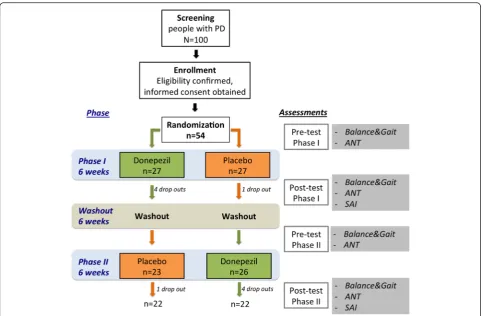
The study is a single-site, proof of concept, randomized, double-blind, cross-over trial in patients with PD. Each
treatment period will be 6 weeks with a 6-week washout between treatments for a total of 18 weeks for each sub-ject. See Fig. 1 for protocol details.
Participants
We anticipate recruiting up to 100 subjects for screening to have 54 enroll and 44 complete both phases of treat-ment. Dropouts will be replaced. As this is a crossover trial, all subjects will be exposed to donepezil and to pla-cebo. Subjects will be 30 years or older, of either sex and any racial or ethnic origin. Women who are capable of child bearing must employ birth control. Pregnant women are not eligible to participate. The subjects will have idiopathic Parkinson’s disease as determined from history and exam and lack of history or physical findings that would suggest another diagnosis or a parkinsonism-plus syndrome.
Subjects may be Hoehn and Yahr stages II to IV. Subjects must be able to stand unassisted for a minute and to walk continuously for 2 min without assistance or assistive devices. The subjects must have a Montreal Cognitive Assessment (MOCA) of 23 or above and be judged to be able to appreciate the purpose of the re-search, give informed consent to participate, be able to cooperate with the testing and be compliant with taking the experimental medications.
Exclusion criteria include: significant tremor which would interfere with recording balance and walking; other factors affecting gait such as musculoskeletal dis-orders (particularly symptomatic hip, knee and lumbar osteoarthritis), uncorrected vision disturbance, vestibular problems or any other health problem judged to inter-fere with participation. Major depression, hallucinations or other psychiatric disturbances will be exclusions. Medical problems that might be worsened by donepezil are exclusion criteria and include tachycardia, bradycar-dia, arrhythmias, and peptic ulcer disease. Finally, use of anticholinergics for parkinsonism, bladder antispas-modics for urinary urgency or tricyclic antidepressants for depression are contraindications as is concurrent use of cholinesterase inhibitors for cognitive problems.
Intervention
captured at baseline (Fig. 1) and will undergo the SAI testing. The subjects will then enter the 6-week washout period. Although the subjects will be on no experimental medications, they will continue to be called weekly to inquire about side-effects, problems and falls. This is partly done to keep the subject involved in the protocol, as well as to collect data about falls. At the conclusion of the 6 weeks, the subjects will return to the clinic for repeat testing and to have medications dispensed for the final 6-week phase of the protocol. The final 6-week phase will be conducted exactly as was the first 6-week phase with repeat testing at the end of the 6 weeks.
Cholinesterase inhibitors, such as donepezil, are stand-ard of care for patients with PD who have cognitive im-pairments [20]. We chose donepezil, an FDA approved drug, because it is possible to create a placebo for the donepezil tablet and it requires only once a day dosing. It is recommended to start donepezil at 5 mg per day to reduce adverse effects on the gastrointestinal system. We will increase the dose to 10 mg/day after 3 weeks, if tolerated, because that is the schedule used in our pilot study and this titration was well tolerated [17]. Donepe-zil has a half-life of 70 h and it requires approximately 15 days to reach steady state. The maximum effects on cognitive measures occur within 3 weeks and loss of
effect requires more than 3 weeks and less than 6 weeks. In our pilot study, there were more falls at 3 weeks and 5 mg/day of donepezil than at 6 weeks and 10 mg/day of donepezil and 10 mg was more effective than 5 mg on cognitive measures in PD [20]. Washout between phases will be 6 weeks to minimize carry-over of effects.
Randomization and blinding
The Research Pharmacy at OHSU will be responsible for purchasing study medication and creating blinded cap-sules for each subject, maintaining and storing drug, randomizing to maintain blinding, dispensing medica-tion, and checking compliance by returned capsule count.
Sample size
sway velocity during donepezil treatment intervals de-creased 2.35 units on average, while those on placebo in-creased 5.38 units, with a common standard deviation estimate of 9. We set power at 0.80 and level of signifi-cance at 0.025 rather than 0.05 since there are two pri-mary endpoints (to control for multiple comparisons). Additionally, we assume no period effects will be ob-served in the crossover design (that is, we do not an-ticipate the order that patients receive treatment will affect the outcomes). Calculations were conducted using SAS v9.3 PROC POWER. Under these assump-tions, a two-sided hypothesis test comparing sway vel-ocity between donezepil and placebo would require 44 patients with complete outcome data. However, we anticipate that some patients may drop out of the study while on active treatment due to side-effects. Thus, we intend to recruit and enroll 54 patients to allow for up to 20 % drop out.
Assessment procedures
Subjects will have been off medications overnight (at least 12 h washout). We will study the subjects when they have been without drug overnight and are“off,” be-cause we have shown that sway while standing still is sensitive to dyskinesia when the subjects are “on” [21]. Further, some of the measures of standing and walking are sensitive to levodopa [8] and we wish to examine the effects of cholinergic manipulation without interference from other drugs as much as possible.
Parkinsonism and general cognition will be docu-mented with the MDS Unified Parkinson’s Disease Rat-ing Scale (MDS-UPDRS) and the Montreal Cognitive Assessment (MOCA) [22–24]. Subjects will also have the Activities of Balance Confidence (ABC) [25] as a measure of mobility limitation and the Parkinson’s Dis-ease Questionnaire (PDQ-39) [26] as a measure of health-related quality of life.
Primary outcome measures
Balance and gait kinematic performance will be recorded by small, body-worn, inertial sensors, Opals by APDM. The Opals consist of wireless, synchronized, triaxial ac-celerometers and gyroscopes that record body motion at 128 Hz. The sensors will be applied bilaterally to the feet and wrists as well as to the sternum and pelvis with Vel-cro straps. Inertial data is wirelessly transmitted with radio signals to a laptop that controls the protocol, al-lows comment on individual trials, automatically calcu-late some balance and gait metrics (Mobility Lab software, www.apdm.com) and store raw data for further analysis in Matlab.
To characterize postural sway, subjects will stand with feet together with hands at their hips looking straight-ahead at a fixed point in 4 different conditions: 1) eyes
opened, 2) eyes closed, 3) eyes open standing on foam pad, 4) eyes closed standing on foam pad.
To characterize gait, subjects will be instructed to walk at their comfortable pace down a 20-m long hallway, turn around at each end and continue walking back and forth. The 180° turns are automatically detected and an-alyzed separately by Mobility Lab. Subjects will be instructed to walk continuously at their natural pace without talking or looking around. The 2-min walk will provide the gait variability measurements.
Subjects will also perform three more balance and gait trials with a cognitive, dual task paradigm, which consist of counting backwards by 3’s. Subjects will first be pre-sented with the task in sitting to make sure they under-stand the instructions and record a baseline for 1 min. Subsequently, subjects will perform the gait and balance task with and without the dual task. The conditions re-peated with dual task are standing with eyes opened on firm surface and foam pad, as well as walking up and down the hallway for 1 min. This will allow calculating the dual-task costs on balance and walking [(dual-task balance or gait performance minus single-task perform-ance)/single task performance*100] as well as the cost of performance of the dual task [(dual-task counting–single task counting)/single task counting*100].
The primary measure of balancewill be medial-lateral postural sway range during quiet stance because: 1) it is a predictor of future fall risk in subjects with PD, 2) it changes significantly with exercise and 3) it predicts falls in elderly subjects. In addition to medial-lateral sway range, we will examine other measures that may reflect changes in the postural motor control loop including: total sway amplitude (measured as root mean square eg; variability around the mean position) and jerkiness of sway (measured by differentiating the acceleration values of sway).
The primary measure of gait stability will be the coefficient variability of stride duration (time) during a 2-min walk, as a surrogate for fall risk based on the lit-erature [27]. Secondary gait outcome measures include the following metrics and their coefficients of variability: stride length, cadence, double support time, arm swing amplitude, and mean trunk rotation. In addition, to de-termine the interaction between attention and gait, we will measure the change in lateral sway velocity and the percent change in the variability of stride duration dur-ing dual-tasks versus sdur-ingle tasks (ie; dual-task cost).
Secondary outcome measures
Attention Network Test (ANT)
alerting, orienting, and executive control networks in-volved in attention [28, 29].
Short-latency afferent inhibition (SAI)
SAI will be performed using a modified version of proto-col described previously in literature [30, 31]. Surface EMGs from the first dorsal interosseous muscle of the most involved arm will record motor evoked potentials (MEPs) from contralateral motor cortex transcranial magnetic stimulation (TMS). We will measure SAI by applying peripheral conditioning stimuli (electrical stimulation of the median nerve at the wrist) followed by central test stimuli (TMS of motor cortex). The in-tensity of the conditioning peripheral stimuli will be set at the value that evokes a twitch of the abductor pollicis brevis muscle. TMS will be performed using a figure-eight stimulating coil (external loop diameter = 9 cm) powered from a Magstim 200 magnetic stimulator. We will determine the resting motor threshold, which is de-fined as the lowest stimulus intensity capable of eliciting at least five MEPs with an amplitude of 50μV or higher in 10 consecutive trials. All subsequent trials to evoke SAI will utilize an intensity of 120 % of resting motor threshold. The peripheral conditioning stimuli will pre-cede the cortical TMS at 6 different interstimulus inter-vals (ISIs). We will determine the ISIs based on the latency of the N20 component of the somatosensory evoked potential (SSEP). To determine the N20 latency of the median nerve, we will attach the active and refer-ence electrodes 3 cm behind C3 and C4 respectively (10–20 system). SAI will be randomly tested at 6 differ-ent interstimulus intervals, with a minimum of 10 trials at each interstimulus interval (from N20 in 1-ms incre-ments until N20 + 5 ms), with 20 unconditioned (test) stimuli also delivered randomly The peak-to-peak ampli-tude of the conditioned motor evoked potentials at teach interstimulus interval will be averaged and expressed as a percentage of the averaged unconditioned motor evoked potential (baseline). To reduce variability, the conditioned responses will be combined across all inter-stimulus intervals and be expressed as the percentage of the unconditioned MEP as described by others [32, 33]. SAI requires no background EMG activity in the target muscles so visual feedback of the background EMG will be used.
Statistical analysis
Our statistical hypothesis is that the change in outcomes between the week 0 and week 6 of the donepezil and placebo phases will differ. Specifically, we will test the hypotheses that augmenting cholinergic neurotransmis-sion will improve sway and gait dual-tasking; attention and SAI will be secondary endpoints. We anticipate the clinical measures of PD severity (MDS-UDPRS), quality
of life (PDQ-39) and balance confidence (ABC) will be less sensitive to drug effects but will examine them as well.
A linear mixed model will be used to analyze out-comes resulting from the crossover design with repeated measures (pre/post for each treatment). The model will include treatment effects, terms to assess period or car-ryover effects (which are not anticipated, but will be assessed and controlled for), and random effects for pa-tients within treatments. The observations on each sub-ject will be measures obtained at week 0 and 6 under the different treatment conditions (donepezil/placebo). Since in a typical experiment using repeated measures, two measurements taken at adjacent times may be more highly correlated than two measurements taken further apart, we will use Bayesian Information Criterion (BIC) to explore optimal covariance structure for the model. The main focus of the study is to determine whether the two treatments exhibit differential change over time, (i.e. time by treatment interaction effect). In crossover de-signs, missing data have much greater influence on the analysis than they would in a parallel-groups design es-pecially when missing data are not at random, such as drop-outs due to the adverse effects of treatments. We have conservatively estimated sample size required for the trial assuming some patients drop out during the donepezil phase. Our primary analytic strategy will em-ploy an intent-to-treat (ITT) approach, whereby all ran-domized patients are included in analyses, even if they drop out before completing both treatment phases. However, we will assess and report the impact of drop-out by a) comparing demographic and clinical character-istics of those that dropout to those that complete, and b) re-analyzing outcomes models to only those that complete the trial.
Discussion
Competing interests
OHSU and Dr. Horak have a significant financial interest in APDM, a company that may have a commercial interest in the results of this research and technology. This potential institutional and individual conflict has been reviewed and managed by OHSU. No other authors have a competing interest.
Authors’contributions
MM participated in design of study, development of the mobility aspect of the study, and drafting of manuscript, BWF participated in design regarding SAI aspect of study, editing of manuscript, AG is coordinating the study, editing of manuscript, JL participated in design of study (statistical design), editing of manuscript, FBH participated in design of study, editing of manuscript, KC JN participated in study design, helping medical management and provided expertise on inclusion and exclusion, edited manuscript, JGN conceived of the study, participated in design of study, editing of manuscript. All authors read and approved the manuscript.
Acknowledgments
We thank Andy Fraser for helping in setting up the study. This study is funded by the Michael J. Fox Foundation (PI Dr. Nutt).
Author details
1Parkinson Center of Oregon, Department of Neurology, Oregon Health & Science University, 3181 S.W. Sam Jackson Park Rd., Portland, OR 97239-3098, USA.2Biostatistical Research Program, OHSU, Portland, OR, USA.3Veterans Affairs Portland Health Care System, Portland, OR, USA.
Received: 11 November 2015 Accepted: 15 December 2015
References
1. Kang GA, Bronstein JM, Masterman DL, Redelings M, Crum JA, Ritz B. Clinical characteristics in early Parkinson’s disease in a central California population-based study. Mov Disord. 2005;20:1133–42.
2. Pickering RM, Grimbergen YA, Rigney U, Ashburn A, Mazibrada G, Wood B, et al. A meta-analysis of six prospective studies of falling in Parkinson’s disease. Mov Disord. 2007;22:1892–900.
3. Wood BH, Bilclough JA, Bowron A, Walker RW. Incidence and prediction of falls in Parkinson’s disease: a prospective multidisciplinary study. J Neurol Neurosurg Psychiatry. 2002;72:721–5.
4. Johnell O, Melton 3rd LJ, Atkinson EJ, O’Fallon WM, Kurland LT. Fracture risk in patients with parkinsonism: a population-based study in Olmsted County, Minnesota. Age Ageing. 1992;21:32–8.
5. Adkin AL, Frank JS, Jog MS. Fear of falling and postural control in Parkinson’s disease. Mov Disord. 2003;18:496–502.
6. Muslimovic D, Post B, Speelman JD, Schmand B, de Haan RJ, Group CS. Determinants of disability and quality of life in mild to moderate Parkinson disease. Neurology. 2008;70:2241–7.
7. Bryant MS, Rintala DH, Hou JG, Charness AL, Fernandez AL, Collins RL, et al. Gait variability in Parkinson’s disease: influence of walking speed and dopaminergic treatment. Neurol Res. 2011;33:959–64.
8. Curtze C, Nutt JG, Carlson-Kuhta P, Mancini M, Horak FB. Levodopa is a double-edged sword for balance and gait in people with Parkinson’s disease. Mov Disord. 2015;30:1361–70.
9. Horak FB, Nutt JG, Nashner LM. Postural inflexibility in parkinsonian subjects. J Neurol Sci. 1992;111:46–58.
10. Lord S, Baker K, Nieuwboer A, Burn D, Rochester L. Gait variability in Parkinson’s disease: an indicator of non-dopaminergic contributors to gait dysfunction? J Neurol. 2011;258:566–72.
11. St George RJ, Nutt JG, Burchiel KJ, Horak FB. A meta-regression of the long-term effects of deep brain stimulation on balance and gait in PD. Neurology. 2010;75:1292–9.
12. Rinne JO, Ma SY, Lee MS, Collan Y, Roytta M. Loss of cholinergic neurons in the pedunculopontine nucleus in Parkinson’s disease is related to disability of the patients. Parkinsonism Relat Disord. 2008;14:553–7.
13. Bohnen NI, Frey KA, Studenski S, Kotagal V, Koeppe RA, Scott PJ, et al. Gait speed in Parkinson disease correlates with cholinergic degeneration. Neurology. 2013;81:1611–6.
14. Bohnen NI, Kaufer DI, Hendrickson R, Ivanco LS, Lopresti BJ, Constantine GM, et al. Cognitive correlates of cortical cholinergic denervation in Parkinson’s disease and parkinsonian dementia. J Neurol. 2006;253:242–7. 15. Bohnen NI, Muller ML, Koeppe RA, Studenski SA, Kilbourn MA, Frey KA, et al.
History of falls in Parkinson disease is associated with reduced cholinergic activity. Neurology. 2009;73:1670–6.
16. Karachi C, Grabli D, Bernard FA, Tande D, Wattiez N, Belaid H, et al. Cholinergic mesencephalic neurons are involved in gait and postural disorders in Parkinson disease. J Clin Invest. 2010;120:2745–54. 17. Chung KA, Lobb BM, Nutt JG, Horak FB. Effects of a central cholinesterase
inhibitor on reducing falls in Parkinson disease. Neurology. 2010;75:1263–9. 18. Litvinenko IV, Odinak MM, Mogil’naya VI, Emelin AY. Efficacy and safety of
galantamine (reminyl) for dementia in patients with Parkinson’s disease (an open controlled trial). Neurosci Behav Physiol. 2008;38:937–45.
19. HIller AP, Nutt JG, Mancini M, Horak FB, Kareus S, Schoneburg BM, et al. Are cholinesterase inhibitors effective in improving balance in Parkinson’s disease? J Neurol Disord. 2015; In press
20. Dubois B, Tolosa E, Katzenschlager R, Emre M, Lees AJ, Schumann G, et al. Donepezil in Parkinson’s disease dementia: a randomized, double-blind efficacy and safety study. Mov Disord. 2012;27:1230–8.
21. Chung KA, Lobb BM, Nutt JG, McNames J, Horak F. Objective measurement of dyskinesia in Parkinson’s disease using a force plate. Mov Disord. 2010;25: 602–8.
22. Chou KL, Amick MM, Brandt J, Camicioli R, Frei K, Gitelman D, et al. A recommended scale for cognitive screening in clinical trials of Parkinson’s disease. Mov Disord. 2010;25:2501–7.
23. Goetz CG, Tilley BC, Shaftman SR, Stebbins GT, Fahn S, Martinez-Martin P, et al. Movement Disorder Society-sponsored revision of the Unified Parkinson’s Disease Rating Scale (MDS-UPDRS): scale presentation and clinimetric testing results. Mov Disord. 2008;23:2129–70.
24. Nasreddine ZS, Phillips NA, Bedirian V, Charbonneau S, Whitehead V, Collin I, et al. The Montreal Cognitive Assessment, MoCA: a brief screening tool for mild cognitive impairment. J Am Geriatr Soc. 2005;53:695–9.
25. Powell LE, Myers AM. The Activities-specific Balance Confidence (ABC) Scale. J Gerontol A Biol Sci Med Sci. 1995;50A:M28–34.
26. Jenkinson C, Fitzpatrick R, Peto V, Greenhall R, Hyman N. The Parkinson’s Disease Questionnaire (PDQ-39): development and validation of a Parkinson’s disease summary index score. Age Ageing. 1997;26:353–7. 27. Hausdorff JM. Gait variability: methods, modeling and meaning. J Neuroeng
Rehabil. 2005;2:19.
28. Fan J, Gu X, Guise KG, Liu X, Fossella J, Wang H, et al. Testing the behavioral interaction and integration of attentional networks. Brain Cogn. 2009;70: 209–20.
29. Fan J, McCandliss BD, Fossella J, Flombaum JI, Posner MI. The activation of attentional networks. Neuroimage. 2005;26:471–9.
30. Tokimura H, Di Lazzaro V, Tokimura Y, Oliviero A, Profice P, Insola A, et al. Short latency inhibition of human hand motor cortex by somatosensory input from the hand. J Physiol. 2000;523(Pt 2):503–13.
31. Rochester L, Yarnall AJ, Baker MR, David RV, Lord S, Galna B, et al. Cholinergic dysfunction contributes to gait disturbance in early Parkinson’s disease. Brain. 2012;135:2779–88.
32. Di Lazzaro V, Oliviero A, Profice P, Pennisi MA, Di Giovanni S, Zito G, et al. Muscarinic receptor blockade has differential effects on the excitability of intracortical circuits in the human motor cortex. Exp Brain Res. 2000;135: 455–61.