Original Research Article
Changes in Enzymatic Activities during Biodegradation Process of Leaf
Residues
of
Tectona grandis
Shweta Yadav*
Department of Zoology, Dr. H. S. Gour Vishwavidyalaya (A Central University), Sagar, Madhya
Pradesh, India
*Corresponding author.
A b s t r a c t
K e y w o r d s
Of late, compost in organic farming has become an accepted practice in agriculture ecosystem because of energy shortage, food safety and environmental concern arising due to indiscrimination use of inorganic fertilizers in conventional farming. In our country enormous amount of leaf residue are produced which can be effectively converted to good quality compost manure. Organic manures are by and large bulky in nature and low in plant nutrients. Their nutrient value can be enhanced by addition of additives like rock phosphates and microbial cultures through cow dung slurry. The present study demonstrated use of 10% rock phosphate with cow dung slurry enhanced enzymatic activity in bioconversion process of Tectona grandis leaf residue.
Bioconversion
Cellulase activity
Compost
Dehydrogenase
Phosphatase
Tectona grandis
Introduction
In recent years, there has been renewed emphasis on the integrated dose of chemical fertilizers and organic manures in order to sustain high yields, maintain chemical, physical and microbiological properties of soils and efficient utilization of all available sources of nutrients. Organic manures were the main source of replenishing soil fertility in India until the 1950’s when chemical fertilizers began to gain popularity. The adoption of high yielding varieties of crops during 1960’s brought greater use of chemical fertilizers to meet the higher nutrient needs of crops. Because of chemical fertilizers, unlike organic manures are less bulky and thus easier and cheaper to transport and produced much greater crop response, the use of
organic measures in field crops lost popularity due to is bulk and low nutrient contents. With increasing productivity of crops there is an increased nutrient removal from the soil. This continuous mining has to be replenished to sustain crop productivity. Presently there is a gap between the nutrient removal and addition through the fertilizer in the country is about 10 million tones. The deficit of 10 million tones have to be partially bridged through the increased use of organic manures as a source of plant nutrients due to neither decreasing nor renewable resources and increasing energy cost involving through the manufacture of inorganic fertilizers. India has the potential of 356 tonnes of crop residue production of which half is
International Journal of Current Research in
Biosciences and Plant Biology
ISSN:
2349-8080
Volume 2 Number 2 (February-2015) pp. 79-83
available for soil incorporation and rest is used as food and fodder for cattle and other purpose. All the nutrients in crop residues are not available to the crops for which the residues are incorporated to soil and sometimes residues also have residual effect. The practice of direct incorporation besides its benefits has its own limitations. It may cause delay in sowing of the immediate next crops, immobilization of soil nitrogen and injurious effects of the produced organic acids. Composting of the organic residues before its application to the soil may be an efficient method for recycling not only the agricultural wastes but also the urban wastes. A diverse kind of organic waste/residues can be easily handled through eco-friendly microbial system of composting. Decomposition of soil incorporated residue is essential for better quality of organic manure, not only by way of crop nutrition but also in terms of health of soil as suggested by Manna et al. (2000).With this concept the leaf residue of Teak plant (Tectona grandis) were subjected to composting independently and with rock phosphates. As India have deposits of about 200 millions rock phosphates and due to of low grade it cannot be used for super phosphate manufacture. It can be effectively and directly used in acid soils and for crops such as wet land rice, sugarcane, coffee and legumes (Panda, 1980) and its efficiency can be increased for alkaline soils by addition to decomposing organic materials (Mishra et al., 1982; Tomar et al., 1983; Khanna et al., 1984).
Materials and methods
Fortified leaf residues of teak plant (LT, Tectona grandis) were chosen for studying their biodegradation process. Dried leaves were crushed and kept in high density, small holed (aeration required for metabolizing reactions of
microorganisms) polythene bags for 90 days. Eight treatments of leaf residues of teak plant with rock phosphate and cow dung in different combinations (LT + 5% Rock Phosphate; LT + 10% Rock Phosphate; LT + 15% Rock Phosphate; LT + 20% Rock Phosphate; LT + 5% Rock Phosphate+ 10% Cow dung; LT + 10% Rock Phosphate+ 10% Cow dung; LT + 15% Rock Phosphate+ 10% Cow dung; LT + 15% Rock Phosphate+ 10% Cow dung) were studied. Enzymatic activities viz., cellulase, dehydrogenase and alkaline phosphatase were measured following Mandels et al. (1976); Casida et al. (1964) and Tabatabai and Bremner (1969) at 30, 60 and 90 days of biodegradation process. Results are the means of three replicates. Two-way analysis of variance (ANOVA) was performed by using the SPSS 10.5 software. The objective of statistical analysis was to determine any significant differences among the parameters analyzed in different treatments during the biodegradation process.
Results and discussion
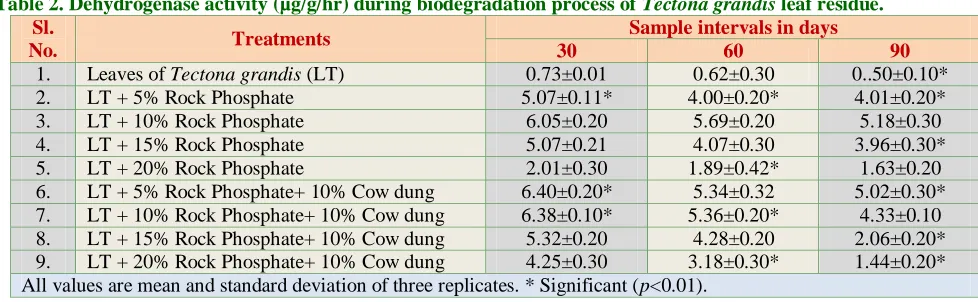
Enzymatic activities (Cellulase, dehydrogenase and alkaline phosphatase activities) at diffident intervals of biodegradation process of teak (Tectona grandis) leaf residues are presented in Tables 1, 2 and 3. It is evident that maximum cellulase (1.40±0.02 IU/ml) activity was recorded in degradation process of teak leaves with fortified with + 5% Rock Phosphate and 10% Cow dung at 30 days (Table 1) at the same time dehydrogenase activity (Table 2) was also recorded significantly high, 6.38±0.20 µg/g/hr. Addition of rock phosphate more than 10% suppresses the cellulase and dehydrogenase activity of degradation process. Activity of dehydrogenase reaches at highest peak with fortified substrate (LT + 5% rock phosphate + 10% cow dung) at 30 days of biodegradation process.
Table 1. Cellulase activity (IU/ml) during biodegradation process of Tectona grandis leaf residue.
Sl.
No. Treatments
Sample intervals in days
30 60 90
1. Leaves of Tectona grandis (LT) 0.23±0.01* 0.16±0.01 0.12±0.01
2. LT + 5% Rock Phosphate 1.07±0.04 1.00±0.21 1.01±0.11*
3. LT + 10% Rock Phosphate 1.05±0.02* 1.00±0.21* 0.95±0.10
4. LT + 15% Rock Phosphate 1.07±0.11 1.07±0.31* 0.96±0.20*
5. LT + 20% Rock Phosphate 1.00±0.04 0.89±0.20 0.83±0.10*
6. LT + 5% Rock Phosphate+ 10% Cow dung 1.40±0.02* 1.34±0.21* 1.31±0.11
7. LT + 10% Rock Phosphate+ 10% Cow dung 1.38±0.03* 1.36±0.30* 1.33±0.20*
8. LT + 15% Rock Phosphate+ 10% Cow dung 1.32±0.21 1.28±0.21 1.06±0.10*
9. LT + 20% Rock Phosphate+ 10% Cow dung 1.25±0.11 1.18±0.21 1.04±0.11
Table 2. Dehydrogenase activity (µg/g/hr) during biodegradation process of Tectona grandis leaf residue.
Sl.
No. Treatments
Sample intervals in days
30 60 90
1. Leaves of Tectona grandis (LT) 0.73±0.01 0.62±0.30 0..50±0.10*
2. LT + 5% Rock Phosphate 5.07±0.11* 4.00±0.20* 4.01±0.20*
3. LT + 10% Rock Phosphate 6.05±0.20 5.69±0.20 5.18±0.30
4. LT + 15% Rock Phosphate 5.07±0.21 4.07±0.30 3.96±0.30*
5. LT + 20% Rock Phosphate 2.01±0.30 1.89±0.42* 1.63±0.20
6. LT + 5% Rock Phosphate+ 10% Cow dung 6.40±0.20* 5.34±0.32 5.02±0.30*
7. LT + 10% Rock Phosphate+ 10% Cow dung 6.38±0.10* 5.36±0.20* 4.33±0.10
8. LT + 15% Rock Phosphate+ 10% Cow dung 5.32±0.20 4.28±0.20 2.06±0.20*
9. LT + 20% Rock Phosphate+ 10% Cow dung 4.25±0.30 3.18±0.30* 1.44±0.20*
All values are mean and standard deviation of three replicates. * Significant (p<0.01).
Table 3. Alkaline phosphatase activity (µmole of PNP released/g/hr) during biodegradation process of Tectona
grandis leaf residue.
Sl.
No. Treatments
Sample intervals in days
30 60 90
1. Leaves of Tectona grandis (LT) 0.71±0.10 0.62±0.40 0.58±0.25
2. LT + 5% Rock Phosphate 3.07±0.25* 3.00±0.35* 2.01±0.25*
3. LT + 10% Rock Phosphate 3.05±0.20* 3.19±0.25* 2.18±0.20*
4. LT + 15% Rock Phosphate 5.07±0.25 4.07±0.35 4.96±0.20*
5. LT + 20% Rock Phosphate 6.61±0.20* 5.89±0.40 4.63±0.25
6. LT + 5% Rock Phosphate+ 10% Cow dung 4.40±0.35 4.34±0.50* 3.12±0.20
7. LS + 10% Rock Phosphate+ 10% Cow dung 5.38±0.20* 5.16±0.90 4.23±0.30*
8. LS + 15% Rock Phosphate+ 10% Cow dung 6.32±0.20 4.88±0.20* 4.06±0.50*
9. LS + 20% Rock Phosphate+ 10% Cow dung 6.28±0.25 4.68±0.35 4.44±0.60*
All values are mean and standard deviation of three replicates. * Significant (p<0.01).
It is significant to evaluate the dehydrogenase activity of degradation process of organic compound as biological oxidation of organic compounds is generally a dehydration process. Although dehydrogenase activity doesn’t consistently correlate with number of organisms in soil or with CO2 evolution in soil it has been used as an indicator for the activity of microorganisms during the composting process as suggested by Ladd (1978) and Tate (1995). On the contrary strong relations were reported between dehydrogenase activity versus total organic carbon and pH by Bolton et al. (1985) and Cochran et al. (1989). Spalding (1977) recorded correlation between CO2 evolution and cellulase activity and humification in decomposition of coniferous leaf litter. Linkins et al. (1990) observed highest cellulase activity during 1st, 2nd and 3rd week of decomposition process as colonization of cellulolytic microorganisms occurs rapidly in spite of high concentration of soluble sugars and phenolics in the litters. Fang et al. (1988) with coal flash and lagoon ash amended with sludge compost on the dehydrogenase activity showed that no suppressing activity was found which indicates that biological activity would be same for all
phosphatase respectively in which thermal stability was recorded higher Roj et al. (1990) in alkaline phosphatase. Skujins (1976) suggested the use of phosphatase activity to estimate general microbial activity in soil that is based on microbial need for phosphorous and also the process of making phosphorous available for plant use (Neill and Reichle, 1980). Tarafdar and Junk (1987) observed a significant correlation between depletion of organic phosphorous and phosphatase activity in rhizosphere soil of wheat. It is known that soil fungi and bacteria can convert organic phosphorous into available phosphorous through the action of phosphatase activity (Casida, 1959). Similarly, Torriani (1968) and Inghan and Klein (1984) were found to produce alkaline phosphatase which degrades complex organic phosphorous compounds and releases orthophosphate in soil. Abbot and Tucker (1973) suggested organic forms of phosphorous are mineralized slowly and made available to plants and, considered compost and other organic manures as good source of phosphorous. The results of enzymatic activities showed that cellulase, dehydrogenase and phosphatase activities was maximum during the initial phase of degradation process and eventually declined after 30 days of decomposition.
Acknowledgment
Author acknowledges the financial support of University Grants Commission, New Delhi to carry out present study.
References
Abbot, J. T., Tucker, T. C., 1973. Persiatance of manure phosphorous availability in calacareous soil. Soil Sci. Am. Proc. 37, 60-63.
Abd-el-Malek , Y., Monib, M., Rizk, S. G., Shehata, S. M., 1976. Biological activities during ripening of compost. Zentraibl Backteriol Parasitenki infe Khonskar Hyg Abt. 13, 744-750.
Bolton, H., Eliot, L. F., Papendick, R. I., Bezdicek, D. F., 1985. Soil microbial biomass and selected soil enzymes: effects of fertilization and cropping practices. Soil. Biol. Biochem. 17, 297-302.
Casida, L. E., 1959. Phosphatase activity of some common soil fungi. Soil Sci. 87, 305-510.
Casida, L. E., Klein, D.A., Santoro, T., 1964. Soil dehydrogenase activity. Soil Sci. 98, 371-376. Cochran, V. L., Elliot, L. F., Lewis, C. E., 1989.
Soil microbial biomass and enzyme activity in subantic agricultural and forest soils. Biol. Fert. Soils. 7, 283-288.
Fang, M., Wong, J. W. C., Li, G. X., Wong, M. H., 1998. Changes in biological parameters during co-composting of sewage sludge and coal ash residues. Bioresour. Technol. 64, 55-61.
Goyal, S. L., Mishra, M. M., 1983.The phosphatse activity and release of phosphorous during composting with fungal inoculants and in the presence of phosphate. Agr. Waste. 7, 51-59. Inghan, E. R., Klein, D. A., 1984. Phosphatase
activity of Penicillium citrinum submerged batch cultures and its relationship to fungal activity. Plant Soil. 81, 61-68.
Khanna, S. S., Chaudhary, M. L., Bathla, R. N., 1979. Influence of moisture, FYM and pyrites on the solubilisation of the rock phosphate in calcareous soils of Haryana. Int. Soil Sci. 12, 545-549.
Ladd, J. N., 1978. Origin and range of enzymes in soil. In: Soil Enzymes. Academic Press, New York. pp.51-96.
Linkins, A. E., Sinsabaugh, R. L., McClaugherty, C. A., Melills, J. M., 1990. Cellulase activity on decomposing leaf litter in monsoons. Plant Soil. 123, 17-25.
Linkins, A. E., Sinsabaugh, R. L., 1990. Comparison of cellulase activity on decomposing leaves in hardwood forest and woodland stream. Soil Biol. Biochem. 22, 423-425.
Mandels, M., Hontz, L., Ystrom, J., 1976. Enzymatic hydrolysis of waste cellulose. Biotechnol. Bioeng. 14, 1471-1493.
Manna, M. C., Ganguly, T. K., Gosh, B. N., Singh, K. N., 2000. Effect of microbial enriched phosphocompost and inorganic fertilizer on yield, uptake of nutrients and quality of soil under soybean wheat crop rotation. In: International Conference on Managing Natural Resources February 14-18, New Delhi. pp.696-697.
Mishra, M. M., Kapoor, K. K., Yadav, K. S., 1982. Effect of compost enriched with Mussoorie rock phosphate on crop yield. Int. J. Apr. Sci. 52, 674-678.
(Ed.: Waring, R.H.). Oregon State Univ. Press, Corvallis.
Panda, M., 1980. Direct application of rock phosphate to soils. Indian Experience presented at the FAI Seminar on Fertilizers in India in Eighties, New Delhi.
Roj, M. J., Carcedo, S. G., Mateos, M. P., 1990. Distribution and characterization of phosphatase and organic phosphorous in soil fractions. Soil Biol. Biochem. 22, 169-174.
Skujins, J. J., 1976. Extracellular enzymes in soil. Crit. Rev. Microbiol. 6, 383-421.
Spalding, B. P., 1977. Enzymatic activities related to decomposition of coniferous leaf litter. Soil Sci. Am. J. 41, 621-627.
Tabatabai, M. A., Bremner, J. M., 1969. Use of p-nitrophenyl phosphate for assay of soil phosphatise activity. Soil Biol. Biochem. 1, 301-307.
Tarafdar, J. C., Junk, A., 1987. Phosphatase activity in the rhizosphere and its relation to the depletion of soil organic phosphorous. Biol. Fert. Soils 3, 199-204.
Tate, R. L., 1995. Soil enzymes as indicators of ecosystem status. In: Soil Microbiology. John Wiley, Chichester. pp.123-146.
Tomar, N. K., Khanna, S. S., Gupta, A. P., 1983. Evaluation of Mussoorie rock phosphate digested manure in wheat. Ind. J. Agr. Chem. 15, 330-336.
Torriani, A., 1968. Alkaline phosphatase of E. coli. Methods Enzymol. 128, 212-213.