International Journal of Emerging Technology and Advanced Engineering
Website: www.ijetae.com (ISSN 2250-2459,ISO 9001:2008 Certified Journal, Volume 4, Issue 6, June 2014)
1
500 kV Single Phase Reclosing Evaluation Using Simplified
Arc Model
Kanchit Ngamsanroaj
1, Suttichai Premrudeepreechacharn
2, Neville R. Watson
31,2
Department of Electrical Engineering, Faculty of Engineering, Chiang Mai University, Chiang Mai 5200, Thailand
3Department of Electrical and Computer Engineering, College of Engineering, University of Canterbury, Christchurch 8140,
New Zealand
Abstract— The interaction between a fault arc and power system has a big influence on the successful reclosing of a faulted system and hence evaluation of this interaction is very important. This paper mainly focuses on a proposed technique of simplified arc model for evaluation of single phase reclosing scheme for extra high voltage transmission system. Both primary and secondary arcs behavior have been simplified and implemented in a custom PSCAD/EMTDC model as a time-varying resistance. The successful single-phase reclosing is investigated by conducting fault clearing and reclosing cases utilizing the simplified arc model. The illustrative cases are presented in order to determine approximately the maximum arc duration that may be expected. To improve the scheme, the shorten pre-set dead time is investigated. The proposed simplified arc model has been used to evaluate the studied existing EHV transmission system for single phase reclosing. By making the pessimistic assumptions with respect to still air conditions, the more severe conditions derived from the studied system were simulated to determine the longest likely extinction times.
Keywords—Single phase reclosing; Secondary arc current;
Arc model; ElectroMagnetic Transients Program.
I. INTRODUCTION
More than 90 % of all line faults are single phase to ground type and most of these are transitory. For these faults, phase-to-ground faults have received the most attention in system studies. The fault arc will be quenched and the fault path dielectric will completely restore during the dead time of the breaker, usually 25 – 30 cycles (0.5 – 0.6 s) for 500 kV systems. Three-phase reclosing, however, may cause system instability and result in system breakup and outages. For such instances, single phase reclosing provides an improvement, without causing system instability, to enhance transmission system availability.
Over the years analog and digital techniques have been extensively used by the researcher to predict system performance, but the main difficulty has always been the arc modeling during the secondary arcing phase with resultant uncertainty associated with the predictions of secondary arc extinction times and the empirical rules used as measures of acceptability and subsequent reclosing.
Auto-enclosing is an efficient tool to compensate the expected growth in the number of line faults caused by lightning strokes which is presumable in any compact line design because of the reduced insulation distances. This is
concluded by L. Prinkler, et al [1 and 2]. A representation
of the secondary arc is essential in determining the auto-reclosing performance of EHV transmission lines. The dynamic behavior of the arc is presented as a time-varying resistance using models feature of the ATP-EMTP program. It is shown that random variation of the arc parameters influences significantly the arc extinction time besides the capacitive and inductive coupling between the faulty and the sound phases. Parameters for the arc model have been extracted from staged fault tests records carried out on a double-circuit uncompensated 400 kV line.
Tavares and Portela [3] studied the importance of optimizing transmission system parameters from its conception, considering altogether the relevant options and possibilities, in order to have better cost-performance result. The presented results were obtained in the study of a real transmission system expansion, based on an 865 km long line. The single-phase auto-reclosing procedure was one of the aspects carefully studied. The secondary arc current was mitigated through the traditional solution of using the neutral reactor on the existing shunt reactor banks. The method of obtaining the optimized value for the neutral reactor was discussed. Several system elements were adjusted to improve the system performance.
International Journal of Emerging Technology and Advanced Engineering
Website: www.ijetae.com (ISSN 2250-2459,ISO 9001:2008 Certified Journal, Volume 4, Issue 6, June 2014)
2 Jamali and Ghaffarzadeh [5] proposes an algorithm for adaptive single phase auto-reclosing based on processing the mode current signal using wavelet packet transform, which can identify transient and permanent faults, as well as the secondary arc extinction time. The studied method has been successfully tested under fault conditions on a 500 kV overhead line using EMTP. The algorithm does not need a case-based threshold level. Its performance is independent of fault location, line parameters, and pre-fault line loading conditions.
Many studies have been made based on measurements of secondary fault current and time for arc extinguishing on single-circuit and double-circuit lines. Hasibar, et al. [6] reported the use of high-speed grounding switches. This is an effective method for extinguishing secondary arc current
associated with single-pole switching. High-speed
grounding switches are connected at each end of BPA’s existing 500 kV transmission line, hence in parallel with the secondary arc, and will permit rapid circuit breaker reclosing.
Kappenman, et al. [7] performed fault tests on a 528 km
500 kV single-circuit line. The tests were made at three different positions along the line. The line had reactive compensation. Although not specifically stated, it is expected that the shunt reactors were selected for optimum or near optimum compensation. The secondary arc current extinguished very quickly, probably because the line was
well compensated and fault current (If) was low. The slope
of the recovery voltage (R) in the first few ms after the arc
extinguished is very low. It was noted that the time until extinguishing was mainly dependent upon the DC offset of the secondary fault current, which was a function of the breaker opening time.
The results of a large number of single-phase reclosing experiments on two transmission lines were reported by Scherer, et al. [8]. The first line was a 243 km 765 kV line in the United States, and the second was a 417 km 750 kV line in the USSR. Reactive compensation with the usual neutral reactor was used on both lines, although various reactor configurations were used during the tests. Scherer, et al. indicates that the tests on the 765 kV line with the 4.2 m arc length support a TRV initial rate of rise of 10 kV/ms for successful extinguishing.
Shperling, et al. [9] presented on test results on the same
243 km 765 kV line as considered in [8]. It was noted that the arc resistance has a significant effect on the secondary arc current, with this secondary current had a third harmonic component of about 40%. It is also stated that the withstand rate of rise of the 4.2 m gap was about 10 kV/ms,
and also that for this line the rate of rise was around 0.2If .
Based on the results reported above, it would appear that for a 500 kV system, single pole reclosing schemes have pre-set delay times (typically 0.4 to 0.5 s) that reclose the open circuit breaker phase whether the arc has extinguished or not. Successful reclosing will occur when the secondary arc self-extinguishes prior to the time of reclosing. Considering the range of published reference data, the following values will result in successful reclosing for the majority of cases:
The secondary arc current is less than 40 A rms.
The rate of the recovery voltage after the arc clears is
less than 10 kV/ms.
In order to improve the stability of the system, it is desirable to restore the service as soon as possible; it is a common operating practices to reclose a circuit breaker a few cycles after it has interrupted a fault.
International Journal of Emerging Technology and Advanced Engineering
Website: www.ijetae.com (ISSN 2250-2459,ISO 9001:2008 Certified Journal, Volume 4, Issue 6, June 2014)
3 The illustrative cases are presented in order to determine approximately the maximum arc duration that may be expected. To improve the scheme, the shorten pre-set dead time is evaluated together with compensation of secondary arc; the successful reclosing will occur and bring the system stability back. The proposed simplified arc model has been used to evaluate the studied existing EHV transmission system for single phase reclosing. By making the pessimistic assumptions with respect to still air conditions, the more severe conditions derived from the studied system were simulated to determine the longest likely extinction times.
II. SINGLE PHASE RECLOSING AND ARC CURRENT
A. Single Phase Reclosing
If single phase reclosing is used, then for a single-line to-ground fault, only the faulted is cleared. After a time delay the breakers at each line end are cleared. The two unfaulted lines remain connected, and keep on carrying around 54 % of the pre-fault power [10 and 11]. With single phase switching, the energized phases inductively and capacitively coupled energy into the faulted phase. This coupled fault current which can sustain the arc. This coupled fault current is usually called the secondary arc current. With relatively short transmission lines, the secondary arc current may be so low that the fault extinguishes quickly and reclosing can be accomplished after only a slight delay. With longer lines, some type of action is needed to reduce the fault current.
After fault inception, the current spurting into the fault with all there beakers poles closed can be defined as
primary arc current (Ifp) as shown in fig. 1 (a). After the
faulted phase is isolated, the current is sustained due to the coupling from the other two phases. Due to this coupling, current will proceed to pour into the fault, by means of maintaining the arc in a reduced state commonly referred to
as a secondary are current (Ifs) as depicted in fig. 1 (b). As
the arc path is cooled, and probability elongated, a current zero may be reached where arc extinction will take place. Even so, the capacitive and inductive coupling also produces a recovery voltage across the former arc path. This recovery voltage may be big enough to cause re-ignitions or restrikes of the fault arc. And finally, after the arc has quenched, a complete reclosing still depends on the ability of the switched phase to withstand the transient voltage at the instant reclosing.
As above explained, the secondary arc current consists
with two currents preserved by electrostatic (Ifc) and
electromagnetic (Ifm) coupling from the two unfaulted
phases [12].
fm fc
fs
I
I
I
(1)
Fig. 1 Diagram concept of arc current
[image:3.612.331.556.438.521.2]The inductive is recognized as the smallest and the capacitive coupling as the largest contributor to the secondary arc current. When shunt reactors are present, these cancel the contribution of the shunt capacitance to the secondary arc current and the inductive component increases.
Fig. 2 Electrostatic coupling diagram of a single, symmetrical and fully transposed line
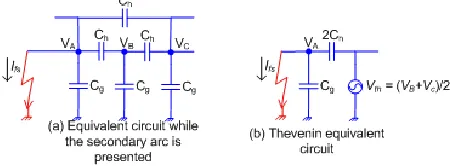
The calculation of secondary arc current via electrostatic coupling was developed by IEEE Power System Relaying Committee Working Group [12]. Fig. 2 illustrates the system during the pole-open condition after the system experiences a single-phase-to-ground fault. Fig. 2(a) depicts the secondary arc for an open phase A. It presents
the capacitive coupling between phases (Ch) and phase to
ground (Cg). The diagram is a representation of a line that
is assumed to be fully transposed. The Thevenin equivalent circuit derived from fig. 2(a) is shown in fig. 2(b).
The magnitude of Ifc is in direct proportion to the line
International Journal of Emerging Technology and Advanced Engineering
Website: www.ijetae.com (ISSN 2250-2459,ISO 9001:2008 Certified Journal, Volume 4, Issue 6, June 2014)
4
)
2
/
1
1
(
h th fcC
j
V
I
(2)When the line is loaded, there is a component of secondary arc current induced by the electromagnetic
coupling (Ifm) from the unfaulted phases. The accurate
calculation of Ifm needs transient studies due to the fact that
the induction is the sum of many dynamic variables involving the line currents flowing in the unfaulted phases, adjacent line loading, the method of secondary arc extinction, etc.
The magnitude of the recovery voltage (Vr) is directly
proportional to the line voltage and the relative value of Ch
and Cg. Consequently, Vrdoes not vary with line length.
According to fig. 2(b), the recovery voltage on phase A
after fault clearingcan be approximated by:
)
/
1
(
)
2
/
1
(
/
1
g h g th rC
j
C
j
C
j
V
V
(3)B. Arc Current
The single phase reclosing of a typical 500 kV untransposed line with length of 135 km has been investigated by the analysis of arc measurement on the arc tests at FGH in Germany [13 and 14]. The single phase to ground fault of phase b at the sending end is isolated by single phase switching. The secondary arc voltage and current obtained from the simulations are presented in Fig. 3. The arc duration determined from the Fig. 3 is 0.42 s. The primary fault arc period is considered between fault inception and clearing at both ends of the faulted phase. After the transition of primary arc to secondary arc occurs, it can be observed that the voltage across the arc path is gradually built-up until the final extinguishment of arc. Then both end breakers are reclosing consequently which characteristic offset of the recovery voltage is noticed as
shown in Fig. 3(a).The arc duration determined from the
Fig. 3(b) is 0.42 s.
The simplification of Johns, et al. [15] in this study can be represented according to the principle of thermal equilibrium for modeling the fault arc. This arc is evaluated by the following differential equation:
)
(
1
fi fi fi fig
G
T
dt
dg
(4)Fig.3 Simulation of single phase reclosing on 500 kV line [14]
(a)Arc voltage (b) Arc current
The subscript fi presents each phases of the fault arc (fp
for primary arc and fs for secondary arc). Tfi is considered
as the time constant of the arc path, while gfi presents the
time varying arc conductance. The stationary arc
conductance (Gfi) and can be obtained from:
fi fi fi
l
V
i
G
(5)The stationary arc conductance can be explained as an arc conductance when the arc current is kept for a fairly long time under constant external conditions. The arc
voltage per unit length is defined as Vfi. For the primary
arc, Vfp is constant and given as 15 V / cm when the range
of the peak of the primary current is between 1.4 to 24 kA
[15]. In the other point, Vfs is a function of the peak of the
secondary current (Ifs) in the range of Ifs from 1 A to 55 A.
Vfs can be averaged by Vfs = 75Ifs-0.4 V/cm. Where
i
is theabsolute value of arc current and lfi presents the arc length
[image:4.612.357.530.135.396.2]International Journal of Emerging Technology and Advanced Engineering
Website: www.ijetae.com (ISSN 2250-2459,ISO 9001:2008 Certified Journal, Volume 4, Issue 6, June 2014)
5 fp
fp fp
l
I
T
(6))
(
4 . 1
r fs
fs
fs
t
l
I
T
(7)Where the coefficient is about 2.85×10⁻⁵ for primary
arc current and β is around 2.51×10³ for secondary arc
current. Ifiis defined for the peak current.
The probability of secondary arc extinction is considered by the sustained secondary arc current and the post-fault recovery voltage. Many published papers have indicated that a typical secondary arc current for a 500 kV is below 20 A per 161 km. The required breaker dead time is between 0.25 and 0.4 s. A typical recovery voltage value is between 10 to 25 % of the live voltage without shunt reactor compensation. [7 - 9], [11], [12] and [16].
III. DESCRIPTION OF ARC MODEL
The fault arc is very important when studying arc phenomena such as single-phase reclosing because reclosing operation must be after secondary arc is permanently extinguished. The secondary arc is what happens to highly sophisticated occurrence. Anticipating the quenching of a second arc is certainly not enough to
make precision impossible with the information and
knowledge that is available to date.
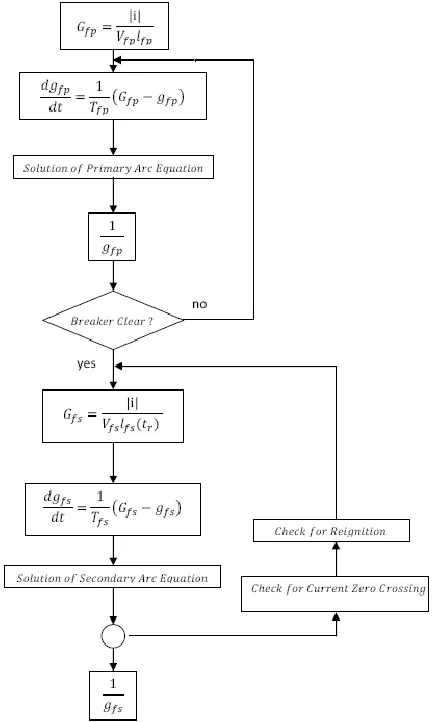
In this paper, the arc is simplified and incorporated as a custom component model in PSCAD/EMTDC. It is based on a changing resistance for the primary arc and a changing resistance for the secondary arc and a changing current source after the transition to secondary arc. The proposed simplified arc model is considered with the successive partial arc extinctions and restrikes when the arc current and voltage pass through zero many times. The permanent arc extinction will occur when the voltage impressed across the discharge path is lower than the arc reignition voltage. The steps for calculating the arc resistance are shown in the flowchart of fig. 4.
The flowchart consists of calculation of arc conductance, arc equation and solution. The arc conductance is updated at each time step of the solution. It consists of an arc component which effectively modeled both a primary arc (the high current arc before circuit breakers open) and the secondary arc which remains after the circuit breakers open.
It needs to be noted that the simplification indicate the desirability of performing simulation runs consistent with relatively low wind speed or zero speed and with initial arc length of 4 m. in order to determine the worst case extinction time condition. When interpolation was added to PSCAD/EMTDC, this component worked satisfactorily for the secondary arc. In this study, the algorithm of fault arc modeling from single phase to ground fault based on simplified model is proposed and simulated. The logic function and other modules in the PSCAD/EMTDC are
used to accurately establish model of dynamic
[image:5.612.335.554.315.676.2]characteristics of primary and secondary arc. The initiation time of fault inception and duration of fault can be set before simulation of fault at desired location in the studied system.
International Journal of Emerging Technology and Advanced Engineering
Website: www.ijetae.com (ISSN 2250-2459,ISO 9001:2008 Certified Journal, Volume 4, Issue 6, June 2014)
6 The alteration from primary arc to the secondary arc can be counted from the time of the first current zero in the arc after which the magnitude of the primary arc decreased significantly. A Thevenin equivalent of the network seen by the arc, which can be done by freezing the entire history in terms of electromagnetic transient solution at each time step. Once the Thevenin equivalent network has been considered in the calculation procedure, its characteristics are superimposed on the secondary arc characteristic. And at the intersection, the arc current is defined robustly. The network solutions are re-calculated with the resolved arc current comprised as a current source.
For verifying of the model, validation test needed to be considered. The comparisons between field tests and simulations are another direct way that directly to verify the representations. But field tests require resources and network outages which may affect the reliability of system Moreover, in some field tests could not be able to perform because of operational limitations. To get more confidence with proposed model, the comparison with published computed result or detailed arc model [19].
In this paper, the simplified arc model has been investigated with a good record of the field test from published detailed arc model [13 and 14] while the rest of studied system models and associated parameters are calibrated with the field test for line energization.
A. Verification with published detailed arc model
The proposed simplified arc model is improved with published detailed arc model. Based on the arc model given in [14], the former detailed arc model described in [14] has been improved by the analysis of arc measurements on the arc tests performed by FGH (Power Research Institute) in Germany. The secondary arc transients have then been compared between the proposed simplified arc model and detailed arc model from [14] and using the same network configuration of 500 kV untransposed line with length of 135 km. as in the published detailed arc model. The secondary arc voltage and current obtained by the proposed arc model are given in Fig. 5. By means of comparison between Fig. 3 and Fig. 5, the influence of arc parameters on arc duration and arc length at the moment of extinction is shown. The elongations of the arc and time variation of arc time constant depending on arc length are the major factors in this respect. The arc extinction is the most difficult phenomenon of the secondary arc to define. The arc extinction criteria used in the detailed models are derived and adjusted empirically and have been improved by means of extensive arc tests on real insulator arrangements.
[image:6.612.330.556.220.409.2]It is apparent from Fig. 5 that the nonlinearities in the fault arc path current manifest itself into significantly distorting the voltage waveforms in the time period from breaker opening to final arc extinction. It is noted that the peaks and trajectories of both voltages and currents in proposed arc model and detailed arc model are in same pattern. This ensures the validity of the proposed model.
Fig. 5 Simulation result from the proposed arc model on 500 kV line from [14]
It, nevertheless, is very hard to have a complete agreement of the field tests and the simulation cases. From
the comparison it is noted that in general the
correspondence of waveforms is reasonably good for
reclosing simulation with following observations:
The simulated primary arc current wave shapes are
somewhat similar in agreement with the recorded primary arc current.
In comparison between actual and simulated cases, the
size of the primary arc currents and the recovery voltages are not always close in the peak value.
For the published detail case, the duration of the
secondary arc extinction time was similar to or less than the simulated case.
International Journal of Emerging Technology and Advanced Engineering
Website: www.ijetae.com (ISSN 2250-2459,ISO 9001:2008 Certified Journal, Volume 4, Issue 6, June 2014)
7
B. Calibration for studied system model components with
field test
[image:7.612.47.287.247.477.2]The rest of the studied system components and associated parameters such as transmission lines, transformers, generating sources, circuit breakers, surge arrestors and shunt reactors are calibrated with field test for line energization. For validating the studied system model components, the comparisons between simulation and field tests are also used.
Fig. 7 Simplified arc model for fault arc at the fault location
Due to the limitation of system availability and stability, the scope of field tests was defined to line energization with all protection. During the simulation, recorded field tests results are used to calibrate the system model components and associated parameters. The accuracy of the model of the system as shown in Fig. 6 can be verified by field tests from the studied system. The receiving end voltage waveform during the field tests were recorded and compared with the corresponding simulation results [18 and 19].
Fig. 7 depicts the comparison results between field test record and simulation test for the case of MM3 – TTK circuit no. 2 which is one of many tests. TTK was he receiving end for each test while the rest of the system was in service. The simulation was configured as the field test configuration. The voltage waveforms are nearly similar. The comparisons give satisfactory results to confirm the validity of the simulation model components and parameters used [7], and [20 - 23].
The almost random variation of arc parameters influences significantly the arc performance during single phase reclosing on transmission lines. Whereas the primary arc presents generally a deterministic behaviour as observed at field and laboratory tests [13 and 14], the secondary arc has extremely random characteristic affected by external conditions around the arc channel like ionized
surrounding air, wind, thermal buoyancy and
[image:7.612.357.529.326.526.2]electrodynamic force. Due to highly random and complex behaviour of the fault arc, it is almost impossible to reproduce the exact arc duration by digital simulations. However, the proposed simplified arc model has been evaluated and can employed to determine maximum dead times (worst case) and to evaluate the performance of arc suppression schemes in single phase reclosing studies. This is point to the essential for this work.
Fig. 7 The comparison of field test (a) and the simulation results (b)
The validation tests for the proposed simplified arc model and transmission line system components from the above ensure the accuracy of representation for this study. The proposed fault arc, transmission line and system component models are used to study secondary arc extinction times for single phase reclosing after single line to ground fault in an EHV line.
IV. SYSTEM MODELING
International Journal of Emerging Technology and Advanced Engineering
Website: www.ijetae.com (ISSN 2250-2459,ISO 9001:2008 Certified Journal, Volume 4, Issue 6, June 2014)
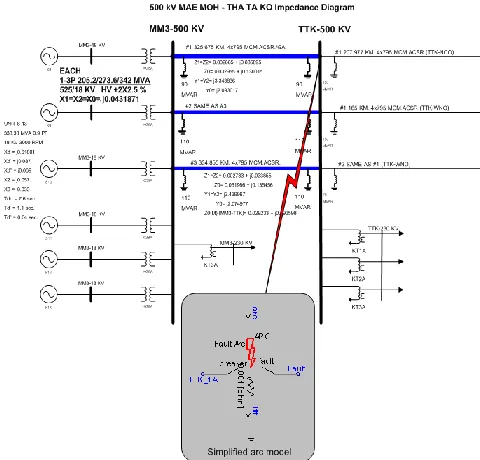
8 The simulation study is conducted to determine the form of single-phase reclosing using simplified arc model occurring after single-line-to-ground fault in different locations. The PSCAD/EMTDC software is incorporated in the study. The 500 kV circuits in the network have been modelled using the frequency dependent model [23]. According to the studied system, the 500 kV interconnected between MM3 and TTK substation comprises three circuits:
Single circuit 500 kV MM3 – TTK, using 4x795 MCM
ACSR/GA conductors per phase, 325.675 km, with 3x90 MVAr/525 kV line shunt reactor at both ends.
Double circuits 500 kV MM3 – TTK, using 4x795
MCM ACSR conductors per phase, 334.855 km, with 3x110 MVAr/525 kV line shunt reactor at both ends. The parameters of the line are calculated based on the conductor sizes and their geometric spacing on the transmission towers. All effects of inductive and capacitive coupling between each phases of particular circuit, and coupling between circuits on the same transmission tower are therefore included in the network model. Phase transposition and fixed compensating reactors are represented. Each transformer and auto-transformer will be modeled in detail with available information: MVA rating, winding voltage and configuration, tap change ranges and normal setting, and leakage reactance between windings. The generators in the network are represented using a 3-phase AC voltage source, with specified source and/or zero-sequence impedance. The locations of the circuit breakers that will be switched are associated on the studied system. Other parameters of the circuit breakers are considered: protection delay or clearing times, reclosing sequences, mechanical closing time and variation in pole closing times, and closing resister. The location and rating of installed surge arresters are included. At the boundary of the simulation, the external grid or the remaining parts of 500 kV network are represented by a voltage source connected with driving impedance for the feeding network. For simulation of the fault, the simplified arc model is applied. The proposed fault can be represented by time varying resistance model during primary arc period and for secondary arc until self-extinguish occurs, as previously described. The arc model will present the successive partial arc extinctions and restrikes when arc current and voltage pass through zero many times. The permanent arc extinction will occur when the voltage impressed across the discharge path lower than the arc reignition voltage. The developed custom model for the arc is used at the fault location as shown in Fig. 6. The investigation is conducted at no load on the system.
The factors considered to have the most influence on arcs are the duration and magnitudes of the primary arc currents, the fault location, wind and humidity conditions, and line power flow. From the test results in [7], no correlation can be determined of the effect of primary arc magnitude and duration as well as fault location upon secondary arc extinction time. Also no correlation could be found linking the pre-fault power flow on the line to secondary arc extinction time. Wind speed may have some subtle effects upon the secondary arc extinction time. It needs to be emphasized that the considerations indicate the desirability of performing simulation runs consistent with relatively low wind speed or zero speed and with initial arc length of 4 m. in order to determine the worst case extinction times.
V. RESULTS
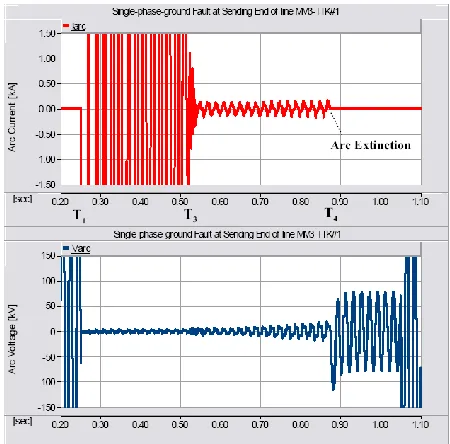
Having developed the proposed simplified arc model, it was decided to utilize the digital simulation to evaluate the studied existing EHV transmission system. By making the pessimistic assumptions with respect to still air conditions, the more severe conditions derived from the studied system were simulated using EMTP to determine the longest likely extinction times. For the 500 kV circuit MM3 – TTK#1, the studied system is considered to be at steady-state operating condition prior to the inception of a
phase-to-ground fault on phase A at time 0.25 s (T1). The sending
end phase A breaker clears at time 0.5 s (T2), followed by
the opening of the receiving end breaker at time 0.52 s (T3).
The primary arc is taken during the primary arc period (T1-
T3). The arc transition is occurred at the time the current in
fault arc path first reached zero, after the receiving end breaker interrupts current. Actual current interruption is arranged to occur at the first current zero following contact separation of breaker pole inquisition. It can be seen that the voltage exhibits the usual high frequency travelling wave induced distortion during the primary arc period. Follow arc transition to secondary arc period at time T3, there is a gradual build-up of the voltage across the arc path. Initial oscillations in the secondary arc current are observed. The source of the oscillation is caused from the excitation of the natural frequency formed by the fault points with transmission line. This does not appear to hinder arc extinction. Considerable high frequency distortion is observed near final arc extinction, and this is caused by collapse of voltage across the secondary arc following sudden restrike. After final extinction of
secondary arc at time 0.604 s (T4), the line is re-energized
by sending end phase breaker closing at time 1.05 s (T5)
International Journal of Emerging Technology and Advanced Engineering
Website: www.ijetae.com (ISSN 2250-2459,ISO 9001:2008 Certified Journal, Volume 4, Issue 6, June 2014)
9 The characteristics of the fault arc, current and voltage at fault point, throughout the process of single-phase reclosing are depicted in Fig. 8.
[image:9.612.343.544.129.244.2]This is also illustrated three distinct stages of development of the secondary arc; an initial half cycle period of relatively high noise distortion caused by travelling wave components traversing the fault point, a relatively long period during which arc the arc voltage increases due to the effect of an increase in the arc length, and a final short pre-extinction period where the arc tries to extinguish but sudden re-ignition causes current and voltage spikes to be generated.
Fig. 8 Simulation result for fault arc at the fault location (System response of Current and Voltage for phase A to ground fault at
sending end, MM3-TTK#1)
When a phase-to-ground fault occurs, a heavy short circuit current or primary arc flows through the faulted phase until both end breakers trip. The arc transition occurs at the time the current in fault arc path first reached zero, after the receiving end breaker trips. Actual current interruption is arranged to occur at the first current zero following contact separation of breaker pole. Before final extinction of secondary arc, several partial extinctions and restrikes are observed. It is noted that the nonlinear variation of the arc manifests itself into producing high frequency components which in turn distort the wave form.
Fig. 9 Primary arc resistance
Fig. 9 depicts the dynamic resistance curve of the primary arc attained by dividing the arc voltage by the arc current. It is clearly seen that the fault arc resistance is highly nonlinear. In particular, it is clear that while the arc current periodically passes through current zero, the arc resistance shows small abrupt changes and is primarily responsible for causing the distortion in the fault arc voltage.
[image:9.612.60.285.278.500.2]A series of studies have been performed in similar manner for each one of the other double circuit between MM3 and TTK (MM3 – TTK#2 and MM3 – TTK#3). Fig. 10 and Fig. 11 present the arc current responses from the simulation for single-line-to-ground fault occurring at the sending end of the line.
Fig, 10 System response for phase A to ground fault at sending end, MM3-TTK#2
[image:9.612.325.564.423.546.2] [image:9.612.326.561.428.688.2]International Journal of Emerging Technology and Advanced Engineering
Website: www.ijetae.com (ISSN 2250-2459,ISO 9001:2008 Certified Journal, Volume 4, Issue 6, June 2014)
10
Following the arc transition at time T3, there is a gradual
build up of the voltage across the arc path until final
extinction occurs at time T4. . The different fault locations
are taken place at the sending end, middle of the line and receiving end for each simulation. The arc duration, as considered from studied system, is concluded in Table 1. Due to highly random and complex behaviour of the secondary arc it is almost impossible to reproduce the exact arc duration by digital simulations. However, the simplified model evaluated in this paper can be employed to determine maximum dead times in the worst case and to examine the performance of arc suppression schemes in reclosing studies. Table 2, 3 and 4 are the studied results from which it can be summarized that the electrostatic component of the secondary arc current and recovery voltage are below 20 A and 50 kV level respectively (often regarded as the limit for successful reclosing). For the system studied, the maximum arc duration is 354 ms at MM3 – TTK #1. It is important to reduce dead time setting and reclose both end breakers as quickly as possible after completely arc extinction for enhancing the operational availability of the system.
TABLE 1
SECONDARY ARC EXTINCTION TIME FROM SINGLE PHASE TO
GROUND FAULT
Fault location
Secondary Arc Extinction Time after Fault Inception (ms)
MM3-TTK#1 MM3-TTK#2 MM3-TTK#3
Sending End 354 324 333
Middle Line 343 266 266
Receiving End 333 255 254
TABLE 2
SECONDARY ARC CURRENT AND RECOVERY VOLTAGE FOR PHASE TO GROUND FAULT MM3–TTK#1
Fault location Ifs, A Recovery voltage, kV
Sending End 12.10 43.60
Middle Line 11.20 41.45
Receiving End 9.10 32.84
TABLE 3
SECONDARY ARC CURRENT AND RECOVERY VOLTAGE FOR PHASE TO
GROUND FAULT MM3–TTK#2
Fault location Ifs, A Recovery voltage, kV
Sending End 11.00 39.96
Middle Line 10.35 38.22
Receiving End 8.34 30.92
TABLE 4
SECONDARY ARC CURRENT AND RECOVERY VOLTAGE FOR PHASE TO
GROUND FAULT MM3–TTK#3
Fault location Ifs, A Recovery voltage, kV
Sending End 10.81 39.21
Middle Line 10.17 37.54
Receiving End 8.18 30.35
As the main purpose of this study, it is important to know the worst dead time that must be allow for complete arc extinction, to prevent the arc restriking when voltage is re-applied. The successful single-phase reclosing is evaluated by conducting fault clearing and reclosing cases utilizing the proposed simplified arc model. The illustrative cases are presented in order to evaluate approximately the maximum arc duration that may be expected. To improve the scheme, the shorten pre-set dead time is investigated together with compensation of secondary arc; the successful reclosing will occur and bring the system stability back. The proposed simplified arc model, which has been used to assess the performance of the system operating conditions in this study, can be employed to determine the maximum dead times in worst case. The maximum secondary arc duration is 354 ms for the studied Mae Moh – Tha Ta Ko system. The total reclosing time, including 300 ms for circuit breaker closing time, should be 654 ms. The existing single phase reclosing schemes have pre-set dead times typically 700 ms ( with total reclosing time of 1000 ms) that reclose the open breaker phase which can be shorten by the studied reference.
VI. CONCLUSIONS
International Journal of Emerging Technology and Advanced Engineering
Website: www.ijetae.com (ISSN 2250-2459,ISO 9001:2008 Certified Journal, Volume 4, Issue 6, June 2014)
11 The transient study evaluated the single-phase reclosing of the 500 kV lines in case of Thailand system between Mae Moh and Tha Ta Ko substations. The results present especially emphasised the effect of EHV transmission system on secondary arc current. The work considers the characteristic of secondary arc current after clearing of transitory fault and returning the system to normal operation. The both primary and secondary arcs behaviour were implemented in a custom PSCAD/EMTDC model as a time-varying resistance. This notes that the simplified arc model is suitable for arcing fault simulation applications. The successful single-phase reclosing is investigated by conducting fault clearing and reclosing cases utilizing the developed arc model. The illustrative cases are presented in order to determine approximately the maximum arc duration that may be expected. Due to highly random and complex behaviour of the secondary arc it is difficult to reproduce the exact arc duration by digital simulation. Single phase reclosing schemes detect the presence of single-phase-to-ground faults on a transmission line and trigger the circuit breaker of only the faulted phase to open. To improve the scheme, the shorten pre-set dead time is investigate together with compensation of secondary arc; the successful reclosing will occur and bring the system stability back. However, the proposed simplified arc model which has been used to evaluate the performance of the system operating conditions in this study, can be employed to determine the maximum dead times in worst case. The results could then be used for further evaluation EHV system in many different areas such as protection, reclosing scheme and power quality.
Acknowledgements
The authors would like to gratefully acknowledge the contributions of Dr. Suthep Chimklai from Electricity Generating Authority of Thailand and Dr. Dharshana Muthumuni from Manitoba HVDC Research Centre, Canada on their technical and information supports, thank the National Research University (NRU) Project from the Office of the Higher Education Commission of Thailand.
REFERENCES
[1] L. Prinkler, M. Kizilcay, G. Ban, and P. Handl, ―Improved secondary arc models based on identification of arc parameters from staged fault test records,‖ the 14th Power Systems Computation Conference, Sevilla, Jun. 2002.
[2] L. Prikler, M. Kizilcay, G. Ban and P. Handl, ―Modeling secondary arc based on identification of arc parameters from staged fault test records ‖, International Journal of Electrical Power and Energy Systems, pp. 581 – 589. 2003.
[3] M. C. Tavares and C.M. Portela, ―Transmission system parameters optimization – analyzing secondary arc current and recovery voltage‖, International Conference on Power Systems Transients 2003, New Orleans, USA, 2003.
[4] M. Danyek and P. Handl, ―Improving the reliability of experimental data about secondary arc duration‖, Proceedings of the 17th Hungarian – Korean Seminar, EHV Technologies – II, Keszthely-Lake Balaton, Hungary, Oct. 2001.
[5] S. Jamali and N. Ghaffarzadeh ―Adaptive single-pole auto-reclosure for transmission lines using sound phses currents and wavelet packet transform.‖ Electric Power Components and Systems, 38:1558-1576, 2010.
[6] R. M. Hasibar, A. C. Legate, J. Brunke, and Peterson, W. G. Peterson, "The application of high-speed grounding switches for single-pole reclosing on 500 kV power systems, " IEEE Transaction on Power Apparatus and Systems, vol. PAS-100, No. 4, pp. 1512-1515, Apr. 1981.
[7] J. G. Kappenman, G. A. Sweezy, V. Koschik, and K. K. Mustaphi, "Staged fault tests with single phase reclosing on the Winnipeg-Twin cities 500 kV interconnection," IEEE Transaction on Power Apparatus and Systems, vol. PAS-101, No. 3, pp. 662-673, Mar. 1982.
[8] H. N. Scherer, B. R. Shperling, J. W. Chadwick, N. N. Belyakov, V. S. Rashkes, and K. V. Khoetsian, "Single phase switching tests on 765 and 750 kV transmission lines," IEEE Transaction on Power Apparatus and Systems, vol. PAS-104, No. 6, pp. 1537-1548, Jun. 1985.
[9] B. R. Shperling, A. J. Fakheri, C. H. Shih, and B. J. Ware, "Analysis of single phase switching field tests on the AEP 765 kV system," IEEE Transaction on Power Apparatus and Systems, vol. PAS-100, No. 4, pp. 1729-1735, Apr. 1981.
[10] E. W. Kimbark, ―Selective-Pole Switching of Long Double-Circuit EHV Line,‖ IEEE Transaction on Power Apparatus and Systems, vol. PAS-95 no. 1, January/February 1976.
[11] L. Edwards, J. W. Chadwick, H. A. Riesch, and L. Smith, ―Single-Pole Switching on TVA’s Paradise-Davidson 500 kV Line,‖ IEEE Transaction on Power Apparatus and Systems, November/December 1971.
[12] IEEE Power System Relaying Committee Working Group, "Single phase tripping and auto reclosing of transmission lines," IEEE Transactions on Power Delivery, vol. 7 no.1, pp. 182-192, Jan. 1992. [13] M.,Kizilcay, ―Evaluation of existing secondary arc models,‖ EEUG
News, May 1997.
[14] M. Kizilcay, and T. Pniok, ―Digital simulation of fault arcs in power systems‖, ETEP (European Transactions on Electrical Power Engineering), Vol. 1, No. 1, pp. 55 – 60. 1991.
[15] A. T. Johns, and W. M. Ritchie, ―Application of an improved technique for assessing the performance of single-pole reclosing schemes,‖ IEEE Transaction on Power Apparatus and Systems, vol. PAS-103 no. 12, December. 1984, pp. 3651-3662.
[16] D. Woodford, ―Secondary arc effects in AC/DC hybrid transmission,‖ IEEE Transaction on Power Delivery, vol. 8 no. 2, April. 1993.
International Journal of Emerging Technology and Advanced Engineering
Website: www.ijetae.com (ISSN 2250-2459,ISO 9001:2008 Certified Journal, Volume 4, Issue 6, June 2014)
12
[18] K. Ngamsanroaj, W. Tayati, and S. Chimklai, "Comparison of field and digital simulation results of switching overvoltages in the EGAT 500 kV transmission system," Pulse 2006 Spring, Manitoba HVDC Research Centre Journal, May. 2006.
[19] A. Clerici, ―Analog and digital simulation for transient overvoltage determinations,‖ CEGRE, ELECTRA no. 20, May 1972, pp. 111-138.
[20] K. Ngamsanroaj, and S. Premrudeeprechacharn, "Analysis of single pole reclosing on EHV line in Thailand," 2007 Large Engineering Systems Conference on Power Engineering, Montreal, Canada, October 2007.
[21] IEEE PES Working Group 15.08.09, Modeling and analysis of system transients using digital programs, IEEE PES Special Publication, 1998, pp. 4-1 - 4-24.
[22] N. R. Watson and J. Arrilaga, Power systems electromagnetic transient simulation, The Institution of Electrical Engineers, London, 2003.
![Fig. 3(b) is 0.42 s. The simplification of Johns, et al. [15] in this study can be represented according to the principle of thermal](https://thumb-us.123doks.com/thumbv2/123dok_us/8712652.882325/4.612.357.530.135.396/fig-simplification-johns-study-represented-according-principle-thermal.webp)
![Fig. 5 Simulation result from the proposed arc model on 500 kV line from [14]](https://thumb-us.123doks.com/thumbv2/123dok_us/8712652.882325/6.612.330.556.220.409/fig-simulation-result-proposed-arc-model-kv-line.webp)