Sensitivity Analysis in MADM Methods: Application of Material Selection
Morteza Yazdani
1, Edmundas Kazimieras Zavadskas
2, Joshua Ignatius
3, Manuel Doval Abad
41Universidad Europea de Madrid
Calle Tajo s/n, Villaviciosa de Odon 28670 Madrid, Spain
E-mail. [email protected]
2Vilnius Gediminas Technical University
Sauletekio av. 11,10223,Vilnius, Lithuania E-mail. [email protected]
3School of Mathematical Sciences
Universiti Sains Malaysia 11800 USM Penang, Malaysia
4Universidad Tecnologica Indoamerica
Av. Manuelita Saez y Agramonte EC180103 Ambato, Ecuador E-mail. [email protected]
http://dx.doi.org/10.5755/j01.ee.27.4.14005
Material selection is a core process in design and engineering, and its effective modeling remains a key strategic concern for production economics and management. The evaluation of materials is subject to various technical and subjective criteria, which may be conflicting in nature. Nonetheless, multi attribute decision making (MADM) models facilitate the complexity in realizing engineering objectives through some form of weight of attributes (criteria) assessment procedure. This study illustrates a new approach to gain those weights based on expert judgments and then select best material using ranking-based MADM methods. Specifically, we applied the SWARA method for the criteria weight assessment of the material selection process, and subsequently prioritize the candidate materials based on WASPAS and MOORA. Sensitivity analysis is performed to assess the robustness of the solution after a comparison is made between WASPAS and MOORA in ensuring the consistency of the results. We illustrate the problem on two real material selection case studies.
Keywords: Multi Attribute Decision Making (MADM), MOORA, WASPAS, SWARA, Material Selection.
Introduction
A reliable engineering process requires accessible resources to comply with various process requirements. One such requirement is in the conversion of design concepts into realizable engineering and manufacturing goals, which are fraught with material challenges. Hence, material selection issues involve several decisions such as design and quality requirements. (Anojkumar et al., 2014).
The traditional approach to material selection is to conduct trial by error experiments. This procedure when used extensively may deviate design engineers from the overall management goal of the firm, thus leading to cost overruns and project delays (Ashby & Cebon, 1993). Any material selection decision based on intuition without a scientific framework should not be taken as conventional wisdom, thus avoiding engineering failures (Girubha & Vinodh, 2012).
The starting point of a material selection decision is to define observable parameters of the design objectives. A decision making framework is then used to aid the assessment of reliable and appropriate material candidates
(Coello Coello, C. A., & Becerra, 2009). Depending on the complexity of the decision, a hybrid structure combining two or more multi-criteria decision making method may be integrated for assessing material selection problems.
To facilitate material selection decisions, multi-attribute decision making (MADM) techniques are used due to their ability to consolidate conflicting criteria. The rest of the paper is organized as follows: Section 2 provides a brief review of MADM techniques in material selection. Section 3 explains the methodology of SWARA, MOORA and WASPAS methods. Section 4 applies those methods on the material selection cases. Section 5 concludes the paper and offers suggestions for future research work in related field.
Literature Review
MADM is a branch of MCDM that handles the assessment of a collection of alternatives based on the level of performance of the criteria. The process of assessment includes the following features: identifying criteria and alternatives, weight each criterion, an algorithmic procedure to reach final solution by normalizing and aggregating the scores of all alternatives across each and every criterion (Yazdani et al., 2016; Hu et al., 2015).
In material selection, the Ashby MADM method is considered to be more popular than other techniques for screening materials (see Reddy & Gupta, 2010; Parate & Gupta, 2011; Rao, 2008 and Roth et al., 1994; Chauhan & Vaish, 2012a). More recent studies in this area are listed in
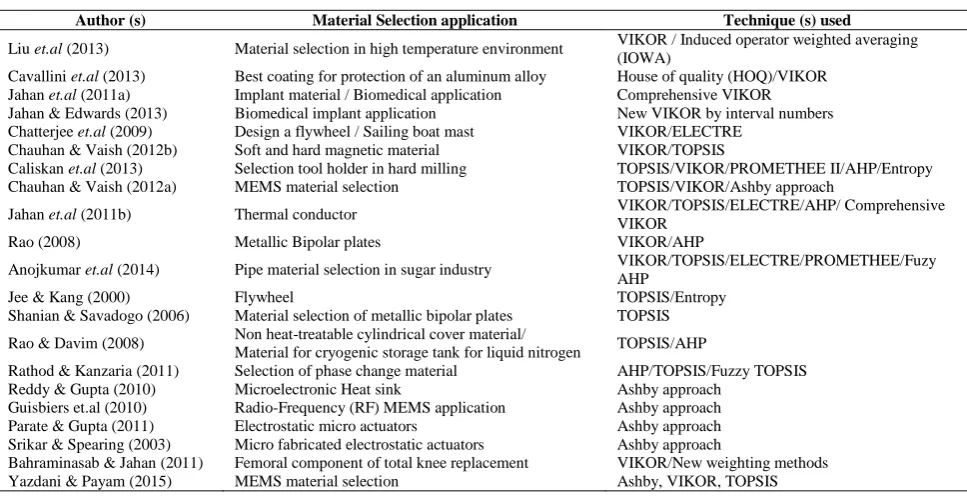
Table 1. Jahan & Edwards (2013) performed material evaluation by using a modified version of VIKOR. Caliskan et al. (2013) selected the best candidate material for a tool holder in a hard milling process by comparing the following MADM methods: TOPSIS, VIKOR, PROMETHEE II, AHP and Entropy. Anojkumar et al. (2014) applied VIKOR, TOPSIS, ELECTRE, PROMETHEE and Fuzzy AHP in the selection of pipe materials of the sugar industry. Yazdani & Payam (2015) solved a micro-electromechanical systems material selection decision by using the Ashby, TOPSIS and VIKOR methods. Table 1 provides a wide range of methods from AHP, TOPSIS, VIKOR, ELECTRE and PROMETHEE that has been applied to real material selection problems.
Table 1 Overview of Material Selection Studies
Author (s) Material Selection application Technique (s) used Liu et.al (2013) Material selection in high temperature environment VIKOR / Induced operator weighted averaging
(IOWA)
Cavallini et.al (2013) Best coating for protection of an aluminum alloy House of quality (HOQ)/VIKOR
Jahan et.al (2011a) Implant material / Biomedical application Comprehensive VIKOR
Jahan & Edwards (2013) Biomedical implant application New VIKOR by interval numbers
Chatterjee et.al (2009) Design a flywheel / Sailing boat mast VIKOR/ELECTRE
Chauhan & Vaish (2012b) Soft and hard magnetic material VIKOR/TOPSIS
Caliskan et.al (2013) Selection tool holder in hard milling TOPSIS/VIKOR/PROMETHEE II/AHP/Entropy
Chauhan & Vaish (2012a) MEMS material selection TOPSIS/VIKOR/Ashby approach
Jahan et.al (2011b) Thermal conductor VIKOR/TOPSIS/ELECTRE/AHP/ Comprehensive
VIKOR
Rao (2008) Metallic Bipolar plates VIKOR/AHP
Anojkumar et.al (2014) Pipe material selection in sugar industry VIKOR/TOPSIS/ELECTRE/PROMETHEE/Fuzy
AHP
Jee & Kang (2000) Flywheel TOPSIS/Entropy
Shanian & Savadogo (2006) Material selection of metallic bipolar plates TOPSIS
Rao & Davim (2008) Non heat-treatable cylindrical cover material/
Material for cryogenic storage tank for liquid nitrogen TOPSIS/AHP
Rathod & Kanzaria (2011) Selection of phase change material AHP/TOPSIS/Fuzzy TOPSIS
Reddy & Gupta (2010) Microelectronic Heat sink Ashby approach
Guisbiers et.al (2010) Radio-Frequency (RF) MEMS application Ashby approach
Parate & Gupta (2011) Electrostatic micro actuators Ashby approach
Srikar & Spearing (2003) Micro fabricated electrostatic actuators Ashby approach
Bahraminasab & Jahan (2011) Femoral component of total knee replacement VIKOR/New weighting methods
Yazdani & Payam (2015) MEMS material selection Ashby, VIKOR, TOPSIS
It is observed that different MADM methods can generate different ranking orders. Prior to the ranking process, it is noteworthy that all MADM require each alternative to be assessed against the performance rating associated with the attributes/criteria. The attributes may take different units of measurement (e.g. meters, kilogram, liter etc). To compare the alternatives with regards to each attribute, a normalization process is performed and each method may provide its own computation in consolidating the diverse measurement units (Yoon & Hwang, 1995; Hwang & Yoon, 1981; Zavadskas & Turskis, 2008).
Therefore, the normalization procedure is a mechanism in MADM models that converts the different measurement units of performance attributes into a comparable (non-dimensional) scale. The normalized value will be a monotonically non-decreasing value, in the range of 0 and 1. Many normalization procedures are available to MADM methods (Opricovic & Tzeng, 2004).
Jahan & Edwards (2015) investigated the effects of normalization methods on the results, taking into account cost and benefit criteria and discussing the issue of rank reversal prevention and handling of negative values. Chatterjee & Chakraborty (2014) showed the normalization process used on PROMETHEE, TOPSIS and GRA for the
flexible manufacturing selection problem. Zavadskas et al. (2006) measured the accuracy of determining the relative significance of the alternatives taking into consideration that the normalization procedure may affect the final MADM solution. They presented computational experiments for the TOPSIS method using vector and linear normalization tools. A new logarithmic normalization tool was later introduced in Zavadskas & Turskis (2008), where the LEVI.3 software supports conditions of risk and uncertainty.
While the normalization process attempts to scale the criteria values and to construct a unified comparable index, different normalization techniques may yield different solutions, and may lead provide error in recommended solutions.
Methods and Materials
SWARA Method
SWARA is a method for weighing decision attributes using direct judgment of experts. The procedure for determining weights by SWARA can be stated as steps below:
Step1 – Should be sorted based on experts’ opinion (Kendall, 1970; Zavadskas et al., 2009).
Step 2 – From the second criterion, comparative importance of average value 𝑠𝑗 should be done as follows:
the relative importance of criterion𝑗 in relation to the previous (𝑗 − 1) criterion (Stanujkic et al. 2015).
Step 3 - Determine the coefficient 𝑘𝑗
𝑘𝑗= {
1 𝑗 = 1
𝑠𝑗+ 1 𝑗 > 1 (1)
Step 4 - Determine weight 𝑤𝑗
𝑤𝑗= {
1 𝑗 = 1
𝑥𝑗−1 𝑘𝑗 𝑗 > 1
(2) Step 5 – Final step in calculating the weights of the criteria
𝑞𝑗= 𝑤𝑗
∑𝑛𝑘=1𝑤𝑗 (3)
where 𝑞𝑗denotes the relative weight of criterion 𝑗.
MOORA
The Multi-Objective Optimization on the basis of Ratio Analysis (MOORA) method was developed by Brauers & Zavadskas (2006). Gadakh (2010) applied MOORA for the milling process. Karande & Chakraborty (2012) solved material selection problems using the MOORA ration based system. Yazdani (2015) extended MOORA with intuitionistic fuzzy sets.
The MOORA procedure is as follows:
Step 1 - Normalize the decision matrix. To have comparable elements across scales in the evaluation process, the ratio system of the MOORA method computes the normalized decision matrix using the following equations; 𝑟𝑘𝑗denotes the normalized generic element of the
decision matrix 𝑟𝑘𝑗 =
𝑥𝑘𝑗
∑𝑡𝑘=1𝑥𝑘𝑗2 (4)
Step 2 - Determine the weighted normalized matrix. The 𝑘𝑗-th element of the normalized matrix is replaced by
𝑣𝑘𝑗= 𝑟𝑘𝑗. 𝑤𝑗 (5)
Step 3 - Compute the overall rating of benefit and cost criteria for each alternative. The overall rating of the 𝑘-th alternative is calculated by implementing Equations 6 and 7, respectively:
𝑠𝑘+= ∑𝑗∈𝐽𝑀𝑎𝑥𝑣𝑘𝑗 (6)
𝑠𝑘−= ∑𝑗∈𝐽𝑀𝑖𝑛𝑣𝑘𝑗 (7)
where 𝐽𝑀𝑎𝑥is the index set of beneficial criteria. Higher
values indicate greater desirability. Contrastingly, 𝐽𝑀𝑖𝑛 is
the index for cost criteria for which lower values are preferable.
Step 4 - Obtain the overall performance index of each alternative.
The overall performance index of the k-th alternative is calculated by subtracting the overall rating for beneficial
and cost criteria using the following formula:
𝑠𝑘 = 𝑠𝑘+− 𝑠𝑘− (8)
Step 5 - Rank the alternatives.
The 𝑠𝑘 values form a cardinal scale that can be used to
rank the alternatives. The ordinal ranking of the alternatives is obtained by rearranging the 𝑠𝑘 values in decreasing order.
Higher values for 𝑠𝑘implies that the k-th alternative is more
preferred.
Weighted Aggregated Sum Product Assessment
(WASPAS)
WASPAS is a mixture between two well-known MADM approaches, i.e. the weighted sum model (WSM) and the weighted product model (WPM). Hashemkhani Zolfani et al. (2013) assessed shopping mall performances in Tehran, and Chakraborty & Zavadskas (2014) solved eight manufacturing decision making problems using WASPAS. The following matrix represents the decision problem:
[
𝑥11 𝑥12 … 𝑥1𝑛
𝑥21 𝑥22 … 𝑥2𝑛
⋮ ⋮ ⋮ ⋮
𝑥𝑚1 𝑥𝑚2 … 𝑥𝑚𝑛
] (9)
where 𝑛 is the number of evaluation criteria and 𝑗 = 1,2, … 𝑛, 𝑥𝑖𝑗 is the performance rating of the 𝑖 alternative
upon the 𝑗-th decision criterion. This decision matrix is normalized using the following equations where the normalized generic element of the decision matrix is denoted by 𝑟𝑖𝑗:
For benefit attributes: 𝑟𝑖𝑗 =
𝑥𝑖𝑗 max
𝑖 𝑥𝑖𝑗
, 𝑗 = 1,2, … 𝑛, 𝑖 = 1,2, … 𝑚 (10) For non-benefit attributes:
𝑟𝑖𝑗 = min
𝑖 𝑥𝑖𝑗
𝑥𝑖𝑗 𝑗 = 1,2, … 𝑛, 𝑖 = 1,2, … 𝑚 (11) To compute the weighted normalized decision matrix in
WASPAS, these two actions must be performed. The first is the summarization process of WASPAS:
𝑦𝑖𝑗,𝑠𝑢𝑚= 𝑟𝑖𝑗. 𝑤𝑗 𝑖 = 1,2, … 𝑚 , 𝑗 = 1,2, … 𝑛 (12)
and for multiplication part; 𝑦𝑖𝑗,𝑚𝑢𝑙𝑡= (𝑟𝑖𝑗)
𝑤𝑗
where = 1,2, … 𝑚 , 𝑗 = 1,2, … 𝑛 (13) A joint generalized criterion of weighted aggregation of
additive and multiplicative methods can then be proposed as follows:
𝑄𝑖= 0.5 ∑ 𝑦𝑖𝑗,𝑠𝑢𝑚+
𝑛
𝑗=1
0.5 ∏ 𝑦𝑖𝑗,𝑚𝑢𝑙𝑡 𝑛
𝑗=1
𝑖 = 1,2, … 𝑚 , 𝑗 = 1,2, … 𝑛 (14) In order to increase the ranking accuracy and
effectiveness of the decision making process, a more generalized equation for determining the total relative importance of the alternatives can be employed for the WASPAS method (see Zavadskas et al., 2012):
𝑄𝑖𝜆= 𝜆 ∑𝑛𝑗=1𝑦𝑖𝑗,𝑠𝑢𝑚+(1 − 𝜆) ∏𝑛𝑗=1𝑦𝑖𝑗,𝑚𝑢𝑙𝑡 (15)
Results and Discussion
The proposed analysis presented in this paper is applied to two material selection problems.
Example 1
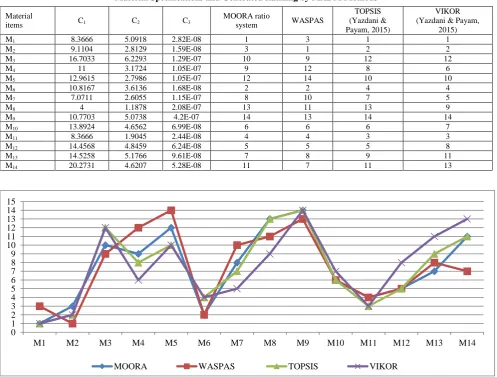
The first example is an application of micro-electromechanical systems (MEMS). The case focuses on material selection in the case of low electrical resistivity, i.e. high speed with low actuation voltage devices. The alternative materials and the relevant properties for this case are given in Table 3, where C1 and C3 are the non-benefit
criteria while C2 is the benefit criterion. Yazdani & Payam
(2015) used experts’ weights to rank the alternatives with the TOPSIS and VIKOR methods.
In this paper, we use the SWARA weighting method following equations 1-3. SWARA reports the weights of
material criteria in Table 2 as (𝑞1, 𝑞2, 𝑞3) = (0.339,0.27,0.39). The ranking of candidate materials is achieved by applying MOORA (using equations 4-8) and WASPAS (equations 9-15). MOORA recommends that 𝑀1
,
𝑀6,
𝑀2 and 𝑀11are the four best options, which areconsistent with the WASPAS method. Yazdani & Payam (2015) provided a similar ranking in the order of 𝑀1
,
𝑀2,
𝑀11and 𝑀6.Figure 1 illustrates the comparison on material ranking for case 1. The order of the material ranks is almost similar. This can be further supported by the statistically significant Spearman correlation coefficient among the four MADM methods. The highest correlation is between MOORA and TOPSIS with correlation coefficient of 0.95 at p < 0.01 and the lowest correlation is observed between WASPAS and VIKOR at 0.66, p <0.05.
Table 2 SWARA Results for MEMS Material Ranking Problem
Material criteria Comparative importance
of average value 𝑠𝑗 Coefficient 𝑘𝑗= 1 +𝑠𝑗
Recalculated weight 𝑤𝑗
Final weight 𝑞𝑗
C3 - 1 1 0.39
C1 0.15 1.15 0.87 0.339
C2 0.25 1.25 0.696 0.271
Table 3 Material Specifications and Generated Ranking by MADM Methods
Material
items C1 C2 C3
MOORA ratio
system WASPAS
TOPSIS (Yazdani & Payam, 2015)
VIKOR (Yazdani & Payam,
2015)
M1 8.3666 5.0918 2.82E-08 1 3 1 1
M2 9.1104 2.8129 1.59E-08 3 1 2 2
M3 16.7033 6.2293 1.29E-07 10 9 12 12
M4 11 3.1724 1.05E-07 9 12 8 6
M5 12.9615 2.7986 1.05E-07 12 14 10 10
M6 10.8167 3.6136 1.68E-08 2 2 4 4
M7 7.0711 2.6055 1.15E-07 8 10 7 5
M8 4 1.1878 2.08E-07 13 11 13 9
M9 10.7703 5.0738 4.2E-07 14 13 14 14
M10 13.8924 4.6562 6.99E-08 6 6 6 7
M11 8.3666 1.9045 2.44E-08 4 4 3 3
M12 14.4568 4.8459 6.24E-08 5 5 5 8
M13 14.5258 5.1766 9.61E-08 7 8 9 11
M14 20.2731 4.6207 5.28E-08 11 7 11 13
Figure 1. Ranking of Four MADM Methods for MEMS Material Problem 0
1 2 3 4 5 6 7 8 9 10 11 12 13 14 15
M1 M2 M3 M4 M5 M6 M7 M8 M9 M10 M11 M12 M13 M14
Example 2
This example deals with the hard magnetic material selection problems (Chauhan & Vaish, 2012b). The case considers a database with twenty four materials evaluated across five material criteria. The criteria for this study are operating temperature (C1), remanence magnetic induction
(C2), coercive magnetic field (C3), intrinsic coercive field
(C4) and magnetic energy (C5). All the criteria are to be
maximized (benefit) except criterion C2. To begin the
material evaluation assessment, Chauhan & Vaish (2012b) weight each criterion using the Entropy method. However, we used SWARA (equations 1-3) to obtain the weights
(𝑤1, 𝑤2, 𝑤3, 𝑤4, 𝑤5) = (0.124,0.162,0.279,0.233,0.202), see
Table 4. The subsequent steps of the material selection problem are then performed by MOORA (equations 4-8) and WASPAS (equations 9-15). According to WASPAS and MOORA’s ranking indices,𝑄𝑖and 𝑠𝑘, the prioritization
for materials are identified. Table 5 lists the rank ordering using the various methods. The results show the similarity
of ranking scores between MOORA and WASPAS, which is not surprising given their spearman’s correlation coefficient, is 0.97. In comparison with example 1, the rank similarities are higher for example 2. In addition, WASPAS ranking is considered stabile when compared across different values of
𝜆
. Therefore, like VIKOR and TOPSIS in material selection problems (Table 1), WASPAS and MOORA can potentially be utilized by engineers.Sensitivity analysis
Sensitivity analysis is generally an approach used to check consistency and robustness of solutions. This is achieved by parameters of factors, and observing ranking changes. One of the strategies used to test the susceptibility of the results to ranking changes is a weight adjustment method. A particular criterion will have its weight varied, while holding the other criteria constant by a decreased amount which is equally shared across remaining criteria.
Table 4 SWARA Weighting Outcomes for Case 2
Material criteria Comparative importance
of average value 𝑠𝑗
Coefficient
𝑘𝑗= 1 +𝑠𝑗
Recalculated weight
𝑤𝑗 Final weight 𝑞𝑗
C3 - 1 1 0.279
C4 0.2 1.2 0.833 0.233
C5 0.15 1.15 0.725 0.202
C2 0.25 1.25 0.58 0.162
C1 0.3 1.3 0.446 0.124
Table 5 Hard Magnetic Material Evaluation Table with MOORA and WASPAS
Material list C1 C2 C3 C4 C5
MOORA index 𝑠𝑘
MOORA ranking
WASPAS index 𝑄𝑖
WASPAS ranking
M1 460 0.4 175000 185000 30 0.5356 1 0.7162 1
M2 500 1.13 640 640 240 0.1122 2 0.2065 2
M3 250 0.92 720 1600 170 0.0716 4 0.1609 5
M4 500 0.86 640 2000 145 0.0735 3 0.1817 3
M5 500 0.8 535 1200 120 0.0613 5 0.1683 4
M6 520 1.06 115 145 71.6 0.0248 6 0.1238 9
M7 500 1.34 58 59 59.7 0.0068 13 0.1071 15
M8 500 1.33 53 53 57.7 0.0061 15 0.1062 16
M9 525 1.27 51 51 43.8 0.0022 23 0.1038 23
M10 550 0.83 131 148 42.2 0.0193 8 0.1229 10
M11 550 0.72 151 173 39.6 0.0222 7 0.1285 8
M12 540 0.74 119 134 31.8 0.0167 9 0.1215 11
M13 525 1.05 62 64 31 0.0037 21 0.1041 21
M14 540 1.07 49 50 30 0.0031 22 0.1041 22
M15 540 0.94 63 65 23.1 0.0043 17 0.1058 17
M16 480 0.6 64 76 14 0.0093 12 0.1151 12
M17 540 0.75 45 46 13.5 0.0063 14 0.1094 14
M18 480 0.71 44 45 11.9 0.004 18 0.1047 19
M19 350 0.54 44 44 12 0.0038 19 0.1054 18
M20 450 0.72 37 38 11.1 0.0016 24 0.1002 24
M21 480 0.7 38 39 11 0.0038 20 0.1047 20
M22 590 0.535 58 62 10 0.0151 11 0.1312 7
M23 590 0.52 56 61 10 0.0156 10 0.1329 6
M24 540 0.67 143 161 4.5 0.0048 16 0.1128 13
This section investigates the consistency, flexibility and efficiency of material selection results in establishing a new normalization tool into both MOORA and WASPAS for each case.
The linear normalization sum-based method is as follows:
𝑟𝑖𝑗 = 𝑥𝑖𝑗 ∑𝑚𝑖=1𝑥𝑖𝑗
(16) For benefit criteria
𝑟𝑖𝑗 = 1 𝑥𝑖𝑗
∑ 1
𝑥𝑖𝑗 𝑚 𝑖=1
In these formulas, 𝑟𝑖𝑗 is the normalized matrix for
criteria j, and 𝑥𝑖𝑗 is the initial performance for
m
candidatematerials. For the MOORA method, only equation 16 is taken into account, whereas equations 16 and 17 are both considered for the WASPAS algorithm. The ranking results for the original and modified version of MOORA and WASPAS are presented in Table 6. In the first case, the correlation coefficient between the original and modified MOORA (e.g. the new MOORA method which contains equation 16 for normalization) is very high (0.99). The same situation is observed for the WASPAS method (0.95). It can be concluded that the effects of normalization methods on WASPAS is higher than MOORA due to less rank order changes for the former. The eight highest ranking materials are equal across the two MOORA versions. Comparing
against WASPAS, equal ranks are found for the first seven materials. Figure 2 illustrates the conformity of the results across methods.
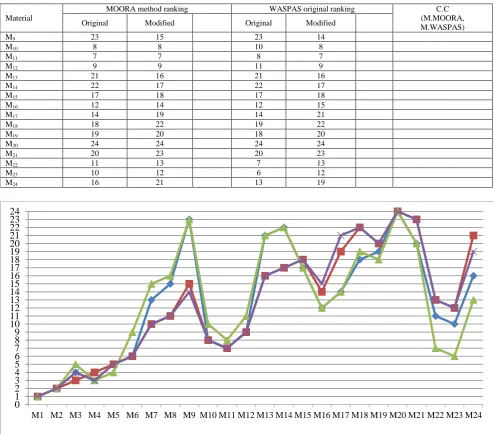
In the second case of hard magnetic material selection, the ranking outcomes based on the different MADM models are presented in Table 7. The noteworthy point here is that that both MOORA and modified MOORA generate similar ranking in almost the first top ten materials. The same condition can be seen for the top three materials when comparing the WASPAS models.
The worst material is uncovered as (𝑀24) by both
modified and original MADM methods. The correlation coefficients are acceptable for case 2 although it was not as high as case 1. Figure 3 illustrates the comparison of material ranking across the MADM methods.
Table 6 Application of New Normalization Tol on WASPAS and MOORA Ranking (Case 1)
Material
MOORA method ranking WASPAS method ranking C.C
(M.MOORA, M.WASPAS)
Original Modified C.C. Original Modified C.C.
M1 1 1 0.99 3 3 0.95 0.83
M2 3 3 1 1
M3 10 9 9 11
M4 9 10 12 12
M5 12 11 14 13
M6 2 2 2 2
M7 8 8 10 9
M8 13 13 11 8
M9 14 14 13 14
M10 6 6 6 6
M11 4 4 4 4
M12 5 5 5 5
M13 7 7 8 10
M14 11 12 7 7
Figure 2. Different Ranking Score for Modified Version of MOORA and WASPAS (case 1)
Table 7 Application of New Normalization Tool on WASPAS and MOORA Ranking (Case 2)
Material
MOORA method ranking WASPAS original ranking C.C
(M.MOORA, M.WASPAS)
Original Modified C.C. Original Modified C.C.
M1 1 1 0.9 1 1 0.83 0.995
M2 2 2 2 2
M3 4 3 5 4
M4 3 4 3 3
M5 5 5 4 5
M6 6 6 9 6
M7 13 10 15 10
M8 15 11 16 11
0 1 2 3 4 5 6 7 8 9 10 11 12 13 14
M1 M2 M3 M4 M5 M6 M7 M8 M9 M10 M11 M12 M13 M14
Material
MOORA method ranking WASPAS original ranking C.C
(M.MOORA, M.WASPAS)
Original Modified Original Modified
M9 23 15 23 14
M10 8 8 10 8
M11 7 7 8 7
M12 9 9 11 9
M13 21 16 21 16
M14 22 17 22 17
M15 17 18 17 18
M16 12 14 12 15
M17 14 19 14 21
M18 18 22 19 22
M19 19 20 18 20
M20 24 24 24 24
M21 20 23 20 23
M22 11 13 7 13
M23 10 12 6 12
M24 16 21 13 19
Figure 3. Comparing Different Ranking Score Modified MOORA and WASPAS (Case 2)
Conclusion
MADM techniques in material selection problems provide a transition from conventional scoring method to a more comprehensive and strategic approach. A broad volume of research articles since the past 2 decades showed the evolution of the material evaluation and selection process. Ashby, TOPSIS, AHP, VIKOR, ELECTRE and PROMETHEE have been successfully deployed in different material selection problems. Lately, methods like COPRAS, MOORA and WASPAS are gaining acceptance in decision making problems.
MADM methods in material selection problems seek to effectively outline decision procedures to enhance the quality of the final product. This aids designers and material engineers to enhance the fit between material properties and design specifications.
We provide a sensitivity analysis approach to evaluate the normalization effect on the original WASPAS and MOORA methods. This normalization process gives us the ability to appreciate how changes affect material engineer’s decision. This helps engineers to embed design preferences prior to developing a new product that is supported by engineering goals. This paper could further be expanded into the domain of group decision making (see Langroudi et al., 2013; Zhang et al. 2014a; Zhang et al., 2014b; Zhang et al., 2014c). The normalization process could be used as a hybrid methodology (see Behzadian et al., 2013; Tavana et al., 2016) in a decision support system (Hashemian et al., 2014) or data envelopment analysis methodology (see Ghasemi et al., 2014; Ghasemi et al., 2015; Ignatius et al., 2016). Applying other types of normalization tools in order to observe the results similarity and possible improvement can be an issue for future attempts
0 1 2 3 4 5 6 7 8 9 10 11 12 13 14 15 16 17 18 19 20 21 22 23 24
M1 M2 M3 M4 M5 M6 M7 M8 M9 M10 M11 M12 M13 M14 M15 M16 M17 M18 M19 M20 M21 M22 M23 M24
References
Anojkumar, L., Ilangkumaran, M., & Sasirekha, V. (2014). Comparative analysis of MCDM methods for pipe material selection in sugar industry. Expert Systems with Applications, 41(6), 2964–2980. http://dx.doi.org/10.1016/ j.eswa.2013.10.028
Ashby, M. F., & Cebon, D. (1993). Materials selection in mechanical design. Le Journal de Physique IV, 3(C7), C7-1. http://dx.doi.org/10.1051/jp4:1993701
Bahraminasab, M., & Jahan, A. (2011). Material selection for femoral component of total knee replacement using comprehensive VIKOR. Materials & Design, 32(8), 4471–4477. http://dx.doi.org/10.1016/j.matdes.2011.03.046 Behzadian, M., Kazemzadeh, R. B., Albadvi, A., & Aghdasi, M. (2010). PROMETHEE: A comprehensive literature review on
methodologies and applications. European journal of Operational research, 200(1), 198–215. http://dx.doi.org/10.1016/ j.ejor.2009.01.021
Behzadian, M., Otaghsara, S. K., Yazdani, M., & Ignatius, J. (2012). A state-of the-art survey of TOPSIS applications. Expert Systems with Applications, 39(17), 13051–13069. http://dx.doi.org/10.1016/j.eswa.2012.05.056
Behzadian, M., Hosseini-Motlagh, S. M., Ignatius, J., Goh, M., & Sepehri, M. M. (2013). PROMETHEE group decision support system and the house of quality. Group Decision and Negotiation, 22(2), 189–205. http://dx.doi.org/10.1007/s10726-011-9257-3
Brauers, W. K. M., & Zavadskas, E. K. (2006). The MOORA method and its application to privatization in a transition economy. Control and Cybernetics, 35(2), 445.
Calıskan, H., Kursuncu, B., Kurbanoglu, C., & Guven, S. Y. (2013). Material selection for the tool holder working under hard milling conditions using different multi criteria decision making methods. Materials & Design, 45, 473–479. http://dx.doi.org/10.1016/j.matdes.2012.09.042
Cavallini, C., Giorgetti, A., Citti, P., & Nicolaie, F. (2013). Integral aided method for material selection based on quality function deployment and comprehensive VIKOR algorithm. Materials & Design, 47, 27–34. http://dx.doi.org/ 10.1016/j.matdes.2012.12.009
Chakraborty, S., & Zavadskas, E. K. (2014). Applications of WASPAS Method in Manufacturing Decision Making. Informatica, 25(1), 1–20. http://dx.doi.org/10.15388/Informatica.2014.01
Chatterjee, P., & Chakraborty, S. (2014). Investigating the effect of Normalization Norms in Flexible manufacturing system selection using Multi criteria decision making methods. Journal of Engineering Science and Technology review, 7(3), 141–150.
Chatterjee, P., Athawale, V. M., & Chakraborty, S. (2009). Selection of materials using compromise ranking and outranking methods. Materials & Design, 30(10), 4043–4053. http://dx.doi.org/10.1016/j.matdes.2009.05.016
Chauhan, A., & Vaish, R. (2012a). A comparative study on material selection for micro-electromechanical systems. Materials & Design, 41, 177–181. http://dx.doi.org/10.1016/j.matdes.2012.04.037
Chauhan, A., & Vaish, R. (2012b). Magnetic material selection using multiple attribute decision making approach. Materials & Design, 36, 1–5. http://dx.doi.org/10.1016/j.matdes.2011.11.021
Coello Coello, C. A., & Becerra, R. L. (2009). Evolutionary multiobjective optimization in materials science and engineering. Materials and manufacturing processes, 24(2), 119–129. http://dx.doi.org/10.1080/10426910802609110
Gadakh, V. S. (2010). Application of MOORA method for parametric optimization of milling process. International Journal of Applied Engineering Research, 1(4), 743.
Ghasemi, M. R., Ignatius, J., & Emrouznejad, A. (2014). A bi-objective weighted model for improving the discrimination power in MCDEA. European Journal of Operational Research, 233(3), 640–650. http://dx.doi.org/10.1016/ j.ejor.2013.08.041
Ghasemi, M. R., Ignatius, J., Lozano, S., Emrouznejad, A., & Hatami-Marbini, A. (2015). A fuzzy expected value approach under generalized data envelopment analysis. Knowledge-Based Systems, 89, 148–159. http://dx.doi.org/10.1016/ j.knosys.2015.06.025
Girubha, R. J., & Vinodh, S. (2012). Application of fuzzy VIKOR and environmental impact analysis for material selection of an automotive component. Materials & Design, 37, 478–486. http://dx.doi.org/10.1016/j.matdes.2012.01.022
Guisbiers, G., Herth, E., Legrand, B., Rolland, N., Lasri, T., & Buchaillot, L. (2010). Materials selection procedure for RF -MEMS. Microelectronic Engineering, 87(9), 1792–1795. http://dx.doi.org/10.1016/j.mee.2009.10.016
Hashemian, S. M., Behzadian, M., Samizadeh, R., & Ignatius, J. (2014). A fuzzy hybrid group decision support system approach for the supplier evaluation process. The International Journal of Advanced Manufacturing Technology, 73(5/8), 1105–1117. http://dx.doi.org/10.1007/s00170-014-5843-2
Hashemkhani Zolfani, S., Aghdaie, M. H., Derakhti, A., Zavadskas, E.K., & Varzandeh, M.H.M. (2013). Decision making on business issues with foresight perspective; an application of new hybrid MCDM model in shopping mall locating. Expert Systems with Applications, 40(17), 7111–7121. http://dx.doi.org/10.1016/j.eswa.2013.06.040
Hwang, C. L., Yoon, K. P. (1981). Multiple Attributes Decision Making: Methods and Applications. Berlin Heidelberg: Springer. http://dx.doi.org/10.1007/978-3-642-48318-9
Ignatius, J., Ghasemi, M. R., Zhang, F., Emrouznejad, A., & Hatami-Marbini, A. (2016). Carbon efficiency evaluation: An analytical framework using fuzzy DEA. European Journal of Operational Research, 253(2), 428–440. http://dx.doi.org/10.1016/j.ejor.2016.02.014
Ignatius, J., Rahman, A., Yazdani, M., Šaparauskas, J., & Hany Haron, S. (2016). An Integrated fuzzy ANP – QFD approach for green building assessment. Journal of Civil Engineering & Management, 22(4), 351–363. http://dx.doi.org/ 10.3846/13923730.2015.1120772
Jahan, A., & Edwards, K. L. (2013). VIKOR method for material selection problems with interval numbers and target-based criteria. Materials & Design, 47, 759–765. http://dx.doi.org/10.1016/j.matdes.2012.12.072
Jahan, A., & Edwards, K. L. (2015). A state-of-the-art survey on the influence of normalization techniques in ranking: Improving the materials selection process in engineering design. Materials & Design, 65, 335–342. http://dx.doi.org/10.1016/j.matdes.2014.09.022
Jahan, A., Ismail, M. Y., Shuib, S., Norfazidah, D., & Edwards, K. L. (2011a). An aggregation technique for optimal decision-making in materials selection. Materials & Design, 32(10), 4918–4924. http://dx.doi.org/10.1016/j.matdes.2011.05.050 Jahan, A., Mustapha, F., Ismail, M. Y., Sapuan, S. M., & Bahraminasab, M. (2011b). A comprehensive VIKOR method for
material selection. Materials & Design, 32(3), 1215–1221. http://dx.doi.org/10.1016/j.matdes.2010.10.015
Jee, D. H., & Kang, K. J. (2000). A method for optimal material selection aided with decision making theory. Materials & Design, 21(3), 199–206. http://dx.doi.org/10.1016/S0261-3069(99)00066-7
Karande, P., & Chakraborty, S. (2012). Application of multi-objective optimization on the basis of ratio analysis (MOORA) method for materials selection. Materials & Design, 37, 317–324. http://dx.doi.org/10.1016/j.matdes.2012.01.013 Kendall, M. G. (1970). Rank Correlation Method. London:Griffin.
Kersuliene, V., Zavadskas, & E. K., Turskis, Z. (2010). Selection of Rational Dispute Resolution Method by Applying New Step-Wise Weight Assessment Ratio Analysis (SWARA). Journal of Business Economics and Management, 11(2), 243– 258. http://dx.doi.org/10.3846/jbem.2010.12
Langroudi, M. Z. A., Emrouznejad, A., Mustafa, A., & Ignatius, J. (2013). Type-2 TOPSIS: a group decision problem when ideal values are not extreme endpoints. Group decision and negotiation, 22(5), 851–866. http://dx.doi.org/10. 1007/s10726-012-9296-4
Liu, H. C., Liu, L., & Wu, J. (2013). Material selection using an interval 2-tuple linguistic VIKOR method considering subjective and objective weights. Materials & Design, 52, 158–167. http://dx.doi.org/10.1016/j.matdes.2013.05.054 Opricovic, S., & Tzeng, G. H. (2004). Compromise solution by MCDM methods: A comparative analysis of VIKOR and TOPSIS.
European Journal of Operational Research, 156(2), 445–455. http://dx.doi.org/10.1016/S0377-2217(03)00020-1
Parate, O., & Gupta, N. (2011). Material selection for electrostatic microactuators using Ashby approach. Materials & Design, 32(3), 1577–1581. http://dx.doi.org/10.1016/j.matdes.2010.09.012
Rao, R. V. (2008). A decision making methodology for material selection using an improved compromise ranking method. Materials & Design, 29(10), 1949–1954. http://dx.doi.org/10.1016/j.matdes.2008.04.019
Rao, R. V., & Davim, J. P. (2008). A decision-making framework model for material selection using a combined multiple attribute decision-making method. The International Journal of Advanced Manufacturing Technology, 35(7/8), 751–760. http://dx.doi.org/10.1007/s00170-006-0752-7
Rathod, M. K., & Kanzaria, H. V. (2011). A methodological concept for phase change material selection based on multiple criteria decision analysis with and without fuzzy environment. Materials & Design, 32(6), 3578–3585. http://dx.doi.org/10.1016/j.matdes.2011.02.040
Reddy, G. P., & Gupta, N. (2010). Material selection for microelectronic heat sinks: An application of the Ashby approach. Materials & Design, 31(1), 113–117. http://dx.doi.org/10.1016/j.matdes.2009.07.013
Roth, R., Field, F., & Clark, J. (1994). Materials selection and multi-attribute utility analysis. Journal of Computer-Aided Materials Design, 1(3), 325–342. http://dx.doi.org/10.1007/BF00712855
Shanian, A., & Savadogo, O. (2006). TOPSIS multiple-criteria decision support analysis for material selection of metallic bipolar plates for polymer electrolyte fuel cell. Journal of Power Sources, 159(2), 1095–1104. http://dx.doi.org/10. 1016/j.jpowsour.2005.12.092
Srikar, V. T., & Spearing, S. M. (2003). Materials selection for microfabricated electrostatic actuators. Sensors and Actuators A: physical, 102(3), 279–285. http://dx.doi.org/10.1016/S0924-4247(02)00393-X
Stanujkic, D., Karabasevic, D., & Zavadskas, E. K. (2015). A Framework for the Selection of a Packaging Design Based on the SWARA Method. Inzinerine Ekonomika-Engineering Economics, 26(2), 181–187. http://dx.doi.org/10.5755/ j01.ee.26.2.8820
Yazdani, M., & Payam, A. F. (2015). A comparative study on material selection of microelectromechanical systems electrostatic actuators using Ashby, VIKOR and TOPSIS. Materials & Design, 65, 328–334. http://dx.doi.org/10. 1016/j.matdes.2014.09.004
Yazdani, M. (2015). New intuitionistic fuzzy approach with multi-objective optimisation on the basis of ratio analysis method. International Journal of Business and Systems Research, 9(4), 355–374. http://dx.doi.org/10.1504/IJBSR.2015.072584 Yazdani, M., Hashemkhani Zolfani, S., & K. Zavadskas, E. (2016). New integration of MCDM methods and QFD in the
selection of green suppliers. Journal of Business Economic & Management. http://dx.doi.org/10.3846/ 16111699.2016.1165282
Yoon, K. P. & Hwang, C. L. (1995). Multiple Attribute Decision Making: An Introduction. Sage Publications. http://dx.doi.org/10.4135/9781412985161
Zavadskas, E. K., Kaklauskas, A., & Vilutiene, T. (2009). Multicriteria Evaluation of Apartment Blocks Maintenance Contractors: Lithuanian Case Study. International Journal of Strategic Property Management, 13(4), 319–338. http://dx.doi.org/10.3846/1648-715X.2009.13.319-338
Zavadskas, E. K., & Turskis, Z. (2008). A new logarithmic normalization method in games theory. Informatica, 19(2), 303– 314.
Zavadskas, E. K., Turskis, Z., Antucheviciene, J., & Zakarevicius, A. (2012). System Engineering, Computer Technology: Optimization of Weighted Aggregated Sum Product Assessment. Elektronika ir Elektrotechnika, 122(6), 3–6. http://dx.doi.org/10.5755/j01.eee.122.6.1810
Zavadskas, E. K., Zakarevicius, A., & Antucheviciene, J. (2006). Evaluation of ranking accuracy in multi-criteria decisions. Informatica, 17(4), 601–618.
Zhang, F., Ignatius, J., Lim, C. P., & Zhao, Y. (2014a). A new method for deriving priority weights by extracting consistent numerical-valued matrices from interval-valued fuzzy judgement matrix. Information Sciences, 279, 280–300. http://dx.doi.org/10.1016/j.ins.2014.03.120
Zhang, F., Ignatius, J., Lim, C. P., & Zhao, Y. (2014b). A new method for ranking fuzzy numbers and its application to group decision making. Applied mathematical modelling, 38(4), 1563–1582. http://dx.doi.org/10.1016/j.apm.2013.09.002 Zhang, F., Ignatius, J., Lim, C. P., & Goh, M. (2014c). A two-stage dynamic group decision making method for processing
ordinal information. Knowledge-Based Systems, 70, 189–202. http://dx.doi.org/10.1016/j.knosys.2014.06.025