COMBINATION OF PALM KERNEL HUSK ASH
(PKHA) AND FREE LIME (CaO) AS AN
ADMIXTURE IN CONCRETE PRODUCTION
Amaziah Walter Otunyoa, Baamii Nuaka and John Chigozie Faith
Department of Civil and Environmental Engineering, University of Port Harcourt, Port Harcourt.
a(Email: [email protected])
Abstract
Almost all admixtures used in concrete construction in Nigeria are imported. In this study, various proportions of free Lime (CaO), Palm Kernel Husk Ash (PKHA) and Ordinary Portland Cement (OPC) were mixed and the setting times of various mix proportions were determined and compared with that of only OPC. The compressive strength of cement mixed with various proportions PKHA was also determined. This was with a view to establishing the use of PKHA as an admixture while still retaining the compressive strength of such cement PKHA combinations. A previous study by the main author studied the suitability of PKHA alone as an admixture, while still retaining the compressive strength char-acteristics. Results revealed that the setting time of the mixture of the PKHA and OPC cubes decreased as the percentage of the PKHA increases as compared to the setting time of pure OPC cubes which was the control test. Also, the cubes obtained by mixing various percentages of the PKHA and OPC showed reduced compressive strength for the 7 and 28 days compressive strength tests respectively relative to those made with 100% OPC which also served as the control test. In this recent study, setting time of the combination of PKHA/CaO and OPC de-creased as the percentage of the PKHA/CaO increases. The compressive strength of the cubes of the combination of PKHA/CaO and cement were higher for the 7 and 14 days strength test but reduced drastically to values below that of OPC alone for the 28 days cube strength test.
Keywords: palm kernel husk ash, free lime, admixture, accelerator, cement, compressive strength, setting time
1. Introduction
The ingredients of normal concretes are ce-ment, water, fine and coarse aggregates.
Con-cretes produced with just these materials may not be able to provide certain properties or characteristics that may be demanded in
that admixtures become useful, (Neville et al., 2005)) The most widely used are chemi-cal admixtures to control setting time and/or
to reduce water. Admixtures primarily fall
into the following categories, accelerators, re-tarders, plasticizers, cementitious and poz-zolanic materials, water-proofers and materi-als used to inhibit alkali-silica reaction,
(Jack-son, et al, 1996)). Palm kernel husk is a
nuisance material in palm oil mills in
Nige-ria. Disposal after extraction of the palm
kernel seeds poses serious challenges. This
study was carried out to find out the setting times of cement cubes made of the PKHA and OPC (different PKHA/CaO/OPC ratios). It is anticipated that should the PKHA/CaO and OPC combination prove to be a useful admixture, enormous amount of foreign cur-rency spent on importation of admixtures will be saved, in addition, the cost of concrete construction works will be reduced from the partial replacement of OPC with CaO. An-other advantage will be the disposal of the palm kernel husk from the palm oil produc-tion mills, which is normally a nuisance in
the palm oil mills. Also the effect of the
PKHA plus CaO on strength development was carried out by determining the compressive Strength tests of the same mixtures after 7, 14 and 28 days respectively. El. Dakroury et al, (2008), carried out a study using Rice Husk Ash (RHA) as cement admixture for immobi-lization of liquid radioactive waste at differ-ent temperatures. It was discovered that the addition of 30% (RHA) causes a significant increase in the hydraulic stability of cement. Also, Satoru, I. (1999), carried out a study on the Utilization of RHA as an Admixture
in High-Strength Concrete. The 7-day,
28-day and 91 28-day compressive strengths of the RHA were higher than those of the control concrete without RHA, also the dosage of su-per plasticizer in concrete increased as the ash
content of the cementing material increased. Furthermore, (Muhammad et al, 2010), con-cluded from their study Mortar Incorporating Rice Husk Ash: Strength and Porosity that strength and porosity of mortar incorporating (RHA) were better, for up to 20% of cement replacement level. An earlier study (Otunyo, 2010) on the use of (PKHA) alone as an ad-mixture has been carried out. The results in-dicated that PKHA reduces the setting time of OPC cubes prepared with a mixture of PKHA and OPC while drastically reducing the com-pressive strength of such OPC cubes.
2. Objective of Study
The main objective of this study is to de-termine the suitability of PKHA as an admix-ture while still seeking to retain the required compressive strength with the aid of free lime (CaO). Other objectives include the following: a) To determine the effect of partial replace-ment of OPC with CaO on the compres-sive strength of concrete in the presence of PKHA.
b) To compare the setting time of the various percentage combination of CaO, PKHA, and OPC with the control mix in other to appreciate its role as an admixture (accel-erator)
c) To compare the compressive strength of cubes made with varying percentage com-bination of PKHA and CaO replacement to achieve a high strength concrete. d) The optimum combination of PKHA and
CaO replacement to achieve a standard compressive strength.
3. Methodology and Specimen Prepa-ration
3.1. Materials
(a) Palm Kernel husk: Approximately 300kg of palm kernel husk was collected in 5 jute bags from a local palm oil mill in Elele (a town in South-Eastern Nigeria).
(b) Cement: Ordinary Portland cement lo-cally available in Nigeria (the DANGOTE (c) Free Lime (CaO); was collected from the now defunct Niger Cement Company lo-cated at Nkalagu (a town in South East-ern Nigieria).
(d) Water: Potable water from the Civil En-gineering Laboratory of the Rivers State University of Science & Technology was used to prepare the cubes. Same water was also used for curing of the concrete cubes.
The palm kernel husks were washed to clean them and then sun dried for 48 hours in the open air to eliminate moisture to ensure faster burning of the husk. Thereafter, the husks were crushed using a steel mallet to break them into smaller particles prior to burning. The smaller pieces of palm kernel husks ob-tained after the crushing were burnt inside a steel container until the husks was com-pletely in form of ash. Approximately 150kg of PKHA was obtained from the 300kg of palm kernel husk after burning. The PKHA was sieved with a 425µm sieve to obtain very fine ash particles that will compare in size with particles of OPC locally available in Nige-ria (the DANGOTE CEMENT Brand Name). Chemical analysis of the PKHA was carried out to determine its chemical composition. Thermal Gravimetry (TG), Porosimetry, Mi-croscopy and X-Ray Diffraction (XRD) tests were also carried out to fully determine other properties of the PKHA. Setting time test us-ing a Vicats apparatus was carried out on various percentages of the PKHA/CaO and OPC cubes, according to BS 4550 Part 1
and Emesiobi, F.C. (2000). 7, 14 and 28
days compressive strength tests (BS 812) were
also carried out on the same compositions of the PKHA /CaO/OPC cubes, to determine the effect of the combination of PKHA/CaO on the strength of the OPC cubes made of mixtures of OPC and PKHA/CaO. 5 test cubes each were prepared for the following PKHA/CaO/OPC ratios:
Total weight of each of the test mould (the mixture of PHKA/CaO and OPC was approx-imately 350gm. The tests were performed in a room with 90% humidity and room temper-ature of between 25and 29.
For the compressive strength test, 3 cubes were prepared for the various combinations of the PKHA/CaO and OPC in the ratio listed above. The water/cement ratio of the
combined mixture was 0.45. A total of 12
cubes were prepared. Four of the cubes were subjected to 7, 14 and 28 days compressive strength tests respectively. The weight of each cube of concrete for the compressive strength test was 3.5kg.
4. Result of Tests
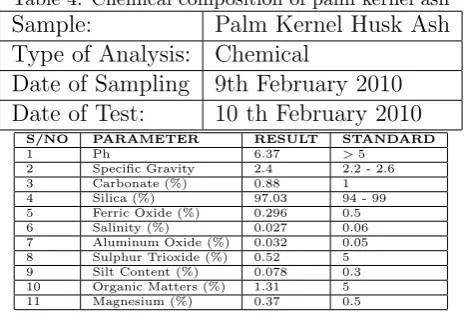
Table 1 shows percentage combination of cubes of OPC, PKHA and Free Lime (CaO) Table 2 is the average setting times for vari-ous mixtures of OPC, PKHA and Free Lime ( CaO ) cubes. Table 3 is the result of the 7, 14 and 28 days compressive strength test results. Table 4.0 is the result of the chemi-cal composition of the PKHA, while Table 5 contains the results of the TG, Porosimetry, Microscopy and XRD.
Figure 1: Setting time versus the various propor-tions of PKHA/CaO and OPC.
! " #
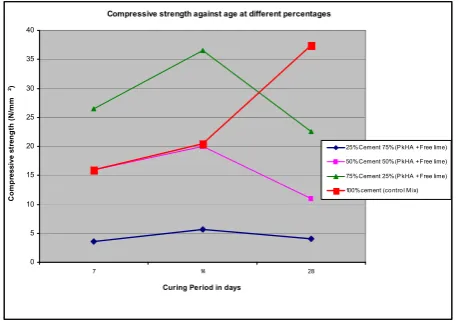
Figure 2: Compressive strength versus age for var-ious proportions of the PKHA/CaO and OPC.
" ! " # !" !" !" "
Figure 3: Compressive strength versus the various proportions of the PKHA/CaO at various ages of curing.
Table 1: Percentage combination of cubes of OPC, PKHA and free lime (CaO).
Control Cube (%) Cube 1 (%) Cube 2 (%) Cube 3 (%)
OPC 100 25 50 75
PKHA - 37.5 25 12.5
CaO - 37.5 25 12.5
Table 2: Average setting times for various mixtures of OPC, PKHA and CaO cubes.
Control Cube (%) Cube 1 (%) Cube 2 (%) Cube 3 (%)
OPC 100 75 50 25
PKHA - 12.5 25 37.5
CaO - 12.5 25 37.5
Setting times (hours)
4 3 3 2
5. Discussion of Test Results
5.1. Setting Times
Table 2, shows the average setting times the various percentage combination of PKHA,
Free Lime (CaO) and OPC. Fig. 1 is a
plot of the final setting times versus the var-ious percentages of PKHA/CaO and OPC cube mixture. The final setting time for 0% PKHA/CaO cubes (which is 100% OPC cube) is 4 hours. At 25% PKHA /CaO and 75% OPC cube mixture, the final setting time is
3 hours. Fig. 1 shows a continuous
de-crease in setting time to 2 hours for the (75% PKHA/CaO and 25% OPC cubes).
5.2. Compressive Strength
strength is as shown in Fig. 2. As can be ob-served, the compressive strength of the cubes made with mixtures of PKHA/CaO and OPC decreases as the quantity of the PKHA/CaO in the cube mixture increases. The values of the compressive strength for the 25% and 50% PKHA/CaO and 75% and 50% OPC mixture for the 7 and 14 days strength are higher than those of 100% OPC for the 7 and 14 days test but decreases dramatically by the 28th day test. The sharp retrogression in compressive strength could be attributed to the presence of hard burnt free lime which hydrates only very slowly and since slaked lime occupies a larger volume than the original free lime, expansion takes place. Cement which exhibit this ex-pansion is said to be unsound. Unsoundness causes strength retrogression. This is proba-bly the reason for the strength retrogression experienced for the PKHA/CaO and OPC cubes after 14 days. Fig. 3 is a revised plot of Fig. 2 ( plot of compressive strength ver-sus various percentages of PKHA/CaO/OPC at 7, 14 and 28days respectively.
5.3. Chemical, Physical and Miner-alogical Analysis of the PKHA:
From Table 4, the chemical analysis of the PKHA shows that it has silicon oxide (97.03%) and Ferric Oxide (0.296%). These are also the main compounds of OPC and Granulated Blast Furnace Slag Cement. From Table 5 it can be observed that 42.4% of mass loss occurs between 600and 900, the porosimetry is 18.3% which is within the stan-dard range of between 15 – 30%. The val-ues of the elongation, roundness, diameter and compactness of the grains are within the ac-ceptable ranges. The elements found from the XRD tests are O2, Mg, Si, Ca and Al, these elements correspond with the chemical com-position of the PKHA in Table 4.
A typical Granulated Blast Furnace Slag
Table 3: Compressive strength results for various per-centages of PKHA/free lime and cement mixture
Material combination
Cube strength at age
(N/mm2)
7 days 14 days 28 days
25% cement +
75% (PKHA
+ Free lime)
3.6 5.65 4.0
50% cement +
50% (PKHA
+ Free lime)
16 20 11
75% cement +
25% (PKHA
+ Free lime)
26.5 36.5 22.5
100% cement (control Mix)
16 20.5 37.5
Table 4: Chemical composition of palm kernel ash
Sample: Palm Kernel Husk Ash
Type of Analysis: Chemical
Date of Sampling 9th February 2010
Date of Test: 10 th February 2010
S/NO PARAMETER RESULT STANDARD
1 Ph 6.37 >5
2 Specific Gravity 2.4 2.2 - 2.6
3 Carbonate (%) 0.88 1
4 Silica (%) 97.03 94 - 99
5 Ferric Oxide (%) 0.296 0.5
6 Salinity (%) 0.027 0.06
7 Aluminum Oxide (%) 0.032 0.05
8 Sulphur Trioxide (%) 0.52 5
9 Silt Content (%) 0.078 0.3
10 Organic Matters (%) 1.31 5
Table 5: TG, porosimetry, microscopy, XRD test re-sults
S/ NO
Parameter Result Standard
1 TG (%) 42.4% Mass loss
oc-curs between 600 -900
2 Porosimetry (%) 18.3 15- 30
3 Microscopy
Elongation (mm) 1.83 1.09 - 6.06
Roundness (mm) 0.39 0.10 - 0.98
Diameter (mm) 30.4 7.9 - 153.8
Compactness (mm) 0.55 0.36 - 0.99
Element found
4 XRD O2, Mg, Si, Ca, Al
Cement produced in the UK has the follow-ing
CaO = 38.0%
SiO2 = 34.6%
Al2O3 = 14.6%
MgO = 9.3%
MnO = 0.5%
Fe2O3 = 0.3%
SO3 = 1.7%
Alkalis = 1.0%
The composition of the Granulated Blast furnace Slag Cement and the chemical compo-sition of the PKHA in Table 4 show that the major missing compound in PKHA is CaO. The Calcium Oxide CaO is responsible for hy-dration of cement. The function of the CaO in the PKHA would have been to provide the correct level of alkalinity for the PKHA to begin to hydrate in the presence of cement. Calcium Chloride is a very common accelera-tor. It has a pH of 7.0 which is acidic. The pH of the PKHA is 6.37 which is acidic. It could therefore be inferred that the acidic na-ture of PKHA is responsible for the shorter setting time of the OPC cubes with higher percentages of the PKHA. The presence of the PKHA/CaO did not appreciably alter the color of the PKHA/CaO and cement cube since the color of the PKHA/CaO is similar to that of OPC.
5.4. Comparison of Result of this study with previous works
An earlier study on the use of (PKHA) alone as an admixture has been carried out (Otunyo, 2010). The results indicated that PKHA reduces the setting time of OPC cubes prepared with a mixture of PKHA and OPC while drastically reducing the compressive
strength of such OPC cubes. There is no
change in this present study with a mixture of PKHA and CaO. The compressive strength of the 25 and 50% mixture of PKHA and CaO was higher than that of OPC for the 7 and 14 days but dramatically reduced to a value below the standard 28 days compressive strength.
6. Conclusion
In conclusion, it can be stated that al-though, a combination of (PKHA/CaO) can be used as an admixture (accelerator) for concrete construction. It is not desirable in construction works requiring standard con-crete compressive strengths, since although the compressive strength is higher than that of OPC between 7 and 14 days, it reduces drastically to a value lower than the standard compressive strength of OPC by the 28th day. A combination of PKHA/CaO and OPC can find use in areas like blinding, mortar, inter-nal and in exterinter-nal rendering in concrete con-struction jobs that require early setting time and where high strength is not a major re-quirement as previously concluded by a previ-ous study by Otunyo ( 2010).
The optimum PKHA/CaO replacement re-quired to achieve a high strength is 75% OPC and 25% (PKHA/CaO).
7. Recommendations
in-vestigated to find out the values of the com-pressive strength after 90 days of curing. Since CaO obtained from lime stone failed to pro-vide a concrete mixed with PKHA with ade-quate compressive strength, other local mate-rials like egg shell (containing CaCO3) should be utilized and tested for setting time and compressive strength properties.
The quantities of the combination of (25%) PKHA and Free Lime gave the shortest set-ting time. It is known that admixtures are usually added in very small quantities. It is therefore recommended to carry out further investigation using lesser percentage combina-tion of PKHA and Free Lime. This may fur-ther improve the compressive strength of the produced concrete will further reducing the setting time.
Appendix
Table A: Cubes for setting time tests
Percentage of OPC and combination of PKHA + FREE LIME
Weight of OPC,
PKHA and FREE
LIME (gms)
OPC PKHA FREE
LIME (CaO) 25% (OPC) + 75%
(PKHA + FREE
LIME)
87.5 131.25* 131.25*
50% (OPC) + 50%
(PKHA + FREE
LIME)
175.0 87.50* 87.50*
75% (OPC) + 25%
(PKHA + FREE
LIME)
262.5 43.75* 43.75*
100% (OPC) 350.0 0* 0
* In all cases equal weights of PKHA and free lime are combined with various weights of OPC to give the percentage in row 1 of the appendix.
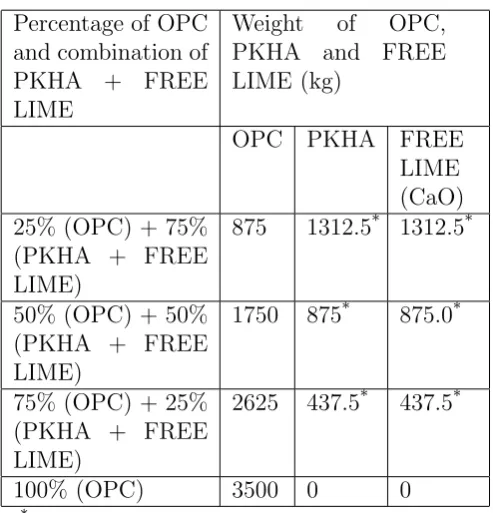
Table B: Cubes for compressive strength test
Percentage of OPC and combination of
PKHA + FREE
LIME
Weight of OPC,
PKHA and FREE
LIME (kg)
OPC PKHA FREE
LIME (CaO) 25% (OPC) + 75%
(PKHA + FREE LIME)
875 1312.5* 1312.5*
50% (OPC) + 50% (PKHA + FREE LIME)
1750 875* 875.0*
75% (OPC) + 25% (PKHA + FREE LIME)
2625 437.5* 437.5*
100% (OPC) 3500 0 0
*
In all cases equal weights of PKHA and free lime are combined with various weights of OPC to give the percentage.
References
BS (British Standards) 4550 Part 1 Methods of Testing Cement: Sampling. 1978.
BS 812-112 .Testing aggregates. Method of de-termination of aggregate impact Value 1990.
El-Dakroury A. and Gasser M.S. Rice Husk Ash (RHA) as Cement Admixture for immo-bilization of liquid radioactive waste at
differ-ent temperatures. J. Nuclear Materials., 381(3),
2008, pp 271-277.
Emesiobi, F.C.Testing and Quality Control of
Materials in Civil and Highway Engineering. The BluePrint Limited, Port Harcourt, Nigeria, 2000.
Neil, J. and Ravindra, K.D. Civil
Engineer-ing Materials, Macmillan Publishers Ltd, Lon-don, UK,1996.
Neville, A.M. and Brooks, J.J.Concrete
Tech-nology, Pearson Education Ltd., India, 1987. Otunyo, A.W. Palm Kernel Husk Ash as
Africana, University of Port Harcourt, Port Har-court. 2010 (Under review).
Otunyo, A.W., Uko, C.E.A. and Omotosho, O. Fundamentals of Civil Engineering Materials. Pearl Publishers Ltd., Port Harcourt, Nigeria, 2010.
Rashid, M. H., Molla, Md K. Ali and Ahmed, T. U. Mortar Incorporating Rice Husk Ash:
Strength and Porosity. European J. Scientific
Re-search, 2010, 40(3) pp. 471-477.
Satoru, I. Utilization of Rice Husk Ash as an
Admixture in High-Strength Concrete. Bull Fac