Application of Modified Subgradient Algorithm
Based on Feasible Values to Security Constrained
Non-Convex Economic Dispatch Problems with
Prohibited Zones and Ramp Rates
Fadıl Salih, Urazel Burak, and Tamyürek Bünyamin
Department of Electrical and Electronics Engineering, Eskisehir Osmangazi University, 26480 Eskisehir, Turkey Email: {sfadil, burazel, btamyurek}@ogu.edu.tr
Abstract—A security constrained non-convex power dispatch problem with prohibited operation zones and ramp rates is formulated and solved using an iterative solution method based on the modified subgradient algorithm operating on feasible values (F-MSG). Since the cost function, all equality and inequality constraints in the nonlinear optimization model are written in terms of the bus voltage magnitudes, the phase angles, the off-nominal tap settings, and the susceptance values of static-var (SVAR) systems, they can be taken as independent variables. The actual power system loss is included in the solution since the load flow equations are inserted into the model as the equality constraints. The proposed technique is tested on the IEEE 30-bus, 140 generator and 40 generator test systems and compared against the other methods based on heuristic and deterministic algorithms. The significant saving in the solution time is due to the elimination of the power flow calculations from the method except at the initial step.
Index Terms—economic power dispatch, F-MSG algorithm,
non-convex fuel cost rate curves, prohibited operation zones, ramp rates, security constraints
I. INTRODUCTION
Economic dispatch problem in electric power systems can be considered as a constrained non-linear optimization problem. The solution of it gives the minimum total active power generation cost rate where all equality and inequality constraints associated with the problem are satisfied.
The non-convex power dispatch problems considered in recent literature are mostly solved via dispatching techniques that employ evolutionary methods and use simplified models of power systems. Although the constraints associated with the active generations of the units are modeled in a detailed manner, the other constraints of the exact models of the power systems such as the voltage magnitude, transmission line loadability, and so on are not employed most of the time in the optimization models used by those methods. If the exact models of the power systems were used in those dispatch techniques, the solution times would increase. This is
Manuscript received January 6, 2015; revised April 15, 2015.
because a power flow calculation is required for each possible solution in the solution population.
Many methods have been developed and applied to solve the economic power dispatch problems and reported in the literature so far. Some of these methods are the shuffle frog leaping algorithm [1], the mixed integer genetic algorithm [2], the particle swarm optimization based techniques [3]-[7], the differential harmony search method [8], the evolutionary and the differential evolutionary based methods [9], [10], the artificial bee colony search method [11], the cuckoo search method [12], the gravitational search and pattern search method [13], the biogeography based optimization methods [14], mixed integer programming [15], [16], “λ-logic” based algorithm [17] and finally interior point methods [18].
In the literature, classical deterministic methods are applied to solution of various power dispatch problems [15]-[18]. In those solutions, active generations of the units are taken as independent variables. Because of that, the total reactive power generation – load balance constraint and the reactive power generation limits for the generators are not handled. Besides the power system loss is either ignored [15]-[17] or is incorporated into the solution process via reference bus penalty factors that are obtained from Jacobian matrix of load flow solution [18]. Since deterministic methods especially based on classical gradient method can have difficulty in finding the absolute minimum solution in the non-convex cost curve case, valve-point loading effects are not considered in references [15]-[18]. Also the prohibited operation zones and the ramp rates of the generators are ignored in [18] in order reduce the non-convex character of the problem. Furthermore, the security constraints associated with the bus voltage magnitude, the transmission line capacity, the off-nominal tap settings of the tap changing transformers and the susceptance values of the SVAR systems are not properly included in their optimization models.
The non-convex power dispatch problems are mostly solved via the evolutionary methods [1]-[14]. Although the constraints associated with the active generations of the units are modeled in detailed manner, the other constraints such as the reactive power generations of the reactive power sources, the transmission line capacities, the bus voltage magnitudes, and the off-nominal tap ratios are not generally modeled in the optimization models that are used by them. The active power system loss is modeled either via approximate B-matrix loss formula or not modeled at all. The active power generations are taken as the decision (independent) variables. If the exact active and reactive power balance constraints, the transmission line capacity constraints, and the bus voltage magnitude constraints are desired to be included in those models, the reactive power generations of the units, susceptance values of SVAR systems, and off-nominal tap ratio values (if there are SVAR systems and off-nominal tap ratio transformers in the system) should be added into the decision variable set and a power flow solution must be performed for each possible solution in the population set. Since the transmission line capacity constraints, the bus voltage magnitude constraints and active and reactive power generation constraints of the slack generator cannot be handled during the production of decision variables, they are possibly considered as penalty terms in the formulation of fitness function. Consequently, if all the constraints of economic dispatch problem are considered in the solution techniques based on evolutionary methods, the number of decision variables will increase, the expression of fitness function for each solution will become more complex, and a load flow solution must be performed to calculate the fitness value of each possible solution. It is because the population size and the number iterations (generation) will increase compared to those models that use a simple model of the considered power system for the same level
of solution accuracy. As a result, the solution time will be higher than what is generally given for the optimization models where the simple mode of the power system is used.
Application of the F-MSG method in a non-convex security constrained dispatch problem is given in reference [19]. Another application of the F-MSG method where it is used in the solution of security constrained non-convex economic dispatch problem of an electric power area that includes the limited energy supply thermal units is given in reference [20]. In reference [21], a security-constrained non-convex pumped-storage hydraulic unit scheduling problem is solved via F-MSG algorithm again. In these three different applications of the F-MSG method; the actual transmission line losses are added into the dispatch problem via formulating the AC load flow equations as equality constraints. What is more, the valve-point loading effects on the generators’ cost rate curves are also considered in the solutions, but the prohibited operation zone and ramp rate constraints are not.
The F-MSG is a deterministic solution method. It can solve security constrained non-convex power dispatch problems with prohibited operation zones and ramp rates. It is especially suitable to solve non-convex dispatch problems where exact model of the considered power system (optimal power flow problem) is used. Since power flow calculation is not used in the calculation process (except initial step), the solution time becomes lower than those of produced by other algorithms mentioned in recent literature. Detailed explanation about the F-MSG method can be found in reference [19]. In this paper, application of the F-MSG method is extended to non-convex dispatch problems with prohibited operation zones and ramp rates. Outperformance of the F-MSG algorithm with respect to some other economic dispatch algorithms based on heuristic and deterministic methods mentioned in recent literature is demonstrated on some well known test systems. In those test systems, prohibited operation zones and ramp rates of the generator are considered and exact or approximate model of power systems are used.
II. PROBLEM FORMULATION
A nonlinear optimization model for an economic power dispatch problem can be described as follows:
Min ( )
G
T i G i
i
F F P
N
(1) subject to
,
,
0
0, 1, 2, , Bi
Bi
Gi Load i i j
j
Gi Load i i j
j
P P p
Q Q q i N
N
N
(2)
1 1 2
,
pzi
min
Gi Gi Gi i i Gi i
max
in Gi Gi G
P P P pz pz P pz
pz P P i
N
min 0
max 0
max( , )
min( , )
min
Gi Gi Gi i
max
Gi Gi Gi i
P P P DR
P P P UR
(4) ,
min max
Gi Gi Gi Q
Q Q Q, , iN
min max
Gi Gi Gi Q
Q Q Q iN (5) ,
man
l l
p manp, , lL
l l
p p lL (6)
, 1, 2, , , ,
min max
i i i
U U U i N iref vc (7) ,
min max
i i i tap
a a ,a , iN
min max
i i i tap
a a a iN (8) ,
min max
svar i svar i svar i svar
b b b iN (9) Note that the active power generation of the th
i unit Gi
P should satisfy one of the inequalities shown in (3). In other words,
Gi
P should not be contained by any of the closed prohibited zone sets PGi pzim, pzim,
1, 2, pzi
m n .
The meanings of the symbols used in this paper are given in list of the symbols section.
A. Determination of Line Flows and Power Generations
To express the total cost rate function in terms of independent variables of the proposed optimization model, the line flows need to be written in terms of the bus voltages, the off-nominal tap settings, and the susceptance values of SVAR systems (see (1) and (2)). The necessary equations, giving the active and reactive power flows ( pi j,qi j) over the line that is connected
between buses i and j in terms of the independent variables, can be found in reference [19]. Using those equations and (2), the active and reactive power generations of the ith unit connected to bus i can be calculated as below:
B i
Gi Load i i j j
P
P
p
N
(10)
B i
Gi Load i i j j
Q Q q
N
(11)
Also, the total loss of the network can be calculated as
loss ij ij ji
p
p
p
(12) and,
LOSS ij
i N j N j i
P
p
(13)The non-convex cost rate function of the ith unit is taken as
2 ( ) sin,
i G i i i G i i G i
min
i i G i G i G
F P b c P d P
e g P P i
N
(14)
where b c d ei, i, i, i and gi are constant coefficients. The sine term in (14) is added to the cost rate curve to reflect the valve point loading affect. The non-convex total cost rate is then determined as
(
)
( / )
G
T i G i
i
F
F P
R h
N
(15)
B. Converting Inequality Constraints into Equality Constraints.
Since the F-MSG algorithm requires that all constraints should be expressed as in equality constraint form, the inequality constraints in the optimization model should be converted into corresponding equality constraints. The method described below is used for this purpose since it does not add any extra independent variable (like in the slack variable approach) into the optimization model. It is therefore the solution time of the considered dispatch problem is reduced further. A double sided inequality
i i i
x x x can be written as the following two inequalities:
( ) ( ) 0, ( ) ( ) 0
i i i i i i i i
h x x x h x xx (16) Then we can rewrite the above inequalities as a single equality constraint form as follows:
max 0, ( )
( ) max 0, 0
max 0, ( )
i i eq i i i i x x h x x x
(17)If xi xi xi , it is obvious that (xi xi ) 0
, (xi xi) 0
and
max 0, xixi 0, ,
max 0, xixi 0. So, the inequality constraints in (16) can be represented by the corresponding single equality constraint in (17). In this paper, the double sided inequality constraints given in (5)-(9) are converted into the corresponding single equality constraints in this manner. By the same reasoning, the union of two sided inequalities shown in (3) can be converted into the corresponding single equality constraint that is given in (18).
1
1
2
max 0, ( )
,
max 0, ( )
max 0, ( )
( ) min , 0
max 0, ( )
max 0, ( )
max 0, ( )
G pz i min Gi Gi Gi i i Gi eq i Gi Gi i in Gi max Gi Gi i P P P pz pz P P P pz pz P P P
h
N (18)It should be noted that when PGi takes an infeasible value, all quantities inside the square brackets in (18) become positive and therefore the equality constraint is not satisfied. In the opposite case, once
Gi
P takes a feasible value, one of the quantities contained by the square brackets becomes zero, so the equality constraint is satisfied in this case.
III. THE F-MSGALGORITHM
off-nominal tap ratio transformers and the susceptance values of the SVAR systems in the network. The method uses an augmented LaGrange function that is called as sharp LaGrange function. The F-MSG algorithm proposed to solve the dispatch problem described in Section 2 and based on the modified subgradient method based on feasible values is given in reference [19] in detailed manner. The reader should refer to reference [19] to examine the F-MSG algorithm.
IV. NUMERIC EXAMPLE
In this section, the proposed technique is going to be tested on non-convex and convex dispatch problems of test systems which were solved via heuristic and deterministic solution methods previously. The test systems include the IEEE 30-bus, the 140 generator and 40 generator test systems. The simulation program is coded in Matlab 6.1. The CSP problem appears in the third step of the F-MSG algorithm is solved by GAMS 21.5 with Conopt type solver [19]. A PC with Intel Core 2 Duo 2.20GHz CPU and 4GB RAM is used for the solution of the dispatch problems.
A. Solving Economic Non-Convex Dispatch Problem of IEEE 30-Bus Test System with F-MSG.
The detailed information about the IEEE 30-bus test system data can be found in web page of University of Washington1. Please refer to reference [1] for detailed generator data. The bus numbered as 1 is chosen as the reference bus and its voltage is taken as 1.05 0 pu. The lower and upper limits of voltage magnitudes for all busses, except the reference bus, are taken as 0.95puand 1.05pu, respectively. Also the lower and upper limits of all off-nominal transformer tap settings are taken as 0.9 and 1.1, respectively. Similarly, the lower and upper limits for susceptances values of all SVAR systems are taken as 0.0pu and 0.1pu, respectively. In addition, the parameters of the F-MSG algorithm are chosen as α=1250, λ=1, ε1=1×10⁻⁵, ε2=0.05, M=250,
1
1[0, 0,...0, 0](1 107)
u =[0,0,…0,0](1×107), 1
1
2500
c
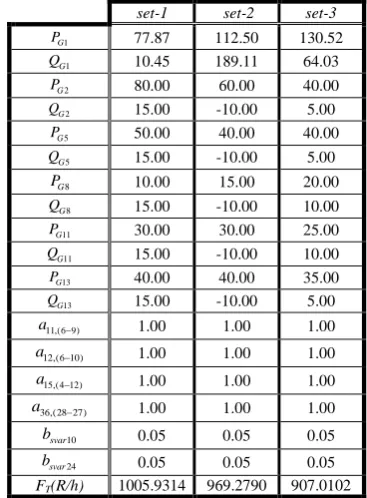
=2500, 1 =100100R/hR h, and / ,( )k k [19]. The same dispatch problem is solved three times via the F-MSG method by using three different initial data sets. The same parameters are used in all solutions. The selected actual initial active and reactive generations, tap ratios, per-unit susceptance values of SVAR systems for three different starting points are given in Table I. To obtain the initial cost rate and the bus voltage values for each initial data set, a load flow solution is carried out by using each data set. The calculated initial total cost rate values for each initial data set are also shown in Table I.
The non-convex dispatch problem of IEEE 30-bus test system, where the prohibited operation zones of generating units are considered, was previously solved and the results were presented in reference [1]. The solution was performed using four different methods: simulated annealing (SA), particle swarm optimization (PSO), shuffled frog leaping algorithm (SFLA), and
1
http://www.ee.washington.edu/research/pstca/pf30/pg_tca30bus.htm
hybrid SFLA-SA. The optimal total cost rate and solution time (ST) values produced by the F-MSG and the other methods are listed in Table II for comparison. The best total cost rate produced by the F-MSG is 7.1725, 5.8396, 5.45276 and 5.27 R/h less than those produced by SA, PSO, SFLA and hybrid SFLA-SA, respectively. Similarly, the solution time of the best total cost rate solution of the F-MSG is 9.33, 1.9375, 1.894 and 1.689 times smaller than those given by SA, PSO, SFLA and hybrid SFLA-SA, respectively. We can conclude that the F-MSG method outperforms the others in terms of both the total cost rate and the solution time.
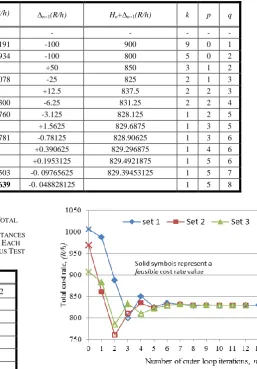
Some intermediate results obtained from application of the F-MSG algorithm to the dispatch problem using the first initial data set is shown in Table III. The total cost rate is decreased from the initial value of 1005.9314 R/h to 826.3639 R/h in 13 outer loop iterations where eight of them give a feasible solution. The algorithm stops at the 13th outer loop since ∆14 becomes less than 0.05(=ε2). Because of this, the last feasible solution, which is 829.3639 R/h found at the 13th outer loop iteration, is taken as the optimal total cost rate value [19].
The change of the total cost rate values (feasible/infeasible) versus number of outer loop iterations during each solution procedure are shown in Fig. 1. Convergence of the F-MSG algorithm to the same optimal total cost rate value for different initial data sets is clearly seen in Fig. 1. It is also seen from Table II that the highest solution time produced by the F-MSG algorithm is much lower than the best of solution times produced by the other methods. The optimal generations, tap ratios and susceptances of SVAR systems are shown in Table IV. We see from the table that generation, tap ratio, and SVAR systems susceptance constraints are met at the solution points.
TABLEI. SELECTED THREE DIFFERENT SET OF INITIAL ACTUAL GENERATIONS,TAP RATIOS,PER-UNIT SUSCEPTANCE VALUES OF SVARSYSTEMS AND THE CORRESPONDING INITIAL TOTAL COST RATE
VALUES FOR THE DISPATCH PROBLEM OF IEEE30-BUS TEST SYSTEM
set-1 set-2 set-3
1
G
P 77.87 112.50 130.52 1
G
Q 10.45 189.11 64.03 2
G
P 80.00 60.00 40.00 2
G
Q 15.00 -10.00 5.00 5
G
P 50.00 40.00 40.00 5
G
Q 15.00 -10.00 5.00 8
G
P 10.00 15.00 20.00 8
G
Q 15.00 -10.00 10.00 11
G
P 30.00 30.00 25.00 11
G
Q 15.00 -10.00 10.00 13
G
P 40.00 40.00 35.00 13
G
Q 15.00 -10.00 5.00
11,(6 9)
a 1.00 1.00 1.00
12,(6 10)
a 1.00 1.00 1.00
15,(4 12)
a 1.00 1.00 1.00
36,(28 27)
a 1.00 1.00 1.00
10
svar
b 0.05 0.05 0.05
24
svar
b 0.05 0.05 0.05
TABLEII. COMPARISON OF THE OPTIMAL TOTAL COST RATE AND SOLUTION TIME VALUES PRODUCED BY THE F-MSGMETHOD WITH THOSE OF FOUND VIA THE OTHER METHODS.
Method F-MSG SA PSO SFLA Hybrid
SFLA-SA Set-1 Set-2 Set-3
Optimal total cost rate
value, (R/h) 829.3639 829.4442 829.4655 836.5364 835.4786 834.8166 834.6339
ST (sec) 16.32 15.65 15.11 152.32 31.62 30.72 27.57
TABLEIII. SOME INTERMEDIATE RESULTS OBTAINED FROM APPLICATION OF THE F-MSGALGORITHM TO THE DISPATCH PROBLEM OF IEEE30-BUS TEST SYSTEM.THE PROHIBITED GENERATION ZONES ARE CONSIDERED.
n Hn(R/h)
Feasible/ Infeasible
n T
F (R/h) ∆n+1(R/h) Hn+∆n+1(R/h) k p q
0 1005.9314 - - - -
1 1000 Feasible 986.9191 -100 900 9 0 1 2 900 Feasible 887.0934 -100 800 5 0 2
3 800 Infeasible - +50 850 3 1 2
4 850 Feasible 849.7078 -25 825 2 1 3
5 825 Infeasible - +12.5 837.5 2 2 3
6 837.50 Feasible 834.7300 -6.25 831.25 2 2 4 7 831.25 Feasible 831.0760 -3.125 828.125 1 2 5 8 828.125 Infeasible - +1.5625 829.6875 1 3 5 9 829.6875 Feasible 829.9781 -0.78125 828.90625 1 3 6 10 828.90625 Infeasible - +0.390625 829.296875 1 4 6 11 829.296875 Infeasible - +0.1953125 829.4921875 1 5 6 12 829.4921875 Feasible 829.4503 -0. 09765625 829.39453125 1 5 7 13 829.39453125 Feasible 829.3639 -0. 048828125 1 5 8
TABLEIV. SOLUTION POINT ACTUAL GENERATIONS, THE TOTAL ACTIVE LOSS, THE TAP RATIOS (aline number bus to bus,( )) THE SUSCEPTANCES
OF SVARSYSTEMS AND THE TOTAL COST RATE VALUES FOR EACH INITIAL DATA SET FOR THE DISPATCH PROBLEM OF IEEE30-BUS TEST
SYSTEM
set-1 set-2 set-3
1
G
P 219.8112 219.7796 219.5812 1
G
Q -50.4049 15.5686 -3.1018
2
G
P 29.5431 30.0076 28.1929
2
G
Q 55.3226 24.4666 71.1305
5
G
P 15.4059 15.0001 16.8843
5
G
Q 40.8463 27.7390 12.0065 8
G
P 10.0000 10.0054 10.0007
8
G
Q 86.9862 72.0524 31.1236
11
G
P 10.0000 10.0000 10.0000
11
G
Q 6.5357 21.7800 19.2252
13
G
P 12.0004 11.9999 12.0000
13
G
Q 3.6599 13.1368 14.7889 LOSS
P 13.3657 13.4046 13.2606
11,(6 9)
a 1.0090 1.0018 0.9961
12,(6 10)
a 0.9984 1.0010 1.0055
15,(4 12)
a 0.9920 0.9886 0.9942
36,(28 27)
a 1.0011 0.9911 0.9971
10
svar
b 0.012 0.023 0.007
24
svar
b 0.026 0.021 0.018
T
F (R/h) 829.3639 829.4442 829.4655
Figure 1. Change of the total cost rate values (feasible/infeasible) versus number of outer loop iterations for the dispatch problem of IEEE
30-bus test system
B. Solving Non-Convex Economic Dispatch Problem of 140 Generator Test System with F-MSG
Please refer to reference [10] for detailed generator data about 140 generators Korean power system. In the dispatch problem considered in reference [10], a simple model of the power system is considered. The total cost rate of the system is minimized under equality constraint
140
1
( )
i Gi LOAD
i
F P P
, where PLOAD stands for the totalWe solved the dispatch problem via our dispatch method by using the same initial active generations and total system active load, PLOAD=49342MW, which are
given in reference [10]. The parameters of the F-MSG algorithm [19] are chosen as α=1.5, λ=1.5, ε1=0.005, ε2=1000, M=250, 1
1[0, 0,...0, 0](1 107)
u =[0,0,…0,0](1×141), c11
=27500,2500
1 100 R h/ ,
=100000R/h, and ( )k k . The dispatch problem considered in this section was solved by means of particle swarm optimization with both chaotic sequences and crossover operation algorithm (CCPSO), particle swarm optimization with the proposed constraint treatment strategy (CTPSO), group search optimizer (GSO),
continuous quick group search optimizer (CQGSO) [22] and differential evolution based on truncated Lévy-type flights and population diversity measure (DEL) [10] previously reported in literature. The solution point total cost rate and solution time values produced by the F-MSG, and the other methods mentioned in the above are given in Table V. It is seen from the table that all the solution methods, except GSO, give almost the same total cost rate value but the solution time produced by the F-MSG is 5.345, 3.563, 1.917 and 1.128 times smaller than those produced by CCPSO, CTPSO, GSO and CQGSO, respectively.
TABLEV. THE SOLUTION POINT TOTAL COST RATE AND SOLUTION TIME VALUES PRODUCED BY THE F-MSG, AND SOME OTHER METHODS FOUND IN THE RECENT LITERATURE.
Method F-MSG CCPSO CTPSO GSO CQGSO DEL Optimal total
cost rate (R/h) 1657961.345 1657962.730 1657962.730 1728151.168 1657962.727 1657962.717
ST (sec) 28.06 150 100 53.80 31.67 -
C. Solving Non-Convex Economic Dispatch Problem of 40 Generator Test System with F-MSG.
Please refer to reference [15] for detailed generator data about 40 generator power test system. In the dispatch problem considered in reference [15], a simple lossless model of the power system is considered. Convex cost rate functions are taken for each generator. The total cost rate of the system is minimized under the following equality constraint
40 1
( )
i Gi LOAD
i
F P P
, where PLOAD standsfor the total system active load, the ramp rates and prohibited operation zones of the generators are considered.
We solved the dispatch problem via our dispatch method by using the same initial active generations and total system active load, 7000 MW, which are given in reference [15]. The parameters of the F-MSG algorithm used in solution of the problem are chosen as α=1.5, λ=1.5, ε1=0.05, ε2=1, M=250, 1
1[0, 0,...0, 0](1 107)
u =[0,0,…0,0](1×41), 1
1
2500
c =15000,
1=500100R/hR h, and / , ( )k k [19].The dispatch problem considered in this section was solved by means of mixed integer quadratic programming (MIQP), which is a deterministic method, previously [15]. The solution point total cost rate and solution time values produced by the F-MSG, and MIQP are given in Table VI. It is seen from the table that both methods give almost the same total cost rate value, but the solution time produced by the F-MSG is lower than the one produced by MIQP.
TABLEVI. OPTIMAL COST RATE AND SOLUTION TIME VALUES PRODUCED BY F-MSG AND MIQP
Method MIQP F-MSG
Optimal total cost rate
(R/h) 100767.6872 100767.644 ST (sec) 0.186 0.150
V. DISCUSSION AND CONCLUSION
In this paper, a power dispatch technique based on the F-MSG algorithm is proposed to solve the security constrained non-convex dispatch problems with prohibited zones and ramp rates. The proposed dispatch technique is tested on IEEE 30-bus, 140 generator and 40 generator test systems. Outperformance of the proposed technique against ten dispatch techniques that are based on evolutionary and deterministic methods and reported in the recent literature is demonstrated on the selected test systems. The advantages of the proposed method can be summarized as follows:
1) The exact optimization model of an electric power system can be used in the proposed solution technique.
2) Since the bus voltage magnitudes and angles, the off-nominal tap ratios, and the susceptance values of SVAR systems are taken as independent (decision) variables, all constraints considered in the dispatch problem are handled in the same model easily.
3) Due to the selection of independent variables, both active and reactive power optimization processes are carried out simultaneously.
4) Although the proposed method is a deterministic one, it can solve non-convex security constrained dispatch problems due to its way of search and the formation of its sharp augmented LaGrange function.
selected initial generations do not even need to satisfy all the constraints of the dispatch problem. Due to the reasons given in the above and in item 4, the solution time of the proposed dispatch technique is much lower than those of the solution techniques based on evolutionary methods once especially the exact model of the power system is employed.
6) The proposed dispatch technique can be applied to high dimensional dispatch problems since the F-MSG method can solve dispatch problems with high number of independent variables.
APPENDIX LIST OF SYMBOLS R: A fictitious monetary unit.
G
N : Set that contains all buses to which a generator is
connected.
Q
N : Set that contains all buses to which a reactive power
source is connected. Bi
N : Set that contains all buses directly connected to bus i.
svar
N : Set that contains all svar systems in the network.
L
: Set that contains all lines in the network. iU : Voltage magnitude of bus i.
svari
b : Susceptance of the svar system connected to bus i. i
a: Off-Nominal tap setting value of tap setting facility at bus i.
,
i j i j
p q : Active and reactive power flows from bus i to bus j at bus i border, respectively.
l
p : Active power flow on line l. ,
Gi Gi
P Q : Active and reactive power generations of the ith unit, respectively.
,, ,
Load i Load i
P Q : Active and reactive loads of the th i bus, respectively.
LOSS
P : Total active power loss in the network.
( )
i Gi
F P : Active power generation cost rate function of
the th
i generation unit.
T
F : Total active power generation cost rate of the system.
,
min max
Gi Gi
P P : Lower and upper active generation limits of the th
i generation unit, respectively.
0
Gi
P : Initial active generation of the ith generation unit.
i
UR, DRi: Ramp-Up and ramp-down rate limits of the ith unit, respectively.
,
im im
pz pz: Lower and upper limits of the th
m prohibited zone for the ith unit’s active power generation, respectively.
pzi
n : Number of prohibited zones for the th
i generating unit. Prohibited zones are numbered in such a way that
( 1) , 2,3,...,
i m im pzi
pz pz m n .
REFERENCES
[1] T. Niknam, M. R. Narimani, and R. Azizipanah-Abarghooee, “A new hybrid algorithm for optimal power flow considering
prohibited zones and valve point effect,” Energy Convers. Manage.,vol. 58, pp. 197-206, 2010.
[2] Z.-L. Gaing and R.-F. Chang, “Security-Constrained optimal power flow by mixed-integer genetic algorithm with arithmetic operators,” in Proc. IEEE Power Engineering Society General Meeting, Montreal, Quebec, Canada, Jun. 2006, pp. 1-8.
[3] Z.-L. Gaing and X.-H. Liu, “New constriction particle swarm optimization for security constrained optimal power flow solution,” in Proc.International Conference on Intelligent Systems Applications to Power Systems, Kaohsiung, Taiwan, Nov. 2007, pp. 1-6.
[4] V. K. Jadoun, N. Gupta, K. R. Niazi, and A. Swarnkar, “Dynamically controlled particle swarm optimization for large-scale nonconvex economic dispatch problems,” International Transactions on Electrical Energy Systems, 2014.
[5] N. Ghorbani, S. Vakili, E. Babaei, and A. Sakhavati, “Particle swarm optimization with smart inertia factor for solving non-convex economic load dispatch problems,” International Transactions on Electrical Energy Systems, vol. 24, pp. 1120-1133, 2014.
[6] T. Niknam, H. D. Mojarrad, and H. Z. Meymand, “A new particle swarm optimization for non-convex economic dispatch,”
European Transactions on Electrical Power, vol. 21, pp. 656-679, 2011.
[7] T. Niknam, M. R. Narimani, and M. Jabbari, “Dynamic optimal power flow using hybrid particle swarm optimization and simulated annealing,” International Transactions on Electrical Energy Systems, vol. 23, pp. 975-1001, 2013.
[8] A. Rajagopalan, V. Sengoden, and R. Govindasamy, “Solving economic load dispatch problems using chaotic selfadaptive differential harmony search algorithm,” International Transactions on Electrical Energy Systems, 2014.
[9] S. S. Reddy, P. R. Bijwe, and A. R. Abhyankar, “Faster evolutionary algorithm based optimal power flow using incremental variables,” Int. J. Elec. Power Energy Syst.,vol. 54, pp. 198-210, 2014.
[10] L. dos S. Coelho, T. C. Bora, and V. C. Mariani, “Differential evolution based on truncated Lévy-type flights and population diversity measure to solve economic load dispatch problems,” Int. J. Elec. Power Energy Syst., vol. 57, pp. 178-188, 2014.
[11] S. Ozyon and D. Aydin, “Incremental artificial bee colony with local search to economic dispatch problem with ramp rate limits and prohibited operating zones,” Energy Convers. Manage., vol. 65, pp. 397-407, 2013.
[12] E. Afzalan and M. Joorabian, “An improved cuckoo search algorithm for power economic load dispatch,” International Transactions on Electrical Energy Systems, 2014
[13] B. Mahdad and K. Srairi, “Interactive gravitational search algorithm and pattern search algorithms for practical dynamic economic dispatch,” International Transactions on Electrical Energy Systems, 2014.
[14] G. Xiong, D. Shi, and X. Duan, “Multi-Strategy ensemble biogeography-based optimization for economic dispatch problems,” Appl. Energy, vol. 111, pp. 801-811, 2013.
[15] L. G. Papageorgiou and E. S. Fraga, “A mixed integer quadratic programming formulation for the economic dispatch of generators with prohibited operating zones,” Electr. Pow. Syst. Res., vol. 77, pp. 1292-1296, 2007.
[16] H. Daneshi, A. L. Choobbari, M. Shahidehpour, and Z. Li, “Mixed integer programming method to solve security constrained unit commitment with restricted operating zone limits,” in Proc.IEEE International Conference on Electro/Information Technology, Iowa, USA, May 2008, pp. 187-192
[17] T. Adhinarayanan and M. Sydulu, “Reserve constrained economic dispatch with prohibited operating zones using λ-logic based algorithm,” in Proc. IEEE Power Engineering Society General Meeting, Tampa, Florida, USA, Jun. 2007, pp. 1-7.
[18] I. A Farhat and M. E El-Hawary, “Interior point methods application in optimum operational scheduling of electric power systems,” IET Gener. Transm. Distrib., vol. 3, no. 11, pp. 1020-1029, 2009.
[20] S. Fadıl, A. Yazıcı, and B. Urazel, “A security-constrained economic power dispatch technique using modified subgradient algorithm based on feasible values and pseudo scaling factor for a power system area including limited energy supply thermal units,”
Electr. Pow. Compo. Syst., vol. 39, no. 16, pp. 1748-1768, 2011. [21] S. Fadıl and B. Urazel, “Solution to security-constrained
nonconvex pumped-storage hydraulic unit scheduling problem by modified subgradient algorithm based on feasible values and pseudo water price,” Electric Power Components and Systems, vol. 41, no. 2, pp. 111-135, 2013.
[22] M. Moradi-Dalvand, B. Mohammadi-Ivatloo, A. Najafi, and A. Rabiee, “Continuous quick group search optimizer for solving non-convex economic dispatch problems,” Electr. Pow. Syst. Res., vol. 93, pp. 93-105, 2012.
Salih Fadıl was born in Istanbul, Turkey, in 1959. He received the B.Sc. and M.Sc. degrees in electric power engineering from Istanbul Technical University in 1982 and 1985, respectively. He received the Ph. D. degree from Washington State University, Wa, USA in 1992. He is currently working as a professor at Electrical and Electronics Engineering Department of Eskişehir Osmangazi Universtiy, Eskisehir, Turkey. His research interests include economic operation of electric power systems, electric power system reliability modeling and small scale microprocessor based systems
Burak Urazel was born in Eskişehir, Turkey, in 1984. He received his B.Sc. degree from Anadolu University, Eskişehir, Turkey, in 2008, his M.Sc. degree from Eskişehir Osmangazi University, Eskişehir, Turkey, in 2011. He is currently working as a research assistant and doing his Ph.D. in Eskişehir Osmangazi University. His main fields of research are optimization methods and their application in power systems.