INTERNATIONAL JOURNAL FOR MATHEMATICS TEACHING AND LEARNING 2018, Vol 19.1. 69-89
Problem-Solving Trajectories in a Dynamic Mathematics
Environment: The Geometer’s Sketchpad
Matthew Jobrack
Washington State University [email protected]
Kayla Chandler
North Carolina State University [email protected]
Michael J. Bossé
Appalachian State University [email protected]
Kwaku Adu-Gyamfi
East Carolina University
Student problem solving in the context of a dynamic mathematics environment (DME) has previously been investigated primarily through the lens of whether or not the student could complete a problem-solving task. Herein, we investigate what trajectories students employ in the realms of mathematics, technology, and problem solving as they attempt to complete tasks and which of these trajectories are more helpful than others. Notably, it was determined that these trajectories are idiosyncratic, nonlinear, and iterative and that, while some trajectories help problem solving, others harm the problem-solving process. Indeed, the trajectory employed by a student during problem solving in a DME may have more to do with different ways that they consider mathematics, technology, and problem solving than their actual skills in such. Among other findings, it was determined that student access to technology may not assist their mathematical problem solving and may at times hinder it even further. Herein, students with weak mathematical skills were less able to accomplish tasks in DMEs than are students with weak technology skills. Technology itself had little effect on mitigating student mathematical weaknesses. However, when students were technologically weaker, stronger mathematical understanding could pull them through DME problem-solving activities.
Introduction
Modern technology has resulted in the development of dynamic mathematics environments (DMEs) that allow access to mathematical concepts through multiple, dynamic representations and afford users the ability to transform mathematical relations and to explore mathematical properties. Various DMEs such as The Geometer’s Sketchpad, Cabri, GeoGebra, and Cinderella are becoming ubiquitous in K-16 mathematics education. These novel technological environments are greatly influencing mathematics instruction in the areas of concept and skill development, reasoning, communication, and problem solving (National Council of Teachers of Mathematics [NCTM], 2000). They highlight new ways to interact with mathematical concepts and provide new types of mathematical tasks that can be investigated.
Problem-Solving Trajectories Jobrack, Bossé, Chandler, & Adu-Gyamfi
70
directions in both mathematics and technology – as students attempt to solve problems in one particular DME, The Geometer’s Sketchpad.
Background Literature
Problem Solving
In order to discuss problem solving, it is first necessary to define the nature of a problem. To do so, Bossé and Bahr (2008) define a problem as:
a scenario in which, upon initiation, neither the result nor a method for solution is known; an exercise is a scenario in which the result is unknown but a method for solution is known. Notably, what may be an exercise for one student may be a problem for another. Furthermore, when students do not know a method to solve a scenario, even though they should, it is a problem until they learn a method for solution; then it becomes an exercise. (p. 10)
Therefore, problem solving connotes both the task at hand and that heuristics needed to solve the problem must be discovered through the process.
Although much has evolved since problem-solving’s heyday in the 1980s and 1990s, the literature of that era recognizes problem solving as an independent field of study through a tableau of dimensions. For instance, problem solving is a sense-making tool leading to generalization and, through the creating, conjecturing, exploring, testing, and verifying associated with problem solving, students develop conceptual understanding and cognitively reorganize concepts involved in the activity (Cobb, Yackel, & Wood, 1992; Lester et al., 1994; Schoenfeld, 1994). However, as an independent topic, it is suggested that students investigate their own problem-solving styles and techniques and that of others in order to better understand and learn about problem solving (Carpenter, 1989; Stacey & Groves, 1985; Thompson, 1985).
Schoenfeld (1992) opines that mathematical thinking is a combination of abstract thought, metacognition, and an understanding of the underlying structures in mathematics and how they can be applied to problem solving. As such, problem solving is instrumental to learning (Wilson, Fernandez, & Hadaway, 1993). However, there seems to be a circular nature regarding problem solving and mathematical knowledge: students with greater mathematical knowledge may be better mathematical problem-solvers and students who are stronger problem-solvers may learn mathematics more efficiently (Pajares & Kranzler, 1995). While students’ mathematical knowledge is an important factor regarding the ability to solve open-ended problems, evidence suggests that other characteristics, such as self-efficacy, perseverance, and how much creative problem solving has been encouraged in the classroom rather than robotic algorithms and memorization, make reliable predictors regarding problem-solving success (Hiebert et al., 1996; Pajares & Kranzler, 1995; Pajares, 1996).
Problem-Solving Trajectories Jobrack, Bossé, Chandler, & Adu-Gyamfi
Dynamic Mathematics Environment
A dynamic mathematics environment (DME) is a computer environment that allows the user to create a mathematical object with various properties, and then manipulate the object while it is still constrained by those properties (Hollebrands & Lee, 2012; Hoyles & Noss, 1994). Examples of DMEs include: interactive geometry environments (IGEs) (e.g., The Geometer’s Sketchpad, GeoGebra, Cabri); dynamic statistical environments (e.g., Fathom, TinkerPlots); and Cinderella, among a growing number of others. One of the most striking features of a DME is that after elements are created (e.g., parameters, functions, geometric objects, measurements, data elements), the DME allows users to manipulate elements, while maintaining the underlying mathematical relationships or properties (Hollebrands & Lee, 2012; Hölzl, 1996; Jones, 2000). In IGEs, this feature, often called dragging, allows users to make connections between the world of mathematical theory and that of actual experience (Baccaglini-Frank & Mariotti, 2010). Dragging also allows users to observe the logical dependence among certain geometric properties and elements regardless of the transformation of other constructed elements.
Through various activities employing DMEs, instructional material can help students deduce those logical dependencies and reinforce mathematical interconnections. Through dynamically interconnected representations and instantaneous feedback, DMEs afford users the opportunity to: concretize mathematical concepts, transform and explore mathematical relations and properties, investigate mathematical notions through unique representational forms, and develop and investigate mathematical conjectures (Arzarello et al., 1998; Baccaglini-Frank & Mariotti, 2010; Goldenberg & Cuoco, 1998; Ruthven, Hennessy, & Deaney, 2008). With activities somewhat similar to physical mathematical manipulatives, the human/DME interface is interactive and provides a tool through which students gain deeper and more interconnected mathematical understanding as they dynamically create, manipulate, and visualize mathematical concepts (Arzarello, Olivero, Paola, & Robutti, 2002; de Villiers, 2004; Dick & Hollebrands 2011; Duval, 2006; Falcade, Laborde, & Mariotti, 2007; Finzer & Bennett, 1995; Gonzalez, & Herbst, 2009; Hollebrands, & Smith, 2009; Lopez-Real & Leung, 2006).
Problem-Solving Trajectories Jobrack, Bossé, Chandler, & Adu-Gyamfi
72
using the software. Notably, there is only a limited amount of research investigating how students interacted with The Geometer’s Sketchpad throughout an entire problem-solving activity (e.g., Brown, Bossé, & Chandler, 2106).
Because students can directly manipulate objects or constructions, Lee and Hollebrands (2006) argue that students may better understand particular mathematical ideas through DMEs. DMEs allow researchers to investigate student understanding by analyzing techniques students use in these dynamic environments (Isiksal & Askar, 2005; DePeau & Kalder, 2010; Lee, Harper, Driskell, Kersaint, & Leatham, 2012). Although DMEs have become powerful problem-solving tools, when problem solving in a DME, multiple dimensions are at play (e.g., mathematics, technology, problem solving, and respective intersections of these) (Hollebrands & Lee, 2012; Garofalo, Drier, Harper, Timmerman, & Shockey, 2000). To understand student problem solving in DMEs, some of these dimensions must be disaggregated from the entire picture of student heuristics. It remains an open question as to how students solve problems in DME, what trajectories they commonly take, and how their background might predict what paths they take to solve problems. It is also unclear how interpreting problems in DMEs, solving problems with the aid of DMEs, and solving problems unique to working in a DME fit within current research regarding problem solving. This study seeks to investigate the sequence of mathematical and technological actions employed by students solving problems in one particular DME, The Geometer’s Sketchpad, and gain a better grasp on the mathematical, technological, and problem-solving trajectories students take while solving problems in this DME.
Methodology
As defined below, this study observed student work as they attempted to complete particular tasks. In order to examine how students with different backgrounds and abilities in mathematics, technology, and problem solving completed the research task, a collective case study design (Stake, 2000) was necessary and employed. Case studies are generally used to explore the interpretative and subjective dimensions of a phenomenon (Strauss & Corbin, 1990). Since a researcher’s comprehension of student thinking and understanding is inherently incomplete, this strategy provides a means through which to make inferences about student actions and thinking.
More precisely, this falls in the realm of a case study on individuals and a cross case comparison synthesizing all the cases (Bogden & Biklen, 2003; Creswell, 2003). Through this methodology, observations of student behavior and activities could be reviewed to identify themes and categories (Bogden & Biklen, 2003; Creswell, 2003), data could be sorted into those categories and questions raised about such, and possible explanations for these questions could be investigated (Strauss & Corbin, 1994).
Participants
Problem-Solving Trajectories Jobrack, Bossé, Chandler, & Adu-Gyamfi
Table 1
Participant Demographic Information.
University
Standing Major
Previous GSP
Experience Gender
Student 1 Junior Math Limited Male
Student 2 Senior Physics None Male
Student 3 Junior Math Extensive Male
Student 4 Junior Education Extensive Female
Student 5 Junior Statistics None Female
Student 6 Junior English None Male
Before the study, significant variation existed among the participants’ previous knowledge of mathematics and the DME, The Geometers’ Sketchpad (GSP), used for this study; some had extensively used the program in the past (N = 2), while others had never seen it before (N = 3). To get participants up to speed on the technology, a week before the start of the study, they were all required to attend two, three-hour training sessions, where they were guided through practice with basic through more advanced construction techniques in the DME, including the use of Boolean operations and custom tools. To supplement the training session and provide participants with sufficient experience with GSP, participants were also required to watch through and practice alongside a series of videos showing many more sample constructions and techniques. The training sessions and the video practice provided each participant with multiple opportunities to practice with all the ideas and techniques that would be necessary to complete the research tasks as well as opportunities to think creatively regarding how to combine and concatenate ideas and techniques into novel heuristic tools and strategies. The techniques learned and practiced in participant training included: constructing points, lines (e.g., segments, rays, parallel, and perpendicular), polygons (exteriors and interiors), and circles; applying transformations and dilations to figures, including dilations by factors of 1, 0, and ∞; measuring distances and angles and applying Boolean comparisons (for instance to determine if a point is on one side of a line rather than the other); constructing Boolean points that exist or do not exist based on particular conditions; dragging figures to determine variant and invariant characteristics; snapping points on coordinate systems; and constructing textboxes and merging them with Boolean points. Without indicating such to the participants, all vocabulary necessary for to understand and complete the tasks were addressed through mini-tasks experienced in the training (e.g., similar versus congruent figures and inside versus overlapping and disjoint figures).
Problem-Solving Trajectories Jobrack, Bossé, Chandler, & Adu-Gyamfi
74
Tasks
The three problem-solving tasks used for the study were selected based on the criteria: the mathematical contexts of the tasks required no more than typical sophomore high school level mathematics and a recollection of minimal mathematical vocabulary; the tasks were open-ended in nature with numerous entry points and many potentially successful heuristics; the tasks focused on different mathematical areas (measurement, fractions and number theory, and geometric congruence and similarity); and the tasks involved the application of Boolean operations within Sketchpad constructions. Notably, the choice was made for the tasks to require Boolean applications in Sketchpad for the following reasons: applying Boolean operation in a DME exemplifies the uniqueness, flexibility, and problem-solving power of DGEs; and, since no participants had experience in applying Boolean operations in the Sketchpad environment, this would equalize the task difficulty for all. In each task, students generated their own dynamic sketches. Tasks were provided in the written form provided below and read aloud to each participant. A description of the three problem-solving tasks follows:
Circle and Triangle Task: In Sketchpad, construct an arbitrary and movable circle and triangle, and create a method to dynamically determine and report which of the following cases manifested at any particular instance: the circle is inside the triangle, the triangle is inside the circle, the two shapes are overlapping, or the two shapes are disjoint.
The Circle and Triangle Task required participants to make numerous Boolean comparisons of lengths or angle measures and make various text boxes exist or not exist based on the conditions in the constructed sketch. Determining how to have Sketchpad dynamically verify and report the disjoint case was the most complex component of this task, requiring the extensive use of Boolean conditions and the examining of two distinct and yet often competing cases (i.e., the circle near a side of the triangle or the circle near a vertex of the triangle). The proposed results of the Circle and Triangle Task are provided in Figure 1.
Figure 1.Proposed results of the Circle and Triangle Task. See
http://appstate.edu/~bossemj/DMETrajectories/CircleTriangle/ for an example of this completed task.
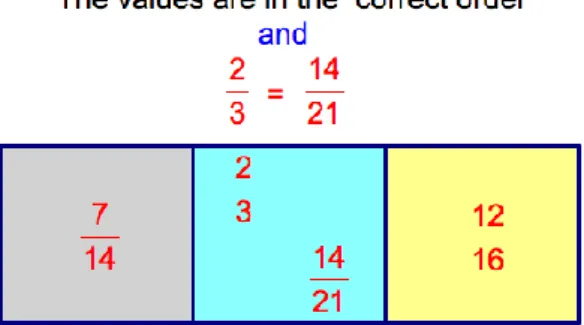
Ordering Fractions Task: Create a minimum of three fractions and move them into sequential order of magnitude. Make Sketchpad indicate whether any (or all) fractions are equal and whether the fractions are correctly placed in ascending order. If the values of the fractions are changed, make Sketchpad dynamically respond regarding the equality and correct placements of the fractions in ascending order.
Problem-Solving Trajectories Jobrack, Bossé, Chandler, & Adu-Gyamfi
order, was most problematic. An example of a correctly completed Ordering Fractions Task is provided in Figure 2.
Figure 2. An example of a correctly completed Ordering Fractions Task. Since no participant successfully completed this task in the allotted timeframe, no completed online example is provided.
Similar or Congruent Triangles: Construct two triangles that can be altered by dragging respective vertices to integral points. Make Sketchpad dynamically indicate whether the two triangles are similar, congruent, or neither. If the triangles are similar or congruent, the construction should state such with the corresponding vertices of the related triangles reported in proper order and the color of the triangles changing when conditions are met.
The Similar or Congruent Triangles Task required participants to make the necessary measurements to verify whether two triangles were similar, congruent, or neither and dynamically report such. Distinguishing similar from congruent triangles and verifying the order of the respective vertices when reporting the results was the most complex component of this task. An example of a correctly completed Similar or Congruent Triangles Task is provided in Figure 3.
Figure 3.An example of a correctly completed Similar or Congruent Triangles Task. See
http://appstate.edu/~bossemj/DMETrajectories/ComparingTriangles/ for an example of this completed task.
Problem-Solving Trajectories Jobrack, Bossé, Chandler, & Adu-Gyamfi
76
Analysis
The qualitative research techniques employed in this study (data collection, observation, analysis, and synthesis) were typical, apart from their iterative nature, which is discussed below. Data analysis occurred through sequential phases. First, Camtasia audio-video data were transcribed and transcripts were synchronized and reviewed to identify themes and categories, and data were sorted into those categories (Bogden & Biklen, 2003; Creswell, 2003). Second, a series of questions about the data were raised: Did the observed activity fall under the domain of mathematics, technology, or mathematical activity? Did the activity lead toward a possible solution or away from a workable heuristic? Is the sequence of activities interesting in some way? Do the activities denote student strengths and weaknesses in particular domains? Possible explanations for these questions were hypothesized, and confirming or disconfirming evidence was systematically investigated (Strauss & Corbin, 1990). Third, the data were then re-examined and the codes were assigned to small units of data. (These codes are explicated in the Findings section of this paper.) Common themes within, and across, the differing participants were then identified. These coding structures were compared and differences reconciled; these processes resulted in the refinement of initial codes. Researchers were able to employ the process of check-coding and thereby reach consensus on the analysis of all transcripts (Miles & Huberman, 1994). The reconciliation enabled the researchers to clarify their thinking and to sharpen each code’s definition.
The unusual form taken in this research methodology arose from the preceding analytical sequence being performed iteratively through five rounds of analysis and synthesis. Each subsequent round of analysis and synthesis built upon the previous findings and produced both additional findings and additional opportunities to verify previous findings of themes and employment of codes. To initially frame this study, student work and actions were coded regarding mathematical or technological activity. The second phase of data analysis considered whether the mathematical or technological steps taken positively or negatively progressed toward the solution of the problem task. The third phase investigated the sequence of mathematical and technological activities students employed in solving the problem task. The fourth phase analyzed student activities to assess the relative strength or weakness of the student in respect to the dimensions of mathematics and technology. (Notably, student participants were not independently assessed on these dimensions. Rather, these references are in respect to evidence from student work, questions, answers, and discussions in the act of problem solving in a DME as defined by this study. Thus, levels of student understanding are defined through the mathematical and technological quality and correctness of student work.) The final phase of this study sought for additional concepts within the data leading to a fuller understanding of the sequence of mathematical and technological activities students followed in their task completion. Initial findings from these analyses are provided in the following section with more detailed results in the discussion section.
Findings
Problem-Solving Trajectories Jobrack, Bossé, Chandler, & Adu-Gyamfi
mathematics or technology (coded with the letter M or T). Occasionally, some actions were recognized as being simultaneously in the realms of both fields. Later, these joined activities are further discussed.
In the second phase of analysis, the previously identified and coded activities were analyzed for whether they led in directions that assisted in the problem-solving task (coded as having proximity) or led in directions that hindered finding the solution to the task (coded as being divergent). (Since each researcher had completed each of the research tasks a number of times using a number of different heuristics, the researchers had intimate understanding of the mathematics, technology, and viable problem-solving heuristics associated with the tasks. Together, they could accurately and consistently recognize student activities as having proximity or divergence.) Altogether, themes and their respective codes included: technologically divergent = TD; technological proximity = TP; mathematically divergent = MD; and mathematical proximity = MP.
Notably, in a few cases, some actions were dual coded as simultaneously having proximity and being divergent. For instance, the code MP/D denotes an action that, while it provided mathematical promise toward a solution, was incorrectly or incompletely applied – thus denoting both a degree of understanding and gaps in such. The codes MP/TP and TD/MD denoted actions and ideas that share simultaneous attributes of both mathematical and technological dimensions. Additionally, the code MP? denoted that an activity had mathematical promise if it had been followed up appropriately to a solution but that this mathematical understanding was not followed correctly or was somewhat convoluted.
The following transcripts include the coding for the student group or individual and the corresponding research activity along with some commentary from researcher notes; these comments are bracketed and italicized. Accompanying figures of student work are color-coded to denote measurements or parameters (in blue), Boolean operations (in red), and textboxes (in green).
Student 1 (math major), completing the Similar and Congruent Triangles task: He begins by measuring the angles on each triangle (MP), assigning letter names to the sides of the triangles (MP/TP), and measuring side lengths (MP). As he begins to set up Boolean operations comparing angle measures on each triangle (MP), he fails to check for all of the possible [and necessary] similarities (MP/D). He then creates Boolean tests comparing the sides (MP), with some missing cases (MP/D). (See Figure 4.) On paper, he maps out how to organize all of
the Boolean statements (MP) to discern whether the triangles are similar, congruent, or neither. He has difficulty involving the rounding of angle measures (TD); [with the help of the researcher], he fixes the problem (TP) and begins to create Boolean statements to test for similarities (MP). As he is doing this, he realizes he is missing comparisons to account for different similarities or congruencies, and fills in the gaps (MP). He then creates the text boxes “similar” and “congruent” on the screen, but has trouble figuring out how to use his correct calculations to make them appear only when the appropriate conditions are met (TD). The researcher reminds him that the triangles should change color when they are similar or congruent. He attempts to do this by creating several differently colored triangles
Problem-Solving Trajectories Jobrack, Bossé, Chandler, & Adu-Gyamfi
78
overlapping each other (TP). [The idea is that only one of the colored triangles will exist when the similarity or congruency conditions are met.] But, he cannot figure out how to do this (TD).
Student 2 (physics major), completing the Triangle and Circle task: After
constructing the circle and triangle (MP/TP), he constructs an intersection of the circle and triangle (MP), dilates another point with this intersection (TP), and merges the text “overlapping” to this point (TP). He successfully repeats this with intersections of the circle and other sides of the triangle (TP), although the word “overlapping” can appear multiple times for multiple intersections (TD), and the words fly around the screen with the dilated point. He then creates many diameters of the circle (MP, albeit unusual), constructs the centroid of the triangle, and many lines connecting edges of the triangle through the centroid (MP, albeit unusual). His plan is to use the intersections of these lines as a method to detect when one shape is completely in the other. He soon realizes that this will inefficiently involve hundreds of cases (TD leading to understanding and a heuristic change) and attempts an alternate method of measuring the “distance” between the two shapes; but he does so by measuring the distance between arbitrary points on each shape’s perimeter (MD). (See Figure 5a.) Realizing this technique will not work as simply as he wants, he then alternates between trying to fix this plan and working on another plan with intersecting secant lines inside each shape (TD/MD). He also attempts another strategy, where he creates a triangle and circle dilated slightly smaller than the original shapes, contained inside the originals (TD). He uses these to test when one shape is totally inside the other one. [The general strategy with most of these plans is to create many elements inside each shape which either intersect with
elements inside the other shape when the circle is inside the triangle, or vice versa. While there is no guarantee that these constructions will intersect in those cases, there are so many constructions that it is likely that some will.] (See Figure 5b.) Near the end, he constructs segments connecting the center of the circle to each side of the triangle and measures ratios on these segments that only exist when the circle is inside the triangle (MP); but he is unable to make a productive use of this discovery (TD). (See Figure 5c.) Eventually he SHOWS ALL HIDDEN work to review his calculations (TD) and gets hopelessly lost with all the constructions.
Student 3 (math major), completing the Ordering Fractions, task: He begins by
constructing three circular regions (in which to drag the fractions and denote order) and line segments between the fractions (MD) and measuring their length (MD). He claims that he will use these segments to measure
Figure 5c.
Figure 6.
Figure 5a.
Problem-Solving Trajectories Jobrack, Bossé, Chandler, & Adu-Gyamfi
the order of the fractions. He creates Boolean statements to determine if the first fraction is greater than the second (MP), [but does not repeat this with any other pairs of fractions (MD)]. He uses maximum and minimum functions (MP) as a method for determining the greatest and least fractions, and calculates the radius of the circle (MP). After realizing the line segments connecting the fractions are useless (TP/MP) he deletes them and instead measures the distance from the center of the middle circle to each of the fractions (MP). He calculates the angles made by a radius of the center circle and the segment connecting the center of that circle to the fractions (MP?). [The goal is to use these angles to determine what order the fractions are in from left to right]; he sets up Boolean statements to this end (MP?). He then uses a parameter equal to 7.5 called “outsideofmiddle” to determine if the fractions are outside of the middle circle (MD) [but this does not account for size changes of the circles]. (See Figure 6.) He calculates the radius of the center circle multiplied by 3 (MD). Boolean operations are created that combine the radius measures, the distances from the fractions to the center of the circle, the max/min functions, and the angle measures to determine if the fractions are placed correctly (MP). [This works somewhat, although some cases aren’t accounted for, and the circle regions aren’t exactly the regions that are considered ‘correct’ in his sketch.] He hides all calculations except for the final one (TP) and spends considerable time trying to get the word “correct” to appear when the fractions are ordered correctly (TD).
Student 4 (middle grades education major), completing the Triangle and Circle
task: This student constructs the circle and triangle (MP), labels the vertices of the triangle
(MP), and measures the radius of the circle (MP). Then she calculates the distance from each vertex to the center of the circle (MP). She also calculates the distance from a point on the perimeter of the circle to each vertex (MD). Then some time is spent manipulating the shapes, paying attention to how these measurements change when the various cases occur. She then creates Boolean statements that check if the radius of the circle is less than each distance from the center of the circle to each vertex (MP); this involves compound Boolean tests combining “less-than” with “and” statements (MP). She calculates 1÷(the compound Boolean statement) (TP). (See Figure 7a.) [All of these steps were promising and could have led to a successful heuristic.] She becomes dissatisfied with
the results and deletes all of this work (TD/MD). She [incorrectly] creates similar Boolean statements using the distance from a point on the circle’s perimeter to each side of the triangle, compared to the radius (MD). After this does not work, she constructs intersections of the circle and the triangle (MP) and calculates the distance between the center of the circle and these intersections (MD). This distance is compared to the radius of the circle and the student seems confused by why these two measurements are always equal (MD). She [incorrectly] thinks this is the result of a rounding problem, and spends an extended period trying to “fix” this issue (TD). (See Figure 7b,) She later successfully creates a system of Boolean statements, dilated points and merged text such that the word “overlapping” appears when any of the circle-triangle intersections exist (TP). Much time is spent working with the center of circle-to-triangle side measures, constantly manipulating the shapes to check if something useful will pop out of the calculations. After experimenting with many new calculations, she eventually stumbles across some angle
Problem-Solving Trajectories Jobrack, Bossé, Chandler, & Adu-Gyamfi
80
measures which sum to 180 degrees only when the center of the circle is inside the triangle (MD). [She mistakes this for a condition that is only met when the whole circle is inside the triangle.] She creates a dilated point with the text “circle inside triangle” merged to it, thinking this case is complete (MD/TD).
Students 5 (statistics major), completing the Similar and Congruent Triangles
task: She begins by [mistakenly] constructing a right triangle (MD). She realizes this and
then constructs arbitrary triangles (MP). She labels the vertices and measures the sides (MP); however, becoming confused as to what to do, she restarts and reconstructs the triangles several times (TD). She [erroneously] thinks there is a difference if she constructs the triangles using the line segment tool versus using the polygon tool (TD). When the researcher recognizes that she does not know the definition of similar triangles [although this was addressed in the training just prior to participants working on the research tasks], she is taught the definition (MP). She begins
setting up Boolean calculations to compare side and angle measures (MP); but before she finishes setting up all possible angle statements, she gets sidetracked by a problem in the rounding of the angles (TP) in order to determine when angle measures are equal. She struggles for a while to correct this, at one point attempting to remedy the issue by [incorrectly] making the measures more precise (TD). (See Figure 8.) After finally correcting this problem (TP), she has forgotten
to finish accounting for all possible similarity cases in her Boolean statements (MD). She shifts focus to making the words “congruent” and “similar” appear on the screen, but makes no meaningful progress to this end (TD) before the researcher points out some missing, necessary Boolean statements (MP). To fix this, she SHOWS ALL HIDDEN work, and gets confused with all the calculations on screen, causing her to create redundant statements while missing others (MD). She uses paper and pencil to work out all of the cases and Boolean statements she needs to show (MP), but at the end, she still finds that there are situations where the triangles are similar, but her construction does not denote so (MP). With help from the researcher, she fixes this (MP), but runs out of time to successfully try to construct labels.
Student 6 (English major), completing the Ordering Fractions task: After spending
much time browsing through the Boolean options (TD/P), she creates minimum and maximum functions (TP), with the three decimal approximations of the fractions as inputs (MP). She accidentally deletes the maximum function (TD) and has to spend extended time recreating it [because she keeps clicking on the wrong numbers as inputs]. She uses the Boolean calculation a < b < c, with three
decimal places of precision as inputs (MP), but she [mistakenly] uses the same number for two of the inputs (TD). The researcher attempts to point out the error, but the student does not understand the problem and it goes uncorrected (TD). She spends time changing
Figure 8.
Problem-Solving Trajectories Jobrack, Bossé, Chandler, & Adu-Gyamfi
the names of the calculations and parameters (TD) [but there is no consistency to the naming]. Although she [eventually] calculates the radius of the circles (MP) and creates segments from the center of the circle to the fractions (TP), she does not measure the distance of the latter (TD), and, after a while, replaces it [incorrectly] with a ray (MD). She starts creating action buttons and presentations that move the fractions to the center of one of the circles, or just seemingly randomly around the screen(TD/MD). Much time is spent trying to make the action buttons do something useful (TD/MD), but she finally deletes them and creates Boolean operations that determine when the fractions are inside one of the circles (TP/MP). Then she quickly uses the a < b < c Boolean function to account for each possible case of ordering the three fractions, including when two or more fractions are equal (TP/MP). (See Figure 9.) She [eventually] has all of the necessary Boolean calculations on the screen to finish the project, but she cannot figure out how to use them to display the intended result (TD).
Analysis and Synthesis
The preceding findings provide a number of insights into these students’ trajectories when working in GSP. The following discussions capture numerous additional ideas found through analysis and synthesis of the data including strength and weaknesses, trajectory sequence, and the greatest affecting dimension.
Strengths and Weaknesses in Student Work
The third phase of this research revealed additional, and interconnected, themes that shed more light on the sequence of actions students employed through these activities. In respect to the preponderance of individual actions as seen through investigated characteristics (i.e., MP, TP, MD, and TD) and the level of sophistication or type of error demonstrated in the students’ mathematical and technological applications, the work of student participants was globally coded with the descriptors of mathematically strong, mathematically weak, technologically strong, and technologically weak. A designation of globally weak actions was coded as such according to whether the majority of actions could be seen as containing mathematical or technological errors associated with either conceptual understanding or processes. Globally strong actions were coded as such based on observed conceptual and procedural understanding of the mathematics and technology involved in the actions. This led to the codes: technologically weak (TW), technologically strong (TS), mathematically weak (MW), or mathematically strong (MS). This provided further insight into the mathematical and technological trajectories taken in the problem-solving activity. Notably, global evaluations of a participant’s work resulted in two pairs of codes: one representing the global mathematical strength or weakness and the other representing the global technological strength or weakness. The following discussions employ a symbolic coding count. For instance, MP9 denoted nine instances of the MP code.
Problem-Solving Trajectories Jobrack, Bossé, Chandler, & Adu-Gyamfi
82
technological knowledge may be weaker, he seems to attempt to use his mathematical understanding to overcome technological weaknesses and attack the problem. Notably, his techniques also reveal a more physical (working with the intersection of elements) and less theoretical (measurement comparisons) understanding of the mathematics.
The work from Student 3 [MP7 ⋀ TP2 ⋀ MD5 ⋀ TD1] demonstrates that he does his utmost to avoid technological solutions to this problem and, leaning on his strength, repeatedly attempts to use mathematical workarounds. Both mathematical and technological understandings fail the student in developing a workable heuristic [MW ⋀ TW]. The problem-solving work of Student 4 [MP9 ⋀ TP2 ⋀ MD7 ⋀ TD2] starts out well, but upon getting confused and feeling the need to change course, she gets increasingly lost in the problem-solving process. Recognizing herself that her mathematical ability is less than adequate for the task, she seems to focus more attention on technological workarounds [MW ⋀ TS]. Her work demonstrates mathematical strength until she stumbles, then neither mathematical understanding nor technological skill can get her back on to a fruitful heuristic.
The work and communication from Student 5 [MP7 ⋀ TP2 ⋀ MD3 ⋀ TD4] demonstrate significant weaknesses in both mathematical content and technological knowledge [MW ⋀ TW]. Her heuristics are equally stymied by mathematical and technological missteps. Notably, since neither dimension is one of strength, neither can be applied to help overcome the other.
As in the case of Student 5, the work of Student 6 [MP5 ⋀ TP5 ⋀ MD3 ⋀ TD9] exemplifies significant weaknesses in both mathematical and technological understanding
[MW ⋀ TW]. However, distinguishing the two sets of work, the problem solving of
Student 6 seems to be more distracted by her weak technological skills and Student 6 seems as if mathematical misunderstandings more significantly negatively impacted her problem solving. However, similar to Student 5, for Student 6, neither mathematical knowledge nor technological skills seem to be able to assist the other.
Trajectory Sequence
The fourth phase of analysis investigated themes regarding the sequence of the actions students experienced in the problem-solving process. Herein, we denote this sequence of actions as a trajectory. The preceding data and the results from this phase of the investigation demonstrate that, for the students in this study, mathematical and technological understandings are both interdependent and independent. The sequence of coded activities demonstrates that, when these students’ work reveals both mathematical and technological strength (e.g., see previous transcripts for Student 1), these areas of knowledge are interconnected and each serves to strengthen the other and provide a far greater number of heuristic paths. However, when these students’ work demonstrates weaknesses in both dimensions, these weaknesses seem quite independent and neither seems to have a significant effect on the other (e.g., see previous transcripts for Students 5 and 6).
Problem-Solving Trajectories Jobrack, Bossé, Chandler, & Adu-Gyamfi
do not focus more attention on their stronger dimension because it is such; rather they focus on their stronger dimension because it is not the weaker one.
These results coincide with findings from other research. Kaput (1987) identifies two types of treatments that can be performed within a representation register: syntactic elaboration (interacting with a representation by directly manipulating the symbols in the representations without reference to the meaning of the idea represented) and semantic elaboration (interacting with a representation based on the features of the ideas represented, rather than the symbols themselves). Other studies have observed that students can interact syntactically or semantically with mathematical domains such as mathematical content, technology, and problem solving (e.g., Adu-Gyamfi, Stiff, & Bossé, 2012; Bossé, Adu-Gyamfi, & Chandler, 2014; Brown, Bossé, & Chandler, 2016; Kaput, 1987). It may be that students stronger in one realm (mathematics or technology) simply interacted semantically within that realm and syntactically in the other realm.
From another perspective, Hiebert (1988) distinguishes two realms of knowledge: representation system knowledge (RK) associated with the characters, operators, conventions, and set rules of the register (or representation) and domain knowledge (DK) associated with the reference domain (core notions and constructs). Some have extended these two realms of knowledge with the inclusion of domain register knowledge (DRK), the intersection of RK and DK (Adu-Gyamfi & Bossé, 2014; Adu-Gyamfi, Bossé, & Chandler, 2015, 2016). It may be that students stronger in one realm (mathematics or technology) possessed greater levels of DK and DRK in that realm than in the other realm.
Adu-Gyamfi, Bossé, and Chandler (2016) distinguish between isomorphic connections (connections of similar concepts across differing mathematical representations) and transcendent connections (connections of a concept to a more global mathematical domain). It may also be the case that the students in this study could only interconnect mathematical and technological domains when they simultaneously employed both isomorphic and transcendent connections in their understanding of the mathematics and application of the technology to the problem.
Summarily, although left for future research, it may be quite possible that interconnected domains (e.g., for Student 1) are only possible when students interact semantically in both domains, possess sufficient DK and DRK in both domains, and employ both isomorphic and transcendent connections in their work.
Dimensional Strength or Weakness and the Greatest Affecting Dimension
After globally coding participant work as strong or weak on each dimension, the final phase of analysis of student work revealed that either their mathematics knowledge (whether its strength or weakness) or their technological ability (whether its strength or weakness) had greater effect (either positive or negative) on their problem solving in a DME. Herein, the term greatest affecting dimension is employed to denote this effect. For instance, in this study, a student’s mathematical ability could have more effect on whether they could or could not solve a problem than their technological skills. Or, conversely, a student’s technological ability could have more effect on whether they could or could not solve a problem than their mathematical understanding. In either case, in the context of this investigation of student work in a DME, the greatest affecting dimension can be either mathematical or technological.
Problem-Solving Trajectories Jobrack, Bossé, Chandler, & Adu-Gyamfi
84
scheme, the first two letters denote the global greatest affecting dimension and the second two letters denote an additional global descriptor. Therefore, for instance, the code MS→TW designates student work that is both mathematically strong and technologically weak, with the former being the greatest affecting dimension.
Analysis determined that the greatest affecting dimension had the potential to be either a strength or a weakness. For instance, in respect to the student work in this study, a student’s mathematical weakness or technological strength can most greatly affect whether or not he can solve a problem in a DME. Additionally, a student’s greatest affecting dimension may be accentuated (either positively or negatively) or mitigated (either positively or negatively) by the second dimension. For instance, a student’s technological predisposition may be hampered by his weakness in mathematics or a student’s mathematical strength may be positively or negatively affected by his technological ability. In the following discussion, the results of these coding classes are presented with some parings of similar results.
MS→TS and TS→MS.Students in this study who were strong in both mathematics and technology were best at problem solving in DMEs. While this observation may seem trivial, in respect to the order of these dimensions (whether the greatest affecting dimension was positive mathematical understanding or positive technological knowledge), nuances were found to produce salient differences in DME problem-solving ability. For instance, although skills were strong in both areas, the DME problem-solving ability of students with a positive technological greatest affecting dimension surpassed the ability of students with a positive mathematical greatest affecting dimension. While students possessing strong technological ability accompanying a mathematically positive greatest affecting dimension (MS→TS, e.g., see previous transcripts for Student 1) demonstrated that this technological ability accentuated their DME problem solving and helped them to be successful, students beginning with a positive technological greatest affecting dimension in tandem with strong mathematical skills (TS→MS) demonstrated even greater success.
Although, in respect to DME problem solving, it can be denoted that (TS→MS) is greater than (MS→TS), this study simultaneously recognizes that the distinction between the DME problem solving between these two groups is observable and not profound. In both cases, students employed both mathematical and technological knowledge to partner with and accentuate the other. Both were used in tandem and neither seemed to vie against the other.
Problem-Solving Trajectories Jobrack, Bossé, Chandler, & Adu-Gyamfi
operation does not produce the expected results, the student may be clueless regarding if the mathematical idea was incorrect or if the technology was incorrectly applied. This typically results in frustration and a failure in the problem-solving process.
Notably, the cases above account for the activity of students who were either strong in both mathematics and technology (MS→TS and TS→MS) or weak in both technology and mathematics (MW→TW and TW→MW). Students who demonstrated strength in one dimension and weakness in the other dimension fall into one of four scenarios: MS→TW; TS→MW; MW→TS; and TW→MS. These are discussed in the following sections.
MS→TW and TS→MW. Students who demonstrate positive greatest affecting dimension in either mathematics or technology, but weaknesses in the other domain problem solve in DMEs in ways quite dissimilar to students defined above. Additionally, differences exist between students demonstrating MS→TW versus TS→MW. While students demonstrating MS→TW (e.g., see previous transcripts for Student 2) understood the mathematics that they wanted to employ in the problem-solving experience, they were often stymied to get the technology to perform what they wanted the math to do. Most often they stood firm on their mathematical convictions and looked for technological workarounds.
While students demonstrating TS→MW (e.g., see previous transcripts for Student 4) had a solid understanding of technological options regarding how to get the results they may want, they often lacked the precise mathematical knowledge needed to accomplish tasks. For these students, the technology became an investigative tool to learn the necessary mathematics. If technological investigations led them to deduce the necessary mathematics, they were able to progress in problem solving. If the technology did not lead to sufficient mathematical understanding, they were hindered from continuing.
MW→TS and TW→MS. Students who begin the DME problem-solving task with a negative greatest affecting dimension in either dimension accompanied with strong understanding in the other dimension demonstrated different experiences. For instance, students with a negative mathematical greatest affecting dimension and strong technological understanding (MW→TS, e.g., see previous transcripts for Student 3) found that the technology was of little assistance. Technological strength could not overcome a negative mathematical greatest affecting dimension. The negative mathematical greatest affecting dimension overpowered all else and technology could not be used as a tool to remediate the mathematics. To contrast this, students with a negative technological greatest affecting dimension and strong mathematical understanding (MW→TS) use what they know the technology can do in order to find a mathematical workaround to accomplish what they need. They use the technology to find either easier or more comprehensible mathematics that they hope will accomplish the task at hand.
Summarily, students with weak mathematical skills are less able to accomplish tasks in DMEs than are students with weak technology skills. Technology itself had little effect on mitigating student mathematical weaknesses. However, when students are technologically weaker, stronger mathematical understanding can pull them through DME problem-solving activities.
Problem-Solving Trajectories Jobrack, Bossé, Chandler, & Adu-Gyamfi
86
2014; Adu-Gyamfi, Bossé, & Chandler, 2015, 2016), and greater combined isomorphic and transcendent connections (Adu-Gyamfi, Bossé, Chandler, 2016) in one domain can mitigate weaker understandings in the other domain. Conversely, it may be that, when understanding in one domain is sufficiently weak, no level in these dimensions in the other domain may be sufficient to ameliorate this weakness. These dimensions warrant further future investigation.
Implications
Care must be taken against assuming that the results for the students and tasks in this study are generalizable to all student performing other tasks. Additionally, while these findings resulted from using the Geometer’s Sketchpad, they cannot be assumed to speak to other DMEs or technology tools such as scientific or graphing calculators. Each technology may have its own research base and set of unique findings. Nevertheless, findings in respect to GSP may speak to some extent regarding other technology applications – the extent to which only future research will precisely address.
It seems far too prevalent a belief among teachers that students should simply be given some technological tool to remediate their mathematical struggles. Even elementary school children are handed calculators to assist them to overcome arithmetic deficiencies. Findings, herein, may demonstrate that when a student possesses weak mathematical skills, far from helping him problem solve using technology, weak technology skills may in fact exacerbate his lacking mathematical understanding. This may connote a significant departure from the beliefs of many.
Mathematics and its respective technological tools work hand-in-hand when engaged in problem solving. However, the effects of each may not be equivalent and one may not mitigate weaknesses associated with the other. Thus – as with the case of all other pedagogical techniques – no one size fits all in respect to employing technology in problem solving, even when the technology is precisely appropriate for the task at hand.
The findings of this study may demonstrate that, in order for students to be strong mathematical problem solvers in the context of using technology, instructional experiences must consider both mathematical content and technological knowledge, both independently and collaboratively. It may be insufficient to simply apply technology to a mathematical problem scenario and assume that students will understand the associated mathematics, the problem scenario, or appropriate heuristics.
Finally, while problem solving is promoted as an activity with multiple entry points and multiple possible heuristics, it may be that students are often much more tunnel-visioned in their selected problem-solving techniques. They may often begin following a particular heuristic and have difficulty leaving it, even when it is proving unfruitful. When they are able to abandon an early heuristic for one that may have more potential, they may often revert to an earlier technique – not because it had new potential, but because they were more comfortable with it. Additionally, it may be that only when students are simultaneously strong in both mathematical content and technology do both aspects truly enhance the other. Altogether, this may indicate the need for far more research into student problem-solving trajectories.
Problem-Solving Trajectories Jobrack, Bossé, Chandler, & Adu-Gyamfi
Student problem-solving success or failure when employing technology must be carefully evaluated.
When teachers develop problem-solving activities involving the use of technology, they must be aware of both the advantages of using technology and technology’s inherent pitfalls. They must also be aware that technology use can mask student misunderstandings.
Errors in solutions or heuristics cannot be easily attributed to either mathematical or technological misunderstandings or misapplications. Often, errors are at the intersection of mathematical understanding and application of technology and, in some instances, even intersected with problem-solving knowledge (Brown, Bossé, & Chandler, 2016). Thus, teachers must well understand the role of technology in problem solving and their students as well.
Altogether, the introduction of technology into problem solving should not be regarded as a panacea to students’ mathematical ills. More the case, when students lack either mathematical knowledge or technological heuristic sophistication, technology may heighten problem-solving difficulties. Quite possibly, only those students who are strong in both mathematical and technological domains may be significantly aided by technology in problem solving situations.
Conclusion
Problem solving using the Geometer’s Sketchpad, and possibly technology in general, contains many interwoven dimensions. Some of these dimensions have greater positive and negative effects on the problem-solving process. Overall, while this investigation may have answered some specific questions, it may be that a far greater number have been opened. It is hoped that this study inspires others to investigate problem-solving trajectories in general and in particular in respect to student work using technology and in DMEs.
References
Adu-Gyamfi, K. & Bossé, M. J. (2014). Processes and reasoning in representations of linear functions. International Journal of Science and Mathematics Education, 12(1), 167-192.
Adu-Gyamfi, K., Bossé, M. J., & Chandler, K. (2016). Students' connections between algebraic and graphical representations in the context of a polynomial relation. International Journal of Science and Mathematics Education. doi:10.1007/s10763-016-9730-1
Adu-Gyamfi, K., Bossé, M. J., & Chandler, K. (2015). Situating student errors: Linguistic-to-algebra translation errors. International Journal for Mathematics Teaching and Learning.
Adu-Gyamfi, K., Stiff, L., & Bossé, M. J. (2012). Lost in translation: Examining translation errors associated with mathematics representations. School Science and Mathematics, 112(3), 159-170.
Arzarello, F., Micheletti, C., Olivero, F., Robutti, O., Paola, D., & Gallino, G. (1998). Dragging in Cabri and modalities of transition from conjectures to proofs in geometry. Proceedings of the 22th annual conference of the International Group for the Psychology of Mathematics Education (pp. 32-39). South Africa.
Arzarello, F., Olivero, F., Paola, D., & Robutti, O. (2002). A cognitive analysis of dragging practises in Cabri environments. Zentralblatt für Didaktik der Mathematik, 34(3), 66-72.
Baccaglini-Frank, A., & Mariotti, M. (2010). Generating conjectures in dynamic geometry: The maintaining dragging model. International Journal of Computers for Mathematical Learning, 15(3), 225-253. Bogdan, R. C., & Biklen, S. K. (2003). Qualitative research for education: An introduction to theories and
methods (4 ed.). Boston: Allyn and Bacon.
Bossé, M. J., Adu-Gyamfi, K., & Chandler, K. (2014). Students’ differentiated translation processes. International Journal for Mathematics Teaching and Learning.
Problem-Solving Trajectories Jobrack, Bossé, Chandler, & Adu-Gyamfi
88
Brown, M., Bossé, M. J. & Chandler, K. (2016). Student errors in dynamic mathematical environments. International Journal for Mathematics Teaching and Learning.
Carpenter, T. P. (1989). Teaching as problem solving. In R. I. Charles and E. A. Silver (Eds), The teaching and assessing of mathematical problem solving (pp.187-202). USA: National Council of Teachers of Mathematics.
Cobb, P., Yackel, E., & Wood, T. (1992). A constructivist alternative to the representational view of mind in mathematics education. Journal for Research in Mathematics Education, 23(1), 2-33.
Creswell, W. J. (2003). Research Design: Qualitative, quantitative and mixed methods approaches (2 ed.). London: Sage Publications.
DePeau, E. A. & Kalder, R. S. (2010). Using dynamic technology to present concepts through multiple representations. Mathematics Teacher, 104(4), 268-273.
de Villiers, M. (2004). Using dynamic geometry to expand mathematics teachers’ understanding of proof. International Journal of Mathematical Education in Science and Technology, 35(5), 703–724.
Dick, T. P., & Hollebrands, K. F. (2011). Introduction to Focus in high school mathematics: Technology to support reasoning and sense making. In T. P. Dick & K. F. Hollebrands (Eds.), Focus in high school mathematics: Technology to support reasoning and sense making (pp. xi - xvii). Reston, VA: National Council of Teachers of Mathematics.
Duval, R. (2006). A cognitive analysis of problems of comprehension in the learning of mathematics. Educational Studies in Mathematics, 61(1-2), 103-131.
Falcade, R., Laborde, C., & Mariotti, M. A. (2007). Approaching functions: Cabri tools as instruments of semiotic mediation. Educational Studies in Mathematics, 66(3), 317-333.
Finzer, W. & Bennett, D. (1995). Technology tips: From drawing to construction with The Geometer’s Sketchpad. Mathematics Teacher, 88(5), 428-431.
Garofalo, J., Drier, H., Harper, S., Timmerman, M.A., & Shockey, T. (2000). Promoting appropriate uses of technology in mathematics teacher preparation. Contemporary Issues in Technology and Teacher Education [Online serial], 1(1). Available: http://www.citejournal.org/vol1/iss1/currentissues/mathematics/article1.htm
Goldenberg, E. P. & Cuoco, A., A. 1998. “What is dynamic geometry?” In R. Lehrer & D. Chazan (Eds.), Designing learning environments for developing understanding of geometry and space (pp. 351-367). Mahwah, NJ: Lawrence Erlbaum Associates.
Goldin, G. A. (2000). A scientific perspective on structure: task-based interviews in mathematics education research. In A. Kelly & R. Lesh (Eds.), Handbook of research design in mathematics and science education (pp. 517-546). Mahwah, NJ: Lawrence Erlbaum Associates.
Gonzalez, G., & Herbst, P. (2009). Students' conceptions of congruency through the use of dynamic geometry software. International Journal of Computers for Mathematical Learning(4), 153-182.
Hannafin, R. D., Burruss, J. D., & Little, C. (2001). Learning with dynamic geometry programs: Perspectives of teachers and learners. The Journal of Educational Research, 94(3), 132-144.
Hannafin, R. D., Truxaw, M. P., Vermillion, J. R., & Liu, Y. (2008). Effects of spatial ability and instructional program on geometry achievement. The Journal of Educational Research, 101(3), 148-157. Hollebrands, K. F. (2007). The role of a dynamic software program for geometry in the strategies high school
mathematics students employ. Journal for Research in Mathematics Education, 38(2), 164-192.
Hiebert, J. (1988). A theory of developing competence with written mathematical symbols. Educational Studies in Mathematics, 19, 333-355.
Hiebert, J., Carpenter, T., Fennema, E., Fuson, K., Human, P., Murray, H., . . . Wearne, D. (1996). Problem solving as a basis for reform in curriculum and instruction: The case of mathematics. Educational Researcher,25(12), 12-21.
Hollebrands, K. F., & Lee, H. S. (2012). Preparing to teach mathematics with technology: An integrated approach to geometry. Dubuque, IA: Kendall Hunt.
Hollebrands, K. & Smith, R. (2009). The impact of dynamic geometry software on secondary students’ learning of geometry: Implications from research. In T. Craine & R. Rubenstein (Eds.), NCTM 2009 yearbook: Understanding geometry for a changing world (pp. 221-232). Reston, VA: NCTM.
Hölzl, R. (1996). How does ‘dragging’ affect the learning of geometry. International Journal of Computers for Mathematical Learning, 1. 169-187.
Hoyles, C., & Noss, R. (1994). Dynamic geometry environments: What’s the point? Mathematics Teacher, 87(9), 716-717.
Problem-Solving Trajectories Jobrack, Bossé, Chandler, & Adu-Gyamfi
Isiksal, M., & Askar, P. (2005). The effect of spreadsheet and dynamic geometry software on the achievement and self-efficacy of 7th-grade students. Educational Research, 47(3), 333-350.
Jones, K. (2000). Providing a foundation for deductive reasoning: Students' interpretations when using dynamic geometry software and their evolving mathematical explanations. Educational Studies in Mathematics,44(1/2), 55-85.
Kaput, J. (1987). Towards a theorey of symbol use in mathematics. In C. Janvier (Ed.), Problems or representation in the teaching and learning of mathematics (pp. 159-195). Hillsdale, NJ: Lawrence Erlbaum Associates.
Lee, H. S., & Hollebrands, K. F. (2006). Students’ use of technological features while solving a mathematics problem. Journal of Mathematical Behavior, 25, 252-266.
Lee, H. S., Harper, S., Driskell, S. O., Kersaint, G., & Leatham, K. (2012). Teachers’ statistical problem solving with dynamic technology: Research results across multiple institutions. Contemporary Issues in Technology and Teacher Education [Online serial], 12(3). http://www.citejournal.org/vol12/iss3/mathematics/article1.cfm.
Lester, F. K. Jr., Masingila, J. O., Mau, S. T., Lambdin, D. V., dos Santon, V. M. and Raymond, A. M. (1994). Learning how to teach via problem solving. In Aichele, D. and Coxford, A. (Eds.), Professional Development for Teachers of Mathematics (pp. 152-166). Reston, Virginia: NCTM.
Lopez-Real, F., & Leung, A. (2006). Dragging as a conceptual tool in dynamic geometry environments. International Journal of Mathematical Education in Science & Technology, 37(6), 665-679.
Miles, M. B. & Huberman, M. N. (1994). Qualitative data analysis: an expanded sourcebook. Thousand Oaks, CA: Sage.
National Council of Teachers of Mathematics [NCTM]. (1989). Curriculum and evaluation standards for school mathematics. Reston, VA: Authors.
National Council of Teachers of Mathematics [NCTM]. (2000). Principles and standards for school mathematics. Reston, VA: Authors.
National Governors Association Center for Best Practices, Council of Chief State School Officers (2010). Common core state standards in mathematics. Washington D.C.: Authors.
Pajares, F. (1996). Self-efficacy beliefs and mathematical problem-solving of gifted students. Contemporary Educational Psychology,25, 325-344.
Pajares, F., & Kranzler, J. (1995). Self-efficacy beliefs and general mental ability in mathematical problem-solving. Contemporary Educational Psychology,20, 426-443.
Ruthven, K., Hennessy, S., & Deaney, R. (2008). Constructions of dynamic geometry: A study of the interpretive flexibility of educational software in classroom practice. Computers & Education 51(1): 297-317.
Schoenfeld, A. (1992). Learning to Think Mathematically: Problem Solving, Metacognition, and Sense Making in Mathematics. In D. A. Grouws (Ed.) Handbook for research on mathematics teaching and learning (pp. 334-370). New York: Macmillian.
Schoenfeld, A. (1994). Reflections on doing and teaching mathematics. In A. Schoenfeld (Ed.), Mathematical Thinking and Problem Solving (pp. 53-69). Hillsdale, NJ: Lawrence Erlbaum Associates. Stacey, K., & Groves, S. (1985). Strategies for problem solving. Melbourne, Victoria: VICTRACC.
Stake, R. E. (2000). Case studies. In N. K. Denzin & Y. S. Lincoln (Eds.), Handbook of qualitative research (2nd ed.). Thousand Oaks, CA: Sage.
Strauss, A., & Corbin, J. (1990). Basics of qualitative research. London: Sage Publications Ltd.
Thompson, P. W. (1985). Experience, problem solving, and learning mathematics: considerations in developing mathematics curricula. In E. A. Silver (Ed.), Teaching and learning mathematical problem solving: Multiple research perspectives (pp.189-236). Hillsdale, N.J: Lawrence Erlbaum.