1
NEED BASED MOTIVATION IN NGO WORKERS
WITH SPECIAL REFERENCE TO MASLOW’S
HIERARCHY OF NEEDS
Dr. Payal Upadhyay
1Suruchi Sharma
2
Introduction
A non-governmental organization is a legally constituted organization created by natural or legal persons that operates independently from any government. The term originated from the United Nations (UN), and refers to organizations that do not form part of the government and are not aimed for profit earning. In the cases in which NGOs are funded totally or partially by governments, the NGO maintains its non-governmental status by excluding government representatives from membership in the organization. India is estimated to have around 3.3 million NGOs in year 2009, which is one NGO per less than 400 Indians, and many times the number of primary schools and primary health centre in India. NGOs are difficult to define and classify due to the term‘s inconsistent use. To attempt a classification of NGOs requires a framework that includes the orientation and the level of operation of an organization.
An NGO's orientation refers to the type of activities an organization takes on. These activities might include:
environmental, development, or advocacy work
An NGO's level of operation indicates the scale at which an organization works on, like the difference in work between:
an international NGO,
1
Principal, MAIIM, RIICO Institutional Area, Ranpur, Kota, [email protected], Maharishi Arvind Group of Institutions
2
Associate Professor & Head, Management, Modi Institute of Management & Technology, Modi Educational Complex, Dadabari Extn., Kota, [email protected],
SHIV SHAKTI
2
a community NGO, or a national NGO.
According to the UN, all kinds of private organizations that are independent from the government control can be recognized as "NGOs." Such organizations (NGO) cannot seek to diminish a nation's government as an opposing political party; NGOs also need to be non-criminal and non-profit.
Professor Peter Willets, from the City University of London, argues the definition of NGOs can be interpreted differently by various organizations and depending on a situation‘s context. He defines an NGO as ―"an independent voluntary association of people acting together on a continuous basis for some common purpose other than achieving government office, making money or illegal activities."
Certain fundamental characteristics differentiate NGOs from political interest groups or commercial organizations. These characteristics are as follows:
Non-profit: NGOs are run as not-for-profit enterprises. They primarily have humanitarian or cooperative rather than commercial objectives.
Independent from government control: although some NGOs may accept government funding for certain projects and activities, the government does not control their operation.
Do not constitute a political party: While some NGOs may be affiliated with a political party, an NGO does not seek to challenge a government as a political party.
Non-violent: NGOs must have a commitment to non-violence and must not engage in violent methods to achieve their goals.
Voluntary membership: NGOs are comprised of members who join on a voluntary basis and who are driven by a common interest. Working for the public good and volunteerism is generally associated with NGOs.
Common purpose/mission: NGOs are created to perform a variety of service and humanitarian functions, as defined by their mission.
Categories of NGOs
The term ―NGO‖ covers a wide range of organizations. Generally, NGOs perform a variety of services and humanitarian functions, bring citizens' concerns to governments, advocate and monitor policies, and encourage political participation through provision of information.
They range from international organizations such as the Red Cross to local, community-based groups found in developing countries. NGOs also include professional associations, grass root organizations, and research institutes.
NGOs are generally categorized as either:
3
(ii) Advocacy NGOs, whose primary purpose is to seek and defend a particular cause and advocate for change in the political system, whether at the regional, national, or international level.
The World Bank and the United Nations further classify operational NGOs into three groups:
(i) Community-based organizations (CBOs), which deal with issues limited to a local region; sometimes referred to as ―grassroots‖ organizations
(ii) National organizations; and
(iii) International organizations, which are headquartered in one country but carry out development projects in more than one country.
The World Bank lists the following strengths of an NGO:
Strong grassroots links;
Field-based development expertise;
The ability to adapt and innovate;
Participatory methodologies and tools;
Long-term commitment; and
Cost-effectiveness.
The World Bank identifies NGO weaknesses as:
Limited financial and management expertise;
Limited institutional capacity;
Low-level of sustainability;
Isolation and lack of inter-organizational communication;
Small-scale interventions; and
Lack of understanding of the broader, social, and economic context.
Many of the weaknesses listed above, however, can be mitigated through training, technical advice, and proper management of NGOs.
Motivation – A driving force
Motivation is a complex phenomenon. Several theories attempt to explain how motivation works. In management circles, probably the most popular explanations of motivation are based on the needs of the individual – it may be an employee
4
In short, all people have needs that they want satisfied. Some are primaryneeds, such as those for food, sleep, and water—needs that deal with the physical aspects of behavior and are considered unlearned. These needs are biological in nature and relatively stable. Their influences on behavior are usually obvious and hence easy to identify.
Secondary needs, on the other hand, are psychological, which means that they are learned primarily through experience. These needs vary significantly by culture and by individual. Secondary needs consist of internal states, such as the desire for power, achievement, and love. Identifying and interpreting these needs is more difficult because they are demonstrated in a variety of ways. Secondary needs are responsible for most of the behavior that a supervisor is concerned with and for the rewards a person seeks in an organization.
Several theorists, including Abraham Maslow, Frederick Herzberg, David McClelland, and Clayton Alderfer, have provided theories to help explain needs as a source of motivation.
Abraham Maslow's hierarchy of needs theory
5
Self Actualization : morality, creativity, spontaneity, acceptance, experience, purpose, meaning and inner potential
Esteem Needs : confidence, achievement, respect of others, need to be a unique individual
Social Needs : love & belonging – friendship, family, intimacy, sense of connection
Safety Needs : health, employment, property, family & social stability
Physiological Needs : breathing, food, water, shelter, clothing, sleep
Maslow's theory is based on the following two principles:
Deficit principle: A satisfied need no longer motivates behavior because people act to satisfy deprived needs.
Progression principle: The five needs he identified exist in a hierarchy, which means that a need at any level only comes into play after a lower-level need has been satisfied.
In his theory, Maslow identified five levels of human needs. Later in his career, Abraham Maslow continued his thought on the hierarchy and further divided the fifth level of
self-actualization into four different parts. He assumed four things of self-actualized people: they are 1) Being problem focused,
2) Incorporating an ongoing freshness of appreciation of life, 3) Concerned about personal growth, and
4) Able to have peak experiences.
Based on these assumptions, he created four more levels.
The table below illustrates these levels and provides suggestions for satisfying each need.
Table 1 - Maslow's Hierarchy of Human Needs
Higher Level Needs To Satisfy, Offer:
Transcendence Mentoring Roles
A role in higher and wider decision making process
Opportunities to project the
capabilities beyond the organizational boundaries
Self-actualization Creative assignments
Challenging work
6
organization and allied
Aesthetic Opportunity to modulate the
workplace
Freehand to decide the efficient route of working
Cognitive Job flexibility
Autonomy in working Out of box thinking avenues
Role of trouble shooter in organization
Esteem needs Responsibility of an important job
Promotion to higher status job Praise and recognition from boss Lower Level Needs To Satisfy, Offer:
Social needs Friendly coworkers
Interaction with customer Pleasant supervisor
Safety needs Safe working conditions
Job security
Base compensation and benefits
Physiological needs Rest and refreshment breaks Physical comfort on the job Reasonable work hours
Organizational Profile
(A)
Arihant Mahila Bal Vikas Samiti - An NGO In Kota(Raj.):
Chief
Functionary
Rashmi Jain, Diksha Sharma
7
Prisoner's Issues, Right to Information & Advocacy, Rural Development & Poverty Alleviation, Scientific & Industrial Research, Science & Technology, Sports, Tribal Affairs, etc.
Operational Area Baran, Bundi, Churu, Jhalawar, Kota, Tonk districts of Rajasthan State
Details of Achievements
From last 10 years NGO have been working for Women empowerment, Skill development, Vocational training courses, Child development, Rural & Agriculture, Health, Education. The NGO has formed more than 500 SHGs groups and 6000 Women men are associated with NGO.NGO also has been awarded from the district collector for his good social work.
(B)
Adarsh Chetna Vidhya Mandir Samiti - An NGO In Kota(Raj.):
Chief
Functionary
Ramratan Meena & Ramavtar Meena
Key Issues Health & Family Welfare
Operational Area Kota (Rajasthan)
Details of Achievements
Blood Donation Camps in every 3 months i.e. 4 times in a year, Providing Knowledge in girls n boys regarding Nationalism, providing information to children on how to participate in
development of country, motivating kids 0f age group 10-20 years for unity and brotherhood, providing house hold jobs to lower class women so that they can make a earning for their family, making arrangement of hostel for poor children and day care facilities for old age persons.
(C)
Shri Karni Nagar Vikas Samiti
Chief
Functionary
Prasanna Bhandari
Key Issues Aged and Child welfare & other social and humanitarian activities
8
Details ofAchievements
The Institution is primarily devoted to the cause of deserted and
relinquished infants, destitute children, distressed women, girls and the helpless aged persons. His Excellency, the President of India, has honored this institution in 1988 by giving away National Award for child welfare. Government of Rajasthan has also recognized its services and honored SKNVS as the Best Social Welfare Organization in the same year. It aims at the overall development of rural areas. Its activities include research programmes on eco-system, promoting home for the aged and conducting legal camps, enhance technical and
management skill of NGO's, CBO's and communities by promoting educational and technical institutions and training and resource centers.
Objectives of the Study
To study the nature of work performed by the relevant NGOs. To survey the need based motivational factors to work in NGO‘s.
To study and categorize the motivational drivers as per the Maslow Need Hierarchy.
Survey Process
The study was conducted through a survey carried out in 3 NGOs working in the geographical area of Kota City and surrounding areas. The criteria for selecting the NGO were based on:
Accessibility provided.
Cooperation extended by the employees.
A sample of 50 workers engaged in various capacities in all the 3 organizations were selected based on the convenience of approach. All the respondents were asked to fill up a questionnaire. Based on their responses, the interpretations and findings were derived.
The two methods of contact were used for this survey:
Intercepts, where respondents were approached in their office (when they were on a break) Appointment arranged with them.
The questions were formulated on the basis of the needs tabled in Table – 1(based on Maslow‘s derivations). The dimensions of broader needs were presented as questions to try to make respondents identify the nuances of their ‗feel good‘ factors at work.
9
Findings and Interpretation
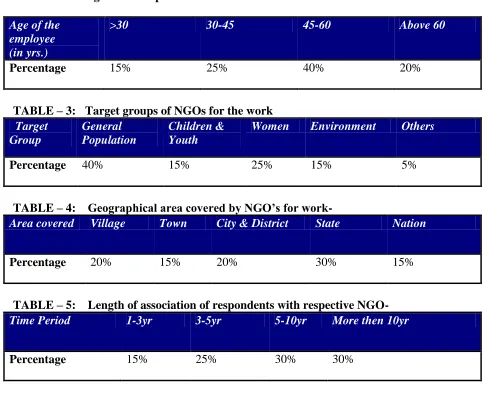
About 60% of all the respondents in the 3 NGOs under study belonged to an age group between 45 – 65 years. Only 15% of the respondents were youngsters under 30 years.
It was observed that in all the 3 NGOs, about 60% of the respondents had been associated with the respective organization for a long period of minimum 5 years to a maximum of 10 years. In general, very few people were there with less than 3 years of association (15%).
According to Chart – 1 and Chart – 7, given below, 87.6% respondents asserted that the motive of working for their organization was not for meeting the different basic necessities of working life as elaborated in the Table – 6. This leads to an inference that the people associated with an NGO do not consider it as mere job to gain a monthly salary, but seek a higher level of satisfaction by working here. The miniscule 12.4% of respondents who either gave importance to basic needs or chose to remain neutral on the issue cater to the lower levels of organizational hierarchy.
In reference to the Chart – 2 and Chart – 7 shown below, about 62.4% of respondents did not consider safety needs related to the work or organization as important motivational factors. Rather, they emphasized that their stressful nature of job was clearly acknowledged by them. It was not a deterrent in maximum cases.
53.2% of total respondents, as against 45.6%, were of the view that their work was a source of different social affiliations for them (as sub-categorized in Table – 8), but, that was not the only reason to work. As is evident, there is not a huge difference between the two, but the majority does not consider their NGO as the only source of social recognition and affiliation.
In contrast to the above findings, in the case of esteem needs (detailed in Table – 9), approximately 56.6% of respondents, as against 39.6%, did agree that their working with the NGO gave a boost to their self esteem. A sharp shift can be seen from the previous responses in the level of disagreement.
A high proportion of 75.8% of respondents stressed that their self actualization needs were highly fulfilled in the work they engaged in the NGO. Their association gave them a feeling of ‗worthwhile living‘. The score was on a higher side on all the sub-dimensions of self-actualization as mentioned in the Table – 10.
self-10
actualization needs. The shift can be seen from 10.4% of initial agreement level of lower need fulfillment to a highest of 75.8% of agreement for fulfillment of higher need.
Data Tabulation and Graphical Representation
(A)Preliminary Respondent Analysis
TABLE – 2: Age of the respondents
Age of the employee (in yrs.)
>30 30-45 45-60 Above 60
Percentage 15% 25% 40% 20%
TABLE – 3: Target groups of NGOs for the work Target
Group
General Population
Children & Youth
Women Environment Others
Percentage 40% 15% 25% 15% 5%
TABLE – 4: Geographical area covered by NGO’s for work-
Area covered Village Town City & District State Nation
Percentage 20% 15% 20% 30% 15%
TABLE – 5: Length of association of respondents with respective NGO-
Time Period 1-3yr 3-5yr 5-10yr More then 10yr
11
(B) 1. BASIC / PHYSIOLOGICAL NEEDS (Table – 6)
2. SAFETY NEEDS (Table – 7) S.
NO.
Strongly Disagree
Disagree Neutral Agree Strongly Agree a I value the job as a source of earning 36 7 1 3 3 b I value provision of satisfactory rest
periods during working
40 3 2 5 0
c I value refreshment breaks while working
31 12 0 3 4
d I value physical comfort on the job 41 3 2 2 2
e I value reasonable working hours 38 8 0 2 2
TOTAL (Column wise) 186 33 5 15 11
AVERAGE SCORE 37.2 6.6 1 3 2.2
RESPONSE INCLINATION 43.8 1 5.2
S. NO.
Strongly Disagree
Disagree Neutral Agree Strongly Agree a I value safe working conditions in
the office
33 6 1 5 5
b I value security of employment 34 4 2 4 6
c I value proper base compensation 21 9 0 10 10
d I value fringe benefits 35 10 0 0 5
e I value good health while working 18 8 2 7 15
f I value giving time to family after work
7 3 6 6 28
TOTAL (Column wise) 148 40 11 32 69
AVERAGE SCORE 24.6 6.6 1.8 5.3 11.5
12
13
CHART – 2
3. SOCIAL NEEDS (Table – 8)
S. NO.
Strongly Disagree
Disagree Neutral Agree Strongly Agree a I value a family like environment in
the organization
14 10 3 12 11
b I value friendly co-workers 17 10 0 12 11
c I value a healthy interaction with target groups most of the time
16 7 0 12 15
d I value friendly senior staff 25 8 0 10 7
e I value a sense of connection among all the members of organization
14 12 0 12 12
TOTAL (Column wise) 86 47 3 58 56
AVERAGE SCORE 17.2 9.4 0.6 11.6 11.2
14
CHART – 3
4. ESTEEM NEEDS (Table – 9)
S. NO.
Strongly Disagree
Disagree Neutral Agree Strongly Agree
a I value confidence 10 7 0 20 13
b I value a sense of achievement 9 5 1 18 17
c I value gaining respect of others 7 7 0 18 18
d I value feeling a unique person 8 9 3 18 12
e I value getting praise from others 16 13 2 11 8 f I value recognition from superiors 16 12 5 10 7
TOTAL (Column wise) 66 53 11 95 75
AVERAGE SCORE 11 8.8 1.8 15.8 12.5
15
16
5. SELF-ACTUALIZATION NEEDS (Table – 10)
S. NO.
Strongly Disagree
Disagree Neutral Agree Strongly Agree
a I value the experiences of life 7 4 0 23 16
b I value moral responsibility 4 5 2 20 19
c I value a sense of purpose in life 0 3 0 25 22
d I value the role of mentoring 4 5 1 25 15
e I value opportunities to project the capabilities beyond the
organizational boundaries
5 6 3 17 19
f I value a role in higher decision making process
7 7 0 16 20
g I value creative assignments 6 5 3 18 18
h I value challenges in life 6 6 2 15 21
i I value a wide area of influence 4 4 2 23 17
j I value the ability to change other‘s life
0 5 0 22 23
k I value the freedom to decide best way of working
9 7 2 16 16
l I value autonomy in working 7 9 1 15 18
m I value the role of problem solver in organization
7 7 1 20 15
TOTAL (Column wise) 66 73 17 255 239
AVERAGE SCORE 5.07 5.6 1.3 19.6 18.3
17
18
19
20
Conclusions
The study highlights the fact that the people, who associate with NGOs or charitable organizations, for that matter, have a different bent of mind as compared to the normal human being who has a limited or restricted approach to life.
It can be concluded that, it is not everyone‘s cup of tea to be a selflessly motivated person for the cause of others.
Most of the respondents, who cater to the requirements of their work and are, in the process, motivated by higher needs of esteem and self-actualization have their lower needs well taken care of. In some cases, life‘s incidents have led the people to develop a philosophical view of life and they tend not to give importance to materialistic things.
Looking to the lower involvement of the youth in the NGOs under consideration, some worries come to the fore. This can be mitigated by sensitizing the school children towards social work as well as the scope of NGOs. Another orientation of life should be inculcated, besides curricular studies which can help students enrich their lives.
Regarding the financial and administrative weaknesses of the NGOs, as rightly put forward by the different governmental agencies, support systems for such organizations need to be developed and further strengthened so that the purity of society and humanity can be sustained in this materialistic world. This can be done both at the system level and social or community level. Voluntary services for NGOs should be duly recognized to encourage continuous inflow of ‗good people‘ in this system.Limitations of Study
The study is limited to 3 approachable NGOs for convenience sake.
Respondent bias may have occurred on certain need dimensions.
All the employees of the 3 organizations could not be reached due to their nature of work and timings.
Though later version of Maslow‘s work indicated 4 subdivisions of self-actualization needs, but, for the survey purpose, it is limited to only 5 divisions ending at self-actualization.