ISSN 0015–5659 www.fm.viamedica.pl
Address for correspondence: J. Skrzat, PhD, Department of Anatomy, Collegium Medicum, Jagiellonian University, ul. Kopernika 12, 31–034 Kraków, Poland, tel: + 48 12 422 95 11, e-mail: [email protected]
A preliminary study of three-dimensional
reconstruction of the human osseous labyrinth
from micro-computed tomography scans
J. Skrzat
1, A. Wróbel
2, J. Walocha
11Department of Anatomy, Jagiellonian University, Collegium Medicum, Cracow, Poland 2Department of Medical Physics, Institute of Physics, Jagiellonian University, Cracow, Poland
[Received 12 August 2012; Accepted 3 November 2012]
The adult human temporal bone was investigated using micro-computed to-mography scans. The effects of the volume rendering used to create three--dimensional reconstructions were presented in images showing components of the osseous labyrinth. The three-dimensional reconstructions were performed to visualise the cochlea and the semicircular canals embedded in the petrous bone. The final product of this study was a digital three-dimensional model of the entire osseous labyrinth, which can be viewed at different angles on the computer screen. (Folia Morphol 2013; 72, 1: 17–21)
Key words: bony labyrinth, petrous bone, microtomography
INTRODUCTION
The osseous labyrinth is lodged inside the pe-trous portion of the temporal bone, also termed as the petrous bone. It consists of three parts: the vestibule, semicircular canals, and cochlea. The entire labyrinth is an intricate, irregular, spatial object of small size. These geometrical features force the application of sophisticated techniques to visualise its anatomy and topography. For a long time spiral computed tomography (CT) has been used to assess the morphology of the tem-poral bone and detect destructive processes in the middle and inner ear [9]. In recent years three--dimensional (3D) volume-rendered CT images have been used to demonstrate the anatomy of the tem-poral bone. The 3D multiplanar images helped to understand temporal bone anatomy and impro-ved the ability to evaluate pathologic conditions [1, 2, 3, 8]. However, microtomography seems to be the most adequate technique to illustrate the nu-ances of temporal bone anatomy. This modality
MATERIALS AND METHODS
The osseous material being the subject of the current study belongs to the Department of Anato-my of the Collegium Medicum of the Jagiellonian University. A single temporal bone was separated from a dry human skull, the morphological charac-ter of which indicated a young individual of female sex. The temporal bone subjected to the micro-CT showed no macroscopic defects and we did not observed any traces of infections of its anatomic regions. Information about previous diseases of the middle or inner ear is unavailable in the studied case because we used osteological material of unknown origin and history. This fact remains without mean-ing for the study, which is basically aimed at testmean-ing the capabilities of micro-CT and applied software to reconstruct and visualise the osseous labyrinth. Therefore, we used only one temporal bone in the study.The separated temporal bone was cleaned of soil particles, washed with water, and immersed in 10% formaldehyde for 24 hours. Next, the bone was dried at room temperature. The petrous part of the tem-poral bone was cut off using an electric precision saw because the whole temporal bone was too big to be placed in the holder of the desktop microto-mograph. Thus, the prepared sample was scanned with a micro-CT scanner (Skyscan 1172, N.V., Aart-selaar, Belgium). The scanner was equipped with an X-ray detector: 11 Megapixel (4024 ¥ 2680 in total; 4000 ¥ 2400 effective), 12-bit digital X-ray camera with 24 ¥ 36 mm field of view. The X-ray source voltage was set to 80 kV and current to 100 µA. The resulting images had dimension 996 ¥ 900 pixels, and the image pixel size was 27 µm. The projection images were acquired over an angular range of 180° with an angular step of 0.5°. Projections were cap-tured along the long axis of the petrous bone and reconstructed using NRECON ver. 1.6.5 SkyScan software based on the Feldkamp algorithm.
The 3D model of the osseous labyrinth was cre-ated in the program CT-analyser (CTAn). It is an ap-plication for deriving quantitative parameters and constructing visual models from scanned datasets obtained with SkyScan micro-CT instruments. The CTAn software allows real time volume rendered model viewing. The purpose of the model was to make visible the 3D structure of an object that has been imaged by micro-CT.
For viewing and manipulating the 3D surface rendered model generated from the micro-CT scans we also used a CT-volume (CTvol) application.
Vol-ume rendering was used as a technique to display a 2D projection of a 3D, discretely sampled data set produced by the micro-CT scanner. Based on the histogram display of the intensities present in the volume data we adjusted interactively the transfer function that maps voxel intensities to provide the best perception of the observed structures. In that way we visualised different material components of the object having differing X-ray opacity. Visualisa-tion of the air spaces was performed using the CTvox software because it allows for exploitation of the blending mode. By modifying the opacity we could control the visibility of the voxels.
The study was conducted with the approval (KBET/109/B/2012) of the Bioethics Committee of the Jagiellonian University.
RESULTS
The osseous labyrinth was reconstructed as a complex cavity consisting of the central vestibule, the semicircular canals, and the cochlea. The com-plex shape of the osseous labyrinth was presented as a 3D volume rendering object. Structures com-posing the osseous labyrinth were easily visible in the CT scans, and the 3D reconstruction was accept-ed as fully satisfactory. The performaccept-ed surface and volume rendering allowed the generation of 3D models of the entire labyrinth or its particular com-ponents. The effects are presented in subsequent Figures 1–4.
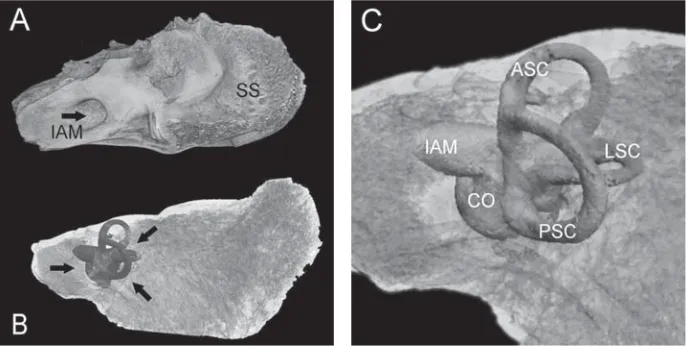
The 3D visualisation based on interactive di-rect volume rendering gave an opportunity to observe the reconstructed structures at various angles.An important feature of visualisation was the ability to show anatomical structures embed-ded in bone. Thereby, we revealed the position of the labyrinth within the petrous bone (Figs. 1, 2). Surface reconstruction of the cochlea and the semi-circular canals within the petrous bone was de-picted in Figure 3.
the ampullas of each semicircular canal were re-constructed, and can be easily recognised in Figure 3B. The mutual topographical relationship between the cochlea and the semicircular canals is shown in Figure 4. The cochlea forms the anteri-or part of the labyrinth, whereas the semicircular canals are located posteriorly. Hence, Figure 4 pre-sents the final effect of the digital reconstruction of the entire osseous labyrinth viewed in the an-terior and posan-terior aspect.
The micro-CT examination of the temporal bone allowed a detailed imaging of the osseous labyrinth to be performed. The generated 3D model of the osseous labyrinth presents its overall appearance and may be used in comparative morphological studies. It also allows interactive exploration of the anatomy
of the inner ear and helps to understand the spatial relationships within its components and surround-ing structures.
DISCUSSION
The first morphological analyses of the inner struc-tures of the temporal bone were based on manual sectioning. Histological sections only permitted 2D ob-servations and planar measurements of the specimens [4]. However, that way of reconstruction was extremely time consuming and was rarely used in the anatomi-cal research of the topography and morphology of the middle and inner ear [5].
Development of computers and graphic software enabled 3D reconstructions to be carried out from the 2D images. The computer graphics system com-Figure 1. A. Volume reconstruction of the right petrous bone, visible medial surface; IAM — internal acoustic meatus; SS — sigmoid sulcus; B. The petrous bone is considered semi-transparent and the labyrinth is visible as an opaque object (indicated by arrows); C. Enlarged image of the osseous labyrinth in the postero-medial aspect; CO — cochlea; ASC — anterior semicircular canal; PSC — posterior semicircular canal; LSC — lateral semicircular canal.
bined with the histologic sections permitted the vi-sualisation of the intratemporal bone structures in a 3D way, and viewing them from various angles [6]. The application of that novel modality in mor-phological science opened new cognitive horizons and deepened knowledge on the spatial organi-sation of the minute structures. Computer-based 3D models of the anatomical structures have be-come an important tool for learning and teaching anatomy. Three-dimensional computer-assisted re-construction simplified the understanding of the complexity of the temporal bone and the relation-ship between its components [7, 11, 13]. In our case, the generated model of the osseous laby-rinth seems to be helpful in understanding both its anatomy and topography within the temporal
Figure 4. A digital model of the right osseous labyrinth; A. Anterolateral view; B. Posterosuperior view; BC — basal turn of the cochlea; AC — apex of the cochlea; VL — vestibule; OW — oval window; RW — round window; ACO — cochlear area; ASC — anterior semicircular canal; PSC — posterior semicircular canal; LSC — lateral semicircular canal; CC — common crus; A — ampulla.
Figure 3. Surface reconstruction of the cochlea (A) in the antero-inferior aspect, and the semicircular canals (B) viewed from the posterior. Surrounding bone was partially removed; PB — petrous bone; BC — base of the cochlea; VL — vestibule; ASC — anterior semicircular canal; PSC — posterior semicircular canal; LSC — lateral semicircular canal; CC — common crus; a — axis of the plane of the anterior semicircular canal, b — axis of the plane of the posterior semicircular canal (long axis of the petrous bone), a ª 90°.
bone. Thus, it can be dedicated for educational purposes.
thick-ness was equal to 27.0 µm. This provided an extraor-dinary accuracy in modelling and approached a vir-tual appearance of the studied structures of the in-ner ear. Thereby, micro-CT isthe best technique for anatomical study of any small osseous components. This modality is superior to the classical radiographic methods, which allow visualisation of the labyrinth components with lower resolution compared to mi-cro-CT. Such images are blurred when magnified whereas the original scans are not always adequate to reveal all anatomical details of the inner structure of the petrous bone. In order to recognise the com-plex spatial relations of a labyrinth and its surround-ing structures a clear visualisation is required. Precise imaging of the cochlea, the vestibule, and the semi-circular canalsis essential for comparative and quan-titative studies. There is a little information on the morphological variation of the osseous labyrinth in man [10, 12]. Possible reasons include accessibility to the micro-CT scanner and its technical capabilities. An-other is the duration of the scanning process (as much as a few hours per sample), and limitations of the sam-ple diameters (up to few centimetres). Therefore, the scanning of large objects (e.g. the whole skull) is im-possible and the process would be extremely time-consuming. For the time being, micro-CT provides im-ages with the highest resolution and fidelity that can be obtained in various imaging modalities. The recon-structed structures reveal a large spectrum of detail which disappears in other radiographic techniques. The anatomical details of the temporal bone (e.g. laby-rinth) are clearly delineated in the micro-CT scans. Therefore, a stack of images can be used to generate excellent computer models of the inner ear.
ACKNOWLEDGEMENTS
This research was carried out with equipment purchased thanks to the financial support of the European Regional Development Fund in the frame-work of the Polish Innovation Economy Operational Program (contract no. POIG.02.01.00-12-023/08).
REFERENCES
1. Bartling SH, Shukla V, Becker H, Brady TJ, Hayman A, Gupta R (2005) High-resolution flat-panel volume-CT of temporal bone. Part 1: axial preoperative anatomy. J Comput Assist Tomogr, 29: 420–423.
2. Dalchow CV, Weber AL, Yanagihara N, Bien S, Werner JA (2006) Digital volume tomography: radiologic exami-nations of the temporal bone. AJR, 186: 416–423. 3. Fatterpekar GM, Doshi AH, Dugar M, Delman BN,
Naidich TP, Som PM (2006) Role of 3D CT in the evaluation of the temporal bone. Radiographics, 26 (suppl. 1): 117–132.
4. Green JD Jr, Marion MS, Erickson BJ, Robb RA, Hino-josa R (1990) Three-dimensional reconstruction of the temporal bone. Laryngoscope, 100: 1–4.
5. Harada T, Ishii S, Tayama N (1988) Three-dimensional re-construction of the temporal bone from histologic sec-tions. Arch Otolaryngol Head Neck Surg, 114: 1139–1142. 6. Lutz C, Takagi A, Janecka IP, Sando I (1989) Three-di-mensional computer reconstruction of a temporal bone. Otolaryngol Head Neck Surg, 101: 522–526.
7. Mason TP, Applebaum EL, Rasmussen M, Millman A, Evenhouse R, Panko W (2000) Virtual temporal bone: creation and application of a new computer based teach-ing tool. Otolaryngol Head Neck Surg, 122: 168–173. 8. Powitzky ES, Hayman LA, Bartling SH, Chau J, Gupta R,
Shukla V (2006) High-resolution computed tomogra-phy of temporal bone. Part III: Axial postoperative ana-tomy. J Comput Assist Tomogr, 30: 337–343. 9. Shaffer M (1981) Computed tomography of the
tem-poral bone. Radiographics, 1: 62–72.
10. Spoor F, Zonneveld F (1998) Comparative review of the human bony labyrinth. Am J Phys Anthropol, 41: 211– –251.
11. Tomandl BF, Hastreiter P, Eberhardt KEW, Rezk-Salama C, Naraghi R, Greess H, Nissen U, Huk WJ (2000) Virtual labyrinthoscopy: visualization of the inner ear with in-teractive direct volume rendering. Radiographics, 20: 547–558.
12. Tomura N, Sashi R, Kobayashi M, Hirano H, Hashimoto M, Watarai J (1995) Normal variations of the temporal bone on high-resolution CT: their incidence and clinical sig-nificance. Clin Radiol, 50: 144–148.