Enabling Novel Interactions between
Applications and Software-Defined
Networks
Ph.D. Candidate:
Antonio Marsico
Advisor:
Over the last few decades the pervasive diffusion of software has greatly simplified the introduction of new functionalities: updates that used to re-quire complex and expensive re-engineering of physical devices can now be accomplished almost at the push of a button. In the context of telecommu-nications networks, recently modernized by the emergence of the Software-Defined Networking (SDN) paradigm, software has manifested in the form of self-containedapplications driving the behavior of thecontrol planeof the network. Such SDN controller applications can introduce profound changes and novel functionalities to large deployed networks without requiring down-time or any changes to deployed boxes, a revolutionary approach compared to current best practices, and which greatly simplifies, perhaps even enables, solving the challenges in the provisioning of network resources imposed by modern distributed business applications consuming a network’s services (e.g., bank communication systems, smart cities, remote surgery, etc.).
This thesis studies three types of interaction between business applica-tions, SDN controller applications and networks with the aim of optimizing the network response to a consumer’s needs.
an increase of the amount of traffic that a SDN device can process in the case of memory overflows.
Second, an interaction between business applications and SDN networks shows how it is possible to reduce the blocking probability of service re-quests in application-centric networks. A negotiation scheme based on an Intent paradigm is presented. Business applications can request connectiv-ity service, receive several alternative solutions from the network based on a degradation of requirements and provide a feedback.
1 Introduction 1
1.1 Structure of the thesis . . . 4
2 Background 6 2.1 SDN generic architecture . . . 6
2.1.1 Modern SDN network controllers . . . 8
3 Interactions between Software-Defined Networking (SDN) controller applications and networks 11 3.1 A SDN application for the Memory Management of SDN devices 12 3.2 Related Work . . . 16
3.3 Memory swapping design . . . 17
3.3.1 Swap out . . . 18
3.3.2 Swap in . . . 21
3.4 Software architecture . . . 21
3.4.1 Interaction with the controller . . . 22
3.4.2 Building blocks . . . 24
3.5 Performance Evaluation . . . 25
3.5.1 Test methodology . . . 25
net-works 32
4.1 An Intent-based Negotiation Scheme
for Application-centric Networks . . . 33
4.2 Related Work . . . 36
4.3 Service Negotiation . . . 38
4.3.1 Negotiation Algorithm . . . 39
4.3.2 Application-Aware Service Provisioning Algorithm . . 41
4.3.3 Alternative Solution Selection Algorithm . . . 43
4.4 Software Architecture . . . 45
4.4.1 ONOS Services and APIs . . . 46
4.4.2 Negotiation in ONOS . . . 48
4.5 Performance Evaluation . . . 50
4.5.1 Simulation Setup . . . 51
4.5.2 Sensitivity Test Methodology . . . 52
5 Interactions between business applications, SDN controller applications and networks 60 5.1 An SDN App Store for Network Connectivity Services . . . . 61
5.2 Related Work . . . 63
5.3 The App Store Model . . . 64
5.3.1 Offer generation and negotiation . . . 67
5.4 Software Architecture . . . 69
5.4.1 Extending the DISMI intent interface . . . 69
5.4.2 ONOS Intent Framework and Services . . . 71
5.4.3 Implementation of the Network Intent Primitives . . . 73
5.4.4 The negotiation phase . . . 74
5.5 Performance Evaluation . . . 75
5.5.1 Test methodology . . . 75
6 Conclusions 80
2.1 SDN General Architecture. . . 7 3.1 The memory swapping in the context of the ONOS platform. 22 3.2 Experiment setups for the evaluation. . . 26 3.3 Number of installed rules without memory swapping at
dif-ferent flow table sizes. . . 28 3.4 Number of installed rules with memory swapping at different
flow table sizes. . . 30 3.5 Throughput comparison with and without memory swapping
at different flow table sizes. . . 31 4.1 Current network traffic aggregation. . . 33 4.2 Application-centric network. . . 34 4.3 Negotiation interaction between orchestrator and application
negotiation-specific algorithms. . . 39 4.4 Negotiation architecture of the ONOS controller. . . 45 4.5 (Experiment 1) Evaluation of SR blocking probability (a),
negotiation probability (b) and negotiation failure probability (c). . . 53 4.6 (Experiment 1) Evaluation of the average degradation of
4.7 (Experiment 2) Evaluation of SR blocking probability (a), negotiation probability (b) and negotiation failure probability
(c). . . 55
4.8 (Experiment 3) Evaluation of SR blocking probability (a), average parameter degradation (b) and average parameter degradation atNL3 (c). . . 57
4.9 (Experiment 3) Negotiation probability. . . 58
5.1 App Store generic model. . . 64
5.2 Software architecture for the ONOS controller. . . 68
5.3 Experiment setup for the evaluation. . . 75
5.4 DISMI processing time for decomposing the SD-WAN appli-cation request. . . 77
5.5 Processing time for generating an offer from the SD-WAN compilers. . . 77
Introduction
In the last years, software has driven innovation in many different fields with a direct impact on society [1]. Cloud, Internet of Things, and Net-working are important examples of how software has rapidly brought novel functionalities, in tight cooperation with hardware advancements.
A particular type of software, the self-contained application package, can be seen as a key enabler for efficiently introducing novel functionalities, even among different technological domains. Applications are computer pro-grams designed to perform different types of functions and activities. An application can receive inputs from users, other applications or hardware, and elaborate an answer (i.e. output) through specific algorithms. They can exploit a modular architecture, which offers the possibility to develop applications as independent and interchangeable modules, and executed on top of an Operating System (OS), which provides a consistent, abstracted view of the underlying hardware. In this way, applications can be easily modified and updated with novel functions when required.
represents the traffic forwarding intelligence of a network, has been sub-jected to a deep change towards an application-based architecture. Indeed, novel SDN network controllers offer features similar to OSs. They provide abstraction with respect to the infrastructure layer by offering many differ-ent Application Programming Interfaces (APIs), which can be exploited by external software modules to interact with network devices. These mod-ules are defined asSDN controller applications. Every SDN application can provide specific functionalities to SDN networks, such as firewalling, load balancing, customized traffic routing, etc.
On top of thecontrol layer, novel business applications for industry ver-ticals, such as trading platforms for banks, e-commerce, video streaming services, etc., pose specific challenges on the network management and ser-vice provisioning. They generate a multitude of diverse traffic patterns, which are characterized by many different requirements, such as bandwidth, latency, availability, etc. These multitude of traffic patterns are usually ig-nored during the provisioning of a connectivity service. Thus, this implies that traffic with diverse requirements is eventually groomed in same net-work connections. For instance, a distributed database application, based on a strict consistency model, requires low traffic latency. If the network cannot provide this requirement, the database application may experience synchronization issues.
The main objective of this thesis is to study how business applications and SDN controller applications can improve the performance of SDN net-works by means of interactions between them. Every interaction tackles a specific network problem and shows one possible solution. Three different type of interactions are analyzed:
• Interaction between SDN controller applications and
of potential issues, such as misconfigurations. SDN applications re-ceive network events, such as traffic statics, topology information, etc. and they perform actions into the network. In particular, this inter-action shows how SDN applications can be exploited to mitigate the limited memory of SDN network devices. This issues may potentially cause delays in accessing distributed services, since a device with a full memory cannot accept anymore the installation of new forwarding rules [2].
• Interaction between business applications and SDN networks: Business applications can interact with the network by exploiting an
application-centric paradigm, which proposes the provisioning of
con-nectivity services based on application-specific requirements. An ap-plication can communicate to a SDN controller its requirements and, whether the network can satisfy all of them, the application request can be provisioned otherwise blocked. In order to reduce the request blocking probability, we propose a novel interaction between business applications and SDN networks, defined as the application-aware
ser-vice negotiation. In the case of the network cannot provide all the
requirements, it calculates a set of alternative solutions based on the
degradationof requirements. The applications analyze the alternatives
and provide a feedback to the network.
controller applications.
1.1
Structure of the thesis
The thesis structure is organized as follows:
Chapter 2 proposes a general description of two paradigms that are exploited in this thesis: the SDN andapplication-centricparadigms. In par-ticular, the former section presents an overview of the SDN technologies, with a focus on the OpenFlow control protocol [3]. While the latter de-scribes an approach for the provisioning of connectivity services based on application-specific requirements.
Chapter 3 analyzes the first form of interaction proposed in this the-sis, the interactions between SDN controller applications and networks. In particular, this Chapter is based on the following joint work:
• A. Marsico, R. Doriguzzi-Corin e D. Siracusa. An effective swapping mechanism to overcome the memory limitation of SDN devices. In: 2017 IFIP/IEEE Symposium on Integrated Network and Service Man-agement (IM), mag. 2017.
Chapter 4describes theinteractions between business applications and
SDN networks. This Chapter collects contributions from the following joint
work:
• A. Marsico, M. Savi, D. Siracusa, An Automated Service-downgrade Negotiation Scheme for Application-centric Networks. In press: 2018 The Optical Networking and Communication Conference & Exhibition (OFC).
Chapter 5 offers an overview on the interactions between business
ap-plications, SDN controller applications and networks. This Chapter is based
Background
This section provides an overview of the Software-Defined Networking (SDN) paradigm exploited in this thesis. In particular, we propose an overview of modern SDN controller architectures, which provides functionalities similar to computer OSs.
2.1
SDN generic architecture
Inside every network device, such as switches or routers, two different logical parts coexist: the control plane and the data plane. The control plane is the intelligence of the system. It is responsible for taking decisions on how packets should be forwarded between the different input/output ports. On the other hand, the data plane represents the hardware part of the device, where decision on packets from thecontrol plane are physically applied (e.g. send the packet out of a specific hardware port).
The SDN paradigm proposes the decoupling between the control plane
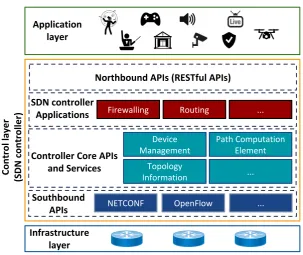
Control layer
(SDN controller)
Northbound APIs (RESTful APIs)
Controller Core APIs and Services
Device Management
Path Computation Element
... Topology
Information
Southbound
APIs NETCONF OpenFlow ...
SDN controller
Applications Firewalling Routing ...
Infrastructure layer Application
layer
Figure 2.1: SDN General Architecture.
composed of three main parts: Application layer,Control layer and
Infras-tructure layer (Fig. 2.1).
TheApplication layer represents all the applications that exploit a SDN
network infrastructure to transmit data traffic. In particular, this thesis con-siders novel business applications for industry verticals, such as live stream-ing video, security systems, on-line tradstream-ing platforms, etc. The second layer,
the Control layer, is the main part of the architecture, where all the
man-agement and provisioning decisions for a network are made. This layer is represented bySDN network controllers. They are compound software pack-ages that configure networks’ behavior by exploiting a centralized view and several Southbound APIs to configure network devices. Finally, the
Infras-trucure layer represents all the physical network devices. They have limited
2.1.1 Modern SDN network controllers
In the last years, SDN network controllers have evolved to provide abstrac-tion with respect to the Infrastructure layer similar to computer OSs. The configurations that should be performed on a device, the network events, such as failures, topology changes, etc., can be managed and processed by exploiting several APIs of a SDN controller, which define a generic and high level language to interact with a network infrastructure.
In general, SDN controller architectures are designed based on a layered structure. Higher layers provide higher abstraction with respect to a network infrastructure, while the bottom layers implement the specific communica-tion protocols required to interact with a network infrastructure. Starting from the top, SDN controllers provideNorthbound APIs to let applications, such as external software for network provisioning, to gather network infor-mation and to interact with them. Usually, these APIs are implemented by exploiting HTTP RESTful APIs, such as Swagger [5], an editor for defining REST APIs and translating them to a programming language. In order to increase the abstraction of Northbound APIs, a new paradigm, called
Intent-based networking [6], has been proposed. It offers a higher level of
abstraction than specific network commands (e.g., send a packet out of port 2). This paradigm can be used to express network requests in the form of high level intentions, which specifywhat it is required by a network rather than how this should be accomplished. For instance, an application can request “I want to connect host A to host B with 10 Gbps of bandwidth”. Then, a SDN controller is responsible to translate thisintentinto commands understandable by network devices.
Beyond the Northbound APIs, a SDN controller can host several SDN
controller applications, each one providing a particular network
of self-contained software applications. They can be installed, updated and uninstalled as computer applications without requiring major modifications to a SDN controller.
SDN applications exploit the Controller Core APIs and Services to in-teract with a network infrastructure. Every API represents a particular network service, which offers a set of functionalities to SDN controller appli-cations. The most important generic services that a SDN controller offers are
theDevice Management, the Path Computation Element and the Topology
Information. The first service provides all the operations required to
inter-act with a network device (e.g. installation of forwarding rules, forwarding table status, etc.). The second service, thePath Computation Element, can be exploited to calculate the shortest paths between different endpoints in a network. Finally, theTopology Information service exploits the centralized view of SDN controllers to provide all the data about the network topology, such as devices, links, etc., and the network events, such as failures.
The bottom layer is represented by the Southbound APIs. These APIs offer a communication interface between a SDN controller and network de-vices. Every API implements a specific communication protocol and the commands required to interact with a network device. Since the SDN envi-ronment is composed by many different communication protocols, the mod-ern SDN controllers implement the APIs as software modules, which can be added or removed at runtime, like the SDN applications.
On of the most well-known Southbound API for SDN is OpenFlow [3]. It is an API that uses an encrypted connection, based onSecure Socket
Lay-er/Transport Layer Secure (SSL/TLS), to exchange messages between the
the Stats. The Flow Match represents thematching structure, thus which are the header field (and their values) of a packet where theActions should be applied. The concept ofFlow is borrowed from the TCP protocol, which creates virtual and reliable connections between hosts for a data transfer in the network. OpenFlow extends and generalizes this concept to all the traffic inside the network. A trafficFlow is a set of packets between a source and a destination that shares the same characteristics with respect to the transport connection (i.e. TCP/UDP), the carried information, etc. For ex-ample, aFlow can be defined by a set of packets sharing the same IP source or destination and TCP/UDP source and destination ports. The Action
field represents what the network device has to perform on the data traffic (e.g. exit from port 2, drop a packet, etc.). TheStats are the statistics, i.e., number of packets that have matched a particularFlow.
Another important Southbound API is NETCONF [7]. Different from OpenFlow, it defines a set of operations to configure network devices based on the YANG data model [8]. The NETCONF protocol can be exploited to edit device configurations and receive events from network devices. In particular, this protocol implements transactions based on the ACID prop-erties: Atomicy, Consistency, Independence and Durability. In this way, every transaction provides a predictable outcome. Indeed, this language is mainly exploited into devices for transport networks, such as routers.
Interactions between SDN
controller applications and
networks
In this chapter we analyze the effect of the interaction between SDN con-troller applications and networks. In particular, we show how this interac-tion can overcome the memory limitainterac-tion of SDN network devices that are usually based on Ternary Content Addressable Memory (TCAM). Unfor-tunately, in many network scenarios, TCAMs can quickly fill due to their limited memory size, thus preventing the installation of new flow-rules and leading to inefficient traffic forwarding. This issue has already been ad-dressed in computer programming, whereVirtual Memory is offered to ap-plications to mimic a much larger physical memory, by swapping memory pages to disk.
Man-agement System (MMS), a SDN controller application for optimizing the memory usage of network devices. We discuss the memory swapping mech-anism design, its implementation; furthermore, we prove its quality using real traffic traces, demonstrating lower TCAM memory utilization and po-tentially increased network performance in terms of end-to-end throughput. A prototype of the MMS is available for testing as an open source project on GitHub [11].
3.1
A SDN application for the Memory
Manage-ment of SDN devices
In SDN, network applications rely on SDN controllers to handle the incoming traffic, via instructions that are executed by network devices. This piece of information is commonly saved in the memory of the devices and it is called
flow entry. In the OpenFlow protocol, a widely used standard for SDN
[3], flow entries can be of variable length/size according to the specificity of the action that is requested to the networking device (e.g. L3 routing, L4 firewalling, etc.). With respect to traditional L2 and L3 forwarding, OpenFlow allows a much finer control of the network traffic, but, at the same time, it requires more memory space for each flow entry. For instance, recent versions of OpenFlow require up to 773 bits for each entry1, while 60 bits are sufficient to identify a flow for L2 forwarding (destination MAC address plus VLAN identifier).
Modern network switches are usually equipped with two different types of memory in which forwarding instructions are stored: Binary andTernary
Content Addressable Memory (BCAM and TCAM). Both memory types can do lookups in one clock cycle and in parallel fashion, therefore they are very efficient when matching the incoming traffic with the forwarding rules they
1
store. However, BCAMs only provide binary lookups, so they can store only information represented by 0 or 1 bits. They are most useful for building tables that search on exact-matches such as MAC address tables. On the other hand, TCAMs can store three bit states (0, 1, and “don’t care”) and are the most commonly used mainly because they can store IP prefixes. TCAMs work very well in conjunction with OpenFlow, where the flow table entries foresee a wildcard bit, used to inform the switch to ignore the value of the specified header field. Unfortunately, TCAMs are very expensive, power hungry and have a considerable footprint size with respect to the number of supported flow entries. Therefore, vendors tend to install TCAMs with very limited capacity, which can quickly get full, leading to inefficient forwarding operations.
This problem is partially mitigated in the switches’ firmware, which com-bine Random Access Memories (SRAM, DRAM, etc.) and TCAM to build the flow table: RAM for exact-match entries, the TCAM for wildcard en-tries [13]. However, this strategy is not suitable for SDN-enabled switches, where exact-match rules are rarely used.
Starting from specification 1.4.0, OpenFlow introduces two mechanisms to allow the SDN developer to handle the lack of memory space available on network devices: eviction and vacancy events. The first one enables the switch to automatically delete the flow entries with lower importance. The degree of importance of each single flow entry is set by the SDN applica-tions. The second mechanism enables the controller to get an early warning based on a capacity threshold set by the SDN application. However, such approaches force the SDN developers (and the SDN applications) to take care of the memory utilization.
the network architecture, changes of the switches’ software or hardware, modifications of the control protocol, or the usage of exact-match rules in BCAMs to save TCAM space.
In our work, we advocate that SDN controllers shall grant their appli-cations a reliable access to network devices’ memory. To this purpose, we propose a Memory Management System (MMS) for SDN that aims at im-proving the TCAM usage and, consequently, the robustness of the network. Compared to the existing approaches, the MMS transparently optimizes the usage of the available memory by exploiting two different functions: (i) the
memory de-allocation and thememory swapping.
The first one offers automatically removal of the flow entries installed by applications that are no longer running. We found that most of network controllers do not automatically remove the flow entries associated to a deactivated application [14].
The second one, thememory swapping, recalls a technique used in com-puter OSs to exchange memory pages between the fast but limited in size Random Access Memory (RAM) and the slow but much larger hard disk. Especially in the past, when the RAM capacity was often not sufficient for multi-tasking environments, memory swapping was the only way to make the applications seamlessly run even in low memory space conditions. In this context, the OS moves (swaps out) the least used memory pages to a pre-configured space on the hard disk called paging file, swap file or swap
partition, and makes the memory available to those applications that need
In the SDN context, the fast/size-limited memory is represented by the B/TCAMs of the network elements and the slow/large memory can be im-plemented as a database maintained by the SDN controller in the RAM memory of the computer where it is running. Our rationale is to maintain the most matched flow rules in the switches’ memory and move the other rules to the database, in a completely transparent way for the network ap-plications running on top of the controller.
We can summarize the contributions of this work as follows:
• Designof a platform-independent memory swapping mechanism for SDN controllers, as part of a more powerful Memory Management Sys-tem, whose aim is to optimize the usage of switches’ memory, trans-parently to SDN network applications.
• Implementation of the swapping mechanism for the ONOS plat-form [9]. ONOS is an advanced SDN controller that provides the required services and APIs for the implementation of the swapping mechanism, as identified in [14]. Unlike other controllers like Ryu [15], where the table full condition must be handled by the SDN applica-tions, ONOS hides these low-level details and holds the flow rules that cannot be installed in apending add state until there is enough mem-ory space in the switches. We compare the ONOS mechanism against our memory swapping.
3.2
Related Work
There is a vast array of work related to the TCAM memory utilization and optimization in SDN. We classify the most relevant techniques in five categories:
Flow rule Caching: Like the MMS, CacheFlow [16] is aVirtual Mem-ory mechanism that gives SDN applications the illusion of an arbitrarily large switch memory. In CacheFlow, the additional memory is provided by software SDN switches which are attached to the datapath and imple-mented as software agents in commodity server-class hardware or directly in the hardware switches. However, while the latter approach requires modifi-cations of the switches’ firmware, the first imposes strict constraints to the network, as CacheMaster, the component that hosts the software switches, must communicate with the hardware switches via either single-hop Layer-1 connectivity or Layer-2 tunnels. Moreover, CacheFlow does not tackle the
table full case, i.e. the critical situation when the TCAM of one or more
hardware switches is full, which the MMS covers by design.
Exact match rules: Authors of DomainFlow [17] leverage exact match rules to overcome the limited capacities of the TCAM memories, as exact match rules are saved in binary memories (like briefly explained in the Intro-duction). DomainFlow keys ideas are: (i) use exact matching where possible and (ii) split the network into sections to allow exact matches to be used more often. DevoFlow [18] propose a modification of the OpenFlow model by introducing a new action type in form of the clone flag. If the flag is set, the switch clones wildcard rules with exact match rules that are saved in the exact match flow table, i.e. saving TCAM memory space. However, DevoFlow imposes modifications of both OpenFlow protocol and switches’ firmware and, like DomainFlow, it does not address the limitations imposed by the size of the TCAM.
timeouts for the flow rules which results in optimal utilization of the TCAM memory. SmartTime pro-actively evicts flow rules with finite timeout in a random manner when the TCAM utilization crosses a pre-defined threshold. However, SmartTime does not cover the common case in which pro-active rules with infinite timeouts are used to control the traffic (e.g. cloud orches-trators like Open-Stack/Neutron pro-actively install all the rules to create the virtual network topologies).
Flow table compression: Tag-in-Tag [20] proposes a technique to re-place the OpenFlow entries stored in the TCAM memories with two layers of simpler and shorter tags. However, Tag-in-Tag requires changes in the packet header and in the switches’ firmware to correctly handle the tags. Authors of [21] leverage OpenFlow’s wildcards to reduce the memory uti-lization in the specific scenario of Border Gateway Protocol (BGP) routing tables.
Flow rule placement optimization: Several recent works propose algorithms or mechanisms for an optimal rule placement across the network, with the aim of saving TCAM memory space ([22], [23], [24], [25]). However, none of them tackles thetable full case.
3.3
Memory swapping design
3.3.1 Swap out
By default, the swap out operation is executed when the SDN controller detects that one or more switches are operating in table full condition. In case of OpenFlow-enabled switches, that condition is notified to the SDN controller via aTABLE FULLerror message. From OpenFlow 1.4.0 or higher, the swapping mechanism can be also configured to react to TABLE STATUS
events with reasonVACANCY DOWN, meaning that the remaining space in the flow table has decreased to less than a pre-defined threshold.
Unlike a traditional computer OS virtual memory system, where a page is either allowed to be swapped out or not, the removal of a flow rule from the TCAM may change the semantic of the network. This problem may happen because high priority rules may be dependent on low priority ones. As a trivial example, consider a rule set where the default rule drops any packet and any allowed communication is handled with higher priority rules. When the MMS swaps out an entry of this rule set because of resource pressure, any further packet matching this rule will be then caught by the default rule and dropped, which is an undesirable result. So, whenever we consider a rule as a candidate to swap out, we have to build the (transitive) set of (lower priority) rules which are also affected. The analysis of the rule-dependency problem, which is outside the scope of this work, has already been tackled by other works such as CacheFlow [16].
Authors of CacheFlow propose an algorithm to incrementally analyze and maintaining rule dependencies. In such a work, a dependency between a child ruleC and a parent rule Ris defined as follows: ifC is removed from the flow table, packets that are supposed to hitC will hit ruleP.
The current design of the MMS leverages on CacheFlow’s algorithms to cor-rectly compute the dependencies between rules and, consequently, toswap
out/in the wildcard entries between TCAM and MMS databases. Please
free TCAM memory space. Thus, it does not take into consideration the rarely used exact match rules (which are likely stored in other memories such as DRAM or SRAM), to avoid the risk freeing the wrong memory.
1 f u n c t i o n i n s t a l l F l o w R u l e ( f l o w _ r u l e fr ):
2 if c h e c k _ w i l d c a r d s ( fr ) is T r u e :
3 d e p _ c h a i n = c o m p u t e _ d e p e n d e n c i e s ( fr , f l o w _ d b )
4 fr . a d d D e p e n d e n c i e s ( d e p _ c h a i n )
5 f l o w _ d b . add ( fr )
6 s w a p _ c h a i n = g e t _ d e p e n d e n c i e s ( fr , s w a p _ d b )
7
8 w h i l e i n s t a l l _ r u l e s ( fr , s w a p _ c h a i n ) is F a l s e :
9 s w a p O u t ()
10
11 f u n c t i o n s w a p O u t ():
12 l e a s t _ u s e d _ f r = g e t _ l e a s t _ u s e d _ f r ( flow_db , q u o t a )
13 for fr in l e a s t _ u s e d _ f r :
14 d e p _ c h a i n = g e t _ d e p e n d e n c i e s ( fr , f l o w _ d b )
15 for d e p _ f r in d e p _ c h a i n :
16 if d e p _ f r . t i m e o u t is 0:
17 s w a p _ d b . add ( d e p _ f r )
18 r e m o v e d e p _ f r
Listing 3.1: Flow rule installation process.
The pseudo-code in Listing 3.1 illustrates how the swap out process is executed. We assume that the SDN/OpenFlow switch is set up to generate
new flowmessages (e.g. an OpenFlowPACKET IN), in the case of an unknown
destination of a packet, and SDN applications may request the installation of flow rules both reactively and proactively (i.e. with/without a new flow message).
rule is stored in the flow db database (line 5) along with the dependency chain. Before installing the flow rule, we retrieve the dependency chain of the new rule from the swap db (which stores the rules that have been previously swapped out), to avoid network inconsistencies (line 6). The actual installation of the new rule onto the device is performed at line 8. If the operation returns either a TABLE FULL error or a VACANCY DOWN event, theswapOutfunction is called to free up some space in the switch flow table (line 9) and then the rule is finally installed.
The swapOutfunction gets the least used flow entries from the flow db
(line 12), based on traffic statistics collected periodically (as described below in this section). quotais the percentage of the installed rules to be swapped out. By default, its value is 20% for all the switches, but this threshold can be tuned dynamically based on the performance of the network. Swapped out flow entries are removed from the TCAM of the devices and from the
flow db. Entries with infinite timeout are saved in the swap db (line 17) and automatically restored by the MMS when necessary. Entries with finite timeout are just dropped, based on the assumption that network applications can autonomously restore them, exactly how they would do if those flow entries were naturally expired due to the lack of matching traffic.
A network application may need to uninstall a flow rule. In this case, the MMS automatically deletes the corresponding entry from the flow db
and from theswap db (if necessary) and updates the dependency chains of the child entries in those databases.
the most recent samples are weighted more than the oldest samples. This approach avoids erroneous classifications where, for instance, a flow entry periodically matched by a micro-flow has more chances to be swapped out than an entry matched by an elephant flow far in the past, i.e. no more active.
3.3.2 Swap in
Swapped out flow rules are automatically re-installed by the MMS onto the network when the switches need them again to forward the traffic, transpar-ently to the SDN applications running atop the SDN controller.
The mechanism is fairly simple: when a switch does not find a match for an incoming flow inside its flow tables, it sends a new flow message (e.g. an OpenFlow PACKET IN) to the SDN controller. The MMS intercepts the message before it arrives to the applications and checks whether the flow matches any of the swapped out rules in the swap db database (line 2 in Listing 3.2). If the MMS finds a match, it automatically reinstalls the rule along with its dependency chain into the switch’s memory (lines 3-5), oth-erwise thenew flow message is released to the other processes of the SDN controller, which eventually relays it to all the listening applications.
1 f u n c t i o n s w a p I n ( p a c k e t pkt ):
2 fr = s w a p _ d b . g e t _ r u l e ( pkt )
3 if fr is T r u e :
4 s w a p _ c h a i n = g e t _ d e p e n d e n c i e s ( fr , s w a p _ d b )
5 i n s t a l l _ r u l e s ( fr , s w a p _ c h a i n )
Listing 3.2: Swap in process.
3.4
Software architecture
Specifically, the MMS requires a number of services and interfaces to inter-act with the network devices and to accomplish the memory management operations. Since not all the SDN controllers meet the requirements, we started our development work by implementing the memory deallocation
function for ONOS [27]. In this section, we recall the building blocks of the MMS architecture and we map them into ONOS with specific focus on the requirements for thememory swapping.
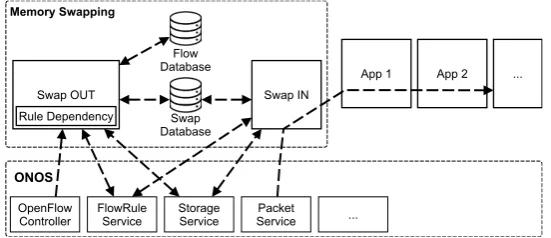
Figure 3.1: The memory swapping in the context of the ONOS platform.
3.4.1 Interaction with the controller
The memory swapping requires read/write access to the flow tables of the
switches. It must keep track of all the flow entries installed in the network along with their statistic counters. Moreover, it must be able to intercept some events generated by the network, such as the TABLE FULL error and theTABLE STATUSevent with reasonVACANCY DOWN, used to trigger theswap out process, and the notification of new flows (i.e., PACKET IN in Open-Flow), used by the swap in process to re-install any previously swapped out entry matching the new flow with all its dependencies (as explained in Section 3.3.2).
As shown in Figure 3.1, in ONOS such functions are accomplished by four different interfaces called: OpenFlowController,FlowRuleservice,
interfaces and how they are used by the memory swapping mechanism. FlowRuleService [28]. Interface for installing/removing flow rules into/from the network and for obtaining updates on those already installed. The MMS is also registered as a listener to this interface to: (i) intercept all the flow rules installed by the SDN applications and (ii) get the statistic counters of the installed flow entries, as soon as such statistics are made available by ONOS which collects them every 5 seconds. This information is used by the memory swapping mechanism to recognize the least matched entries which are swapped out in case of full TCAM.
OpenFlowController [29]. Abstraction of the OpenFlow controller. It is used for obtaining OpenFlow devices, for sending OpenFlow messages to them and to register/unregister listeners on OpenFlow events. Specifically, in the current version the MMS registers as a listener to this interface to get theTABLE FULLerror message. We plan to add the support forTABLE -STATUSevents in the next releases.
StorageService [30]. ONOS is a distributed SDN controller platform. An ONOS cluster comprises one or more ONOS instances, running the same set of modules and sharing network state with each other. In that respect, MMS internal databases are based on the StorageService interface which ensures a consistent state of the databases across all the instances of a ONOS cluster.
3.4.2 Building blocks
Flow Database: The MMS implements an internalFlow Databaseto repli-cate the information contained in the flow tables of network devices. To do so, the MMS is registered as a listener to the FlowRuleService to intercept and collect the new rules installed by the network applications. The database is implemented using the EventuallyConsistentMap [32] distributed primi-tive, a data structure provided by ONOSStorageServicewhich provides high read/write performance. The structure of the data stored in the database extends the ONOS FlowRule to contain: (i) current statistics counters of each flows rule, (ii) the whole history of statistic counters and (iii) the list of parent rules, based on the computation of the CacheFlow algorithm [16]. Swap Database: It is implemented as an EventuallyConsistentMap
containing all the swapped out flow rules. In the first prototypes, theSwap
Database was obtained with just a flag in the Flow Database indicating
whether the flow rule was swapped out from the switches’ memory. However, as the number of swapped out rules is low compared to the total amount of entries in the Flow Database, we realized that a dedicated database for the swapped out rules was a better idea to minimize the lookup time and to reduce the latency introduced by the swap in process when inspecting the
new flow messages.
BlocksSwap OUTandSwap INin Figure 3.1 represent the two main processes of the memory swapping mechanism.
Theswap out process is in charge of freeing the switch’s TCAM by moving
the least matched flow entries to the RAM memory of the machine where the SDN controller is running. This process is configured to react toTABLE FULL
The swap out process is divided into the following steps: (i) the MMS re-trieves from the Flow Database all the wildcard entries associated to the switch that generated theTABLE FULLalarm, (ii) the flow entries are sorted based on the average number of matching flows as computed by the EWMA algorithm, (iii) finally the least matched rules are removed from the TCAM with all their dependent rules. The copies of such rules maintained in the
Flow Database are moved to the Swap Database.
Based on our experiments (cf. Section 3.5), we swap out the 20% of the whole TCAM content. However, this value can be tuned switch by switch at runtime based on the performance of the network, i.e. it should be in-creased in case of frequent TABLE FULL events or decreased in case of too many rules re-installed into the network by theswap in process after being swapped out.
3.5
Performance Evaluation
We evaluate the memory swapping mechanism by considering two metrics: (i) average end-to-end throughput and (ii) TCAM space available for new flow entries. The effectiveness of the proposed approach is measured by comparing the results observed with and without the memory swapping using flow table of different sizes.
3.5.1 Test methodology
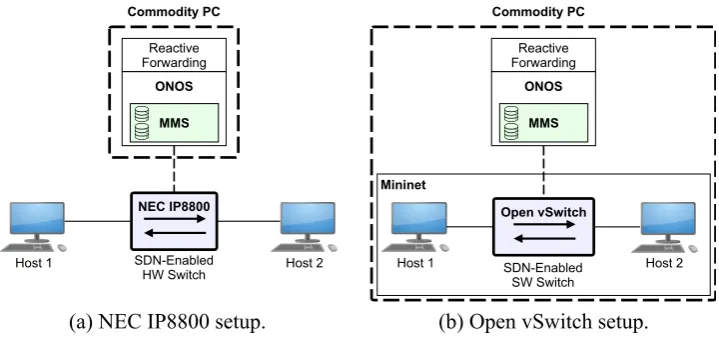
Experimental setup. For the experiments, we use both hardware and software OpenFlow-enabled switches. In the first case we use the NEC IP8800 [33] (Figure 3.2a), while in the second, Mininet [34] and Open vSwitch (OVS) [35] switches (Figure 3.2b).
working at 1600Mhz. This machine is connected to the NEC switch via Gigabit Ethernet for the OpenFlow control channel. Two physical hosts are connected to the switch via Gigabit Ethernet to inject network traffic during the evaluation. For the test with software switches, the commodity PC also hosts Mininet configured with a single OVS-based switch and two virtual hosts attached to it.
We use publicly available SMTP and HTTP traffic traces from [36]. The first one produces 23 new flows per second on average when considering Layer 3 fields, while the second trace produces 65 new flows per second on average.
Figure 3.2: Experiment setups for the evaluation.
Context. The result of the evaluation depends on three main aspects: (i) the flow table size of the switch, (ii) the flow rate of the traffic trace, i.e., number of new flows per second, and (iii) how fast the corresponding flow entries expire. Thus, we expect our memory swapping mechanism to be more effective with small flow tables and high rate of flows controlled using flow entries with high expiry timeouts.
limit the evaluation with the hardware switch to just the SMTP trace. The TCAM of our NEC IP8800 can host up to 1500 flow entries, but we are interested to understand the effectiveness of the memory swapping mecha-nism when varying the size of the flow table. For this reason, we move to the OVS switch, since it can be set up to have different flow table sizes. We configured it from 1500 entries (like our NEC), to 2000 entries like a HP 8200/5400 [37]. In this case, we use the HTTP traffic trace.
Methodology. We compare the memory swapping implementation for ONOS described in Section 3.4 with the default ONOS memory management system. By default, ONOS holds in pending add state the flow rules that cannot be installed until there is enough memory space in the switches. We demonstrate that our mechanism is better in terms of (i) memory space available in the switches for the new entries, and (ii) performance of the network measured in terms of end-to-end throughput.
The experiments are executed under the following conditions:
• At time 0, one of the hosts (e.g.,Host1in Figure 3.2) starts injecting the traffic trace into the switch (either hardware or software). At this point in time, the flow table of the switch is empty.
• The switch is controlled by ONOS via theReactiveForwarding applica-tion [38]. This applicaapplica-tion reactively installs a flow entry in the switch for each incoming new flow.
• The application is configured to generate wildcard flow entries with the only IP source and destination addresses specified. The application also randomly assigns either infinite or 10 seconds idle timeouts to the flow entries.
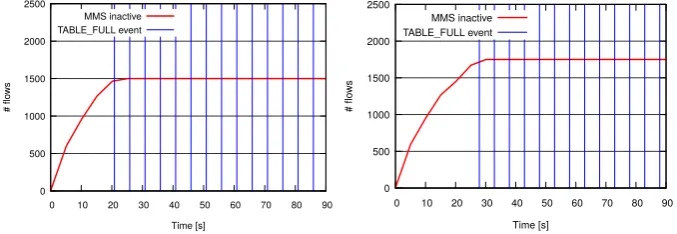
0 500 1000 1500 2000 2500
0 10 20 30 40 50 60 70 80 90
# fl ow s Time [s] MMS inactive TABLE_FULL event
(a) Flow Table size: 1500 rules.
0 500 1000 1500 2000 2500
0 10 20 30 40 50 60 70 80 90
# fl ow s Time [s] MMS inactive TABLE_FULL event
(b) Flow Table size: 1750 rules.
0 500 1000 1500 2000 2500
0 10 20 30 40 50 60 70 80 90
# fl ow s Time [s] MMS inactive TABLE_FULL event
(c) Flow Table size: 2000 rules.
Figure 3.3: Number of installed rules without memory swapping at different flow table sizes.
configured the forwarding application to randomly apply different lev-els of priorities combined with different submasks by following the longest prefix match principle, where the longer the subnet mask, the higher the priority.
3.5.2 Results and discussion
example, when accessing an online service provided by a data center, such as on-demand video streaming, the service performance may drastically drop down [2].
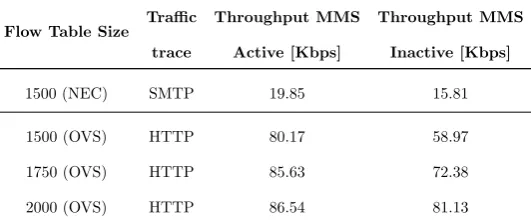
One of the possible criteria to evaluate the loss of performance is the end-to-end throughput measured at the destination host (e.g.,Host2in Fig-ure 3.2). In this way, we demonstrate the effects of a device with a full flow table on the network traffic. Table 3.1 summarizes the results obtained with the NEC hardware switch using the SMTP traffic trace (23 new flows per second), and with the OVS software switch using the HTTP trace (65 new flows per second).
Table 3.1: Average throughput (90 sec. test).
Flow Table Size Traffic
trace
Throughput MMS
Active [Kbps]
Throughput MMS
Inactive [Kbps]
1500 (NEC) SMTP 19.85 15.81
1500 (OVS) HTTP 80.17 58.97
1750 (OVS) HTTP 85.63 72.38
2000 (OVS) HTTP 86.54 81.13
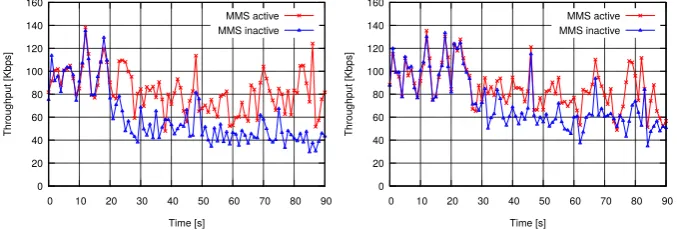
Specifically, when using the memory swapping we measure a throughput increase from 15.81 Kbps to 19.85 Kbps (21% on average) with the NEC switch and the SMTP trace. When using the software switch and the HTTP trace, we observe different performance depending on the size of the flow table. We measure throughput increases of 26%, 15% and 6% with flow table sizes of 1500, 1750 and 2000 flow entries respectively.
0 500 1000 1500 2000 2500
0 10 20 30 40 50 60 70 80 90
# fl ow s Time [s] MMS active TABLE_FULL event
(a) Flow Table size: 1500 rules.
0 500 1000 1500 2000 2500
0 10 20 30 40 50 60 70 80 90
# fl ow s Time [s] MMS active TABLE_FULL event
(b) Flow Table size: 1750 rules.
0 500 1000 1500 2000 2500
0 10 20 30 40 50 60 70 80 90
# fl ow s Time [s] MMS active TABLE_FULL event
(c) Flow Table size: 2000 rules.
Figure 3.4: Number of installed rules with memory swapping at different flow table sizes.
readability, we represent only one error message for each attempt.
Without the memory swapping, the flow table is constantly full and every time ONOS tries to empty the pending add queue, it gets a TABLE FULL
0 20 40 60 80 100 120 140 160
0 10 20 30 40 50 60 70 80 90
Thr
oughput [Kbps]
Time [s]
MMS active MMS inactive
(a) Flow Table size: 1500 rules.
0 20 40 60 80 100 120 140 160
0 10 20 30 40 50 60 70 80 90
Thr
oughput [Kbps]
Time [s]
MMS active MMS inactive
(b) Flow Table size: 1750 rules.
0 20 40 60 80 100 120 140 160
0 10 20 30 40 50 60 70 80 90
Thr
oughput [Kbps]
Time [s]
MMS active MMS Inactive
(c) Flow Table size: 2000 rules.
Figure 3.5: Throughput comparison with and without memory swapping at differ-ent flow table sizes.
trol new flows. The benefits of the memory swapping are demonstrated by the reduced number of TABLE FULL errors, as shown in Figure 3.4, and by the increased performance in terms of end-to-end throughput at different flow table sizes, as shown in Figure 3.5 and also summarized in Table 3.1.
Interactions between
business applications and
SDN networks
Novel business applications for industry verticals with specific and stringent service requirements are expected to represent one of the key challenges for the future transport networks, forcing network operators to design multiple services to cope with these requirements. By exploiting an application-centric paradigm, the operators can provide connectivity service differentia-tion to business applicadifferentia-tions. However, maintaining all the requirements is not always possible and application requests can experience higher service blocking probability.
re-quirements. The application can provide a feedback to the network, based on an autonomous interaction. We prove the effectiveness of our approach by showing how it leads to a lower blocking probability of service requests with respect to the case no negotiation scheme is adopted, without in turn causing significant service degradation to the applications.
4.1
An Intent-based Negotiation Scheme
for Application-centric Networks
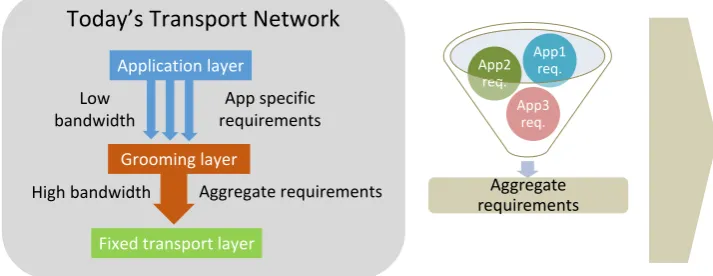
Today’s transport networks are composed by a three layer architecture in which on top sits theapplication layer, agrooming layer and the transport
layer (Figure 4.1). The application layer is composed by a multitude of
diverse applications, characterized by their own requirements in terms of bandwidth, latency, availability, etc. These parameters define the type of connectivity service that an application requires from the network. For instance, distributed databases running between several data centers require low latency, guaranteed bandwidth and minimum packet losses in order to avoid synchronization issues [39]. The grooming layer, usually IP/MPLS, aggregates all the application flows into large optical connections at the
transport layer.
Aggregate requirements
App3 req. App2
req. App1
req.
Today’s Transport Network
Application layer
Grooming layer
Fixed transport layer
App specific requirements
Aggregate requirements Low
bandwidth
High bandwidth
However, the existence of a grooming layer implies that applications with different requirements are always subjected to the same treatment in the transport layer. All the applications are aggregated in the same optical connections, thus, this implies an inefficient use of network resources and a static model for traffic treatment. Indeed, the network traffic generated by applications with diverse requirements is always groomed in the same large optical connection pipes.
Application-aware transport layer
App specific requirements
Grooming layer
Application layer
Low bandwidth
Medium / High bandwidth
App-class requirements
Application-Centric Transport Networks
Figure 4.2: Application-centric network.
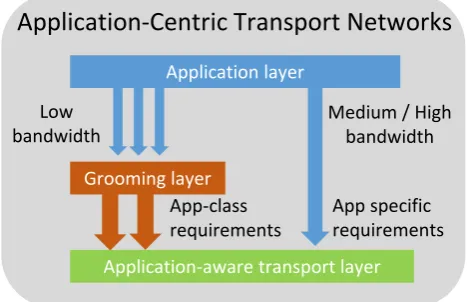
To this end, the Application-centric (or application-aware) networking
is an emerging paradigm that aims at catering to multiple requirements (e.g. bandwidth, latency, availability, security, etc.) when serving the traf-fic generated by business applications (e.g. live video streaming, financial transactions, remote control of drones, etc.). This paradigm enables a novel network model, which offers a more fine-grained traffic control for the pro-visioning of connectivity services. The application-specific requirements are mapped into the lower network layers, either into pre-defined traffic classes or directly into the transport layer (Figure 4.2). A generic Network
Provi-sioning and Management plane, based on a SDN paradigm, is in charge of
Recent studies (e.g. [40, 41]) show how application-centric networking can be pursued in multi-layer transport networks by means of joint config-uration/optimization of IP/MPLS and optical layers, in order to provide a tailored service throughout the network stack. Specifically, in [41] we showed the advantages of considering a number of application requirements (ARs) in addition to simple bandwidth when applications’ service requests (SRs) must be provisioned. We proved that it is possible to achieve service blocking probabilities similar to an application-unaware scheme, while also ensuring that application needs are met. In this way, the network can ulti-mately deliver added-value services to customers at roughly the same cost. However, when facing high network utilizations, the service acceptance ra-tio experiences a reducra-tion that negatively impacts on the revenues of both network operators, which cannot accommodate new SRs while meeting all the ARs, and customers, which have their service blocked.
In this section, we propose the concept of application-aware service
ne-gotiation. The negotiation offers the possibility to find an agreement
be-tween applications and networks for the provisioning of a service withlooser
requirements. The algorithm offers several alternative solutions to the ap-plication, based on the current status of the network. The application can analyze the solutions and provide a feedback to the network. In this way, the application can receive a predictable service degradation and avoid a block of its request. We propose an architecture and a fully working proof of concept on top of the ONOS network controller [9]. The communication between the applications and the SDN orchestrator is performed by means of a Northbound Interface (NBI) based on anIntent paradigm.
The contributions of this chapter can be summarize as follows:
• Extension of a multi-layer provisioning algorithm for
Application-Aware (AA) services. We extend this algorithm in order to support
solutions for applications.
• Definition of a negotiation scheme between applications and net-works. We propose a negotiation scheme based on the degradation of application requirements. In addition, we propose an algorithm to let the applications automatically select or reject the alternative solutions offered by the network.
• Implementationof the intent-based negotiation scheme on top of the ONOS network controller. We modified the ONOS Intent Framework [42] and adapt the REST API to support the negotiation. The software has been released as open source project [43].
• Validation of the performance of the application-aware negotiation
system on both the network and the application sides. On the net-work side, we demonstrate a lower service blocking probability with respect to the AA provisioning algorithm without the negotiation. On the application side, we show that the service degradation with re-spect bandwidth and latency constraints can be kept below a certain threshold.
4.2
Related Work
interaction between applications and SDN network controllers. An applica-tion (or a user) may inform the network of either what are the connectivity requirements or provide feedbacks on the traffic treatment experienced. For instance, Jarschel et al. [44] shows that a video streaming application bene-fits of a high performance improvement, in the case of network congestion, if the application provides feedbacks about the amount left of the video buffer. In [45], the authors presented a system where the users can directly inter-act with a browser-based Graphical User Interface (GUI) and choose which application, within several pre-configured ones, they want to prioritize. The SDN controller receives the requests from the user and it translates them into forwarding rules for the network. Ferguson et al. [46] proposes a frame-work to request netframe-work policies by the users, such as bandwidth limitation or access control (e.g., firewalling) on traffic, and the possibility to schedule a request for a certain amount of time. However, these works do not consider a possible solution when the application request cannot be satisfied.
Negotiation models: In the state of the art there are a few exam-ples of negotiation mechanisms between a generic control and management plane and a user or an application. These models are not only related to networks but also to cloud computing. In [47], the authors propose a negotiation mechanism based on aprice/service trade-off based on the net-work congestion. The application chooses the alternative based on an utility function. However, this work does not provide an evaluation of other pa-rameters rather than the bandwidth. Another type of negotiation is the
auction [48, 49]. The users can create economical offers to request the
Offers Protocol [51]. Specifically, the requesters can make a counter offer to the resource manager. The negotiation finishes when the application and the resource manager find an agreement for the execution of the requested task.
Degradation of service requirements: This technique has been pro-posed to increase the number of service request that can be accommodated in a network. The application requirements can be degraded to looser values than the initial request. For example, [52] and [53] propose the admission of services with a bandwidth requirement degradation in the case of network failures and/or network congestions. However, all these works propose a degradation that is unilaterally decided by the network without any feed-back from applications. In addition, they evaluate only the degradation of the bandwidth without considering other application specific requirements.
4.3
Service Negotiation
This section presents our scheme for the application-aware negotiation of network services. As general model, the negotiation is based on the degra-dation of the service requirements. The application requests a connectivity service to the network and, in the case of the service cannot be provisioned, the application receives several alternatives from the network. The applica-tion analyzes the alternatives and provides a feedback based on an algorithm that selects the best alternative solution for the service provisioning.
connections.
4.3.1 Negotiation Algorithm
Figure 4.3: Negotiation interaction between orchestrator and application negotiation-specific algorithms.
The negotiation system is divided into two algorithmic blocks (Fig. 4.3). On the network side, we rely on an extended version of the
Application-Aware Service Provisioning Algorithm [41], including the negotiation
fea-tures. The algorithm is implemented as part of a generic Control and Man-agement plane that controls the multi-layer network, e.g. a hierarchical SDN controller. On the application side, an algorithm is designed to au-tonomously decide among multiple solutions with degraded service offered by the network in the negotiation process (Alternative Solution Selection
Algorithm). The communication between the two blocks can be provided
by a well-designed intent-based northbound interface[54].
We define the application requests to the network as Service Requests, SR (i.e., intents). Every SR is represented as a tupleSR ={s, d, b, l, a}, in which s and d represent the source node and the destination node IDs, b
is the minimum required bandwidth, l the maximum allowed latency and
network orchestrator. The provisioning algorithm aims at finding a path meeting all the service requirements, i.e. an application-aware path. If an application-aware path can be provisioned without requirement violations, the SR is accepted. This happens when the network has enough resources to provision an application-aware path. Otherwise the SR isblocked.
In this section, we extend the features of [41]. In fact, in our new scheme there is a new outcome in this interaction between the application and the network. When it is not possible to provision an application-aware path, since some of the requested service requirements cannot be guaranteed, a
negotiationphase for the SR is started. This can happen because a network
has limited resources that have already been provisioned to meet other SRs with strict requirements. After the negotiation phase, a new negotiated SR can beaccepted, or the negotiation is aborted and the original SR blocked.
For example, a SR generated by an application with stringent latency requirements may find the shortest paths busy because of traffic generated by other applications, but may be willing to negotiate a lower requirement instead of having its request blocked. In this way, the application can achieve a predefined service degradation and it can modify its behavior based to the new service requirements. In order to inform the network that an application is willing to negotiate, theSRtuple reported above is extended to carry also the information on which requirements of a SR are negotiable. In particular, the new considered tuple isSR={s, d, b, l, a, nb, nl, na}, where the flagsnb,
nl,na are associated to b, l and a, respectively. They can be set to true or
false to inform the provisioning algorithm of which service constraint can
be negotiated.
The provisioning algorithm offers a set of Alternative Solutions (AS)
to the application, in which the negotiable requirements have looser values than the original SR. For example, if a SR requires a particular value of l
meaning that it can provide an application-aware path meeting such looser latency requirement, as in the example above. The application evaluates the new solutions and accepts one of them or rejects all. If all the alternative solutions are rejected, the SR is blocked.
Note that, since the Provisioning Algorithm does not have any knowledge on the threshold values for the service constraints, it cannot bias its choice to provide the least acceptable constraints to the application. In this way, the application can potentially experience a lower downgrade than the least-acceptable one, if there are enough available resources in the network. This assumption is valid if there is no a pricing model applied in the system. The application can have a more complex decision process in which evaluates all the alternatives based on an utility function. On the other side, also the network can have an utility function which can try to maximize both the resource occupation and the revenues.
4.3.2 Application-Aware Service Provisioning Algorithm
The Application-Aware Service Provisioning Algorithm presented in this section extends the algorithm presented in [41]. Such algorithm offers the provisioning of application-aware services on top of multi-layer IP/optical networks. For every SR, the algorithm attempts to find an application-aware path between the existing lightpaths, i.e., IP adjacenices, first and then, if no application-aware path is found, by considering also thepotential
lightpaths(i.e., lightpaths that have not been established yet, but that could
be established if needed). This increases the chance of finding a solution at the expense of resorting to new optical resources. The algorithm exploits an Auxiliary Graph (AG) model [55]. The algorithm works as follows, and is executed for every SR:
requirements of the SR are pruned from the AG.
2. TheKip-Shortest Path (SP) algorithm is executed on the AG betweens
and d of the SR. The weight for each edge is the physical length of the correspondinglightpath.
3. Up toKip candidate paths are returned, all meeting theb requirement.
4. Then, the algorithm prunes all thecandidates paths not meetingl anda, and returns the first in the list (i.e., the shortest).
5. If the list of candidate paths is empty after step 4, the algorithm augments the AG by including the potential lightpaths and steps 2, 3 and 4 are executed again. In the original version of the algorithm, if no cadidate path is found at this point, the request is blocked. For more details on the algorithm implementation see [41].
Then, we extended the Application-Aware Service Provisioning Algo-rithm described above to support the negotiation phase for the SRs in case no application-aware path can be found. The Provisioning Algorithm thus computes a set ofM ASs, in which the negotiable service requirements can have looser and network-achievable values than the ones specified in the SR. In particular, the Provisioning Algorithm in the negotiation phase works as follows:
1. A copy of the initial SR is created and all the negotiable parameters are neglected.
2. Such modified SR is used as input for the Application-Aware Service Provisioning Algorithm described above.
candidate path (e.g., the minimum available bandwidth, the maximum latency, etc.).
4. The number of candidate paths can be high, if there are many negotiable parameters and a high value of Kip is used. The algorithm thus keeps
only the best path for each of the negotiable requirements. For example, ifbandl are negotiable, the provisioning algorithm offers twoalternative
solutions to the application: the one corresponding to the path with
maximum residual bandwidth and the one corresponding to the path with minimum guaranteed latency.
5. The alternative solutions selected in step 4 are sent to the application, that can thus run the Alternative Solution Selection Algorithm, which is described in the next section.
4.3.3 Alternative Solution Selection Algorithm
On the application side, the AS needs to be analyzed in order to find which is the best one for the application. In our model, every application has a set of preferable valuesSRp= (bp, lp, ap) and a set of least acceptable valuesSRt=
(bt, lt, at), represented as tuples. The former indicates the preferable values
that the application wants to obtain from the network, while the second represents the threshold values that the application is willing to accept in the case of a negotiation is needed. If the preferable and minimum value for a service requirement is the same, it means that such requirement is not negotiable. The application communicates only the values included in SRp when it sends the SR to the orchestrator. For example, a VoIP
request a SR whereSRp has lp = 50 ms and set a SRmin withl= 150 ms.
The application can is thus flexible in accepting an alternative solution with
reduced quality but with a predictable degradation.
The Alternative Solution Selection Algorithm is in charge of automat-ically selecting the best AS for each application. The algorithm works as follows:
1. The application receives M ASs in the form of reduced SR tuples (i.e., without negotiation flags). Each tuple is defined asASj ={bnj, lnj, anj},
in whichbnj, lnj, anj represent the values, for each ASj, as computed by
the orchestrator in the negotiation phase.
2. The algorithm prunes all the solutions that have requirement lower than the values specified in theSRttuple (e.g., if bnj < bt, prune the solution j).
3. If there is no alternative solution meeting all the requirements specified in SRmin, the SR is blocked. Conversely, the algorithm calculates the
weighted Euclidean distance dj betweenSRp and every ASj, as defined
in Eq. 4.1.
dj(SRp, ASj) =
v u u t
N
X
i=1
wi(SRpi −ASji)2 (4.1)
where the indexirefers to each one of theNservice requirements included inSRp andASj and wi represent the weight for the service requirements
i. By properly tuning the weights wi, the application can specify a
dif-ferent preference for every service requirement. For example, in the case of an application has a more stringent latency requirement among the negotiable ones, the weight wl will be higher than the weights of other
4. After evaluating every Euclidean distance, the algorithm selects the al-ternative solution leading to the minimum Euclidean distance toSRp:
ASbest=ASj :j= arg min(d1,· · · , dM) (4.2)
5. ASbest is sent to the orchestrator, which allocate resources on the
associ-ated path.
4.4
Software Architecture
Resource Service IntentInstaller
ONOS Intent Framework REST API
ONOS
ACI IntentACI Intent
ACiIntent ACiIntent
Network Config
IntentService Path
Service
Network Substrate ACiIntentCompiler
2
3
4 1
Service Requester
Figure 4.4: Negotiation architecture of the ONOS controller.
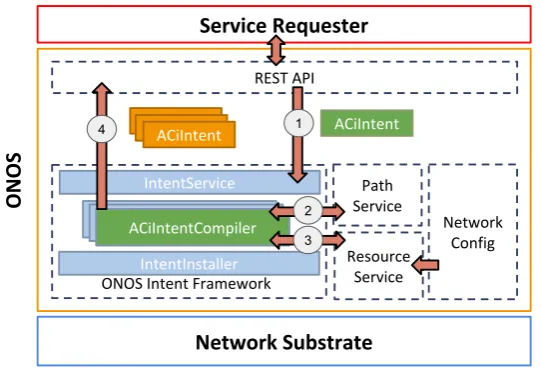
The negotiation algorithm requires several services from a SDN con-troller: (i) a RESTful API to simplify the submission of the intents from the users or applications, (ii) the translation of the intents in forwarding rules, i.e. the intent compilers, and, (iii) a networkresource manager, which keeps track of the available resources in the network.
interact with the controller core and the underlying network substrate. The negotiation algorithm is implemented as a ONOS module, which exploits several Services and relative APIs to work.
In this section, we describe the implementation of thenegotiation module
for ONOS. We describe the ONOSServices used, how they are mapped to the negotiation module and how the negotiation works in ONOS.
4.4.1 ONOS Services and APIs
The negotiation module exploits the followingServicesfrom the ONOS con-troller:
ONOS Intent Framework. The ONOS controller provides a compre-hensiveintent framework, which manages the intent submission, compilation and the installation of the corresponding forwarding rules in the network de-vices. The intents can be submitted via the IntentService, which exposes the Java APIs for interacting with the service. It is composed of several intent compilers, each one compiling a specific type of intent. The intent compilers interact with the other ONOS Services in order to obtain the in-formation required for the intent translation in specific forwarding rules. For example, ONOS provides a set of pre-defined intents representing a network connectivity action, such as theHostToHostIntent. This intent represents a point-to-point connection between two host in the network. The only com-piler responsible for the translation in forwarding rules is the
HostToHostIn-tentCompiler, which interacts with the other ONOS Services to define the
associated forwarding rules. When a compiler defines the forwarding rules, it requests to the IntentInstaller the installation. The negotiation module exploits the ONOS intent framework since it implements the
ACiIntent-Compiler for the Application-Centric Intents (ACiIntents). This type of
such as bandwidth, latency, availability, etc.
PathService. It represents the Path Computation Element (PCE) of ONOS. All the modules can query this service to obtain the shortest path (i.e. a set of links) between two endpoints of a network (e.g., devices, hosts, etc.). TheACiIntentCompiler exploits this service to get the shortest path between the two network endpoints defined in the ACiIntent.
ResourceService. This service provides a database to keep track of all the available network resources (e.g., links, the ports of a device, etc.), their characteristics (e.g., latency, capacity, etc.) and consumption. The ONOS modules can use the APIs to interact with the service both to query or update the consumption of a resource. Only particular type of resources can be consumed, such as the capacity of a device port or the number of a VLAN. For example, an intent requires a bandwidth constraint of 100 Mbps between two host in a network. The IntentCompiler queries the PathSer-vice and receives the shortest path connecting the two hosts. Then, the
IntentCompiler checks if all the devices’ ports a