R E V I E W
Open Access
Experimental determination of the oral
bioavailability and bioaccessibility of lead particles
Elise Deshommes
1, Robert Tardif
2, Marc Edwards
3, Sébastien Sauvé
4*and Michèle Prévost
1Abstract
In vivoestimations of Pb particle bioavailability are costly and variable, because of the nature of animal assays. The most feasible alternative for increasing the number of investigations carried out on Pb particle bioavailability is in vitrotesting. This testing method requires calibration usingin vivodata on an adapted animal model, so that the results will be valid for childhood exposure assessment. Also, the test results must be reproducible within and between laboratories. The Relative Bioaccessibility Leaching Procedure, which is calibrated within vivodata on soils, presents the highest degree of validation and simplicity. This method could be applied to Pb particles, including those in paint and dust, and those in drinking water systems, which although relevant, have been poorly investigated up to now for childhood exposure assessment.
Keywords:Oral bioavailability, Bioaccessibility, Lead [Pb] particles,In vivotests,In vitrotests
Review
Introduction
Lead [Pb] is hazardous to humans, and is of particular concern for fetuses, infants, children, and women of child-bearing age [1,2]. Knowledge of Pb toxicity has progressed significantly since the 1970s. Initially considered toxic only at blood lead levels [BLLs] over 60μg/dL, it is now consid-ered to have no definable threshold below which “no harmful effect” can be determined [3]. Early studies de-monstrate the immediate and long-term effects of low Pb level exposure during childhood, such as neurobehavioral and neurodevelopmental deficiencies, and effects on growth, hearing, and blood pressure [3,4]. Pb uptake may reduce the intelligence quotient [IQ] of infants and chil-dren, and affect some brain responses, even at low BLLs. Recently, the effect on IQ has been shown to be even stron-ger at low BLLs, since decrements in IQ were more dra-matic between BLLs categories < 5μg/dL and 5–9.9μg/dL than between categories 5–9.9 μg/dL and ≥ 10 μg/dL, which has led to a reconsideration of the 10μg/dL health advisory level [5-8]. Indeed, the European Food and Safety Agency (EFSA) has set the 95thpercentile lower confidence limit of the benchmark dose [BMD] of an incremental 1%
risk (BMDL01) at 1.2μg Pb/dL as a reference point when assessing the risk of intellectual deficits in children mea-sured by the Full Scale IQ score [9]. Also, the EU Risk As-sessment Report states that Pb exposure effects cannot be measured reliably at BLLs < 5 μg/dL, due to the limited precision of methods of behavioral testing and Pb quantita-tion in blood [10]. Considering the neurocognitive and neurophysiological effects observed at low BLLs, a new reference level of 5μg/dL was recently set by the CDC, and will be revised downwards every 4 years [11].
Early studies on the health impacts on children led to public policies to remove Pb sources from food and leaded gasoline, resulting in the steady decline of BLLs in recent years [3,12-15]. Remedial actions have also been taken to decrease Pb levels in the soil and dust of Pb-contaminated sites, although decreasing these levels may not always result in lower BLLs in children [14-17]. Lead paint is a common cause of clinical Pb poisoning, and remains a strong contributor to childhood exposure, as it is still present in houses built before 1978 in the United States; its abatement cost is estimated in the billions of dollars [3,14,15]. Now, as BLL guidelines be-come more stringent, the relative contribution of tap water to total Pb exposure may become highly signifi-cant [18-21]. Lanphear et al. report that Pb occurrence in water > 5 μg/L after 1 min of flushing increases the BLLs of children aged 6–24 months by 1.02 μg/dL, * Correspondence:[email protected]
4
Department of Chemistry, Université de Montréal, 2900, Édouard-Montpetit, Montréal, QC H3C 3A7, Canada
Full list of author information is available at the end of the article
contributing to about 20.4% of the total BLL [22]. Re-cently, abnormal BLLs in young children have been associated with elevated Pb concentrations in drinking water, particulate Pb representing a significant fraction of this [23-26]. However, because of its sporadic occur-rence, exposure to particulate Pb in drinking water is es-pecially difficult to characterize [27]. Most regulatory and research efforts have assumed that soluble Pb is the predominant form of exposure. Interest in particulate Pb is now growing, because of its potential contribution to chronic and acute exposure [27-29]. The most direct ap-proach to assessing the contribution of various Pb sources to human exposure is to conduct epidemiological studies or in vivo studies. Numerous epidemiological studies of particulate Pb exposure from various media (i.e. air, soil, paint, and dust) have been reviewed [14,15,30,31]. Some of these revealed a significant relationship between environ-mental Pb levels and BLLs, and a decrease in BLLs after remediating Pb sources, providing direct measurements of exposure and its impacts on body burden. However, they are challenging to carry out because of cost, the variability of exposure among the population studied, and BLL evo-lution since exposure [32].
In vivoexperiments are much simpler to plan and per-form than epidemiological studies. Key parameters can be controlled, such as exposure levels and conditions, and the relationships between exposure levels and levels of Pb absorbed by the in vivo specimen tested can be quantified. However, the measurements are indirect, based on animal models, and require extrapolation to human ex-posure conditions. A primary outcome ofin vivostudies of oral Pb exposure is the oral bioavailability of Pb occurring in both dissolved and particulate form. Several in vivo experiments have been performed, first with readily soluble Pb forms such as Pb acetate [PbAc], and then mostly with Pb-contaminated soils. But comprehensive bioavailability experiments are long, expensive, demanding, and the use of animal models can raise ethical issues. Moreover, bioavail-ability results show significant varibioavail-ability, which is inherent to the use of animal models.
In vitro experiments are simpler, faster, cheaper, and highly reproducible, and do not raise ethical concerns, and therefore are best suited to test replication. How-ever, they can only assess the bioaccessibility of Pb, defined as the fraction of ingested Pb dissolved during the digestion process and available for absorption into the systemic circulation (bloodstream). Bioavailability is the fraction actually available and taken up by an organ-ism, while bioaccessibility is an experimentally deter-mined estimate of what is potentially bioavailable [33]. If well calibrated, an in vitro test can adequately predict in vivo results. A significant number of bioaccessibility studies have been conducted on Pb contaminated soils. However, the bioaccessibility of other sources of Pb
particles to which infants/children can be exposed (paint, dust, drinking water particles, toys, and food) has not been thoroughly investigated.In vivotesting of these particulate forms can be limited by experimental con-straints, which can be addressed usingin vitrotests.
This review summarizes the information available on the bioavailability and bioaccessibility testing that have been proposed for estimating the oral bioavailability of Pb particles in children. Our objectives are to identify the strengths and weaknesses of these procedures, to highlight differences between them to support the inter-pretation of study conclusions, and, finally, to draw attention to gaps in the data on Pb particles that are relevant for childhood exposure assessment.
Approaches to estimating Pb bioavailability
Many definitions of bioavailability have been proposed for soil and sediments [33]. In this review, the term“oral bioavailability” refers to the amount of ingested Pb that reaches the systemic circulation and that is likely to ac-cumulate in the body, including organs and bones. His-torically, bioavailability has been determined in the laboratory using in vivo testing. In vivo testing to esti-mate Pb bioavailability must be carried out over an extended period to ensure that the metal is absorbed, retained, and excreted. The half-life of Pb is about 25 days in blood, 40 days in soft tissues, and 25 years in bones [34]. Early human experiments were conducted using Pb in the diet, Pb tracers, or Pb salts labeled with radioactive Pb203[35-37]. A detailed review and critical evaluation of these studies is available in Mushak (1991) [30]. Such studies helped identify absorption mechan-isms for soluble Pb and interactions with food, although there are still some uncertainties on the specific sites where Pb uptake actually takes place [30]. However, these results cannot be directly extrapolated to Pb parti-cles in soil, dust, paint, or drinking water, because of po-tential matrix effects. A more recent study measured the bioavailability of soil borne Pb in human adults, and is the only study performed on humans with Pb-contaminated soil [38]. The target population was adults, whose digest-ive absorption processes differ markedly from those of infants and children [30].
materials are comparable. Also, the range of the dosages applied usually includes low to high doses so that some degree of active transport (saturable) is represented in the blood compartment. Pb salts such as PbAc (soluble) are used as references to compare test materials and cal-culate bioavailability. Administering Pb salts intraven-ously allows the absolute bioavailability [ABA] – the fraction of Pb that enters the bloodstream (absorption fraction) – to be calculated (Equations 1–2). If PbAc is delivered orally, the relative bioavailability [RBA] – the bioavailability of the test material relative to that of PbAc–is calculated (Equation 3). The intravenous dos-age for determining ABA is also used to set minimum and maximum BLLs for a range of doses and to better characterize Pb distribution in a steady state [39-41]. RBA is also called“oral bioavailability”, but relative to an appropriate reference material (PbAc) [41,42]. RBA is more informative, because it takes the exposure matrix into account [43]. The ABA can be calculated, as opposed to measured, through intravenous injections, by multiplying the RBA by the Pb absorption fraction (ABA) of PbAc administered orally (Equation 4).
Oral ABA calculation:
ABATM¼IDMoral TM IDMiv PbAc
Doseiv PbAc
Doseoral TM: ð1Þ
ABAPbAc¼IDMoral PbAc IDMiv PbAc
Doseiv PbAc
Doseoral PbAc: ð2Þ
Oral RBA calculation:
RBATM¼
ABATM ABAoral PbAc:
RBATM¼
IDMoral TM IDMoral PbAc
Doseoral PbAc
Doseoral TM : ð
3Þ
Link between ABA and RBA:
ABATM¼ABAoral PbAcRBATM: ð4Þ
IDM–Internal Dose Metrics (BLL, Pb in tissues, etc.); iv–intravenous; TM–Test Material.
The internal dose metrics [IDM] measured during in vivo experiments can also vary. Several kinetic pools for Pb in the human body with varying rates of turnover, partly depending on the time elapsed since the adminis-tration of the Pb dose, affect bioavailability estimation. To address this, sequential blood samples can be col-lected during the experiment, as well as blood and tissue samples on the last day of the test. The tissue samples most frequently collected are from the liver, kidneys, and femurs. The amount of Pb stored in other parts of the body is considered to be small, in the order of 4% of total Pb measured in blood, bones, liver, and kidneys for short-term experiments [44]. So, RBA calculation can be
based on Pb levels either in blood or in tissues: blood-based RBA is calculated by measuring the ratio between BLL following test material ingestion and BLL following oral ingestion of PbAc for a similar dosage (Equation 3). This ratio is measured under presumed steady state con-ditions after repeated exposure, resulting in a stable BLL, or at various times during the experiment to moni-tor BLL evolution [44]. Similar ratios can be established for bones, kidneys, and liver on the last day of the ex-periment [45-47].
The most commonly used approach for evaluating bio-availability, and a comprehensive one, is based on moni-toring BLLs over the course of the experiment for different dosages, as well as the Pb content in bones, kidneys, and liver at the end of the exposure period for different dosages. The “area-under-the-blood concentra-tion versus time curve” [AUC] of BLL is then calculated for each Pb dose and test material (Figure 1). The AUC approach for BLL has the advantage of including the whole dose–response relationship of the BLL over the time of the experiment. However, the information it pro-vides on the evolution of absorption over that period is poor [48]. AUC BLL (e.g.μg×day/dL), bone Pb levels, or other kinds of IDM for Pb salt and test material are then fitted versus Pb dose. Identical absorbed doses of Pb delivered to target Pb pools are assumed to produce an equivalent IDM [40]. Bioavailability is determined by cal-culating the ratio of Pb test material dose and the PbAc dose that yields an identical IDM [40,49] (Figure 2). This calculation is equivalent to Equation 3, since the IDM for both the test material and the PbAc administered or-ally cancel each other out:
Oral RBA based on equivalent IDM:
RBATM¼DosePbAc oral producing equivalent IDM to TM DoseTM oral producing equivalent IDM to PbAc: ð5Þ
2 3 4
6
B
LL (µ
g /
d
L)
Time (days) PbAc dose X
PbAc dose Y TM dose X TM dose Y
AUC for TM at dose Y
Figure 1Calculation of blood Area Under the Curve (AUC).TM
This approach requires finding the most suitable mathematical model for both the PbAc dose and the Pb test material dose IDMs. Indeed, an IDM per unit of absorbed Pb dose does not depend on the Pb source. The best fit for bone, liver, and kidney Pb levels is usu-ally linear, whereas for BLL/AUC, which increases gradually and then reaches a plateau (steady state), the best fit is non linear and varies [42,49]. Doses of Pb test material and Pb salt producing the same IDM can be calculated from the best fitting equations, and the bio-availability ratio calculated for each endpoint studied (AUC, BLL, Pb in bones, etc.). The BLL/AUC used for this ratio is usually the point before the rate of uptake of Pb from the test material starts to decrease owing to in-creasing dosage [40]. The ratio can also be calculated for a range of doses that reflects currently estimated expos-ure. Finally, a point estimate can also be calculated, which combines the bioavailability related to each of the endpoints studied simultaneously, and is weighted according to its uncertainty. However no significant dif-ferences were shown between using only a BLL estimate or a point estimate based on multiple IDM [42,49].
Another way to evaluate bioavailability is to complete a total mass balance. This method requires sequential BLL sampling, as well as total collection of urine and feces to recover all the excreted Pb. Pb content in feces and urine is subtracted from total Pb intake, and pro-vides an estimate of the body’s net retention [37]. Urine samples represent the absorbed dose of Pb that is pri-marily excreted, whereas fecal samples provide the frac-tion of Pb that is unabsorbed [50]. When BLLs reach a steady-state with multiple dosing, bioavailability can be determined by calculating the ratio of total Pb in the urine plus total Pb retained in the body to total Pb recovered. Such results have limited value if the total net excretions are underestimated. However, this method is nearly non invasive for the test subject, and can provide information on Pb accumulation in the body after repeated exposure. This makes it useful for studies on Pb uptake and Pb distribution in the whole body [48].
The method for calculating the bioavailability and IDM on which it is based directly influences the bio-availability estimates. Understanding these differences is important when comparing results based on different methodologies. An RBA based on BLL is unlikely to pro-vide the same results as global bioavailability based on the whole body’s Pb uptake derived from a complete mass balance. If bioavailability is based on the blood AUC, the results will be influenced by the duration of the experiment and the timing of sampling. Further-more, the interactions between Pb in soft tissues, bones, and blood determine the fractional absorption, and thus the bioavailability [51]. The timing of the sampling should be chosen carefully, considering the evolution of BLL over time and whether or not steady state is reached [52].
Experimental factors influencing Pb bioavailability
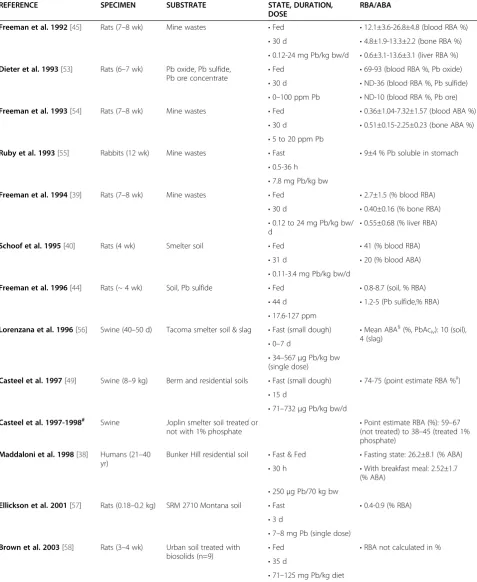
Thein vivoexperimental design parameters affecting the estimation of Pb bioavailability include: the animal model (species), its age, the addition of food, the dur-ation of the experiment, and the dosage. The selection of these parameters and corresponding bioavailability results for published studies are summarized in Table 1.
Animal model
A major factor affecting bioavailability estimation is the animal species used, and includes its age and its deve-lopmental stage. Intra-species differences in anatomy, feeding behavior, absorption rate, and digestion pro-cesses influence the results. As shown in Table 1, rats, piglets, and rabbits have been used to estimate Pb par-ticle bioavailability. Pioneer studies used rodents and rabbits to determine bioavailability and the risk to infants/children [39,44,45,54,55,71-74].
Although rodents and lagomorphs are widely used and well-known animal in vivo models, differences in their
(a)
(b)
7
0 1 2 3 4 5 6 7
)
L
d/
y
a
d
x
g
µ(
C
U
A
d
o
ol
B
Pb dose (µg/kg/day)
PbAc best fit
TM best fit
0 0.5 1 1.5 2 2.5 3 3.5 4 4.5
0 1 2 3 4 5 6 7
P
b
i
n
ti
ssu
es
(µ
g
/
k
g
b
w
)
Pb dose (µg/kg/day)
PbAc best fit
TM best fit
Table 1In vivoexperiments on Pb particles and bioavailability results (2 pages)
REFERENCE SPECIMEN SUBSTRATE STATE, DURATION,
DOSE
RBA/ABA
Freeman et al. 1992[45] Rats (7–8 wk) Mine wastes •Fed •12.1±3.6-26.8±4.8 (blood RBA %)
•30 d •4.8±1.9-13.3±2.2 (bone RBA %) •0.12-24 mg Pb/kg bw/d •0.6±3.1-13.6±3.1 (liver RBA %)
Dieter et al. 1993[53] Rats (6–7 wk) Pb oxide, Pb sulfide, Pb ore concentrate
•Fed •69-93 (blood RBA %, Pb oxide) •30 d •ND-36 (blood RBA %, Pb sulfide) •0–100 ppm Pb •ND-10 (blood RBA %, Pb ore)
Freeman et al. 1993[54] Rats (7–8 wk) Mine wastes •Fed •0.36±1.04-7.32±1.57 (blood ABA %)
•30 d •0.51±0.15-2.25±0.23 (bone ABA %) •5 to 20 ppm Pb
Ruby et al. 1993[55] Rabbits (12 wk) Mine wastes •Fast •9±4 % Pb soluble in stomach
•0.5-36 h •7.8 mg Pb/kg bw
Freeman et al. 1994[39] Rats (7–8 wk) Mine wastes •Fed •2.7±1.5 (% blood RBA)
•30 d •0.40±0.16 (% bone RBA)
•0.12 to 24 mg Pb/kg bw/ d
•0.55±0.68 (% liver RBA)
Schoof et al. 1995[40] Rats (4 wk) Smelter soil •Fed •41 (% blood RBA)
•31 d •20 (% blood ABA)
•0.11-3.4 mg Pb/kg bw/d
Freeman et al. 1996[44] Rats (~ 4 wk) Soil, Pb sulfide •Fed •0.8-8.7 (soil, % RBA)
•44 d •1.2-5 (Pb sulfide,% RBA) •17.6-127 ppm
Lorenzana et al. 1996[56] Swine (40–50 d) Tacoma smelter soil & slag •Fast (small dough) •Mean ABA§(%, PbAciv): 10 (soil), 4 (slag)
•0–7 d
•34–567μg Pb/kg bw (single dose)
Casteel et al. 1997[49] Swine (8–9 kg) Berm and residential soils •Fast (small dough) •74-75 (point estimate RBA %‡) •15 d
•71–732μg Pb/kg bw/d
Casteel et al. 1997-1998# Swine Joplin smelter soil treated or
not with 1% phosphate
•Point estimate RBA (%): 59–67 (not treated) to 38–45 (treated 1% phosphate)
Maddaloni et al. 1998[38] Humans (21–40 yr)
Bunker Hill residential soil •Fast & Fed •Fasting state: 26.2±8.1 (% ABA) •30 h •With breakfast meal: 2.52±1.7
(% ABA) •250μg Pb/70 kg bw
Ellickson et al. 2001[57] Rats (0.18–0.2 kg) SRM 2710 Montana soil •Fast •0.4-0.9 (% RBA) •3 d
•7–8 mg Pb (single dose)
Brown et al. 2003[58] Rats (3–4 wk) Urban soil treated with
biosolids (n=9) •
Fed •RBA not calculated in %
•35 d
Table 1In vivoexperiments on Pb particles and bioavailability results (2 pages)(Continued)
Hettiarachchi et al. 2003[59]
Rats (12 wk) Joplin soil treated or not with Mn, phosphate, or CRYP (n=15)
•Fed•21 d •Blood RBA%: 34 (not treated); 19–33 (treated)
•1–6 mg Pb/kg bw/d •Kidney RBA%: 48 (not treated); 19–39 (treated)
•Liver RBA%: 27 (not treated); 19–21 (treated)
•Bone RBA%: 34 (not treated); 20–24 (treated)
USEPA 2004, 2009[60,61] Juvenile swine 2 Omaha smelter soils •Fast (small dough) •83 & 96 (point estimate RBA %) •15 d
•75–675μg Pb/kg bw/d
Casteel et al. 2006[42] Swine (5–6 wk) 19 soil or soil-like materials† •Fast (small dough) •1-105 (point estimate RBA %*) •15 d
•75–675μg Pb/kg bw/d
Marschner et al. 2006[62] Swine (70 d) 5 soils •Semi-fed (milk powder after 5 h fast)
•17-63 (RBA %)
•28 d
•0.1-3.2 mg Pb/kg bw/d
MSE Technology Application 2006[63]
Swine (5–6 wk) Smelter soil HER-2930 •Fast (small dough) •82 (point estimate RBA %) •15 d
•77–686μg Pb/kg bw/d
Smith Jr. et al. 2008[46] Rats (~ 21 d) Micropigs (~ 30 d)
2 smelter soils •Fed •Rats RBA %: 88 (blood), 62 (bone) •30 d •Micropigs RBA %: 81 (blood),
68 (bone) •50μg Pb/g diet
Smith Jr. et al. 2008[47] Rats (~ 21 d) 5 soils •Fed •85±48 (blood RBA %)
•35 d •91±12 (bone RBA %)
•6.8-150μg Pb/g diet
Bannon et al. 2009[64] Juvenile swine 8 small arms range soils •Fast (small dough) •108±18 (point estimate RBA %) •15 d
•75–675μg Pb/kg bw/d
Caboche 2009 Denys et al. 2012[65,66]
Swine (28 d) 15 mining and smelting soils •Fast (small dough) •6-100 (kidney RBA %) •14 d •8–100 (urine RBA %) •<1 to 8 mg Pb/kg bw/d •9–100 (bone RBA %) •10–85 (liver RBA %)
Juhasz et al. 2009[67] Swine (6–8 wk) 5 incinerator and urban soils •Fast •10.1±8.7-19.1±14.9 (blood RBA %) •5 d
•0.1-1.2 mg Pb/kg bw (single dose)
Smith et al. 2011[68] Adult mice 12 Pb impacted soils from
various sources •
Fast •10±2.8-89±15.3 (blood RBA %)
•48 h
•0.1-1.7 mg Pb (single dose)
RBA–relative bioavailability; ABA–absolute bioavailability; ND–not determined;§
estimates include 0 & 100% in the confidence interval;‡USEPA and Casteel et al. point estimate [42,43];#
data from the Ruby et al. review [69];†including soils tested by Schroder et al. [70];*
digestive systems compared to the human prevent direct extrapolation to the Pb exposure of human children. First, rodent stomachs have a smaller glandular region than human stomachs, and consequently less surface area for parietal cells secreting acid [48]. This results in a higher stomach pH of 3.9 and 3.2 in the fasting and fed states respectively [75]. In contrast, rabbits present a relatively low pH of 1.6 in the fed state, which is signifi-cantly lower than that of humans [76]. Also, the surface area of the small intestine of a rat is about one-fifth the size a human one, which implies decreased Pb bioavail-ability, since some absorption mechanisms in the small intestine are surface area-dependent [48]. Another sig-nificant difference is that the rat’s small intestine is ma-ture at weaning, unlike that of the human newborn, and its Ca absorption capacity decreases rapidly within 30 days [48]. This results in a drastic decrease in the rat’s Pb absorption rate, from about 80% between 0 and 30 days to about 50% between 1–2 weeks and 6–8 weeks [30,51]. Severalin vivostudies listed in Table 1 have used rats aged 4 weeks and 6–7 weeks [39,40,44,45,54,57], which may have been too old to be representative of the high Pb absorption rates found in children 0–6 years old [52]. Differences in the soils tested aside, the animal’s age may actually explain the significantly higher blood RBA (85-88%) observed in weaning rats aged 21 days [46,47], compared to that of rats aged 4 weeks and older (0.8-41%) [39,40,45,54]. Also, the 12-week old rabbits used by Ruby et al. [55] may be more representative of adult digestive conditions, as a 5-week old rabbit absorbs twice as much Pb as an older rabbit [52]. The declining absorption rates within a relatively short period constitute a challenge in it-self, since bioavailability tests must extend over several weeks owing to the half-life of Pb in blood. During a sub-chronic testing period of 15–30 days, the weanling rat’s Pb absorption can vary significantly, depending on its age at the start of the testing period.
Specific behavior and defense mechanisms of rats and rabbits also influence absorption. For example, in response to exposure to Pb, rats lower their body temperature, which decreases its RBA. Furthermore, the constant feed-ing pattern of rats and rabbits and their cellulose-type diet are not favorable to Pb dissolution in the stomach, as this organ rarely empties completely, resulting in a pH buffer effect and the constant availability of ligands for Pb ions [48]. Finally, coprophagic behavior in both species can lead to an inaccurate estimation of Pb bioavailability, because of Pb recirculation. Coprophagy is essential to the assimi-lation of all the nutrients necessary for the growth and de-velopment of rodents and rabbits, which, if impeded, can cause deficiencies in some minerals/vitamins that interfere with Pb absorption. Biliary excretion is also greater in rodents than in humans, and can generate errors in the es-timation of Pb excreted and absorbed [40,46-48]. Despite
these differences, rats and rabbits are species commonly used forin vivoexperiments, and so are very well charac-terized. Interpretation of the results, adjustments to them, and extrapolation to humans may therefore be more ac-curate than for other animal models that are less often used in laboratories. Moreover, even with the marked dif-ferences between their digestive systems and those of chil-dren, these species remain highly useful for studying many aspects of Pb exposure, such as estimating the potential health risks of Pb (e.g., [77]).
USEPA Region VIII scientists conductedin vivo experi-ments on piglets to estimate the bioavailability of soil Pb particles, and from there the potential burden for infants/ children [41,79,80]. The juvenile swine model experimen-tal procedure for assessing oral bioavailability from soils, detailed in Weis et al. [41] and further developed by Casteel et al. [42], was then applied to a wide variety of soils [60,63,64,70], in some cases with modifications to the original EPA procedure [46,62].
Conditions of dose and application
The dosage and its frequency are key factors affecting bioavailability estimation [41]. Generally, a fixed quantity of soil/dust is administered based on the estimated aver-age daily soil/dust intake for children, which corre-sponds to a variable Pb dosage depending on the Pb content of the soil. However, for some animal models, such as the rat, it is often necessary to increase dosages in order to increase BLLs to detectable levels that permit reliable differentiation between the PbAc and the test material [45]. Bioavailability results obtained under such conditions may be underestimated, as the rate of elimin-ation of Pb at these high dosages could be much higher, especially if they largely exceed the saturation concentra-tion for active transport mechanisms in the gut [79].
Childhood soil/dust ingestion rates from hand-to-mouth activity refer to small quantities ingested repeat-edly during the day, resulting in a cumulative dose of around 100 mg/day [52]. The bioavailability estimation based on in vivo experiments is only valuable if the in-gestion of the test material/PbAc and subsequent ab-sorption by the test animal are representative of those of children ingesting Pb from diet, soil, dust, paint, or water [48,52]. Mushak’s review stresses that the dosages for in vivo testing should be representative of children’s exposure in terms of amount and number of ingestions [52]. For example, the single high dose of 4.2 g of test material in the Ruby et al. study [55] is not representa-tive of normal children exposure, but more akin to soil geophagia, a form of pica ingestion [52]. Realistic expo-sures can be achieved by administering lower doses twice daily, as performed in several swine studies in Table 1 [42,49,60,61,63-65]. These studies suggest that realistic dosages administered through multiple daily ingestions are preferable, and represent a better simula-tion of the exposure of the infant/child.
The choice of a fasting state or a fed state when administering Pb doses is a major factor in calculating bioavailability, since the stomach’s retention time and pH, which are determining factors for Pb dissolution, depend on that state.In vivostudies presented in Table 1 were performed either in fasting or fed state. The uptake of PbAc is reduced by about half when Pb is adminis-tered in food, rather than in a fasting state as in
rat-based experimental studies [43]. Maddaloni et al. also observed a decrease in RBA of about 24% from fasting to feeding conditions in human adults after ingesting contaminated soil [38]. The type of food also signifi-cantly influences bioavailability, as shown by the wide retention range associated with food type (3.5-56.8%), as compared to 61.3% for fasting adults dosed with PbAc [35]. That study concluded that Pb ingestion during meals, as well as the presence of calcium, phosphate, and phytate in the meals, notably decreases Pb bioavail-ability three hours before and after ingestion. Indeed, calcium, iron, and phosphate were shown to compete with Pb for absorption through the intestine because of similar uptake mechanisms, although Pb uptake was not evidenced to occur via active iron transporters or cal-cium channels [30,34]. Higher estimates of Pb bioavail-ability were reported for liquids poor in nutritional elements (33-72%), and the lowest for milk (11-17%), traditional breakfast (0-8%), and calcium phytate (1-9%) [35]. Given the significant impact of food, the fasting state appears to be the conservative choice simulating the worst, but still plausible scenario, since soil, dust, and paint can be ingested by children during playtime between meals. However, Pb particles ingested via drink-ing water or formula, or incorporated into food durdrink-ing cooking can be ingested in both the fasting and the feed-ing state.
In vivo testing of Pb particles
Table 1 summarizes results from in vivo experiments completed with Pb-contaminated soils and Pb paint chips. Significant differences between the animal models, their age, the dosages, the duration, and the calculation method for generating RBA/ABA values must be taken into account when comparing these estimates. The ex-tent of fasting is highly variable in these studies, and only a few studies were conducted in a complete fasting state [38,55,57,67,68].
bone, liver, and kidneys. Such an approach provides in-formation on the distribution of body Pb and the inter-action between accumulated lead in blood, soft tissues, and bones.
In vitrobioaccessibility testing procedures
Bioaccessibility can be estimated at laboratory scale using chemical extractions of Pb contaminated test ma-terial in solution and under experimental conditions that mimic the mixing and processing of GI fluids. The total recoverable Pb is generally determined by subjecting a subsample of the test material [TM] to strong acid di-gestion, as, for example, in Method 3050 developed by the USEPA for soils and sediments. In vitro bioaccessi-bility [IVBA] is calculated as follows:
Pb IVBA¼mg Pb leached in extraction fluid per g of TM mg total recoverable Pb per g of TM :
ð6Þ
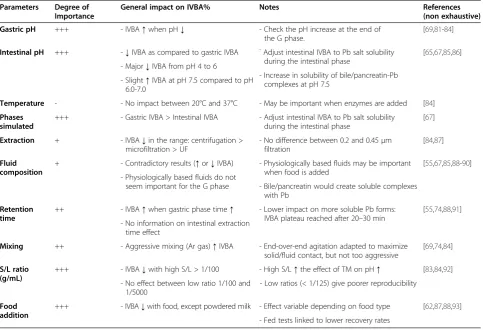
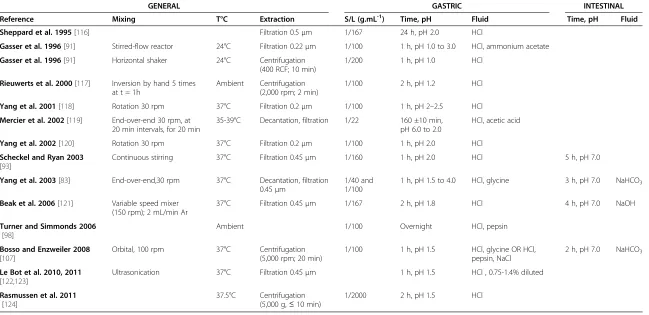
Several experimental factors affect the estimates of bioaccessibility yielded byin vitrotests, and their impact varies according to the type and form of the Pb sources investigated. Choosing an adequate combination of these factors is important for generating bioaccessibility results that can be correlated to bioavailability results. Key fac-tors include the physico-chemical conditions maintained during the in vitro test, especially gastric and intestinal pH, but also the co-presence of food, mixing conditions, the solid to liquid [S/L] ratio, and the retention time. Their relative importance is summarized in Table 2. Fi-nally, it should be noted that we discuss all the tests in this section, including those that were not correlated to in vivo data. In fact, although they were not calibrated, the latter tests provide an indication of the trends observed when the parameters of anin vitrotest are var-ied, which makes it possible to rank the importance of each of these parameters.
pH
Pb dissolution is very sensitive to pH. The correlation of in vitro to in vivoresults for weanling rats, for example, has been shown to be critically dependent on the pH in gastric simulations [74]. The solubility of mineral species under the conditions that prevail in the stomach and upper intestinal tract determines their bioavailability, the factors affecting solubility being the mineral form, associ-ation, inclusion, and size distribution. Overall, chemical species formed under acidic conditions (e.g. Pb sulfate) will tend to be more stable in simulated acidic conditions and yield lower bioaccessibility values than those formed under alkaline conditions, such as Pb oxide and Pb car-bonate [69]. Notwithstanding the specific dissolution rates of these forms of Pb, gastric pH stands out as a dominant
factor influencing bioaccessibility results for a similar par-ticle size distribution. For mine waste impacted soil and anglesite soil, Ruby et al. found that the rate of Pb dissol-ution was linearly dependent on HCl content during the first two hours of gastric retention [81]. Yang et al. mea-sured Pb bioaccessibility values ranging from 50 to 80% for soil with a gastric pH of 2, those figures dropping to 10 to 20% at pH 3 or 4 [83]. Drexler and Brattin showed that pH was the most sensitive parameter in the RBALP: a variation in pH between 1.5 and 3.5 resulted in a variation in bioaccessibility by a factor from 2 to 7 that was only sta-tistically significant above pH 2.5 [84]. Bruce et al. found significantly higher rates of gastric bioaccessibility for mine wastes tested at pH 1.3 (47%), as compared to pH 2.5 and 4 (17-18%) [94]. Oomen et al. concluded that gas-tric simulation pH was the major source of variability be-tween the results of a round robin test of five in vitro models [82]. The stability of pH during the gastric phase also appears to be critical [95]. In fact, Oliver et al. found a higher bioaccessibility (26-46%) when the pH of the test was maintained at 1.3 than when the test was performed without any pH control (20-30%) [89]. Therefore, pH should be controlled at the end of the gastric phase, in order to provide the same acidic conditions for the various substrates tested. Results from the RBALP, RIVM, and UBM tests (calibrated) are only considered valid if the pH at the end of the experiment does not exceed a set refer-ence value [66,84,86].
Juhasz et al. showed that the solubility of PbAc salt decreases greatly under simulated intestinal conditions (pH 4–7.5), reflecting the gradual increase in pH at the en-trance to the intestine: from nearly 100% at pH 1.5, the IVBA decreases markedly between pH 4 and 6 to about 14.3±7.2% at pH 6–7 (Figure 3) [67]. Overall, initial concen-trations in the range of 1 to 10 mg Pb/L did not influence solubility in the pH 1.5-7.5 range; slight differences were noted for high dosages of 5 and 10 mg/L with lower bility at pH 5.5, and small but significant increases in solu-bility at pH 7.5. The steep decrease in PbAc solusolu-bility between pH 4.0 and 6.0 corresponds to the gradual increase in pH in the duodenum and jejunum, where most of the absorption and transport of Pb cations and complexes is supposed to take place [30,52]. Therefore, an intestinal phase carried out at pH 5.0 may not give the same results as an intestinal phase performed at pH 7.0. A realistic rep-resentation of the intestinal phase would include gradually increasing the pH and performing a series of sample collec-tions during this increase, but doing so would be a huge challenge and would introduce much variability.
Temperature
Pb dissolution as it is of the optimal activity of enzymes in the digestive juices. Drexler and Brattin found no significant difference between the RBALP results obtained at ambient temperature and those at human body temperature for seventeen test materials [84]. Most of the procedures apply a 37°C temperature by default, since temperature is a fixed parameter in the digestive process and closely mimics bio-logical conditions.
Separation of the liquid from the solid
The separation method is an essential step in determin-ing the bioaccessible Pb fraction [87], and the definition of the separation limit between particulate and dissolved Pb varies significantly in the literature and between models. Extraction can be achieved by centrifugation (e.g. [55,82,96]), centrifugation followed by filtration of the supernatant (e.g. [83,94]), or direct filtration (e.g. [84,89]). Others have used epithelial Caco-2 cells, in order to better represent the intestinal wall morphology [97]. Also, an aliquot of the digestion product can be analyzed directly, based on the hypothesis that the analytical instrument will only detect dissolved Pb [26,98].
In the absence of an extraction step, the digestion product should be analyzed immediately. Centrifugation
can be applied at various combinations of rotational speed and time, which can influence separation and im-pact estimates of bioaccessible Pb. In filtration, the filter cut-off varies. Several studies used 0.45 μm filters [84,88,89], others used 0.2 μm filters [67,94], while the TIM model recommends ultra-filtration [UF] [82,87]. However, filtration at the end of the intestinal phase may bias results, since some filter materials are known to absorb dissolved Pb at neutral pH, the absorbed quantity varying with Pb concentration [99].
The impact of the various extraction methods identified above can be classified by the magnitude of bioaccessibi-lity, as follows: no extraction > centrifugation > microfil-tration > UF > Caco-2 cells. Van De Wiele et al. applied various extraction methods to the fed-RIVM, and bioac-cessibility decreased from 31.5% (centrifugation) to 22% (microfiltration) to 3.5% (UF) [87]. Bioaccessibility results with UF were the closest toin vivodata on the same single soil tested [38,87]; however, the authors stress that these results are less reliable. Finally, Drexler and Brattin found no significant difference between bioaccessibility estimated with a filtration at 0.45μm and one at 0.2μm, suggesting that non bioaccessible Pb would be mainly particles > 0.45
μm for the test materials in question [84].
Table 2In vitrotests design: main factors affecting bioaccessibility results
Parameters Degree of Importance
General impact on IVBA% Notes References
(non exhaustive)
Gastric pH +++ - IVBA↑when pH↓ - Check the pH increase at the end of
the G phase.
[69,81-84]
Intestinal pH +++ -↓IVBA as compared to gastric IVBA -Adjust intestinal IVBA to Pb salt solubility during the intestinal phase
[65,67,85,86]
- Major↓IVBA from pH 4 to 6
- Increase in solubility of bile/pancreatin-Pb complexes at pH 7.5
- Slight↑IVBA at pH 7.5 compared to pH 6.0-7.0
Temperature - - No impact between 20°C and 37°C - May be important when enzymes are added [84]
Phases simulated
+++ - Gastric IVBA > Intestinal IVBA - Adjust intestinal IVBA to Pb salt solubility during the intestinal phase
[67]
Extraction + - IVBA↓in the range: centrifugation > microfiltration > UF
- No difference between 0.2 and 0.45μm filtration
[84,87]
Fluid composition
+ - Contradictory results (↑or↓IVBA) - Physiologically based fluids may be important when food is added
[55,67,85,88-90]
- Physiologically based fluids do not
seem important for the G phase - Bile/pancreatin would create soluble complexes with Pb
Retention time
++ - IVBA↑when gastric phase time↑ - Lower impact on more soluble Pb forms: IVBA plateau reached after 20–30 min
[55,74,88,91]
- No information on intestinal extraction time effect
Mixing ++ - Aggressive mixing (Ar gas)↑IVBA - End-over-end agitation adapted to maximize solid/fluid contact, but not too aggressive
[69,74,84]
S/L ratio (g/mL)
+++ - IVBA↓with high S/L > 1/100 - High S/L↑the effect of TM on pH↑ [83,84,92]
- No effect between low ratio 1/100 and 1/5000
- Low ratios (< 1/125) give poorer reproducibility
Food addition
+++ - IVBA↓with food, except powdered milk - Effect variable depending on food type [62,87,88,93]
- Fed tests linked to lower recovery rates
Fluid composition
The primary function of digestive enzymes is the decom-position of proteins (pepsin and trypsin) and carbohydrates (pancreatic and small intestine enzymes), while bile emulsi-fies lipids.
Oliver et al. showed that adding pepsin to the gastric fluid decreased the amount of dissolved Pb by about 28%. However, gastric pH did not remain constant, in fact, pH was increasing from 1.3 to 3 after the addition of the dust substrate, and this may be the factor responsible for the decreased bioaccessibility [89]. Conversely, Medlin compared bioaccessibility results using a physiologically-based gastric fluid and diluted HCl, and found little diffe-rence for cerussite, anglesite, and SRM 2710 at pH 1.5 [88]. However, at pH 2.8, the use of pepsin-based fluid increased bioaccessibility significantly (by up to 42%). Fi-nally, Drexler and Brattin showed that the addition of enzymes was unnecessary for achieving a good in vivo-in vitrorelationship using the validated RBALP procedure, which only simulates a gastric phase [84]. Consequently, for tests simulating this phase, the addition of enzymes appears unnecessary.
The simulation of physiological secretions may, how-ever, be important for intestinal extraction. Ruby et al. found an increase in bioaccessibility of about 20% with the addition of organic acids and/or enzymes [55]. This was explained by the chelating characteristics of organic acids and by the binding of Pb to organic acids and enzymes, which kept the Pb dissolved in the intestinal fluid and prevented precipitation. Moreover, Juhasz et al. explained the increase in Pb solubility at pH 7.5 (com-pared to pH 6.0-7.0) by the formation of organo (pancrea-tin/bile)-Pb complexes [67]. Oomen et al. have suggested that the formation of Pb-bile complexes could increase Pb2+concentrations [85]. In addition, the bioaccessibility results of Oomen et al. were about 10 to 40% higher for
chicken bile than for ox or pig bile, which means that bile will affect bioaccessibility differently, depending on its ani-mal origin [90]. Finally, in the case of anin vitroprocedure simulating a fed state, the introduction of food may re-quire the addition of enzymes and bile from both the gastric and intestinal phases, since they play a role in food degradation prior to absorption and in Pb complex forma-tion [87].
Retention time
Retention times vary considerably between test method-ologies and can impact the estimates of Pb bioaccessibil-ity. Intuitively, for particles with limited solubility, longer stomach retention time should enhance bioaccessibility, since the extent of Pb dissolution increases with more contact time at a given rate. Ruby et al. evaluated Pb bioaccessibility in the stomach and intestine, and observed an average increase of 4.8% between 30 min and 1 h dur-ing the gastric phase, while an unsystematic decrease was noted during the intestinal phase [74]. Gasser et al. studied Pb dissolution in a stomach environment using a stirred flow reactor, and observed an initial rapid increase in Pb dissolution rate, which tended to decrease over time (0–60 min) and pH (1–3) [91]. Both the time and pH in-crement of this dissolution rate was substrate dependent. Moreover, Ruby et al. stated that, if the dissolution of the Pb-bearing mineral is controlled by a surface reaction rate, then the transit time will control that dissolution, suggest-ing that the impact of retention time in anin vitrotest will depend on the form of the substrate studied [69]. For low solubility minerals, the dissolution kinetics would be con-trolled by surface reactions, and so the major parameter governing Pb release during digestion for these minerals would be stomach retention time. This is illustrated by Medlin’s results: less soluble Pb bearing minerals (angle-site, pyromorphite, galena) exhibited the highest dissol-ution rate, which continued to rise after the 1 h stomach simulation, whereas more soluble Pb ones (e.g. cerussite) generally reached a plateau after the first 20 min of the gastric simulation [88]. In another study, however, Drexler and Brattin applied 1, 2, and 4 h retention time to 11 sub-strates from comparable sources (mining sites) and found no significant differences [84].
Mixing
Determination of the mixing type and intensity depends on the test material studied. Ruby et al. stated that mix-ing controls the dissolution of Pb bearmix-ing materials through transport mechanisms [69]. For more soluble minerals, the kinetics of dissolution are controlled by transport mechanisms in which dissolved ions are quickly detached from the particle surface, accumulate, and form a saturation solution at the boundary layer. In addition, mixing conditions should be set to keep the Pb 0%
20% 40% 60% 80% 100% 120%
0.
5 1
1.
5 2
2.
5 3
3.
5 4
4.
5 5
5.
5 6
6.
5 7
7.
5
P
b
A
c
so
lu
b
ility
pH
INTESTINAL PHASE (Pb ABSORPTION) GASTRIC PHASE, STABLE
STABLE PART
particles in suspension. Ruby et al. mixed by means of argon [Ar] injection, which efficiently kept the particles in suspension, but this type of aggressive mixing may overestimate bioaccessibility [74]. According to Drexler and Brattin, end-over-end mixing is the most appropri-ate for such experiments, because it maximizes the con-tact between sample and fluid (substrate surface area), and consequently Pb dissolution rate, and minimizes contamination caused by interacting devices (paddle, etc.) [84]. Moreover, it prevents the test material from sticking to the bottom of the tube/beaker, as observed for procedures using shaking water-bath (the authors’ observations in the laboratory).
Solid to liquid ratio [S/L]
The S/L ratio is another major factor impacting Pb dissol-ution and the resulting bioaccessibility estimation. According to Dean and Ma, the most common S/L ratios used forin vitroextractions vary between 1/2 and 1/250 g. mL-1 [100]. Lower ratios, such as 1/1800 [101], 1/2160 [102], 1/5000 [92], and 1/16,667 [26], are also reported. The gastric ratio should be limited to reduce the effect of metal dissolution (observed for 1/5 and 1/25 ratios) and to prevent Pb chloride crystal precipitation upon cooling (for media containing over 50,000 mg Pb/kg) [84]. However, gastric ratios as high as 1/2.5 [82], 1/10 (e.g. [55,89]) and 1/30 to 1/40 have been applied (e.g. [103,104]). Such ratios may also increase the positive impact of the test material on the pH, if the latter is not controlled, and consequently underestimate bioaccessibility ([86]). For the same BMW soil and similar PBET conditions at a 1/100 ratio, Ruby et al. found higher bioaccessibility (9.5-35%) than at a 1/10 ratio (≤6%) [74]. The 1/10 ratio used in Oliver et al. may have influenced the low bioaccessibility range found for dusts (20-30%), compared to other studies on dust for which Pb bioaccessibility generally exceeded 50% in the gastric phase [89]. Yang et al. demonstrated that Pb bioac-cessibility in soil increased by about 10% between gastric ratios of 1/40 and 1/100 [83]. Hamel et al. had concluded that Pb bioaccessibility was only slightly affected with ratios between 1/100 and 1/5000 [92]. Medlin found that the Pb bioaccessibility of SRM 2710 soil increases by about 11% between the ratios 1/100 and 1/500 [88]. Drexler and Brattin standardized the procedure and recommended ap-plying a ratio of 1 g of substrate per 100 mL fluid for media containing Pb in amounts less than 5% by weight (0.5/100 for substrates > 5 wt % Pb) [84]. Ratios below 1/125 are not recommended because of poorer reproduci-bility (substrate heterogeneity, weighing errors), as well as issues with the detection of low Pb concentrations during subsequent analysis. The effect of the S/L ratio during the intestinal phase has not been studied systematically, but could influence the precipitation reactions and also the
stability of the solution, which has been shown to be diffi-cult to maintain.
Food/substrate
The presence of food/substrate during digestion and its type will influence bioaccessibility, and a systematic de-crease in bioaccessibility following the addition of food has been reported in most in vitro experiments, espe-cially for gastric phase results. Indeed, dissolved Pb is adsorbed on non-digested elements, and forms com-plexes with some elements. Scheckel and Ryan found a Pb bioaccessibility close to zero for highly soluble hydrocerussite-based paint after the addition of a cola soft drink to the gastric fluid [93]. These results were explained by the reaction of soluble Pb with phosphates in the drink to form pyromorphite solid. Results obtained by Schroder et al. showed that the median bioaccessibility without dough added was 36.3% and 0.62% for the gastric and the intestinal phase respect-ively, while the test performed with dough resulted in bioaccessibility medians of 27% and 0.58% [70]. The swallow model performed by Brandon et al. in fasting conditions estimated the Pb bioaccessibility of ‘real-life’ paint at about 10%, while it was about 4.5% for the test performed with 4.5 g of infant food [101]. This decrease may be partly attributed to the difference in the stomach pH used to simulate a fasting state (1.6) or a fed state (2.5), but the presence of food may also have an influ-ence. Additionally, the RIVM and TIM models run with and without solid food for the same soil resulted in higher bioaccessibility values for the fasting state m (32-47%) than for the fed state (RIVM: 24-39%; TIM: 7%) [87]. Retention times and pH were quite close be-tween the tests performed with and without food, suggesting that food would be partly responsible for this decrease. Recovery efficiencies influence these estimates, and the fed tests were linked to lower recoveries (70-93%) than were observed in fasting tests (≥83%) [87].
In vitrotesting bioaccessibility procedures and validation
Various methods have been published to investigate the bioaccessibility of Pb particles in environmental media, using simple to more complex methodologies aimed at reproducing to a varying extent the conditions in the di-gestive tract to which the particles are exposed. These methods can be classified in two categories:
1. Non physiologically based tests simulating the conditions of acidic pH and retention time in the stomach, without enzymes or other physiological fluids representative of real digestive conditions (or only additions that were shown to impact IVBA), namely: HCl extractions, the Relative Bioaccessibility Leaching Procedure [RBALP] or Simple
Bioaccessibility Extraction Test [SBET], the Solubility Bioavailability Research Consortium procedure [SBRC], and variants of these tests.
2. Physiologically based extraction tests which attempt to simulate the physiological fluids and conditions of the digestive tract, namely: the Physiologically Based Extraction Test [PBET], theIn VitroGastrointestinal method [IVG], the RIVM model, the Unified Barge Method [UBM], the DIN model, the TIM model, the SHIME model, and variants of these tests, either dynamic or static.
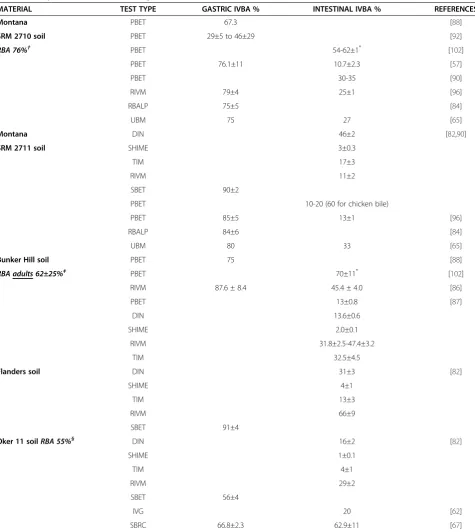
Table 3 summarizes the results obtained for the same test materials using variousin vitroprocedures. Depend-ing on the procedure applied, the estimated IVBA varies widely, especially the intestinal IVBA. Results obtained with different in vitro test designs should be compared with caution, in light of the differences in testing condi-tions discussed previously. A more important aspect to consider is whether or not these tests provide estimates of bioaccessibility that are useful for refining bioavail-ability and Pb exposure assessments. In fact, the main objective of a bioaccessibility test is to offer a rapid and low cost alternative to bioavailability testing. Therefore, the optimal bioaccessibility test should produce data that can be adequately correlated to in vivo data. In vivo to in vitro correlation [IVIVC] can be used to calibrate in vitrotesting conditions, which is highly desirable as it would ensure that anin vitromethod is an acceptable al-ternative to animal investigations. These correlations are usually presented as linear regression models, and their strength will depend on the number of substrates tested and the range of IVBA/RBA available. According to Drexler and Brattin, a strong correlation is determined by an R2> 0.6 and a significant relationship with a slope as close as possible to 1 [84]. However, it is suggested that the correlation coefficient may be more important than the slope, since a slope≠1 does not impede linking IVBA to RBA [105].
Another important aspect to consider in the selection of the in vitrotesting procedure is the validation of the in vitro test. In vitro procedures should ideally be sub-jected to round robin testing to verify the ability of the results to be accurately reproduced or replicated. Inter-laboratory testing is needed to standardize the procedure, so that it can be applied in any laboratory on multiple test materials [65,84]. For example, the UBM procedure is considered valid when the relative standard deviation (RSD) of within-laboratory results and between-laboratory results was≤10% and≤20% respectively [95]. Then, mul-tiple low cost experiments can be completed and extrapo-lated using existing data on animals and/or humans, and can be expected to be semi-quantitatively accurate. In vitroprocedures that have not been calibrated or validated can nevertheless be useful, but should be considered as approximations and interpreted with caution.
In vitro test results compared to in vivo data
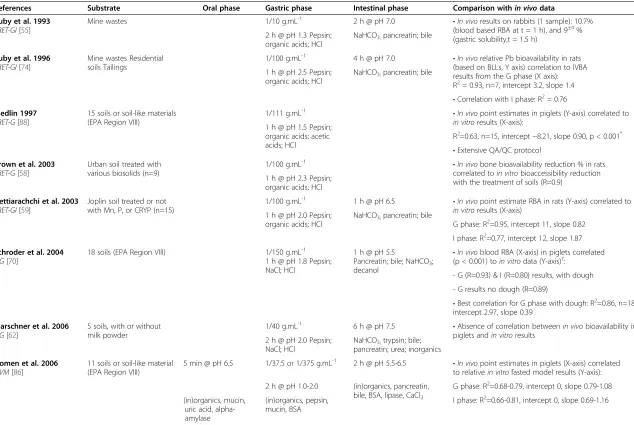
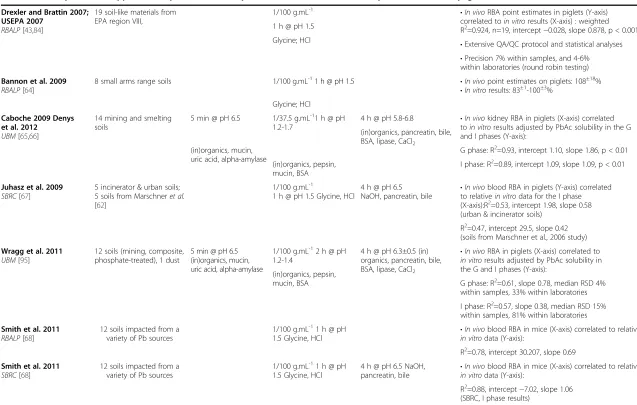
Table 4 lists in vitro tests that have been correlated to in vivo data, including variants of the PBET and IVG procedures: RIVM, UBM, RBALP, and SBRC.
PBET and IVG procedures
Results from the gastric phase using the Ruby et al. [74] procedure were calibrated for Pb in mine wastes with previous in vivo studies on Sprague Dawley rats. Only in vitro results of the gastric phase at pH 1.3 and 2.5 were linearly correlated toin vivoresults (R2= 0.93),
with a slope closer to 1 at pH 2.5 [45,71-74]. The pro-cedure by Medlin also showed that gastric bioaccessibil-ity predicted in vivo juvenile swine data better than intestinal bioaccessibility (Table 4) [88]. Bioaccessibility estimates from the intestinal phase (tested for SRM 2710
Table 3 Comparison of bioaccessibility results obtained with the same test materials
MATERIAL TEST TYPE GASTRIC IVBA % INTESTINAL IVBA % REFERENCES
Montana PBET 67.3 [88]
SRM 2710 soil PBET 29±5 to 46±29 [92]
RBA 76%† PBET 54-62±1* [102]
PBET 76.1±11 10.7±2.3 [57]
PBET 30-35 [90]
RIVM 79±4 25±1 [96]
RBALP 75±5 [84]
UBM 75 27 [65]
Montana DIN 46±2 [82,90]
SRM 2711 soil SHIME 3±0.3
TIM 17±3
RIVM 11±2
SBET 90±2
PBET 10-20 (60 for chicken bile)
PBET 85±5 13±1 [96]
RBALP 84±6 [84]
UBM 80 33 [65]
Bunker Hill soil PBET 75 [88]
RBA adults 62±25%‡ PBET 70±11* [102]
RIVM 87.6 ± 8.4 45.4 ± 4.0 [86]
PBET 13±0.8 [87]
DIN 13.6±0.6
SHIME 2.0±0.1
RIVM 31.8±2.5-47.4±3.2
TIM 32.5±4.5
Flanders soil DIN 31±3 [82]
SHIME 4±1
TIM 13±3
RIVM 66±9
SBET 91±4
Oker 11 soilRBA 55%§ DIN 16±2 [82]
SHIME 1±0.1
TIM 4±1
RIVM 29±2
SBET 56±4
IVG 20 [62]
SBRC 66.8±2.3 62.9±11 [67]
IVBA–in vitro bioaccessibility;*
bioaccessible Pb (mg) included Pb leached in G&I phases;†RBA on juvenile swine[65];‡RBA on human adults[38,86];§
RBA on juvenile swine[62].
and Pb oxide) underestimated the bioavailability data fromin vivocalibration studies. Brown et al. observed a significant relationship between gastric RBA reduction and IVBA reduction following different Pb remediation methods performed on the tested soil [58]. Finally, Het-tiarachchi et al. observed a stronger correlation of the RBA point estimates in rats with gastric IVBA, than with intestinal IVBA (Table 4) [59]. This lack of strong and significant correlations demonstrates the extent of the challenges in relating intestinal phase results from PBET to in vivo data, possibly due to precipitation reactions and the complexity of the mechanisms involved in intes-tine wall absorption.
Although the demonstration of a strong correlation with an animal model is highly valuable, the significance of the calibration is maximized if it is obtained using an adapted animal model that can be used to estimate exposure and risk assessment in human populations. The IVIVC observed for the PBET using rats [59,74], although signifi-cant, may not be as valuable for studying childhood expos-ure, however, because of the in vivo test design (animal model and/or dose administered), as underlined by Mushak [52]. In contrast, the PBET later developed by Medlin was correlated toin vivodata in juvenile swine [88], which are considered to be a better model for simulating digestion and absorption processes in children. In addition, this test was performed on a significant number of soils (n=15) using an extensive QA/QC protocol. Therefore, it appears to be more reliable than the Ruby et al. initial PBET [74]. Nonetheless, this test has not been subjected to the inter-laboratory validation and statistical analysis that would demonstrate good laboratory reproducibility of the results.
The IVG model, initially developed for PAH and PCB [106], was subsequently applied to Pb. It reproduces the PBET gastric and intestinal phases using physiological fluids, but the formulation of the fluids, retention time, and pH are different (Table 4). Schroder et al. and Marschner et al. compared the IVG results to in vivo results on swine using the same soils [62,70]. The ab-sence of IVIVC in the Marschner et al. (2006) study was attributed to the technical difficulties during the intes-tinal phase simulation. However, Schroder et al. did find significant relationships between in vivo and in vitro results performed with and without dough: blood-based bioavailability was correlated to gastric in vitro results (R=0.93; p < 0.001) and to intestinal in vitro results (R=0.80; p < 0.001) with dough.In vitrotests performed without dough showed significant correlation toin vivo blood-based bioavailability in the gastric phase, but not in the intestinal phase (Table 4) [70]. However, the in vivodata used for this correlation were later corrected by Casteel et al. and the USEPA [42,43], and so the rela-tionship would need to be re-evaluated with the cor-rected data prior to any use for other test materials.
Finally, this test cannot be considered as a fully validated standardized in vitro procedure, because of the limited use of a QA/QC protocol and incomplete statistical ana-lysis [84]. Nonetheless, it can be noted that, here again, the highest correlation was observed within vitrogastric results.
RBALP and SBRC procedures
Considering the apparently good correlation of bioavail-ability and gastric bioaccessibility and the limited benefit of including an intestinal phase [88], a protocol reprodu-cing only the gastric phase was developed in Dr. John Drexler’s laboratory. The RBALP was proposed after some investigation into the impact of temperature, con-tact time, pH, and S/L ratio to maximize correlation to in vivo data [84,88]. The RBALP includes an extraction with a synthetic fluid composed of glycine and HCl at 37°C (1 h, pH of 1.5, 1/100 g.mL-1). End-over-end mixing is performed (28±2 rpm), and separation is achieved via filtration at 0.45μm. The test also includes criteria allowing for rigorous, reliable, and reproducible results that are only considered valid if: (1) the pH at the end of the extraction is within 0.5 units of the initial pH, which ensures that glycine buffering capacity is not exceeded; (2) the maximum holding time before analysis is one week; and (3) a rigorous QA/QC protocol is applied, including analysis of a bottle blank, a blank spike, a matrix spike, a duplicate sample, and a control soil at a 5-10% frequency. The test was applied to two SRM materials and nineteen test materials through round robin testing by four laboratories, and the results were compared via a statistical analysis. Intra-laboratory results showed good precision and agreement, with a CV of 2-6%, and the laboratory results respecting SRM standards were highly reproducible (CV of 7%). These observations confirm good reproducibility, precision, and standardization of the method.
PBET-GI[55] (blood based RBA at t = 1 h), and 9±4% (gastric solubility,t = 1.5 h)
2 h @ pH 1.3 Pepsin; organic acids; HCl
NaHCO3;pancreatin; bile
Ruby et al. 1996
PBET-GI[74]
Mine wastes Residential soils Tailings
1/100 g.mL-1 4 h @ pH 7.0
•In vivorelative Pb bioavailability in rats (based on BLLs, Y axis) correlation to IVBA results from the G phase (X axis): R2= 0.93, n=7, intercept 3.2, slope 1.4 1 h @ pH 2.5 Pepsin;
organic acids; HCl
NaHCO3;pancreatin; bile
•Correlation with I phase: R2= 0.76
Medlin 1997
PBET-G[88]
15 soils or soil-like materials (EPA Region VIII)
1/111 g.mL-1 •In vivopoint estimates in piglets (Y-axis) correlated to in vitroresults (X-axis):
1 h @ pH 1.5 Pepsin; organic acids; acetic acids; HCl
R2=0.63, n=15, intercept
−8.21, slope 0.90, p < 0.001*
•Extensive QA/QC protocol
Brown et al. 2003
PBET-G[58]
Urban soil treated with various biosolids (n=9)
1/100 g.mL-1
•In vivobone bioavailability reduction % in rats correlated toin vitrobioaccessibility reduction with the treatment of soils (R=0.9)
1 h @ pH 2.3 Pepsin; organic acids; HCl
Hettiarachchi et al. 2003
PBET-GI[59]
Joplin soil treated or not with Mn, P, or CRYP (n=15)
1/100 g.mL-1 1 h @ pH 6.5 •In vivopoint estimate RBA in rats (Y-axis) correlated to in vitroresults (X-axis)
1 h @ pH 2.0 Pepsin; organic acids; HCl
NaHCO3;pancreatin; bile
G phase: R2=0.95, intercept 11, slope 0.82
I phase: R2=0.77, intercept 12, slope 1.87
Schroder et al. 2004
IVG[70]
18 soils (EPA Region VIII) 1/150 g.mL-1 1 h @ pH 1.8 Pepsin; NaCl; HCl
1 h @ pH 5.5
Pancreatin; bile; NaHCO3; decanol
•In vivoblood RBA (X-axis) in piglets correlated (p < 0.001) toin vitrodata (Y-axis)†:
- G (R=0.93) & I (R=0.80) results, with dough
- G results no dough (R=0.89)
•Best correlation for G phase with dough: R2=0.86, n=18, intercept 2.97, slope 0.39
Marschner et al. 2006
IVG[62]
5 soils, with or without milk powder
1/40 g.mL-1 6 h @ pH 7.5 •Absence of correlation betweenin vivobioavailability in piglets andin vitroresults
2 h @ pH 2.0 Pepsin; NaCl; HCl
NaHCO3;trypsin; bile; pancreatin; urea; inorganics
Oomen et al. 2006
RIVM[86]
11 soils or soil-like material (EPA Region VIII)
5 min @ pH 6.5 1/37.5 or 1/375 g.mL-1 2 h @ pH 5.5-6.5 •In vivopoint estimates in piglets (X-axis) correlated to relativein vitrofasted model results (Y-axis):
2 h @ pH 1.0-2.0 (in)organics, pancreatin, bile, BSA, lipase, CaCl2
G phase: R2=0.68-0.79, intercept 0, slope 0.79-1.08
(in)organics, mucin, uric acid, alpha-amylase
I phase: R2=0.66-0.81, intercept 0, slope 0.69-1.16 (in)organics, pepsin,
mucin, BSA
s
et
al.
Chemistry
Central
Journal
2012,
6
:138
Page
16
of
31
rycentral.co
m/content/6/1/
RBALP[43,84] R=0.924, n=19, intercept−0.028, slope 0.878, p < 0.001 Glycine; HCl •Extensive QA/QC protocol and statistical analyses
•Precision 7% within samples, and 4-6% within laboratories (round robin testing)
Bannon et al. 2009
RBALP[64]
8 small arms range soils 1/100 g.mL-11 h @ pH 1.5 •In vivopoint estimates on piglets: 108±18%
•In vitroresults: 83±1-100±3% Glycine; HCl
Caboche 2009 Denys et al. 2012
UBM[65,66]
14 mining and smelting soils
5 min @ pH 6.5 1/37.5 g.mL-11 h @ pH 1.2-1.7
4 h @ pH 5.8-6.8 •In vivokidney RBA in piglets (X-axis) correlated toin vitroresults adjusted by PbAc solubility in the G and I phases (Y-axis):
(in)organics, pancreatin, bile, BSA, lipase, CaCl2
G phase: R2=0.93, intercept 1.10, slope 1.86, p < 0.01 (in)organics, mucin,
uric acid, alpha-amylase
I phase: R2=0.89, intercept 1.09, slope 1.09, p < 0.01 (in)organics, pepsin,
mucin, BSA
Juhasz et al. 2009
SBRC[67]
5 incinerator & urban soils; 5 soils from Marschneret al. [62]
1/100 g.mL-1
1 h @ pH 1.5 Glycine, HCl
4 h @ pH 6.5
NaOH, pancreatin, bile •
In vivoblood RBA in piglets (Y-axis) correlated to relativein vitrodata for the I phase (X-axis):R2=0.53, intercept 1.98, slope 0.58 (urban & incinerator soils)
R2=0.47, intercept 29.5, slope 0.42 (soils from Marschner et al., 2006 study)
Wragg et al. 2011
UBM[95]
12 soils (mining, composite, phosphate-treated), 1 dust
5 min @ pH 6.5 (in)organics, mucin, uric acid, alpha-amylase
1/100 g.mL-12 h @ pH 1.2-1.4
4 h @ pH 6.3±0.5 (in) organics, pancreatin, bile, BSA, lipase, CaCl2
•In vivoRBA in piglets (X-axis) correlated to in vitroresults adjusted by PbAc solubility in the G and I phases (Y-axis):
(in)organics, pepsin,
mucin, BSA G phase: R2=0.61, slope 0.78, median RSD 4% within samples, 33% within laboratories
I phase: R2=0.57, slope 0.38, median RSD 15% within samples, 81% within laboratories
Smith et al. 2011
RBALP[68]
12 soils impacted from a variety of Pb sources
1/100 g.mL-11 h @ pH
1.5 Glycine, HCl •
In vivoblood RBA in mice (X-axis) correlated to relative in vitrodata (Y-axis):
R2=0.78, intercept 30.207, slope 0.69
Smith et al. 2011
SBRC[68]
12 soils impacted from a variety of Pb sources
1/100 g.mL-11 h @ pH 1.5 Glycine, HCl
4 h @ pH 6.5 NaOH, pancreatin, bile
•In vivoblood RBA in mice (X-axis) correlated to relative in vitrodata (Y-axis):
R2=0.88, intercept−7.02, slope 1.06 (SBRC, I phase results)
IVBA–in vitrobioaccessibility; RBA–relative bioavailability; G–gastric; I–intestinal; RSD–relative standard deviation;*
relationship with corrected EPAin vivodata from [84];†in vitro-in vivorelationship not performed with EPA corrected data (in vivobioavailability or bulk Pb concentrations).
s
et
al.
Chemistry
Central
Journal
2012,
6
:138
Page
17
of
31
rycentral.co
m/content/6/1/
protocol, and round robin testing, this test stands out as a reference for application to other test materials. How-ever, as underlined by the USEPA and Juhasz et al., al-though the substrates used for calibrating this procedure were numerous and originated from various sources, they do not represent the variety of Pb particles that exist in the environment. Also, they are made up of a significant number of substrates at mining sites for which Pb dissolution is limited during the gastric phase [43,67]. Therefore, the RBALP IVIVC may not hold for any other test material. Specifically, the RBALP applied to substrates containing more soluble forms of Pb than those found on mine sites, which partially precipitate/ react during the intestinal phase, may overestimate Pb bioavailability [67]. Finally, results performed on soils following remediation with phosphates showed a better IVIVC with IVBA results performed at pH 2.5, suggest-ing that the RBALP would give more valuable results at pH 2.5 for evaluating soil remediation effectiveness [110,111].
To respond to these concerns, Juhasz et al. added an intestinal phase to the RBALP and compared the results obtained for the gastric and intestinal phases toin vivo bioavailability results on juvenile swine [67]. The SBRC intestinal test simulates a gastric phase identical to that of the RBALP, except that the agitation is performed at 40 rpm and the filtration on 0.2 μm filters, and then a 4-h intestinal phase is simulated at pH 6.5 with the addition of NaOH, bile, and pancreatin. In order to take into account precipitation reactions occurring during the intestinal phase and better relate intestinal IVBA to in vivoresults, a relative intestinal IVBA was calculated. This was adjusted with the solubility of PbAc at pH 6.5 in the synthetic fluid, which was estimated at about 10-20%, as compared to 100% during the gastric phase at pH 1.5 (Equation 7). The application of an intestinal pH of 6.5 was justified by the fact that PbAc solubility was quite stable between 6.0 and 7.0, making the results more robust.
Relative Pb IVBA¼
in vitro PbTM
total extractable PbTM
in vitro PbPbAc
total PbPbAc
: ð7Þ
Gastric IVBA and absolute intestinal IVBA were poorly correlated toin vivodata for the five soils tested, while relative intestinal IVBA was satisfactorily corre-lated (R2 = 0.53). Although based on a weak fit (R2 = 0.12), and on few test materials, the authors state that the slightly negative Pearson correlation coefficient observed for the gastric phase may indicate an overesti-mation of the gastric phase estimates for some Pb forms. Applied to the same soils tested in the Marschner et al. study [62], relative intestinal IVBA estimates were well correlated to blood RBA on piglets, unlike the IVG
results obtained by Marschner et al. [67]. This suggests that the calculation of relative bioaccessibility is a better RBA predictor. Interestingly, Smith et al. tested soils with a wide range of bioavailability (10-83%) and report excellent correlations between in vivo mouse data and both the RBALP test and the SBRC-intestinal test (Table 4) [68]. The slightly lower correlation obtained using the RBALP is explained by the overprediction of the RBA using this test for some soil types. This over-prediction occurs because the presence of iron reduces the intestinal estimates, but not the gastric estimates, and so, the iron soil results correlated better using the SBRC-intestinal test [68]. It should be noted, however, that these conclusions were based on a comparison with mouse in vivo data, which is a less adequate animal model than the juvenile swine model. The IVIVC was then applied to the SBRC relative bioaccessibility results for thirty-one peri-urban soils, and compared to bio-availability predictions using the USEPA regression equation [43] on the SBRC results for the gastric phase. The bioavailability predictions were in agreement for shooting range soils, however different predictions were found for soils with high iron content, incinerator soils, historical fill soils, gasworks soils, and gossan soils (Fe-oxide rich soils). Overall, the RBALP relationships applied to the SBRC gastric results yielded more conser-vative bioavailability predictions than when the SBRC relationships were applied to the relative intestinal results [112]. This suggests that the addition of an intes-tinal phase to the RBALP, along with the use of relative bioaccessibility instead of absolute bioaccessibility, may yield bioaccessibility estimates that are closer to actual bioavailability results for some soil matrices. Nonethe-less, as emphasized previously, additional inter-laboratory testing, statistical analysis, and further testing on juvenile swine (N=5) would be desirable to reinforce and standardize the SBRC-intestinal test, since, unlike the RBALP, this procedure has not yet been validated. We conclude that, while some refinements could be added to the RBALP, this test is the one that has been more thoroughly validated, and therefore is the most reliable.
RIVM and UBM procedures