VOLUME 41, ARTICLE 25, PAGES 713
-
752
PUBLISHED 11 SEPTEMBER 2019
https://www.demographic-research.org/Volumes/Vol41/25/ DOI: 10.4054/DemRes.2019.41.25
Research Article
Maternal educational attainment and infant
mortality in the United States: Does the gradient
vary by race/ethnicity and nativity?
Tiffany Green
Tod G. Hamilton
© 2019 Tiffany Green & Tod G. Hamilton.
This open-access work is published under the terms of the Creative Commons Attribution 3.0 Germany (CC BY 3.0 DE), which permits use, reproduction, and distribution in any medium, provided the original author(s) and source are given credit.
1 Introduction 714
2 Background 715
2.1 Variation in the link between maternal education and infant health by nativity status
716 2.2 Variation in the link between maternal education and infant health
by race/ethnicity
717
3 Current study 719
4 Data and methods 719
4.1 Data 719
4.2 Measures 720
4.3 Estimation sample 721
4.4 Summary statistics 722
5 Methods 725
6 Differences in the maternal education–infant mortality gradient 727 6.1 Nativity differences in the maternal education–infant mortality
gradient within racial/ethnic groups 727
6.2 Nativity differences among white mothers 728
6.3 Nativity differences among black mothers 730
6.4 Nativity differences among Hispanic mothers 730
6.5 Nativity differences among Asian mothers 731
6.6 Racial/ethnic differences in the maternal education–infant mortality gradient and the foreign-born advantage
731
6.7 Neonatal and postneonatal mortality 732
7 Discussion and conclusion 735
8 Limitations of the existing study 737
9 Acknowledgements 738
References 739
Maternal educational attainment and infant mortality in the United
States: Does the gradient vary by race/ethnicity and nativity?
Tiffany Green1
Tod G. Hamilton2
Abstract
BACKGROUND
Maternal education-infant health gradients are flatter among foreign-born mothers than U.S.-born mothers; However, because common metrics of infant health are less predictive of infant mortality for some racial/ethnic and nativity groups, further study of maternal education-infant mortality gradients is necessary.
OBJECTIVE
We investigate whether maternal education–infant mortality gradients vary by race/ethnicity and nativity among infants born to mothers in the United States.
METHODS
We use data from the 1998‒2002 National Vital Statistics Birth Cohort Linked Birth/Infant Death Data published by the National Center for Health Statistics (N = 17,520,140) to estimate logistic regression models predicting infant, neonatal, and postneonatal mortality by race/ethnicity and nativity.
RESULTS
The negative associations between maternal education and infant mortality are stronger for US-born mothers than foreign-born mothers. Among both groups, Non-Hispanic whites have the highest returns to education and Non-Hispanic blacks have the lowest returns. While foreign-born mothers are less likely to have an infant die than their native-born counterparts, this advantage is largest at the lowest levels of education and converges at the highest levels of education . For most racial/ethnic groups, the maternal education–infant mortality gradient is steeper during the postneonatal period than during the neonatal period.
CONCLUSIONS
The maternal education–infant mortality gradient varies substantially by the timing of infant death, race/ethnicity, and nativity.
CONTRIBUTION
This study extends the literature on nativity disparities in infant health by documenting how the maternal education-infant mortality gradient varies by nativity within racial/ethnic groups. To our knowledge, this is the first study to produce these estimates.
1. Introduction
A large literature documents that maternal education is positively associated with favorable infant health, including lower rates of low birth weight, preterm birth, and infant mortality (Chou et al. 2010; Currie and Moretti 2003; Price, Price, and Simon 2011; Bhalotra and Rawlings 2013; Makate and Makate 2016). These findings have led researchers to focus on inequalities in maternal education as one potential pathway to improving early life survival (Prickett and Augustine 2016; Ahmed et al. 2010). Fewer studies, however, have examined whether the maternal education–infant mortality gradient is uniform across US populations; variations in this gradation would have important implications for population health over time.
This study focuses on two important sources of variation in the maternal education–infant mortality gradient: maternal nativity and race/ethnicity. In 2014, infants born to foreign-born women accounted for nearly one-quarter of all US births (Livingston 2016). Although foreign-born women, on average, have lower education levels than their US-born racial/ethnic counterparts, children born to foreign-born women have more favorable birth outcomes (e.g., lower rates of low birth weight and preterm birth) than their US-born counterparts (Hummer et al. 2007; Elo, Vang, and Culhane 2014; Green 2012; Giuntella 2017; Acevedo-Garcia, Soobader, and Berkman 2005, 2007; Janevic, Savitz, and Janevic 2011). Further, the foreign-born advantage in infant health is largest among the least educated women (Acevedo-Garcia, Soobader, and Berkman 2005; Janevic, Savitz, and Janevic 2011; Acevedo-Garcia, Soobader, and Berkman 2007).
mortality, which leaves two important gaps in the extant literature. First, infant mortality is one of the most important metrics of population health (Riddell, Harper, and Kaufman 2017; Hummer et al. 1999). Researchers argue that disparities in infant mortality reflect disparities in access to medical care, income inequality, and other unequal social conditions (Olson et al. 2010; MacDorman et al. 2014). Second, prior research shows that the association between infant health (e.g., low birth weight) and infant mortality varies by race/ethnicity and nativity (Ray et al. 2009; Kierans et al. 2008). For example, Kierans and colleagues (2008) find that compared to Canadian infants born to Native Americans and mothers classified as ‘other race,’ those born to foreign-born Asian mothers had lower rates of perinatal mortality during the entire gestational period despite having lower average birth weight and a higher rate of being small for gestational age. This finding suggests that the maternal education–infant mortality gradient may not mirror the maternal education–infant health (e.g., low birth weight or preterm birth) gradients documented in prior studies.
We investigate whether the maternal education–infant mortality gradient varies by race/ethnicity and nativity. Specifically, using a complete sample of US births from 1998–2002, we estimate the relationships between maternal education, maternal nativity, and the probability of infant death. Given prior evidence of racial/ethnic variation in the maternal education–infant health gradient, we calculate separate estimates for non-Hispanic (NH) whites, NH blacks, Hispanics, and NH Asians.3
Because the causes of early infant death (e.g., access to medical care) differ from the causes of later infant death (e.g., accidents), we document the associations between maternal education and three measures of infant mortality: overall infant mortality, perinatal mortality, and postneonatal mortality (Hummer et al. 2007).
2. Background
There are several mechanisms through which maternal education might influence infant health, including better access to prenatal care, better health behaviors during pregnancy, and access to economic and social resources. Currie and Moretti (2003) use US natality data combined with national data on local college availability to explore the causal effects of maternal education on infant health. The authors find that compared to mothers who had not completed high school, college-educated mothers are more likely to initiate first trimester prenatal care and are less likely to smoke. In addition, more-educated women may have better access to health information and more resources to
implement this information, which may ultimately improve infant health outcomes. Aizer and Stroud (2010) show that after the release of the Smoking and Health Report of the Advisory Committee to the Surgeon General of the Public Health Service in 1964, high school graduates were more likely than high school dropouts to reduce the intensity of their smoking during pregnancy. The authors also find that more-educated mothers experienced disproportionate decreases in rates of low birth weight and fetal deaths compared to less-educated mothers.
2.1 Variation in the link between maternal education and infant health by nativity status
While a higher level of maternal educational attainment is generally associated with better infant health,4 the direction and magnitude of the relationships differ by maternal
nativity (Acevedo-Garcia, Soobader, and Berkman 2005, 2007; Auger et al. 2008; Janevic, Savitz, and Janevic 2011; Hummer et al. 1999; Powers 2016). The ‘epidemiological paradox’ suggests that although some foreign-born mothers have low levels of educational attainment and often lack prenatal care, their birth outcomes (e.g., low birth weight and infant mortality) are on par with those of more-educated US mothers who are more likely to have access to medical care (i.e., white women) (Acevedo-Garcia, Soobader, and Berkman 2005, 2007; Auger et al. 2008; Janevic, Savitz, and Janevic 2011; Hummer et al. 2007; Elo, Vang, and Culhane 2014; Green 2012). Using US natality data, Acevedo-Garcia, Soobader, and Berkman (2005) find that (for all racial/ethnic groups except Asians) the foreign-born advantage in low birth weight is strongest among women with the least education (0 to 11 years). Similarly, Janevic, Savitz, and Janevic (2011) find that compared to US-born white women, the least educated foreign-born Eastern Europeans experience similar advantages with respect to low birth weight, preterm birth, and small size for gestational age. Studies using Canadian data report similar findings: Auger et al. (2008) conclude that not having a high school diploma is associated with low birth weight among Canadian-born mothers but not among foreign-born mothers. The authors also note that foreign-born status is associated with adverse birth outcomes only among the most educated mothers (those with a university degree).
Several behavioral and social factors may help explain why the association between maternal educational attainment and birth outcomes is weaker among foreign-born mothers than among US-foreign-born mothers. First, relative to their US-foreign-born counterparts, foreign-born mothers are less likely to smoke during pregnancy (Teitler,
Hutto, and Reichman 2012). Further, while less-educated US-born women are more likely to smoke than women with greater educational attainment, foreign-born women exhibit similar smoking rates regardless of schooling levels (Kimbro et al. 2008; Goldman et al. 2006). Prior studies find that foreign-born mothers are more likely to report having social support during pregnancy, which might help mitigate the stressors typically associated with lower educational attainment and socioeconomic status (Elo and Culhane 2010; Landale, Oropesa, and Gorman 2000).
Health selection and selective return migration may also contribute to differences in the maternal education–infant health gradient between foreign- and US-born mothers. Research suggests that people who immigrate tend to be healthier than those who remain in their country of origin (Akresh and Frank 2008; Jasso et al. 2004). If foreign-born individuals are positively selected on health rather than just on educational attainment, this might weaken the link between educational attainment and infant health outcomes and result in a flatter maternal education–infant mortality gradient than might be expected otherwise. In one of the only studies examining the role of selective migration on birth outcomes, Landale, Oropesa, and Gorman (2000) find that infant mortality is much lower among recent Puerto Rican migrants to the US mainland than among women who did not migrate from the island and migrants who had resided in the United States for longer periods of time. This result provides strong evidence of selective migration among Puerto Rican women who gave birth in the United States.
2.2 Variation in the link between maternal education and infant health by race/ethnicity
maternal education is weakly associated with birth outcomes among Mexican Americans relative to European and African Americans. Further, the disparity in infant mortality between European and African Americans increased with education.
While the reasons behind racial/ethnic differences in the maternal education–infant health gradient have not been fully elucidated, the ability to leverage educational attainment into access to employment and resources might be one important mechanism. Researchers argue that compared to white mothers with similar education levels, black mothers are less likely to attain commensurate benefits in income, health care, and housing (Williams 2002; Williams and Collins 2001). In a study of birth outcomes among women who spent their childhoods in poverty, Colen et al. (2006) show that among white mothers, increases in adult family income decrease the probability of low birth weight by 50% for every one unit increase in the natural logarithm of adult family income. However, there is no significant parallel relationship between changes in family income and infant health among black women.
Much of the prior work on racial/ethnic differences in the maternal education– infant health gradient fails to examine whether there are also differences between US-and foreign-born mothers (Din-Dzietham US-and Hertz-Picciotto 1998; Braveman et al. 2015; Gage et al. 2013). One important exception is Acevedo-Garcia, Soobader, and Berkman (2005), who show that the association between education and low birth weight is significantly stronger among US-born black women than among foreign-born black women. The authors also report that the effects of educational attainment on low birth weight are muted for white and Hispanic foreign-born women compared to their US-born counterparts. Similarly, in a study of US- and foreign-born Hispanics, Acevedo-Garcia, Soobader, and Berkman (2007) find that the educational gradient in low birth weight is steeper among the US-born mothers than among foreign-born mothers. Janevic, Savitz, and Janevic (2011) report that less-educated foreign-born white women from Eastern Europe also experience better infant health outcomes than all US-born white women.
3. Current study
No prior studies simultaneously examine variations in the maternal education–infant mortality gradient by nativity within or across each of the major racial/ethnic groups in the United States. The current study addresses this gap in the literature by examining 1) whether the education–infant mortality gradient differs between US- and foreign-born mothers and 2) whether the slope of the gradient differs across racial/ethnic groups. Given prior evidence on infant health outcomes such as low birth weight (Garcia, Soobader, and Berkman 2005; Janevic, Savitz, and Janevic 2011; Acevedo-Garcia, Soobader, and Berkman 2007) and one existing study on nativity differences in the maternal education–infant mortality association among Chinese Americans (Li and Keith 2011), we conjecture that the maternal education–infant mortality gradient will be flatter among foreign-born mothers than among US-born mothers across racial/ethnic groups and that black mothers, followed by Hispanic mothers, will have the largest foreign-born advantage in infant mortality.
4. Data and methods
4.1 Data
This study uses data from the 1998–2002 National Vital Statistics Birth Cohort Linked Birth-Infant Death Data (LBID), published by the National Center for Health Statistics. The data consists of nearly the entire annual census of births and infant deaths in the United States5 and is the largest and most complete data source on births to US- and
foreign-born women. The LBID contains information on mothers’ years of educational attainment and infant survival up to age one.6 Additionally, the data contains
information on prenatal behaviors such as first trimester prenatal care initiation and maternal characteristics such as age and number of prior births. Two drawbacks of the data are that it contains information on country of origin for only a few countries (Mexico and Canada) and the only socioeconomic status measure it contains is educational attainment. These limitations make it difficult to identify the extent of within-group heterogeneity in the educational gradient or the mechanisms linking maternal education to infant mortality. Nevertheless, the primary advantage of the
5 There may be a very small number of births missing from the data (e.g., off-the-grid births), but the data is essentially complete.
LBID is that it contains data on births to US- and foreign-born women in large enough numbers to estimate racial/ethnic differences in infant mortality, which is a relatively rare outcome at the population level.
We use the most recent data available with consistent information on educational attainment across states. Ideally, we would have used more recent data (i.e., from the past five years); however, in 2003, states began to replace an earlier version of the birth certificate with a new version that captured the mother’s highest completed level of education rather than her years of education (e.g., high school degree versus 12 years of education) (Martin et al. 2005). Unfortunately, the new ‘level’ measures of educational attainment differ across states (Martin et al. 2005). Further, while more than 70% of states had adopted the revised birth certificate by 20117 (the most recent year in which
birth-death cohort data is available), the National Center for Health Statistics omitted information on maternal place of birth from the publicly available data between 2003 and 2013. Thus, the 1998–2002 data represents the most recent public data that allows us to consistently capture the educational attainment of all women giving birth in the United States.
4.2 Measures
The primary outcome of interest in this study is infant death during the first year of life. We examine infant death during the first month after birth (i.e., neonatal mortality) and more than a month after birth (i.e., postneonatal mortality) separately because their causes and implications are often different. Neonatal mortality is often due to factors such as congenital abnormalities and lack of access to proper medical care. In contrast, death after the first month of life is often attributable to sudden infant death syndrome and accidents, which may be more reflective of social, economic, and environmental conditions (Olson et al. 2010; MacDorman and Mathews 2010). Prior research also shows that maternal education may be more strongly associated with postneonatal mortality than neonatal mortality (Cammu et al. 2010; Chou et al. 2010). We estimate the following outcomes: neonatal mortality (0 to 27 days), postneonatal mortality (28 to 364 days), and overall infant mortality (0 to 364 days).
The main right-hand side variables of interest are educational attainment and nativity status of mothers. Prior research on adult mortality suggests that categorical measures of educational attainment provide better explanatory power than continuous measures (Everett, Rehkopf, and Rogers 2013). Following prior work (Acevedo-Garcia, Soobader, and Berkman 2005; Janevic, Savitz, and Janevic 2011; Li and Keith 2011),
we include the following indicator variables for educational attainment: 0 to 11 years of schooling (reference category), 12 years of schooling, 13 to 15 years of schooling, and 16 or more years of schooling. Maternal foreign-born status is a dichotomous variable indicating whether a mother reported being born outside the United States.
The regression models also include controls for maternal characteristics, including maternal age, marital status, and prenatal behaviors that prior research suggests may influence infant mortality and may at least partially account for the association between maternal education and infant health. Maternal age is measured as a continuous variable (in years), and we also include a nonlinear term (age squared) to allow the association between age and infant death to vary with increasing maternal age. We include a dichotomous measure of maternal marital status, which is an important predictor of infant morbidity and mortality, potentially due to differences in household resources available for child health and improved health behaviors (Buckles and Price 2013). The primary measure of prenatal behavior is whether the mother initiated prenatal care during the first trimester of pregnancy. In alternate models, we also include a measure of whether the mother smoked during pregnancy (results available upon request).8
Prior research shows that a child’s sex and birth order influence mortality risk during the first year of life. To account for these factors, the regression models include an indicator for whether a child was male, as well as a categorical indicator of the number of prior births to the same mother (0, 1, 2, or 3 or more prior births). Lastly, the regression models include indicator variables that account for variation in infant mortality by US region of birth (Northeast, South, West, Midwest) (MacDorman, Hoyert, and Mathews 2013).
4.3 Estimation sample
The estimation sample for the study includes all singleton births that occurred to white, black, Asian, and Hispanic mothers between 18 and 46 years of age. Because of morbidity and mortality differences between singleton and multiple births, we exclude births of multiples (Mathews and MacDorman 2007). For similar reasons, we exclude pregnancies among very young and older mothers (Cavazos-Rehg et al. 2015). From the initial sample of singleton births to mothers ages 18 to 46 (n = 18,589,724), we also exclude births to mothers with missing information on race or whose reported racial/ethnic group was not one of the prespecified racial/ethnic groups of interest (n = 356,293) as well as those with missing information on nativity status (n = 44,809),
educational attainment (n = 218,792), birth order (n = 56,932), or trimester of prenatal care initiation (n = 381,223). We also exclude mothers who were not residents of the United States (n = 11,535). The final estimation sample consists of 17,520,140 observations. Less than 4% of the target sample had missing data on the covariates of interest. Maternal smoking is the only exception to this general pattern; approximately 18.5% of the sample had missing information on this variable. A large proportion of the observations with missing data on smoking (86%) are from California, which did not routinely collect information on smoking. Because California is an important receiving region for foreign-born citizens (López and Bialik 2017), we include these observations in the main estimation sample, which means we did not include measures of smoking in our main set of analyses. To assess the effect of including controls for smoking, we estimated models for a subset of individuals with valid information on maternal smoking (n = 14,857,143) and found similar results (results available upon request).
4.4 Summary statistics
Table 1 displays the summary statistics for the entire sample as well as by race and nativity. Table 1 shows that foreign-born white and Asian mothers have the lowest overall infant mortality rates (IMRs) (3.48 and 3.72 deaths per thousand, respectively), followed by foreign-born Hispanic mothers (4.14 deaths per thousand), US-born white mothers (4.58 deaths per thousand), US-born Hispanic mothers (5.22 deaths per thousand), and US-born Asian mothers (5.25 deaths per thousand). As expected, black mothers have the highest IMRs: 7.36 deaths per thousand for foreign-born black mothers and 11.55 deaths per thousand for US-born black mothers. Similar patterns emerge for neonatal and postneonatal deaths.
foreign-and US-born mothers, respectively, report having 16 or more years of education. In contrast, only 11% and 7% of foreign- and US-born Asian mothers, respectively, fall into the least educated category.
Table 1: Summary statistics stratified by race/ethnicity and nativity
Variables All NH White NH Black Hispanic NH Asian
US-born Foreign-born
US-born Foreign-born
US-born Foreign-born
US-born Foreign-born n =
17,520,140 n =10,093,743 n =574,239 n =2,209,892 274,554n = n =1,297,741 n =2,219,064 n =127,099 n =723,808 Infant mortality
Infant mortality (birth to 1 year), per 1,000 births
5.43 4.58 3.48 11.55 7.36 5.22 4.14 5.25 3.72
Neonatal mortality (0–28
days), per 1,000 births 3.40 2.80 2.26 7.32 5.21 3.22 2.70 3.16 2.44
Postneonatal mortality (29 days to 1 year), per 1,000 births
2.04 1.78 1.22 4.26 2.16 2.00 1.44 2.09 1.29
Maternal education
<12 years 0.19 0.10 0.09 0.20 0.15 0.27 0.57 0.07 0.11
12 years 0.33 0.32 0.27 0.43 0.37 0.41 0.26 0.29 0.23
13–15 years 0.23 0.25 0.23 0.25 0.25 0.22 0.10 0.24 0.21
16 or more years 0.26 0.32 0.41 0.11 0.24 0.10 0.07 0.40 0.45
Child characteristics
Child male 0.51 0.51 0.51 0.51 0.51 0.51 0.51 0.51 0.52
Maternal race/foreign-born status
Mother NH white 0.61 – – – – – – – –
Mother NH black 0.14 – – – – – – – –
Mother Hispanic 0.20 – – – – – – – –
Mother NH Asian 0.05 – – – – – – – –
Mother foreign-born 0.22 – – – – – – – –
Prenatal behaviors/pregnancy characteristics
1st trimester prenatal care 0.84 0.89 0.86 0.76 0.77 0.80 0.74 0.85 0.85
First birth 0.39 0.40 0.42 0.34 0.38 0.36 0.33 0.47 0.47
1 prior birth 0.39 0.35 0.33 0.31 0.31 0.33 0.32 0.32 0.35
2 prior births 0.34 0.16 0.15 0.19 0.18 0.19 0.21 0.14 0.12
3 or more prior births 0.17 0.09 0.09 0.16 0.13 0.12 0.15 0.08 0.06
Other maternal characteristics
Maternal age 27.60 28.14 29.86 25.48 29.39 25.20 27.07 27.98 29.96
(5.85) (5.78) (5.49) (5.73) (5.89) (5.50) (5.66) (6.19) (5.11)
Married 0.69 0.79 0.90 0.31 0.60 0.56 0.63 0.72 0.89
Region of birth
Northeast 0.17 0.18 0.27 0.13 0.43 0.11 0.13 0.09 0.22
Midwest 0.22 0.29 0.18 0.21 0.08 0.09 0.10 0.09 0.13
South 0.37 0.35 0.28 0.58 0.43 0.34 0.32 0.13 0.21
West 0.24 0.18 0.26 0.08 0.07 0.46 0.45 0.70 0.43
Table 2 displays infant mortality rates across educational categories within each racial/ethnic nativity subgroup. The descriptive statistics suggest that educational differences in infant mortality are larger among mothers born in the United States than among foreign-born mothers – for US-born mothers moving from the lowest to the highest educational category results in an IMR reduction of approximately 67% for whites, 36% for blacks, 52% for Hispanics, and 65% for Asians. There is far less variation in IMRs across educational categories among foreign-born mothers. Among this group, moving from the lowest to the highest educational category reduces infant mortality by 47% for whites, 3% for blacks, 32% for Hispanics, and 31% for Asians.
Table 2: Infant mortality rates stratified by educational attainment, race/ethnicity, and nativity
NH white
US-born Foreign-born
Maternal education (in years) Maternal education (in years)
<12 12 13 to 15 16 or more <12 12 13 to 15 16 or more
Infant mortality 8.53 5.53 3.99 2.85 5.16 4.23 3.27 2.74
Neonatal mortality 4.20 3.35 2.57 2.00 2.87 2.66 2.06 1.98
Postneonatal mortality 4.34 2.19 1.42 0.85 2.29 1.57 1.22 0.76
NH black
US-born Foreign-born
Maternal education (in years) Maternal education (in years)
<12 12 13 to 15 16 or more <12 12 13 to 15 16 or more
Infant mortality 13.72 11.98 10.34 8.76 7.51 7.49 7.20 7.26
Neonatal mortality 7.28 7.69 7.10 6.48 4.78 5.30 5.17 5.39
Postneonatal mortality 6.49 4.32 3.26 2.29 2.74 2.20 2.04 1.88
Hispanic
US-born Foreign-born
Maternal education (in years) Maternal education (in years)
<12 12 13 to 15 16 or more <12 12 13 to 15 16 or more
Infant mortality 6.48 5.28 4.54 3.12 4.41 3.97 3.84 3.01
Neonatal mortality 3.66 3.27 3.08 2.19 2.81 2.67 2.54 2.15
Postneonatal mortality 2.82 2.01 1.46 0.93 1.60 1.30 1.30 0.86
NH Asian
US-born Foreign-born
Maternal education (in years) Maternal education (in years)
<12 12 13 to 15 16 or more <12 12 13 to 15 16 or more
Infant mortality 8.65 7.35 5.26 3.07 4.54 4.45 3.73 3.14
Neonatal mortality 4.38 4.03 3.54 2.08 2.87 2.75 2.46 2.17
Postneonatal mortality 4.29 3.34 1.73 0.99 1.68 1.70 1.27 0.98
Source: 1998–2002 Birth Cohort Linked Birth-Infant Death Data (LBID), published by the National Center for Health Statistics; all variables expressed as percentages or means (standard deviations).
predominant pattern remains consistent with other groups for postneonatal deaths, which are 31% more likely among the least educated then among the most educated. For both neonatal and postneonatal mortality, the maternal education–infant mortality gradient varies by nativity, with steeper gradients among US-born mothers than among foreign-born mothers.
5. Methods
To study the association between maternal education and infant mortality, we estimate the following logistic regression models of infant deaths:
( | , , )= + + + + (1),
where represents infant, neonatal, or postneonatal mortality; indicates maternal nativity; represents maternal educational attainment; and is an interaction between maternal nativity and educational attainment. Finally,X is a vector of additional maternal and child characteristics that are potentially related to infant mortality, including maternal age, number of previous live births, maternal marital status, whether the mother had first trimester prenatal care, sex of the child, year of birth, and region of birth. We estimate separate models for white, black, Hispanic, and Asian mothers and calculate robust standard errors clustered at the regional level due to potential correlations between observations within regions. To aid in interpretation, we provide predicted infant, neonatal, and postneonatal mortality rates calculated from these estimates.9
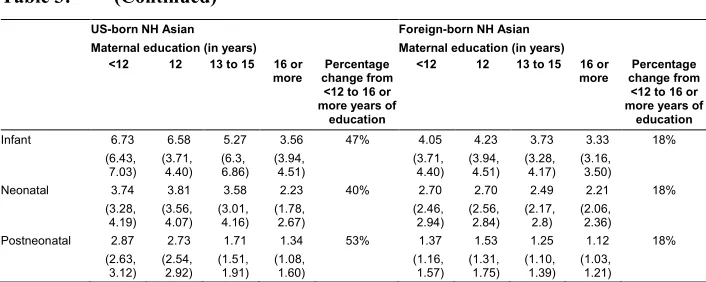
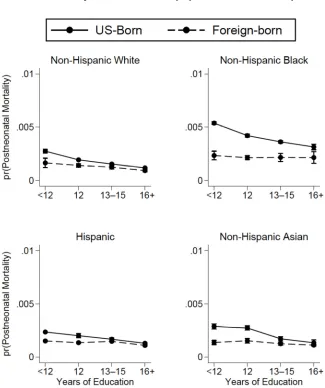
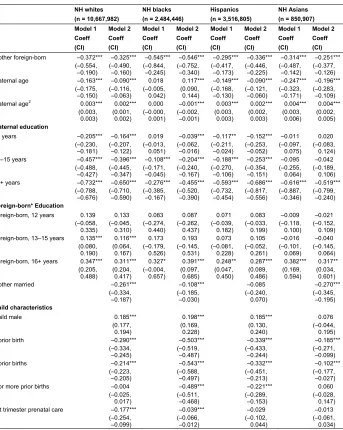
Appendix Tables A-1, A-2, and A-3 present the results from logistic regression models examining the associations between maternal education and three measures of infant mortality (overall infant, neonatal, and postneonatal) stratified by race/ethnicity. As the baseline specification, Model 1 includes only foreign-born status, education, and an interaction term between foreign-born status and education. We then estimate Model 2, which accounts for all the maternal and child characteristics listed earlier in Section 4. Regression results are expressed in coefficient form. To aid in interpretation, Table 3 shows predicted infant, neonatal, and postneonatal mortality rates based on Model 2 from Appendix Tables A-1, A-2, and A-3. We also display these results graphically by generating graphs of the infant mortality–education gradients by race and nativity (Figures 1, 2, and 3). For brevity, we only discuss the predicted probabilities from
Table 3 and Figures 1 (infant mortality), 2 (neonatal mortality), and 3 (postneonatal mortality).
Table 3: Predicted infant, neonatal, and postneonatal mortality rates by educational attainment, race/ethnicity, and nativity
US-born NH white Foreign-born NH white
Maternal education (in years) Maternal education (in years) <12 12 13 to 15 16 or
more
Percentage change from <12 to 16 or more years of
education
<12 12 13 to 15 16 or more
Percentage change from <12 to 16 or more years of
education
Infant 6.78 5.20 4.13 3.22 53% 4.42 4.05 3.31 2.91 34%
(6.48,
7.09) (5.11,5.29) (4.06,4.20) (3.13,3.32) (3.54,5.30) (4.03,4.08) (2.82,3.79) (2.74,3.08)
Neonatal 3.90 3.31 2.63 2.04 48% 2.76 2.68 2.09 1.97 29%
(3.74,
4.06) (3.24,3.38) (2.6,2.65) (1.97,2.10) (2.26,3.27) (2.52,2.84) (1.64,2.54) (1.79,2.15)
Postneonatal 2.74 1.92 1.52 1.16 58% 1.63 1.39 1.23 0.91 44%
(2.57, 2.91) (1.89, 1.95) (1.45, 1.6) (1.14, 1.19) (1.18, 2.07) (1.22, 1.57) (1.06, 1.39) (0.80, 1.02)
US-born NH black Foreign-born NH black
Maternal education (in years) Maternal education (in years) <12 12 13 to 15 16 or
more
Percentage change from <12 to 16 or more years of
education
<12 12 13 to 15 16 or more
Percentage change from <12 to 16 or more years of
education
Infant 13.85 12.05 10.31 8.46 39% 7.49 7.54 7.29 7.10 5%
(13.75,
13.96) (11.87,12.24) (10.08,10.54) (7.92,9.00) (6.35,8.63) (6.83,8.25) (6.91,7.68) (6.76,7.43)
Neonatal 8.27 7.96 6.76 5.27 36% 5.22 5.47 5.16 4.90 6%
(8.13,
8.41) (7.89,8.03) (6.63,6.89) (4.96,5.57) (4.21,6.23) (4.63,6.32) (4.53,5.80) (4.70,5.10)
Postneonatal 5.37 4.19 3.61 3.13 42% 2.33 2.12 2.14 2.13 9%
(5.25, 5.50) (4.05, 4.34) (3.5, 3.72) (2.87, 3.40) (1.91, 2.74) (1.93, 2.32) (1.77, 2.52) (1.59, 2.67)
US-born Hispanic Foreign-born Hispanic
Maternal education (in years) Maternal education (in years) <12 12 13 to 15 16 or
more
Percentage change from <12 to 16 or more years of
education
<12 12 13 to 15 16 or more
Percentage change from <12 to 16 or more years of
education
Infant 6.24 5.29 4.66 3.23 48% 4.37 4.02 3.93 3.04 30%
(5.97,
6.5) (5.03,5.55) (4.54,4.78) (3.07,3.39) (4.28,4.45) (3.82,4.21) (3.73,4.13) (2.78,3.30)
Neonatal 3.86 3.31 3.00 1.94 50% 2.87 2.68 2.47 1.93 33%
(3.51, 4.20) (3.21, 3.42) (2.87, 3.12) (1.82, 2.07) (2.80, 2.93) (2.53, 2.82) (2.33, 2.62) (1.71, 2.14)
Postneonatal 2.35 2.00 1.67 1.29 45% 1.51 1.35 1.47 1.09 28%
Table 3: (Continued)
US-born NH Asian Foreign-born NH Asian
Maternal education (in years) Maternal education (in years) <12 12 13 to 15 16 or
more change fromPercentage <12 to 16 or more years of
education
<12 12 13 to 15 16 or
more change fromPercentage <12 to 16 or more years of
education
Infant 6.73 6.58 5.27 3.56 47% 4.05 4.23 3.73 3.33 18%
(6.43, 7.03)
(3.71, 4.40)
(6.3, 6.86)
(3.94, 4.51)
(3.71, 4.40)
(3.94, 4.51)
(3.28, 4.17)
(3.16, 3.50)
Neonatal 3.74 3.81 3.58 2.23 40% 2.70 2.70 2.49 2.21 18%
(3.28,
4.19) (3.56,4.07) (3.01,4.16) (1.78,2.67) (2.46,2.94) (2.56,2.84) (2.17,2.8) (2.06,2.36)
Postneonatal 2.87 2.73 1.71 1.34 53% 1.37 1.53 1.25 1.12 18%
(2.63,
3.12) (2.54,2.92) (1.51,1.91) (1.08,1.60) (1.16,1.57) (1.31,1.75) (1.10,1.39) (1.03,1.21)
Note: Confidence intervals in parentheses. Predicted infant mortality rates are based on Appendix Tables A-1–A-3.
Source: 1998–2002 Birth Cohort Linked Birth-Infant Death Data (LBID), published by the National Center for Health Statistics.
6. Differences in the maternal education–infant mortality gradient
To identify variations in the strength of the maternal education–infant mortality gradient, we use the results from the fully specified models for each racial/ethnic group (Model 2) to generate the predicted probabilities of infant mortality and the associated confidence intervals for the estimation sample. Based on the predicted probabilities in Table 3 (also displayed graphically in Figures 1, 2, and 3), we first examine variation in the gradient by nativity status within each of the focal racial/ethnic groups and then examine racial/ethnic variation in the gradients and the foreign-born advantage. Finally, we examine the corresponding estimates for neonatal and postneonatal mortality.
6.1 Nativity differences in the maternal education–infant mortality gradient within racial/ethnic groups
6.2 Nativity differences among white mothers
The upper left panel of Figure 1 (whites) shows that among US-born whites, the predicted IMR falls steadily as mothers’ education level increases. Mothers with 16 or more years of education have an approximately 53% lower risk of giving birth to a child who dies during the first year of life than their peers with 12 or fewer years of education (approximately 3.22 deaths per thousand versus 6.78 deaths per thousand, respectively). Within most education categories, foreign-born white mothers have a lower predicted IMR than that of born white mothers. Moreover, compared to US-born white women, the difference in predicted IMR between the most and least educated foreign-born white women is much smaller. Foreign-born white mothers with 16 or more years of schooling have an IMR of 2.91 deaths per thousand compared to 4.42 deaths per thousand for foreign-born white mothers with 12 or fewer years of schooling, a difference of 34%. The findings also show that the nativity gap in infant mortality is largest among the least educated white women, more than 2 deaths per thousand.
Figure 1: Predicted infant mortality by maternal race/ethnicity
Note: Predicted probabilities of infant mortality for the estimation sample are based on logistic regression analyses that control for maternal nativity, maternal age, marital status, maternal smoking, first trimester prenatal care, child sex, and US region of birth (Appendix: Table A-1). Regressions are estimated separately by race/ethnicity (NH Whites, n = 10,667,982; NH blacks, n = 2,484,446; Hispanics, n = 3,516,805; NH Asians, n = 850,907).
6.3 Nativity differences among black mothers
The upper right panel in Figure 1 (blacks) shows a clear downward sloping education– IMR gradient among US-born black mothers, with the most highly educated women having lower predicted mortality rates than their less-educated counterparts. Specifically, US-born black mothers with 16 or more years of schooling have a 39% lower predicted mortality rate than those with less than 12 years of schooling (13.85 deaths per thousand compared to 8.46 deaths per thousand, respectively). In contrast, the curve of predicted IMRs among foreign-born black mothers is essentially flat. While infant mortality does generally decline with increases in maternal educational attainment for foreign-born black women, the effect is quite small, a difference of only about 5% between mothers with 16 or more years of education (7.1 deaths per thousand) and those with less than 12 years of education (7.49 deaths per thousand).
The foreign-born advantage in infant mortality among black mothers is greatest for women with the least education (a difference of 6.36 deaths per thousand), followed by those with 12 years of education (4.51 deaths per thousand), and then those with 13 to 15 years of education (3.02 deaths per thousand), and is smallest for those with the most education (1.36 deaths per thousand).
6.4 Nativity differences among Hispanic mothers
respectively, and disappearing among the most educated mothers. Overall, the foreign-born advantage in infant mortality is smaller among Hispanic mothers than among black and white mothers.
6.5 Nativity differences among Asian mothers
Finally, the lower right panel of Figure 1 (Asians) displays predicted IMRs for Asian mothers. Infant mortality declines substantially with increases in education among US-born Asian mothers, just as it does among US-US-born white and Hispanic mothers. In the case of Asian mothers, the IMR declines by 47%, from 6.73 deaths per thousand among those with 12 years of education to 3.56 deaths per thousand among mothers with 16 or more years of education. The maternal education–infant mortality gradient for Asian mothers is flatter among the foreign-born than among US-born women, but the flattening is even more dramatic for this group than for whites or Hispanics. In fact, foreign-born black mothers are the only other group with a flatter education–infant mortality gradient than foreign-born Asians. Predicted infant mortality declines by only approximately 18% as education increases among foreign-born Asian women, from 4.05 deaths per thousand among mothers with less than 12 years of education to 3.33 deaths per thousand among those with 16 or more years of education. As with mothers in other racial/ethnic groups, the foreign-born advantage is greatest among the least educated Asian mothers (a difference of 2.68 deaths per thousand), declines slightly among those with 12 years of education (a difference of 2.35 deaths per thousand), and falls even further for those with 13 to 15 years of education (a difference of 1.54 deaths per thousand). Among Asian mothers with 16 or more years of education, the foreign-born advantage in infant mortality is not statistically significant.
6.6 Racial/ethnic differences in the maternal education–infant mortality gradient and the foreign-born advantage
foreign-born black mothers, who have the flattest maternal education–infant mortality gradient.
With respect to the foreign-born advantage in infant mortality, there are some similarities across the focal racial/ethnic groups as well as some differences. For all four groups of mothers (whites, blacks, Hispanics, and Asians), the foreign-born advantage is largest among the least educated women and then declines as education increases. For white, Hispanic, and Asian mothers, IMRs converge among those with the highest level of education (16 or more years), but for black mothers, the foreign-born advantage remains, albeit at a lower level, even among the most educated women. In addition, for each education category, the magnitude of the foreign-born advantage is much larger for black mothers than for white, Hispanic, or Asian mothers. Indeed, in many cases the magnitude of the foreign-born advantage is nearly twice as large for black mothers compared to the other groups.
6.7 Neonatal and postneonatal mortality
One important question is whether the maternal education–infant mortality gradient varies by the timing of infant death. Thus, we also calculated predicted gradients (see Table 3) and generated figures for neonatal (Figure 2) and postneonatal (Figure 3) mortality by race/ethnicity and nativity. In general, the observed patterns are consistent with those for overall infant mortality: For all racial/ethnic groups, the magnitude of the foreign-born advantage in both neonatal and postneonatal mortality is generally largest among the least educated women and smallest (or nonexistent) among the most educated women.
Figure 2: Predicted neonatal mortality by maternal race/ethnicity
Note: Predicted probabilities of neonatal mortality for the estimation sample are based on logistic regression analyses that control for maternal nativity, maternal age, marital status, maternal smoking, first trimester prenatal care, child sex, and US region of birth (Appendix: Table A-2). Regressions are estimated separately by race/ethnicity (NH Whites, n = 10,667,982; NH blacks, n = 2,484,446; Hispanics, n = 3,516,805; NH Asians, n = 850,907).
Figure 3: Predicted postneonatal mortality by maternal race/ethnicity
Note: Predicted probabilities of postneonatal mortality for the estimation sample are based on logistic regression analyses that control for maternal nativity, maternal age, marital status, maternal smoking, first trimester prenatal care, child sex, and US region of birth (Appendix: Table A-3). Regressions are estimated separately by race/ethnicity (NH Whites, n = 10,667,982; NH blacks, n = 2,484,446; Hispanics, n = 3,516,805; NH Asians, n = 850,907).
Among foreign-born mothers, we also observe differences between the gradients for neonatal mortality and postneonatal mortality. Among foreign-born white mothers, predicted neonatal mortality falls by 29% from the lowest to highest education categories while postneonatal mortality falls by 44% across the same educational difference. For black and Asian mothers, the difference between the neonatal and postneonatal gradients is small or nonexistent. Finally, among foreign-born Hispanics, the pattern is reversed: Neonatal mortality declines by 33% across education categories while postneonatal mortality is about 28% lower among those with the most education than among those with the least education.
7. Discussion and conclusion
This study contributes to the growing literature on nativity disparities in infant health by documenting how the maternal education–infant mortality gradient varies by nativity within each of the major racial/ethnic groups in the United States. To our knowledge, this is the first study to produce these estimates. Four key findings emerge from the study. First, although overall levels of infant mortality are lower among foreign-born mothers, the maternal education–infant mortality gradient is steeper among US-born mothers. Within the latter group, the gradient is steepest for US-born whites and flattest for blacks. Second, there is considerable variation in the maternal education–infant mortality gradient among foreign-born mothers. While foreign-born white and Hispanic mothers have relatively steep gradients, the gradients for foreign-born Asian and black mothers are essentially flat. Third, the relationship between maternal education and infant mortality varies by the timing of infant death for some groups, particularly for US-born mothers. Specifically, maternal education has a stronger association with postneonatal mortality than with neonatal mortality. Finally, for most racial/ethnic groups, absolute differences in infant mortality between US- and foreign-born mothers are largest at the lowest levels of education and tend to converge at the highest levels of education. The study results are generally consistent with the prior literature on nativity, education, and infant health (Acevedo-Garcia, Soobader, and Berkman 2005, 2007; Auger et al. 2008; Janevic, Savitz, and Janevic 2011; Li and Keith 2011).
While the results clearly show that both nativity and race/ethnicity influence the association between maternal education and infant mortality, the mechanisms by which this occurs remain unclear. We offer several potential explanations.10 One potential
reason that education is more strongly related to infant mortality among US-born mothers than among foreign-born mothers is that education is likely more closely
connected to income, access to resources, and behaviors that directly and indirectly influence child health, such as smoking and/or drinking for US-born mothers compared to foreign-born mothers. For example, relative to US-born individuals with the same level of education, foreign-born individuals often earn lower wages (Hamilton 2014a), which may influence their ability to translate schooling into resources that improve infant mortality outcomes.
Selective migration may also contribute to racial/ethnic differences in maternal education–infant mortality gradients among the foreign-born in the present study. For example, others find evidence that foreign-born individuals from Mexico and Central America are less positively selected on health than those from Africa and Asia (Akresh and Frank 2008) and that health selection is particularly consequential among foreign-born blacks (Hamilton and Hummer 2011; Hamilton 2014b). This cross-country variation may be one reason why foreign-born black and Asian mothers had the flattest maternal education–infant mortality gradient in our sample.
Discrimination is another plausible explanation for the weaker link between maternal education and infant mortality among US-born black mothers in particular. Discrimination-related stress is associated with worse infant health outcomes among black mothers (Dole et al. 2003; Collins et al. 2004; Dominguez et al. 2008), and unequal treatment – for example, in the labor and housing markets (Pager and Shepherd 2008) – might affect black mothers’ ability to access resources related to child health, such as medical care. Further, research suggests that more-educated black women are disproportionately affected by discrimination: Collins et al. (2004) found that the links between lifetime discrimination exposure and very low birth weight were strongest among college-educated black women. Few studies have examined differences in the relationship between discrimination and infant health among US- and foreign-born black women. However, one study conducted among black pregnant women finds that foreign-born black mothers (from any region) who moved to the United States before age 18 or who are from the Caribbean are likely to report similar levels of lifetime discrimination as US-born black women, while those from Africa are likely to report lower levels (Dominguez et al. 2009). Although we cannot evaluate the role of disparate treatment in the present study, this remains an important area for further investigation.
2015), while the leading causes of postneonatal mortality (sudden infant death syndrome and unintentional accidents) are likely related to factors partially outside the scope of medical care (Shapiro-Mendoza et al. 2014; Mathews, MacDorman, and Thoma 2015). If women with higher educational attainment are better able to reduce the probability of injuries or accidents (Lahr, Rosenberg, and Lapidus 2007; Goldstein et al. 2016), this could partially explain the difference between the neonatal gradient and the postneonatal gradient.
8. Limitations of the existing study
The current study has several limitations. First, while the LBID data set is one of the few sources that contain enough observations on foreign-born whites, blacks, Hispanics, and Asians to conduct the focal analyses, the data set lacks information on characteristics that might further clarify the study findings, such as maternal country of origin (Elo, Vang, and Culhane 2014) and duration of US residence (Teitler, Martinson, and Reichman 2015; Li and Hummer 2015) among foreign-born women, and maternal labor market participation, stress (e.g., discrimination), income, and wealth among all mothers. Second, the content and quality of secondary and postsecondary education as well as the degree to which educational qualifications are rewarded in the labor market vary widely by race/ethnicity and country of origin (Bratsberg and Terrell 2002; Oreopoulos 2011), but this variation is not assessed in the current analyses. Third, studies find that events such as the terrorist attacks of September 11, 2001, and subsequent anti-immigrant sentiments increased the risk of poor birth outcomes for some foreign-born groups (i.e., Arab Americans) (Lauderdale 2006; El-Sayed, Hadley, and Galea 2008). Further, changes in US immigration policy and the economic landscape (i.e., Great Recession of 2008) may have resulted in changes in fertility patterns among the foreign-born (Comolli 2017) – potentially altering the relationships between maternal education and infant health over time. While our study was unable to account for these factors, more recent data will help to clarify any changes in the maternal education–infant mortality gradient since 2002. Finally, the ability to acquire additional schooling is constrained by any number of geographic, social, and economic factors (Byun, Meece, and Irvin 2012), and thus mothers who are able to invest in more education might be positively selected on unobserved characteristics correlated with better infant health (Currie and Moretti 2003). Given this possible selection bias, any observed relationships should be interpreted as descriptive rather than causal.
research on the links between maternal education and infant mortality using richer and more recent sources of data, specifically more complete data sets or creative linkages between administrative data sources that allow researchers to account for the effect of selective immigration. In addition, the findings reveal serious implications for the black-white infant mortality gap in the United States. Even among the foreign-born mothers, there is a replication of the black-white infant health gap typically observed among US-born mothers. Although foreign-born black mothers demonstrate a marked infant mortality advantage relative to black US-born mothers, even the most educated have higher infant mortality rates than almost all groups of even the least educated non-black mothers. Because foreign-born non-black women give birth to a growing share of the black children born in the United States (Livingston and Cohn 2012), it is critically important for researchers to continue exploring the complex relationships among race/ethnicity, nativity, and infant mortality.
9. Acknowledgements
References
Acevedo-Garcia, D., Soobader, M.J., and Berkman, L.F. (2005). The differential effect of foreign-born status on low birth weight by race/ethnicity and education. Pediatrics 115(1): e20–e30.doi:10.1542/peds.2004-1306.
Acevedo-Garcia, D., Soobader, M.J., and Berkman, L.F. (2007). Low birthweight among US Hispanic/Latino subgroups: The effect of maternal foreign-born status and education. Social Science and Medicine 65(12): 2503–2516.
doi:10.1016/j.socscimed.2007.06.033.
Ahmed, S., Creanga, A.A., Gillespie, D.G., and Tsui, A.O. (2010). Economic status, education and empowerment: Implications for maternal health service utilization in developing countries. PLoS ONE 5(6): e11190. doi:10.1371/journal.pone. 0011190.
Aizer, A. and Stroud, L. (2010). Education, knowledge and the evolution of disparities in health. Cambridge: National Bureau of Economic Research (NBER Working Paper 15840).doi:10.3386/w15840.
Akresh, I.R. and Frank, R. (2008). Health selection among new immigrants.American Journal of Public Health 98(11): 2058–2064.doi:10.2105/AJPH.2006.100974.
Almond, D., Doyle Jr., J.J., Kowalski, A.E., and Williams, H. (2010). Estimating marginal returns to medical care: Evidence from at-risk newborns. The Quarterly Journal of Economics 125(2): 591–634. doi:10.1162/qjec.2010. 125.2.591.
Auger, N., Luo, Z.-C., Platt, R.W., and Daniel, M. (2008). Do mother’s education and foreign born status interact to influence birth outcomes? Clarifying the epidemiological paradox and the healthy migrant effect. Journal of Epidemiology and Community Health 62: 402–409. doi:10.1136/jech.2007. 064535.
Bhalotra, S. and Rawlings, S. (2013). Gradients of the intergenerational transmission of health in developing countries.Review of Economics and Statistics 95(2): 660– 672.doi:10.1162/REST_a_00263.
Bratsberg, B. and Terrell, D. (2002). School quality and returns to education of US immigrants.Economic Inquiry 40(2): 177–198.doi:10.1093/ei/40.2.177.
factors in black–white disparities in preterm birth.American Journal of Public Health 105(4): 694–702.doi:10.2105/AJPH.2014.302008.
Buckles, K.S. and Price, J. (2013). Selection and the marriage premium for infant health.Demography 50(4): 1315–1339.doi:10.1007/s13524-013-0211-7.
Byun, S.-y., Meece, J.L., and Irvin, M.J. (2012). Rural–nonrural disparities in postsecondary educational attainment revisited.American Educational Research Journal 49(3): 412–437.doi:10.3102/0002831211416344.
Cammu, H., Martens, G., Van Maele, G., and Amy, J.-J. (2010). The higher the educational level of the first-time mother, the lower the fetal and post-neonatal but not the neonatal mortality in Belgium (Flanders). European Journal of Obstetrics and Gynecology and Reproductive Biology 148(1): 13–16.
doi:10.1016/j.ejogrb.2009.08.016.
Cavazos-Rehg, P.A., Krauss, M.J., Spitznagel, E.L., Bommarito, K., Madden, T., Olsen, M.A., Subramaniam, H., Peipert, J.F., and Bierut, L.J. (2015). Maternal age and risk of labor and delivery complications. Maternal and Child Health Journal 19(6): 1202–1211.doi:10.1007/s10995-014-1624-7.
Chen, A., Oster, E., and Williams, H. (2016). Why is infant mortality higher in the United States than in Europe? American Economic Journal: Economic Policy 8(2): 89–124.doi:10.1257/pol.20140224.
Chou, S.-Y., Liu, J.-T., Grossman, M., and Joyce, T. (2010). Parental education and child health: evidence from a natural experiment in Taiwan.American Economic Journal: Applied Economics 2(1): 33–61.doi:10.1257/app.2.1.33.
Colen, C.G., Geronimus, A.T., Bound, J., and James, S.A. (2006). Maternal upward socioeconomic mobility and black-white disparities in infant birthweight. American Journal of Public Health 96(11): 2032–2039. doi:10.2105/AJPH. 2005.076547.
Collins, J.W., David, R.J., Handler, A., Wall, S., and Andes, S. (2004). Very low birthweight in African American infants: The role of maternal exposure to interpersonal racial discrimination. American Journal of Public Health 94(12): 2132–2138.doi:10.2105/AJPH.94.12.2132
Currie, J. and Moretti, E. (2003). Mother’s education and the intergenerational transmission of human capital: Evidence from college openings. Quarterly Journal of Economics 118(4): 1495–1532.doi:10.1162/003355303322552856.
Din-Dzietham, R. and Hertz-Picciotto, I. (1998). Infant mortality differences between whites and African Americans: the effect of maternal education. American Journal of Public Health 88(4): 651–656.doi:10.2105/AJPH.88.4.651.
Dole, N., Savitz, D.A., Hertz-Picciotto, I., Siega-Riz, A.M., McMahon, M.J., and Buekens, P. (2003). Maternal stress and preterm birth. American Journal of Epidemiology 157: 14–24.doi:10.1093/aje/kwf176.
Dominguez, T.P., Dunkel-Schetter, C., Glynn, L.M., Hobel, C., and Sandman, C.A. (2008). Racial differences in birth outcomes: The role of general, pregnancy, and racism stress. Health Psychology 27(2): 194–203. doi:10.1037/0278-6133. 27.2.194.
Dominguez, T.P., Ficklin Strong, E., Krieger, N., Gillman, M.W., and Rich-Edwards, J.W. (2009). Differences in the self-reported racism experiences of US-born and foreign-born Black pregnant women.Social Science and Medicine 69(2): 258– 265.doi:10.1016/j.socscimed.2009.03.022.
Elo, I.T. and Culhane, J.F. (2010). Variations in health and health behaviors by nativity among pregnant Black women in Philadelphia. American Journal of Public Health 100(11): 2185–2192.doi:10.2105/AJPH.2009.174755.
Elo, I.T., Vang, Z., and Culhane, J.F. (2014). Variation in birth outcomes by mother’s country of birth among non-Hispanic black women in the United States. Maternal and Child Health Journal 18(10): 2371–2381. doi:10.1007/s10995-014-1477-0.
El-Sayed, A., Hadley, C., and Galea, S. (2008). Birth outcomes among Arab Americans in Michigan before and after the terrorist attacks of September 11, 2001. Ethnicity and Disease 18(3): 348–356.
Everett, B.G., Rehkopf, D.H., and Rogers, R.G. (2013). The nonlinear relationship between education and mortality: An examination of cohort, race/ethnic, and gender differences. Population Research and Policy Review 32(6): 893–917.
doi:10.1007/s11113-013-9299-0.
Gage, T.B., Fang, F., O’Neill, E., and DiRienzo, G. (2013). Maternal education, birth weight, and infant mortality in the United States.Demography 50(2): 615–635.
Giuntella, O. (2017). Why does the health of Mexican immigrants deteriorate? Evidence from linked birth records. Journal of Health Economics 54: 1–16.
doi:10.1016/j.jhealeco.2017.03.002.
Goldman, N., Kimbro, R.T., Turra, C.M., and Pebley, A.R. (2006). Socioeconomic gradients in health for white and Mexican-origin populations.American Journal of Public Health 96(12): 2186–2193.doi:10.2105/AJPH.2005.062752.
Goldstein, R.D., Trachtenberg, F.L., Sens, M.A., Harty, B.J., and Kinney, H.C. (2016). Overall postneonatal mortality and rates of SIDS. Pediatrics 137(1): 1–10.
doi:10.1542/peds.2015-2298.
Green, T. (2012). Black and immigrant: Exploring the effects of ethnicity and foreign-born status on infant health. Washington, D.C.: Migration Policy Institute. Hamilton, T.G. (2014a). Selection, language heritage, and the earnings trajectories of
Black immigrants in the United States. Demography 51(3): 975–1002.
doi:10.1007/s13524-014-0298-5.
Hamilton, T.G. (2014b). Do country-of-origin characteristics help explain variation in health among Black immigrants in the United States? Social Science Quarterly 95(3): 817–834.doi:10.1111/ssqu.12063.
Hamilton, T.G. and Hummer, R.A. (2011). Immigration and the health of US black adults: Does country of origin matter? Social Science and Medicine 73(10): 1551–1560.doi:10.1016/j.socscimed.2011.07.026.
Hayward, M.D., Hummer, R.A., and Sasson, I. (2015). Trends and group differences in the association between educational attainment and US adult mortality: Implications for understanding education’s causal influence.Social Science and Medicine 127: 8–18.doi:10.1016/j.socscimed.2014.11.024.
Hummer, R.A., Biegler, M., De Turk, P.B., Forbes, D., Parker Frisbie, W., Hong, Y., and Pullum, S.G. (1999). Race/ethnicity, nativity, and infant mortality in the United States.Social Forces 77(3): 1083–1117.doi:10.1093/sf/77.3.1083.
Hummer, R.A., Powers, D.A., Pullum, S.G., Gossman, G.L., and Frisbie, W.P. (2007). Paradox found (again): Infant mortality among the Mexican-origin population in the United States.Demography 44(3): 441–457.doi:10.1353/dem.2007.0028.
Jann, B. (2013).Predictive margins and marginal effects in Stata. Paper presented at the 11th German Stata Users Group Meeting, Potsdam, Germany, June 7, 2013.
Jasso, G., Massey, D.S., Rosenzweig, M.R., and Smith, J.P. (2004). Immigrant health: Selectivity and acculturation. In: Anderson, N.B., Bulatao, R.A., and Cohen, B. (eds.).Critical perspectives on racial and ethnic differences in health in late life. Washington, D.C.: National Academies Press: 227–266.
Kierans, W.J., Joseph, K.S., Luo, Z.-C., Platt, R., Wilkins, R., and Kramer, M.S. (2008). Does one size fit all? The case for ethnic-specific standards of fetal growth.BMC Pregnancy and Childbirth 8(1): 1–9.doi:10.1186/1471-2393-8-1.
Kimbro, R.T., Bzostek, S., Goldman, N., and Rodríguez, G. (2008). Race, ethnicity, and the education gradient in health. Health Affairs 27(2): 361–372.
doi:10.1377/hlthaff.27.2.361.
Lahr, M.B., Rosenberg, K.D., and Lapidus, J.A. (2007). Maternal-infant bedsharing: Risk factors for bedsharing in a population-based survey of new mothers and implications for SIDS risk reduction.Maternal and Child Health Journal 11(3): 277–286.doi:10.1007/s10995-006-0166-z.
Landale, N.S., Oropesa, R.S., and Gorman, B.K. (2000). Migration and infant death: Assimilation or selective migration among Puerto Ricans? American Sociological Review 65(6): 888–909.doi:10.2307/2657518.
Lauderdale, D.S. (2006). Birth outcomes for Arabic-named women in California before and after September 11. Demography 43(1): 185–201. doi:10.1353/dem.2006. 0008.
Li, J. and Hummer, R.A. (2015). The relationship between duration of US residence, educational attainment, and adult health among Asian immigrants. Population Research and Policy Review 34(1): 49–76.doi:10.1007/s11113-014-9344-7.
Li, Q. and Keith, L.G. (2011). The differential association between education and infant mortality by nativity status of Chinese American mothers: A life-course perspective.American Journal of Public Health 101(5): 899–908. doi:10.2105/ AJPH.2009.186916.
Lindeboom, M., Llena-Nozal, A., and van der Klaauw, B. (2009). Parental education and child health: Evidence from a schooling reform. Journal of Health Economics 28(1): 109–131.doi:10.1016/j.jhealeco.2008.08.003.
Livingston, G. and Cohn, D. (2012). US birth rate falls to a record low; decline is greatest among immigrants. Washington, D.C.: Pew Research Center.
López, G. and Bialik, K. (2017). Key findings about US immigrants. Washington, D.C.: Pew Research Center.
Lynch, J.L. and von Hippel, P.T. (2016). An education gradient in health, a health gradient in education, or a confounded gradient in both? Social Science and Medicine 154: 18–27.doi:10.1016/j.socscimed.2016.02.029.
MacDorman, M.F. and Mathews, T.J. (2010). Behind international rankings of infant mortality: How the United States compares with Europe. International Journal of Health Services 40(4): 577–588.doi:10.2190/HS.40.4.a.
MacDorman, M.F., Hoyert, D.L., and Mathews, T.J. (2013). Recent declines in infant mortality in the United States, 2005–2011. Atlanta: National Center for Health Statistics (NCHS Data Brief 120).
MacDorman, M.F., Mathews, T.J., Mohangoo, A.D., and Zeitlin, J. (2014). International comparisons of infant mortality and related factors: United States and Europe, 2010.National Vital Statistics Reports 63(5): 1–6.
Makate, M. and Makate, C. (2016). The causal effect of increased primary schooling on child mortality in Malawi: Universal primary education as a natural experiment. Social Science and Medicine 168: 72–83.doi:10.1016/j.socscimed.2016.09.003.
Martin, J.A., Hamilton, B.E., Sutton, P.D., Ventura, S.J., Menacker, F., and Munson, M.L. (2005). Births: Final data for 2003.National Vital Statistics Reports 54(2): 1–116.
Martin, J.A., Hamilton, B.E., Ventura, S.J., Osterman, M.J.K., and Mathews, T.J. (2013). Births: Final data for 2011.National Vital Statistics Reports 62(1): 1–90. Mathews, T.J. and MacDorman, M.F. (2007). Infant mortality statistics from the 2004 period linked birth/infant death data set.National Vital Statistics Reports 55(14): 1–32.
Mathews, T.J., MacDorman, M.F., and Thoma, M.E. (2015). Infant mortality statistics from the 2013 period linked birth/infant death data set. National Vital Statistics Reports64(9): 1–30.
Montez, J.K. and Barnes, K. (2016). The benefits of educational attainment for US adult mortality: Are they contingent on the broader environment? Population Research and Policy Review 35(1): 73–100.doi:10.1007/s11113-015-9377-6.
Montez, J.K. and Friedman, E.M. (2015). Educational attainment and adult health: Under what conditions is the association causal? Social Science and Medicine 127: 1–7.doi:10.1016/j.socscimed.2014.12.029.
Montez, J.K., Hayward, M.D., Brown, D.C., and Hummer, R.A. (2009). Why is the educational gradient of mortality steeper for men? Journals of Gerontology Series B: Psychological Sciences and Social Sciences 64(5): 625–634.
doi:10.1093/geronb/gbp013.
Montez, J.K., Hummer, R.A., Hayward, M.D., Woo, H., and Rogers, R.G. (2011). Trends in the educational gradient of US adult mortality from 1986 to 2006 by race, gender, and age group. Research on Aging 33(2): 145–171.doi:10.1177/ 0164027510392388.
Olson, M.E., Diekema, D., Elliott, B.A., and Renier, C.M. (2010). Impact of income and income inequality on infant health outcomes in the United States.Pediatrics 126(6): 1165–1173.doi:10.1542/peds.2009-3378.
Oreopoulos, P. (2011). Why do skilled immigrants struggle in the labor market? A field experiment with thirteen thousand resumes. American Economic Journal: Economic Policy 3(4): 148–171.doi:10.1257/pol.3.4.148.
Pager, D. and Shepherd, H. (2008). The sociology of discrimination: Racial discrimination in employment, housing, credit, and consumer markets.Annual Review of Sociology 34: 181–209.doi:10.1146/annurev.soc.33.040406.131740.
Powers, D.A. (2016). Erosion of advantage: Decomposing differences in infant mortality rates among older non-Hispanic White and Mexican-origin mothers. Population Research and Policy Review 35(1): 23–48. doi:10.1007/s11113-015-9370-0.
Price, J., Price, J., and Simon, K. (2011). Educational gaps in medical care and health behavior: Evidence from US natality data. Economics of Education Review 30(5): 838–849.doi:10.1016/j.econedurev.2011.03.012.