Role of Information Technology in Education and
Skill Based Learning for Employability
Monalisa Mohapatra, Srikanta Charana Das, B. C. M.Patnaik, Ipseeta Satpathy
Abstract: Today India is one of the fastest growing economies in the world and with liberalisation, privatisation and globalisation it is poised to grow further. But the question arises whether we are really ready for this growth? Whether our students are skilled enough to compete worldwide and be a partner in this growth mechanism? The answer is big ‘No’. It is a fact that education, lifelong learning and training are essential, but by themselves inadequate to help individuals gain good and decent jobs. The employability scenario of graduates in India is undoubtedly an area of great concern. In recent times information Communication Technology plays an important role for the employability scenario in India. The old concepts of literate and illiterate society have been replaced by digital divided. Considering the growing demand of industry it is high time for all the students to be part of ICT driven education and training system. Further the growing demand of artificial intelligence and data analytics put the students in more challenging position to obtain a job. The present paper is a conceptual one and it will be an addition to the existing literature related to employability issues.
Keywords: Employability, skills development, training, quality, ICT, digital divide
I. INTRODUCTION
A. Background of the study
“Employability is a set of achievements- skills, knowledge and personal attributes- that make an individual more likely to gain employment and be successful in their chosen occupations, which benefit themselves, the workforce, the community and the economy”1.
The term employability refers a person who possesses skills, attributes and abilities to get a job and to be successful in his job. The employee must have all the abilities what is expected from them by the industries. It has been assumed that possessing a higher degree can ensure of getting a good and preferred job. Higher education can develop employability among the students. A student must possess soft skill along with the subject knowledge.
Most of the literatures related with employability have observed that there exists a gap between the need of the employer and skill levels of the students that exists in the present scenario. There is a specific need from the employer that they are looking for people who do not have basic skills but a diversity of knowledge that helps them to achieve business optimization. The empirical study observed that employers value generic employability skills rather than specific occupational skills that are necessary for long term growth in the organization. Diversified workforce is able to absorb any kind of competitive market conditions in a better way (K.Cotton, 1993).
Revised Manuscript Received on November 05, 2019.
Monalisa Mohapatra, Research Scholar, KSOM,email-
Dr.Srikanta Charana Das, KSOM, KIIT University, email- sriknatdas
B.C.M.Patnaik, KSOM, KIIT University
Ipseeta Satpathy, KSOM, KIIT University
There are factors that affect employability skills and it has an important role in impacting the class room environment. The factors that may change the classroom environment, viz. flexibility of course delivery method, availability of community resources, availability of department of education to prepare lesson plan, difficulty of integrating project based education, inability of interacting with managers to identify what skills are important and lack of availability of professional development. The experience of the teaching professionals, certificates and teaching methods are some of the important parameter which can be the game changer for employability situation (T, 2006).
According to Hillage and Pollard (Pollard, 1998), employability is all about having the capability to gain initial employment, maintain that employment and obtain new employment if required. They propose that any individual should have three assets which consist of their knowledge, skills and attitudes. Those three assets are: i) Baseline Assets: It mostly comprises with basic skills and personal attributes like reliability and integrity
ii) Intermediate Assets: It consists of occupational specific skills, communication skills, problem solving skills etc. iii) High Level Assets: It involves such skills which will be helping in the performance in the organizations such as self management, team work, commercial awareness etc. Mainly employability assets depend on the individual’s personal and external circumstances and the correlation between the two (Pollard, 1998).
Bennett (1999) has proposed a model on the provision in higher education which include five elements such as knowledge, disciplinary skills, workplace awareness, workplace experience and generic skills. It includes all the necessary elements which help the graduate to achieve an optimum level of employability.
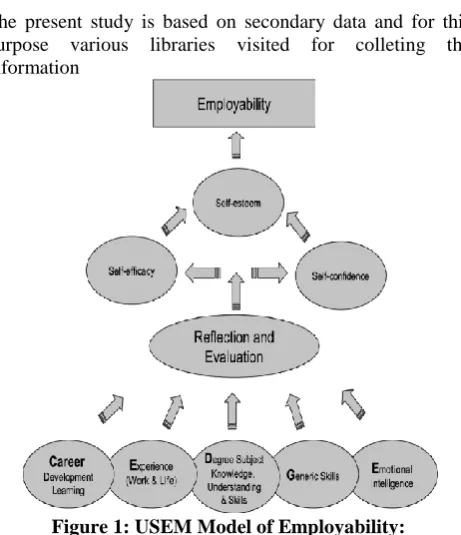
There exists another model for workforce skills for the future which is known as USEM Model. USEM was conducted by Knight and Yorke in the year 2004 to theorizing learning outcome through employability settings. The development of this model has helped the educators to guide and make skilled employees. This model is the most well known and respected model in the field of employability. It comprises with four elements such as understanding, skills, efficacy beliefs and Meta cognition (Yorke, 2006).
II. OBJECTIVESOFTHESTUDY
● To understand the concept of employability
● To know the role of Information technology for employability
III. METHODOLOGY
[image:2.595.54.285.63.331.2]The present study is based on secondary data and for this purpose various libraries visited for colleting the information
Figure 1: USEM Model of Employability:
Source: Yorke, M. and Knight, P.T. (2006) Embedding Employability into the Curriculum: Learning & Employability Series 1. The Higher Education Academy, York.
[image:2.595.327.508.201.311.2]The above model shows the way by which graduate students can achieve success. When all the students are provided proper opportunities to access all the needs then only all the candidates can evaluate themselves and can rework to develop their self efficacy, self confidence and self esteem. Knight and Yorke also projected that each term of USEM Model showed significant correlation to contribute to higher employability skills. Graduate Prospect (2010) in another study has investigated the role of each element which is present in a USEM Model. Efficacy beliefs were found to be most critical elements in constructing image and self confidence among graduates and ability to tolerate failure from the job process.
Figure 2: The USEM Account for Employability:
Source: Yorke & Knight (2006),"Embedding Employability to the Curriculum"
[image:2.595.318.542.547.691.2]The above model reveals that individual personal factors in one of the important antecedent of employability. The design of the model reflects a contention that each component is absolutely essential and one missing element will considerably reduce a graduate’s employability. Employability is a critical concern for higher education and it should be addressed as a matter of urgency. Higher education system gather academic and learning analytics and it can track students’ behavior and can develop employability capabilities, competencies. Employability development should focus on five things which are shown in the following figure (Bennett, 2016).
Figure 3: Five Employability Things:
Source:https://melbourne-cshe.unimelb.edu.au/__data/assets/pdf_file/0011/1874774/S P13 3258_Curtin_Bennett_Graduate-Employability_Final-Report_Part-A_20163.pdf
All these models can be used to explain the concept of employability to the students. It is a useful tool for the students in employability activities. The Career Edge model (Sewell, 2007) also provides useful summary of five essential elements that help in employability scenario of the students. It consists of the five things such as, i) Career Development Learning: Knowledge, skills and experience, ii) Experience: Work and life experience, iii) Degree: Subject Knowledge, Understandings, Skills, iv) Generic Skills and v) Emotional Intelligence: It is important in recruitment situations and in developing the working relationships. All these elements are overlapped but integral to each other (Sewell, 2007).
Figure 4: Career-Edge: The Key to Employability:
[image:2.595.64.265.554.734.2]Employability Scenario in Higher Education in India, In Special Reference with Management Graduates:
In today’s world employers are demanding skills from the graduate students which are outside the study area in terms of higher education. Many organizations give more attention to the generic skills of the students rather than actual degree discipline.
As employers intend to maintain their brand identity they are making fewer job offers by targeting specific skill sets (Bassou El Mansour, 2016). The job market is becoming more complex and the rate of change in today’s job market continues to accelerate. Higher education must strengthen its connection with the industries to get knowledge about their demand from the students and to ensure the graduates to understand the conditions of job market so that they can develop the skills as per the requirement of the employer (Bassou El Mansour, 2016).
Higher education can provide a way to employment by developing the pertinent workplace knowledge, skills and approaches. College graduate generally face increase competition from the experienced workers (Bassou El Mansour, 2016). Evolving skill requirements and reduced level of hiring also bring problem for the graduate students. In last few decades the demand for highly technical and professional skills has increased. As the job market is continuously changing now, workers must be able to adopt critical thinking, decision making and problem solving skills and communication skills as well as academic and technical knowledge (Bassou El Mansour, 2016).
Being an integral part of higher education, Management education is also on the verge of transformation. It is based on innovative thinking and liberalized learning. A graduate or post graduate candidate must have the soft skills, communication skills, analytical skills with the subject knowledge to qualify for the interview. But according to the report on employability of ASSOCHAM (2016) it can be seen that in India 97% of graduate students of several programmes such as BTech, MBA, MCA want core function job, whereas merely 3% have suitable skills to be employed and 7% can handle the core function job. It indicates 93% Indian Graduates lack in employability skills though they possess high professional degree . Therefore they do not have any role in Indian Economy (Standard, 2016).
In India number of management students in higher education is much more in numbers compared to other streams. From the report of the Department of Higher Education, MHRD, 2017 we can find the following table of the percentage of enrolment in various disciplines in higher education:
Discipline PhD Post Graduation
Agriculture & Allied 3.83 0.57
Commerce 2.74 10.75
Engineering & Technology 24.19 6.69
Foreign Language 2.11 4.95
Home Science 0.51 0.26
Indian Language 5.49 8.77
IT & Computer 2.19 6.22
Law 0.88 0.66
Management 5.03 15.28
Medical Science 4.14 3.33
Science 26.25 13
Social Science 12.56 17.52
Others 10.08 12
[image:3.595.318.517.435.622.2]Total 100 100
Table-1: Percentage of Enrolment in Various Disciplines in Higher Education, 2015-2016:
Source:https://mhrd.gov.in/sites/upload_files/mhrd/files/stati stics-new/ESAG-2018.pdf, Page: 9
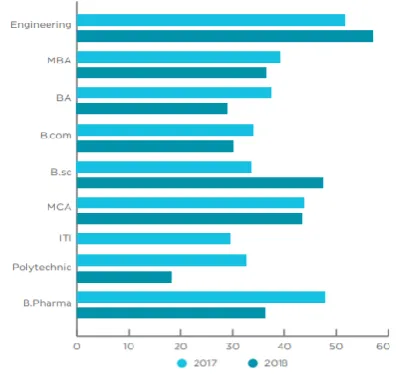
Therefore, from the above table we can see that 15.28% of students are getting enrolled in management education which is the second highest percentage after social science. But if we look at the job market scenario it can be seen that the employability amongst MBA graduates has dropped by 3% over last year . According to India Skills Report, 2019 the exponential increase in the number of MBA colleges are responsible for this situation. The quality of talent is seen to be declining. According to the report of ASSOCHAM, 2017 most of the business schools are struggling hard for placement. Most of the institutions in India are becoming dysfunctional as they are not getting enough students to be viable. The report also said that, out of 5,500 B-Schools (Authorized and Unauthorized) in India around 220 business schools are already closed their operation in the year 2016 due to less students in Delhi, Kolkata, Mumbai, Bangalore, Lucknow, Dehradun etc . The main problem is most of the institutes concentrate only into fill up the seats and do not consider quality of the students. In 2015-2016 the number of seats in management institutions has increased to 520000 from 360000 of 2011-2012 . Demand supply gap is increasing day by day. Only 7% of MBA graduates are getting a job after completing their course which is very disgraceful.
Figure 5: Domain wise Employability (2017-2018): Source: India Skills Report, 2019 (page no: 27)
[image:3.595.71.267.665.785.2]Figure 6: Hiring Intent: By Education Domain: Source: India Skills Report, 2019 (Page No: 33)
From figure 6, we can see that hiring trend of management students is only 13% whereas 22% engineers are getting job. Skill deficit or skill mismatch is considered as the main reason of that. Today higher education is posed by various eventuality demanding diverse skills, innovation, creativity and design thinking. The biggest gap is the impact on quality of learning outcomes. The management education system in a call for rethinks the way things are functioning. The digital education is becoming a norm of the future. Technology based education system becomes a powerful tool to aid and assist the entire education system (Awasthi, 2018).
Role of Information Technology in Education and Skill Based Learning:
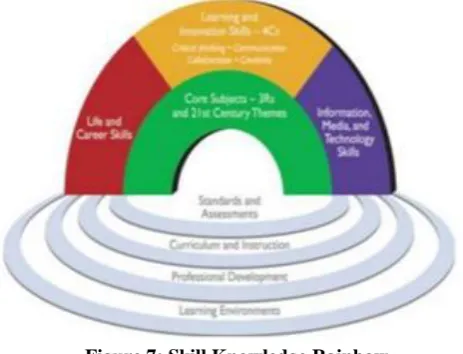
[image:4.595.52.278.55.201.2]A report from Little India Desk, 2018 (Desk, 2018) says that Indian MBA graduates have lost the edge and for that reason there has been a huge drop of placement in last few years. According to the report about 3, 60,000 MBA students are getting passed annually from different 4000 business schools of India and 61% are unemployable due to skill gaps. In fulfilling the need of 21st century’s students need to be skillful before entering into the workforce. Since internet was introduced in early 1970, information rapidly distributed to the entire world. Education becomes more important to ensure students to get a skill, creativity, teamwork, ability of innovation, problem solving skill. In the existing educational system the concept of current students are not building up to maintain the job level. It shows lack of concerns towards knowledge and skills which are needed to understand existing perspective (Trilling. B., 2009). The implication of problem solving skills in the learning process can be initiated by practicing students with basic skills on practical application subjects. According to Trilling and Fadel (2009), three skills are grouped in a scheme called 21st century skill knowledge rainbow (Fadel, 2009) include life and career skill, learning and innovation skill and information skills.
Figure 7: Skill Knowledge Rainbow
Source: https://iopscience.iop.org/article/10.1088/1757-899X/296/1/012036/pdf
In current world Information Technology (IT) is playing a vital role in every sphere of life. It has a significant effect on the way people work and live. New and emerging technology has challenged the traditional process of teaching and learning. It helps to access a vast array of data, challenging assimilation and assessment skills. With the help of IT learning has become an easy lifelong activity which can help in constant evaluation (Budhwar, 2017).
Educational technology is an organized process of applying modern technology to improve the quality of education. IT is only a systematic way of conceptualizing the execution and evaluation of the educational process. With technology education has taken a whole new meaning that it leaves us with no doubt that our educational system has been transformed owing to the ever advancing technology. It’s accepted that a well rounded education is a gateway to the success. Through education individuals can expand their minds and new ideas (Maria de Hoyos, 2013).
Technical training is one of the most important factors out of all. In technical training session students are usually given exposure to their basic concept along with the subject specific training which helps them to proof that they are good in their area of expertise. Information Technology (IT) is now playing a vital role in enhancing the employability skill with current market situations. The implementation and adoption of IT have enabled opportunities in various ways of working and for organizing and managing work schedule. IT skill has been recognized as essential qualities for the management students’ employment. It can be considered as a first step which enables the possibility of employment and a necessary element of the set of requisite skills (Garrido, 2009). Nowadays The IT skills are not only required for jobs in IT sector rather the demand for this skill is required in each and every domain. These skills are increasingly important in sectors such as agriculture, construction, education and different service industries (Garrido, 2009). The changing skill demand in today’s knowledge economy has been the subject through policy and academic discussions. Workers in a wide variety of fields have had to adapt and incorporate IT into their jobs. Workers with computer training are only more employable if a potential employer values
Developing IT skills in combination with training experience can advance anyone’s employability in several ways. The IT training can also help to overcome language barriers and it enhance the confidence level (Garrido, 2009). There are a diversity of factors which can manipulate the progress towards employability further than an individual’s IT knowledge such as level of formal education, social networks, economic viability, learning styles and the dynamics of labor market. At the heart of economic growth across the world there is a need for a highly skilled, bendable, flexible, independent, creative and productive workforce with high-level skills. Those who experience long periods of unemployment will as a result suffer “significant reductions in employability, human capital, skills, and the motivation and ability to upgrade skills, making them far less attractive to employers” (Garrido, 2009). Information Technology has a key responsibility in supporting workforce learning and development, and importantly employability skills.
Information and communication technology (ICT) have the supremacy in changing learning processes. The change of ICT is one of the important drivers of evolving skills. Education with ICT will provide the students with some special aptitude of a vast amount of digital tools and resources. Most of the academic institutions adopted learning procedure with digital technology for improving the employability of the graduates with incorporating business cases of different segments and sectors. Most of the employers expect digital competence along with other educational degrees and skills which are related to social skills. The effectual use of digital technologies combined with ICT practice is important for an institution to link with the industries to update the progress in the business activity (Dr. R.Mary Metilda, 2017). Many of the institutions opt for the use of ICT has an integral relation with the outcome of the students which exhibits in improving their self-esteem, subject knowledge, cognitive skills, ICT skills etc. Business management studies through online are highly accepted with the launch of Massive Open Online Course (MOOC) that was highly accepted globally. The academic factors of employability from the institutional standpoint includes infrastructural facilities such as digital library, smart classroom, computer lab with updated analytical and statistical software, conference sessions with digital satellite technology, case studies, soft copies of updated management related journals etc. Different research journals can strengthen the knowledge of the students and it can be considered as the source of enhancing graduate’s employability skills (Dr. R.Mary Metilda, 2017).
IV. RESULTANDDISCUSSION
In the present scenario information technology plays an important role for the employability and survival of employees. We cannot think about employability without knowledge about the information technology. People with less technosavy faces lot of problems in day to day life and sometimes the job is endanger. Information and technology replaced entirely the traditional way of doing things. The IT skills are very much needed for all the sectors. Now days corporate focus on paper less work culture. The present
society and work culture is digitally divided. Only the IT skilled people can only survive in the job industry. So the employability of an individual depends not only on the academics and at the same time on the IT friendliness on their part. The paper will be an additional contribution to the existing literature
V. CONCLUSION
Employability skills are skills which can be applied diagonally the variety of jobs and life contexts. In a country like India management study is used as passport to get a good job. Management programmes in different business schools in India is now seen as a workable choice and considered as comprehensive chronological process of the study. This thing raises the criticality of employability skill development among management students in India. Enhancing employability skills of management students is a challenge of the management institutions. Management education has to address a wide variety of critical issues of the industries. Due to a skill gap occurring in the nation now days employers find it difficult to include management graduates into the workforce. The employability of management students have fallen in India in last few years. Information Technology skill is one of the most important skills by which a student can get ready to face or solve the critical issues in the industries. Information and communication technology is very important in modern world. ICT skills are essential and should form a major part of organization strategy in providing better quality of the students. This skill is an important factor in inhibiting the learning of the students from developing communities. If ICT literacy is not recognized or dealt with, the lack of ICT skills may demoralize the efforts to use e-learning in bridging the digital divide.
REFERENCES
1. Abrol, M. (2016). Emerging Trends of Privatization of Education in India. International Journal of Educational Administration, 8(1), 1-6. 2. All India Survey On Higher Education 2017-18, Ministry Of Human
Resource Development, Department Of Higher Education, New Delhi, 2018.
3. All India Survey On Higher Education 2016-17, Ministry Of Human Resource Development, Department Of Higher Education, New Delhi, 2017.
4. Agarwal, P., & Kamalakar, G. (2013). Indian higher education: Envisioning the future. The Indian Economic Journal, 61(1), 151-155. 5. Anderson, J., & Mitchell, H. (2004). Education students, employers
and employability: a report on a small scale project in 2004.
6. Bansal, A. (2018). A STUDY ON EMPLOYABILITY SKILLS OF
MBA STUDENTS: EMPLOYERS AND STUDENTS
PERSPECTIVE. GURUKUL BUSINESS REVIEW-GBR, 14, 47-51. 7. Bapna, A., & Sharma, N. (2015). School Education in India: A
Handbook.
8. Bargsted, M. (2017), Impact Of Personal Competencies and Market Value Of Type Of Occupation Over Objective Employability And Perceived Career Opportunities Of Young Professionals, Journal of Work and Organizational Psychology 33 (2017) 115–123.
9. Basu, A. N. (1947). Education in modern India. Calcutta: Orient Book Co.
10. Bennett, T. (2006), Defining the Importance of Employability Skills in Career/Technical Education, Auburn, Alabama, December 15, 2006. 11. Bhola, S. S., & Dhanawade, S. (2013). Higher education and
employability-A review. 12. Blades, R., Fauth, B., & Gibb, J.
(2012). Measuring
review to inform development of tools for project evaluation. London National Children’s Bureau.
13. Boffo, V., Federighi, P., & Torlone, F. (2015). Educational Jobs: Youth and Employability in the Social Economy: Investigations in Italy, Malta, Portugal, Romania, Spain, United Kingdom (Vol. 2). Firenze University Press.
14. Brent, G., Sanger, G. & John, R. (2017), A framework to embed employability initiatives in undergraduate Science, Technology, Engineering and Maths programs. In R.G. Walker & S.B. Bedford (Eds.), Research and Development in Higher Education: Curriculum Transformation, 40 (pp 38 - 49). Sydney, Australia, 27–30 June 2017. 15. Cotton, K. (1993), Developing Employability Skills, School
Improvement Research Series, Educational Research and Improvement (OERI), U.S. Department of Education, under Contract Number RP91002001.
16. Final Report of DEHEMS Project (2012), Employability of Graduates and Higher Education Management Systems, University of Ljubljana, Faculty of Social Sciences, Project Number: 502890-LLP-1-2009-1-SI-ERASMUS-ENWS.
17. Forsythe, A. (2017), I doubt very seriously whether anyone will hire me; factors predicting employability perceptions in higher education, Cogent Psychology(2017), 4: 1385131.
18. Fugate, M. et al. (2004), Employability: A psycho-social construct, its dimensions, and applications, Journal of Vocational Behavior 65 (2004), 14–38.
19. Garrido, M., Sullivan, J., & Gordon, A. (2010, December). Understanding the links between ICT skills training and employability: an analytical framework. In Proceedings of the 4th ACM/IEEE International Conference on Information and Communication Technologies and Development (p. 15). ACM.
20. Gogoi, L. (2016). Education with ICT for developing employability in higher education institutions. Techno Learn, 6(2), 45.
21. Gupte, M. Role Of Research And Higher Education In India.
22. Hamid, A. S., et al. (2014), Employability Skills Development Approaches: An Application Of The Analytic Network Process, Asian Academy of Management Journal, Vol. 19, No. 1, 93–111, 2014. 23. Harrison, S. S. (2015). India: The most dangerous decades. Princeton
University Press.
24. Harvey, L. (2001). Defining and measuring employability. Quality in higher education, 7(2), 97-109.
25. Hayes, C., Fulton, J., Devlin, S., Westwood, D., Garfield, I., Beardmore, P., ... & Bingle, L. (2016). Perception of academic learning environments and perceived impact on articulation of employability; a mixed methods study. Journal of Learning Development in Higher Education, (10).
26. Heslop, L. (2014). Understanding India: The future of higher education and opportunities for international cooperation. British Council. 27. Hinton, C. (2012), The Relationship between Employability and Hope,
College of Education Theses and Dissertations, 27,
https://via.library.depaul.edu/soe_etd/27.
28. Higher education in India: Moving towards global relevance and competitiveness, FICCI Higher Education Summit, 2014.
29. Hiremath, S. S., & Albal, D. R. (2016). Current scenario of higher education in India: Reflections on some critical issues. International research Journal of Social Science and Humanities, 1(1).
30. Holford, A. (2016). Youth employment and academic performance: production functions and policy effects.