G
lobal
J
ournal of
E
ngineering
S
cience and
R
esearch
M
anagement
INTEGRATION OF THE ENVIRONMENTAL DIMENSION IN MAINTENANCE
DECISION SUPPORT TOOL FMEA: CASE OF A MOROCCAN FOUNDRY
Halima TAJRI*1, Mohammed El Hammoumi2, BrahimHerrou 3
*1Laboratory of Industrial Technologies (LTI), Faculty of Science and Technology FST, University Sidi Mohammed ben Abdallah, Fez, Morocco.
2Laboratory of Industrial Technologies (LTI), Faculty of Science and Technology FST, University Sidi Mohammed ben Abdallah, Fez, Morocco.
3Laboratory of Industrial Technologies (LTI), Superior School of Technology, University Sidi Mohammed ben Abdallah, Fez, Morocco.
KEYWORDS
:
ENVIRONMENT, EMS, MAINTENANCE, FMEA.
ABSTRACT
Nowadays, more and more companies communicate on their commitments concerning the protection of the environment, and seek to integrate environmental criteria in their management. As part of our research project which aims to integrate the environmental aspect into maintenance using the environmental management system, we offer a green Failure Mode and Effect Analysis (FMEA) that respects the environment during all of its implementation stages. We start in this article by defining the environment, environmental management system (EMS), maintenance and its relevance, and the relationship 'maintenance-environment'. Then we define the improvement process of maintenance FMEA, and how can the integration of environmental aspect be done, we will end up an industrial application of our proposal in a Moroccan foundry.
INTRODUCTION
Companies are now evolving in an economic context marked by competition increasingly intense and always more demanding customers. To differentiate them from the mass, nothing beats a certification. And to go further, nothing beats an environmental certification. Moroccan companies have finally understood and are thus more likely to take the plunge.
The challenges of competitiveness, profitability and environmental protection call out the maintenance function and make it one of the pillars of an environmental management system.
In this paper, we present at first the environment and environmental management system (EMS), as well as maintenance function and the implicit link that gather them. We will then define Failure Mode and Effect Analysis (FMEA) and detail the integration of the environmental aspect in this approach, Finally, we will present a part of the industrial application of this integration in a Moroccan foundry.
Definition of Environment and OF EMS
G
lobal
J
ournal of
E
ngineering
S
cience and
R
esearch
M
anagement
The international standard ISO 14001, defines EMS as "Component of the organization management system used to develop and implement its environmental policy and manage its environmental aspects. A management system is a set of interrelated elements used to establish policy and objectives and to achieve those objectives. A management system includes organizational structure, planning activities, responsibilities, practices, procedures, processes and resources. "
ANALYSIS OF THE ENVIRONMENT/MAINTENANCE RELATIONSHIP
Definition of MaintenanceAccording to the literature, the maintenance term, from Latin manu (hand) and tenerer (hold) appears a long time ago in the French language vocabulary (XII century). However, he was more dedicated to a military sense more than industrial one. He then pointed to the maintenance of the normal number of staff and equipment of a combat troop. Industrial connotation of the term comes from the Anglicism 'maintenance' dated on the middle of the twentieth century: Holding of technical equipment in function state; all set of maintenance ways and of their implementation.
For industrial activities, the most commonly and originally used term was maintenance: Care, repairs, expenses required to hold in good condition (Small Robert).
Before 1900, the term repair or fixing of equipment once it has failed. The goal was to have a quick restart.
From 1900 to 1970 the maintenance concept is used with the development of railways, automotive, aviation and armament during the two world wars. The majority of maintenance operations consisted of troubleshoots and repairs after failure [1].
From 1970, the development of risk sectors and modern tools leads to the implementation of maintenance. Indeed, for the responsible of these areas, to maintain the equipment undergoing his behavior is becoming inadequate to the risks incurred: it was necessary to master these automated systems, preventing incidents to avoid accidents, while avoiding prohibitive extra costs [2].
Maintenance is the optimization of upkeep parameters. If the upkeep was not considered productive yesterday, today's maintenance becomes [3].
We can make the sub-maintenance or over-maintenance. In one case, the process will lead to premature degradation of equipment, in the other case the overflow of useless interventions brings to a waste of money for the company.
It can be considered henceforth that "maintenance becomes a productive activity and not a cost for the company. Maintaining ensures availability of production, then assurance of the quantity but also the quality "[4]. And the slogan
"Caring is undergoing, maintenance is to master" sums up the attitude changing1.
Maintenance can be defined as "the set of all what helps maintain or restore a system in working order."
G
lobal
J
ournal of
E
ngineering
S
cience and
R
esearch
M
anagement
The NF X 60-010 has defined maintenance in June 1984 to be "All actions to maintain or restore a property in a specified state or to provide a specific service". This definition has been supplemented by specifying the nature of the maintenance function activities and the introduction of the concept of dependability in the definition of December 1995, 'all activities to maintain or restore in a state or in given conditions of security operation, to perform a function. These activities are a combination of technical, administrative and Managerial ones'.
Thus, we find the standard AFNOR NF X 60-000 definition (February 1985) that incorporates the economics of the
maintenance function "Well maintained is to ensure the optimal operation overall cost''
As part of our research we use the definition of the standard EN 13306: maintenance is "The set of all technical, administrative and management activities throughout the life cycle of an asset intended to maintain or restore it to a state in which it can perform a required function. "This definition introduces the concept of maintenance throughout the life cycle of a material, the thing that was absent in that of the NF X 60-010.
The objective of this section is to reveal all the areas and concepts that are included in this function, and during this analysis we noticed that the environmental dimension is absent in all definitions of the maintenance function but it does not reject our assumption that the link Maintenance & environment is obvious. We will try to find this link by analyzing the objectives of maintenance or by following the maintenance activities on the life of the equipment.
The relevance of the maintenance management:
The relevance of the maintenance management was demonstrated in several books ([5], [6], [7], [8] ....). Indeed, a good maintenance management can help the company remain competitive both nationally and internationally.
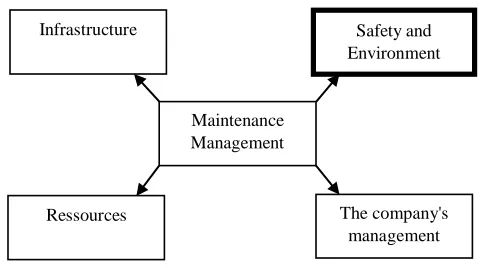
A maintenance management implemented properly has a positive impact at different levels: infrastructure, resources (human and material), company's management (spare parts, inventory, etc.), safety and environment (figure 1). This is what we will detail in what follows.
Figure 1: the impact of the maintenance management
On the infrastructure side, maintenance management allows ([9], [10], [11] and [12]):
Infrastructure Safety and
Environment
Ressources The company's
management Maintenance
G
lobal
J
ournal of
E
ngineering
S
cience and
R
esearch
M
anagement
Protect investments by providing the machines and buildings prolonged life through regular and effective Maintenance;
Ensure return on these investments by making maximum use of the equipment and thereby minimizing downtime (unplanned) production system.
On terms of resources, the effect of maintenance management is also well situated to human resources nival as material resources. As regards the first component, the maintenance management allows ([13], [14], [11] and [15]):
Supervise and direct service maintenance personnel to improve to the maximum the use and allocation of resources;
Ensure effective staff technical training, so that mastery stains it is trying to accomplish. As regards the material aspect, maintenance management allows ([7], [14], [11] and [15]):
Improve the use of these resources (equipment, tools and spare parts);
Optimize their allocation (to avoid waste);
Reduce production costs.
At the company's management, it allows ([8], [14], [11] and [15]):
Record spending, and many estimate the cost of upkeep work ,and maintenance to try to reduce them;
Check the upkeep costs to keep accounts for the establishment of future budgets.
In terms of safety and environment, maintenance management allows at the first part of ([5], [6] [11]):
Establish an accident prevention system, ensuring the safe functioning of equipment, building safety;
Have a working climate within in the company, thus creating a safe working environment; In terms of environment, maintenance management allows ([16], [17], [18]):
Extend the lifetime of the property;
Reduce noise (eg. A vibration motor).
Reduce consumption of matter and energy (eg. Water and electricity)
Reduce solid and liquid waste (oil leakage ...).
Reduce air pollution (gas leak ...).
Reduce costs related to the environment (the penalty cost due to the impact of the deterioration of the production system on the environment).
Authors who have introduced the environment among the pertinence of maintenance management are very rare, which explains the implicit form of the relationship ‘maintenance environment'.
G
lobal
J
ournal of
E
ngineering
S
cience and
R
esearch
M
anagement
Figure2: The implication relation Maintenance/ Environment
The relationship 'maintenance-environment’
The 'environmental' dimension is absent in all definitions of maintenance, even after the awareness of the issue of protecting the environment and international multilateral actions between states in this regard that are being in place, such as:
Kyoto Protocol: protocol to reduce the effects of global warming and reducing certain gases that contribute to global warming. It is signed on 11 December 1997, ratified2 by 37 countries3.
Montreal Protocol4: protocol that aims to remove certain gases contributing to the destruction of the ozone
layer, approved on September 16 1987 and applied in 1 January 19895, ratified by 197 countries.
Etc.
Nationally, Morocco has:
Developed a national global environmental charter, which is available in Law No. 99-12,
Ratified the Kyoto Protocol in 2002 [19].
In the time when the environment became an international scale policy and maintenance is an essential function in an industry, there is very little research work which deals with the relationship between maintenance and the environment.
All maintenance definitions have a common point which is 'to ensure a good functioning’, the latter remains incomplete if a machine for example works without fail and consumes much energy. The good functioning includes also the respect for the environment, so the proper functioning means working without breakdown, without failure, without energy overconsumption and no air, soil or water pollution.
2www.commaissancedesenergies.org
3 Kyoto protocol to the united nations framework convention on climate change. Technical report, United Nations. 4 The Montreal Protocol on substances that deplete the ozone layer. Technical report, Programme des Nations Unies pour l’Environnement.
5http://ozone.unep.org
Improvement of
environmental
management Improvement of
Maintenance
G
lobal
J
ournal of
E
ngineering
S
cience and
R
esearch
M
anagement
Although the link “Maintenance-Environment” is obvious, it remains implicit. Our objective seeks to strengthen it and make it more explicit through its integration in all strategies of maintenance function and its decision support tools including the FMEA approach, which we have presented in this article.
FAILURE MODE AND EFFECTS ANALYSIS (FMEA)
The FMEA made its appearance in France in aeronautics (Concorde and Airbus) in 1960. Introduced in manufacturing series since the 1980s, its application remains there today widespread [20]. Initially FMEA techniques was mainly used for product failures analysis modes only in the nuclear, aerospace, automotive, chemical, mechanical industries, but with the passage of time, FMEA becomes widely used in the analysis fault industries softwares: [21] [22] and in the information security [23].
The FMEA helps to identify the potential failure mode and its causes, effects, and it’s Risk Priority Number (RPN) which is traditionally defined as the product of the occurrence (O), severity (S) and detection (D).
Maintenance can act on a product, service or process. And as we have mentioned before, maintenance actions can be technical, administrative or managerial and must be implemented throughout the lifetime of a material (equipment). Some of these actions are situated at the conception of equipment, others are actions of surveillance and monitoring, end of life, maintenance of equipment offers a decommissioning [17].This is why in the rest of our research we treat FMEA generally, without considering its types (e.g. Process FMEA, Design FMEA, System FMEA, Product FMEA, etc.).
THE ADDED VALUE OF THE PROPOSAL FOR A GREEN FMEA
Among the benefits that the company can gain by integrating environmental criteria into the continuous improvement process FMEA:
Improving the conception of the good, service or process to the 'environmental' objective.
The integration of the environmental dimension in maintenance allows for monitoring and reassessment of environmental performance since the FMEA is an approach based on the principle of continuousimprovement.
Taking into account the direction of the company in terms of environmental management and response to the requirements of the ISO 14001 standard "The organization shall establish, implement and maintain one (of) procedure (s) to identify potential emergency situations and potential accidents that can have (the) impact (s) on the environment, and how to react 'and' use practices process, materials, products, services or energy to prevent , reduce or control (separately or in combination) the creation, emission or discharge of any type of pollutant or waste '.
Continuous improvement of environmental performance required by the implementation of an environmental management system6.
Look for potential failures or malfunctions which may affect equipment, machine, process, or the environment.
Analyze the consequences of these failures, identify situations that would result.
G
lobal
J
ournal of
E
ngineering
S
cience and
R
esearch
M
anagement
Assess the level of severity, criticality or acceptability of these situations,
Know how and what action, consider what steps, if these unacceptable situations appears.I
NTEGRATION OF ENVIRONMENTAL CRITERIA INFMEA
Several research works have used the FMEA approach as a potential risk analysis tool on a system, we cite the research of [24], [25], [26], [27], [28], [29] etc ... others have made the process FMEA their research object and they criticized the Risk Priority Number (RPN), and his traditional method calculates, which is given by the product of three parameters: occurrence (O), severity (S) and detection (D) by assigning to each parameter an integer from 1 to 5 for example, they have proposed a new method based on fuzzy numbers as works of [21], [30], [31], [32], [33] etc ... but the number of researches that analyze the criticality of a system on the environment or dealing relationship FMEA / environment is very limited, we quote in this direction the research of [34], [35] and [36] who proposed the FMEA method as a tool for impact analysis of a system on the quality, safety and the environment, so the research work of [37] which analyzed the impact of maintenance activities on the environment and safety by using the FMEA. In this paper, we propose the integration of the environmental dimension in the FMEA approach; we will analyze and treat the introduction of environmental criteria in maintenance in the following three steps: calculates RPN matrix, action plan and monitoring and verification step.
Risk Priority Number (RPN) taking into account the environmental dimension:
Each failure is usually judged on three criteria: their occurrence (O), the severity of their consequences (or their effects) (S) and detection (D) .We therefore proposes for each failure to add the criterion 'environment'(see Table 1).
Table 1: FMEA after the integration of environmental criteria E.
The following equation shows the Risk Priority Number (RPN) after the integration of the environmental criteria: RPN= O × S × D × E (1)
E: Environmental criteria
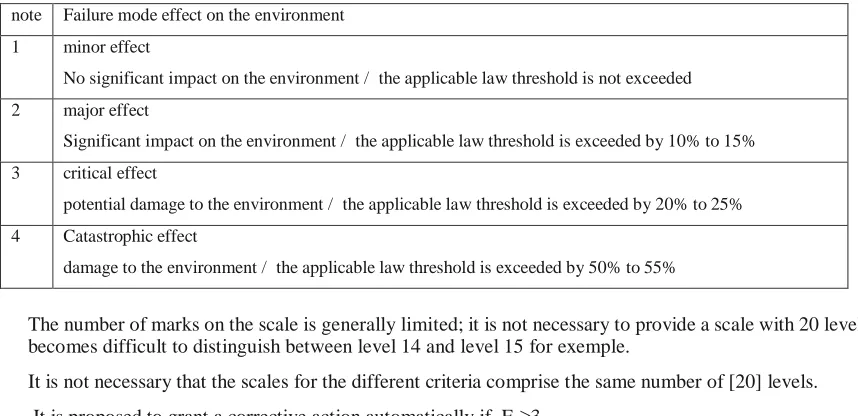
It represents the effect of the failure mode on the environment. Rating scales which vary between 1 and 4 are based on the effects caused by the failure, in terms of environment and on the applicable law (see Table 2).
Function or operation of
the process
Failure
mode
Failure
Effect
Failure
cause
G
lobal
J
ournal of
E
ngineering
S
cience and
R
esearch
M
anagement
Table 2: Matrix of result of failure mode on the environment
The number of marks on the scale is generally limited; it is not necessary to provide a scale with 20 levels, it becomes difficult to distinguish between level 14 and level 15 for exemple.
It is not necessary that the scales for the different criteria comprise the same number of [20] levels.
It is proposed to grant a corrective action automatically if E3. Action Plan
An action plan aims to reduce the Risk Priority Number (RPN) which is the product of four parameters O, S, D, and the effect of the failure mode on the environment E, thus, one of the objectives of an action plan is to decrease E, that is to say improving the management of the environment, which enhances the relation (1) described in figure 1.
In other words, Corrective and preventive actions aim to reduce the Risk Priority Number (RPN) of failures, also acting on management environment. So the improvement of environmental management helps, to reduce the RPN and consequently, to improve the maintenance management within an industry (see Fig.3).
note Failure mode effect on the environment
1 minor effect
No significant impact on the environment / the applicable law threshold is not exceeded
2 major effect
Significant impact on the environment / the applicable law threshold is exceeded by 10% to 15%
3 critical effect
potential damage to the environment / the applicable law threshold is exceeded by 20% to 25%
4 Catastrophic effect
G
lobal
J
ournal of
E
ngineering
S
cience and
R
esearch
M
anagement
Figure3: The implication relation Environment/ Maintenance
And according to the relation (1) and (2) described in Figure 2 and Figure 3, we can conclude the relation (3) described below (see Figure 4):
Fig.4: the equivalence relation Maintenance/Environment.
Monitoring And Verification:
The company analyzes and evaluates its technical and environmental performance after the implementation of corrective or preventive action plan.
Assessment of environmental performance is one link in the cycle that allows measurement and synthesis, by the scoreboard of environmental performance of the system studied.
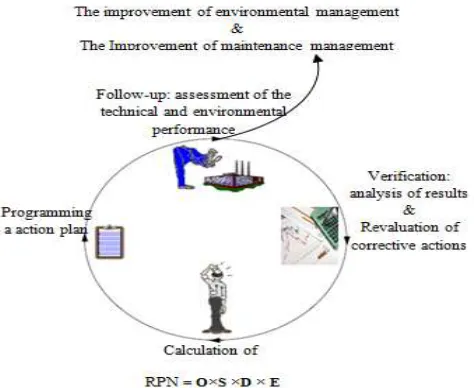
We are inspired of the PDCA methodology to present the continuous improvement process FMEA (Figure 5). RPN= O × S × D × E
Improvement of Maintenance Improvement of
environmental management
(2)
Improvement of Maintenance If E
(decreased)
RPN
Improvement of environmental
management Improvement of
maintenance
G
lobal
J
ournal of
E
ngineering
S
cience and
R
esearch
M
anagement
Figure 5: Presenting continuous improvement process FMEA
Based on results of assessment of environmental performance, the information is communicated to management of the company, it must find treatments of deviations solutions, and program an action plan. The cycle is completed by regular re-evaluation of the effects of planned corrective actions, and the opportunity to correct the action plan accordingly.
To meet the needs of the business, and for it to be able to drive the course of action towards the achievement a goal
or to evaluate the result, we formalize the information later by environmental indicators.
INDUSTRIAL APPLICATION
The industrial application of our proposal is to a Moroccan Foundry Company, which has as main activity the production of pistons, liners and automobile routes.
The working group has decided to set 16 as the threshold value for the Risk Priority Number (RPN), beyond this threshold, the effect of the failure is not sustainable, so action is needed.
Elements whose criticality exceeds 16 are combined in a preventive maintenance plan.
We will present in this article the application of FMEA on a machining center OP 50, the function of this machine is to realize finishing hole axis, its functional breakdown is as follows:
G
lobal
J
ournal of
E
ngineering
S
cience and
R
esearch
M
anagement
3. Pin 4. Dredge 5. Switch cabinet
We will present in this article just a part of the FMEA analysis regarding a set Table. The most elementary decomposition of the entire table is as follows (see Figure 6):
Fig. 6: the elementary decomposition of a set Table
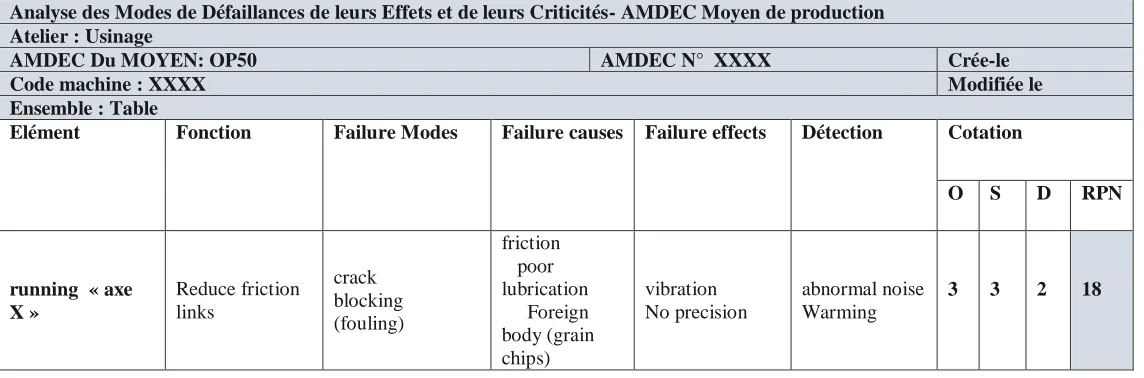
Following the presentation of the FMEA with traditional RPN.
Table 3: Failure Mode and Effects analysis with RPN.
Analyse des Modes de Défaillances de leurs Effets et de leurs Criticités- AMDEC Moyen de production Atelier : Usinage
AMDEC Du MOYEN: OP50 AMDEC N° XXXX Crée-le
Code machine : XXXX Modifiée le
Ensemble : Table
Elément Fonction Failure Modes Failure causes Failure effects Détection Cotation
O S D RPN
running « axe X »
Reduce friction links
crack blocking (fouling)
friction poor lubrication Foreign body (grain chips)
vibration No precision
abnormal noise Warming
3 3 2 18 Table
G
lobal
J
ournal of
E
ngineering
S
cience and
R
esearch
M
anagement
Servo-motor « axe X »
To train la vis à billes axe X
irregular working
- tiredness - overload
bad precision
Visual
1 2 2 4
Servomotor Stop no table
movement
1 2 1 2
Ballscrew
Converting the rotational movement to a translational movement
wear Tiredness bad precision -Vibration
- noise
1 3 2 6
coupling Forward speed and torque between the motor and running
wear Tiredness bad transmission Visual
1 1 2 2
stopper Indicate the end
of race It does not work Fatigue
problems of the origins of the machine and programming
Visual
1 2 2 4
oblique Rolling Support the load
carriage wear Tiredness Vibration
- noise - Warming
1 3 2 6
hydraulic cylinder double effect Transform the hydraulic energy into mechanical energy
Piston wear Choc of piston
bad or no tightening
visual
1 1 1 1
BLock cylinder Insufficient oil flow
3 2 1 6
sealing ring
Protect hydraulic components against leaks
wear Tiredness
- Warming - Bad piece precision
Oil leak
1 2 2 4
Water hose
Direct the water lubricant on the piston
crack Tiredness - extraction -
detachment flight
1 1 1 1
Air hose driving of air through the tools crack Tiredness -arrachement
-Détachement flight
2 1 2 4
pneumatic supply
Discharge air
- Warming - default flow
- faulty joint -fuite
Not reached the nominal pressure
Warming
2 2 3 12
filter regulator Removed the
water bubbles fouling
Presence of the body suspended deterioration of the pneumatic circuit Visual
G
lobal
J
ournal of
E
ngineering
S
cience and
R
esearch
M
anagement
Air distributor Air distribution
at the piston blocking
- overvoltage - low pressure
Stopping the
flow of water Visual
1 2 3 6
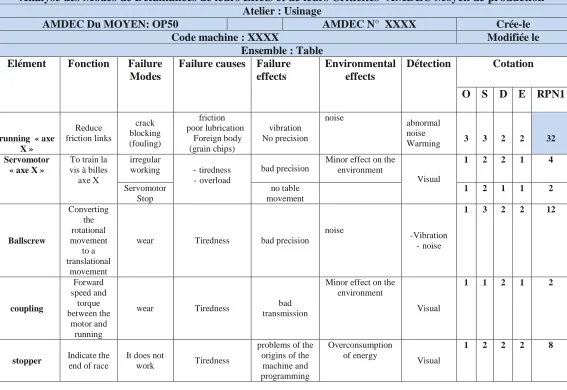
Following the presentation of the FMEA taking consideration the environmental dimension with RPN1.
Table 4: Failure Mode and Effects analysis with RPN1.
Analyse des Modes de Défaillances de leurs Effets et de leurs Criticités- AMDEC Moyen de production
Atelier : Usinage
AMDEC Du MOYEN: OP50 AMDEC N° XXXX Crée-le
Code machine : XXXX Modifiée le
Ensemble : Table Elément Fonction Failure
Modes
Failure causes Failure effects
Environmental effects
Détection Cotation
O S D E RPN1
running « axe X » Reduce friction links crack blocking (fouling) friction poor lubrication Foreign body (grain chips) vibration No precision noise abnormal noise
Warming 3 3 2 2 32
Servomotor « axe X »
To train la vis à billes axe X
irregular
working -tiredness -overload
bad precision
Minor effect on the environment
Visual
1 2 2 1 4
Servomotor Stop
no table movement
1 2 1 1 2
Ballscrew Converting the rotational movement to a translational movement
wear Tiredness bad precision
noise
-Vibration -noise
1 3 2 2 12
coupling Forward speed and torque between the motor and running
wear Tiredness bad
transmission
Minor effect on the environment
Visual
1 1 2 1 2
stopper Indicate the end of race
It does not
work Tiredness
problems of the origins of the
machine and programming
Overconsumption of energy
Visual
G
lobal
J
ournal of
E
ngineering
S
cience and
R
esearch
M
anagement
oblique Rolling Support the load carriagewear Tiredness Vibration
noise
-noise -Warming
1 3 2 2 6
hydraulic cylinder double effect Transform the hydraulic energy into mechanical energy
Piston wear Choc of piston
bad or no tightening
Minor effect on the
environment visual
1 1 1 1 1
BLock cylinder
Insufficient oil flow
Minor effect on the environment
3 2 1 1 6
sealing ring
Protect hydraulic components against leaks
wear Tiredness
- Warming -Bad piece precision
liquid waste
Oil leak
1 2 2 2 8
Water hose
Direct the water lubricant on
the piston
crack Tiredness -extraction
-detachment
liquid waste
flight
1 1 1 2 2
Air hose
driving of air through
the tools
crack Tiredness -arrachement -Détachement
Minor effect on the
environment flight
2 1 2 1 4
pneumatic supply Discharge air - Warming -default flow
-faulty joint -fuite
Not reached the nominal pressure
Overconsumption
of energy Warming
2 2 3 2 24
filter regulator
Removed the water bubbles
fouling Presence of the body suspended
deterioration of the pneumatic
circuit
Damage to
property Visual
1 2 2 2 8
Air distributor
Air distribution at the piston
blocking -overvoltage -low pressure
Stopping the flow of water
Minor effect on the
environment Visual
1 2 3 1 6
For RPN1, the working group has decided to set 20 as the threshold value.
After consideration of the environmental dimension, RPN has changed value in some cases, one case has entered the preventive maintenance plan.
The case that concerns us is the case of the element 'air supply' 'who had RPN equal to 12 and spent 24 after taking into account the E criterion.
G
lobal
J
ournal of
E
ngineering
S
cience and
R
esearch
M
anagement
Limits of our industrial application:
The working group does not contain an expert environmental, this is why we found it difficult to find the most appropriate value to E, but we will try to insert an environmental expert in our group.
The industrial application has not yet finished, we presented in this article just a part that we have partially finished, and this part can be improved thereafter.
CONCLUSION
The improvement of the environmental management system in industry requires improved maintenance management, and our industrial application, shows how to reduce negative environmental impact by maintenance management, using the FMEA method.
The industrial application that we presented in this article is only a very small part of the study that we did in a Moroccan foundry.
In our study, we conclude that the integration of the environmental dimension in the tool of decision support maintenance FMEA increases reliability and made it more significant.
REFERENCES
1. Terrier, 2002, La maintenance, DESS Quassi, département qualité
2. Monchy F, Pichot C, 2003, Maintenance Méthodes et organisations, Dunod, Usine Nouvelle, Paris
3. Francastel J.C, 2005, Externalisation de la maintenance stratégie – méthodes – contrats, 2ème édition, Dunod,Paris
4. Souris JP, 1993, La maintenance source de profit, Editions d’organisation, Paris
5. Monchy, F, La fonction maintenance: Formation à la gestion de la maintenance industrielle, Collection technologies de l’université de l’industrie, MASSON, 1991
6. Lyonnais P., Maintenance mathématique et méthode, troisième édition, technique et édition Lavoisier, France, 1992
7. Pricket P.W., An integrated aproach to autonomous maintenance management , Integrated Manufacturing Systems, Vol. 10. No. 4, pp. 233-243, 1999
8. Jardine A. K. S., Joseph T. et Banjevic D., Optimizing condition-based maintenance decision for equipment subject to vibration monitoring, Journal of Quality in Maintenance Engineering, Vol. 5, No. 3, pp. 192-202, 1999
9. Tsang A.H.C. , Jardine A.K.S. et Kolodny H., measuring maintenance performance : a holistic approach, International Journal of Operations and Prodaction Management, Vol 19,No. 7, pp. 691-715, 1999
10. Sherwin D.., A review of overall models for maintenance management, Journal of Quality in Maintenance Engineering, Vol.6, No.3,pp.138-164,1999
G
lobal
J
ournal of
E
ngineering
S
cience and
R
esearch
M
anagement
12. Ben-Daya M. et Alghamdi A. S., On an imperfect preventive maintenance model, International Journal of Quality and reliability Management, Vol. 17, No. 6, pp. 661-670, 2000
13. Vineyard M., Amoako-Gyampah K. et Meredith J. R., An evaluation of maintenance policies for flexible manufacturing systems, Internatioanal Journal of Operations and production Management, Vol. 20, No. 4, pp.409-426, 2000
14. Whisterkamp T. A, Evaluating the maintenance process, IIE solution, pp. 22-27, December 1998
15. Wang S., An object-oriented approach to plant configuration management information systems analysis , Industrial management and Data Systems, Vol. 99, No. 4, pp. 159-167, 1999
16. H.CHOUIKHI, Optimisation des stratégies de maintenance verte pour les systèmes de production de biens et de services, thèse, École doctorale IAEM Lorraine, UFR Mathématiques, Informatique, Mécanique – Metz, 2012
17. H.tajri et al.,Intégration du système de management environnemental (SME) en maintenance industrielle, 5ème édition du Colloque International sur « Les Systèmes Industriels et Logistique » à l’école nationale des sciences appliquées de Marrakech , maroc, 2014.
18. Zille. V Modélisation et évaluation des stratégies de maintenance complexes sur des systèmes multi-composants, thèse de doctorat, l'Université de Technologie de Troyes, Institut Charles Delaunay, 2009. 19. Rapport dune étude sur le développement d'un programme de communication sur le Mécanisme pour un
Développement Propre, Ministère de l'Aménagement du Territoire, de l'Eau et de l'Environnement, Secrétariat d'Etat chargé de l'Environnement, Royaume du Maroc, juin 2004
20. METAIS E –DEVINCI Conseil - Stratégie et organisation industrielle - Ingénierie des produits et des process, 2004.
21. S. Mandalet all, Risk analysis using FMEA: Fuzzy similarity value and possibility theory based approach, Expert Systems with Applications 2014.
22. G.Park et al, Software FMEA analysis for safety-related application software, journal homepage: www.elsevier.com/locate/anucene
23. M.M. Silva et al., A multidimensional approach to information security risk management using FMEA and fuzzy theory, International Journal of Information Management 34 (2014) 733–740
24. Z. Chen et al,Risk assessment of an oxygen-enhanced combustor using a structural model based on the FMEA and fuzzy fault tree, Journal of Loss Prevention in the Process Industries 2014
25. J. Trafialek, Application of Failure Mode and Effect Analysis (FMEA) for audit of HACCP system, Food Control, 2014
26. H.R. Feili et al., Risk analysis of geothermal power plants using Failure Modes and Effects Analysis (FMEA) technique, Energy Conversion and Management 72 (2013) 69–76
27. M.Bahrami et al, Innovation and Improvements In Project Implementation and Management; Using FMEA Technique, The First International Conference onLeadership, Technology and Innovation Management,2012 28. H. Arabian-Hoseynabadi et al., Failure Modes and Effects Analysis (FMEA) for wind turbines, Electrical
Power and Energy Systems 32 (2010) 817–824
G
lobal
J
ournal of
E
ngineering
S
cience and
R
esearch
M
anagement
30. D.M. Barends et al, Risk analysis of analytical validations by probabilistic modification of FMEA, Journal of Pharmaceutical and Biomedical Analysis, 2012
31. M. Kumru et al, Fuzzy FMEA application to improve purchasing process in a public hospital, Applied Soft Computing 13 (2013) 721–733
32. N. Xiao et al., Multiple failure modes analysis and weighted risk priority numberevaluation in FMEA, Engineering Failure Analysis 18 (2011) 1162–1170
33. K.-S. Chin et al., Development of a fuzzy FMEA based product design system, Int J Adv Manuf Technol (2008) 36:633–649
34. m.majernik et j.chovancova, Application of Environment Management Systems in Environmental Security and Risk Prevention, Acta Mechanica Slovaca 13 (3): 74-83, 2009
35. A.Badreddine et al , A New Process-Based Approach for Implementing an Integrated Management System: Quality, Security, Environment, Proceedings of the International MultiConference of Engineers and Computer Scientists 2009 Vol II, IMECS 2009, March 18 - 20, 2009, Hong Kong
36. A.Badreddine et al, A Multi-objective Approach to Implement an Integrated Management System: Quality, Security, Environment, Proceedings of the World Congress on Engineering 2009 Vol I, WCE 2009, July 1 - 3, 2009, London, U.K.
37. I.Patriota de Siqueira, INTER-INDUSTRIAL COOPERATION FOR APPLICATION OF