WHY HEALTH INSURANCE IS IMPORTANT IN INDIA: A STUDY
1 Dr .G. Suresh Babu, 2Dr. C. Sreeramulu
1 Associate Prof. of Commerce, Department of Commerce, Govt. Degree & Pg College,
Puttur, Chittoor Dist, AP, India
2 Associate Prof. of Economics, Department of Economics, Govt. Degree & PG College, Sri Kalahasti (W)
Chittoor Dist, AP, India
1. INTRODUCTION:
Insurance has evolved as a process of safeguarding the interest of people from loss and uncertainty. It may be described as a social device to reduce or eliminate risk of loss to life and property. For every individual in India, health insurance has become a necessity. It provides risk coverage against expenditure which is caused by unforeseen medical emergencies. Today, when the medical inflation rates are so high, failing to hold an adequate health cover can prove costly financially. However, the awarene ss about health insurance is on the rise in urban India.
According to WHO statistics 31% and 47% of the hospital admissions in urban and rural India are either financed by loans or through sale of assets. Additionally as per the statistics, 70% of Indians spend their entire income on healthcare and 3.2% of Indians fall under the poverty line owing to high medical bills.
Medical emergencies come unannounced. To get the best medical facilities without a financial burden you will need a health insurance. Buying a health cover is no longer an option but has become a compulsion. Health insurance policy is well established in most countries but in India is remains an untapped market. Only 1.1 billion of the Indian population which is less than 15% of the Indian population is covered through health insurance.
2. REVIEW OF LITERATURE:
Aggarwal et al. (2013)1 studied that, the innovations and challenges of health insurance sector. According to the
study product development and innovation both are very important for new customers and existing customers.
Akila (2013)2 reported that, health insurance sector has the greatest potential in India and the penetration to be
exercised faster by means of various marketing activities like micro finance extensive coverage of ailments, Improving the reimbursement machinery, encouraging Individual policy holders and service agents etc., Increasing health care cost, growing awareness about Health Insurance, community based new groups and new policy adopted by the government are some opportunities for health insurance market.
Abstract: The health of a nation is an essential component of development vital to the Nation’s economic growth and internal stability. Everyone needs medical care sometimes and health falls with age. The condition of the health insurance in India is pathetic. A huge part of Indian population does not use health insurance to finance their medial expenditure. These people pay for their medical expenditure from their pocket as a result, many of these uninsured individuals either and up with poor quality health care or have to bear financial hardship.
The financial stress that is engendered due to rising medical expenses is believed to affect the life style of all family members for years. There is a need to increase the number of insured individuals in India, working in this direction, every individual, every medical care provider and every health insurance company should play an active role. It is only their possible that people would be able to avail quality health care in times of medical emergency. Insurances have designed plans, but people should be encouraged to buy them so that the overall condition of medical care insurance in the country can be improved.
It is really pathetic to know that many Indian people believe that health insurance is not a worthy investment and thus, do not buy these products. These people realize the significance of these products only when their friend or relatives fall sick and face financial hardship. Learning from the experience of other is always good. It is always a good decision to be a prepared for such circumstances of life that may bring a great change
in an individual’s life. A person should buy a health insurance policy so that there is no financial stress faced by
the family at the time of setting long hospitalization or treatment bills. One should buy health insurance at the earliest as these product come along with several benefits
Hence, there is need of health insurance study and awareness in India. In this paper, an attempt has been made to the analyze the importance of health insurance in India
Garg (2013)3 emphasized that, the respondents are satisfied with private sector insurance companies than the
public sector. Main factor identified for satisfaction of the respondents are claim settlement, sales force, time taken for the policy issuance, compliant handling mechanism.
Devi et (2015)4 highlighted that, the problems of health insurance sector. According to them, problem exists
with every stakeholder like TPA make delay in claims, Insurance companies have high claim paid out ratio , consumers are less aware about health insurance basic terms and hospitals charge more expenses from insured patients.
3. OBJECTIVES OF THE STUDY:
To study the need and importance of health insurance in India
To study the present status of health insurance sector in India
4. METHODOLOGY:
The present study is descriptive in nature and will be mainly based on secondary data collected from reputed journals, research reports, books, research articles, information from insurance personnel, IRDA and web sites.
5. NEED OF THE STUDY:
In health insurance sector there is immense opportunity because of the gap between health care spending which is covered by health insurance. Health insurance is on rise because of change in lifestyle, lifestyle diseases, rising of educated people and middle class. So, the growth and the scope are immense in this sector.
According to a survey by NSSO (National Sample Survey Organization), 40% of the people hospitalized have either had to borrow money or sell assets to cover their medical expenses. A significant proportion of population may have had to forego treatment all together. Thus, more than the disease it is the cost of treatment that takes its toll. To get rid of health worries health insurance is the answer.
6. HEALTH INSURANCE:
Health insurance in a narrow sense would be, “an individual or a group purchasing health care coverage in
advance by paying a fee called premium”. In this broader sense, it would be any arrangement that helps to defer, delay,
reduce or altogether avoid payment for health care incurred by individuals and household. Health insurance covers all medical expenses related to treatment of the disease.
Health insurance is an insurance product which covers medical and surgical expenses of an insured individual. It reimburses the expenses incurred due to illness or injury or pays the care provider of the insured individual directly.
7. IMPORTANCE OF HEALTH INSURANCE:
It will ensure that you get appropriate treatment in a timely manner. Irrespective of your financial capability, with an active policy you can avail the best treatment at any network of hospitals, with the clause those terms and conditions of the policy are met. After we have bought a health insuranc e policy, not only will it bring peace of mind but also can avail the tax benefits under section 80D of the Income Tax Act, 1961.
It is important to note that cashless benefit is the most important advantage of purchasing health cover in the country. This facility helps tremendously when a policy holder falls under medical emergency which requires immediate medical attention. During the treatment whatever medical expense is incurred, it is borne by the insurance company. Thus, not only will you be able to avail quality medical facility, but at red uced costs.
8. PRESENT SCENARIO OF HEALTH INSURANCE:
Health Insurance is an emerging service sector in India. In India, penetration of health insurance has been low,
person covered under any health insurance scheme is 14.1% in rural areas and 18.1% in urban areas of India’s population
is covered in which Govt. employees sharing the major part. At present picture 52 insurance companies are operating out of which 24 in Life and 28 companies in non-life insurance segment. Non-life insurance sector in India are dominated by motor insurance with market share 43%, followed by health insurance (25%). More than 80% of the population is uninsured which provide great scope and potential for health insurance market. The general insurance industry recorded a 12% growth in Gross Direct Premium underwritten in April 2016 at Rs 105.25 billion.
About 24% of India’s population has been covered who has undergone the health insurance policies in 2014 -15. The health Insurance segment in the country is witness of continuous and steady growth due to increasing healthcare costs and increasing penetration levels with total premium collection growing 15% in 2014-15 year on year. During 2014-15 the gross health insurance premium collected by nonlife insurance companies was 20,096 cr. compared with Rs.17,495 cr. in 2013-14, recording an increase of 14.87% (IRDAI). In 2015-16, stand alone health insurers collected close to Rs 60,000crore, recording a 41% growth over the previous fiscal. All Stand alone insurers recorded a health double digit growth last fiscal. Demand for insurance products may rise as people’s preference shifts from formal investment products post demonetization. Study by ASSOCHAM (2013) found that health insurance premium may cross Rs 32,000 by 2016-17.
According to latest annual report of IRDAI (Insurance Regulatory & Development Authority of India), the insurance penetration has started its journey can be seen from the fact that it has been increased from 3.3% in 2014 to 3.44% in 2015 on the back of various insurance schemes launched by the government. The number of lives covered under health insurance policies during 2015-16 was 36 crore which is approximately 30% of India’s total population The number has seen an increase every subsequent year (ASSOCHAM 2015).
The four public sector general insurance companies – New India , United India , Oriental and National insurance accounted a major share of health Insurance premium at 64% of Total health segment followed by private sector (22%) ,Stand alone health insurance contributed 14%(IRDA annual report). So India has a vast scope of expansion for health Insurance.
9. TYPES OF HEALTH INSURANCE SCHEMES:
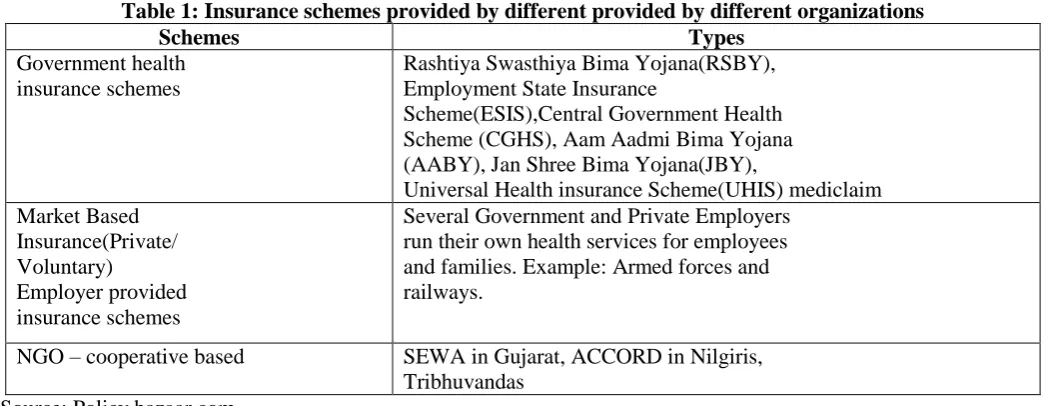
There are different types of health insurance schemes in India. Some are government provided; some are based on private funding, whereas some are provided by NGOs. So broadly health insurance is classified as follows:
Government Health insurance schemes
Market based Insurance
Employer provided insurance schemes
All insurance companies provide different insurance plans like family floaters, senior citizen, critical illness and maternity insurance etc.
Table 1: Insurance schemes provided by different provided by different organizations
Schemes Types
Government health insurance schemes
Rashtiya Swasthiya Bima Yojana(RSBY), Employment State Insurance
Scheme(ESIS),Central Government Health Scheme (CGHS), Aam Aadmi Bima Yojana (AABY), Jan Shree Bima Yojana(JBY),
Universal Health insurance Scheme(UHIS) mediclaim Market Based
Insurance(Private/ Voluntary)
Employer provided insurance schemes
Several Government and Private Employers run their own health services for employees and families. Example: Armed forces and railways.
NGO – cooperative based SEWA in Gujarat, ACCORD in Nilgiris, Tribhuvandas
Source: Policy bazaar.com
10. HEALTH INSURANCE SECTOR:
Health insurance is the emerging service sector in India. India is a growing economy, people in urban and rural areas are now days more educated, health conscious, rise in their living standard and need of quality healthcare leads to need of health Insurance. Health insurance in India is provided by the government sector as well as the private sector players. After deregulation, many private sector insurance companies entered in the insurance market and offer a wide range of innovative products to the consumers
Liberalization also opened the doors for foreign player to enter in health insurance sector. As a result the scope of health insurance sector is getting wider. Government of India is also focusing on the improvement of health care and health insurance services .Recently government envisioned health insurance for each citizen. It has planned to cover the medical treatments of the entire population like free drugs, insurance for serious ailments under Universal Health Insurance called National Health Assurance Mission.
Growing middle class, educated youth, awareness of need for protection against lifestyle disease, tax benefits are the factors which are giving growth opportunities to health insurance sector to become fastest growing non-life insurance segment. These opportunities are facilitating market players to expand their business and competitiveness in the market. Companies are becoming more customer centric, drive down cost, using new technology etc which are helping them to grow.
Health insurance plans in India today can be broadly classified into these categories:
1. Hospitalization: Hospitalization plans are indemnity plans that pay the cost of hospitalization and medical cost of the insured subject to the sum assured.
2. Family Floater Health Insurance: All members of a family will not suffer from sickness at the same time. Family health insurance plan is a policy which covers entire family in one health insurance plan. It covers pre and post hospitalization expenses.
3. All Pre-Existing Disease Cover Plans: People suffer from different diseases, so to claim medical benefit for such diseases Pre-existing disease cover plan is appropriate. It provides coverage against diseases that policy holder had before buying health policy.
4. Senior Citizen Health Insurance: In old age people require protection for health issues. Senior citizen health insurance plans are for old age people to receive medical benefits.
5. Maternity Health Insurance: For women medical facilities are necessary pre and post-delivery. maternity health insurance provides coverage for maternity and other additional expenses.
Hospital daily cash benefit plans: This plan pays a defined sum of money for every day of hospitalization.
Critical illness plans: People now-a-days suffer from critical illness like heart-attack, cancer etc. These illness costs high when compared to other day-to day medical needs. Critical illness plans pay lump sum amount on diagnosis of covered critical illness and medical procedures.
6. Disease specific special plans: These plans are introduced due to growing occurrence of viral diseases like dengue, malaria etc., in India which has become a cause of concern. It provides assistance based on medical needs, behavioral and life style factors associated with such
11. HEALTH INSURANCE CLAIM IN THE FOLLOWING TWO WAYS:
Cashless: Every insurance company has its network of hospitals where cashless treatment is given to policyholders. It means, if you visit any of these hospitals, you only need to submit your insurance card to the hospital billing desk who will further process cashless treatment for the patient, subject to the approval of the insurance company.
Reimbursement: In case you admit in a hospital, which is not in the list of network hospitals of the insurance company, you will have to make all payments on your own and then approach the insurance company for reimbursement.
12. BENEFITS OF HEALTH INSURANCE:
Don't Pay for Your Hospitalization: It means that medical expenses are paid by the insurance company on behalf of the policy holders. It is a benefit to the patients as they do not pay out of pocket.It relieves the patient from unnecessary mental burden and allows him to concentrate on recovery.
Safeguard Your Finances and Avail Tax Benefits:The health insurance policy helps in meeting the unexpected health careexpenses so that the savings are not disturbed. The health insurance premiums paid are considered to avail tax benefits.
Cover for Life Threatening Critical Illnesses: The fixed pre-defined benefit type of medical insurance policies provides a fixed lump- sum payment upon diagnosis and confirmation of certain critical illnesses like cancer, stroke, paralysis, kidney failure etc. Irrespective of the actual amount spent by insured, they receive the lump-sum amount which can be used to fund rehabilitation, life style adjustment etc.
Get Allied Benefits: Certain progressive insurance companies offer benefits that are generally not associated with health insurance policies. Some such benefits are:
Consultation with nutritionists
Free health check-ups
Tie-ups with health service providers
Free Consultation with doctors
Discounts Coupons on healthcare services
-5000 500 1000 1500 2000 2500 3000 3500 4000
Govt. sponsored
schemes
Group( other than
Govt. )
Individual Total
1 2 3
2011-12
2012-13
2013-14
2014-15
Table 2 : No. of persons covered under health insurance (in Lakhs)
S.No Class of
business
2011-12 2012-13 2013-14 2014-15 2015-16
1 Govt. sponsored schemes
1612 (76%)
1494 (74%)
1553 (72%)
2143 (74%)
2733 (76%) 2 Group (other
than Govt.)
300 (14%)
343 (17%)
337 (15%)
483 (17%)
670 (16%) 3 Individual 206 (10%) 236
(11%)
272 (13%)
254 (9%)
287 (8%)
Total 2118 2073 2162 2880 3590
Source: IRDA report
Above table shows that, population are invested in Govt. sponsored schemes and it shows, the increasing trend of health insurance sector as the number of person covered are increasing over the years.
13. MAJOR PLAYERS IN HEALTH INSURANCE INDUSTRY:
Public Sector Providers (Government) : Major Premium underwritten in health insurance is from public sector players. Major public sector players are New India Assurance, United India Insurance, National Insurance, Oriental Insurance etc. Government also provides health insurance schemes for the population. For example RSBY, AABY etc.
Private Sector Providers : Private sector health insurance is held by four big players i.e. ICICI Lombard, Bajaj-Allianz, HDFC-ERGO, Reliance- General-Insurance and some other are IFFCO TOKIO, Royal Sundram, TATA-AIG, Bharti-AXA, Cholamandalam etc.
Stand alone Providers : As per IRDAI report, there are five private sector insures are registered to underwrite health insurance policies. Companies are Star health , Allied Insurance, Apollo Munich, Max Bupa , Religare and Cigna TTK health insurance company Ltd.
14. OPPORTUNITIES IN HEALTH INSURANCE SECTOR:
Health insurance sector has immense opportunities as this sector maintained double digit growth last fiscal year. Health Insurance has been witnessing a rapid expansion and has significant growth potential for future as well. While multiple factors drive this growth, innovation in health insurance products would be a significant factor (IRDAI annual report). New Products, new services, new distribution channels leads to the innovation in this sector. Companies are working on all these perspectives.
HIGH POTENTIAL MARKET:
Potential for health insurance market is very high. Health insurance market is growing at a compound annual growth rate of 25% and is on a consistent rise. In India out of pocket expenditure are very high as compare to other countries. According to WHO 60% of total health expenditure in India was paid by common man from his pocket.
Table 3 Trend in health insurance premium over past five years (Crore)
S.No Sectors 2011-12 2012-13 2013-14 2014-15 2015-16
1 Public sector general insurers 8015 (61%) 9580 (62%) 10841 (62%) 12882 (64%) 15591 (64%) 2 Private sector
general insurance 3445 (27%) 4205 (27%) 4482 (26%) 4386 (22%) 4911 (20%) 3 Stand alone health
insurers 1609 (12%) 1668 (11%) 2172 (12%) 2828 (14%) 3946 (16%) 4 Industry total 13069 15453 17495 20096 24448 5 Annual Growth Rate 18.5% 18.2% 13.2% 14.9% 21.7% Source: IRDAI report 2015-16
According to the report, Premium collected during 2015-16 is 24,448 as compare to 20-096 in 2014-15. It shows the growth from 14.9% to 21.7% which clearly shows that health insurance market has maintained double digit growth.
15. GOVERNMENT INITIATIVE:
With Individuals, Government of India is taking initiative to provide health insurance benefits to common people. Government has Launched many schemes example; Rashtriya Swasthiya Bima Yojana (RSBY), Aam Aadmi Bima Yojana (AABY), Employment State Insurance Scheme (ESIS), Universal health insurance Scheme(UHIS) etc. for healthy India.
16. RECOMMENDATIONS:
1. The Indian health insurance is a growing sector. For companies to enhance their insurance business and customer base must opt to new business modles with innovations, innovative products and services should be used by companies to increase their revenues also.
2. In India, there is need of universal health program with the intention to enhance people’s access of health care especially for the families below the poverty line.
3. The biggest opportunity lies in innovative products, innovative services, innovate distribution channels and trained workforce.
4. Quality services and cost control and to meet the customer need are the keys for bright future.
17. CONCLUSION:
Health insurance sector has the greatest potential in India and the penetration to be exercised faster by means of various marketing activities like micro finance, extensive coverage of ailments, improving the reimbursement machinery, encouraging individual policy holders and service agents etc., Increasing the health care cost, growing awareness about health insurance, community based new groups and new policy adopted by the government are some opportunities for health insurance market.
REFERENCES:
1. Aggarwal A., Kapoor N. and Anchal G. (2013), Health Insurance: Innovation and challenges ahead. Global journal of management and Business studies. Vol. 3, Issue 5, Pp. 475-780.
2. Akila M. (2013), Penetration of health insurance sector in Indian market. International Journal of Management Vol. 3, Issue 1, Pp.55-67.
3. Garg A. (2013), Satisfaction and Problems of Health insurance Policy holders in India. International journal of Banking, Risk and Insurance. Vol. 1, Issue 2, Pp. 43-53.
-5000 0 5000 10000 15000 20000 25000 30000 Public sector general insurers Private sector general insurance Stand alone health insurers Industry total Annual Growth Rate
1 2 3 4 5
2011-12
2012-13
2013-14
2014-15
4. Devi S. (2015), The problems with health insurance sector in India. Indian journal of research, Vol. 4, Issue 3, Pp .
5. Binny1, Dr. Meenu Gupta, (2017)“Health Insurance in India – Opportunities and Challenges” International
Journal of Latest Technology in Engineering, Management & Applied Science (IJLTEMAS), Volume VI, Issue VIII, August 2017 |
6. AlamSingh (2008), Health Insurance Data, Enhancing Quality And Analysis, IRDA Journal, June/July 2008 7. Ramani, K.V. and Mavalankar, D. (2006), Health System in India: opportunities and challenges for
improvements‖ Journal of Health Organization and Management, Vol.20, No. 6, pp. 560-572.
8. Nagendranath, A. and Chari, P. (2002), Health Insurance in India The emerging paradigms‖ School of
International Business management, New Delhi.
9. K.Swathi, R.Anuradha, Health Insurance in India-An Overview, IOSR Journal of Business and Management (IOSR-JBM) e-ISSN: 2278-487X, p-ISSN: 2319-7668