3200 *Address for correspondence
Lalitha Medisetti*
Aditya Pharmacy College, Aditya nagar, ADB road, Surampalem,
East Godavari District, Andhra Pradesh – 533437, Contact: +91-9581909083 E-mail: [email protected] Research Article
FORMULATION DEVELOPMENT AND EVALUATION OF ORAL DISSOLVING FILMS OF APREPITANT
Lalitha Medisetti*, D.Suma
Aditya Pharmacy College, Aditya nagar, ADB road, Surampalem, East Godavari District, Andhra Pradesh – 533437, Andhra Pradesh, India
A RT I C L E I N F O A B S T R AC T
Key words:
HPMC E15,
PEG400, Aprepitant, Oral dissolving films, Solvent casting method
The present investigation was undertaken with an objective of formulating oral dissolving films (ODFs) of Aprepitant by solvent casting technique to enhance convenience and compliance of the elderly and pediatric patients for better therapeutic efficacy. Film formers like hydroxy propyl methyl cellulose E5 (HPMC E5), HPMC E15 and Poly vinyl alcohol along with plasticizers like Glycerol, PEG400, and Isopropyl alcohol (IPA), Dichloromethane as solvents were evaluated. The prepared films were evaluated for film thickness, average weight, folding endurance, %drug content and content uniformity, tensile strength, percent elongation, in vitro disintegration time and in vitro dissolution studies. The optimized formulation F4 prepared using HPMC E15 (drug to polymer ratio of 1:1) showed minimum disintegration time (49±2 sec), highest dissolution rate i.e. 99.98% of drug within 15 min and satisfactory physicomechanical properties. Release kinetics data reveals that drug release follows first order. Results of FTIR data of optimized formulation (F4) revealed that there was no incompatibility observed between the drug and excipients used in the formulation. These findings suggest that the fast dissolving oral film containing Aprepitant is considered to be potentially useful for the treatment of nausea where quick onset of action is desirable when compared with the standard Emend conventional capsule.
INTRODUCTION
Despite of tremendous advancement in drug delivery the oral route of drug administration is the most important method of administration of drug for systemic effect. About 60% of all dosage forms available are the oral solid dosage form. The liquid orals (syrup, suspension, emulsion etc) have the problem of accurate dosing mainly and parenterals are painful drug delivery, so most patient incompliance.
Fast-dissolving drug-delivery systems were first developed in the late 1970s as an alternative to tablets, capsules, and syrups for pediatric and
geriatric patients who experience difficulties
swallowing traditional oral solid-dosage forms. The novel technology of oral fast-dispersing dosage forms is known as fast dissolve, rapid dissolve, rapid melt and quick disintegrating tablets. By definition, a solid dosage form that dissolves or disintegrates quickly in the oral cavity, resulting in solution or suspension without the need for the administration of water, is known as an oral fast-dispersing dosage form.
The problem of swallowing tablets was more evident in geriatric and pediatric patients, as well as traveling patients who may not have ready access to water [1]
So many pharmaceutical companies have directed their research activity in reformulating existing drugs
Journal of Global Trends in Pharmaceutical Sciences
into new dosage forms. One such relatively new dosage form is the oral strip, a thin film that is prepared using hydrophilic polymers that rapidly dissolves on the tongue or buccal cavity. Many pediatric and geriatric patients are unwilling to take these solid preparations due to fear of choking. Although oral disintegrating tablets have an advantage of administration without choking and fast disintegration; the disintegrated materials contained in them are insoluble and remain same until swallowing. In such cases formulation of fast
dissolving film will be advantageous [2, 3]. Fast
dissolving films (FDF), a type of drug delivery system for the oral delivery of the drug, was developed based on the technology of the transdermal patch. This delivery system consists of a thin film, which is simply placed on the patients’s tongue or mucosal tissue, instantly wet by saliva, the film rapidly dissolves. Then it rapidly disintegrates and dissolves to release the medication for mucosal
absorption[4]. The RDFs are essentially prepared
using water soluble and fast disintegrating polymers which also possess good film forming properties like hydroxy propyl methylcellulose (HPMC), polyvinyl alcohol (PVA), hydroxy propyl cellulose (HPC), along with plasticizers like glycerol, PEG400. Aprepitant (brand name: Emend is an antiemetic chemical compound that belongs to a class of drugs called substance P antagonists (SPA). It mediates its effect by blocking the neurokinin 1 (NK1) receptor. APRI is used for short-term (usually about two to six weeks) treatment of emesis related to cancer chemotherapy. APRI is available as pellets filled in capsules to be taken to prevent emesis due to anti cancer drugs. The drug is practically insoluble in water and has to be nanonized before being sprayed on to pellets and filled into capsules shell. The objective of the current work is to develop a fast disintegrating thin film dosage form as a better alternative to sublingual tablet. Anticipated patient convenience for thin film shall be significantly better than for sublingual tablets .The types and concentration of polymer and the plasticizer were optimized with respect to physical properties of the films, in vitro disintegration time and in vitro dissolution studies.
MATERIALS AND METHODS
Aprepitant was obtained as a gift sample from EMCO industries, Hyderabad. HPMC E5, HPMC E15, Poly vinyl alcohol (PVA) were obtained from Dow Chemicals, USA. Glycerol, PEG 400, Mannitol (sweetening agent), Isopropyl alcohol (IPA) and Dichloromethane (used as solvents) were obtained from Merck Chemicals, Mumbai.
Drug polymer compatibility studies: The infrared spectra of drug, polymers, physical mixture of drug and polymers were recorded at a scanning range of
400-4000 cm-1 using FTIR spectrometer.
Standard curve of Aprepitant: 100mg of Aprepitant was dissolved in 10ml ethanol and volume was made upto 100ml with distilled water. From this standard stock solution – I 10ml was withdrawn and diluted upto 100ml with distilled water (100μg/ml). Then by serial dilution, solutions with concentrations 2μg/ml, 4μg/ml, 6μg/ml, 8μg/ml and 10μg/ml were prepared and analyzed spectrophotometrically at 240 nm and a calibration curve shown in figure 1 was constructed according to the values obtained shown in table 1.
Preparation of Placebo formulations
Placebo formulations were prepared by using solvent casting technique. The film forming polymers HPMC and PVA were accurately weighed and dispersed in 7:3 ratio of IPA and dichloromethane each and then soaked for 4 hours. To these polymer solutions, glycerol and Mannitol were added with continuous stirring on a magnetic stirrer. The resulting bubble free solution was poured on to a glass plate and was dried at 50˚C in hot air oven for 24hr. Like this many blank films were developed by using polymer (HPMC E5, HPMC E15, PVA) and plasticizer (Glycerol, PEG400) in various combination and concentration, which were carefully removed from glass plate and evaluated for drying time, average weight, thickness, tensile strength, folding endurance and in vitro disintegration time[5,6,7] and the best
were selected for incorporation of Aprepitant. The placebo film formulations are given in Table 2 and Table 3.
Preparation of Drug loaded formulations
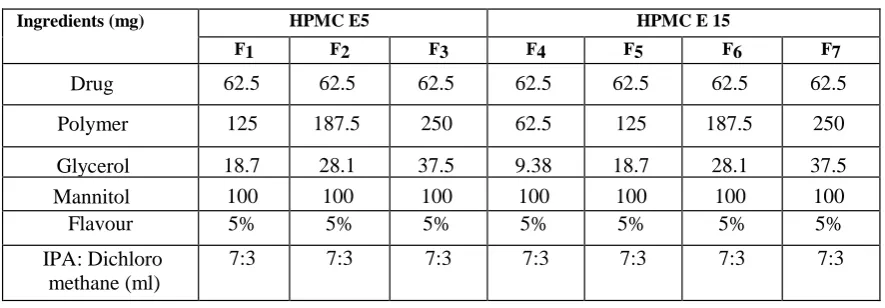
The composition for the drug-loaded films is given in Table 4. The procedure followed was similar to the placebo formulations. Aprepitant was added to the polymer solution and sonicated for 15 minutes until the drug was completely dissolved. The drug-loaded films were evaluated for average weight, thickness, tensile strength, folding endurance, in vitro disintegration time and in vitro dissolution studies.
EVALUATION OF THE ORAL DISSOLVING FILMS
Average weight measurements
The weight of the films was determined by analytical balance. One centimetre sq. was cut at five different places in the casted film. The weight of each film was taken and the average weight was calculated. Uniformity in weight of the films indicates accuracy of dose of the oral films [8].
Thickness
Uniformity in the thickness of the film was related in accuracy of dose of the ODFs. At different locations of the strip the thickness was measured using vernier calliper micrometer [9].
determined by folding the strip repeatedly at the same place till it breaks. The number of times the film was folded without breaking and it was
computed as the folding endurance value [9].
Tensile strength
Tensile strength indicates mechanical strength of the oral films. It indicates maximum stress required to break the strip when applied at a point. It was determined using Texture Analyzer Stable Micro system [10].
Percentage elongation: Percentage elongation of the strip was determined using Texture Analyzer Stable Micro system. The strip was taken and force was gradually applied till the film elongates and finally breaks. The readings were taken from the instrument
[10].
Assay and Content uniformity
Films of 2×1 cm2 were taken and dissolved in 2.2% SLS in water and made up to 100 ml in a volumetric flask. Then 1mL was withdrawn from the solution and diluted to 10 mL. The absorbance of the solution was measured spectrophotometrically at 240 nm. The assay was calculated by this method. Limit of content uniformity is 85-115% [11].
Disintegration time: The film equivalent to one dose (2×1 cm2) was placed in a glass petridish containing 5 ml of water. The time required for the film to break was noted as disintegration time [12].
In vitro dissolution studies: The in-vitro dissolution studies were conducted using 2.2% SLS in water (500 mL). The dissolution studies were carried out using USP dissolution apparatus I (Electrolab, Mumbai, India) at 37± 0.5 °C and at 50 rpm using specified dissolution media. Each film with dimension (2 x 1 cm2) was placed on a stainless steel wire mesh. The film sample placed on the sieve was submerged into dissolution media. Samples were withdrawn at 0, 2, 5, 10, 15 and 30 min. time intervals and filtered through wattmann filter paper and were analyzed spectrophotometrically at 240 nm. To maintain the volume, an equal volume of fresh dissolution medium maintained at same temperature was added after withdrawing samples. The absorbance values were converted to concentration using standard calibration curve previously obtained by experiment [13]
Kinetic modeling: Model dependent methods are based on different mathematical functions, which describe the dissolution profile. Once a suitable function has been selected, the dissolution profiles can easily be evaluated depending on the derived model parameters. The model dependent approaches include zero order, first order, Higuchi,
Hixson-Crowell, Korsmeyer-Peppas, Baker-Lonsdale,
Weibull, Hopfenberg, Gompertz, Non-conventional
order 1, Non- conventional order 2, Reciprocal
powered time and regression models
[14]
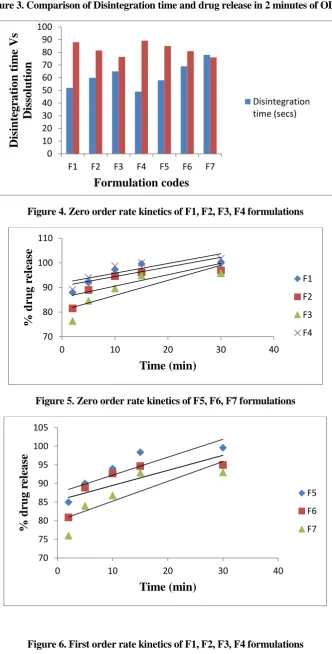
. Among them tried two models to fit the data, with zero order and first order models which are shown in figure 4,5,6,7.
Zero-order model- 𝑄𝑡 = 𝑄𝑜− 𝑘𝑜𝑡
First order model- log 𝐶 = 𝑙𝑜𝑔𝐶𝑜 −
𝑘𝑡
2.303
RESULTS AND DISCUSSION
Drug polymer compatibility studies
FTIRstudies conducted on pure drug and mixture of
drug with excipients given in figure no. 2 showed that there is no marked interaction between drug and excipients used.
Physical characterization of fast dissolving oral films
The physical characterisation of the formulated oral films shown in figure 3 was done by solvent casting method. The results were tabulated in table 5.
The average weight and thickness of the film ranges from 16.5±0.3 to 22±2mg and 0.082±0.01mm to 0.157±0.02 respectively. Percent elongation ranges from 25.44±0.68 to 71.6±0.23
Tensile strength and folding endurance of the films
ranges from 1.03±0.05 to 3.02±0.01 N/cm2 and
119±1 to 140.6±1 folds respectively. Drug Content
(mg/ 2cm2) and content uniformity of films ranges from 19.6 to 20.4mg and 83 to 105% respectively
Distintegration time and in vitro drug release of films ranges from 52±1 to 78±1 secs and 92.9 to 99.98% in 15min in 900ml of 2.2% SLS in water. As the polymer concentration increases the thickness, tensile strength, folding endurance and disintegration time of the film also increases.
The formulation F4 exhibited required
Disintegration time of 49±2 seconds, acceptable content uniformity, least thickness of 0.081±0.02
mm, Tensile strength of 1.88±0.02 N/cm2 and
invitro dissolution of 99.98% within 15min.
Release kinetics: The regression coefficient R2 for all the formulations (sh o w n in tab le 6) in first order kinetics is near to unity than zero order kinetics, hence the films are following first order release kinetics . The highest first order
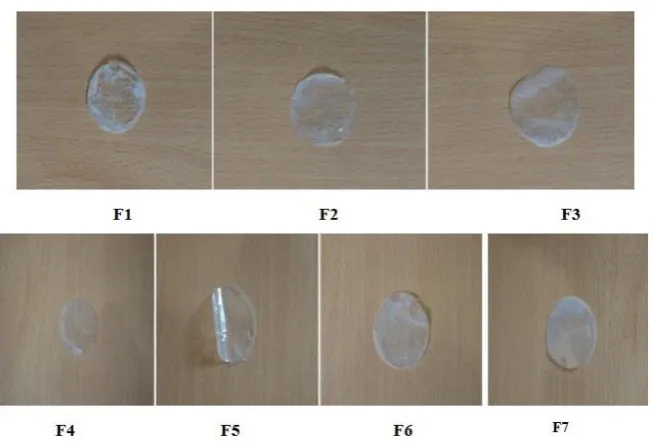
F4 emerged as the overall best formulation based on drug release characteristics and disintegration time
which is shown in figure 8.
Table 1. Standard curve of Aprepitant
Concentration (μg/ml) Absorbance
0 0
2 0.172
4 0.325
6 0.501
8 0.683
10 0.829
Table 2. Composition of Placebo formulations (PF) with Glycerol as Plasticizer
Ingredients (mg) PF1 PF2 PF3 PF4 PF5 PF6 PF7 PF8 PF9 PF10 PF11
HPMC E5 62.5 125 187.5 250 --- --- --- --- ---- --- ---
HPMC E15 --- --- --- ---- 62.5 125 187.5 250 --- --- ----
PVA --- --- --- --- --- --- --- --- 125 187.5 250
Glycerol 9.38 18.7 28.1 37.5 9.38 18.7 28.1 37.5 18.7 28.1 37.5
Mannitol 100 100 100 100 100 100 100 100 100 100 100
IPA: Dichloro methane (ml)
7:3 7:3 7:3 7:3 7:3 7:3 7:3 7:3 7:3 7:3 7:3
Table 3. Composition of Placebo formulations (PF) with PEG 400 as Plasticizer
Ingredients
(mg )
PF12 PF13 PF14 PF15 PF16 PF17 PF18 PF19 PF20 PF21 PF22
HPMC E5 62.5 125 187.5 250 - - - -
HPMC E15 - - - - 62.5 125 187.5 250 - - -
PVA
- - - 125 187.5 250
PEG 400
9.38 18.7 28.1 37.5 9.38 18.7 28.1 37.5 18.7 28.1 37.5
MANNITOL 100 100 100 100 100 100 100 100 100 100 100
IPA: Dichloro methane(ml)
7:3 7:3 7:3 7:3 7:3 7:3 7:3 7:3 7:3 7:3 7:3
Table 4. Composition of drug loaded Aprepitant films
Ingredients (mg) HPMC E5 HPMC E 15
F1 F2 F3 F4 F5 F6 F7
Drug 62.5 62.5 62.5 62.5 62.5 62.5 62.5
Polymer 125 187.5 250 62.5 125 187.5 250
Glycerol 18.7 28.1 37.5 9.38 18.7 28.1 37.5
Mannitol 100 100 100 100 100 100 100
Flavour 5% 5% 5% 5% 5% 5% 5%
IPA: Dichloro methane (ml)
Table 4. Composition of drug loaded Aprepitant films
Table 6. Release rate kinetics
Formulation Code
Zero Order Equation
First Order Equation K
R2 K R2
F1 0.8955 0.9294 0.1385 0.9573 F2 1.087 0.8032 0.0818 0.8756 F3 1.3398 0.8341 0.0721 0.8453 F4 0.8192 0.9642 0.2197 0.9902 F5 0.9878 0.8776 0.0968 0.9013 F6 0.9813 0.7413 0.0708 0.8469 F7 1.1827 0.7687 0.0617 0.8014
Figure 1. Standard calibration curve of Aprepitant in 2.2% SLS in water
Figure 2. FTIR of Aprepitant+HPMCE15
y = 0.083x + 0.0002 R² = 0.999
0 0.2 0.4 0.6 0.8 1
0 2 4 6 8 10 12
Abso
rb
an
ce
(nm
)
Concentration (μg/ml)
Formulation code
Average weight (mg)
Thickness (mm)
Folding endurance
In vitro
disintegration time (secs)
Tensile strength (N/cm2)
% Elongation Drug content (mg)
Content uniformity (%)
F1 16.5±0.3 0.082±0.01 119±1 52±1 1.03±0.05 25.44±0.68 20.2 103-105
F2 18±0.4 0.109±0.02 130.3±9 60±2 1.87±0.01 49.5±0.62 20.0 89-101
F3 19.9±0.8 0.126±0.01 136.3±3 65±2 2.23±0.04 65.5±0.50 19.8 83-91
F4 17.5±0.7 0.081±0.02 112±3 49±2 1.88±0.02 25.62±0.82 20.3 100-104
F5 19±2.6 0.113±0.01 134±2 58±1 2.03±0.07 38.94±0.83 20.4 85-93
F6 21.4±0.4 0.134±0.05 145.3±2 69±2 2.43±0.02 69.2±0.36 20.0 85-87
Figure 3. Comparison of Disintegration time and drug release in 2 minutes of ODFs
Figure 4. Zero order rate kinetics of F1, F2, F3, F4 formulations
Figure 5. Zero order rate kinetics of F5, F6, F7 formulations
Figure 6. First order rate kinetics of F1, F2, F3, F4 formulations
0 10 20 30 40 50 60 70 80 90 100
F1 F2 F3 F4 F5 F6 F7
Disi
n
te
gr
ation
tim
e Vs
Dissol
u
tion
Formulation codes
Disintegration time (secs)
70 80 90 100 110
0 10 20 30 40
%
d
ru
g r
elease
Time (min)
F1
F2
F3
F4
70 75 80 85 90 95 100 105
0 10 20 30 40
%
d
ru
g r
elease
Time (min)
F5
F6
Figure 7. First order rate kinetics of F5, F6, F7 formulations
Figure 8. Physical appearance of drug loaded formulations
-6 -5 -4 -3 -2 -1 0 1 2 3
0 10 20 30 40
L
og %
d
ru
g
u
n
re
lease
d
Time, min
F1
F2
F3
F4
-1.5 -1 -0.5 0 0.5 1 1.5 2 2.5
0 10 20 30 40
L
og %
d
ru
g
u
n
re
lease
d
Time, min
F5
F6
CONCLUSION:
Fast dissolving oral films have several advantages over the conventional dosage forms. So they are of great importance during the emergency cases such as allergic reactions and asthmatics attacks whenever immediate onset of action is desired. In the present research work, an attempt has been made to prepare films of Aprepitant by solvent casting method with enhanced dissolution rate and taste masking by using suitable combination of polymers, plasticizers, sweeteners and flavours. HPMC polymers can be concluded as the best film forming polymer as they are giving more transparent films. The final composition optimized was drug to HPMC E15 ratio of 1:1 (F4), plasticizer concentration of 15% w/w of polymer. The film had acceptable physical properties, assay and uniformity values and in vitro dissolution within 2 minutes. The prepared strips seem to be an attractive alternative to conventional marketed formulations.
REFERENCES:
1. Anderson O. Problems when swallowing
tablets. Tidsskr NorLaegeforen. 1995; 115: 947-949.
2. Doheny K. You really expect me to
swallow those horse pills? Am Druggist. 1993; 208: 34-35.
3. Nishimura M, Matsuur K, Tsukioka T,
Yamashita H. In-vitro and In vivo
characterstics of prochlorperazine oral
disintegrating film. Int J Pharm 2009; 368: 98-102.
4. T Nishi, B Mayank, S Neha, Y Ghanshyam
and K Pragati Overview “A Novel Approach of Fast Dissolving Films and their Patients” Adyan. Biol. Res, 7(2), 2013, 50-8.
5. Farhana S, Mohammad A. Preparation and
Evaluation of Fast Dissolving Oral Thin Film of Caffeine. Int J Pharm.Sci. 2013, 3(1), 153-161
6. Mohammad Rafi S. Formulation and
Characterization of Domperidone Oral Thin Films. Int J Pharm.Sci. 2013, 3(1), 126-128.
7. PK Lakshmi, J Srikanth. Formulation
development of fast releasing oral thin films of levocetrizine dihydrochloride
with Eudragit® Epo and optimization through Taguchi orthogonal experimental design. Asian J Pharm. 2011, 5(2), 84-92.
8. Aditya D and Mangal N. Formulation and
Evaluation of Fast Dissolving Films for Delivery of Triclosan to the Oral Cavity. AAPS Pharm Sci Tech. 2008, 9(2), 349-356.
9. Renuka Mishra, Avani Amin. Formulation
and Characterization of Rapidly Dissolving Films of Cetrizine Hydrochloride using Pullulan as a Film forming agent. Ind.J Pharm Edu Res.2011, 45(1), 71-77.
10. Mihir P, Nirvi G. Formulation Development
and Evaluation of Quick Dissolving Oral Strips containing Sumatriptan Succinate. Int J Pharm Res. 2012, 3(11), 216-219.
11. Nehal Siddiqui. A Short Review on “A
Novel Approach in Oral Fast Dissolving Drug Delivery System and Their Patents”. Advan.Biol.Res. 2011, 5(6), 291-303.
12. Doaa Ahmed El-Setouhy and Nevine
Shawky Abd El-Malak. Formulation of a Novel Tianeptine Sodium Orodispersible Film. AAPS Pharm Sci Tech. 2010, 11(4), 1499
13. Prabhakara P, Ravi M and RN Charyulu.
Formulation and evaluation of fast
dissolving films of levocitirizine di
hydrochloride. Int J Pharm Inves. 2011, 1(2), 99-104
14. Paulo Costa, Jose Manuel Sousa Lobo,