Development and
In Vitro
/
In Vivo
Evaluation of Floating
In Situ
Gelling Oral Liquid
Extended Release Formulation of Furosemide
Anas Tarik Nafei Alhamdany
1*, Nidhal Khazaal Maraie
1, Bahir Abdul Razzaq Msheimsh
21
Department of Pharmaceutics, College of Pharmacy, University of Al-Mustansiriya, Baghdad-Iraq
2
Department of Pharmacology, College of Pharmacy, University of Al-Mustansiriya, Baghdad-Iraq
Article Information Received 25 September 2014 Received in revised form 30 Oct 2014 Accepted 1 Nov 2014
Abstract
Floating in situ gel as gastroretentive drug delivery system represents a revolution in oral controlled release dosage forms in comparison with conventional oral liquids, as it prolongs the residence time of the drugs that have narrow absorption windows in the absorptive sites like stomach or upper gastrointestinal tract by having a bulk density lower than gastric fluids and thus remains buoyant in the stomach without affecting the gastric emptying rate until the drug released slowly, continuously and completely. This study was undertaken to formulate furosemide oral solution, which undergoes gelation when it is in direct contact with gastric fluid by using primary polymer (sodium alginate) in addition to the secondary polymer (iota-carrageenan) at different concentrations. Different variables that affect drug release profile like cross linking agent, combination of polymer, gas generating agent and drug concentrations were studied to optimize the best formulation through measuring their effects on viscosity, gel strength, floating lag time and floating duration. The best formulation exhibited 94.9% release of the drug after 5 h with effective floating property. In vivo test was applied and demonstrated good indication to the gastroretentive property of the optimum formulation through its relation to the diuretic property of the drug, and it agreed with in vitro release and the proposed kinetic mathematical modeling.
Keywords: Furosemide, Floating in situ gel, Iota-carrageenan, Sodium alginate, Gastroretentive *
Corresponding Author:
E-mail: [email protected] Tel.: +964 7901298750
1 Introduction
Today the enhancement of bioavailability and development of continuous controlled release formulations has tremendous impact on the drug delivery field especially for drugs with a narrow absorption window1. However, conventional oral liquid dosage forms are limited by insufficient retention in the upper gastric region, thus lead to bioavailability complications. From this the requisites to prolong the residence time of such dosage forms in the stomach leads to an important approach including decrease in the density to stimulate floating in the gastric fluids and thus gastroretentive sustained release dosage form is reached2. This new revolution that has been achieved in sustained drug delivery system represents today by floating in situ gel system. In this system, a solution of low viscosity can be easily applied; which upon reaching gastric contents it undergoes polymeric changes; thus producing a viscous in situ gel of density lower than the gastric fluids3.
Furosemide is a high ceiling loop diuretic, and widely used to treat congestive heart failure to get rid of excess body water, reducing blood pressure and mobilizing edemas. However, furosemide has a short half-life of less than 2 h and a narrow absorption window (stomach and proximal small intestines). Unfortunately, these absorptive sites, where furosemide has very low water solubility because it is in the unionized form. It is classified as a class IV in Biopharmaceutical Classification System (BCS)4. The conventional oral liquids of furosemide demonstrated irregular absorption, thus poor bioavailability (30–60%) is only achieved; and according to this the requirement for dosing 3–4 times/day is necessary. Consequently peak diuretic effect of furosemide leads to a significant short period of diuresis and dissipation of saluretic effect in patients5. Therefore, in this study, floating in situ gelling (sol-gel) preparation of furosemide was formulated where the drug was prepared as oral solution (using mixed solubilizers) and once the dose comes in contact with stomach content it forms floating gel and gives to prolong the sustained release. In vivo test of the formulation was
UK Journal of Pharmaceutical and Biosciences
Available at www.ukjpb.com
Alhamdany et al. Extended Release Formulation of Furosemide
UK J Pharm & Biosci, 2014: 2(5); 2 applied to verify the improvement in drug absorption and
bioavailability, thus proposing the reduction in dose and dose frequency. No previous study on such a drug delivery solution of furosemide had been reported.
2 Materials and Methods
2.1 Materials
Furosemide (Samara drug industry-Iraq), Sodium Alginate (Avonchem-UK), Iota Carrageenan (Provizer pharma-India), Calcium Chloride (Gainland chemical company- UK), Sodium Citrate (Panreac-Spain), Sodium Benzoate (British drug house (BDH)-UK), PEG 6000 (Sigma chemical co. (Aldrich)-USA), Propylene Glycol (Samara drug industry-Iraq), Glycerol (Gainland chemical company – UK), Sodium Bicarbonate (Scharlau-Germany), Sodium Methyl Paraben (Samara drug industry-Iraq), Sodium Propyl Paraben (Samara drug industry-Iraq).
2.2 Methods
2.2.1 Preparation of oral Furosemide solution to act as in situ gel
using sodium alginate
Sodium benzoate, sodium citrate and PEG 6000 were mixed and dissolved in distilled water, heated to 37 oC while stirring, and then
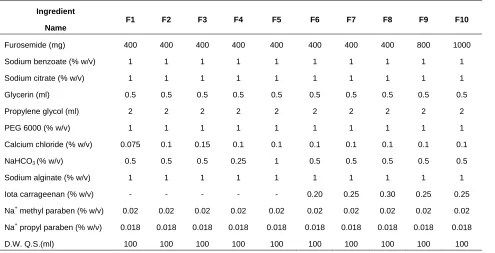
glycerin and propylene glycol were added with continuous stirring and heating until all ingredients dissolved and mixed completely. At the same time Na alginate was dissolved in distilled water containing sodium citrate and different concentrations of calcium chloride, heating to 60 oC while stirring. Then the mixed solubilizers solution was added to the polymer solution with continuous stirring. Finally various amounts of sodium bicarbonate were added, then furosemide was dispersed in the resulting solution after cooling6, 7. To the final cooled solution, sodium methyl paraben and sodium propyl paraben were added as shown in Table 1.
2.2.2 Preparation of oral Furosemide solution to act as in situ gel
using combination of sodium alginate and iota carrageenan
Sodium benzoate, sodium citrate and PEG 6000 were dissolved in distilled water to prepare mixed solubilizers solution, heated to 37 oC while stirring, then glycerin and propylene glycol were added with continuous stirring and heating until all ingredients dissolved and mixed completely. At the same time Na alginate was dissolved in distilled water containing sodium citrate and calcium chloride, heating to 60 oC while stirring. Iota carrageenan solution was prepared separately by dissolving different concentrations in distilled water containing sodium citrate and heating to 80 oCwhile stirring. Then the three prepared solutions were mixed together after cooling to 60 oCwith continuous stirring. Finally sodium bicarbonate was
added, then furosemide dispersed in the resulting solution after
cooling8,9, and sodium methyl paraben and sodium propyl paraben were added as above.
2.2.3 Physicochemical characterization of the floating in situ gel
2.2.3.1 Gel strength and gelation time determination
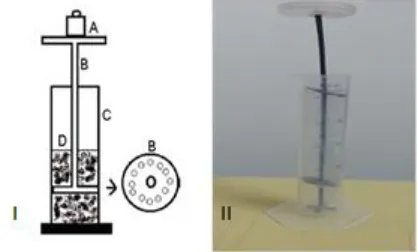
Gel strength is indicative of the tensile strength of the gelled mass to withstand the peristaltic movement’s in vivo. The method to measure gel strength was modified; by using fabricated gel strength apparatus, and it was done in triplicate as shown in Figure 1. Solution of 5 ml was taken in the cylinder followed by addition of 25 ml of 0.1 N HCl (pH 1.2) for gelation time determination. After gelation, 0.1 N HCl was drained off leaving the formed gel mass, and then the device was rested on to surface of the gel. At the free end of the device, a light weight pan (4 g) was attached to which the weights were added. The gel strength was reported in terms of weight required to pass the apparatus through the formed gel mass10.
Figure 1: Gel strength measuring device as I- represents schematic labeled as; (A) weights; (B) device; (C) cylinder; (D) gel. II- modified gel strength measuring apparatus
2.2.3.2 Viscosity measurements of solutions
The viscosities of the prepared solutions were measured by using viscometer (Brookfield-DVE- USA) and were read directly after 30 seconds. Measurements were performed in triplicate using suitable spindle number 64 and sheared at a rate of 3, 4, 5, 6, 10, 12, 20, 30, 50, 60, 100 rpm, at 37 °C11.
2.2.3.3 In vitro buoyancy study
UK J Pharm & Biosci, 2014: 2(5); 3 formulation took to emerge on to the medium surface (floating lag
time) and the time over which the formulation constantly floated on the dissolution medium surface (duration of floating) were reported12.
2.2.3.4 Determination of drug content
Five ml of liquid solution from all formulations was taken and 70 ml of 0.1 N HCl was added, after that sample was sonicated for 30 minutes until clear solution obtained. The volume was diluted to 100 ml and filtered using whatman filter paper No.41. One ml sample was withdrawn from prepared solution and diluted to 10 ml with 0.1 N HCl. Contents of Furosemide was determined spectrophotometrically using double beam UV-Visible spectrophotometer (Shimadzu 1650 pc-Japan) at λ max= 274.2 nm13
.
2.2.3.5 In vitro drug release study
The in vitro release of Furosemide from buoyant in situ gel solutions was studied by using USP type II (paddle type) dissolution test apparatus. Five ml from each formulation was transferred using disposable syringe. The syringe plunger depressed slowly to extrude 5 ml into a petridish with an internal diameter of 4.5 cm already containing 10ml of 0.1 N HCl. This petridish containing formulation was placed on the surface of the medium and plunged into a dissolution vessel containing 900 ml of 0.1 N HCl (pH 1.2) without much disturbance. The dissolution test apparatus was run at 50 rpm for 5 h at temperature 37± 0.5°C. Five ml samples were withdrawn from dissolution medium at predetermined time intervals of 5, 10, 15, 20, 30, 60, 120, 180, 240, 300 minutes and replenished with 5 ml of pre-warmed fresh medium. Samples were filtered using whatman filter paper No.41 and furosemide contents in the aliquots was determined spectrophotometrically using double beam UV-Visible spectrophotometer (Shimadzu 1650 pc-Japan) at a λ max=274.2 nm after suitable dilution. The experiments were conducted triplicate at each time interval14.
2.2.3.5.1 Effect of different concentrations of ion crosslinking agent
The prepared formulations F1-F3 were selected to study the effect of different CaCl2 concentrations on release profile of furosemide.
2.2.3.5.2 Effect of different concentrations of gas generating agent
The prepared formulations F4, F2 & F5 were selected to the study the effect of different concentrations of NaHCO3 on release profile of
Furosemide.
2.2.3.5.3 Effect of combination of polymers
The prepared formulations F6-F8 were selected to study the effect of combination of iota-carrageenan as secondary polymer with Na alginate as primary polymer in the presence of NaHCO3 on release
profile of Furosemide.
2.2.3.5.4 Effect of different drug concentrations
The prepared formulations F7, F9 & F10 were selected to study the effect of different drug concentrations (0.4% w/v equivalent to 20 mg/5 ml, 0.8% w/v equivalent to 40 mg/5 ml, 1% w/v equivalent to 50 mg/5 ml) on release profile of Furosemide.
2.2.3.6 In vivo test of Furosemide
The in vivo diuretic activity assay was performed on the optimum formula (F7) using male Wister albino rats. All procedures were approved by the Appropriate Animal Care Ethics Committee in Al-Mustansiriya University; the animals were acclimatized for 7 days under standard conditions, i.e. room temperature 35 ± 1 °C, relative humidity 45-55% and light/dark cycle 12/12 h. Twelve healthy rats weighing 250-360 g; these rats were involved (in each step), divided into 4 groups, each group consisted of 3 rats placed in modified metabolic cages (each cage equipped with a wire mesh floor that allowed for free passage and collection of excreted material while containing the rats, also stainless steel sieves were placed on to the mesh which assured good separation of urine from feces, then urine was collected in a plate)15. Before treatment; rats after overnight fasting and free access to water, were anesthetized in an induction chamber with ether for 5–10 minutes. Once anesthetized, the rats were removed from the induction chamber and they received physiological saline (0.9% NaCl) at an oral dose of 4% body weight by oral gavage syringe to impose water and salt load16.
Step one: Each group was received same volume of distilled water in a feeding bottle (200 ml) orally and considered as control, then urine was collected from each group and measured over a periods of 1, 5 and after 24 h. Electrolyte (Na+, K+) concentrations were estimated from each urine sample of each group at all-time intervals using flame photometry (Jenway 8515- Germany).
Step two: After one week recovery period for rats (with free access to water and food). The rats were fasted overnight and subsequently received commercial furosemide solution (Fudesix®) orally using gavage syringe at a dose of 10, 25, 50, and 100 mg/kg for group I, II, III and IV respectively. Urine volume and electrolyte concentrations were estimated similar to step 1.
Step three: After the one-week recovery period similar to that of step 2, the rats were fasted overnight and subsequently received the optimum formula (F7) orally at a dose of 10, 25, 50 and 100 mg/kg for group I, II, III and IV respectively. Urine volume and electrolyte concentrations were estimated similar to step 117.
2.2.4 Accelerated stability studies
Alhamdany et al. Extended Release Formulation of Furosemide
UK J Pharm & Biosci, 2014: 2(5); 4 12 weeks. Samples of 5 ml were taken every 2 weeks and
characterized for furosemide content by measuring their UV absorbance at 274.2 nm, also pH, viscosity, floating lag time and floating time were measured (at room temperature 25 0C) during the experiment period18.
3 Results and Discussions
3.1 Gel strength and gelation time determination
Table 2 exhibited that on increasing concentration of CaCl2 (F1-F3)
significantly increased gel strength and decreases gelation time (p >
0.05) due to increase in gel rigidness as the degree of crosslinking of divalent Ca2+ ions with the polymer chains increases and thus causing gelation to undergo instantly19. Moreover, in (F6-F8) as the
concentration of iota-carrageenan increased, it showed significant increase in gel strength (p > 0.05) by producing rigid gel of three dimensional networks of double helices due to crosslinking of the adjacent chains in which the sulfate groups are oriented externally as it has the optimum degree of sulfation, thus increasing gel formation in the presence of divalent ions such as calcium resulting in an increase in gel strength and thus decrease in gelation time21.
Table 1 Composition of Different Formulas of in situ Gel of Furosemide
Ingredient Name
F1 F2 F3 F4 F5 F6 F7 F8 F9 F10
Furosemide (mg) 400 400 400 400 400 400 400 400 800 1000
Sodium benzoate (% w/v) 1 1 1 1 1 1 1 1 1 1
Sodium citrate (% w/v) 1 1 1 1 1 1 1 1 1 1
Glycerin (ml) 0.5 0.5 0.5 0.5 0.5 0.5 0.5 0.5 0.5 0.5
Propylene glycol (ml) 2 2 2 2 2 2 2 2 2 2
PEG 6000 (% w/v) 1 1 1 1 1 1 1 1 1 1
Calcium chloride (% w/v) 0.075 0.1 0.15 0.1 0.1 0.1 0.1 0.1 0.1 0.1 NaHCO3 (% w/v) 0.5 0.5 0.5 0.25 1 0.5 0.5 0.5 0.5 0.5
Sodium alginate (% w/v) 1 1 1 1 1 1 1 1 1 1
Iota carrageenan (% w/v) - - - 0.20 0.25 0.30 0.25 0.25
Na+ methyl paraben (% w/v) 0.02 0.02 0.02 0.02 0.02 0.02 0.02 0.02 0.02 0.02
Na+ propyl paraben (% w/v) 0.018 0.018 0.018 0.018 0.018 0.018 0.018 0.018 0.018 0.018
D.W. Q.S.(ml) 100 100 100 100 100 100 100 100 100 100
Table 2 Evaluations of Furosemide Floating in Situ Gel
Formula No. Gel strength (N/m2) + SD
Gelation time (sec) + SD
Content uniformity (%) Floating lag time (sec) + SD Floating duration (h) + SD
F1 6.87+ 0.24 11+0.05 95 90+0.07 17+0.08
F2 8.01+ 0.15 2+0.01 97 60+0.06 19+0.05
F3 11.72+ 0.1 0 90.6 30+0.12 20.5+0.07
F4 9.45+ 0.08 0 90.5 120+0.55 20+0.08
F5 2.27+ 0.3 0 94 20+0.09 12+0.2
F6 1.89+ 0.27 7+0.06 99.6 55+0.07 23.5+0.03
F7 10.96+ 0.09 2+0.01 99.9 35+0.02 24+0.01
F8 15.49+ 0.05 0 92 29+0.06 24+0.04
F9 3.02+ 0.4 0 91 - -
UK J Pharm & Biosci, 2014: 2(5); 5
3.2 Viscosity measurements
The ease of swallowing a liquid is primarily depends on the rheological properties of the solutions and such liquid undergoes a rapid sol–gel transition due to ionic interaction upon direct contact with stomach contents. Figure 2 & 3 showed that the formulations with different concentrations of CaCl2 and NaHCO3 showing
non-significant (p > 0.05) increase in viscosity due to the fact that Na alginate form strong crosslinking in the polymer matrix and addition of NaHCO3 decreased the elasticity of matrix without effecting
viscosity, while CaCl2 upon contact with 0.1 N HCl (pH 1.2); the liquid
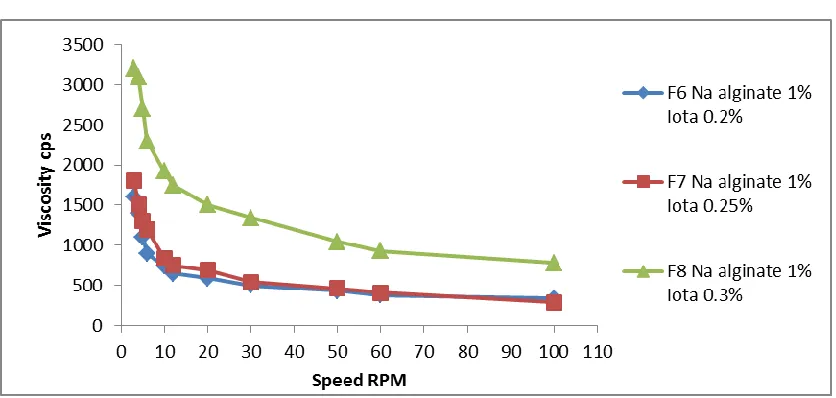
polymeric solutions undergo a rapid sol-to-gel transition by ionic gelation without effecting viscosity21, 18. Whereas, Figure 4 demonstrated that increasing iota carrageenan concentration resulted in a significant (p > 0.05) increase in viscosity due to strong crosslinking of iota carrageenan which resulted in strong elastic crosslinking polymeric network22. Moreover, increasing drug concentration has non-significant effect on the rheological properties of the polymeric solution as shown in Figure 5, the reason behind this is that viscosity depends mainly on concentration of polymer more than on concentration of drug, Therefore, as the drug concentration is increased, the mass of insoluble drug increased and this has no significant effect on the viscoelastic, flow and textural properties of the formulations23.
3.3 In vitro buoyancy
Table 2 showed that in (F1-F3) increasing CaCl2 concentration has
significant (p < 0.05) decrease in decrease in floating lag time and the floating duration increased due to the formation of double helical segments that form a compact network by complexation of Na alginate with Ca2+ ions12. Also in (F4, F2 & F5) as the amount of NaHCO3 increased, the floating lag time decreased significantly (p >
0.05). F4 showed highest floating lag time due to generation of small amount of CO2 gas, while F2, the amount of CO2 was essential to
achieve optimum in vitro buoyancy since Na alginate reacted with CaCl2 to produce a crosslinking three dimensional gel network and
swollen structure that may restrict further liberation of carbon dioxide and drug molecules, with intact formed gel. Further increase in concentration of sodium bicarbonate in (F5) did not show any significant effect on floating behaviour (p > 0.05), where, the increased amount of NaHCO3 causing a large amount of
effervescence, which in turn resulted in pore formation, leading to rapid hydration of the polymer matrix and thereby weak gel was formed that may be removed early from stomach by peristaltic movement24. Moreover, increasing iota carrageenan concentration in
(F6-F7) resulted in decreasing floating lag time significantly (p < 0.05) while floating duration remained almost constant. This is due to rapid crosslinking of polymer matrix as a result of the presence of strongly acidic sulfate groups in iota carrageenan molecule that
allows a certain degree of polymer ionization in 0.1 N HCl (pH 1.2) leading to the formation of insoluble gel-like layer of aggregated double helical segments that form a three dimensional network by complexation, and consequently slower solvent penetration into the matrices and more controlled CO2 diffusion were achieved and thus
inducing the in situ gel to float rapidly25.
3.4 In vitro drug release study
3.4.1 Effect of different concentrations of ion crosslinking agent
The results displayed that on increasing concentration of CaCl2 from
0.075% to 0.15% in (F1-F3) has significant effect (p < 0.05) to retard the release rate as shown in Figure 6. This is related to the fact that increasing in Ca2+ ions in such formulations results an increase in the crosslinking with the polymer network in that way contributing to slight increase in the density of the polymer matrix and subsequent increase in the diffusional path26.
3.4.2 Effect of different concentrations of gas forming agent
Formulations (F4, F2 & F5) exhibited significant effect (p <0.05) on the release profile of Furosemide. It was found that in the existence of low concentration of NaHCO3 as in F4, the release rate of
Furosemide from the formulation was lesser; this is due to the fact that the highly dense internal structure of the prepared gel was found to retain the drug more effectively. The rate of drug release was found to increase with increasing concentration of NaHCO3 as shown
in Figure 727.
3.4.3 Effect of combination of polymers
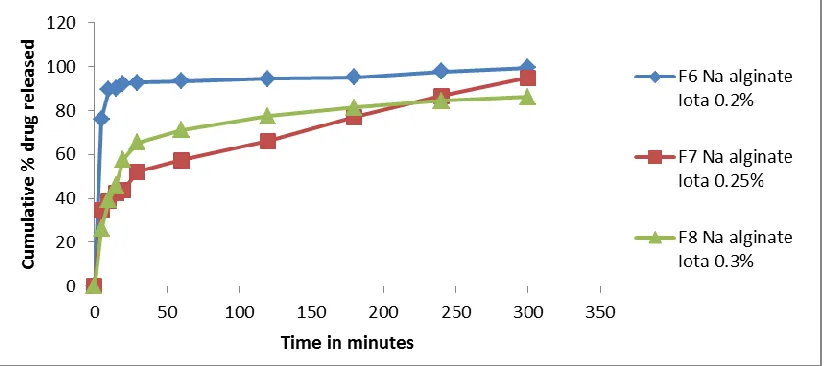
Formulations (F6- F8) were selected to illustrate the effect of combination of iota carrageenan as secondary polymer with Na alginate as primary polymers in the presence of NaHCO3 on release
profile of furosemide. The results showed significant decrease (p < 0.05) in drug release as shown in Figure 8. This is due to the appreciable ability of iota carrageenan gels to sustain drug release as its concentration is increased correlating with their ability on wetting in their matrices, thus the gel matrices swell at low grade and resist erosion under the acidic conditions of the stomach maintaining constant diffusion path length; forming highly crosslinked matrices with minimum porosity20.
3.4.4 Effect of different drug concentrations
Alhamdany et al. Extended Release Formulation of Furosemide
UK J Pharm & Biosci, 2014: 2(5); 6 bonding between the polymer and drug improve the morphological strength28.
Figure 2 Rheological properties of Na alginate with different concentrations of CaCl2
Figure 3: Rheological properties of Na alginate with different concentrations of NaHCO3
UK J Pharm & Biosci, 2014: 2(5); 7
Figure 5: Rheological properties of Na alginate with increasing furosemide concentration
Figure 6: Effect of adding different concentrations of CaCl2 on release profile of furosemide in 0.1 N HCl, at 37 0
C
Figure 7: Effect of adding different concentrations of NaHCO3 on release profile of furosemide in 0.1 N HCl, at 37 0
Alhamdany et al. Extended Release Formulation of Furosemide
UK J Pharm & Biosci, 2014: 2(5); 8
Figure 8:Effect of adding different concentrations of iota carrageenan by using Na alginate as primary polymer on release profile of furosemide in 0.1 N HCl, at 37 0C
Figure 9:Effect of adding different drug concentrations on release profile of furosemide in 0.1 N HCl, at 37 0C
3.5 Determination of drug content
The content uniformity test was done for the selected formula, and the result was 99.9%. This result agreed with the requirements of the United States pharmacopeia.
3.6 In vivo test of Furosemide
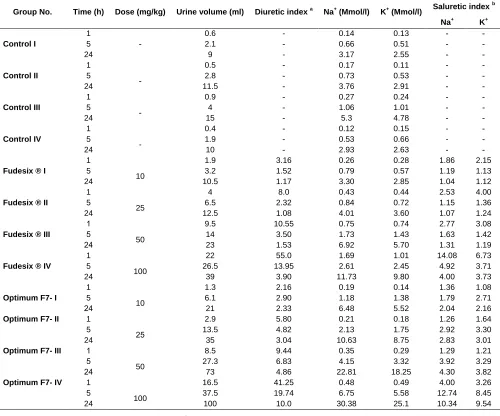
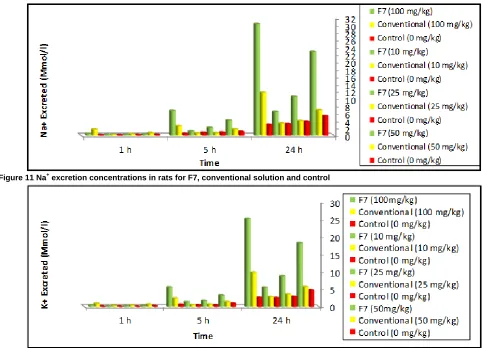
Tables 3 and Figures (10-12) showed that selected formula (F7) had lower excretion rate (urine volume and electrolyte concentrations) during the first hour in comparison to Fudesix®; this can be related to faster onset of action of furosemide from the conventional solution. While after 5 and 24 h; the excretion rates of the drug from the selected formula were significantly higher than that from the
conventional solution (Fudesix®), indicating the slow, continuous and prolonged mode of release of the drug from the in situ gel preparation; that improved drug absorption from the stomach region and as a result increased its pharmacodynamic action and minimizing the counteractivity of the body after the administration due to delayed activation of the compensatory mechanisms (tolerance development)2,5. Moreover, the results showed dose-dependent increase in the diuretic index and saluretic index of the drug from the optimum formula which is significantly (p < 0.05) higher than that for the control, indicating that the mechanism of absorption is mainly diffusion and it is in a good agreement with the in vitro
UK J Pharm & Biosci, 2014: 2(5); 9
Table 3: Effect of Single Oral Furosemide Administration on Urine Volume and Electrolyte Excretion
Group No. Time (h) Dose (mg/kg) Urine volume (ml) Diuretic index a Na+ (Mmol/l) K+ (Mmol/l) Saluretic index
b
Na+ K+
Control I 1 5 24 - 0.6 2.1 9 - - - 0.14 0.66 3.17 0.13 0.51 2.55 - - - - - - Control II 1 5
24 -
0.5 2.8 11.5 - - - 0.17 0.73 3.76 0.11 0.53 2.91 - - - - - - Control III 1 5
24 -
0.9 4 15 - - - 0.27 1.06 5.3 0.24 1.01 4.78 - - - - - - Control IV 1 5
24 -
0.4 1.9 10 - - - 0.12 0.53 2.93 0.15 0.66 2.63 - - - - - -
Fudesix ® I
1 5
24 10
1.9 3.2 10.5 3.16 1.52 1.17 0.26 0.79 3.30 0.28 0.57 2.85 1.86 1.19 1.04 2.15 1.13 1.12
Fudesix ® II
1 5
24 25
4 6.5 12.5 8.0 2.32 1.08 0.43 0.84 4.01 0.44 0.72 3.60 2.53 1.15 1.07 4.00 1.36 1.24
Fudesix ® III
1 5
42 50
9.5 14 23 10.55 3.50 1.53 0.75 1.73 6.92 0.74 1.43 5.70 2.77 1.63 1.31 3.08 1.42 1.19
Fudesix ® IV
1 5
24 100
22 26.5 39 55.0 13.95 3.90 1.69 2.61 11.73 1.01 2.45 9.80 14.08 4.92 4.00 6.73 3.71 3.73
Optimum F7- I
1 5
42 10
1.3 6.1 21 2.16 2.90 2.33 0.19 1.18 6.48 0.14 1.38 5.52 1.36 1.79 2.04 1.08 2.71 2.16
Optimum F7- II 1 5
24 45
2.9 13.5 35 5.80 4.82 3.04 0.21 2.13 10.63 0.18 1.75 8.75 1.26 2.92 2.83 1.64 3.30 3.01
Optimum F7- III 1 5
42 50
8.5 27.3 73 9.44 6.83 4.86 0.35 4.15 22.81 0.29 3.32 18.25 1.29 3.92 4.30 1.21 3.29 3.82
Optimum F7- IV 1 5
24 100
16.5 37.5 100 41.25 19.74 10.0 0.48 6.75 30.38 0.49 5.58 25.1 4.00 12.74 10.34 3.26 8.45 9.54 a
Diuretic index (volume treated group/ volume control group), b
Saluretic index (Mmol/l treated group/ Mmol/l control group)
Alhamdany et al. Extended Release Formulation of Furosemide
UK J Pharm & Biosci, 2014: 2(5); 10
Figure 11 Na+ excretion concentrations in rats for F7, conventional solution and control
Figure 12 K+ excretion concentrations in rats for F7, conventional solution and control
3.7 Stability study (determination of expiration date)
The expiration date of the selected formula was calculated at 25 ºC and was found to be 2.9 years, thus indicating the stability of the drug in the prepared formulation.
4 Conclusions
The overall results showed that addition of iota carrageenan with Na alginate gave stable gastroretentive floating in situ gel for furosemide solution that improved the absorption of the drug and may offer a promising control for diuretic and saluretic activity. Hence a proposing reduction in the dose, dose frequency and drug side effects could be achieved in comparison with the conventional oral Furosemide solution.
5 References
1. Darandale SS,Vavian PR. Design of a Gastroretentive Mucoadhesive Dosage Form of Furosemide for Controlled Release. Acta Pharmaceutica Sinica B. 2012; 2(5):509–517.
2. Ozdemir N, Ordu S, Ozkan Y, Studies of Floating Dosage Forms of Furosemide: In vitro and In vivo Evaluation of Bilayer Tablet Formulations. Drug Development and Industrial Pharmacy. 2000; 26(8): 857-866.
3. Debnath S, Babu MN, Kusuma G, Saraswathi K, Saramika NR, Reddy AK. Formulation and Evaluation of Floatable in situ Gel as Carrier for Stomach–Specific Drug Delivery of Metoclopramide HCl. International Journal of Pharmaceutical Frontier Research. 2011; 1(1): 53-64.
4. Laulicht B, Tripathi A, Mathiowitz E. Diuretic Bioactivity Optimization of Furosemide in Rats. European Journal of Pharmaceutics and Biopharmaceutics. 2011; (79): 314–319. 5. Klausner EA, Lavn E, Stepensky D, Cserepes E, Barta M,
UK J Pharm & Biosci, 2014: 2(5); 11 6. Agrawal A, Maheshwari RK. Formulation Development and
Evaluation of in situ Nasal Gel of Poorly Water Soluble Drug Using Mixed Solvency Concept. Asian Journal of Pharmaceutics. 2011; 5(3): 131-140.
7. Marie NK. Formulation and in vitro/ in Vivo Evaluation of Sustained Oral Delivery of Mefenamic acid from Floating Oral in Situ Gelling System. American Journal of PharmaTech Research. 2013; 3(3): 830-844.
8. Shete AS, Yadav AV, Dabke AP, Sakhare SS. Formulation and Evaluation of Hydrotropic Solublization Based Suspensions of Griseofulvin. International Journal of Pharma Sciences and Research. 2010; 1(1): 51-57.
9. Vipul V, Basu B, Formulation and Characterization of Novel Floating in situ Gelling System for Controlled Delivery of Ramipril. International Journal of Drug Delivery. 2013; 5(1):43-55.
10. Gulecha BS, Shahi S, Lahoti SR.Floating in Situ Gelling Drug Delivery System of Verapamil Hydrochloride. American Journal of PharmTech Research. 2012; 2(4): 954-969.
11. Xu H, Shi M, liu Y, Jiang J, Ma T. A Novel in situ Gel Formulation of Ranitidine for Oral Sustained Delivery. Biomolecules and Therapeutics.2014; 22(2): 161-165. 12. Hallur N, Rajashekhar, Swamy NGN, Abbas Z. Development
and in vitro Evaluation of an in situ Gelling Oral Liquid Sustained Release Formulation of Nizatidine. World Journal of Pharmacy and Pharmaceutical Sciences. 2013; 2(6): 6001-6015.
13. Rani K, Garg V, Goswami DS. Formulation and Evaluation of Stomach Specific in Situ Gel of Ofloxacin Using Natural, Synthetic Polymer. World Journal of Pharmaceutical research. 2013; 2(3): 631-645.
14. Nassoura L, Hasana I, El-Hammadia M, Abboud H. Floating in situ Gelling Gellan Formulations of Metformin Hydrochloride. Journal of Chemical and Pharmaceutical Research. 2014; 6(7):1509-1517.
15. Kau ST, Keddie JR, Andrews D. A Method for Screening Diuretic Agents in the Rat. Journal of Pharmacological Methods. 1984; (11): 67-75 .
16. Modasiya MK, Patel AK, Patel VM, Patel GC. In vitro and In vivo Characterization of Pectin Based in situ Gelling System of Famotidine. International Journal of Pharmaceutical Sciences and Nanotechnology. 2014; 5(4): 1885- 1894.
17. Silva Novaesa AS, Patel AK, Patel VM, Patel GC. Diuretic and Antilithiasic Activities of Ethanolic Extract from Piperamalago (Piperaceae). Phytomedicine. 2014; 21(4): 523–528.
18. Reddy RA, Ramesh B, Kishan V. Drug-Excipient Interaction During Formulation Development, in vitro and in vivo Evaluation of Gastroretentive Drug Delivery System for Nizatidine.
International Journal of Pharmaceutical Sciences and Nanotechnology. 2013; 6(4): 2281- 2293.
19. Wamorkar V, Varma MM, Manjunath SY. Formulation and Evaluation of Stomach Specific in situ Gel of Metoclopramide Using Natural, Bio-Degradable Polymers. International Journal of Research in Pharmaceutical and Biomedical Sciences. 2011; 2(1): 193-201.
20. Popa EG, Gomes ME, Reis RL. Cell Delivery Systems Using Alginate−Carrageenan Hydrogel Beads and Fibers for Regenerative Medicine Applications. Biomacromolecules. 2011; (12): 3952−3961.
21. Rhee CS, Majima Y, Cho JS, Arima S, Min YG, Sakakura Y. Effects of Mucokinetic Drugs on Rheological Properties of Reconstituted Human Nasal Mucus. Archives of Otolaryngol Head & Neck Surgery. 1999; 125(1):101-105.
22. Kawata K, Hanawa T, Endo N, Suzuki M, Oguchi T. Formulation Study on Retinoic Acid Gel Composed of Iota-Carrageenan, Polyethylene Oxide and Emulgen® 408. Chemical & Pharmaceutical Bulletin. 2012; 60(7) 825–830. 23. Jones DS, Michelle S, Lawlor MS, Woolfson AD. Formulation
and Characterisation of Tetracycline-Containing Bioadhesive Polymer Networks Designed for the Treatment of Periodontal Disease. Current Drug Delivery. 2004; (1): 17-25.
24. Dhiman S, Singh TG. Design and Optimization of Floating Matrix Tablets of Famotidine by Central Composite Design. Asian Journal of Pharmaceutical and Clinical Research. 2012; 5(1): 45-49.
25. Onyishi IV, Chime SA, Egwu E. Application of ĸ-carrageenan as a Sustained Release Matrix in Floating Tablets Containing Sodium Salicylate. African Journal of Pharmacy and Pharmacology. 2013; 7(39): 2667-2673.
26. Potu AR, Reddy VRP. In vitro and In vivo Characterization of Sodium Alginate Based in situ Gelling System of Meloxicam for Stomach Specific Drug Delivery. Journal of Pharmaceutical and Scientific Innovation. 2014; 3(2): 125-134.
27. Jassem NA, Rajab NA. Effect of Effervescent Agents on the Formulation of Famotidine Loaded Sodium Alginate Floating Beads. Kerbala Journal of Pharmaceutical Sciences. 2012; (4): 166-176.