Available Online at www.ijpret.com 198
INTERNATIONAL JOURNAL OF PURE AND
APPLIED RESEARCH IN ENGINEERING AND
TECHNOLOGY
A PATH FOR HORIZING YOUR INNOVATIVE WORK
MOTOR CONTROL USING GSM AND WIFI TECHNOLOGY
SHREYA S KUDALKAR1, H. G. VIRANI2
1. Microelectronics, ETC Dept, Goa College of engineering, Goa University. 2. Professor, ETC Dept, Goa College of engineering, Goa University.
Accepted Date: 27/02/2016; Published Date: 01/03/2016
\
Abstract: -In modern world, wireless technologies such as GSM, WiFi have been of great use
in various sectors including industries which are dealing with the energy automation products. The wireless technologies give great flexibility in the operation and control of devices across a certain range depending on the technology that is being used. Addition of wireless technologies can help in serviceability and maintainability of the devices when installed in remote stations. It is significant to evaluate the GSM and WiFi technology and to recommend its applicability with respect to the Industrial Applications.
Keywords:Motor control, WiFi, GSM.
Corresponding Author: MS. SHREYA S KUDALKAR
Access Online On:
www.ijpret.com
How to Cite This Article:
Available Online at www.ijpret.com 199 INTRODUCTION
A motor controller might include a manual or automatic means for starting and stopping the motor, forward or reverse direction, selecting and regulating the speed, regulating or limiting the torque, and protect against overloads and faults. Small motors may have built-in overload devices to automate open circuit on overload. Larger motors have a protective overload relay or temperature sensing relay including in the controller and fuses or circuit breaker for over current protection. A motor controller is connected to a power source such as a battery (dc) or power supply, and control circuitry in the form of analog or digital input signals.
Switchgears are important electronic components that perform a wide range of functions. They distribute the power, provide protection and monitor, control and regulate, make connections for communication processes. Switchgear is also used to enhance system availability by allowing more than one source to feed a load. Switchgear incorporates switches, circuit breakers, disconnects and fuses used to route the power and in the case of a fault, isolate parts of an electric circuit. The switchgear unit of the motor starter has three functions for protecting the motor. The first function is switching of the motor during operation, and is performed by dedicated standard unit, usually a called contactor. The contactor is designed to repeatedly switch high currents on-off, during the operation. Furthermore, in a switchgear unit, the functions of short circuit protection and the overload protection are integrated in one standard unit referred to power breaker. The power breaker separates the load from the power supply system when a short circuit happens and also when the currents are too high. The two standard units are arranged next to one another on a common carrier and form the switchgear unit. The project deals with replacing the contactor used for switching by a wireless electronic circuit called the motor control unit.
II. WIFI TECHNOLOGY
Wi-Fi (/ WiFi) is a local area wireless technology that allows electronic devices to participate in computer network using 2.4 GHz UHF and 5 GHz SHF ISM radio bands.
Available Online at www.ijpret.com 200
can sustain a good life span grow day by day, it is significant to evaluate Wi-Fi for controlling of appliances specially in industrial domain along with other protocols of Fi. The speed and Wi-Fi network difference factors like freq, bandwidth. Generally Wi-Wi-Fi is designed for the medium ranges data transfers i.e. 100 to 300 feet in indoor.
III. GSM TECHNOLOGY
GSM (Global System for Mobile) is a digital mobile telephone system that is widely used all over. GSM uses the variation of Time Division Multiple Access (TDMA). GSM digitizes and compresses the data, then sends it to the channel with two other stream of user data each in the own time slot. It operates at either 900MHz or 1800MHz frequency Band.
The two parts of the mobile state allow a distinct difference between the actual equipment and the subscriber who will be using it. The IMSI identifies the subscriber within the GSM network while the MS ISDN is the actual telephone number a caller (possibly in another network) uses to reach that person.
IV. APPLICATION WORKING/METHOD USED
Generally switchgears are designed to operate the switch manually. However in order to achieve automated operation locally or through remote, motorized mechanism is implemented.
One of the methods to implement motorized mechanism of three position switch is by using motor control unit.
Available Online at www.ijpret.com 201
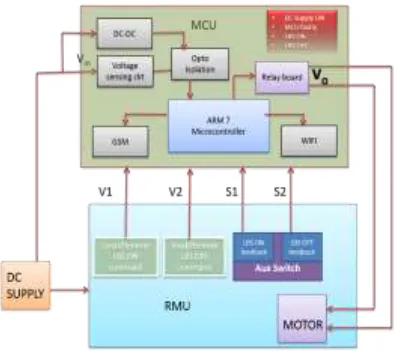
Where V1 and V2 are the load break switch on and off commands respectively, S1 and S2 are the feedback commands from the auxiliary switch.
Experimental setup
Table 1: Commands for motor direction control
GSM: GSM measurements quantify the: 1) Ramp energy: energy required to switch to the high-power state, 2) Transmission energy, and 3) Tail energy: energy spent in high-high-power state after the completion of the transfer. We conduct measurements for data transfers of different sizes (1 to 1000 KB) with varying intervals (1 to 20 seconds) between successive transfers.
WiFi: WiFi measurements quantify the energy: 1) to scan and associate to an access point and 2) to transfer data.
V. GRAPHS AND SIMULATION
Motor control measurements
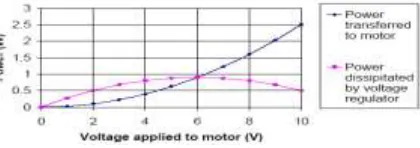
Fig 2: Power transfer characteristics of voltage controlled motor controller.
S.no V1 V2 S1 S2 direction
1 1 0 0 1 reverse
2 1 0 1 0 Reverse with delay
3 0 1 1 0 Forward
Available Online at www.ijpret.com 202 Fig 3: Motor performance graph –voltage, power, torque ,efficiency
GSM Measurements
Figure 4: (a) Avg. ramp, transfer and tail energy consumed to download 50K data. The lower portion of the stacked column show the proportion of energy spent on each activity compared to the total energy. (b) Avg energy consumed for downloading data of different
sizes against the inter transfer time.
Available Online at www.ijpret.com 203
WiFi Measurements
Figure 6: (a) Avg scan/associate and transfer energy consumed to download 50 K data. The lower portion of the stacked columns show the proportion of energy spent on each activity compared to the total energy. (b) Avg energy consumed for downloading data of different
sizes against the inter transfer time.
Available Online at www.ijpret.com 204 VI. CONCLUSION
The paper was focused on the study of motor control using GSM and Wifi technology for replacement of contactor in the switchgear in the industrial power distribution panels using wireless transmission of the data for the maintenance and servicing by reliable data updates with the help of spectrums and its comparison with the simulated model.
The paper also proves that Gsm and Wi-Fi hence can be used specifically for replacing the wired cable transmission with wireless approach.Gsm and Wi-Fi technology helps to eliminate wired links thereby avoiding chaos determing the signal strength up and download speed and helps in establishing wireless links for data transmission. All these features make the technology, market attractive and future proof which makes it inevitable for any vendor to implement the technology in their industrial panels
The GSM and Wi-Fi communication between 2 devices was successfully established and both the devices were able to respond each other to the messages via its respectable wireless Links.
ACKNOWLEDGMENT
I am deeply indebted to my guide, Prof. Hasan Ali Virani for allowing me to carry out this project under her supervision. He has given me confidence to take up this project and is a pillar of support that I have banked in times of difficulty. I express my gratitude to my company guide, Mr. Ravindra Chikhale at Siemens Ltd. who exhorted me to pursue the challenges posed by the project. I also thank my parents, family members and friends along with the almighty without whom this work would not have seen the light of the day.
REFERENCES
1. Medium-Voltage Switchgear INSTALLATION AND OPERATINGINSTRUCTIONS Order No.:
502-8015.9 Revision: 01 Issue: noch nicht freigegeben (1.3.2009).
2. Dr. Jamal A. Mohammed, “Pulse Width Modulation for DC Motor Control C Based on LM324”, Electromechanical Engineering Department, University of Technology/ Baghdad, Eng. &Tech. Journal, Vol. 31, Part (A), No.10, Mar 2013.
3. Suroor Moaid Dawood, Dr. Rabee' Hashim Thejeel, “PIC 16F877AMicrocontroller Based Multiple DC Motors Controller”, Department of Electrical Engineering-University of Basrah-Iraq, Asian Transactions on Engineering (ATE ISSN: 2221-4267) Volume 03 Issue 02, May 2013.
Available Online at www.ijpret.com 205