Kishore Kamere
*
Department of Pharmacy,
KGR Institute of Technology and
Management, Telangana State,
Phone: 9912829144
E-mail: [email protected]
Address for correspondenceFORMULATION AND CHARACTERIZATION OF GALANTAMINE
HYDROBROMIDE EXTENDED RELEASE TABLETS
INTRODUCTION:
The oral route is the route most often
used for administration of drugs. Tablets are
the most popular oral formulations available in
the market and are preferred by patients and
physicians alike. In long-term therapy for the
treatment of chronic disease conditions,
conventional formulations are required to be
tablets of Galantamine Hydrobromide which can be used to moderate
or delay the manifestation of Alzheimer’s disease
HPC HXF as the retardant polymer and to study the effect of various
formulation factors such as polymer proportion, concentration of
glidant, lubricant and their impact on the formulation. The tablets were
prepared by the direct compression
were also characterized by physical and chemical parameters. The
powder blend showed satisfactory flow properties, compressibility, and
drug content. In vitro release studies were performed using US
Pharmacopeia type II appa
phosphate buffer, 0.1 N HCl and pH 4.5 Acetate buffer. The total
release proportions of galantamine hydro bromide from extended
release tablets of optimized formula of F15 reached higher than 85 %
within 12 hrs in
Kishore Kamere*
1,
Gampa Vijay Kumar
1,
Gopala Krishna SV
21
Department of Pharmacy, KGR
Institute of Technology and
Management, Rampally, Keesara,
Rangareddy Dist, Telangana State
501301, India.
2
Vasavi Institute of Pharmaceutical
Sciences, Vasavi nagar, Peddapalli,
Madhavaram, YSR dist,
Andhrapradesh State, 516247, India.
Journal of Global Trends in Pharmaceutical Sciences
*
Department of Pharmacy,
KGR Institute of Technology and
Telangana State, India
[email protected]
Address for correspondenceISSN
FORMULATION AND CHARACTERIZATION OF GALANTAMINE
HYDROBROMIDE EXTENDED RELEASE TABLETS
The oral route is the route most often
used for administration of drugs. Tablets are
the most popular oral formulations available in
the market and are preferred by patients and
term therapy for the
treatment of chronic disease conditions,
conventional formulations are required to be
administered in multiple doses and therefore
have several disadvantages.1 Controlled
release (CR) tablet formulations are preferred
for such therapy because they offer better
patient compliance, maintain uniform drug
levels, reduce dose and side effects, and
increase the safety margin for high
drugs.
Extended release dosage forms are
designed to achieve a prolonged therapeutic
effect by continuously releasing drug over an
extended period of time after administration of
a single dose. The advantages of extended
release dosage forms over conventional forms
include the less fluctuation in drug blood
levels, frequency reduction in dosing,
enhanced convenience and compliance,
reduction in adverse side effects and reduction
The objective of this study was to design oral extended release
tablets of Galantamine Hydrobromide which can be used to moderate
or delay the manifestation of Alzheimer’s disease
HPC HXF as the retardant polymer and to study the effect of various
formulation factors such as polymer proportion, concentration of
glidant, lubricant and their impact on the formulation. The tablets were
prepared by the direct compression method. The formulated tablets
were also characterized by physical and chemical parameters. The
powder blend showed satisfactory flow properties, compressibility, and
drug content. In vitro release studies were performed using US
Pharmacopeia type II apparatus (Paddle method) in 900 ml of pH 6.8
phosphate buffer, 0.1 N HCl and pH 4.5 Acetate buffer. The total
release proportions of galantamine hydro bromide from extended
release tablets of optimized formula of F15 reached higher than 85 %
within 12 hrs in all media.
Keywords:
Galantamine Hydrobromide, Alzheimer’s disease, HPC
HXF Polymer.
ABSTRACT
Journal of Global Trends in Pharmaceutical Sciences
Journal home page: www.jgtps.com
ISSN- 2230-7346
FORMULATION AND CHARACTERIZATION OF GALANTAMINE
administered in multiple doses and therefore
have several disadvantages.1 Controlled
release (CR) tablet formulations are preferred
herapy because they offer better
patient compliance, maintain uniform drug
levels, reduce dose and side effects, and
increase the safety margin for high-potency
Extended release dosage forms are
designed to achieve a prolonged therapeutic
continuously releasing drug over an
extended period of time after administration of
a single dose. The advantages of extended
release dosage forms over conventional forms
include the less fluctuation in drug blood
levels, frequency reduction in dosing,
anced convenience and compliance,
reduction in adverse side effects and reduction
The objective of this study was to design oral extended release
tablets of Galantamine Hydrobromide which can be used to moderate
or delay the manifestation of Alzheimer’s disease symptoms, using
HPC HXF as the retardant polymer and to study the effect of various
formulation factors such as polymer proportion, concentration of
glidant, lubricant and their impact on the formulation. The tablets were
method. The formulated tablets
were also characterized by physical and chemical parameters. The
powder blend showed satisfactory flow properties, compressibility, and
drug content. In vitro release studies were performed using US
ratus (Paddle method) in 900 ml of pH 6.8
phosphate buffer, 0.1 N HCl and pH 4.5 Acetate buffer. The total
release proportions of galantamine hydro bromide from
extended-release tablets of optimized formula of F15 reached higher than 85 %
in overall health care costs. The rate of drug
release from solid dosage form may be
modified by the technologies, which in general
are based on modifying drug dissolution by
controlling access of biologic fluids to the
drug through the use of barrier coatings and
controlling drug diffusion rates from dosage
forms. Generally the different techniques
employed to fabricate the modified release
dosage forms are coated beads, granules and
microspheres, multi tablet system, micro
encapsulated drug, complex formation, ion
exchange resins, and embedding drug in
slowly eroding or hydrophilic matrix system.
The use of polymeric matrix devices
to control the release of a variety of
therapeutic agents as become increasingly
important in the development of modified
release dosage forms. This device may be a
swellable, hydrophilic monolithic systems,
erosion controlled monolithic systems or non
erodible systems. The hydrophilic gel forming
matrix tablets are extensively used for oral
extended release dosage forms due to their
simplicity, cost effectiveness and reduction of
the risk of systemic toxicity due to dose
dumping.
Alzheimer’s disease is a slowly
developing neurodegenerative disease that
produces a progress loss of memory and
cognitive function, i.e., Dementia. Alzheimer’s
disease is a gradual and irreversible decline in
intellectual ability that usually appears after
the age of 60. The disease has been estimated
to affect 5 % of over 65 year olds. Patients
experience a progressive loss of cognitive
function, usually beginning with loss of
short-term memory followed by loss of other
functions such as ability to calculate and
ability to use everyday objects. These
functional changes appear to result primarily
from the loss of cholinergic transmission in the
neocortex and are characterized pathologically
by abundant diffuse and neurotic plaques
throughout most cortical regions.
Galantamine hydro bromide is a
phenanthridine alkaloid and isolated from
several members of the Amaryllidaceae family
plant, such as snowdrops. It can be used to
moderate or delay the manifestation of AD
symptoms as one of the selective and
reversible acetyl cholinesterase (AChE)
inhibitors, thus show the memoryenhancing
effects. Further, its concentration-dependent
inhibitive effect on AChE activity has
antioxidative properties, involving decreased
super oxide anion and NO overproduction, as
well as restoring mitochondrial membrane
potential Galantamine hydro bromide has been
approved most recently by the FDA for
symptomatic treatment for AD and vascular
dementia by oral or inject able administration.
MATERIALS:
Galantamine Hydrobromide as a gift
sample from Aurobindo pharma ltd, Hyd.
Hydroxy propyl cellulose HXF, Colloidal
silicon dioxide , Avicel.
METHODOLOGY:
Analytical Method
An in-house developed and validated
chromatographic method (HPLC, Schimadzu),
was used for the estimation of drug in bulk,
formulations, and dissolution samples.
Chromatographic conditions:
Column
: X-Terra
RP-18, 5m (150mm ´ 4.6mm)
Pump mode
: Isocratic
Flow rate
: 1.0 ml/min
Detection
: UV, 220 nm
Injection Volume
: 10 ml
Column temperature : 40°C
Run time
: 12 minutes.
Procedure:
Inject 10 ml of sample solution in duplicate
into the chromatograph. Record the
chromatograms and measure the peak areas.
Retention time of Galantamine peak is about
6.5 minutes.
Table 1Composition of different trials taken for development of final formula
Ingredients F1 F2 F3 F4 F5 F6 F7 F8 F9 F10 F11 F12 F13 F14 F15 Galatamine
HCL 10.252 10.252 10.252 10.252 10.252 10.252 10.252 10.252 10.252 10.252 10.252 10.252 10.252 10.252 10.252 Hydroxyl
Propyl
Cellulose 48.647 66.647 48.647 64.568 74.868 64.568 64.568 64.568 64.568 64.568 64.568 64.568 64.568 64.568 64.568 Talc 1.860 1.860 1.860 1.860 1.860 1.860 1.66 1.860 2.06 1.860 1.860 1.860 1.860 1.860 1.860 Aerosol 200 0.620 0.620 0.620 2.400 2.400 2.400 2.400 2.400 2.200 2.400 2.600 2.400 2.400 2.400 2.400 Magnesium
stearate 0.620 0.620 0.620 0.620 0.620 0.620 0.620 0.620 0.620 0.620 0.620 0.420 0.620 0.820 0.620 Avicel -- -- -- -- -- 0.500 0.300 0.100 0.500 0.300 0.100 0.500 0.300 0.100 0.300 Tablet total
Formulation development & formula
optimization
Formulation 1: Trial batch of Galantamine
Hydrobromide Extended Release Tablets by
direct compression approach.
Formulation 2: Trial batch to reduce the rate
and extent of drug release by increasing the
concentration of polymer i.e. Hydroxypropyl
cellulose.
Formulation 3, 4 & 5: Trial to optimize the
concentration of Release rate controlling
Polymer i.e. Hydroxypropyl Cellulose.
Formulation 6, 7 & 8: Trial to optimize the
concentration of Glidant i.e. Talc.
Formulation 9, 10 & 11: Trial to optimize the
concentration of Glidant i.e. Silica, Colloidal
anhydrous.
Formulation 12, 13 & 14: Trial to optimize the
concentration of Lubricant i.e. Magnesium
stearate.
Formulation 15: Trial batch to improve flow
properties of the final blend by increasing the
concentration of Glidant i.e. Silica Colloidal
Anhydrous and Diluent i.e. Cellulose
microcrystalline.
Table 2. Final unit composition of Galantamine Hydrobromide Extended Release Tablets
Ingredients Qty per tablet (mg)
Galantamine hydrobromide 10.252
Cellulose microcrystalline 0.3
Hydroxypropyl cellulose 64.568
Silica Colloidal Anhydrous 2.4
Talc 1.86
Magnesium stearate 0.62
Tablet weight 80.00 mg
Manufacturing process development- direct
compression approach
Weigh accurately all excipients and dispense
separately. Co sift talc and Galantamine
hydrobromide through # 30 sieve. Co sift
Silica Colloidal Anhydrous and step - 2 and
pass through # 30 sieve. Sift Hydroxy propyl
cellulose through # 30 sieve. Resift the step - 3
and step - 4 through # 30 sieve. Unload
the
blend of step - 5 into blender and mix for 15
minutes. Magnesium stearate was sifted
through # 60 sieve mesh, loaded into blender
and blended for 5 minutes. The blend of step-7
was compressed using 5.2 mm round, standard
concave punches.
RESULTS & DISCUSSIONS:
Characterization of Bulk Drug and Effect
of Various Formulation Excipients
The bulk drug was characterized by
various tests of identification according to the
certificate of analysis given by the supplier
and analyzed by the above-mentioned UV
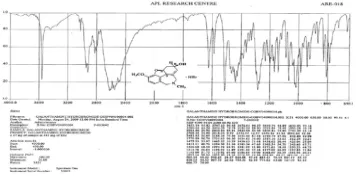
spectrophotometric method. The infrared (IR)
spectrum obtained (IR spectrophotometer; IR
Report 100, Jasco) was compared with that of
the standard. To study the compatibility of
various
formulation
excipients
with
Galantamine, solid admixtures were prepared
by mixing the drug with each formulation
excipients separately in the ratio of 1:1 and
then stored in airtight containers at 30-C ±
2-C/65% relative humidity (RH) ± 5% RH.
The
solid
admixtures
were
characterized using Fourier transform infrared
spectroscopy
(FTIR)
(IR
Prestige-21,
Shimadzu, Kyoto, Japan).
The drug substance is structurally
elucidated and characterized based upon
spectroscopy, analytical testing and inference.
Various characteristics of Drug
substance were evaluated as follows:
Particle size, shape and Surface area.
Powder characteristics:
•
Bulk &Tapped density
•
Compressibility Index
API Solubility:
The
saturation
solubility
of
Galantamine
Hydrobromide
API
drug
substance in different physiological media
with different pH has been determined and the
results are tabulated below.
From above data it is evident that
Galantamine Hydrobromide API has a high
solubility over the entire pH range from pH
1.2 – pH 7.2. Further the solubility was found
to be pH independent, being a modified
release dosage formulation, pH 6.8 phosphate
buffer was selected as a Suitable dissolution
medium
for
testing
Galantamine
Hydrobromide Extended Release tablets.
Dissolution parameters:
Medium: 50M Phosphate Buffer pH
6.8, 900mL
Apparatus: USP Apparatus II [Paddle]
Rotation Speed: 50 rpm
Temperature: 37.0 ± 0.5°C
Time: 1, 4 and 12 Hours
Drug product release profile in different
dissolution media: As a part of the
development activity, the dissolution studies
were carried out on various strengths of
Galantamine Hydrobromide Extended Release
Tablets at different pH (viz., pH 6.8 Phosphate
buffer, 0.1N HCl and pH 4.5 Acetate buffer) to
determine the most relevant medium for
dissolution of the drug. The mean results
(n=12) are as follows:
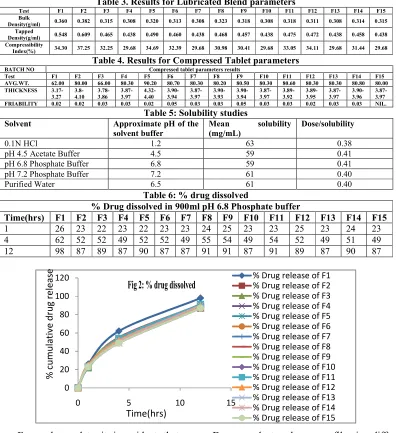
Table 3. Results for Lubricated Blend parameters
Test F1 F2 F3 F4 F5 F6 F7 F8 F9 F10 F11 F12 F13 F14 F15
Bulk
Density(g/ml) 0.360 0.382 0.315 0.308 0.320 0.313 0.308 0.323 0.318 0.308 0.318 0.311 0.308 0.314 0.315
Tapped
Density(g/ml) 0.548 0.609 0.465 0.438 0.490 0.460 0.438 0.468 0.457 0.438 0.475 0.472 0.438 0.458 0.438
Compressibility
Index(%) 34.30 37.25 32.25 29.68 34.69 32.39 29.68 30.98 30.41 29.68 33.05 34.11 29.68 31.44 29.68
Table 4. Results for Compressed Tablet parameters
BATCH NO Compressed tablet parameters results
Test F1 F2 F3 F4 F5 F6 F7 F8 F9 F10 F11 F12 F13 F14 F15
AVG.WT. 62.00 80.00 66.00 80.30 90.20 80.70 80.30 80.20 80.50 80.30 80.60 80.30 80.30 80.80 80.00
THICKNESS
3.17-3.27 3.8-4.10
3.78-3.86
3.87-3.97
4.32-4.40
3.90-3.94
3.87-3.97
3.90-3.93
3.90-3.94
3.87-3.97
3.89-3.92
3.89-3.95
3.87-3.97
3.90-3.96
3.87-3.97
FRIABILITY 0.02 0.02 0.03 0.03 0.02 0.05 0.03 0.03 0.05 0.03 0.03 0.02 0.03 0.03 NIL.
Table 5: Solubility studies Solvent Approximate pH of the
solvent buffer Mean (mg/mL) solubility Dose/solubility
0.1N HCl 1.2 63 0.38
pH 4.5 Acetate Buffer 4.5 59 0.41
pH 6.8 Phosphate Buffer 6.8 59 0.41
pH 7.2 Phosphate Buffer 7.2 61 0.40
Purified Water 6.5 61 0.40
Table 6: % drug dissolved
% Drug dissolved in 900ml pH 6.8 Phosphate buffer
Time(hrs) F1 F2 F3 F4 F5 F6 F7 F8 F9 F10 F11 F12 F13 F14 F15
1 26 23 22 23 22 23 23 24 25 23 23 25 23 24 23
4 62 52 52 49 52 52 49 55 54 49 54 52 49 51 49
12 98 87 89 87 90 87 87 91 91 87 91 89 87 90 87
0 20 40 60 80 100 120
0 5 10 15
% Drug release of F1 % Drug release of F2 % Drug release of F3 % Drug release of F4 % Drug release of F5 % Drug release of F6 % Drug release of F7 % Drug release of F8 % Drug release of F9 % Drug release of F10 % Drug release of F11 % Drug release of F12 % Drug release of F13 % Drug release of F14 % Drug release of F15
Time(hrs)
%
c
um
ul
at
iv
e
dr
ug
re
le
as
e
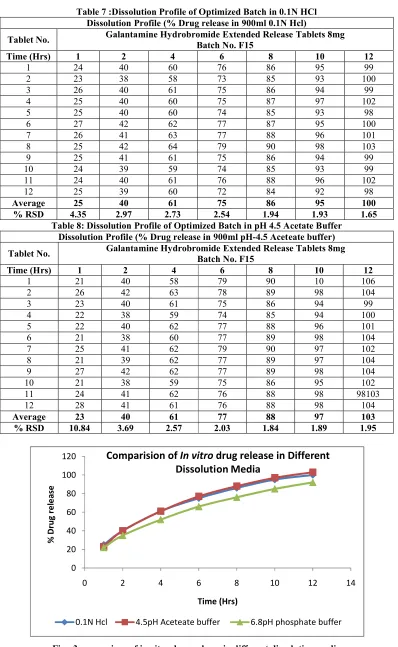
Table 7 :Dissolution Profile of Optimized Batch in 0.1N HCl Dissolution Profile (% Drug release in 900ml 0.1N Hcl)
Tablet No. Galantamine Hydrobromide Extended Release Tablets 8mgBatch No. F15
Time (Hrs) 1 2 4 6 8 10 12
1 24 40 60 76 86 95 99
2 23 38 58 73 85 93 100
3 26 40 61 75 86 94 99
4 25 40 60 75 87 97 102
5 25 40 60 74 85 93 98
6 27 42 62 77 87 95 100
7 26 41 63 77 88 96 101
8 25 42 64 79 90 98 103
9 25 41 61 75 86 94 99
10 24 39 59 74 85 93 99
11 24 40 61 76 88 96 102
12 25 39 60 72 84 92 98
Average 25 40 61 75 86 95 100
% RSD 4.35 2.97 2.73 2.54 1.94 1.93 1.65
Table 8: Dissolution Profile of Optimized Batch in pH 4.5 Acetate Buffer Dissolution Profile (% Drug release in 900ml pH-4.5 Aceteate buffer) Tablet No. Galantamine Hydrobromide Extended Release Tablets 8mgBatch No. F15
Time (Hrs) 1 2 4 6 8 10 12
1 21 40 58 79 90 10 106
2 26 42 63 78 89 98 104
3 23 40 61 75 86 94 99
4 22 38 59 74 85 94 100
5 22 40 62 77 88 96 101
6 21 38 60 77 89 98 104
7 25 41 62 79 90 97 102
8 21 39 62 77 89 97 104
9 27 42 62 77 89 98 104
10 21 38 59 75 86 95 102
11 24 41 62 76 88 98 98103
12 28 41 61 76 88 98 104
Average 23 40 61 77 88 97 103
% RSD 10.84 3.69 2.57 2.03 1.84 1.89 1.95
Fig : 3 comparison of in vitro drug release in different dissolution media 0
20 40 60 80 100 120
0 2 4 6 8 10 12 14
%
D
ru
g
re
le
as
e
Time (Hrs)
Comparision of
In vitro drug release in Different
Dissolution Media
CONCLUSION:
In vitro
release studies were
performed using US Pharmacopeia type II
apparatus (Paddle method) in 900 ml of pH 6.8
phosphate buffer. From the above obtained
lubricated blend parameters, compressed
profiles it indicates that amongst all the trial
batches, F15 of Galantamine Hydrobromide
Extended Release Tablets showed good
results. In order to analyze and standardize the
extended release of drug from F15, further the
study was carried out with 3 different buffer
media namely pH 6.8 phosphate buffer, 0.1 N
HCl and pH 4.5 Acetate buffer and it was
observed the total release proportions of
galantamine hydro bromide from
extended-release tablets reached higher than 85 %
within 12 h in all buffer media.
REFERENCES:
1. Kun Li and Shuoye Yang, Study on
novel
galantamine
hydrobromide
sustained-release tablets and it’s in
vitro releasing property, Pak. J.
Pharm. Sci., Vol.27, No.5(Suppl),
September 2014, pp.1621-1626
2. Chavan Ritesh A. And Mayee Rahul,
Formulation
and
evaluation
of
extended release pellets of an
antialzhimer drug, ijpi.,Volume 3,
Issue 4, PP.65-75
3. Arunkanth
Krishnakumar
Nair*,
Dr.Subhash pandurang Gore, Anand
shankaranarayanan
and
Balaji
sathurappan et al, A study of
controlled
release
galantamine
hydrobromide
solid
dosage
formulations: a novel approach,
ijrrpas, dec-2012, 2(6).965-980
4. Biswajit Biswal and Darshan Sharma,
Design, Development and Evaluation
of Galantamine Hydrobromide Bilayer
Sustained Release Tablet, Der
Pharmacia Lettre, 2013, 5 (6):12-19
5. Punna Rao Ravi,1 Sindhura Ganga,1
and Ranendra Narayan Saha1, Design
and Study of Lamivudine Oral
Controlled Release Tablets, AAPS
pharmscitech 2007; 8 (4) Article 101
6. Avinash G.Thombre, Assessment of
the feasibility of oral controlled
release in an exploratory development
setting DDT • Volume 10, Number 17
• September 2005
7. Margret
Chandira1*,
B.S.Venkateswarlu1
,jadhavanup
Shankarrao1,
debjitbhowmik1,
B.Jayakar1,
T.V.Narayana2,
Formulation and Evaluation
of
Extended Release Tablets containing
Metformin
hcl/Int.J.
Chemtech
Res.2010,2(2)
8. Kuldeep Malodia1, Anil Kumar1,
Sunil Kumar1 and Pankaj Rakha2,
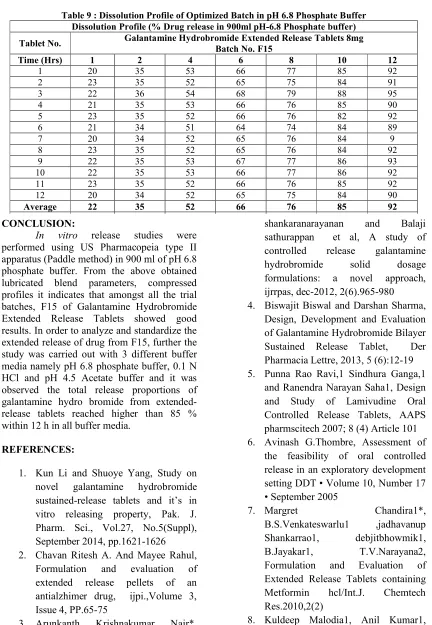
Table 9 : Dissolution Profile of Optimized Batch in pH 6.8 Phosphate Buffer Dissolution Profile (% Drug release in 900ml pH-6.8 Phosphate buffer) Tablet No. Galantamine Hydrobromide Extended Release Tablets 8mg
Batch No. F15
Time (Hrs) 1 2 4 6 8 10 12
1 20 35 53 66 77 85 92
2 23 35 52 65 75 84 91
3 22 36 54 68 79 88 95
4 21 35 53 66 76 85 90
5 23 35 52 66 76 82 92
6 21 34 51 64 74 84 89
7 20 34 52 65 76 84 9
8 23 35 52 65 76 84 92
9 22 35 53 67 77 86 93
10 22 35 53 66 77 86 92
11 23 35 52 66 76 85 92
12 20 34 52 65 75 84 90
Average 22 35 52 66 76 85 92
Formulation
and
evaluation
of
extended release tablets of salbutamol
sulphate, Der Pharmacia Lettre, 2013,
5 (1):177-181
9. Sathish Ummadi, B. Shravani, N. G.
Raghavendra Rao*, M. Srikanth
Reddy, B. Sanjeevnayak, Overview on
Controlled Release Dosage Form, Int J
Pharma Sci. 2013, 3(4): 258-269
10. Vijay D. Wagh* and Kailas S. Patil,
Formulation,
development
and
evaluation of extended release tablets
of metoprolol succinate J Pharm
Phytother 2013, 1:4 (ISSN 2321-5895)
11. Vijay J, Sahadevan JT1, Prabhakaran
R2, Mehra Gilhotra R, Formulation
and
Evaluation
of
Cephalexin
Extended-release
Matrix
Tablets
Using Hydroxy Propyl
Methyl
Cellulose as Rate-controlling Polymer,
Journal of Young Pharmacists Vol 4 /
No 1
12. Lloyd N. Sansom, Oral
extended-release
products
-
Australian
Prescriber,
http://www.australianprescriber.com/
magazine/22/4/88/90
13. Shashidhar Reddy Dodda1, Prakash
Rao Boggrapu2* Development and in
Vitro-in
Vivo
Evaluation
of
Controlled Release Matrix Tablets of
Desvenlafaxine
Pharmacology
&
Pharmacy, 2012, 3, 15-19
14. Basavaraj K Nanjwade*, Sunil R
Mhase and FV Manvi, Formulation of
Extended-Release
Metformin
Hydrochloride Matrix Tablets, Trop J
Pharm Res, August 2011;10 (4): 375
15. Mohammad Usman3, Irshad Ali1,
Hafsa Bibi1, Javeid Iqbal2 and Kashif
Iqbal3* Preparation and Evaluation of
Controlled Release Tablets Containing
Mefenamic Acid Clin Exp Pharmacol
2:107
16. Narasimharao R*, Anusha Reddy M,
Swetha Reddy N, Divyasagar P and
Keerthana K, Design and Evaluation
of Metformin Hydrochloride Extended
Release
Tablets
by
Direct
Compression, www.ijrpbsonline.com,
Vol. 2 (3) Jul – Sep 2011
17. Vamsy
krishna.a*3,
K.R.Srinath2,C.Pooja
Chowdary2
Palanisamy.p3,
G.R.Vijayasankar1,
Stavudine Loaded Microtablets using
various
Cellulose
Polymers:
Preparation and In-Vitro Evaluation
www.ijrpbsonline.com, Vol. 2 (2) Apr
– Jun 2011
18. K. P. Sampath Kumar*1, Debjit
Bhowmik2,
Chiranjib2,
Margret
Chandira, K. K.Tripathi2, Innovations
in Sustained Release Drug Delivery
System and Its Market Opportunities,
J. Chem. Pharm. Res., 2010, 2(1):
349-360
All © 2010 are reserved by Journal of Global Trends in Pharmaceutical Sciences.