4768 DESIGN AND CHARACTERIZATION OF SOLID LIPID NANOPARTICLES OF
GANCICLOVIR FOR IMPROVED ORAL ABSORPTION
M. Ravindra Babu*1, P. Ravi Prakash2, N. Devanna3
1Research Scholar, JNTUA, Ananthapuramu, Andhra Pradesh, India
2Department of Pharmaceutics, Creative Educational Society’s College of Pharmacy,
Kurnool, Andhra Pradesh, India.
3Department of Chemistry, JNTUA College of Engineering, Ananthapuramu, Andhra
Pradesh India.
*Corresponding author E-Mail:[email protected]
ARTICLE INFO ABSTRACT
Key Words
Ganciclovir SLN Oral absorption
Ganciclovir is a BCS Class-III drug is used in first line therapy for immunocompromised people for prevention & treatment of infections caused by cytomegalovirus. Delivery of this drug by oral route is limited as a result of its low oral bioavailability. Thus, design of novel oral delivery system in the form of solid lipid Nanoparticles (SLN) overcomes these drawbacks. Total 12 (GSLN 1 to GSLN 12) formulations by hot homogenization (Quantum H-900) method followed by ultrasonication (Sonics U-164) were prepared. The process parameters like type of lipid, surfactant, power input & pulse for ultrasonication were optimized. The SLN dispersion is subjected for characterization which includes particle size, zeta potential, entrapment efficiency, in vitro drug release. Among all formulations, SLN 8 is found to be optimized formulation as it is confirmed as safest formulation without rupturing the epithelial cells.
1. INTRODUCTION:
Biopharmaceutical Classification System (BCS) classified all the drugs based on the permeability and solubility into four classes. Drugs which are characterized by high solubility and low permeability fall under BCS Class – III drugs. The oral bioavailabilities of most of the drugs are limited by their low permeability which belongs to the same class. Ganciclovir is an anti viral drug
belongs to the same BCS classification. The core objective of the present study is
to design & characterize solid Lipid Nanoparticulate drug delivery systems to enhance oral bioavailability of the antiviral drug Ganciclovir (Sam Maher et al., 2015). This drug is used in first line therapy for immunocompromised people for prevention & treatment of infections caused by cytomegalovirus. Ganciclovir is primarily delivered through intravenous route which suffers from several drawbacks like high cost, skilled person for administration which finally leads to patient incompliance. Delivery of this drug by oral route is limited as a result of its low oral bioavailability. Thus, design of novel oral delivery system in the form of
An Elsevier Indexed Journal ISSN-2230-7346
4769
solid lipid Nanoparticles (SLN) overcomes these drawbacks. Solid Lipid Nanoparticles (SLN) are nanoparticles invented 20 years ago and are prepared from a lipid matrix which is a solid at body and room temperature, stabilized by suitable surfactants. The researchers identified a fact that the use of solid lipids instead of liquid oils may provide the controlled drug release. This is because of the lower mobility of the drug in solid matrix compared to liquid oil. SLNs. Contribute their widespread in treating the pulmonary diseases, cancers, central nervous system related diseases, cardiovascular system related diseases, osteoporosis, diabetes etc. Despite from advantages, several challenges like burst release, inefficient release remains to be resolved in SLNs for better delivery of drugs (Schipper NGM et al.,1997).
2. MATERIALS & METHODS
2.1 Materials
Ganciclovir drug is obtained as a gift sample from Hetero drugs Pvt.Ltd. Jadcherla, Telangana. Compritol 888, Glyceryl monostearate (GMS),Glyceryl distearate (GDS) were obtained from S.D. Fine chemicals, Mumbai. Poloxamer 188 was obtained as gift samples from Orchid chemicals, Chennai. Steraic acid is obtained from Hi-media, Chennai. All the chemicals used in the study were of Pharmaceutical grade.
2.2 Methods
2.2.1 Preparation of Ganciclovir Solid Lipid Nanoparticles: High Pressure Homogenization (HPH) method is used to prepare the Solid Lipid Nanoparticles (SLN) of TDF. HPH is a powerful technique for the large scale production. It has been used for years for the preparation of nanoemulsions and SLN. One of the sub method of HPH is Hot Homogenization method which is used for the present formulation. In hot HPH, lipid and drug are melted in the presence of surfactant at
the same temperature. This mixture is sheared by hot shear device, to form a pre emulsion (Pre em). The hot Pre em was cooled to recrystallize in order to generate SLN. In this lipid phase containing TDF, Compritol 888, GMS and GDS separately were taken in a beaker and in other hand Poloxamer 188 with water is taken. Both were heated at 750C (above the melting point of lipid). Then the aqueous phase is added to lipid phase gradually by shearing to obtain a primary emulsion. This is subjected to ultrasonication at 400 watts power and 90%pulse for 15 minutes followed by subjecting it to High Pressure Homogenization at 750 bars pressure for 3 cycles. The resultant dispersion is cooled at 180C to generate the SLN (JH Hochman etal.,1994).
2.2.2 Formulation Optimization:
The formulation optimization was done by preparing different bathes by varying the parameters. The parameters studied were type of surfactant and its amount, energy input & pulse for ultra sonication, time of ultrasonication.
2.2.2.1 Selection of Lipid:
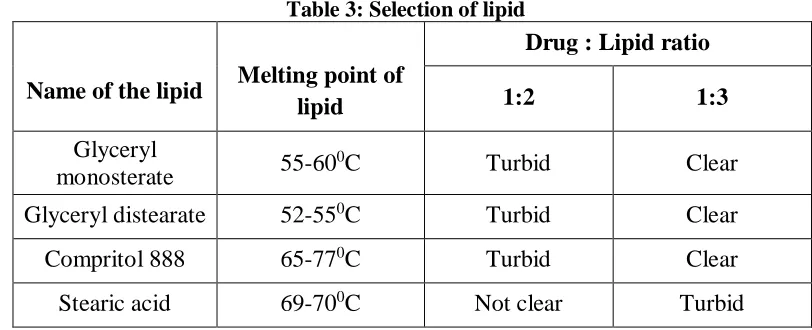
Suitable surfactant selection was done by solubility study of lipid in drug. Drug and lipid were mixed in two different ratios 1:2 & 1:3 in different test tubes. The mixture of lipids and drug were melted above 50C melting point of lipid using water bath. The test tubes were observed for miscibility and clarity whose results were tabulated below (ShineyTakatsuka et al.,2006).
4770
better entrapment efficiency (Schipper NGM et al., 1997).
2.2.2.3 Optimization of ultrasonication for energy input and pulse: The energy input & pulse required for the stable SLN dispersion can be optimized by preparing the formulations with 250, 400, 750 watts power and 30, 60 and 90% pulse. All the prepared formulations were checked for entrapment efficiency. The formulation prepared by 400 watts power and 90% pulse shown better entrapment efficiency than other types of formulations.
2.3 Evaluation studies:
2.3.1 Percent Entrapment Efficiency (%EE): The prepared SLN were evaluated for percent drug entrapment efficiency. To obtain the %EE, 10ml of the prepared SLN dispersion is taken in a centrifuge tube and it is placed in Remi cooling centrifuge. The centrifuge is rotated at 20,000 RPM for 2 hours. The resultant supernatant is taken and analyzed at 261nm (n=3) by UV visible spectrophotometer to obtain the amount of drug present in the dispersion. The %EE is calculated by the following mathematical expression (Varma MV et al., 2003).
%EE = Total amount of drug – amount of drug present in supernatant/ Total amount of drug X 100
2.3.2 Particle size and Zeta potential: The particle size & Zeta potential is the vital characterization parameter for Nanoparticles. The particle size decides whether the prepared formulation is in nano size or not. The zeta potential explains about the degree of aggregation of Nanoparticles. The average particle size and zeta potential of best formulation was analysed by HORIBA (zeta sizer). A small volume of SLN dispersion is diluted with high purity water which is again filled in polysterene cells and subjected to particle size analyser at a wavelength of 632nm. The scattering of light on the sample was monitored at 1730 angle at a temperature of 250C. the values of particle size and zeta
potential were obtained from the software present in the instrument.
2.3.3 Transmission Electron Microscopy (TEM for morphological
characterization):
The formulated Solid Lipid Nanoparticles were characterized for their morphological study by using Transmission Electron Microscopy (Zeiss EVOMa 15). The SLN dispersion was mixed with phosphotungstic acid (0.02% w/v) and kept aside in room temperature (for 5minutes) to obtain the equilibration. A drop of this preparation is placed on a copper grid which is coated with carbon. Draining of excess liquid is done and dried at room temperature. The prepared sample is micrographed at 200kv on a digital TEM station.
2.3.4 In vitro release studies:
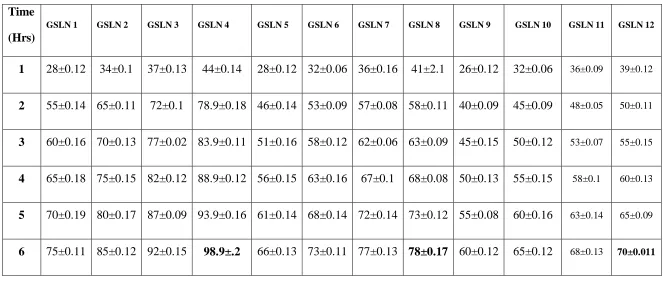
The in vitro release of Ganciclovir from prepared SLN formulations is performed by dialysis bag diffusion technique. The dialysis membrane was soaked for 12h in water before it is used for drug release studies and is sealed at one end and 5ml of drug loaded SLN was placed and sealed at another end. This is hanged and immersed in a beaker. The release studies were conducted in 0.1N HCl in first 2hours and in 6.8 phosphate buffer in the next 4 hours. The contents of the beaker were stirred at 100rpm at 37±0.50C. The aliquots of the sample were withdrawn at regular intervals of time (every 1hr) and replaced with same amount of fresh medium. The samples were diluted suitably and analyzed by UV-Visible spectrophotometric method. The % cumulative drug release was calculated (Bruce J. Aungst etal.,1996).
4771 3. RESULTS & DISCUSSION
3.1 Preformulation studies:
The preformulation studies for both drugs Tenofovir Disproxil fumerate and Ganciclovir were conducted. The FTIR spectral studies drug with polymers and absorption enhancers were conducted. The spectrums of FTIR shown that no functional group is mixed in the admixture of drug and polymers which were present in the individual ingredients. So, there is no interaction between drug and polymers for the formulation of Solid Lipid Nanoparticles.
3.2Particle size: The particle size and zeta potential of SLN 8 was performed. It shown the nanoparticulate range as mentioned in results (27nm). The zeta potential values (-18.3) reveal that the particles in the dispersion were in non aggregated state.
3.3Percent entrapment efficiency: The entrapment efficiency of all the prepared formulations was studied. The %EE of first four formulations is less when compared to SLN 5 – SLN8. The reason is assumed that the presence of piperine, the lipid is unable to hold the drug in its matrix beacause of its nature of making more pores on any structure. Where in the latter case they contained the chitosan which is not having any effect on entrapment of drug as like that of piperine 3.4 In vitro drug release studies:
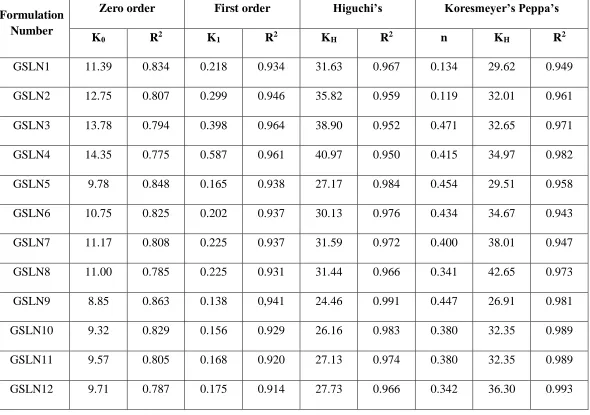
The invitro drug release studies reveals that SLN 1 –SLN 4 the drug release is more when compared to SLN 5 – SLN 8 owing to the reason that the first four formulations consists of the piperin as an absorption enhancer which enhances more pores in the nano particle structure due to which the release. Where as in the latter case absorption enhancer is chitosan where it doesn’t forms pores as much as that of piperine, so the less release than first four formulations. The SLN 9- SLN 12 showed more release than the first eight formulations because of the presence of both enhancers (Piperine, Chitosan) which made more number of pores on nano
particle structure. Different kinetic models like zero order, first order, Higuchi’s, korsemeyer, Hixson-crowel plots were plotted.
3.5TEM (Transmission Electron Microscopy) Analysis:
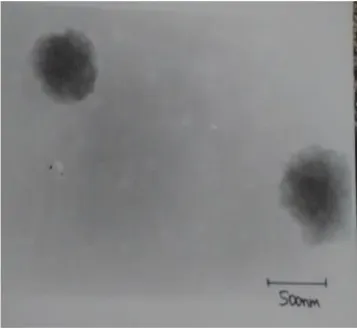
The TEM analysis (Zeiss EVOMa 15) of the best formulation (SLN8) reveals that the Nanoparticles are in round shape with smooth morphological structure. The TEM images of best formulation (SLN 8) were shown in figure 10.
4. CONCLUSION
4772 Figure 1: FTIR for Ganciclovir
Figure 2: FTIR Spectrum for Compritol 888
Figure 3: FTIR Spectrum of GMS
4773 Figure 5: FTIR spectrum of GDS
D:\IR DATA\.1027 F 4 SOLID 12/31/2015
38 54 .64 36 76 .85 34 41 .90 29 23
.84 2854
.96 23 59 .02 16 32 .94 13 82 .72 10 19 .51 66 8.9 9 1000 1500 2000 2500 3000 3500
W avenumber cm-1
70 75 80 85 90 95 100 Tra ns mi tta nc e [ %] Page 1/1
Figure 6: FTIR Spectrum of Admixture
Table 1: FTIR Spectral studies
Name of the functional
group
Frequency of Ganciclovir
(cm-1)
Frequency of Compritol
888 (cm-1)
Frequency of GMS
(cm-1)
Frequency of GDS(cm -1 ) Frequency of Poloxamer
188(cm-1)
Frequency of Admixture
(cm-1) C=C & C=N
stretching 1485 - 1434 1467 - 1580
C-C
stretching 1024 1019 - 801 1279 1249
C-H bending 748 - 828 - - 720
C-H
stretching 2850 - 2939 3023 2877 2848
N-H
stretching - 2359 2310 - - 2332
C=O
4774 Table 2: Composition of Ganciclovir Solid Lipid Nanoparticles
Code Ganciclovir
Compritol 888 (Lipid)
Glyceryl di stearate
(Lipid)
Glyceryl monostear
ate (Lipid)
Tween 80 (Surfactant)
Poloxamer 188 (Surfactant)
GSLN1 50 150 - - 1% -
GSLN 2 50 150 - - 2% -
GSLN 3 50 150 - - - 1%
GSLN 4 50 150 - - - 2%
GSLN 5 50 - 150 - 1% -
GSLN 6 50 - 150 - 2% -
GSLN 7 50 - 150 - - 1%
GSLN 8 50 - 150 - - 2%
GSLN 9 50 - - 150 1% -
GSLN 10 50 - - 150 2% -
GSLN 11 50 - - 150 - 1%
GSLN 12 50 - - 150 - 2%
Table 3: Selection of lipid
Name of the lipid Melting point of lipid
Drug : Lipid ratio
1:2 1:3
Glyceryl
monosterate 55-60
0C Turbid Clear
Glyceryl distearate 52-550C Turbid Clear
Compritol 888 65-770C Turbid Clear
Stearic acid 69-700C Not clear Turbid
3.3 Evaluation studies
Percent Entrapment Efficiency (%EE):
4775 Table 4: Percent Entrapment Efficiency (%EE)
Formulation No. Percent Entrapment Efficiency (%EE)
(n=3)
GSLN1 62.1 ±0.32
GSLN2 59.3 ±0.43
GSLN3 68.2 ±0.26
GSLN4 64.7 ±0.28
GSLN5 51.3 ±0.95
GSLN6 49.2 ±0.92
GSLN7 57.8 ±0.43
GSLN8 54.2 ± 0.53
GSLN9 44.1 ± 0.23
GSLN10 42.6 ± 0.31
GSLN11 48.2 ± 0.63
GSLN12 46.1 ± 0.87
4776 Figure 8: Zeta potential of GSLN 4
Table 5. Zeta potential
Formulation No. Zeta potential
GSLN 4 -18.3mV
GSLN 8 -25.0mV
GSLN 12 -2.6 mV
Table 6. Particle size
Formulation No. Particle size
GSLN 4 37.2 nm
GSLN 8 271.5 nm
4777 Time
(Hrs)
GSLN 1 GSLN 2 GSLN 3 GSLN 4 GSLN 5 GSLN 6 GSLN 7 GSLN 8 GSLN 9 GSLN 10 GSLN 11 GSLN 12
1 28±0.12 34±0.1 37±0.13 44±0.14 28±0.12 32±0.06 36±0.16 41±2.1 26±0.12 32±0.06 36±0.09 39±0.12
2 55±0.14 65±0.11 72±0.1 78.9±0.18 46±0.14 53±0.09 57±0.08 58±0.11 40±0.09 45±0.09 48±0.05 50±0.11
3 60±0.16 70±0.13 77±0.02 83.9±0.11 51±0.16 58±0.12 62±0.06 63±0.09 45±0.15 50±0.12 53±0.07 55±0.15
4 65±0.18 75±0.15 82±0.12 88.9±0.12 56±0.15 63±0.16 67±0.1 68±0.08 50±0.13 55±0.15 58±0.1 60±0.13
5 70±0.19 80±0.17 87±0.09 93.9±0.16 61±0.14 68±0.14 72±0.14 73±0.12 55±0.08 60±0.16 63±0.14 65±0.09
6 75±0.11 85±0.12 92±0.15 98.9±.2 66±0.13 73±0.11 77±0.13 78±0.17 60±0.12 65±0.12 68±0.13 70±0.011
4778 Formulation
Number
Zero order First order Higuchi’s Koresmeyer’s Peppa’s
K0 R2 K1 R2 KH R2 n KH R2
GSLN1 11.39 0.834 0.218 0.934 31.63 0.967 0.134 29.62 0.949
GSLN2 12.75 0.807 0.299 0.946 35.82 0.959 0.119 32.01 0.961
GSLN3 13.78 0.794 0.398 0.964 38.90 0.952 0.471 32.65 0.971
GSLN4 14.35 0.775 0.587 0.961 40.97 0.950 0.415 34.97 0.982
GSLN5 9.78 0.848 0.165 0.938 27.17 0.984 0.454 29.51 0.958
GSLN6 10.75 0.825 0.202 0.937 30.13 0.976 0.434 34.67 0.943
GSLN7 11.17 0.808 0.225 0.937 31.59 0.972 0.400 38.01 0.947
GSLN8 11.00 0.785 0.225 0.931 31.44 0.966 0.341 42.65 0.973
GSLN9 8.85 0.863 0.138 0,941 24.46 0.991 0.447 26.91 0.981
GSLN10 9.32 0.829 0.156 0.929 26.16 0.983 0.380 32.35 0.989
GSLN11 9.57 0.805 0.168 0.920 27.13 0.974 0.380 32.35 0.989
GSLN12 9.71 0.787 0.175 0.914 27.73 0.966 0.342 36.30 0.993
4779 Figure 9: Transmission Electron Microscopy
4780
REFERENCES
1. Sam Maher, Marc Davocelle, Sinead Ryan, Siobhan McClean, Impact of amino acid replacements on invitro permeation enhancement and cytotoxicity of the intestinal absorption promoter, melittin;
International Journal of
Pharmaceutics 387 (2010) 154-160. 2. Jonathan M. Miller, ArikDahan,
Quasi-equilibrium analysis of the ion-pair mediated membrane transport of low-permeability drugs; Journal of controlled release; 137(2009) 31-37.
3. M. RavindraBabu, P. Ravi Prakash, N. Devenna; Intestinal drug transporters; Creative Journal of Pharmaceutical research; 02 (2015) 88-99.
4. Dimple pabla, Intestinal permeability enhancement of levothyroxine sodium by straight chain fatty acids studied in MDCK epithelial cell line; European Jpournal of Pharmaceutical Sciences 40 (2010) 466-472.
5. Myungjookang, jaeyoulcho, Byung Ho Shim, Bioavailability enhancing activities of natural compounds from medicinal plants; Journal ofs Medicinal plants research 13 (2009) 1204 – 1211.
6. Shiney Takatsuka, Takeo Kitazawa, Enhancement of intestinal absorption of poorly absorbed hydrophilic compounds by Simultaneous use of mucolytic agent and non-ionic surfactant; EJP&B, 62 (2006) 52-58. 7. Hochman; Mechanism of absorption
enhancement and tight junction Regulation; JCR; 29 (1994) 253-267. 8. Schipper, chitosans as absorption
enhancers for poorly absorbable drugs; Journal of pharmaceutical research 14 (1997) 923-929.
9. Buur A, Bundgaard H, Falch E; Prodrugs of 5- Fluorouracil; Acta Pharm. Suec 23 (1986);205-216. 10.Varma MV, P-glycoprotien inhibitors
and their screening; a perspective from bioavailability enhancement; Journal of Pharmacology research 48 (2003) 347-359.
11.Viega, Oral bioavailability and hypoglycaemic activity of tolbutamide/cyclodextrin inclusion complexes; International Journal of Pharmaceutical sciences 202 (2000) 165-171.
12.Bruce, Enhancement of the intestinal absorption of peptides and non-peptides; Journal of controlled release 41 (1996) 19-31.
13.Myung Joo Kang, Bioavailability enhancing activities of natural compounds from medicinal plants; School of Bioscience and Biotechnology; 16 December, 2009; 200-701.
14.Dimple pabla; Intestinal permeability enhancement of levothyroxine sodium by straight chain fatty acids studied in MDCK epithelial cell line; European Jpournal of Pharmaceutical Sciences 40 (2010) 466-472.
4781
17.Young, “Chemical laboratory information profile, Oleic acid; Journal of chemical education; 79:24 18.Martena, “Medium chain triglyceride
;International airy journal 16(11): 1374-1382.
19.Stonge, MP; Jones; “Physiological effects of medium chain triglycerides; Potentialagents in the prevention of obesity”; The journal of nutrition 132(3).