Note
New
d
fistr
fibut
fion
records
of
some
w
fild
crop
relat
fives
from
Ind
fia
K
.
Pradheep
,
R
.S
.
Rath
fi
,
K
.
Joseph
John
,
S
.M
.
Su
ltan
,
B
.
Abraham
,
An
ju
la
Pandey
,
E
.
Rosh
fin
fi
Nayar
,
S
.P
.
Ah
lawat
&
R
fita
Gupta
26 May 2017 | Vol. 9| No. 5 | Pp. 10223–10228 10.11609/jot.2930.9.5.10223-10228
Threatened Taxa TheJournal of Threatened Taxafis dedficatedto bufildfing evfidencefor conservafion globally by publfishfing peer-revfiewed arficles onlfine every month at a reasonably rapfid rate at www.threatenedtaxa.org.All arficles publfishedfin JoTT are regfistered under Creafive Commons Atrfibufion 4.0InternafionalLficense unless otherwfise menfioned.JoTT allows unrestrficted use of arficles finany medfium, reproducfion, and dfistrfibufion by provfidfing adequate credfit to the authors and the source of publficafion.
OPEN
ACCESS
Partner
www
.
threa
tenedtaxa
.org
ISSN 0974-7907(Onlfine) |ISSN 0974-7893(Prfint) Bufildfing evfidencefor conservafion globally
Journa
l
o
f
Threatened
Taxa
Pub
l
fisher/Host
For Focus, Scope, Afims, Polficfies and Gufidelfines vfisfit htp://threatenedtaxa.org/About_JoTTFor Arficle Submfissfion Gufidelfines vfisfit htp://threatenedtaxa.org/Submfissfion_Gufidelfines
10223
No
te
LOGOs
DOI: http://doi.org/10.11609/jott.2930.9.5.10223-10228
Editor: N.P. Balakrishnan, Coimbatore, India. Date of publication: 26 May 2017 (online & print)
Manuscript details: Ms # 2930 | Received 23 July 2016 | Final received 08 May 2017 | Finally accepted 15 May 2017
Citation: Pradheep, K., R.S. Rathi, K.J. John, S.M. Sultan, B. Abraham, A. Pandey, E.R. Nayar, S.P. Ahlawat & R. Gupta (2017). New distribution records of some wild crop relatives from India. Journal of Threatened Taxa 9(5): 10223–10228; http://doi.org/10.11609/jott.2930.9.5.10223-10228
Copyright: © Pradheep et al. 2017. Creative Commons Attribution 4.0 International License. JoTT allows unrestricted use of this article in any medium, reproduc-tion and distribureproduc-tion by providing adequate credit to the authors and the source of publicareproduc-tion.
Funding: ICAR-NBPGR, New Delhi.
Competing interests: The authors declare no competing interests.
Acknowledgements: Authors acknowledge the Director, ICAR-NBPGR for guidance and support for this study.
New distribution records of some wild
crop relatives from India
K. Pradheep 1, R.S. Rathi 2, K. Joseph John 3, S.M. Sultan4, B. Abraham 5,Anjula Pandey 6, E. Roshini Nayar 7, S.P. Ahlawat 8& Rita Gupta 9
1,2,6,7,8,9 Division of Plant Exploration and Germplasm Collection,
ICAR-National Bureau of Plant Genetic Resources (ICAR-NBPGR), Pusa Campus, New Delhi 110012, India
3 ICAR-NBPGR, Regional Station, Kerala Agricultural University P.O.,
Thrissur, Kerala 680056, India
4 ICAR-NBPGR, Regional Station, Rangreth, Srinagar, Jammu &
Kashmir 191007, India
5 ICAR-NBPGR, Regional Station, Hyderabad, Telangana 500030, India 1 [email protected] (corresponding author),
2 [email protected], 3 [email protected], 4 [email protected], 5 [email protected], 6 [email protected], 7 [email protected], 8 [email protected]; 9 [email protected]
ISSN 0974-7907 (Online) ISSN 0974-7893 (Print)
OPEN ACCESS
Journal of Threatened Taxa | www.threatenedtaxa.org | 26 May 2017 | 9(5): 10223–10228
Doing field survey and collection of plant genetic resources in various parts of the country during the past seven years, the authors came across the natural distribution of a few wild relatives of crops in some Indian states, which were neither reported in the floristic literature (including eFlora of India 2014) nor in recent literature (e.g., Chakravarty 1982; Naithani 1990; Rao & Ellis 1995; Pullaiah & Chennaiah 1997; Kumar 2001; Murti 2001; Renner & Pandey 2013; Pradheep et al. 2014; Yadav et al. 2014). These plants were critically studied in natural habitats as well as in the herbarium. It is supplemented with the study of relevant literature, online herbaria of London (BM), Edinburgh (E), Kew (K), Paris (P) and Beijing (PE) including the type specimens. Herbarium vouchers were collected and deposited in the National Herbarium of Cultivated Plants (NHCP) at
ICAR-NBPGR, New Delhi/Thrissur.
1. Cajanus scarabaeoides
(L.) Thouars, Dict. Sci. Nat. 6: 617. 1817. Van der Maesen, Agric. Univ. Wageningen Pap. 85(4): 183. 1986 (“1985”). Dolichos scarabaeoides L., Sp. Pl. 2: 720. 1753. Atylosia scarabaeoides (L.) Benth., Baker in Fl. Brit. India 2: 215. 1879. [Family Fabaceae]. Fig. 1.
Creeper-climber supported by grasses and shrubs. Branches: woody at the base, striate, pubescent, up to 1.5m long. Stipules: small, ovate, hairy, caducous, stipels absent. Leaves: pinnately 3-foliolate; petioles 1.4–1.7 cm, terminal petiolule ~3mm long, leaflet coriaceous, glandular punctate below, pubescent on both surfaces, greyish green; terminal leaflet obovate-elliptic, 2–2.5 x 1–1.5 cm, apex obtuse, base cuneate; lateral leaflets (sub)sessile, smaller, obliquely obovate, 1.3–1.5 x 0.9– 1.0 cm. Inflorescence: raceme, axillary, 1–6 flowered, peduncle 3-6 mm long. Flowers: yellow to cream-yellow. Calyx: campanulate, 5–lobed, lower one longest, upper ones incompletely connate, lobes linear-lanceolate. Corolla: ~1cm long, deciduous, standard obovate, wing petals narrowly elliptic, and keel curved at apex. Stamens: ~9mm long, anther dorsifixed. Ovary: densely white pubescent, ovules 6. Pods: oblong, 1.8–2.0 x 0.6 cm, leathery, densely villous, transversely constricted between seeds. Seeds: 3–6, greyish with black and cream mosaic, rectangular-rounded, ~4mm.
Journal of Threatened Taxa | www.threatenedtaxa.org | 26 May 2017 | 9(5): 10223–10228 10224
Distribution records of wild crop relatives Pradheep et al.
Flowering & Fruiting: September–November & October–February.
Distribution: World: Asia (Bangladesh, Bhutan, Cambodia, India, Indonesia, Japan, Laos, Malay sia, Myanmar, Nepal, Pakistan, Sri Lanka, Thailand, Vietnam), Africa and Oceania; India (ILDIS World Database of Legumes 2015): Andhra Pradesh, Arunachal Pradesh, Assam, Bihar, Dadra-Nagar-Haveli, Delhi, Goa, Gujarat, Haryana, Himachal Pradesh, Jammu & Kashmir, Karnataka, Kerala, Madhya Pradesh, Maharashtra, Manipur, Meghalaya, Mizoram, Nagaland, Odisha, Puducherry, Punjab, Rajasthan, Sikkim, Tamil Nadu, Tripura, Uttar Pradesh, West Bengal, and Lakshadweep (now); along fields, roadsides, grassy slopes, seashores from sea level to 1,500m altitudes.
Notes: Although a common species in mainland India, this wild relative of the pigeon pea was noticed for the first time in this group of Islands in the calcareous soils with very low humus and nitrogen. Though it is of rare occurrence (as only 10 plants could be observed within the radius of 1km2),the third author observed its prolific
fruit bearing.
2. Cucumis javanicus
(Miq.) Ghebretinsae & Thulin, Novon 17(2): 177. 2007. Karivia javanica Miq., Fl. Ned. Ind. 1(1): 661. 1856. Melothria javanica (Miq.) Cogn. in Monogr. Phan. 3: 625. 1881. Mukia javanicus (Miq.) C.Jeffrey, Hooker’s Icon. Pl. 37: t. 3661. 1969. Melothria assamica Chakrav., J. Bombay Nat. Hist. Soc. 50(4): 897.1952. M. assamica var. scabra Chakrav., J. Bombay. Nat. Hist. Soc. 50(4): 898. 1952. [Family Cucurbitaceae]. Fig. 1; Images 1A & 2.
Annual scandent monoecious herbs. Stems and branches: slender, scabrous, hairy. Tendril: simple, slender, hispid. Leaves: petiole shortly hispid with hairs curved downwards, 4.5–5.5 cm long, lamina ovate-hastate, suborbicular in outline, 5.5–6 cm diam., usually 3(-5) lobed up to two third deep, median lobe ovate-triangular, both surfaces shortly hairy, denser on the veins below, margin remotely dentate, base cordate, apex obtuse or acuminate. Male and female flowers in different leaf axils. Male flowers: 2–4, fasciculate, ~1.5x2.0 cm, pedicel very short; calyx tube, ~2mm long, sepal subulate, ~1.5cm long, petal yellow, ovate, stamen inserted on calyx tube, anthers c. 1.5mm. Female flowers: 2-4, ~1.5x2.5 cm, sepal and petal as in male, ovary ellipsoid. Fruiting pedicel ~4mm long. Fruits: red, oblong, 1.2–1.4 cm long, juicy, with thin pericarp. Seeds: ~15, obovate, whitish, compressed, with a broad 2-grooved margin.
Specimen examined : 1468 [NHCP21204], Meghalaya,
Ri-Bhoi District, Umiam, 25040’828”N & 91054’055”E
elevation at 939m, 31.vii.2013 (part of leaf), coll. K. Pradheep & R.S. Rathi (National Herbarium of Cultivated Plants, ICAR-NBPGR, New Delhi).
Flowering & Fruiting: April–July & July–October. Distribution: World: India, Bangladesh, Myanmar, China, Taiwan, Thailand, Indonesia, Malaysia, Philippines; India: Assam, Meghalaya (now); occasional in open forests, scrub edges, grasslands on mountain slopes at 500–1,500 m.
Notes: It is distinguished from the nearest species C. maderaspatanus L. by fruits being oblong (vs. globose in C. maderaspatanus), fruit coat not thickened (vs. thickened) and seeds indistinctly scrobiculate and marginate. Though morphologically very different from cucumber and muskmelon, all these have been placed by molecular taxonomists (e.g., Ghebretinsae et al. 2007) under the section Cucumis.
3. Hystrix duthiei
(Stapf ex Hook.f.) Bor in Indian Forester 66: 544. 1940 & Grasses Burma, Ceylon, India & Pakistan 677. 1960. Asperella duthiei Stapf ex Hook.f., Fl. Brit. India 7: 375. 1897 [Family Poaceae]. Fig. 1; Image 1B & 3.
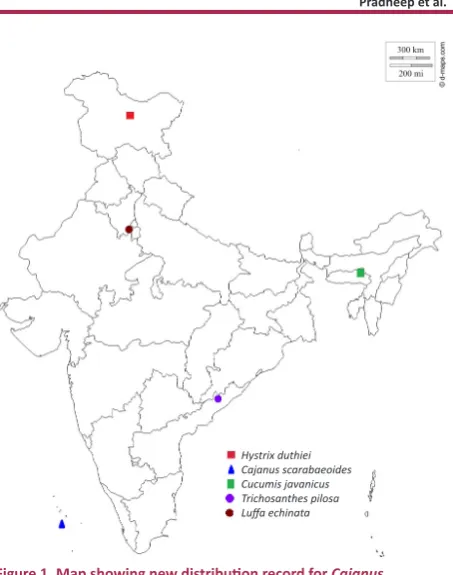
Perennial. Culms: 50–80 cm long, 3–4 - noded. Leaf sheath: glabrous, ligule eciliate, truncate. Leaf blade: Figure 1. Map showing new distribution record for Cajanus scarabaeoides, Cucumis javanicus, Hystrix duthiei, Luffa echinata, and Trichosanthes pilosa (original map from d-maps.com)
Journal of Threatened Taxa | www.threatenedtaxa.org | 26 May 2017 | 9(5): 10223–10228 10225
Distribution records of wild crop relatives Pradheep et al.
15–20 cm long, 1.2–1.5 cm wide, glabrous, scabrid, apex attenuate. Inflorescence: a spike, slender, 15–20 cm long, rachis puberulent, spikelet packing broadside to rachis, lax. Spikelets: 2 per node, 1.5–2 cm long, lanceolate, compressed, breaking up at maturity; florets 2–4 per
spikelet with fewer number at rachis apex, disarticulating below each fertile floret; rachilla pubescent. Glume: persistent, similar, shorter than spikelet, lower glume lanceolate, apex awned, 3.5–4 mm long, upper glume ~ 5mm long. Fertile lemma: oblong-lanceolate, ~ 1cm Image 1. New plant distributions in Indian states
A - Cucumis javanicus in Umiam, Meghalaya; B - Hystrix duthiei in Silmo, Jammu & Kashmir; C - Luffa echinata in Nasirbas, Haryana (inset: female flower); D & E - Trichosanthes pilosa in Norumothy, Andhra Pradesh (twig, fruit, inset: seeds)
Journal of Threatened Taxa | www.threatenedtaxa.org | 26 May 2017 | 9(5): 10223–10228 10226
Distribution records of wild crop relatives Pradheep et al.
long (excluding awn), puberulous, 5-veined, apex acute, 1-awned, awn ~2 cm long, a little curved. Palea: almost equals lemma. Anthers: 3, yellow. Stigmas: 2. Fruit: a caryopsis with adherent pericarp.
Specimen examined: 1680 [NHCP22156], Jammu & Kashmir, Kargil District, Silmo (near Batalik), 34037’724”N
& 76019’599”E, elevation at 3,172m, 05.ix.2015, K.
Pradheep & S.M. Sultan (National Herbarium of Cultivated Plants, ICAR-NBPGR, New Delhi).
Flowering & Flowering: May–August & September. Distribution: India, Nepal, China, Korea and Japan; India: Himachal Pradesh (Bor 1960), Uttarakhand, and Jammu & Kashmir (now). Forest margins, thickets, along water courses, at ~3200m altitude.
Notes: Joseph Dalton Hooker in Flora of British India, gave its locality of occurrence as ‘Tihri-Garwhal’ [Tehri-Garhwal] based on J.F. Duthie’s collection. In K, another specimen of this species, J.F. Duthie s.n. [K000032442], annotated as “Jamu Valley, plentiful under the shade of trees and near water” is available, indicating presence in
Jammu Valley. This, however, was not noticed in later works. Authors too could observe this species exactly in the habitat mentioned above, but could hardly find 25 plants in collected locality. As grouped under the tribe Triticeae, it forms a distant relative of wheat and barley, along with the species in allied genera Elymus and Leymus. Zhang et al. (2009) suggested transferring H. duthiei into the genus Leymus within the tribe Triticeae owing to its similar C-banding pattern with those of Leymus.
4. Luffa echinata
Roxb. Fl. Ind. 3: 716. 1832. Clarke in Fl. Brit. India 2: 615. 1879. Chakravarty in Rec. Bot. Surv. Ind. 17(1): 77. 1959. Chakravarty in Fasc. Fl. India 11: 71–72. 1982. L. echinata var. longistyla C.B. Clarke, Fl. Brit. India 2: 615. 1879. [Family Cucurbitaceae]. Fig. 1; Images 1C, 4 & 5.
Annual dioecious climber. Stem: sulcate, almost glabrous, smooth. Tendril: bifid, puberulous or glabrous. Leaf: petiole stout, puberulous, up to 15cm long; lamina 8–9 x 9–10 cm, reniform-suborbicular in outline, obscurely 5-lobed, apex short acute, scabrous, margin irregularly Image 2. Herbarium specimen of Cucumis javanicus in NHCP,
New Delhi
Journal of Threatened Taxa | www.threatenedtaxa.org | 26 May 2017 | 9(5): 10223–10228 10227
Distribution records of wild crop relatives Pradheep et al.
denticulate. Male inflorescence: paired in leaf axil, one 1-flowered and early in flowering, the other a 6–10 flowered raceme; raceme 12–15 cm long, bracteate, bract small, flower white, ~2.5cm across, pedicel 0.7–1 cm long. Calyx tube: hairy, villous, 3–4 mm long, lobes lanceolate. Petals: obovate, 1–1.1 cm long, hairy, obtuse. Stamens: triadelphous, 1 with single anther, 2 with 2 anthers each. Female flower: solitary, pedicel 4–5 cm long; calyx lobe 7–8 mm long, hairy, persistent; petals as in male; ovary ovoid-ellipsoid, densely bristly, bristle ciliate, style 3-cleft, divisions 2-parted. Fruits and seeds not seen.
Specimen examined: 2223 [NHCP22211], Haryana, Mewat District, Ferozepur Jhirka Tehsil, Nasirbas, 27055’536”N & 76054’481”E, elevation at 195m,
23.viii.2015 (fruiting twigs- female and male), coll. K. Pradheep (National Herbarium of Cultivated Plants, ICAR-NBPGR, New Delhi).
Flowering & Fruiting: August–September & September–October.
Distribution: World: Tropical Africa
(Chad, Ethiopia, Somalia, Sudan, Mali, Mauritiana, Niger, Nigeria, Cameroon), Pakistan, Nepal, Bangladesh and India; India (Renner & Pandey 2013): Assam, Bihar, Gujarat, Himachal Pradesh, Madhya Pradesh, Maharashtra, Uttar Pradesh, Uttarakhand, Tamil Nadu, West Bengal, Haryana (now); occasionally along dump heaps along roadsides.
Notes: This relative of ridge and sponge gourds was specifically found over dump heaps. It is the only species with white-flowers in this genus occurring in India.
5. Trichosanthes pilosa
Lour., Fl. Cochinch. 2: 588. 1790. T. ovigera Blume, Bijdr. Fl. Ned. Ind. 15: 934. 1826. T. himalensis C.B.Clarke, in Fl. Brit. India 2: 608. 1879. [Family Cucurbitaceae]. Fig. 1; Images 1D,E & 6.
Perennial dioecious climber to ~5m long. Stem: woody near base, ~2cm diam., deeply grooved, young twig sulcate, pubescent. Probract: absent. Tendril: stout, 2-fid, sulcate, puberulent. Leaf: petiole 4–6 cm long, striate, densely pubescent; lamina chartaceous, cordate in outline, almost simple with subtle projections, two Image 4. Herbarium specimen of Luffa echinata (female plant) in
NHCP, New Delhi
Journal of Threatened Taxa | www.threatenedtaxa.org | 26 May 2017 | 9(5): 10223–10228 10228
Distribution records of wild crop relatives Pradheep et al.
on either side, shortly villose beneath especially along nerves, basal sinus ~2.5cm deep, apex short-acute, margin denticulate. Male inflorescence and flowers not seen. Fruiting pedicel: 1.5–1.7 cm long, puberulent. Fruit: oblong, 6–6.5 x 2.5–3 cm, smooth, base rounded, apex acute, braked, beak ~4mm; immature one with 7–8 irregular white-stripes arising from distal end over dark green background, which turns orange-red on ripening, exocarp leathery, pulp yellowish-orange. Seeds: sub-quadrangular, c. 8x8x3.5 mm, emarginate, 3-loculed with lateral ones empty, thick near middle.
Specimen examined : 2112 [NHCP22158], Andhra Pradesh, Visakhapatnam District, Gangaraju Madugula Mandal, Norumothy, 18005’272”N & 82028’679”E,
elevation at 1,000m, 01.xi.2015 (fruiting twig), coll. K. Pradheep & B. Abraham (National Herbarium of Cultivated Plants, ICAR-NBPGR, New Delhi).
Flowering & Fruiting: May–September & September– December.
Distribution: World: South, East and Southeast Asia, Oceania; India: Andaman & Nicobar Islands, Arunachal Image 6. Herbarium specimen of Trichosanthes pilosa (female plant) in NHCP, New Delhi
Pradesh, Assam, Meghalaya, Nagaland, Sikkim, Tripura, West Bengal, and Andhra Pradesh (now); thickets along valleys, open forests on mountain slopes; at 700–2,500 m altitude.
Notes: Extended distribution of this distant relative of snake gourd westwards into the Eastern Ghats region is of phytogeographic significance. Authors could observe only two plants (one female and one juvenile) in open forest areas, climbing over a Lauraceous member. It is a polymorphic species showing wide variation in pubescence, leaf shape and fruit size; however seeds remain more or less tumid and subquadrangular. Collected specimen showed more or less cordate outline with no lobation and reduced pubescence.
References
Bor, N.L. (1960). The Grasses of Burma, Ceylon, India and Pakistan
(Indian Reprint 1979). International Book Distributors, Dehradun, 767pp.
Chakravarty, H.L. (1982). Fascicles of the flora of India: Cucurbitaceae,
No. 11. Botanical Survey of India, Calcutta, 135pp.
eFlora of India (2014). http://efloraindia.nic.in/efloraindia/homePage.
action Electronic version accessed 30 May 2016.
Ghebretinsae, A.G., M. Thulin & J.C. Barber (2007). Relationships
of cucumbers and melons unraveled: molecular phylogenetics of Cucumis and related genera (Benincaseae, Cucurbitaceae).
American Journal of Botany 94: 1256–1266.
ILDIS World Database of Legumes (2015). Cajanus
scarabaeoides (L.) Thouars. http://ildis.org/ cgi-bin/Araneus.
pl?version~10.01&LegumeWeb&t no~1612&genus~Dolichos&speci es~scara-baeoides Electronic version accessed 30 May 2016.
Kumar, S. (2001). Flora of Haryana (Materials). Bishen Singh Mahendra
Pal Singh, Dehra Dun, 507pp.
Murti, S.K. (2001). Flora of Cold Desert of Western Himalaya, Vol. I.
(Monocotyledons). Botanical Survey of India, Kolkata, 452pp.
Naithani, H.B. (1990). Flowering Plants of India, Nepal and Bhutan: Not
Recorded in Sir JD Hooker’s Flora of British India. Surya Publications,
Dehradun, 711pp.
Pradheep, K., D.C. Bhandari & K.C. Bansal (2014). Wild Relatives of
Cultivated Plants in India. Indian Council of Agricultural Research,
New Delhi, 728pp.
Pullaiah, T. & E. Chennaiah (1997). Flora of Andhra Pradesh, Vol. 1.
Scientific Publishers, Jodhpur, 463pp.
Rao, T.A. & J.L. Ellis (1995). Flora of Lakshadweep Islands off the
Malabar Coast, peninsular India, with emphasis on phytogeographical distribution of plants. Journal of Economic and Taxonomic Botany 19: 235–250.
Renner, S.S. & A.K. Pandey (2013). The cucurbitaceae of India: accepted
names, synonyms, geographic distribution, and information on images and DNA sequences. PhytoKeys 20: 53–118.
Zhang, H.Q., R.W Yang, L. Zhang, C.B. Ding, J. Zeng & Y.H. Zhou (2009).
Genetic diversity and phylogeny in Hystrix (Poaceae, Triticeae) and related genera inferred from Giemsa C-banded karyotypes. Genetics
and Molecular Biology 32(3): 521–527.
Yadav, S.R., K.V. Bhat, M. Latha, K.J. John, S.K. Malik, M. Aitawade, S.R. Rao, S. Scariah, M. Nissar, S. Umdale, P. Patil, G. Krishnan & R. Khedsana (2014). An Illustrated Guide for the Identification of Vigna
Savi, Cucumis L. and Abelmoschus Medik. Species in India. National
Bureau of Plant Genetic Resources, New Delhi; Shivaji University, Kolhapur; North Eastern Hill University, Shillong, 145pp.
The Journal of Threatened Taxa is dedicated to building evidence for conservation globally by publishing peer-reviewed articles online every month at a reasonably rapid rate at www.threatenedtaxa.org. All articles published in JoTT are registered under Creative Commons Attribution 4.0 International License unless otherwise mentioned. JoTT allows unrestricted use of articles in any medium, reproduction, and distribution by providing adequate credit to the authors and the source of publication.
May 2017 | Vol. 9 | No. 5 | Pages: 10141–10248
Date of Publication: 26 May 2017 (Online & Print)
DOI: 10.11609/jott.2017.9.5.10141-10248
www.threatenedtaxa.org
ISSN 0974-7907 (Online); ISSN 0974-7893 (Print)
OPEN ACCESS
Threatened Taxa
ArticleDna barcoding, population genetics, and phylogenetics of
the illegally hunted Philippine Duck Anas luzonica (Aves: Anseriformes: Anatidae)
-- Ardea Mingoa Licuanan, Mariano Roy Martin Duya, Perry Sim Ong & Ian Kendrich Carandang Fontanilla, Pp. 10141–10150
Communications
Population dynamics of medium and large mammals in a West African gallery forest area and the potential effects of poaching -- Emmanuel M. Hema, Yaya Ouattara, Mamadou Karama, Fabio Petrozzi, Massimiliano Di Vittorio, Wendengoudi Guenda & Luca Luiselli, Pp. 10151–10157
A comparative study of avian diversity in Teknaf Wildlife Sanctuary, Inani Reserve Forest and Chittagong University campus
in Bangladesh
-- M. Farid Ahsan & Ibrahim Khalil Al Haidar, Pp. 10158–10170
On two little-known terrestrial South Asian geckoes Hemidactylus
reticulatus and Hemidactylus scabriceps (Reptilia: Gekkonidae) -- S.R. Ganesh, M. Rameshwaran, Naveen A. Joseph & Ahamed M. Jerith, Pp. 10171–10177
Freshwater fish fauna of Hiranyakeshi River, the northern Western
Ghats, India
-- Pradeep Kumkar, Sanjay S. Kharat, Nitin S. Sawant, Unmesh Katwate & Neelesh Dahanukar, Pp. 10178–10186
Short Communications
A new species of sea squirt Rhopalaea bilobata (Ascidiacea: Diazonidae) from the Andaman Islands, India
-- Jhimli Mondal, C. Raghunathan & Tamal Mondal, Pp. 10187– 10193
Observations on the association of Scaphula deltae Blanford
(Mollusca: Bivalvia) in Garanga Wetland of Pobitora Wildlife
Sanctuary, Assam, India
-- Girindra Kalita, Pp. 10194–10197
Butterfly fauna of Baghmundi, Purulia, West Bengal, India:
a preliminary checklist
-- Supriya Samanta, Dipanwita Das & Sudipta Mandal, Pp. 10198– 10207
Butterflies of the Kole Wetlands, a Ramsar Site in Kerala, India -- S. Sarath, E.R. Sreekumar & P.O. Nameer, Pp. 10208–10215
A first record of three hitherto unreported species of bats from Kerala, India with a note on Myotis peytoni (Mammalia: Chiroptera: Vespertilionidae)
-- Bhargavi Srinivasulu & Chelmala Srinivasulu, Pp. 10216–10222
Notes
New distribution records of some wild crop relatives from India -- K. Pradheep, R.S. Rathi, K. Joseph John, S.M. Sultan, B. Abraham, Anjula Pandey, E. Roshini Nayar, S.P. Ahlawat & Rita Gupta, Pp. 10223–10228
Ixora polyantha Wight (Rubiaceae) a new record for northeastern
India
-- Deiji Narah, Nazir Ahmad Bhat & Yogendra Kumar, Pp. 10229– 10232
Euphorbia royleana Boiss., (Euphorbiaceae) a new record for the
Eastern Ghats, India
-- N. Sarojinidevi & Rudraraju Reddi Venkataraju, Pp. 10233–10235
Notes on the extended distribution of two threatened species of
Strobilanthes Blume (Acanthaceae) in Kerala, India
-- E.J. Josekutty, P. Biju & Jomy Augustine, Pp. 10236–10239
A first report of the Broad-Tail Royal Creon cleobis Godart,
1824 (Insecta: Lepidoptera: Lycaenidae) and its host plant from
Agasthyamalai Biosphere Reserve of the southern Western Ghats, India
-- Raveendran Lekshmi, Pp. 10240–10241
A photographic record of the Rusty-spotted Cat Prionailurus
rubiginosus (Mammalia: Carnivora: Felidae) in a forest plantation
on the east coast of Tamil Nadu, India
-- M. Bubesh Guptha & M. Eric Ramanujam, Pp. 10242–10245
Stomach contents of the Indian Pangolin Manis crassicaudata
(Mammalia: Pholidota: Manidae) in tropical forests of southern
India