Dr. V. M. Thakare
Department of Pharmaceutics,
TVES’s Honorable Loksevak Madhukarrao Chaudhari College of Pharmacy, Faizpur, India
Email:[email protected] Address for correspondence
Access this article online www.japer.in
Development of metoclopramide hydrochloride orodispersibal
tablets using taste masking tulsion 339
INTRODUCTION
The growing importance of mouth dissolving tablet
was underlined recently when European
Pharmacopoeia adopted the term Orodispersible
Tablet as a tablet that to be placed in the mouth where
it disperses rapidly before swallowing.[1,2] A solid
dosage form that dissolves or disintegrates rapidly in
oral cavity, resulting in solution or suspension without
the need of water is known as fast dispersing dosage
formmouth dissolving tablets. [3] When this type of
tablet is placed into the mouth, the saliva will serve to
rapidly dissolve the tablet. Most commonly used drugs
under this formulation are the agents active against
migraine. The tablets are designed to disintegrate as
well as dissolve within one minute or some within 10
seconds of oral administration in limited quantity of
saliva. They liquefy on tongue and patient swallows
the liquid, without the need of water.
Metoclopramide is used to treat Gastroparesis, by
stimulating stomach activity to empty the stomach.
Complicating the matter of oral administration of
Metoclopramide is the fact that patients with
Gastroparesis often have symptoms such as vomiting
and nausea as well as fullness and bloating, each of
which can lead to patient discomfort with or
unwillingness to swallow the available oral tablet and
associated water. If vomiting takes place, the amount
of Metoclopramide that remains in the stomach is
unknown, and the result of treatment is even less
predictable. The present invention provides an oral
rapidly dissolving Metoclopramide formulation and
administration of Metoclopramide of the oral
immediate release formulation to abate the rapid
onset of Gastroparesis. [4, 5]
MATERIALS AND METHODS
Metoclopramide Hydrochloride was obtained as gift
sample by Shalaks Pharmaceuticals, New Delhi,
India. Tulsion339 was obtained as gift sample by
Thermax Ltd. Mumbai All other materials and solvents
used were of analytical grade.
Formulation of drug polymer complex
Tulsion-339 was weighed 45gm, transferred to
container containing purified water and make up the
volume 100 ml [6]. This mixture was stirred on
mechanical stirrer for 15 minutes. Metoclopramide
hydrochloride 20 gm was added to above solution and In the present work, orodispersible tablets of Metoclopramide HCl were prepared by direct compression techniques using complex of drug with various superdisintegrant. Before formulation of tablets, the best superdisintegrant among Tulsion 339, Ac-Di-Sol, and Sodium starch glycolate was formulated with drug and tested. For taste masking ion exchange resin Tulsion 339 Drug: Tulsion339, 1:2.25 ratios was used. The blends were examined for pre-compression parameters. The result were complies with Pharmacopeial and non official limits. The prepared batches of tablets were evaluated for post compression parameters. Formulations were tested for in vitro drug release pattern (in pH 6.8 buffer), Batch F5 containing Tulsion 339 showed better disintegrating character along with the immediate release (100.32% within 6 minutes). Optimized batch F5 and tablets containing different concentration of Tulsion were compared with available marketed commercial formulation.
Keywords: Metoclopramide HCl, Oral dispersible Tablet, Tulsion 339,
Superdisintigrant. ABSTRACT ABSTRACT ABSTRACT ABSTRACT Vinod M Thakare*, Umesh T
Jadhao, Bharat W Tekade, Kundan P Chaudhari, Piyush N Mahajan
Department of Pharmaceutics, TVES’s Honorable Loksevak Madhukarrao Chaudhari College of Pharmacy, Faizpur, India
J. Adv. Pharm. Edu. & Res.
this mixture was stirred for 3 h and kept overnight.
After 24 h. the solution was filtered through muslin
cloth and the precipitate was washed 2 to 3 times with
water. All drug polymer complexes were kept for
drying in oven at 700C for 3 h and weighed. Practical
yield was obtained by dividing the practical weight
obtained from the sum of the weight of
Metoclopramide HCL and Tulsion 339 added by using
the following calculation.
Weight of solid dispersion x100 % yield of = --- Drug polymer Sum of the Metoclopramide HCL and complex Tul.339 added
Formulation of mouth dissolving tablet of drug polymer complex
Selection of superdisintegrant
Before formulation of tablets, the best
superdisintegrant among Tulsion 339, Ac-Di-Sol, and
Sodium starch glycolate was evaluated for suitability
in the formulations as per Table 1.
Table 1: Selection of Superdisintegrant
Batchs Disintegrant Disintegrant %w/w
Diluents %w/w
Disintegration time (sec.)
D1 --- --- 100 64
D2 Tul 339 8 92 9
D3 Tul 339 10 90 11
D4 Tul 339 12 88 11
D5 Ac-Di-Sol 8 92 32
D6 Ac-Di-Sol 10 90 25
D7 Ac-Di-Sol 12 88 19
D8 SSG 8 92 43
D9 SSG 10 90 41
D10 SSG 12 88 33
Tablets were prepared in various batches containing a
blend of microcrystalline cellulose and mannitol (1:1)
as a diluents and superdisintegrant in various
concentrations. The best superdisintegrant was
screened and used for the final formulation. All
materials were passed through sieve no. 40 # Drug
polymer complex (1:2.25) was mixed with diluents
and Superdisintegrants. Sweetener and flavor was
added to above blend, lubricated with
magnesium-stereate. Powder blend was compressed on eight
station rotary compression machine using flat
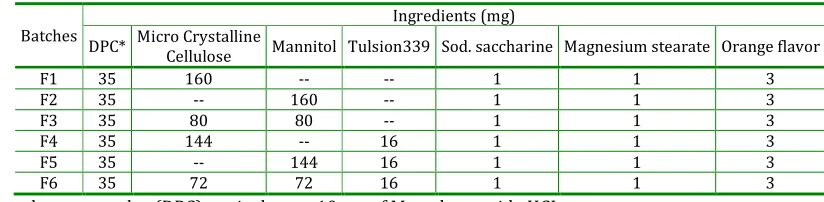
punches as shown in Table 2. Orodispersible tablets
was prepared by using direct compression technique.
Table 2: Formulation of Orodispersible Tablet
Batches
Ingredients (mg)
DPC* Micro Crystalline
Cellulose Mannitol Tulsion339 Sod. saccharine Magnesium stearate Orange flavor
F1 35 160 -- -- 1 1 3
F2 35 -- 160 -- 1 1 3
F3 35 80 80 -- 1 1 3
F4 35 144 -- 16 1 1 3
F5 35 -- 144 16 1 1 3
F6 35 72 72 16 1 1 3
* Drug polymer complex (DPC) equivalent to 10 mg of Metoclopramide HCL.
Evaluation of formulated tablet
Physical properties such as bulk density, tapped
density, compressibility index, and the angle of repose
of blend were determined of powder blend. [7,8]
Hardness
Hardness or tablet crushing strength the force
required to break a tablet in a diametric compression.
[9, 10] It is expressed in kg/cm2.
Thickness
The thickness of the tablets was measured using
vernier calliper. It is expressed in mm.
Friability
Friability of the tablet determined using Roche
friabilator. This device subjects the tablet to the
combined effect of abrasion and shock in a plastic
chamber revolving at 25 rpm and dropping a tablet at
height of 6 inches in each revolution. Preweighted
sample of tablets was placed in the friabilator and
were subjected to the 100 revolutions. Tablets were
de dusted using a soft muslin cloth and reweighed.
The friability (F) is given by the formula. [11]
Winitial - Wfinal
F = --- ×××× 100 Winitial
Wetting time & Water Absorption Ratio
A piece of paper folded twice was placed in Petri dish
having internal diameter of 5 cm containing 6 ml of
water. [12, 13] A tablet was placed on the paper and the
time required for complete wetting was measured.
The wetted tablet was then weighed for % water
absorption ratio.
It was determined using the equation
100(Wb - Wa) R = --- Wa
Where, Wa = Weight of tablet before water absorption
Wb = Weight of tablet after water absorption.
In-vitro disintegration time
The in-vitro disintegration time was determined using
disintegration test apparatus. One tablet was placed in
each of the six tubes of the apparatus and one disc was
added to each tube. The time in seconds taken for
complete disintegration of the tablet with no palatable
mass remaining in the apparatus was measured in
seconds. [14, 15] Tablet was added to phosphate buffer
solution pH 6.8 (which correlates pH of saliva) at
37±0.5°c. Time required for complete disintegration
of tablet was measured.
Drug Content
Weigh and powder 20 tablets. Weigh accurately a
quantity of the powder equivalent to 10 mg of
anhydrous Metoclopramide hydrochloride, add 50 ml
of 0.1M hydrochloric acid, heat on a water-bath at 70o
for 15 minutes, cool, dilute to 100.0 ml with water and
filter. To 20.0 ml of this solution add 15 ml of 1.25M
sodium hydroxide and extract with three quantities,
each of 30 ml, of chloroform, dry each extract with
anhydrous sodium sulphate and filter. Dilute the
combined extracts to 100.0 ml with chloroform and
mix. Measure the absorbanceof the resulting solution
at the maximum at about 305 nm.
In-vitro dissolution study
In vitro drug release study of DPC of Metoclopramide
HCl was performed in USP dissolution apparatus Type
2 (paddle).Phosphate buffer ph 6.8 was used as a
dissolution media. The bowls of the dissolution tester
was filled with 900 ml of phosphate buffer PH 6.8 and
allows to attaining a temperature of 37±0.5ºc and 50
rpm. Dissolution apparatus was started. At
predetermined time interval i.e.1, 2, 3, 4, 5, 6 min. 5ml
sample withdrawal and addition of fresh dissolution
media. The collected samples were filtered and
absorbance of the solution was measured at 305 nm.
The concentration of Metoclopramide HCl was
calculated using slope of calibration curve and
cumulative percentage release was calculated.
Drug Release from MDT and marketed
From the results of the tests, tablets of batch F5 were
considered to posses the best physical properties
accompanied with quick disintegration and, therefore,
tested and compared with the marketed tablet for
dissolution. The dissolution study of the optimized
tablet revealed rapid release.
Characterization of DPC and Molecular Properties
Molecular properties on complexation were studied
by x-ray diffraction (XRD) and Fourier transform
infrared spectroscopy (FTIR). The X-ray powder
diffractograms of the DPC (1:2.25), Metoclopramide
HCl and Tulsion 339 were recorded using a Philips PW
1729 X-ray diffractometer (Legroupe Interconnection,
Canada) with monocrotized Cu Kα radiation (1.314
A0), at a speed of 2θ min–1 from 10- to 60- (2θ) under
the voltage and current of 40 Kv and 30 Kv
respectively (Figure14, 15 and 16). Infrared (IR)
spectra of these samples were obtained by KBr disc
method (1800, Shimadzu Asia Pacific Pvt. Ltd,
Singapore) in the range of 4000 to 400 cm–1. [16, 17]
RESULTS AND DISCUSION
The angle of repose for the entire formulations blend
was found to be in the range of 26.12o to 33.21o.
Compressibility Index was found to be in the range of
14.61%. Bulk density was found to be in range of 0.26
to 0.51. Tapped density and Hausner ratio was also
carried out. And found in the range of 0.35 ± 0.35-0.60
± 0.39, 1.10 ± 0.17-1.34 ± 0.16.Drug content in drug
polymer complex was found 98.5 ± 0.5 [Table 3].
Table 3: Physical Properties of Tablet Blend
Parameters Formulation
F1 F2 F3 F4 F5 F6
Angle of repose 42.1± 0.55 37.8± 0.32 34.1± 0.51 31.0± 0.44 27.5± 0.65 33.0± 0.47 Bulk density 0.26 ± 0.29 0.51 ± 0.24 0.49 ± 0.25 0.49 ± 0.36 0.46 ± 0.63 0.47± 0.19 Tapped density 0.35 ± 0.35 0.60 ± 0.39 0.54 ± 0.28 0.58 ± 0.19 0.50 ± 0.42 0.54± 0.23 % Compressibility 25.4± 0.13 15.0± 0.37 9.82 ± 0.23 14.4± 0.30 8.37 ± 0.17 11.4± 0.18 Hausner ratio 1.34 ± 0.16 1.17 ± 0.12 1.16 ± 0.14 1.17 ± 0.14 1.10 ± 0.17 1.12± 0.16
All the tablets passed weight variation test as the
percent weight variation was within the
pharmacopoeial limits. The hardness of the table was
found to be between 2.85 to 5.5 kg/cm2. The
maximum thickness of the formulation was found to
be 4.19 mm and the minimum thickness of the
formulation was found to be 4.10 mm. The average
thickness of all the formulation was found to be 4.15
mm. The maximum friability of the formulation was
found to be 0.23 % and the minimum friability of the
formulation was found to be 0.15%. The friability was
less than 1% in all the formulations ensuring that the
tablet were mechanically stable.
The results of disintegration of all the tablets were
found to be within prescribed limits and satisfied the
criteria of Orodispersible tablet. The values were
found to be in the range of 75± 1.32 to 131 ±.041 sec.
The wetting time and water absorption ratio was also
in acceptable limit i.e. between 52.34 ± 1.10 to 111.04
±1.44 sec and 82.31 ± 0.35 to 84.62 ± 0.20. The
maximum drug content for all formulation was found
to be 100.84% and the minimum % drug content was
found to be 98.89 % .The result were complies the
Pharmacopeial limits [Table 4].
Table 4: Evaluation of Physical Parameter of Tablet
Parameter Batches
F1 F2 F3 F4 F5 F6
Thickness (mm) 4.11± 0.03 4.16± 0.06 4.15±0.02 4.14± 0.05 4.18± 0.02 4.18± 0.03
Hardness (kg/cm2) 3.1±0.62 4.1±0.38 3.5±0.16 4.3±0.39 2.85±0.22 3.8±0.16 Weight variation 199 ±1.50 201± 1.85 198±1.66 200 ± 1.33 198± 1.79 201± 1.45
Friability (%) 0.18± 0.59 0.17± 0.14 0.22±0.34 0.16± 0.19 0.12± 0.24 0.18± 0.29
Disintegration Time (Sec) 95± 1.12 131± 1.49 100± 1.67 127± 1.52 75± 0.32 128± 1.15
Assay (%) 98.89 99.58 99.25 99.45 100.84 100.65
Wetting time (sec) 70± 0.112 111± 0.80 86± 1.90 101± 0.10 52± 0.90 100± 1.44
% Water absorption ratio 84.62±0.32 83.27±0.20 84.2±0.21 82.87±0.35 82.31±0.51 82.5±0.40
Dissolution Study in 6.8 pH phosphate buffer: formulation of F1, F2, F3, F4, F5 and F6 have a recorded drug release
98.5%, 97.8%, 98.2%, 98.6%,100.32% and 98.5% at the end of 07 min the results was showed in [ Figure 1].
Figure 1: % Drug Release from Metoclopramide Orodispersible Tablet
The FTIR spectra of the pure drug were recorded in
between 4000 to 400 cm-1. Characteristics peak and
chemical group present in IR spectrum of
Metoclopramide was showed in[ Figure 2,3,4] C-H
Stretching of alkane at 2856-2939 cm-1, C=O
stretching of amide at 1650-1690 cm-1, C=C stretching
aromatic at 1550 cm-1, N-H stretching of amine at
3249-3323 cm-1, C-N stretching at 1275 cm-1 Can be
seen in spectra of individual drugs as well as in
spectra of physical mixture. So there is no interaction
between Metoclopramide and Tulsion 399.
Figure 2: IR Spectrum of the Metoclopramide Sample
Figure 3: IR Spectrum of the Metoclopramide Tulsion complex
Figure 4: IR Spectrum of the Physical mixture
The x-ray diffractogram of Metoclopramide HCl
confirms its crystalline nature, as evidenced from the
number of sharp and intense peaks [Figure 5, 6,7]. The
diffractogram of polymer (Tulsion 339) showed
diffused peaks, indicating its amorphous nature while
the diffraction pattern of the drug polymer physical
mixture showed simply the sum of the characteristic
peaks of pure drug and the diffused peaks of polymer,
indicating presence of drug in the crystalline state.
However, the diffraction pattern of DPC represents
complete disappearance of crystalline peaks of drug.
These findings suggest the formation of a new solid
phase with a lower degree of crystallinity due to
complexation.
Figure 5: XRD of Metoclopramide Hydrochloride
Figure 6: XRD of Tulsion 339
Figure 7: XRD of Metoclopramide:Tulsion complex
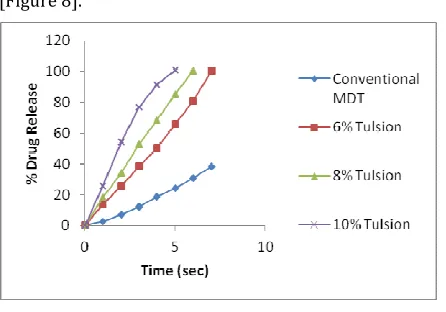
Effect of increasing concentration of Tulsion 339 on
dissolution of Metoclopramide hydrochloride
orodispersibletablets compared with marketed
conventional tablet. Formulations which contained
increasing concentrations of Tulsion 339 from 6%, 8%
and 10%, were recorded 100% dissolution of drug
within 7 min., 6 min. and 5 min. respectively. Given in
[Figure 8].
Figure 8: Comparison with Marketed Conventional Tablet
CONCLUSION
The Present study was undertaken with an aim to
formulate and evaluated Taste masked orodispersible
tablets of Metoclopramide Hydrochloride using direct
compression method with the addition of super
disintegrating agents Tulsion 339. Preformulation
study was carried out initially with study of selection
of superdisintegrants was done and different
formulations were prepared using superdisintegrants
Tulsion339 and different excipients. Results of all the
physical and in-vitro dissolution data, In-vitro
disintegration study was performed and from all
evaluation data concluded that the F-5 formulation
was the best one. From the present study it may be
concluded that formulation of orodispersible tablet of
Metoclopramide Hydrochloride containing
superdisintegrants Tulsion339 and mannitol is
suitable and can be taken as an ideal formulation.
REFERENCES
1. Abdelbary G., Eouani C., Joachim J., Reynier J.P.,
Piccerelle P.H. The Preparation of Orally
Disintegrating Tablets Using a Hydrophilic Waxy
Binder. Int J. Pharm 2004; 278, 423–433.
2. Aithal K., Harish N.M., Rathanand M., Shirwaikar A.,
Dutta M. Once Daily Fast Dissolving Tablets of
Granisetron Hydrochloride Formulation and In-Vitro
Evaluation. Indian Drugs 2006; 43(7): 576- 581.
3. Chang R.K., Guo X., Burnside B., Couch R.
Fast-DissolvingDrug Delivery System: A New Approch.
Pharm Technology 2000; 24(6): 52-58.
4. Rang H.P., Dale M.M., Ritter J.M., Moore P.K.
Pharmacology, Churchill Livingstone, Edinburgh, 5th
Edition, 2003, ISBN0-443-07145-4.
5. Tripathi K.D. Essentials of Medicinal Pharmacology,
Jaypee Brothers Medicinal Publishers Pvt. Ltd, New
Delhi, 5th Edition, 1999, 601-606.
6. Borodkin S. “Ion exchange resins and sustained
release”, In: Swarbrick J., Boylan J.C. editors.
Encyclopedia of Pharmaceutical Technology. New
York ,Marcel Dekker, 1993. p. 203– 216.
7. Banker S., Rhodes C. Modern Pharmaceutics, Marcel
Dekker Inc, 4th Edition, 1996, 635- 668.
8. Aulton M.E. The Science of Dosage Form Design,
Churchill Living Stone, 2nd Edition, 2002, 414-418.
9. Indian Pharmacopoeia, Ministry of Health and
Welfare, Controller of Publication, 2007, p. 780-782.
10. Ahad H., Sreenivasulu R., “Novel Approach in
Designing and In-Vitro Evaluation of Mouth
Dissolving Tablets of Metoclopramide
Hydrochloride”, Scholar Research Library, 2011,
3(1), 201-207.
11. Patel B and Patel J. “Formulation and Evaluation of
Mouth Dissolving Tablets of Cinnazarine”,
International Journal of Pharmaceutical Science,
2010, 72(4), 522-525.
12. Bhardwaj S and Jain V., “Formulation and Evaluation
of Fast Dissolving Tablet of Aceclofenac”,
International Journal of Drug Delivery, 2010, 93-97.
13. Lachman L., Libermann H.A., Karlig H. The theory
and practice of Industrial pharmacy; Varghese
Publishing House; 3rd edition; 1991. 412-429.
14. Khan S., Kataria P., Nakha P., Yeole P. “Taste Masking
of Ondansetron Hydrochloride by Polymer Carrier
System and Formulation of Rapid-Disintegrating
Tablets”, AAPSPharm SciTech., 2007; 8:127-133.
15. Narazaki R., Harada T., Takami N., Koto Y., Ohwaki T.
“A new method for disintegration studies of rapid
disintegrating tablets.”Chem Pharm Bull Tokyo.
2004; 52:704-707.
16. Duerst, M., Spectroscopic methods of analysis:
infrared spectroscopy. In: Swarbrick J and Boylon J.C.
(Eds.), Encyclopedia of Pharmaceutical Technology.
3rd Edn. Vol.5. Marcel Dekker Inc. New York, 2007.
17. Skoog D.A., Holler F.J., Nieman T.A., Principles of
Instrumental Analysis. 5th edn. Sounder’s College
Publishing, 2004. pp. 798- 808.
How to cite this article: Vinod M Thakare*, Umesh T Jadhao, Bharat W Tekade, Kundan P Chaudhari, Piyush N Mahajan; Development of metoclopramide hydrochloride orodispersibal tablets using taste masking tulsion 339; J. Adv. Pharm. Edu. & Res. 2013: 3(4): 480-486.
Source of Support: Nil, Conflict of Interest: Nil