Employability Feedback for Engineering Students
NORTCLIFFE, Anne <http://orcid.org/0000-0001-6972-6051> and
MIDDLETON, Andrew
Available from Sheffield Hallam University Research Archive (SHURA) at:
http://shura.shu.ac.uk/14538/
This document is the author deposited version. You are advised to consult the
publisher's version if you wish to cite from it.
Published version
NORTCLIFFE, Anne and MIDDLETON, Andrew (2011). Employability Feedback for
Engineering Students. In: International Conference on Engineering Education,
Belfast, Northern Ireland, 21-26 August 2011.
Copyright and re-use policy
See
http://shura.shu.ac.uk/information.html
Sheffield Hallam University Research Archive
Employability Feedback for Engineering Students
1
A.L. Nortcliffe, and
2A.J.W. Middleton
Dept. of Engineering and Maths, Sheffield Hallam University, UK [email protected] Learning and Teaching Institute, Sheffield Hallam University, UK, [email protected]
Abstract
A mock placement application process was devised for engineering and computing students incorporating various feedback techniques towards preparing students for success in being selected for placement interview. The simulated application process was intended to be a highly formative experience for students; one that would allow them to reflect upon and develop their individual approaches to writing placement applications in a safe and supportive situation before making real applications. The paper describes how students responded to the mock application process, which was supported by various modes of feedback, and how this has impacted on them personally with respect to their confidence and ability in making applications for placement. Research findings, based upon data from two questionnaires and student focus groups, were positive. The simulation improved student confidence. Peer review of the mock applications was more beneficial to the reviewers than those receiving the feedback. However, students valued the audio and written feedback they received from tutors, noting the formative impact of this in writing successful applications.
1. Introduction
In 2010 employers reported that they received 45 applications for each graduate vacancy, [1]. The volume of applications explains why recruitment processes, whether they are paper-based or online processes, have to be designed to make the selection of student applicants manageable and why the important formative dimension becomes lost in the process. This weakens an otherwise intense and formative opportunity. This is counter to the commercial sector‟s call for graduates with strong employability skills, [2], who are able to present themselves well during the recruitment process. It creates a conundrum: how can students learn from the process and improve their applications if the feedback they get from employers during the placement application process is unhelpful or non-existent?
Some critics argue that the process is flawed in other ways; for example, research indicates that success in securing employment is affected by the reputation of the institution that a student attends, by their social economic grouping, or by their social and familial networks rather than a student‟s academic ability, [4].
In the case of Engineering and Computing students the application process is competence-based. All large employers require students to complete an application form, [5], in which they are required to demonstrate their skills: for example, a Microsoft 2010 application competence based question was:
“Please describe a time when you worked effectively within a team, where other team members had differing views or priorities to yourself.”
2. Background
At the University of Glamorgan, a programme of placement preparation workshops and credit bearing placement application assignments for Civil Engineering students was shown to enhance student job-hunting skills and aid student preparation for employment, [6]. Led by Careers tutors, the key to success in this case was the tutors‟ teaching abilities and their relevant commercial experience. Feedback can be instrumental to the personal development of students and this is especially so when it demonstrates student progression and encourages reflection, enabling a student to assess their performance and to build upon it, [7]. On these career preparation assignments, feedback led to student success when students were inspired and stretched and when they had the capacity to reflect upon and feed forward the feedback they received.
Though academic tutors can provide rich and constructive feedback [8], the effect of feedback can be enhanced through peer assessment by increasing the number of assessors, [9]. If each student assesses more than one fellow student, engagement with the feedback process can produce a good dialogical experience, [27]. Peer feedback is not always constructive and can easily stray from the assessment criteria [11-12]. This can be resolved by giving student assessors clear guidance of how to use them and assessment criteria [13]. Not only can peer assessment provide valuable peer feedback [14], but it can aid learner reflection [15].
A well-designed assessment rubric provides insight into the assessment criteria, [16], making it easier for academics and students to provide effective feedback [17]. A rubric can also promote student self-regulation, but students are not always good at making use of them, [18]. A blended feedback approach involving the use of an assessment rubric and audio recordings of one-to-one tutor-student feedback conversations can help the student to use a rubric effectively, [19]. However, this level of support is often impractical in terms of time and resources, [20]. Some tutors have turned to technology for solutions and have found the recording of audio feedback, rather than written feedback, supports a more efficient pastoral approach to giving feedback, [21-22]. In earlier work by the authors, a blend of personal audio feedback, in the form of a tutor monologue model in conjunction with an assessment rubric proved to be timely, highly informative, engaging and motivational, and resulted in an increase in the students‟ self-esteem, [23]. However, audio feedback is not suited to every academic, [24]. This suggests the use of a multi-layered feedback strategy would be beneficial involving self and peer assessment, and personal tutor feedback (audio or written) used in conjunction with an assessment rubric, to encourage student reflective practice.
3. A Mock Application Process
3.1 Purpose
All full-time level 5 Engineering and Computing students are registered on a sandwich degree program. Employability learning outcomes are embedded into second year modules, constituting 10% of the module assessment for Engineers and 20% for Computing students. The learning outcomes relating to employability lead to students who are capable of being recruited for placement recruitment and undertaking placement employment.
This paper examines the extent to which a mock application process provides an effective way of preparing students so that they are selected for placement interview and not left emotionally stranded by the first stage in the employer application process. Specifically, this paper considers the efficacy of the simulated application process used with Engineering and Computing students, which was rich in feedback and designed to develop students' confidence and ability in applying for placement positions.
3.2 Simulation design
be similar in design and focus to questions used by employers‟ in application and recruitment processes.
For the simulation, all of the full-time Engineering students were provided with job descriptions for placement positions at Tata Steel and. They were required to submit a covering letter and to complete an electronic application form. For the Computing students, details of an IT Support position at A4employment were provided. These students were only required to complete an application form.
The strategy for giving feedback on the assessment involved using a mixed approach of an assessment rubric, peer feedback, self assessment and tutor feedback. Peer feedback was conducted in class on the day of submission. This involved distributing the application forms anonymously for peer assessment. Peers annotated an assessment rubric and also added written feedback to application scripts submitted by their fellow students. In theory the self assessment occurred concurrently with the peer assessment as students reflected on their own work in light of what they had learnt from their peers. At the end of the class the scripts were collected by the tutor and graded over two weeks. Most of the teaching team gave feedback in the form of annotations on the assessment rubric and on the students' scripts. However, one member of the teaching team provided audio feedback in the form of a commentary on the mock applications in conjunction with an annotated assessment rubric for each student which were returned using email. All the scripts and annotated assessment rubrics were returned in class or through reception for those students who were absent.
4. Research Methodology
An evaluative action research methodology that involves student respondents, as used in this study, is frequently affected by prosaic constraints such as curriculum modularisation and timetabling. However, it is important to engage student and staff participants whilst the affect of a teaching intervention is still fresh and clearly meaningful. This needs a flexible methodology, therefore, and methods that engage the target respondent group realistically.
The researchers in this study (the module leader and an educational developer) found it necessary to use a variety of methods to evaluate the simulation and the consistency and effectiveness of the feedback received by the students. The aim was to create a rich picture of the student‟s experience and to evaluate this against the following hypothesis: a simulated application process supported by multiple layers of feedback provides an effective strategy for developing student confidence and ability in applying for placement positions.
Initially the research employed was a semi-structured group conversation, [25], and was conducted with students who had received audio feedback. This took place two and a half months after receiving feedback on their mock application. To validate this, and to ensure a wider response, students who were unable to participate in the group conversation were emailed by their tutor for their reflections on the feedback approach they had experienced and the impact they believed that this had had on their learning.
This was followed three months later by an online survey accessed by the student respondents through the VLE. The survey aimed to identify the impact of the various feedback methods upon the students and their subsequent placement applications. Open ended questions in the survey were used to semantically analyse the frequency of common emotional themes in the student responses, [26].
Finally, the faculty‟s Placement, Employability and Experience Unit (PEEU) were asked to provide examples of employer feedback so that it could be compared to feedback provided during the mock application simulation.
5. Findings
5.1 Student reflections on employability feedback
showed that the students believed that the use of mock applications impacted positively upon their learning. For example, one reported how they felt the process was constructive for them, explaining how they had secured interviews with three different employers. The active participation in the peer reviewing process was particularly noted as a valuable opportunity to reflect on and be critical of their own applications in this case. However, the same student was unsuccessful at the interview stage and now needs to develop their interview technique.
Another student noted how they had come to appreciate the need for each application to be bespoke for each job due to their experience of the mock application. However, the same student explained that the feedback they had received from their peers was mostly uncritical and unhelpful. This was in contrast to the audio feedback they had received from their tutor, which had helped them to decode the advert. They said, “I liked the audio feedback you gave because it meant I could get some 'real' ideas and help from someone who knew what to look for rather than my peers who may not have wanted to upset me.”
5.3 Survey of application feedback
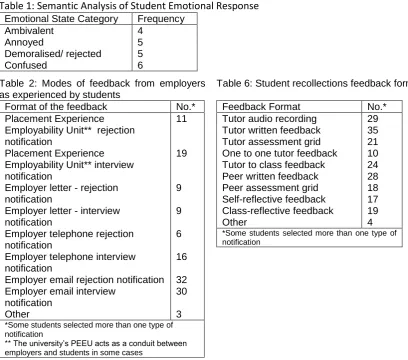
68 students responded to the second survey out of a cohort of 844, of which 130 had received tutor audio feedback. 22 of the respondents said they had not received any feedback from employers and 20 of these explained how that affected them emotionally. A lack of employer feedback on applications is likely to undermine student confidence, [27], as highlighted in the semantic analysis of the data (Table 1) where students are shown to be left confused. The following comment captures this,
“
It puts me in a limbo, don’t know which companies are interested if any”
Table 1: Semantic Analysis of Student Emotional Response
Emotional State Category FrequencyAmbivalent 4
Annoyed 5
Demoralised/ rejected 5
Confused 6
Table 2: Modes of feedback from employers as experienced by students
Format of the feedback No.* Placement Experience
Employability Unit** rejection notification
11
Placement Experience Employability Unit** interview notification
19
Employer letter - rejection notification
9 Employer letter - interview
notification
9 Employer telephone rejection
notification
6 Employer telephone interview
notification
16 Employer email rejection notification 32 Employer email interview
notification
30
Other 3
*Some students selected more than one type of notification
[image:5.595.86.495.375.735.2]** The university‟s PEEU acts as a conduit between employers and students in some cases
Table 6: Student recollections feedback format Feedback Format No.*
Tutor audio recording 29 Tutor written feedback 35 Tutor assessment grid 21 One to one tutor feedback 10 Tutor to class feedback 24 Peer written feedback 28 Peer assessment grid 18 Self-reflective feedback 17 Class-reflective feedback 19
Other 4
46 of the 68 respondents reported that they had received feedback from their employers. The mode of the feedback (Table 2) shows there is a relationship between feedback and applicant success.
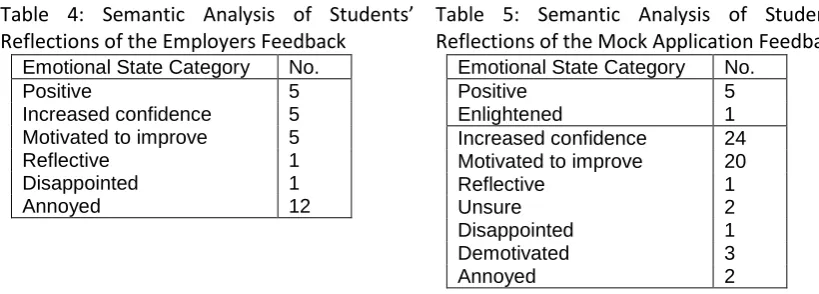
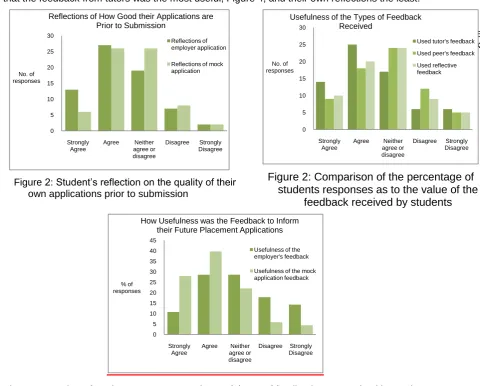
The impact upon the confidence of students from the employers‟ notifications was tempered by the belief held by the majority of students in their abilities and the quality of their applications following the mock application exercise, as shown by Figure 1. Feedback on the mock application clearly affected the students‟ approach to their real world applications. This is confirmed in the semantic analysis of the free text responses to student feelings about the feedback students received on their mock application and actual applications (Tables 4 and 5). The mock application increased student motivation and confidence in embarking upon the employment application process. However, confidence needs to be underpinned by constructive feedback to be useful. Students found the feedback on their mock applications more useful than the feedback they received from employers, Figure 2. The student comments reflect this, for example:
Student A on employer‟s feedback;
“I was a little disappointed with the rejections but then again, it was very highly competitive.”
Student A on the mock application feedback;
“It was good as it gave me an idea of what employment applications are like.” Student B on employer‟s feedback;
“Email feedback said what I was good in, but never hi-lighted what I should improve.”
Student B on mock application feedback;
“It was good practice, and peer assessment gave me good points to think about.”
Table 4: Semantic Analysis of Students’
Reflections of the Employers Feedback
Emotional State Category No.
Positive 5
Increased confidence 5 Motivated to improve 5
Reflective 1
Disappointed 1
Annoyed 12
Table 5: Semantic Analysis of Students’
Reflections of the Mock Application Feedback
Emotional State Category No.
Positive 5
Enlightened 1 Increased confidence 24 Motivated to improve 20
Reflective 1
Unsure 2
Disappointed 1 Demotivated 3
Annoyed 2
These findings are consistent with those of the staff in the faculty‟s PEEU, where they have observed the frequency of employer feedback. However, employer feedback is usually given after the interview process and the feedback is mostly on interview performance. Whilst this is typical of the form of feedback given to job applications in the real world, it excludes feedback for unsuccessful applications. For example, the feedback from one employer on four interview candidates is provided below;
The student’s CV was good, although there was little mention of projects, planning and research. The student seemed a little nervous and therefore some of his answers to questions were short and therefore limited in detail…
[image:6.595.85.495.412.559.2]The student’s CV needs to provide more detail on his IT technical skills and also on projects and organisation as his results are excellent and he should use this to his advantage. The student came across as a likeable individual and was more confident with some questions than others…
Student's CV was good. He came across as a likeable and confident individual who gave some well rounded answers…
Note that the feedback discusses the student, being addressed to the PEEU rather than directly to the student. The feedback varies in detail and consistency with respect to student applications, with some receiving more constructive feedback on how to improve than others. The survey results indicate that although all students were given a blended mix of feedback for the mock application, (Figure 3), not all students recall receiving all of it. Students paid more attention to, and recalled, the feedback they received from their tutor (Table 6). Upon further analysis of how students perceived the value of each type of feedback, students said they found that the feedback from tutors was the most useful, Figure 4, and their own reflections the least.
Figure 2: Student‟s reflection on the quality of their own applications prior to submission
Figure 1: Comparison of the percentage of students responses as to the value of the feedback
received by students
Figure 2: Comparison of the percentage of
students responses as to the value of the
[image:7.595.82.563.263.649.2]feedback received by students
Figure 4: Number of students' responses to the usefulness of feedback type received by student
7. Conclusion
This study evaluated a simulation that took students through a mock job application process as a way of preparing them for making successful applications for placement positions. It also considered the role of feedback in supporting learner reflection and the value of different feedback methods and combinations. To do this it was hypothesised that a simulated application process supported by multiple layers of feedback provides an effective strategy for developing student confidence and ability in applying for placement positions.
0 5 10 15 20 25 30 Strongly Agree Agree Neither agree or disagree Disagree Strongly Disagree No. of responses
Reflections of How Good their Applications are Prior to Submission
Reflections of employer application Reflections of mock application 0 5 10 15 20 25 30 Strongly Agree Agree Neither agree or disagree Disagree Strongly Disagree No. of responses
Usefulness of the Types of Feedback Received
Used tutor's feedback Used peer's feedback Used reflective feedback 0 5 10 15 20 25 30 35 40 45 Strongly Agree Agree Neither agree or disagree Disagree Strongly Disagree % of responses
How Usefulness was the Feedback to Inform their Future Placement Applications
The mock application method was well received by students and effectively engaged them in preparation for making placement applications. Students believed the summative approach aided them to increase the quality of their actual placement applications, their confidence and their motivation in applying for placement positions. The feedback approach is multi-layered, but the students did not value their own reflections on their mock application as much as the peer feedback they received. However, it became clear when interviewed and questioned by email, students were also dismissive of peer feedback believing it to be unreliable, and instead indicated that they valued the act of reviewing as a way to reflect upon their own approach. The tutor feedback, whether in written or audio formats, was found to be the most useful by the students who were clear that this had improved their actual placement applications. There is some difference in the appreciation of audio and written feedback, but in this simulation it is not clear how significant this is.
Whilst a tutor might use the word „feedback‟ in devising a multiple layered feedback strategy, its meaning to students is not so clear and this has undoubtedly affected this evaluation. For example, students in the study appreciated tutor feedback as being affective, though in general did not recognise their own reflective response to this as being part of a feedback cycle impacting upon their eventual applications. This highlights the difficulty, for example, of talking about and evaluating feedback in simple terms. This explains, for example, why the consistently low student satisfaction ratings for feedback in higher education as evidenced in the National Student Survey in recent years, [28], probably only reflect a quite particular understanding of feedback and its role in the curriculum.
Effective summative feedback increased confidence and improved the quality of applications submitted to employers. However, if there is value in connecting learning to real world activity, [29], as is the case in placements, educators need to make those connections explicit and meaningful in designing placement-based pedagogy. Feedback from employers on applications, both successful and unsuccessful, provides a rich learning opportunity potentially; however, students reported dismay and confusion at the lack of meaningful feedback on their actual placement applications. This left them feeling unsure of what was strong or weak in determining employer selection. Further thought should be given, therefore, to how feedback methods can be developed around the submission of actual applications, whether this involves employers, placement unit agents, tutors, or peers. Students and tutors need to think particularly about how students could solicit feedback from employers, and institutions need to look at developing mutually beneficial arrangements with employers that value the exchange of feedback on submissions as well as interviews.
Acknowledgements
The authors would like to acknowledge the support of the Placement tutor team who were responsible for designing and implementing the feedback approaches discussed in this paper.
References
1. High Fliers, The Graduate Market in 2011 High Fliers Research, published at
http://www.highfliers.co.uk/download/GMReport11.pdf, last accessed 10/2/11, 2011
2. C. Davidson, So last century Times Higher Education, No. 1,996, pp. 32-36 (2011)
3. L. Holmes, Reconsidering Graduate Employability: The 'graduate identity' approach, Quality in Higher
Education, Vol. 7: No. 2, pp. 111-119, 2001
4. A. Chevalier and G. Conlon, Does It Pay to Attend a Prestigious University? (August 2003). IZA
Discussion Paper No. 848. Available at SSRN: http://ssrn.com/abstract=435300 (2003)
5. J. Raybould, and V. Sheedy, Are graduates equipped with the right skills in the employability stakes?,
Industrial and Commercial Training, Vol. 37 Iss: 5, pp.25-263, 2005
6. S. Barthorpe; and M. Hall, A collaborative approach to placement preparation and career planning for
university students: a case study, Journal of Vocational Education & Training, Vol. 52, No. 2, pp
165-175 2000
7. D. J. Nicol and D. Macfarlane-Dick, Formative assessment and self-regulated learning: a model and
2006
8. D. Whitelock, S. Watt, Y. Raw and E. Moreale, Analysing tutor feedback to students: First steps
towards constructing an electronic monitoring system, Research in Learning Technology, vol.11,
No.3, pp31-34, 2003
9. N. Falchikov, Involving students in feedback and assessment: a report from the Assessment
Strategies in Scottish Higher Education (ASSHE) Project, in Brown, S (ed) , Peer Assessment in
Practise, Staff Education Development Association (SEDA): Scotland 1998
10. D. Nicol, From monologue to dialogue: improving written feedback processes in mass higher
education, Assessment and Evaluation in Higher education, Vol. 35, No. 5 August 2010 , pp501-517,
2010
11. A. Conant, Every Student a Teacher: Peer Assessment,
http://www.umcs.maine.edu/~orono/collaborative/spring/every.html, last accessed May‟07, 1997
12. A. Zariski, Student Peer Assessment in Tertiary Education: Promise, Perils and Practice, Teaching
and Learning Within and Across Disciplines, Abbott and Willcoxson: Perth: Murdoch University,
http://law.murdoch.edu.au/academics/zariski/peer1.html, last accessed May‟07, 1996
13. C. Mindham, Peer assessment: Report of a project involving group presentations and assessment by
peers in Brown, S (ed) , Peer Assessment in Practise, Staff Education Development Association
(SEDA):Scotland, 1998
14. J. Mills, C. Glover, and V. Stevens, Using assessment within course structures to drive student
engagement with the learning process. In Refocusing Feedback Proceedings of the 2005 13th
International Symposium Improving Students Learning: Improving Student Learning Through Assessment, London 5-7 September 2005, Oxford: Alden Press, pp358-367
15. D. Sluijsmans, F. Dochy and G. Merkerke, Creating a learning environment by using self-, peer-and
co-assessment, Learning Environments Research1(3) 293, 1998
16. J. McTighe, K. O'Connor. Seven practices for effective learning Educational Leadership Vol. 63, No.
3; pp10-17 2005
17. J. Gaytan, and B. C. McEwen, Effective Online Instructional and Assessment Strategie', American
Journal of Distance Education, Vol.21, No.3, pp117-132, 2007
18. H. Andrade and Y. Du, Student use of Rubrics, Practical Assessment Research & Evaluation, Vol 10,
No 3,pp1-11, http://pareonline.net/pdf/v10n3.pdf, last accessed May 2011, 2005
19. A. L. Nortcliffe, and A. J. Middleton, A. Blending the engineer's learning environment through the use
of audio. Engineering Education 2008 Conference, Loughborugh, UK, July 2008
20. T. Burgess, H. Lewis, H., and T. Mobbs, Academic workload planning revisited. Higher Education,
Vol.46, No.2: pp.215-233, 2003
21. K. Croker, Giving Feedback via audio files‟. HEA Assessment SIG 5th June 2008 Meeting, York, UK,
2008
22. B. Rotheram, Sounds Good:- quicker, better assessment using audio feedback? Assessment SIG:
Working with students to enhance feedback, The Higher Education Academy, 25th March 2010, York, 2010
23. A. Nortcliffe, and A. Middleton, Effective assignment feedback through timely and personal digital
audio engagement' in John O'Donoghue (ed.) Technology-Supported Environments for Personalized
Learning: Methods and Case Studies. Hershey Pennsylvania, USA: IGI Global. 2009
24. Rodway, S. And Dunne, E., Questioning Audio Feedback, A Word in Your Ear - Audio Feedback
Conference: http://research.shu.ac.uk/lti/awordinyourear2009/, last accessed Jan‟10, Sheffield, UK,
18th December 2009
25. L. Cohen, L. Manion, and K. Morrison, Research methods in education. 5th edition.Routledge and
Falmer, London and New York. 2000
26. Jackson, Concept mapping as an alternative approach for the analysis of open-ended survey
responses, Organizational research methods vol.5, No. 4 iss:4 pp307, 2002
27. M. Deutsch and H. B. Gerard, A study of Normative and Information Social influences upon Individual Judgment, The Journal of abnormal and social psychology, Vol. 51, No. 3, pp629, 1955
28. HEFCE, National student survey: findings and trends 2006 to 2009. Online at: http://www.hefce.ac.uk/pubs/hefce/2010/10_18/, 2010