inorganic papers
i188
Spek and Jong K1.33Na0.67Si2O5 doi:10.1107/S1600536805022348 Acta Cryst.(2005). E61, i188–i190 Acta Crystallographica Section E
Structure Reports Online
ISSN 1600-5368
Potassium sodium phyllosilicate,
K
1.33Na
0.67Si
2O
5Anthony L. Speka* and Bernard H. W. S. de Jongb
a
Faculty of Sciences, Bijvoet Center for Biomolecular Research, Department of Crystal and Structural Chemistry, Utrecht University, Padualaan 8, 3584 CH Utrecht, The Netherlands, andbFaculty of Geosciences,
Utrecht University, Budapestlaan 4, 3584 CD, Utrecht, The Netherlands
Correspondence e-mail: [email protected]
Key indicators
Single-crystal X-ray study
T= 150 K
Mean(Si–O) = 0.004 A˚
Rfactor = 0.043
wRfactor = 0.118
Data-to-parameter ratio = 11.4
For details of how these key indicators were automatically derived from the article, see http://journals.iucr.org/e.
#2005 International Union of Crystallography Printed in Great Britain – all rights reserved
The two-dimensional network topology of the mixed alkali title compound, K1.33Na0.67Si2O5, is found to differ from that of the end-member compositions, Na2Si2O5and K2Si2O5. The network of the silicate sheet consists of rings with four, six and eight SiO4 tetrahedra. The cations are sandwiched between the silicate sheets.
Comment
In previous papers, we have described the preparation and structures of a number of crystalline alkali and mixed alkali disilicates (phyllosilicates) with chemical formula R2O2SiO2 (R= Li, Na, K, Rb and Cs; de Jonget al., 1994, 1996, 1998, 2000; Veldman et al., 1995). Not all combinations of alkali metals form mixed alkali disilicates at ambient pressure. The impossible combinations are (Li,Na), (K,Rb), (K,Cs) and (Rb,Cs) disilicates. Their cationic field strength difference is too small according to a theory proposed by Dietzel (1983).
There are many reasons why the study of these materials is useful. Our reason was to find an explanation for the variation in hygroscopicity of mixed alkali disilicate glasses. These glasses may be used as model compounds for dried soluble silicates (Weldes & Lange, 1969), for which there was an industrial need to make them non-hygroscopic. Though
[image:1.610.207.457.472.679.2]Received 1 July 2005 Accepted 12 July 2005 Online 27 July 2005
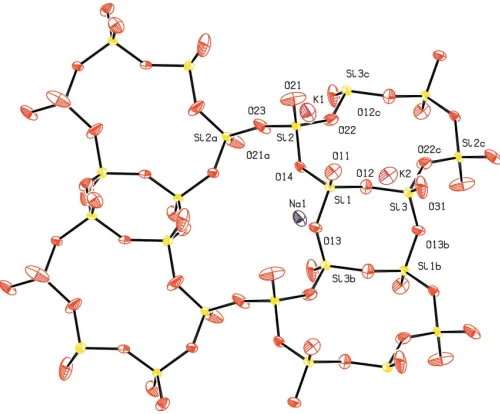
Figure 1
View of part of the Si2O5two-dimensional network consisting of four-, six- and eight-membered rings of SiO4tetrahedra and crystallographically independent cations, along with the atom-numbering scheme. Displace-ment ellipsoids are drawn at the 70% probability level. [Symmetry codes: (a)x,y,1
2z; (b) 1 2x,
1
2y,z; (c) 1 2x,
3
soluble silicates tend to have a lower alkali-to-silica ratio, we chose as a homologous the alkali disilicates. The advantage of this system is that it can form, next to glasses, crystalline disilicates, which have hygroscopicities similar to their glassy congeners. Such crystalline materials can of course be analyzed structurally as well as chemically in much more detail to discover the causes for the observed very large variations in hygroscopicity. Unfortunately, no obvious structure–hygro-scopy relation was found.
From a crystal chemical perspective, these single and mixed alkali systems turned out to be surprisingly rich in network topologies. Though compositionally constrained to structures in which each tetrahedron contains three O atoms connected to two Si atoms, and one O atom connected to only one Si atom, they formed not only sheets but also three-dimensional networks and one-dimensional ribbons. One of the few remaining phases we synthesized in this system was the mixed (K,Na) disilicate structure, which has recently received renewed attention (Rakic & Kahlenberg, 2001; Rakic et al., 2003a,b).
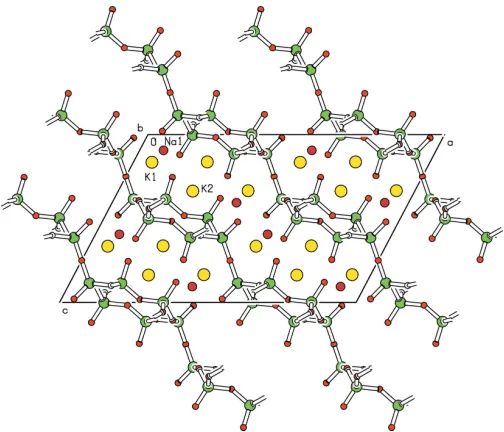
The title compound, K1.33Na0.67Si2O5, is a sheet silicate (Figs. 1 and 2) with four-, six- and eight-membered rings of SiO4tetrahedra. Na is five-coordinated and K six-coordinated by oxygen.
Experimental
The crystalline phase can be made without any special precaution by mixing K2CO3(1 mol), Na2CO3(1 mol) and SiO2(4 mol), calcining the mixture at 800 K to remove the CO2, and melting the resulting K2ONa2O4SiO2 (m.p. 878 K; Kracek, 1932) mixture at 1000 K, followed by cooling at a rate of 0.5 K min1. Samples were immersed in petroleum jelly to prevent absorption of moisture.
Crystal data
K1.33Na0.67Si2O5
Mr= 203.64 Monoclinic,C2=c a= 19.6816 (15) A˚ b= 7.2656 (6) A˚ c= 12.5710 (15) A˚ = 117.82 (1)
V= 1589.9 (3) A˚3
Z= 12
Dx= 2.552 Mg m3
MoKradiation Cell parameters from 9
reflections = 10–14
= 1.71 mm1
T= 150 K Block, colorless 0.30.30.2 mm
Data collection
Enraf–Nonius TurboCAD-4 diffractometer
!scans
Absorption correction: none 2841 measured reflections 1406 independent reflections 1094 reflections withI> 2(I) Rint= 0.068
max= 25
h=23!8 k=8!8 l=13!14 1 standard reflections
frequency: 60 min intensity decay: none
Refinement
Refinement onF2
R[F2> 2(F2)] = 0.043 wR(F2) = 0.118
S= 1.09 1406 reflections 123 parameters
w= 1/[2(F
o2) + (0.0465P)2
+ 11.2001P]
whereP= (Fo2+ 2Fc2)/3
[image:2.610.314.566.69.285.2](/)max= 0.001 max= 0.65 e A˚3 min=0.92 e A˚3
Table 1
Selected interatomic distances (A˚ ).
Si1—O11 1.559 (4)
Si1—O12 1.636 (5)
Si1—O13 1.634 (5)
Si1—O14 1.650 (4)
Si2—O14 1.647 (4)
Si2—O21 1.550 (6)
Si2—O22 1.620 (5)
Si2—O23 1.6024 (16)
Si3—O12 1.643 (4)
Si3—O31 1.550 (4)
Si3—O13i
1.630 (5) Si3—O22ii
1.638 (5)
K1—O11 2.563 (5)
K1—O21 2.562 (5)
K1—O14iii 2.899 (5) K1—O14iv 2.904 (4) K1—O13iv 3.353 (5) K1—O31v 2.637 (5)
K2—O11 2.614 (4)
K2—O31 2.607 (5)
K2—O12iv
2.884 (4) K2—O22iv 2.850 (5) K2—O22vi
2.980 (6) K2—O12vi
3.127 (4)
Na1—O11 2.495 (5)
Na1—O13 2.702 (5)
Na1—O21vii
2.356 (5) Na1—O21iii
2.271 (7) Na1—O31vi 2.291 (5)
Symmetry codes: (i)xþ1 2;yþ
1
2;z; (ii)xþ 1 2;yþ
3
2;z; (iii)x;yþ1;z;
(iv) x;yþ1;þzþ1
2; (v) xþ12;þyþ12;zþ12; (vi) xþ12;þy12;zþ12; (vii)
x;y1;z.
The displacement parameters of O23 were restrained to be approximately isotropic.
Data collection: locally modifiedCAD-4 Software(Enraf–Nonius, 1989); cell refinement: SET4(de Boer & Duisenberg, 1984); data reduction:HELENA(Spek, 1997); program(s) used to solve struc-ture:DIRDIF99(Beurskenset al., 1999); program(s) used to refine structure: SHELXL97 (Sheldrick, 1997); molecular graphics:
PLATON (Spek, 2003); software used to prepare material for publication:PLATON.
This work was supported in part (ALS) by the Council for the Chemical Sciences of the Netherlands Organization for Scientific Research (CW-NWO).
References
Beurskens, P. T., Beurskens, G., de Gelder, R., Garcı´a-Granda, S., Gould, R. O., Israel, R. & Smits, J. M. M. (1999).The DIRDIF99 Program System. Technical Report of the Crystallography Laboratory, University of Nijmegen, The Netherlands.
inorganic papers
Acta Cryst.(2005). E61, i188–i190 Spek and Jong K
1.33Na0.67Si2O5
i189
Figure 2 [image:2.610.313.565.366.497.2]Boer, J. L. de & Duisenberg, A. J. M. (1984).Acta Cryst.A40, C-410. Dietzel, A. (1983).Phys. Chem. Glasses,24, 172–180.
Enraf–Nonius (1989).CAD-4 Software. Version 5. Enraf–Nonius, Delft, The Netherlands.
Jong, B. H. W. S. de, Slaats, P. G. G., Super, H. T. J., Veldman, N. & Spek, A. L. (1994).J. Non-Cryst. Solids,176, 64–71.
Jong, B. H. W. S. de, Super, H. T. J., Frijhoff, R. M., Spek, A. L. & Nachtegaal, G. (2000).Z. Kristallogr.215, 397–405.
Jong, B. H. W. S. de, Super, H. T. J., Spek, A. L., Veldman, N., Nachtegaal, G. & Fischer, J. C. (1998).Acta Cryst.B54, 568–577.
Jong, B. H. W. S. de, Super, H. T. J., Spek, A. L., Veldman, N, van Wezel, W. & van der Mee, V. (1996).Acta Cryst.B52, 770–776.
Kracek, F. C. (1932).J. Phys. Chem.36, 2529–2542.
Rakic, S. & Kahlenberg, V. (2001).Solid State Sci.5, 659–667.
Rakic, S., Kahlenberg, V. & Schmidt, B. C. (2003a).Solid State Sci.5, 473– 480.
Rakic, S., Kahlenberg, V. & Schmidt, B. C. (2003b).Z. Kristallogr.218, 413– 420.
Sheldrick, G. M. (1997).SHELXL97. University of Go¨ttingen, Germany. Spek, A. L. (1997).HELENA. Utrecht University, The Netherlands. Spek, A. L. (2003).J. Appl. Cryst.36, 7–13.
Veldman, N., Spek, A. L., Super, H. T. J. & de Jong, B. H. W. S. (1995).Acta Cryst.C51, 1972–1975.
Weldes, H. K. & Lange, K. R. (1969).Ind. Eng. Chem.61, 4, 29–44.
inorganic papers
i190
Spek and Jong Ksupporting information
sup-1 Acta Cryst. (2005). E61, i188–i190
supporting information
Acta Cryst. (2005). E61, i188–i190 [https://doi.org/10.1107/S1600536805022348]
Potassium sodium phyllosilicate, K
1.33Na
0.67Si
2O
5Anthony L. Spek and Bernard H. W. S. de Jong
Potassium sodium phyllosilicate
Crystal data K1.33Na0.67Si2O5
Mr = 203.64
Monoclinic, C2/c
Hall symbol: -C 2yc
a = 19.6816 (15) Å
b = 7.2656 (6) Å
c = 12.5710 (15) Å
β = 117.82 (1)°
V = 1589.9 (3) Å3
Z = 12
F(000) = 1208
Least Squares Treatment of 25 SET4 setting angles.
Dx = 2.552 Mg m−3
Mo Kα radiation, λ = 0.71073 Å
Cell parameters from 9 reflections
θ = 10–14°
µ = 1.71 mm−1
T = 150 K
Block, colorless 0.3 × 0.3 × 0.2 mm
Data collection
Enraf–Nonius TurboCAD-4 diffractometer
Radiation source: Rotating Anode Graphite monochromator
ω scans
2841 measured reflections 1406 independent reflections 1094 reflections with I > 2σ(I)
Rint = 0.068
θmax = 25°, θmin = 2.3°
h = −23→8
k = −8→8
l = −13→14
1 standard reflections every 60 min intensity decay: none
Refinement
Refinement on F2
Least-squares matrix: full R[F2 > 2σ(F2)] = 0.043
wR(F2) = 0.118
S = 1.09
1406 reflections 123 parameters 6 restraints
Primary atom site location: structure-invariant direct methods
Secondary atom site location: difference Fourier map
w = 1/[σ2(F
o2) + (0.0465P)2 + 11.2001P]
where P = (Fo2 + 2Fc2)/3
(Δ/σ)max = 0.001
Δρmax = 0.65 e Å−3
Δρmin = −0.92 e Å−3
Special details
supporting information
sup-2 Acta Cryst. (2005). E61, i188–i190
Refinement. Refinement on F2 for ALL reflections except those flagged by the user for potential systematic errors.
Weighted R-factors wR and all goodnesses of fit S are based on F2, conventional R-factors R are based on F, with F set to
zero for negative F2. The observed criterion of F2 > σ(F2) is used only for calculating -R-factor-obs etc. and is not relevant
to the choice of reflections for refinement. R-factors based on F2 are statistically about twice as large as those based on F,
and R-factors based on ALL data will be even larger.
Fractional atomic coordinates and isotropic or equivalent isotropic displacement parameters (Å2)
x y z Uiso*/Ueq
Si1 0.15093 (8) 0.3950 (2) 0.00188 (12) 0.0083 (4)
Si2 0.06654 (8) 0.7460 (2) −0.11486 (12) 0.0085 (4)
Si3 0.32560 (8) 0.4508 (2) 0.11444 (14) 0.0131 (4)
O11 0.1430 (2) 0.3936 (6) 0.1196 (3) 0.0219 (12)
O12 0.2340 (2) 0.4647 (5) 0.0170 (3) 0.0162 (12)
O13 0.1349 (2) 0.1899 (6) −0.0584 (4) 0.0181 (12)
O14 0.0870 (2) 0.5250 (5) −0.1061 (3) 0.0114 (10)
O21 0.0425 (3) 0.8137 (6) −0.0203 (4) 0.0303 (14)
O22 0.1441 (2) 0.8450 (6) −0.1007 (5) 0.0338 (16)
O23 0.00000 0.7746 (8) −0.25000 0.0305 (17)
O31 0.3418 (2) 0.4068 (7) 0.2448 (3) 0.0311 (14)
K1 0.06258 (9) 0.6274 (2) 0.16520 (13) 0.0293 (5)
K2 0.25138 (8) 0.3240 (2) 0.33695 (11) 0.0246 (4)
Na1 0.08060 (13) 0.0864 (3) 0.09417 (19) 0.0209 (7)
Atomic displacement parameters (Å2)
U11 U22 U33 U12 U13 U23
Si1 0.0097 (7) 0.0067 (7) 0.0070 (7) −0.0008 (6) 0.0027 (6) 0.0011 (6)
Si2 0.0094 (7) 0.0073 (7) 0.0051 (7) −0.0010 (6) 0.0003 (6) 0.0002 (6)
Si3 0.0097 (8) 0.0075 (7) 0.0180 (8) −0.0008 (6) 0.0030 (6) −0.0026 (6)
O11 0.026 (2) 0.027 (2) 0.015 (2) 0.005 (2) 0.0116 (18) 0.0052 (18)
O12 0.014 (2) 0.012 (2) 0.020 (2) −0.0015 (17) 0.0057 (17) 0.0082 (17)
O13 0.016 (2) 0.011 (2) 0.028 (2) −0.0030 (17) 0.0109 (18) −0.0073 (18)
O14 0.0137 (19) 0.0085 (18) 0.0078 (17) −0.0016 (16) 0.0014 (15) 0.0005 (15)
O21 0.060 (3) 0.023 (2) 0.022 (2) 0.017 (2) 0.031 (2) 0.009 (2)
O22 0.017 (2) 0.010 (2) 0.074 (4) −0.0042 (18) 0.021 (2) −0.009 (2)
O23 0.039 (3) 0.012 (3) 0.012 (3) 0.0000 −0.012 (2) 0.0000
O31 0.018 (2) 0.056 (3) 0.011 (2) −0.007 (2) −0.0003 (18) −0.008 (2)
K1 0.0291 (8) 0.0260 (8) 0.0241 (8) −0.0036 (6) 0.0052 (6) 0.0052 (6)
K2 0.0325 (8) 0.0325 (8) 0.0125 (6) 0.0087 (6) 0.0136 (6) 0.0084 (6)
Na1 0.0224 (13) 0.0163 (12) 0.0138 (11) −0.0039 (10) 0.0000 (9) 0.0042 (9)
Geometric parameters (Å, º)
Si1—O11 1.559 (4) K1—O14iv 2.904 (4)
Si1—O12 1.636 (5) K1—O13iv 3.353 (5)
Si1—O13 1.634 (5) K1—O31v 2.637 (5)
Si1—O14 1.650 (4) K2—O11 2.614 (4)
supporting information
sup-3 Acta Cryst. (2005). E61, i188–i190
Si2—O21 1.550 (6) K2—O12iv 2.884 (4)
Si2—O22 1.620 (5) K2—O22iv 2.850 (5)
Si2—O23 1.6024 (16) K2—O22vi 2.980 (6)
Si3—O12 1.643 (4) K2—O12vi 3.127 (4)
Si3—O31 1.550 (4) Na1—O11 2.495 (5)
Si3—O13i 1.630 (5) Na1—O13 2.702 (5)
Si3—O22ii 1.638 (5) Na1—O21vii 2.356 (5)
K1—O11 2.563 (5) Na1—O21iii 2.271 (7)
K1—O21 2.562 (5) Na1—O31vi 2.291 (5)
K1—O14iii 2.899 (5)
O11—Si1—O12 115.4 (2) O12—Si3—O31 114.4 (2)
O11—Si1—O13 110.6 (2) O12—Si3—O13i 107.2 (2)
O11—Si1—O14 114.1 (2) O12—Si3—O22ii 101.1 (2)
O12—Si1—O13 107.6 (2) O13i—Si3—O31 115.1 (3)
O12—Si1—O14 104.8 (2) O22ii—Si3—O31 113.1 (3)
O13—Si1—O14 103.4 (2) O13i—Si3—O22ii 104.6 (3)
O14—Si2—O21 114.3 (2) Si1—O12—Si3 139.2 (2)
O14—Si2—O22 103.7 (2) Si1—O13—Si3i 138.1 (3)
O14—Si2—O23 104.5 (2) Si1—O14—Si2 133.0 (2)
O21—Si2—O22 112.6 (3) Si2—O22—Si3ii 139.6 (3)
O21—Si2—O23 112.4 (2) Si2—O23—Si2viii 165.1 (4)
O22—Si2—O23 108.7 (2)