• No results found

Additional File 1Table S1.

N/A
N/A
Protected

Academic year: 2020

Share "Additional File 1Table S1."

Copied!
7
0
0

Loading.... (view fulltext now)

Full text

(1)

Additional File 1

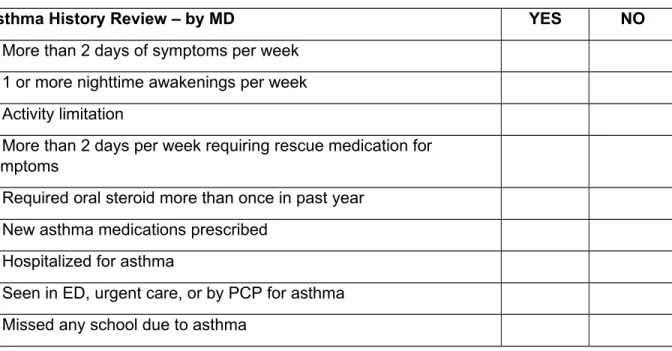
Table S1. Standardized asthma history obtained by study physicians at both study visits.

Asthma History Review – by MD YES NO

1. More than 2 days of symptoms per week 2. 1 or more nighttime awakenings per week 3. Activity limitation

4. More than 2 days per week requiring rescue medication for symptoms

5. Required oral steroid more than once in past year 6. New asthma medications prescribed

7. Hospitalized for asthma

8. Seen in ED, urgent care, or by PCP for asthma 9. Missed any school due to asthma

Table S2. Correlation between baseline ACT score and spirometry measurements (as

(2)

Pearson correlation coefficients).

Spirometry AA nAA

FEV

1

-0.04 0.18

FEV1/FVC 0.07 0.29

FEF

25-75

0.03 0.28

ACT, Asthma Control Test; AA, African-American; FEF

25-75

, Forced Expiratory Flow at 25-

75% of Pulmonary Volume; FEV

1,

Forced Expiratory Volume in 1 Second; FVC, Forced Vital

Capacity; nAA, non-African-American

(3)

controlled asthma in African-American adolescents.

ACT Score

Sensitivit

y

Specificit y

PPV NPV AUC

Q1: In the past 4 weeks, how much of the time did your asthma keep you from getting as much done at work, school or at home?

1=All of the time; 2=Most of the Time; 3=Some of the time; 4=A little of the time;

5=None of the time

2 0.03 0.03 1.00 1.00 0.40 0.52

3 0.24 0.28 1.00 1.00 0.48 0.64

4 0.59 0.72 0.91 0.92 0.68 0.81

Q2: During the past 4 weeks, how often have you had shortness of breath?

1=More than once a day; 2=Once a day; 3=3 to 6 times a week; 4=Once or twice a week; 5=Not at all

2 0.18 0.22 1.00 1.00 0.46 0.61

3 0.17 0.25 0.95 0.89 0.46 0.6

4 0.15 0.72 0.43 0.66 0.5 0.57

Q3: During the past 4 weeks, how often did your asthma symptoms (wheezing, coughing, shortness of breath, chest tightness or pain) wake you up at night or earlier than usual in the morning?

1=4 or more nights a week; 2=2-3 nights a week; 3=Once a week; 4=Once or twice;

5=Not at all

2 0.1 0.13 1.00 1.00 0.43 0.56

3 0.27 0.31 1.00 1.00 0.49 0.66

4 0.6 0.69 0.95 0.96 0.67 0.82

Q4: During the past 4 weeks, how often have you used your rescue inhaler or nebulizer medication (such as albuterol)?

1=3 or more times per day; 2=1 or 2 times per day; 3=2 or 3 times per week; 4=Once a week or less; 5=Not at all

2 0.12 0.28 0.86 0.75 0.44 0.57

3 0.2 0.59 0.62 0.7 0.5 0.61

4 0.3 0.81 0.48 0.7 0.63 0.64

Q5: How would you rate your asthma control during the past 4 weeks

1=Not controlled at all; 2=Poorly controlled; 3=Somewhat controlled; 4=Well

controlled; 5=Completely controlled

(4)

2 -0.04 0.00 0.95 0.00 0.39 0.48

3 0.33 0.47 0.91 0.88 0.53 0.69

4 0.34 0.97 0.33 0.69 0.88 0.65

Performance of Combined Score on “Sub-Test” of Q1 and Q3 Combine

d score

 Sensitivity Specificity PPV NPV AUC

6 0.16 0.19 1.00 1.00 0.45 0.59

7 0.29 0.34 1.00 1.00 0.5 0.67

8 0.60 0.66 1.00 1.00 0.66 0.83

9 0.76 0.91 0.86 0.91 0.86 0.88

ACT, Asthma Control Test; AUC, Area Under the Curve;  , Cohen’s kappa statistic;

NPV, Negative Predictive Value; PPV, Positive Predictive Value

Asthma Control Test 2002 by Quality Metric Incorporated.

Table S4. Screening accuracy of individual ACT questions for detection of not well

controlled asthma in non-African American adolescents.

(5)

ACT Score

Sensitivit

y

Specificit y

PPV NPV AUC

Q1: In the past 4 weeks, how much of the time did your asthma keep you from getting as much done at work, school or at home?

1=All of the time; 2=Most of the Time; 3=Some of the time; 4=A little of the time;

5=None of the time

2 0.08 0.07 1.00 1.00 0.59 0.54

3 0.24 0.21 1.00 1.00 0.63 0.61

4 0.37 0.57 0.79 0.67 0.71 0.68

Q2: During the past 4 weeks, how often have you had shortness of breath?

1=More than once a day; 2=Once a day; 3=3 to 6 times a week; 4=Once or twice a week; 5=Not at all

2 0.33 0.36 0.95 0.83 0.67 0.65

3 0.33 0.36 0.95 0.83 0.67 0.65

4 0.34 0.71 0.63 0.59 0.75 0.67

Q3: During the past 4 weeks, how often did your asthma symptoms (wheezing, coughing, shortness of breath, chest tightness or pain) wake you up at night or earlier than usual in the morning?

1=4 or more nights a week; 2=2-3 nights a week; 3=Once a week; 4=Once or twice;

5=Not at all

2 0.1 0.14 0.95 0.67 0.6 0.55

3 0.1 0.14 0.95 0.67 0.6 0.55

4 0.1 0.36 0.74 0.5 0.61 0.55

Q4: During the past 4 weeks, how often have you used your rescue inhaler or nebulizer medication (such as albuterol)?

1=3 or more times per day; 2=1 or 2 times per day; 3=2 or 3 times per week;

4=Once a week or less; 5=Not at all

2 0.33 0.36 0.95 0.83 0.67 0.65

3 0.62 0.71 0.9 0.83 0.81 0.81

4 0.53 0.93 0.63 0.65 0.92 0.78

Q5: How would you rate your asthma control during the past 4 weeks

1=Not controlled at all; 2=Poorly controlled; 3=Somewhat controlled; 4=Well controlled; 5=Completely controlled

2 0.24 0.21 1.00 1.00 0.63 0.61

(6)

3 0.4 0.43 0.95 0.86 0.69 0.69

4 0.26 0.86 0.42 0.52 0.8 0.64

ACT, Asthma Control Test; AUC, Area Under the Curve;  , Cohen’s kappa statistic; NPV, Negative Predictive Value; PPV, Positive Predictive Value

Asthma Control Test 2002 by Quality Metric Incorporated.

Table S5. Correlations between change in ACT score and change in spirometry measurements between study visits (as Pearson correlation coefficients).

AA nAA

(7)

Measurement s

Measurement s

FVC 0.02 0.90 FVC 0.32 0.08

FEV

1

0.11 0.46 FEV

1

0.53 0.002

FEV1/FVC 0.20 0.15 FEV1/FVC 0.55 0.001

FEF

25-75

0.11 0.44 FEF

25-75

0.6 <0.001

PEFR 0.23 0.12 PEFR 0.5 0.004

ACT, Asthma Control Test; AA, African-American; FEF

25-75

, Forced Expiratory Flow at

25-75% of Pulmonary Volume; FEV

1,

Forced Expiratory Volume in 1 Second; FVC,

Forced Vital Capacity; nAA, non-African-American

Figure

Table S1. Standardized asthma history obtained by study physicians at both study visits
Table S4. Screening accuracy of individual ACT questions for detection of not well  controlled asthma in non-African American adolescents.
Table S5. Correlations between change in ACT score and change in spirometry  measurements between study visits (as Pearson correlation coefficients).

References

Related documents

Based on the advantages of thermal decomposition methods in comparison with the steam methane reformation method, in this paper the hydrogen production process from sour

This study describes the qualitative phytochemical screening, antimicrobial and GC-MS analyses of the crude methanol extract of the stem and roots parts of Bidens pilosa

New records of earthworm fauna (Oligochaeta: Glossoscolecidae and Megascolecidae) collected from Satkosia-Baisipalli Wildlife Sanctuary of Odisha, India Rinku

This meter can be used to monitor the respiration rate, pulse rate (by using a proper sensor) and heart rate.. It responds fast and is cost-effective compared to

Methods: Isolated perfused rat hearts were divided into fi ve groups: 1) vehicle, 2) pre-, 3) post- or 4) pre- and post-ischemic administration of XE991 or 5) chromanol 293B

As part of a prospective study of possible effects of early-life otitis media on speech, language, cognitive, and psychosocial development, we tested relationships between

The frames describe the context within which individuals interpreted their experiences and made sense of information they received (Rein, 1984). Individual frames of reference

Recent work has shown that selected strains from New Zealand brooms and kowhai did not nodulate white clover (T. subterraneum), lucerne, Lotus pedunculatus, field pea