Available online:http://edupediapublications.org/journals/index.php/IJR/ P a g e | 1030
Identity-Based Encryption with Outsourced
Revocation in Cloud Computing
1
Mrs. RAJA RAJESWARI. CH,
2Mr. G.LAKPATHI
1
Pursuing M.Tech(CSE) from Jagruti Institute of Engineering and Technology
2
Assistant Professor, Department of Computer Science and Engineering,
Jagruti Institute of Engineering and Technology, Telangana State, India.
Abstract:
In this paper, aiming at tackling the significant concern of identity revocation, we set up outsourcing addition into IBE for the first time and recommend a revocable IBE proposal in the server-aided setting. Our proposal off-load the majority of the key making interrelated operations during issuing and key-update processes to a Key Update Cloud Service Provider, departure only a regular number of operations for PKG and users to make locally. This goal is accomplish by exploit a novel collusion -resistant procedure: we take up a hybrid private key for every user, in which an AND gate is complicated to bond and jump the individuality component and the time constituent. Additionally, we suggest another creation which is incontestable secure under the Refereed Delegation of Computation model. In conclusion, we offer extensive untried results to express the efficiency of our projected construction.
Keywords: ;
Revocation; Outsourcing; computing,Identity-based encryption
1. INTRODUCTION
Identity-Based Encryption (IBE) is an exciting substitute to public key encryption, which is projected to make simpler key managing in a certificate-based Public Key Infrastructure (PKI) by using human-intelligible characteristics (e.g., unique name, email address, IP address, etc) as public keys. Therefore, sender with IBE does not call for to look up public key and certificate, but openly encrypts significance with
Available online:http://edupediapublications.org/journals/index.php/IJR/ P a g e | 1031 same trusted domain of users and are curious for
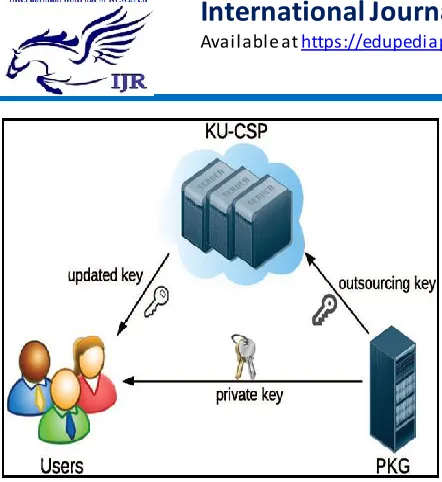
users’ individual privacy. For this reason, a challenge on how to design a secure revocable IBE scheme to reduce the overhead computation at PKG with an entrusted CSP is raised. In this paper, we introduce outsourcing computation into IBE revocation, and formalize the security definition of outsourced revocable IBE for the first time to the best of our knowledge. We propose a scheme to offload all the key generation related operations during key-issuing and key-update, leaving only a constant number of simple operations for PKG and eligible users to perform locally. In our scheme, as with the suggestion in [4], we realize revocation through updating the private keys of the unrevoked users. But unlike that work [4] which trivially concatenates time period with identity for key generation/update and requires to re-issue the whole private key for unrevoked users, we propose a novel collusion-resistant key issuing technique: we employ a hybrid private key for each user, in which an AND gate is involved to connect and bound two sub-components, namely the identity component and the time component. At first, user is able to obtain the identity component and a default time component (i.e., for current time period) from PKG as his/her private keying key-issuing. Afterwards, in order to maintain decrypt ability, unrevoked users needs to periodically request on key-update foretime component to a newly introduced entity named Key Update Cloud Service Provider (KU-CSP).Compared with the previous work [4], our scheme does not have to re-issue the whole private keys, but just need to update a lightweight component of it at a specialized entity KU-CSP. We also specify that 1) with the aid of KU-CSP, user needs not to contact with PKG in key-update, in other words, PKG is allowed to be offline after sending the revocation list to KU-CSP. 2) No secure channel or user authentication is required during key-update between user and KU-CSP. Furthermore, we consider to realize revocable IBE with a semi honest KU-CSP. To achieve this goal, we present a security enhanced construction under the recently formalized Refereed Delegation of Computation (RDoC) model [7]. Finally, we provide extensive experimental results to demonstrate the efficiency of our proposed
construction. Identity-based Encryption An IBE scheme which typically involves two entities, PKG and users (including sender and receiver) is consisted of the following four algorithms. Setup(λ) : The setup algorithm takes as input a security parameter λ and outputs the public key PK and the master key MK. Note that the master key is kept secret at PKG. KeyGen(MK, ID) : The private key generation algorithm is run by PKG, which takes as input the master key MK and user’s identity ID ∈{0, 1}∗ . It returns a private key SKID corresponding to the identity ID. Encrypt (M,ID) : The encryption algorithm is run by sender, which takes as input the receiver’s identity ID_ and a message M to be encrypted. It outputs the cipher text CT.Decrypt (CT,SKID_) : The decryption algorithm is run by receiver, which takes as input the cipher text CT and his/her private key SKID_ . It returns a message M or an error.
2. RELATED WORK
Identity-Based Encryption (IBE) which simplifies the public key and certificate management at Public Key Infrastructure (PKI) is an important alternative to public key encryption. However, one of the main efficiency drawbacks of IBE is the overhead computation at Private Key Generator (PKG) during user revocation. Efficient revocation has been well studied in traditional PKI setting, but the cumbersome management of certificates is precisely the burden that IBE strives to alleviate,
Disadvantages Are: However, one of the main efficiency drawbacks of IBE is the overhead computation at Private Key Generator (PKG) during user revocation.
Available online:http://edupediapublications.org/journals/index.php/IJR/ P a g e | 1032 multiple lattice-based constructions for IBE Systems
.Nevertheless, concerning on revocable IBE, there is little work Presented. As mentioned before, Boneh and Franklin’s suggestion is more a viable solution but impractical. Hanaoka et al. proposed a way for users to periodically renew their private keys without interacting with PKG. However, the assumption required in their work is that each user needs to possess a tamper-resistant hardware device. Another solution is mediator-aided revocation
2.3 Outsourcing Computation: The problem that how to securely outsource different kinds of expensive computations has drawn considerable attention from theoretical computer science community for a long time. Chaum and Pedersen firstly introduced the notion of wallets with observers, a piece of secure hardware installed on the client’s computer to perform some expensive computations. Attalla et al. Presented a framework for secure outsourcing of scientific computations such as matrix multiplication and quadrature. Nevertheless, the solution used the disguise technique and thus leaded to leakage of private information. Rosenberger and Lysyanskaya proposed the first outsource-secure algorithm for modular exponentiations based on pre-computation and serveraided computation. Atallah and Li investigated the problem of computing the edit distance between two sequences and presented an efficient protocol to securely outsource sequence comparison with two servers. Furthermore, Benjamin and Atallah addressed the problem of secure outsourcing for widely applicable linear algebraic computations. Nevertheless, the proposed protocol required the expensive operations of homomorphism encryption. Attalla and Frikken further studied this problem and gave improved protocols based on the so-called weak secret hiding assumption. Chen et al. made an efficiency improvement on the work and proposed a new scheme for outsourcing single/simultaneous modular exponentiations.
3. SYSTEM STUDY
Any application development follows the some software In this paper, intend at tackling the significant matter of identity revocation, we initiate
outsourcing subtraction into IBE for the first time and put forward a revocable IBE format in the server-aided scenery. Our system off-load mainly of the key making related operations throughout key-issuing and key-update processes to a Key Update Cloud Service Provider, leave-taking only a invariable amount of simple functions for PKG and users to make locally. This goal is attain by operate a novel collusion-resistant technique: we occupy a hybrid private key for each user, in which an AND gate is implicated to connect and vault the identity constituent and the time constituent. Furthermore, we recommend another assembly which is verifiable protected under a moment ago formulized Refereed Delegation of Computation model. Finally, we present general investigational consequences to make obvious the effectiveness of our proposed edifice. ADVANTAGES it achieves constant competence for both calculation at PKG and private key size at user; User desires not to contact with PKG throughout key-update, in additional, PKG is permitted to be offline after conveyance the revocation list to KU-CSP,No protected canal or user confirmation is required during key-update among user and KU-CSP.
3.1 System Implementation
Data Users: In this module the data user can register with cloud server to access file search, file upload and download...
Data owner: In this module the data owner can register to maintain their file into cloud server and allow access to data users to access the file.
File search: In this module user can search needed file to download with proper key.
File upload: User can upload their file into cloud server with high level security system.
File download: In this module the user can download file with proper key which provided by data owner.
3.2 INPUT DESIGN
Available online:http://edupediapublications.org/journals/index.php/IJR/ P a g e | 1033 specification and procedures for data preparation and
those steps are necessary to put transaction data in to a usable form for processing can be achieved by inspecting the computer to read data from a written or printed document or it can occur by having people keying the data directly into the system. The design of input focuses on controlling the amount of input required, controlling the errors, avoiding delay, avoiding extra steps and keeping the process simple.
3.3 INTENTS:
Input Design is the process of converting a user-oriented description of the input into a computer-based system. This design is important to avoid errors in the data input process and show the correct direction to the management for getting correct information from the computerized system. It is achieved by creating user-friendly screens for the data entry to handle large volume of data. The goal of designing input is to make data entry easier and to be free from errors. The data entry screen is designed in such a way that all the data manipulates can be performed. It also provides record viewing facilities. When the data is entered it will check for its validity. Data can be entered with the help of screens.Appropriate messages are provided as when needed so that the user will not be in maize of instant. Thus the objective of input design is to create an input layout that is easy to follow.
3.4 OUTPUT DESIGN:
A quality output is one, which meets the requirements of the end user and presents the information clearly. In any system results of processing are communicated to the users and to other system through outputs. In output design it is determined how the information is to be displaced for immediate need and also the hard copy output. It is the most important and direct source information to the user. Efficient and intelligent output design improves the system’s relationship to help user decision-making. Designing computer output should proceed in an organized, well thought out manner; the right output must be developed while ensuring that each output element is designed so that people will find the system can use easily and effectively. When analysis design computer output, they should Identify
the specific output that is needed to meet the requirements.. Select methods for presenting information..Create document, report, or other formats that contain information produced by the system. The output form of an information system should accomplish one or more of the following objectives. Convey information about past activities, current status or projections of the Future. Signal important events, opportunities, problems, or warnings. Trigger an action. Confirm an action.
3.5 SYSTEM DESIGN
Available online:http://edupediapublications.org/journals/index.php/IJR/ P a g e | 1034 Fig 1. System Architecture
4. CONCLUSION
In this paper, center of attention on the significant concern of identity revocation, we initiate outsourcing division into IBE and propose a revocable scheme in which the revocation operations are delegated to CSP. We present a sophisticated construction and demonstrate it is protected under RDoC model, in which at least one of the KU-CSPs is implicit to be honest. Therefore, even if a revoked user and each of the KU-CSPs collude, it is not capable to help such user re-obtain his/her decrypt capability. Finally, we offer general tentative results to lay bare the competence of our anticipated construction.
5. REFERENCES
[1] W. Aiello, S. Lodha, and R. Ostrovsky, “Fast digital identity revocation,” in Advances in Cryptology – CRYPTO’98. Springer, 1998.
[2] V. Goyal, “Certificate revocation using fine grained certificate space partitioning,” in Financial Cryptography and Data Security, ser. Lecture Notes in Computer Science, S. Dietrich and R. Dhamija, Eds. Springer Berlin / Heidelberg, 2007, vol. 4886, pp. 247–259.
[3] F. Elwailly, C. Gentry, and Z. Ramzan, “Quasimodo: Efficient certificate validation and revocation,” in Public Key Cryptography PKC 2004,
ser. Lecture Notes in Computer Science, F. Bao, R. Deng, and J. Zhou, Eds. Springer Berlin / Heidelberg, 2004, vol. 2947, pp. 375–388.
[4] D. Boneh and M. Franklin, “Identity-based encryption from the weil pairing,” in Advances in Cryptology – CRYPTO 2001, ser. Lecture Notes in Computer Science, J. Kilian, Ed. Springer Berlin / Heidelberg, 2001, vol. 2139, pp. 213–229.
[5] A. Boldyreva, V. Goyal, and V. Kumar, “Identity-based encryption with efficient revocation,” in Proceedings of the 15th ACM conference on Computer and communications security, ser. CCS ’08. New York, NY, USA: ACM, 2008, pp. 417–426.
[6] A. Sahai and B. Waters, “Fuzzy identity-based encryption,” in Advances in Cryptology EUROCRYPT 2005, ser. Lecture Notes in Computer Science, R. Cramer, Ed. Springer Berlin / Heidelberg, 2005, vol. 3494, pp. 557–557.
7] R. Canetti, B. Riva, and G. N. Rothblum, “Two 1- round protocols for delegation of computation, ” Cryptology ePrint Archive, Report 2011/518, 2011.
[8] U. Feige and J. Kilian, “Making games short (extended abstract),” in Proceedings of the twenty-ninth annual ACM symposium on Theory of computing, ser. STOC ’97. New York, NY, USA: ACM, 1997, pp. 506–516.
[9] S. Hohenberger and A. Lysyanskaya, “How to securely outsource cryptographic computations,” in Proceedings of the Second international conference on Theory of Cryptography, ser. TCC’05. Berlin, Heidelberg: Springer-Verlag, 2005, pp. 264–282.
Available online:http://edupediapublications.org/journals/index.php/IJR/ P a g e | 1035