Simplified Dependency Annotations with GFL-Web
Michael T. Mordowanec Nathan Schneider Chris Dyer Noah A. Smith
School of Computer Science Carnegie Mellon University Pittsburgh, PA 15213, USA
[email protected], {nschneid,cdyer,nasmith}@cs.cmu.edu
Abstract
We present GFL-Web, a web-based in-terface for syntactic dependency annota-tion with the lightweight FUDG/GFL for-malism. Syntactic attachments are spec-ified in GFL notation and visualized as a graph. A one-day pilot of this work-flow with 26 annotators established that even novices were, with a bit of training, able to rapidly annotate the syntax of En-glish Twitter messages. The open-source tool is easily installed and configured; it is available at: https://github.com/ Mordeaux/gfl_web
1 Introduction
High-quality syntactic annotation of natural lan-guage is expensive to produce. Well-known large-scale syntactic annotation projects, such as the Penn Treebank (Marcus et al., 1993), the En-glish Web Treebank (Bies et al., 2012), the Penn Arabic Treebank (Maamouri et al., 2004), and the Prague dependency treebanks (Hajiˇc, 1998; ˇCmejrek et al., 2005), have relied on expert lin-guists to produce carefully-controlled annotated data. Because this process is costly, such anno-tation projects have been undertaken for only a handful of important languages. Therefore, devel-oping syntactic resources for less-studied, lower-resource, or politically less important languages and genres will require alternative methods. To address this, simplified annotation schemes that trade cost for detail have been proposed (Habash and Roth, 2009).1
1These can be especially effective when some details of the syntax can be predicted automatically with high accuracy (Alkuhlani et al., 2013).
The Fragmentary Unlabeled Dependency Grammar (FUDG) formalism (Schneider et al., 2013) was proposed as a simplified framework for annotating dependency syntax. Annotation effort is reduced by relaxing a number of constraints placed on traditional annotators: partial fragments can be specified where the annotator is uncertain of part of the structure or wishes to focus only on certain phenomena (such as verbal argument structure). FUDG also offers mechanisms for excluding extraneous tokens from the annotation, for marking multiword units, and for describing coordinate structures. FUDG is written in an ASCII-based notation for annotations called Graph Fragment Language (GFL), and text-based tools for verifying, converting, and rendering GFL annotations are provided.
Although GFL offers a number of conveniences to annotators, the text-based UI is limiting: the existing tools require constant switching between a text editor and executing commands, and there are no tools for managing a large-scale annotation effort. Additionally, user interface research has found marked preferences for and better perfor-mance with graphical tools relative to text-based interfaces—particularly for less computer-savvy users (Staggers and Kobus, 2000). In this paper, we present theGFL-Web tool, a web-based face for FUDG/GFL annotation. The simple inter-face provides instantaneous feedback on the well-formedness of a GFL annotation, and by wrapping Schneider et al.’s notation parsing and rendering software, gives a user-friendly visualization of the annotated sentence. The tool itself is lightweight, multi-user, and easily deployed with few software dependencies. Sentences are assigned to anno-tators via an administrative interface, which also records progress and provides for a text dump of
(a)@Bryan_wright11 i lost all my contacts , smh .
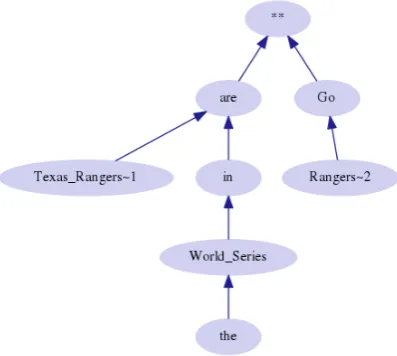
[image:2.595.321.520.65.243.2](b) Texas Rangers are in the World Series ! Go Rangers !!!!!!!!! http://fb.me/D2LsXBJx
Figure 1:FUDG annotation graphs for two tweets.
all annotations. The interface for annotators is de-signed to be as simple as possible.
We provide an overview of the FUDG/GFL framework (§2), detail how the tool is set up and utilized (§3), and discuss a pilot exercise in which 26 users provided nearly 1,000 annotations of En-glish Twitter messages (§4). Finally, we note some of the technical aspects of the tool (§5) and related syntactic annotation software (§6).
2 Background
GFL-Web is designed to simplify the creation of dependency treebanks from noisy or under-resourced data; to that end, it exploits the lightweight FUDG/GFL framework of Schneider et al. (2013). Here we outline how FUDG differs from traditional Dependency Grammar (§2.1) and detail major aspects of GFL (§2.2).
[image:2.595.136.250.92.247.2]2.1 FUDG
Figure 1 displays two FUDG graphs of annota-tions of Twitter messages (“tweets”, shown below in tokenized form). Arrows point upwards from dependents to their heads. These tweets illustrate several characteristics of the formalism, including: • The input may contain multiple independent syntactic units, or “utterances”; the annotation indicates these by attaching their heads to a spe-cial root node called**.
• Some input tokens are omitted if deemed ex-trinsic to the syntax; by convention, these in-clude most punctuation, hashtags, usernames, and URLs.
• Multiword units may be joined to form com-posite lexical nodes (e.g., World_Series in
fig-ure 1b). These nodes are not annotated with any internal syntactic structure.
• Tokens that are used in the FUDG parse must be unambiguous. If a word appears multiple times in the input, it is disambiguated with ~ and an
index (e.g.,Rangers~2in figure 1b).
(Some of the other mechanisms in FUDG, such as coordinate structures and underspecification, are not shown here; they are not important for pur-poses of this paper.)
2.2 GFL
The Graph Fragment Language is a simple ASCII-based language for FUDG annotations. Its norms are designed to be familiar to users with basic pro-gramming language proficiency, and they are intu-itive and easy to learn even for those without. The annotation in figure 1a may be expressed in GFL as:2
i > lost** < ({all my} > contacts) smh**
In GFL, angle brackets point from a dependent (child) to its head (parent). Parentheses group nodes together; the head of this group is then at-tached to another node. The double asterisk (**)
marks a root node in an annotations containing multiple utterances. Curly braces group nodes that modify the same head.
GFL corresponding to Figure 1b is:
Sentence:Texas Rangers are in the World Series ! Go Rangers !!!!!!!!! http://fb.me/D2LsXBJx Input format:
---% ID data_set_name:417 % TEXT
Texas Rangers~1 are in the World Series ! Go Rangers~2 !!!!!!!!! http://fb.me/D2LsXBJx
% ANNO
[image:3.595.122.449.219.368.2]Texas Rangers~1 are in the World Series Go Rangers~2 http://fb.me/D2LsXBJx
Figure 2: Illustration of the GFL-Web input format for a tweet. TheANNOsection will be shown to the user as the default
annotation; punctuation has been stripped out automatically to save time.
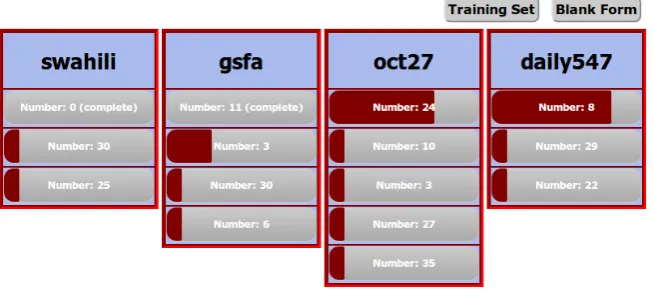
Figure 3:User home screen showing assigned batches for annotation, with links to the training set and blank annotation form.
[Texas Rangers~1] > are** < in in < (the > [World Series]) Go** < Rangers~2
This uses square brackets for multiword expres-sions. Similar to a programming language, there are often many equivalent GFL annotation options for a given sentence. The annotation can be split across multiple lines so that annotators can ap-proach smaller units first and then link them to-gether.
3 Using GFL-Web
The GFL-Web tool uses the Python programming language’s Flask microframework for server-side scripting. This allows it to be deployed on a web server, locally or via the Internet. This also en-ables the interface to rely on scripts previously created for analyzing GFL. Once installed, the re-searcher need only configure a few settings and be-gin entering data to be annotated.
3.1 Setup
There are a few simple configuration options. The most useful of these options specify how many sentences should be in each batch that is assigned
to an annotator, and how many sentences in each batch should be doubly annotated, for the purpose of assessing inter-annotator agreement. By de-fault, the batch size is 10, and the first 2 sentences of each batch overlap with the previous batch, so 4/10 of the sentences in the batch will be annotated by someone else (assuming no two consecutive batches are assigned to the same user). The pro-gram requires tokenized input, with indices added to distinguish between words that appear twice (easily automated). The input format, figure 2, al-lows for easy editing with a text editor if so de-sired.
Once the input files have been placed in a des-ignated directory, anadmin interfacecan be used to assign batches of data to specific users (annota-tors).
3.2 Annotation
Annotators log in with their username and see a
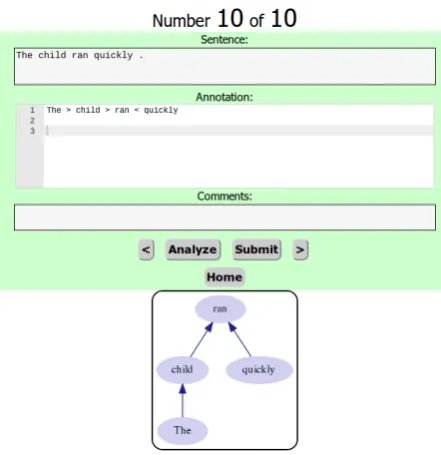
Figure 4: A well-formed GFL annotation is indicated by a green background and visualization of the analysis graph.
any of these will take the annotator to an annota-tion page, which displays the text to be annotated, an input field, and a comments box.
The annotation interface is simple and intuitive and provides instant feedback, preventing the an-notator from submitting ill-formed annotations. Annotators press the Analyzebutton and receive
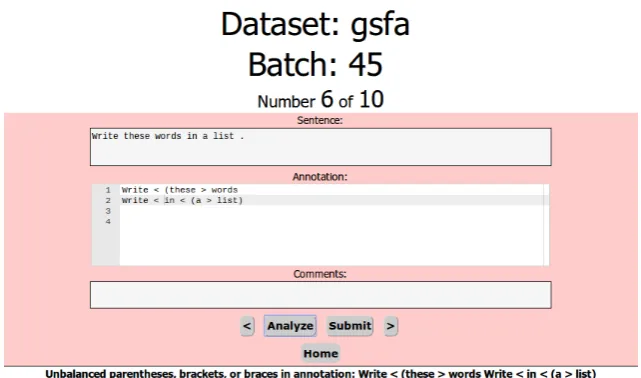
feedback before submitting annotations (figure 4). Common GFL errors such as unbalanced paren-theses are caught by the program and brought to the attention of the annotator with an informative error message (figure 5). The annotator can then fix the error, and will be able to submit once all errors are resolved.
The training set consists of 15 sentences se-lected from Rossman and Mills (1922), shown in the same annotation interface. Examples become increasingly more complicated in order to famil-iarize the user with different syntactic phenomena and the entry-analyze-review workflow. A button displays the FUDG graph from an expert annota-tion so the novice can compare it to her own and consult the guidelines (or ask for help) where the two graphs deviate.
4 Pilot User Study
We conducted a pilot annotation project in which 26 annotators were trained on GFL-Web and asked to annotate English Twitter messages from the daily547 and oct27 Twitter datasets of Gimpel et al. (2011). The overwhelming majority were all
trained on the same day, having no prior knowl-edge of GFL. Most, but not all, were native speak-ers of English. Those who had no prior knowl-edge of dependency grammar in general received a short tutorial on the fundamentals before being introduced to the annotation workflow. All par-ticipants who were new to FUDG/GFL worked through the training set before moving on to the Twitter data. Annotators were furnished with the English annotation guidelines of Schneider et al. (2013).3
4.1 Results
In the one-day event, 906 annotations were gen-erated. Inter-annotator agreement was high—.9 according to the softComPrec measure (Schnei-der et al., 2013)—and an expert’s examination of a sample of the annotations found that 75% of con-tained no major error.
Annotators used the analysis feature of the interface—which displays either a visual represen-tation of the tree or an error message—an aver-age of 3.06 times per annotation. The interface re-quires they analyze each annotation at least once. Annotators have the ability to resubmit annota-tions if they later realize they made an error, and each annotation was submitted an average of 1.16 times. Disregarding instances that took over 1,000 seconds (under the assumption that these repre-sent annotators taking breaks), the median time between the first analysis and the first submission of an annotation was 30 seconds. We take this as evidence that annotators found the instant feed-back features useful in refining their annotations.
4.2 Post-Pilot Improvements
Annotator feedback prompted some changes to the interface. The annotation input box was changed to incorporate bracket-matching. The graph visu-alization for a correct annotation was added for each example in the training set so new annota-tors could compare their tree to an example. Pre-sumably these changes would further reduce anno-tators’ training time and improve their efficiency. Progress bars were added to the user home screen to show per-batch completion information.
4.3 Other Languages
In addition to English, guidelines for Swahili, Zulu, and Mandarin are currently in development.
3https://github.com/brendano/gfl_syntax/
Figure 5:An example error notification. The red background indicates an error, and the cause of the error is displayed at the bottom of the screen.
5 Technical Architecture
GFL-Web and its software dependencies for ana-lyzing and visualizing GFL are largely written in Python. The tool is built with Flask, a Python framework for web applications. Data is stored and transmitted to and from the browser in the Javascript Object Notation (JSON) format, which is supported by libraries in most programming lan-guages. The browser interface uses AJAX tech-niques to interact dynamically with the server.
GFL-Web is written for Python version 2.7. It wraps scripts previously written for the analy-sis and visualization of GFL (Schneider et al., 2013). These in turn require Graphviz (Ellson et al., 2002), which is freely available.
Flask provides a built-in server, but can also be deployed in Apache, via WSGI or CGI, etc. 6 Other Tools
In treebanking, a good user interface is essen-tial for annotator productivity and accuracy. Sev-eral existing tools support dependency annota-tion; GFL-Web is the first designed specifi-cally for the FUDG/GFL framework. Some, including WebAnno (Yimam et al., 2013) and brat (Stenetorp et al., 2012), are browser-based, while WordFreak (Morton and LaCivita, 2003), Abar-Hitz (Ilarraza et al., 2004), and TrEd (Pa-jas and Fabian, 2000–2011) are client-side appli-cations. All offer tree visualizations; to the best of our knowledge, ours is the only dependency annotation interface that has text as the
exclu-sive mode of entry. Some, such as WebAnno and brat, aim to be fairly general-purpose, sup-porting a wide range of annotation schemes; by contrast, GFL-Web supports a single annotation scheme, which keeps the configuration (and code-base) simple. In the future, GFL-Web might in-corporate elements of monitoring progress, such as display of evaluation measures computed with existing FUDG/GFL scripts.
Certain elements of the FUDG/GFL framework can be found in other annotation systems, such as the PASSAGE syntactic representation (Vilnat et al., 2010), which allows for grouping of words into units, but still requires dependency relations to be labeled.
Finally, we note that new approaches to corpus annotation of semantic dependencies also come with rich browser-based annotation interfaces (Ba-narescu et al., 2013; Abend and Rappoport, 2013).
7 Conclusion
Acknowledgments
The authors thank Archna Bhatia, Lori Levin, Ja-son Baldridge, Dan Garrette, JaJa-son Mielens, Liang Sun, Shay Cohen, Spencer Onuffer, Nora Ka-zour, Manaal Faruqui, Wang Ling, Waleed Am-mar, David Bamman, Dallas Card, Jeff Flani-gan, Lingpeng Kong, Bill McDowell, Brendan O’Connor, Tobi Owoputi, Yanchuan Sim, Swabha Swayamdipta, and Dani Yogatama for annotating data, and anonymous reviewers for helpful feed-back. This research was supported by NSF grant IIS-1352440.
References
Omri Abend and Ari Rappoport. 2013. Universal Con-ceptual Cognitive Annotation (UCCA). InProc. of ACL, pages 228–238. Sofia, Bulgaria.
Sarah Alkuhlani, Nizar Habash, and Ryan Roth. 2013. Automatic morphological enrichment of a mor-phologically underspecified treebank. In Proc. of NAACL-HLT, pages 460–470. Atlanta, Georgia. Laura Banarescu, Claire Bonial, Shu Cai, Madalina
Georgescu, Kira Griffitt, Ulf Hermjakob, Kevin Knight, Philipp Koehn, Martha Palmer, and Nathan Schneider. 2013. Abstract Meaning Representation for sembanking. InProc. of the 7th Linguistic An-notation Workshop and Interoperability with Dis-course, pages 178–186. Sofia, Bulgaria.
Ann Bies, Justin Mott, Colin Warner, and Seth Kulick. 2012. English Web Treebank. Technical Re-port LDC2012T13, Linguistic Data Consortium, Philadelphia, PA.
Martin ˇCmejrek, Jan Cuˇrín, Jan Hajiˇc, and Jiˇrí Havelka. 2005. Prague Czech-English Dependency Treebank: resource for structure-based MT. InProc. of EAMT, pages 73–78. Budapest, Hungary.
John Ellson, Emden Gansner, Lefteris Koutsofios, Stephen C. North, and Gordon Woodhull. 2002. Graphviz—open source graph drawing tools. In Pe-tra Mutzel, Michael Jünger, and Sebastian Leipert, editors, Graph Drawing, pages 483–484. Springer, Berlin.
Kevin Gimpel, Nathan Schneider, Brendan O’Connor, Dipanjan Das, Daniel Mills, Jacob Eisenstein, Michael Heilman, Dani Yogatama, Jeffrey Flanigan, and Noah A. Smith. 2011. Part-of-speech tagging for Twitter: annotation, features, and experiments. In Proc. of ACL-HLT, pages 42–47. Portland, Ore-gon.
Nizar Habash and Ryan Roth. 2009. CATiB: The Columbia Arabic Treebank. In Proc. of ACL-IJCNLP, pages 221–224. Suntec, Singapore. Jan Hajiˇc. 1998. Building a syntactically annotated
corpus: the Prague Dependency Treebank. In Eva
Hajiˇcová, editor, Issues of Valency and Meaning. Studies in Honor of Jarmila Panevová, pages 12– 19. Prague Karolinum, Charles University Press, Prague.
Arantza Díaz De Ilarraza, Aitzpea Garmendia, and Maite Oronoz. 2004. Abar-Hitz: An annotation tool for the Basque dependency treebank. In Proc. of LREC, pages 251–254. Lisbon, Portugal.
Mohamed Maamouri, Ann Bies, Tim Buckwalter, and Wigdan Mekki. 2004. The Penn Arabic Tree-bank: building a large-scale annotated Arabic cor-pus. InNEMLAR Conference on Arabic Language Resources and Tools, pages 102–109. Cairo. Mitchell P. Marcus, Beatrice Santorini, and Mary Ann
Marcinkiewicz. 1993. Building a large annotated corpus of English: the Penn Treebank. Computa-tional Linguistics, 19(2):313–330.
Thomas Morton and Jeremy LaCivita. 2003. WordFreak: An open tool for linguistic anno-tation. In Proc. of HLT-NAACL: Demonstrations, pages 17–18. Edmonton, Canada.
Petr Pajas and Peter Fabian. 2000–2011. Tree Editor TrEd 2.0. http://ufal.mff.cuni.cz/tred/. Mary Blanche Rossman and Mary Wilda Mills. 1922.
Graded Sentences for Analysis, Selected from the Best Literature and Systematically Graded for Class Use. L. A. Noble.
Nathan Schneider, Brendan O’Connor, Naomi Saphra, David Bamman, Manaal Faruqui, Noah A. Smith, Chris Dyer, and Jason Baldridge. 2013. A frame-work for (under)specifying dependency syntax with-out overloading annotators. InProc. of the 7th Lin-guistic Annotation Workshop and Interoperability with Discourse, pages 51–60. Sofia, Bulgaria. Nancy Staggers and David Kobus. 2000. Comparing
response time, errors, and satisfaction between text-based and graphical user interfaces during nursing order tasks. Journal of the American Medical Infor-matics Association, 7(2):164–176.
Pontus Stenetorp, Sampo Pyysalo, Goran Topi´c, Tomoko Ohta, Sophia Ananiadou, and Jun’ichi Tsu-jii. 2012. brat: a web-based tool for NLP-assisted text annotation. InProc. of EACL: Demonstrations, pages 102–107. Avignon, France.
Anne Vilnat, Patrick Paroubek, Eric Villemonte de la Clergerie, Gil Francopoulo, and Marie-Laure Guénot. 2010. PASSAGE syntactic representation: a minimal common ground for evaluation. InProc. of LREC, pages 2478–2485. Valletta, Malta. Seid Muhie Yimam, Iryna Gurevych, Richard