Automatic prediction of aspectual class of verbs in context
Annemarie Friedrich and Alexis Palmer Department of Computational Linguistics Saarland University, Saarbr¨ucken, Germany
{afried,apalmer}@coli.uni-saarland.de
Abstract
This paper describes a new approach to predicting the aspectual class of verbs in context, i.e., whether a verb is used in a stative or dynamic sense. We identify two challenging cases of this problem: when the verb is unseen in training data, and when the verb is ambiguous for aspec-tual class. A semi-supervised approach us-ing lus-inguistically-motivated features and a novel set of distributional features based on representative verb types allows us to predict classes accurately, even for unseen verbs. Many frequent verbs can be either stative or dynamic in different contexts, which has not been modeled by previous work; we use contextual features to re-solve this ambiguity. In addition, we intro-duce two new datasets of clauses marked for aspectual class.
1 Introduction
In this work, we focus on the automatic prediction of whether a verb in context is used in astativeor in adynamicsense, the most fundamental distinc-tion in all taxonomies ofaspectual class. The as-pectual class of a discourse’s finite verbs is an im-portant factor in conveying and interpreting tem-poral structure (Moens and Steedman, 1988; Dorr, 1992; Klavans and Chodorow, 1992); others are tense, grammatical aspect, mood and whether the utterance represents an event as completed. More accurate temporal information processing is ex-pected to be beneficial for a variety of natural lan-guage processing tasks (Costa and Branco, 2012; UzZaman et al., 2013).
While most verbs have one predominant inter-pretation, others are more flexible for aspectual class and can occur as either stative (1) or dynamic (2) depending on the context. There are also cases that allow for both readings, such as (3).
(1) The liquidfillsthe container. (stative)
(2) The pool slowlyfilledwith water. (dynamic)
(3) Your soul was made to be filled with God Himself. (both)(Brown corpus, religion)
Cases like (3) do not imply that there is a third class, but rather that two interpretations are avail-able for the sentence, of which usually one will be chosen by a reader.
Following Siegel and McKeown (2000), we aim to automatically classify clauses forfundamental aspectual class, a function of the main verb and a select group of complements, which may dif-fer per verb (Siegel and McKeown, 2000; Siegel, 1998b). This corresponds to the aspectual class of the clause’s main verb when ignoring any as-pectual markers or transformations. For exam-ple, English sentences with perfect tense are usu-ally considered to introduce states to the discourse (Smith, 1991; Katz, 2003), but we are interested in the aspectual class before this transformation takes place. The clauseJohn has kissed Maryintroduces a state, but the fundamental aspectual class of the ‘tenseless’ clauseJohn kiss Maryis dynamic.
In contrast to Siegel and McKeown (2000), we do not conduct the task of predicting aspectual class solely at the type level, as such an approach ignores the minority class of ambiguous verbs. In-stead we predict the aspectual class of verbs in the context of their arguments and modifiers. We show that this method works better than using only type-based features, especially for verbs with am-biguous aspectual class. In addition, we show that type-based features, including novel distribu-tional features based on representative verbs, accu-rately predict predominant aspectual class for un-seen verb types. Our work differs from prior work in that we treat the problem as a three-way clas-sification task, predicting DYNAMIC, STATIVE or BOTHas the aspectual class of a verb in context.
2 Related work
Aspectual class is well treated in the linguistic lit-erature (Vendler, 1957; Dowty, 1979; Smith, 1991, for example). Our notion of the stative/dynamic distinction corresponds to Bach’s (1986) distinc-tion between states and non-states; to states ver-sus occurrences (events and processes) according to Mourelatos (1978); and to Vendler’s (1957) dis-tinction between states and the other three classes (activities, achievements, accomplishments).
Early studies on the computational modeling of aspectual class (Nakhimovsky, 1988; Passon-neau, 1988; Brent, 1991; Klavans and Chodorow, 1992) laid foundations for a cluster of papers pub-lished over a decade ago (Siegel and McKeown, 2000; Siegel, 1998b; Siegel, 1998a). Since then, it has mostly been treated as a subtask within temporal reasoning, such as in efforts related to TimeBank (Pustejovsky et al., 2003) and the Tem-pEval challenges (Verhagen et al., 2007; Verha-gen et al., 2010; UzZaman et al., 2013), where top-performing systems (Jung and Stent, 2013; Bethard, 2013; Chambers, 2013) use corpus-based features, WordNet synsets, parse paths and fea-tures from typed dependencies to classify events as a joint task with determining the event’s span. Costa and Branco (2012) explore the usefulness of a wider range of explicitly aspectual features for temporal relation classification.
Siegel and McKeown (2000) present the most extensive study of predicting aspectual class, which is the main inspiration for this work. While all of their linguistically motivated features (see section 4.1) are type-based, they train on and eval-uate over labeled verbs in context. Their data set taken from medical discharge summaries com-prises 1500 clauses containing main verbs other thanbe andhavewhich are marked for aspectual class. Their model fails to outperform a baseline of memorizing the most frequent class of a verb type, and they present an experiment testing on un-seen verb types only for the related task of classi-fying completedness of events. We replicate their method using publicly available software, create a similar but larger corpus,1 and show that it is
indeed possible to predict the aspectual class of unseen verbs. Siegel (1998a) investigates a classi-fication method for the verb have in context; in-1Direct comparison on their data is not possible; feature values for the verbs studied are available, but full texts and the English Slot Grammar parser (McCord, 1990) are not.
COMPLETE W/Ohave/be/none
genre clauses κ clauses κ
jokes 3462 0.85 2660 0.77
letters 1848 0.71 1444 0.62
news 2565 0.79 2075 0.69
[image:2.595.319.510.61.130.2]all 7875 0.80 6161 0.70
Table 1: Asp-MASC: Cohen’s observed un-weightedκ.
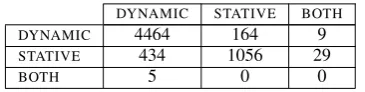
DYNAMIC STATIVE BOTH DYNAMIC 4464 164 9
STATIVE 434 1056 29
BOTH 5 0 0
Table 2: Asp-MASC: confusion matrix for two annotators, withouthave/be/noneclauses,κis 0.7.
spired by this work, our present work goes one step further and uses a larger set ofinstance-based
contextual features to perform experiments on a set of 20 verbs. To the best of our knowledge, there is no previous work comprehensively addressing aspectual classification of verbs in context.
3 Data
Verb type seed sets Using the LCS Database (Dorr, 2001), we identify sets of verb types whose senses are only stative (188 verbs, e.g. belong, cost, possess), only dynamic (3760 verbs, e.g. al-ter, knock, resign), or mixed (215 verbs, e.g. fill, stand, take), following a procedure described by Dorr and Olsen (1997).
Asp-MASC The Asp-MASC corpus consists of 7875 clauses from the letters, news and jokes sec-tions of MASC (Ide et al., 2010), each labeled by two annotators for the aspectual class of the main verb.2Texts were segmented into clauses
us-ing SPADE (Soricut and Marcu, 2003) with some heuristic post-processing. We parse the corpus us-ing the Stanford dependency parser (De Marneffe et al., 2006) and extract the main verb of each seg-ment. We use 6161 clauses for the classification task, omitting clauses withhaveorbeas the main verb and those where no main verb could be iden-tified due to parsing errors (none). Table 1 shows inter-annotator agreement; Table 2 shows the con-fusion matrix for the two annotators. Our two an-notators exhibit different preferences on the 598 cases where they disagree betweenDYNAMICand STATIVE. Such differences in annotation
prefer-2Corpus freely available from
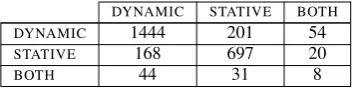
[image:2.595.326.509.175.221.2]DYNAMIC STATIVE BOTH DYNAMIC 1444 201 54
STATIVE 168 697 20
[image:3.595.93.273.62.107.2]BOTH 44 31 8
Table 3: Asp-Ambig: confusion matrix for two annotators. Cohen’sκis 0.6.
ences are not uncommon (Beigman Klebanov et al., 2008). We observe higher agreement in the jokes and news subcorpora than for letters; texts in the letters subcorpora are largely argumentative and thus have a different rhetorical style than the more straightforward narratives and reports found in jokes. Overall, we find substantial agreement.
The data for our experiments uses the labelDY -NAMIC or STATIVE whenever annotators agree,
andBOTHwhenever they disagree or when at least
one annotator marked the clause asBOTH,
assum-ing that both readassum-ings are possible in such cases. Because we don’t want to model the authors’ per-sonal view of the theory, we refrain from applying an adjudication step and model the data as is. Asp-Ambig: (Brown) In order to facilitate a first study on ambiguous verbs, we select 20 fre-quent verbs from the list of ‘mixed’ verbs (see section 3) and for each mark 138 sentences. Sen-tences are extracted randomly from the Brown cor-pus, such that the distribution of stative/dynamic usages is expected to be natural. We present entire sentences to the annotators who mark the aspectual class of the verb in question as high-lighted in the sentence. The data is processed in the same way as Asp-MASC, discarding instances with parsing problems. This results in 2667 in-stances.κis 0.6, the confusion matrix is shown in Table 3. Details are listed in Table 10.
4 Model and Features
For predicting the aspectual class of verbs in con-text (STATIVE, DYNAMIC, BOTH), we assume a
supervised learning setting and explore features mined from a large background corpus, distribu-tional features, and instance-based features. If not indicated otherwise, experiments use a Random Forest classifier (Breiman, 2001) trained with the implementation and standard parameter settings from Weka (Hall et al., 2009).
4.1 Linguistic indicator features (LingInd) This set of corpus-based features is a reimple-mentation of the linguistic indicators of Siegel
FEATURE EXAMPLE FEATURE EXAMPLE
frequency - continuous continually
present says adverb endlessly
past said evaluation better
future will say adverb horribly perfect had won manner furiously progressive is winning adverb patiently negated not/never temporal again particle up/in/... adverb finally
no subject - in-PP in an hour
[image:3.595.307.530.62.182.2]for-PP for an hour Table 4:LingIndfeature set and examples for lex-ical items associated with each indicator.
FEATURE VALUES
part-of-speech tag of the verb VB, VBG, VBN, ...
tense present, past, future
progressive true/false
perfect true/false
voice active/passive
[image:3.595.309.525.220.299.2]grammatical dependents WordNet lexname/POS
Table 5: Instance-based (Inst) features
and McKeown (2000), who show that (some of) these features correlate with either stative or dy-namic verb types. We parse the AFE and XIE sec-tions of Gigaword (Graff and Cieri, 2003) with the Stanford dependency parser. For each verb type, we obtain a normalized count showing how often it occurs with each of the indicators in Ta-ble 4, resulting in one value per feature per verb. For example, for the verb fill, the value of the featuretemporal-adverbis 0.0085, meaning that 0.85% of the occurrences offillin the corpus are modified by one of the temporal adverbs on the list compiled by Siegel (1998b). Tense, progres-sive, perfect and voice are extracted using a set of rules following Loaiciga et al. (2014).3
4.2 Distributional Features (Dist)
We aim to leverage existing, possibly noisy sets of representative stative, dynamic or mixed verb types extracted from LCS (see section 3), mak-ing up for unseen verbs and noise by averagmak-ing over distributional similarities. Using an exist-ing large distributional model (Thater et al., 2011) estimated over the set of Gigaword documents marked as stories, for each verb type, we build a syntactically informed vector representing the contexts in which the verb occurs. We compute three numeric feature values per verb type, which correspond to the average cosine similarities with the verb types in each of the three seed sets.
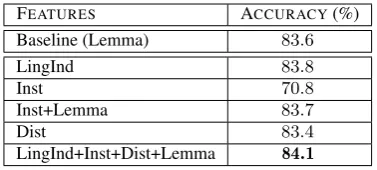
FEATURES ACCURACY(%)
Baseline (Lemma) 83.6
LingInd 83.8
Inst 70.8
Inst+Lemma 83.7
Dist 83.4
[image:4.595.87.276.61.146.2]LingInd+Inst+Dist+Lemma 84.1
Table 6: Experiment 1: SEENverbs, using Asp-MASC. Baseline memorizes most frequent class per verb type in training folds.
[image:4.595.339.493.61.123.2]4.3 Instance-based features (Inst)
Table 5 shows our set of instance-based syntac-tic and semansyntac-tic features. In contrast to the above described type-based features, these features do not rely on a background corpus, but are ex-tracted from the clause being classified. Tense, progressive, perfect and voice are extracted from dependency parses as described above. For fea-tures encoding grammatical dependents, we focus on a subset of grammatical relations. The fea-ture value is either the WordNet lexical filename (e.g. noun.person) of the given relation’s argu-ment or its POS tag, if the former is not avail-able. We simply use the most frequent sense for the dependent’s lemma. We also include features that indicate, if there are any, the particle of the verb and its prepositional dependents. For the sentence A little girl had just finished her first week of school, the instance-based feature values would include tense:past, subj:noun.person,
dobj:noun.timeorparticle:none.
5 Experiments
The experiments presented in this section aim to evaluate the effectiveness of the feature sets de-scribed in the previous section, focusing on the challenging cases of verb types unseen in the train-ing data and highly ambiguous verbs. The feature Lemmaindicates that the verb’s lemma is used as an additional feature.
Experiment 1: SEENverbs
The setting of our first experiment follows Siegel and McKeown (2000). Table 6 reports results for 10-fold cross-validation, with occurrences of all verbs distributed evenly over the folds. No feature combination significantly4 outperforms the
base-line of simply memorizing the most frequent class 4According to McNemar’s test with Yates’ correction for continuity,p <0.01.
FEATURES ACCURACY(%)
1 Baseline 72.5
2 Dist 78.3∗
[image:4.595.307.526.209.359.2]3 LingInd 80.4∗ 4 LingInd+Dist 81.9*†
Table 7: Experiment 2: UNSEENverb types,
Lo-gistic regression,Asp-MASC. Baseline labels ev-erything with the most frequent class in the train-ing set (DYNAMIC). *Significantly4different from
line 1.†Significantly4different from line 3.
DATA FEATURES ACC. (%)
one-label Baseline 92.8
verbs LingInd 92.8
Dist 92.6
(1966 inst.) Inst+Lemma 91.4∗ LingInd+Inst+Lemma 92.4
multi-label Baseline 78.9
verbs LingInd 79.0
Dist 79.0
(4195 inst.) Inst 67.4∗
Inst+Lemma 79.9
LingInd+Inst+Lemma 80.9* LingInd+Inst+Lemma+Dist 80.2*
Table 8: Experiment 3: ‘ONE- VS. MULTI -LABEL’ verbs, Asp-MASC. Baseline as in Table
6. *Indicates that result is significantly4different
from the respective baseline.
of a verb type in the respective training folds. Experiment 2: UNSEEN verbs
This experiment shows a successful case of semi-supervised learning: while type-based feature val-ues can be estimated from large corpora in an un-supervised way, some labeled training data is nec-essary to learn their best combination. This exper-iment specifically examines performance on verbs not seen in labeled training data. We use 10-fold cross validation but ensure that all occurrences of a verb type appear in the same fold: verb types in each test fold have not been seen in the re-spective training data, ruling out the Lemma fea-ture. A Logistic regression classifier (Hall et al., 2009) works better here (using only numeric fea-tures), and we present results in Table 7. Both the LingInd and Dist features generalize across verb types, and their combination works best.
Experiment 3: ONE- vs.MULTI-LABELverbs
SYSTEM CLASS ACC. P R F baseline micro-avg. 78.9 0.75 0.79 0.76
LingInd DYNAMIC 0.84 0.95 0.89
+Inst STATIVE 0.76 0.69 0.72
+Lemma BOTH 0.51 0.24 0.33
[image:5.595.308.525.59.371.2]micro-avg. 80.9* 0.78 0.81 0.79 Table 9: Experiment 3: ‘MULTI-LABEL’,
preci-sion, recall and F-measure, detailed class statistics for the best-performing system from Table 8.
for multi-label verbs (instances have differing la-bels in Asp-MASC). We expect one-label verbs to have a strong predominant aspectual class, and multi-label verbs to be more flexible. Otherwise, the experimental setup is as in experiment 1. Re-sults appear in Table 8. In each case, the linguistic indicator features again perform on par with the baseline. For multi-label verbs, the feature combi-nation Lemma+LingInd+Inst leads to significant4
improvement of 2% gain in accuracy over the baseline; Table 9 reports detailed class statistics and reveals a gain in F-measure of 3 points over the baseline. To sum up, Inst features are essential for classifying multi-label verbs, and the LingInd features provide some useful prior. These results motivate the need for an instance-based approach. Experiment 4: INSTANCE-BASEDclassification
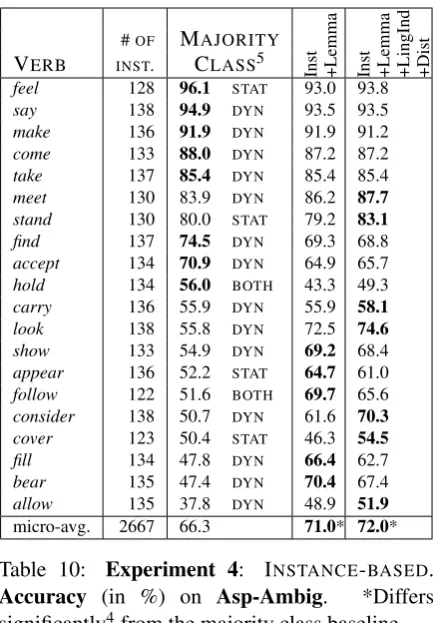
For verbs with ambiguous aspectual class, type-based classification is not sufficient, as this ap-proach selects a dominant sense for any given verb and then always assigns that. Therefore we pro-pose handling ambiguous verbs separately. As Asp-MASC contains only few instances of each of the ambiguous verbs, we turn to the Asp-Ambig dataset. We perform a Leave-One-Out (LOO) cross validation evaluation, with results reported in Table 10.5 Using the Inst features alone (not
shown in Table 10) results in a micro-average ac-curacy of only 58.1%: these features are only use-ful when combined with the feature Lemma. For classifying verbs whose most frequent class oc-curs less than 56% of the time, Lemma+Inst fea-tures are essential. Whether or not performance is improved by adding LingInd/Dist features, with their bias towards one aspectual class, depends on the verb type. It is an open research question which verb types should be treated in which way.
5 The third column also shows the outcome of using ei-ther only the Lemma, only LingInd or only Dist in LOO; all have almost the same outcome as using the majority class, numbers differ only after the decimal point.
Inst +Lemma Inst +Lemma +LingInd +Dist #OF MAJORITY
VERB INST. CLASS5
feel 128 96.1 STAT 93.0 93.8
say 138 94.9 DYN 93.5 93.5
make 136 91.9 DYN 91.9 91.2
come 133 88.0 DYN 87.2 87.2
take 137 85.4 DYN 85.4 85.4
meet 130 83.9 DYN 86.2 87.7
stand 130 80.0 STAT 79.2 83.1
find 137 74.5 DYN 69.3 68.8
accept 134 70.9 DYN 64.9 65.7 hold 134 56.0 BOTH 43.3 49.3 carry 136 55.9 DYN 55.9 58.1
look 138 55.8 DYN 72.5 74.6
show 133 54.9 DYN 69.2 68.4
appear 136 52.2 STAT 64.7 61.0 follow 122 51.6 BOTH 69.7 65.6 consider 138 50.7 DYN 61.6 70.3
cover 123 50.4 STAT 46.3 54.5
fill 134 47.8 DYN 66.4 62.7
bear 135 47.4 DYN 70.4 67.4
allow 135 37.8 DYN 48.9 51.9
micro-avg. 2667 66.3 71.0* 72.0*
Table 10: Experiment 4: INSTANCE-BASED. Accuracy (in %) on Asp-Ambig. *Differs significantly4from the majority class baseline.
6 Discussion and conclusions
We have described a new, context-aware approach to automatically predicting aspectual class, includ-ing a new set of distributional features. We have also introduced two new data sets of clauses la-beled for aspectual class. Our experiments show that in any setting where labeled training data is available, improvement over the most frequent class baseline can only be reached by integrating instance-based features, though type-based fea-tures (LingInd, Dist) may provide useful priors for some verbs and successfully predict predom-inant aspectual class for unseen verb types. In or-der to arrive at a globally well-performing system, we envision a multi-stage approach, treating verbs differently according to whether training data is available and whether or not the verb’s aspectual class distribution is highly skewed.
[image:5.595.73.289.62.135.2]References
Emmon Bach. 1986. The algebra of events. Linguis-tics and philosophy, 9(1):5–16.
Beata Beigman Klebanov, Eyal Beigman, and Daniel Diermeier. 2008. Analyzing disagreements. In Pro-ceedings of the Workshop on Human Judgements in Computational Linguistics, pages 2–7. Association for Computational Linguistics.
Steven Bethard. 2013. ClearTK-TimeML: A minimal-ist approach to TempEval 2013. In Second Joint Conference on Lexical and Computational Seman-tics (* SEM), volume 2, pages 10–14.
Leo Breiman. 2001. Random forests. Machine Learn-ing, 45(1):5–32.
Michael R. Brent. 1991. Automatic semantic classifi-cation of verbs from their syntactic contexts: an im-plemented classifier for stativity. InProceedings of the fifth conference on European chapter of the As-sociation for Computational Linguistics, pages 222– 226. Association for Computational Linguistics.
Nathanael Chambers. 2013. Navytime: Event and time ordering from raw text. InSecond Joint Con-ference on Lexical and Computational Semantics (* SEM), volume 2, pages 73–77.
Francisco Costa and Ant´onio Branco. 2012. Aspec-tual type and temporal relation classification. In
Proceedings of the 13th Conference of the European Chapter of the Association for Computational Lin-guistics, pages 266–275. Association for Computa-tional Linguistics.
Marie-Catherine De Marneffe, Bill MacCartney, Christopher D Manning, et al. 2006. Generat-ing typed dependency parses from phrase structure parses. InProceedings of LREC, volume 6, pages 449–454.
Bonnie J. Dorr and Mari Broman Olsen. 1997. De-riving verbal and compositional lexical aspect for NLP applications. InProceedings of the eighth con-ference on European chapter of the Association for Computational Linguistics, pages 151–158. Associ-ation for ComputAssoci-ational Linguistics.
Bonnie J. Dorr. 1992. A two-level knowledge repre-sentation for machine translation: lexical semantics and tense/aspect. InLexical Semantics and Knowl-edge Representation, pages 269–287. Springer.
Bonnie J. Dorr. 2001. LCS verb database. Online software database of Lexical Conceptual Structures, University of Maryland, College Park, MD.
David Dowty. 1979. Word Meaning and Montague Grammar. Reidel, Dordrecht.
David Graff and Christopher Cieri. 2003. English gi-gaword.
Mark Hall, Eibe Frank, Geoffrey Holmes, Bernhard Pfahringer, Peter Reutemann, and Ian H. Witten. 2009. The weka data mining software: an update.
ACM SIGKDD explorations newsletter, 11(1):10– 18.
Nancy Ide, Christiane Fellbaum, Collin Baker, and Re-becca Passonneau. 2010. The manually annotated sub-corpus: a community resource for and by the people. InProceedings of the ACL 2010 Conference Short Papers, pages 68–73. Association for Compu-tational Linguistics.
Hyuckchul Jung and Amanda Stent. 2013. ATT1: Temporal annotation using big windows and rich syntactic and semantic features. In Second Joint Conference on Lexical and Computational Seman-tics (* SEM), volume 2, pages 20–24.
Graham Katz. 2003. On the stativity of the english perfect. Perfect explorations, pages 205–234.
Judith L. Klavans and Martin Chodorow. 1992. De-grees of stativity: the lexical representation of verb aspect. In Proceedings of the 14th conference on Computational Linguistics, pages 1126–1131. Asso-ciation for Computational Linguistics.
Sharid Loaiciga, Thomas Meyer, and Andrei Popescu-Belis. 2014. English-French Verb Phrase Align-ment in Europarl for Tense Translation Modeling. InLanguage Resources and Evaluation Conference (LREC), Reykjavik, Iceland.
Michael C. McCord. 1990.Slot Grammar. Springer.
Marc Moens and Mark J. Steedman. 1988. Tempo-ral ontology and tempoTempo-ral reference. Computational Linguistics, 14(2):15–28.
Alexander P.D. Mourelatos. 1978. Events, processes, and states. Linguistics and philosophy, 2(3):415– 434.
Alexander Nakhimovsky. 1988. Aspect, aspectual class, and the temporal structure of narrative. Com-putational Linguistics, 14(2):29–43.
Rebecca Passonneau. 1988. A computational model of the semantics of tense and aspect. Computational Linguistics, Spring 1988.
James Pustejovsky, Patrick Hanks, Roser Sauri, An-drew See, Robert Gaizauskas, Andrea Setzer, Dragomir Radev, Beth Sundheim, David Day, Lisa Ferro, et al. 2003. The timebank corpus. InCorpus linguistics, volume 2003, page 40.
Eric V. Siegel. 1998a. Disambiguating verbs with the WordNet category of the direct object. In Proceed-ings of Workshop on Usage of WordNet in Natural Language Processing Systems, Universite de Mon-treal.
Eric V. Siegel. 1998b. Linguistic Indicators for Language Understanding: Using machine learn-ing methods to combine corpus-based indicators for aspectual classification of clauses. Ph.D. thesis, Columbia University.
Carlota S. Smith. 1991. The Parameter of Aspect. Kluwer, Dordrecht.
Radu Soricut and Daniel Marcu. 2003. Sentence level discourse parsing using syntactic and lexical infor-mation. In Proceedings of the 2003 Conference of the North American Chapter of the Association for Computational Linguistics on Human Language Technology-Volume 1, pages 149–156. Association for Computational Linguistics.
Stefan Thater, Hagen F¨urstenau, and Manfred Pinkal. 2011. Word meaning in context: A simple and ef-fective vector model. InIJCNLP, pages 1134–1143. Naushad UzZaman, Hector Llorens, Leon Derczyn-ski, Marc Verhagen, James Allen, and James Puste-jovsky. 2013. Semeval-2013 task 1: Tempeval-3: Evaluating time expressions, events, and temporal relations. InSecond joint conference on lexical and computational semantics (* SEM), volume 2, pages 1–9.
Zeno Vendler, 1957. Linguistics in Philosophy, chapter Verbs and Times, pages 97–121. Cornell University Press, Ithaca, New York.
Marc Verhagen, Robert Gaizauskas, Frank Schilder, Mark Hepple, Graham Katz, and James Pustejovsky. 2007. Semeval-2007 task 15: Tempeval temporal relation identification. In Proceedings of the 4th International Workshop on Semantic Evaluations, pages 75–80. Association for Computational Lin-guistics.