Resolving Entity Morphs in Censored Data
Hongzhao Huang1, Zhen Wen2, Dian Yu1, Heng Ji1,Yizhou Sun3, Jiawei Han4, He Li5
1Computer Science Department and Linguistics Department,
Queens College and Graduate Center, City University of New York, New York, NY, USA 2IBM T. J. Watson Research Center, Hawthorne, NY, USA
3College of Computer and Information Science, Northeastern University, Boston, MA, USA 4Computer Science Department, Univerisity of Illinois at Urbana-Champaign, Urbana, IL, USA
5Admaster Inc., China
{hongzhaohuang1,yudiandoris1,hengjicuny1, liheact5}@gmail.com,
[email protected], [email protected], [email protected]
Abstract
In some societies, internet users have to create information morphs (e.g. “Peace West King” to refer to “Bo Xilai”) to avoid active censorship or achieve other com-munication goals. In this paper we aim to solve a new problem of resolving en-tity morphs to their real targets. We ex-ploit temporal constraints to collect cross-source comparable corpora relevant to any given morph query and identify target can-didates. Then we propose various novel similarity measurements including surface features, meta-path based semantic fea-tures and social correlation feafea-tures and combine them in a learning-to-rank frame-work. Experimental results on Chinese Sina Weibo data demonstrate that our ap-proach is promising and significantly out-performs baseline methods1.
1 Introduction
Language constantly evolves to maximize com-municative success and expressive power in daily social interactions. The proliferation of online so-cial media significantly expedites this evolution, as new phrases triggered by social events may be disseminated rapidly in social media. To automati-cally analyze such fast evolving language in social media, new computational models are demanded.
In this paper, we focus on one particular lan-guage evolution that creates new ways to commu-nicate sensitive subjects because of the existence of internet information censorship. We call this 1Some of the resources and open source programs devel-oped in this work are made freely available for research pur-pose at http://nlp.cs.qc.cuny.edu/Morphing.tar.gz
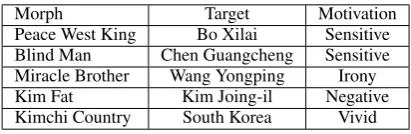
phenomenon information morph. For example, when Chinese online users talk about the former politician “Bo Xilai”, they use a morph “Peace West King” instead, a historical figure four hun-dreds years ago who governed the same region as Bo. Morph can be considered as a special case of alias used for hiding true entities in ma-licious environment (Hsiung et al., 2005; Pantel, 2006). However, social network plays an impor-tant role in generating morphs. Usually morphs are generated by harvesting the collective wisdom of the crowd to achieve certain communication goals. Aside from the purpose of avoiding cen-sorship, other motivations for using morph include expressing sarcasm/irony, positive/negative senti-ment or making descriptions more vivid toward some entities or events. Table 1 presents the wide range of cases that are used to create the morphs. We can see that a morph can be either a regular term with new meaning or a newly created term.
Morph Target Motivation
[image:1.595.312.518.526.593.2]Peace West King Bo Xilai Sensitive Blind Man Chen Guangcheng Sensitive Miracle Brother Wang Yongping Irony Kim Fat Kim Joing-il Negative Kimchi Country South Korea Vivid
Table 1: Morph Examples and Motivations.
We believe that successful resolution of morphs is a crucial step for automated understanding of the fast evolving social media language, which is important for social media marketing (Bar-wise and Meehan, 2010). Another application is to help common users without enough back-ground/cultural knowledge to understand internet language for their daily use. Furthermore, our ap-proaches can also be applied for satire or other im-plicit meaning recognition, as well as information extraction (Bollegala et al., 2011).
However, morph resolution in social media is challenging due to the following reasons. First, the sensitive real targets that exist in the same data source under active censorship are often au-tomatically filtered. Table 2 presents the distribu-tions of some examples of morphs and their tar-gets in English Twitter and Chinese Sina Weibo. For example, the target “Chen Guangcheng” only appears once in Weibo. Thus, the co-occurrence of a morph and its target is quite low in the vast amount of information in social media. Second, most morphs were not created based on pronunci-ations, spellings or other encryptions of their origi-nal targets. Instead, they were created according to semantically related entities in historical and cul-tural narratives (e.g. “Peace West King” as morph of “Bo Xilai”) and thus very difficult to capture based on typical lexical features. Third, tweets from Twitter/Chinese Weibo are short (only up to
140characters) and noisy, resulting in difficult
ex-traction of rich and accurate evidences due to the lack of enough contexts.
Frequency in Twitter
Frequency in Weibo Morph Target
Morph Target Morph Target Hu Ji Hu Jintao 1 3,864 2,611 71 Blind
Man
Chen Guangcheng
18 2,743 20,941 1
[image:2.595.315.503.251.459.2]Baby Wen Jiabao 2238 2021 26,279 8
Table 2: Distributions of Morph Examples
To the best of our knowledge, this is the first work to use NLP and social network analysis tech-niques to automatically resolve morphed informa-tion. To address the above challenges, our paper offers the following novel contributions.
• We detect target candidates by exploiting the
dynamics of the social media to extract tem-poral distribution of entities, based on the as-sumption that the popularity of an individ-ual is correlated between censored and un-censored text within a certain time window.
• Our approach builds and analyzes heteroge-neous information networks from multiple sources, such as Twitter, Sina Weibo and web documents in formal genre (e.g. news) be-cause a morph and its target tend to appear in similar contexts.
• We propose two new similarity measures, as well as integrating temporal information into
the similarity measures to generate global se-mantic features.
• We model social user behaviors and use so-cial correlation to assist in measuring seman-tic similarities because the users who posted a morph and its corresponding target tend to share similar interests and opinions.
Our experiments demonstrate that the pro-posed approach significantly outperforms tradi-tional alias detection methods (Hsiung et al., 2005).
2 Approach Overview
Morph Query
Comparable Data Acquisition
Target Candidate Ranking
Target Learning to Rank Semantic Features Semantic Annotation and Target Candidate Identification
Surface Features Social Features Censored
Data
[image:2.595.83.280.373.444.2]Uncensored Data
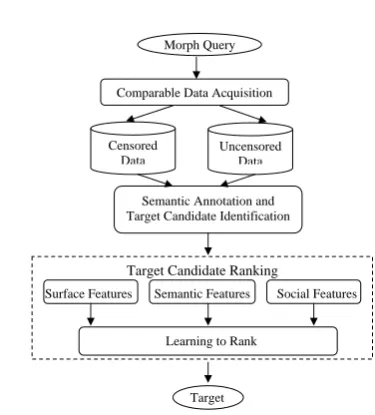
Figure 1: Overview of Morph Resolution
Given a morph querym, the goal of morph
res-olution is to find its real target. Figure 1 depicts the general procedure of our approach. It consists of two main sub-tasks:
• Target Candidate Identification: For each
m, discover a list of target candidates E = {e1, e2, ..., eN}. First, relevant comparable data sets that include m are retrieved. In
this paper we collect comparable censored data from Weibo and uncensored data from Twitter and Web documents such as news ar-ticles. We then apply various annotations such as word segmentation, part-of-speech tagging, noun phrase chunking, name tagging and event extraction to these data sets.
• Target Candidate Ranking: Rank the target
candidates inE. We explore various features
rank framework. Finally, the top ranked can-didate is produced as the resolved target.
3 Target Candidate Identification
The general goal of the first step is to identify a list of target candidates for each morph query from the comparable corpora including Sina Weibo, Chi-nese News websites and English Twitter. How-ever, obviously we cannot consider all of the named entities in these sources as target candi-dates due to the sheer volume of information. In addition, morphs are not limited to named entity forms. In order to narrow down the scope of tar-get candidates, we propose a Temporal Distribu-tion AssumpDistribu-tion as follows. The intuition is that a morphm and its real targeteshould have sim-ilar temporal distributions in terms of their occur-rences. Suppose the data sets are separated intoZ
temporal slots (e.g. by day), the assumption can be stated as:
Let Tm = {tm1, tm2, ..., tmZm} be the set of temporal slots each morph m occurs, and Te =
{te1, te2, ..., teZe}be the set of slots a target
can-didateeoccurs. Then eis considered as a target candidate ofmif and only if, for each tmi ∈ Tm (i = 1,2, ..., Zm), there exist aj ∈ {1,2, ..., Ze} such that tmi −tej ≤ δ, where δ is a threshold value (in this paper we set the threshold to7days,
which is optimized from a development set). For comparison we also attempted topic modeling ap-proach to detect target candidates, as shown in sec-tion 5.3.
4 Target Candidate Ranking
Next, we propose a learning-to-rank framework to rank target candidates based on various levels of novel features based on surface, semantic and so-cial analysis.
4.1 Surface Features
We first extract surface features between the morph and the candidate based on measuring or-thographic similarity measures which were com-monly used in entity coreference resolution (e.g. (Ng, 2010; Hsiung et al., 2005)). The measures we use include “string edit distance”, “normalized string edit distance” (Wagner and Fischer, 1974) and “longest common subsequence” (Hirschberg, 1977).
4.2 Semantic Features 4.2.1 Motivations
Fortunately, although a morph and its target may have very different orthographic forms, they tend to be embedded in similar semantic contexts
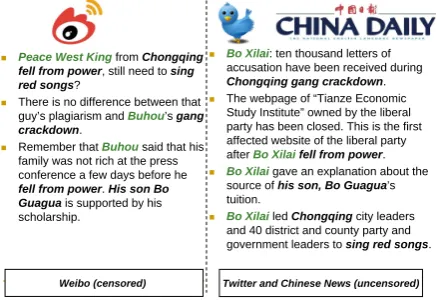
which involve similar topics and events. Figure 2 presents some example messages under censor-ship (Weibo) and not under censorcensor-ship (Twitter and Chinese Daily). We can see that they include similar topics, events (e.g., “fell from power”, “gang crackdown”, “sing red songs”), and se-mantic relations (e.g., family relations with “Bo Guagua”). Therefore if we can automatically ex-tract and exploit these indicative semantic con-texts, we can narrow down the real targets effec-tively.
Peace West Kingfrom Chongqing fell from power, still need to sing red songs?
There is no difference between that guy’s plagiarism and Buhou’sgang crackdown.
Remember that Buhousaid that his family was not rich at the press conference a few days before he
fell from power. His son Bo Guaguais supported by his scholarship.
Bo Xilai: ten thousand letters of accusation have been received during
Chongqing gang crackdown.
The webpage of “Tianze Economic Study Institute” owned by the liberal party has been closed. This is the first affected website of the liberal party after Bo Xilaifell from power.
Bo Xilaigave an explanation about the source of his son, Bo Guagua’s tuition.
Bo Xilailed Chongqing city leaders and 40 district and county party and government leaders to sing red songs.
[image:3.595.307.526.304.454.2]Weibo (censored) Twitter and Chinese News (uncensored)
Figure 2: Cross-source Comparable Data Example (each morph and target pair is shown in the same color)
4.2.2 Information Network Construction We define an information network as a directed graph G = (V,E) with an object type mapping functionτ :V → Aand a link type mapping func-tionφ:E → R, where each objectv ∈ Vbelongs
to one particular object typeτ(v) ∈ A, each link e ∈ E belongs to a particular relation φ(e) ∈ R. If two links belong to the same relation type, then they share the same starting object type as well as the same ending object type. An information net-work ishomogeneousif and only if there is only one type for both objects and links, and an infor-mation network isheterogeneouswhen the objects are from multiple distinct types or there exist more than one type of links.
segmenter with Chinese Penn Treebank segmen-tation standard (Chang et al., 2008) and Stan-ford part-of-speech tagger (Toutanova et al., 2003) to process each sentence in the comparable data sets. Then we apply a hierarchical Hidden Markov Model (HMM) based Chinese lexical analyzer ICTCLAS (Zhang et al., 2003) to extract named entities, noun phrases and events.
We have also attempted using the results from Dependency Parsing, Relation Extraction and Event Extraction tools (Ji and Grishman, 2008) to enrich the link types. Unfortunately the state-of-the-art techniques for these tasks still perform poorly on social media in terms of both accuracy and coverage of important information, these so-phisticated semantic links all produced negative impact on the target ranking performance. There-fore we limited the types of vertices into: Morph
(M),Entity(E), which includes target candidates,
Event (EV), and Non-Entity Noun Phrases(NP); and usedco-occurrenceas the edge type. We ex-tract entities, events, and non-entity noun phrases that occur in more than one tweet as neighbors. And for two vertices xi and xj, the weight wij of their edge is the frequency they co-occur to-gether within the tweets. A network schema of such networks is shown in Figure 3. Figure 4
M E
NP EV
Figure 3: Network Schema of Morph-Related Het-erogeneous Information Network
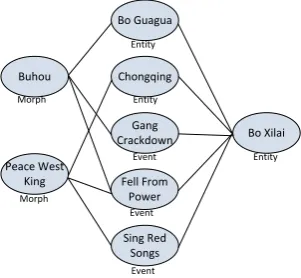
presents an example of a heterogeneous informa-tion network from the motivainforma-tion examples fol-lowing the above network schema, which connects the morphs “Peace West King”, “Buhou” and their corresponding target “Bo Xilai”.
4.2.3 Meta-Path-Based Semantic Similarity Measurements
Given the constructed network, a straightforward solution for finding the target for a morph is to use link-based similarity search. However, now ob-jects are linked to different types of neighbors, if all neighbors are treated as the same, it may cause information loss problems. For example, the en-tity “重庆(Chongqing)” is a very important aspect characterizing the politician “薄熙来(Bo Xilai)”
Gang Crackdown
Fell From Power Chongqing
Sing Red Songs Buhou
Peace West King
Bo Xilai Bo Guagua
Entity
Entity Entity
Event
Event
Event Morph
[image:4.595.342.493.63.202.2]Morph
Figure 4: Example of Morph-Related Heteroge-neous Information Network
since he governed it, and if a morph m which is
also highly correlated with “重庆(Chongqing)”, it is very likely that “Bo Xilai” is the real target ofm.
Therefore, the semantic features generated from neighbors such as the entity “重庆(Chongqing)” should be treated differently from other types of neighbors such as “人才(talented people)” .
In this work, we propose to measure the simi-larity of two nodes over heterogeneous networks as shown in Figure 3, by distinguishing neighbors into three types according to the network schema (i.e. entities, events, non-entity noun phrases). We then adopt meta-path-based similarity measures (Sun et al., 2011a; Sun et al., 2011b), which are defined over heterogeneous networks to extract se-mantic features. A meta-path is a path defined over a network, and composed of a sequence of rela-tions between different object types. For example, as shown in Figure 3, a morph and its target can-didate can be connected by three meta-paths, in-cluding “M - E - E”, “M - EV - E”, and “M - NP - E”. Intuitively, each meta-path provides a unique angle to measure how similar two objects are.
For the determined meta-paths, we extract se-mantic features using the similarity measures pro-posed in (Sun et al., 2011a; Hsiung et al., 2005). We denote the neighbor sets of certain type for a morph m and a target candidate e as Γ(m) and Γ(e), and a meta-path as P. We now list several
meta-path-based similarity measures below.
Common neighbors (CN).It measures the num-ber of common neighbors that m and eshare as |Γ(m)∩Γ(e)|.
Path count (PC).It measures the number of path instances betweenmandefollowing meta-pathP.
meta-paths with the same length P = (P1P2),
pairwise random walk measures the probabil-ity of the pairwise random walk starting from both m and e and reaching the same mid-dle object. More formally, it is computed as P
(p1p2)∈(P1P2)prob(p1)prob(p
−1
2 ), where p−21 is
the inverse ofp2.
Kullback-Leibler distance (KLD). For m and e, the pairwise random walk probability of their
neighbors can be represented as two probability vectors, then Kullback-Leibler distance (Hsiung et al., 2005) can be used to computesim(m, e).
Beyond the above similarity measures, we also propose to use cosine-similarity-style normaliza-tion method to modify common neighbor and pair-wise random walk measures so that we can ensure the morph node and the target candidate node are strongly connected and also have similar popular-ity. The modified algorithms penalize features in-volved with the highly popular objects, since they are more likely to have accidental interactions with each other.
Normalized common neighbors (NCN). Nor-malized common neighbors can be measured as
sim(m, e) = √|Γ(m)∩Γ(e)|
|Γ(m)|√|Γ(e)|. It refines the simple counting of common neighbors by avoiding bias to highly visible or concentrated objects.
Pairwise random walk/cosine (PRW/cosine). Pairwise random walk measures linkage weights disproportionately with their visibility to their neighbors, which may be too strong. Instead, we propose to use a tamer normalization method as P
(p1p2)∈(P1P2)f(p1)f(p
−1
2 ), where.
f(p1) =
count(m, x)
pP
x∈Ωcount(m, x)
,
f(p2) = pPcount(e, x)
x∈Ωcount(e, x) ,
andΩis the set of middle objects connecting the decomposed meta-paths p1 andp2−1, count(y, x)
is the total number of paths betweenyand the
mid-dle objectx,ycould bemore.
The above similarity measures can also be ap-plied to homogeneous networks that do not differ-entiate the neighbor types.
4.2.4 Global Semantic Feafure Generation A morph tends to have higher temporal correlation with its real target, and share more similar topics compared to other irrelevant targets. Therefore, we propose to incorporate temporal information
into similarity measures to generate global seman-tic features.
LetT =t1∪t2∪...∪tN be a set of temporal slots (i.e. by day),Ebe the set of target candidates for each morphm. Then for eachti ∈T, and each
e ∈ E, the local semantic features simti(m, e)
is extracted based only on the information posted withinti using one of the similarity measures in-troduced in Section 4.2.3. Then we propose two approaches to generate global semantic features. The first approach is adding the similarity score betweenm ande in each temporal slot to attain
the first set of global features:
simglobal sum(m, e) = X
ti∈T
simti(m, e).
The second method first normalizes the similarity score in each temporal slotti, them sum the nor-malized scores to generate the second set of global features, which can be calculated as
simglobal norm(m, e) = X
ti∈T
normti(m, e).
wherenormti(m, e) =
simti(m,e)
P
e∈Esimti(m,e).
4.2.5 Integrate Cross Source/Cross Genre Information
Due to internet information censorship or surveil-lance, users may need to use morphs to post sensi-tive information. For example, the Chinese Weibo message “都进去了,还要贡着不厚吗 (Already put in prison, still need to serve Buhou?” include a morph不厚(Buhou). In contrast, users are less restricted in some other uncensored social media such as Twitter. For example, the tweet from Twit-ter “...把薄熙来称作“平西王”或者“不厚”...
(...call Bo Xilai“peace west king” or “buhou”...)” contains both the morph and the real target薄熙
来(Bo Xilai). Therefore, we propose to integrate information from another source (e.g. Twitter) to help resolution of sensitive morphs in Weibo.
Another difficulty from morph resolution in micro-blogging is that tweets are only allowed to contain maximum 140 characters with a lot of
embedded URLs in tweets to enrich information network construction. After applying the same an-notation techniques as tweets for uncensored data sets, sentence-level co-occurrence relations are ex-tracted and integrated into the network as shown in Figure 3.
4.3 Social Features
It has been shown that there exist correlation be-tween neighbors in social networks (Anagnos-topoulos et al., 2008; Wen and Lin, 2010). Be-cause of such social correlation, close social neighbors in social media such as Twitter and Weibo may post similar information, or share sim-ilar opinion. Therefore, we can utilize social cor-relation to assist in resolving morphs.
As social correlation can be defined as a func-tion of social distance between a pair of users, we use social distance as a proxy to social correla-tion in our approach. The social distance between user iandj is defined by considering the degree
of separation in their interaction (e.g. retweet-ing and mentionretweet-ing) and the amount of the in-teraction. Similar definition has been shown ef-fective in characterizing social distance in social networks extracted from communication data (Lin et al., 2012; Wen and Lin, 2010). Specifically, it is dist(i, j) = PK−k=11 strength1(v
k,vk+1), where v1, ..., vk are the nodes on the shortest path from userito userj, andstrength(vk, vk+1)measures
the strength of interactions betweenvk and vk+1
as: strength(i, j) = log(Xij)
maxjlog(Xij), where Xij is
the total interactions between useriandj, includ-ing both retweetinclud-ing and mentioninclud-ing (IfXij <10, we setstrength(i, j) = 0).
We integrate social correlation and temporal formation to define our social features. The in-tuition is that when a morph is used by an user, the real target may also in the posts by the user or his/her close friends within a certain time period. LetT be the set of temporal slots a morphm
oc-curs,Utbe the set of users whose posts includem in slottwheret ∈ T, andUc be the set of close friends (i.e., social distance < 0.5) for Ut. The
social features are defined as
s(m, e) =
P
t∈T f(e, t, Ut, Uc)
|T| .
wheref(e, t, Ut, Uc)is a indicator function which return1if one of the users inUtorUcposts tweets include the target candidateewithin7days before t.
4.4 Learning-to-Rank
Similar to (Hsiung et al., 2005; Sun et al., 2011a), we then model the probability of linkage predic-tion between a morphm and its target candidate eas a function incorporating the surface, semantic
and social features. Given a training pairhm, ei,
we choose the standard logistic regression model to learn weights for the features defined above. The learnt model is used to predict the probabil-ity of linking an unseen morph and its target can-didate. Based on the descending ranking order of the probability, we select topk candidates as the
final answers based on the answer sizek.
5 Experiments
Next, we present the experiment under various set-tings shown in Table 3, and the impacts of cross source and cross genre information.
5.1 Data and Evaluation Metric
We collected1,553,347tweets from Chinese Sina
Weibo from May 1 to June 30 to construct the censored data set, and retrieved66,559web doc-uments from the embedded URLs in tweets as the initial uncensored data set. Retweets and redun-dant web documents are filtered to ensure more reliable frequency counting of co-occurrence rela-tions. We asked two native Chinese annotators to analyze the data, and construct a test set consisted of 107 morph entities (81 persons and 26
loca-tions) and their real targets as our references. We verified the references by Web resources includ-ing the summary of popular morphs in Wikipedia 2. In addition, we used23 sensitive morphs and the entities that appear in the tweets as queries and retrieved25,128Chinese tweets from10%
Twit-ter feeds within the same time period, as well as
7,473web documents from the embedded URLs
and added them into the uncensored data set. To evaluate the system performance, we use leave-one-out cross validation by computing ac-curacy as Acc@k = Ck
Q, where Ck is the to-tal number of correctly resolved morphs at top
k ranked answers, and Q is the total number of morph queries. We consider a morph as correctly resolved at the topk answers if the topkanswer
set contains the real target of the morph.
Feature sets Descriptions Surf Surface features
HomB Semantic features extracted from homogeneous CN, PC, PRW, and KLD HomE HomB + semantic features extracted from homogeneous NCN and PRW/cosine HetB Semantic features extracted from heterogeneous CN, PC, PRW and KLD HetE HetB + Semantic features extracted from heterogeneous NCN and PRW/cosine Glob∗ Global semantic features
[image:7.595.73.525.60.150.2]Social Social network features
Table 3: Description of feature sets.∗Glob only uses the same set of similarity measures when combined with other semantic features.
5.2 Resolution Performance
5.2.1 Single Genre Information
We first study the contributions of each set of sur-face and semantic features, as shown in the first five rows in Table 4. The poor performance based on surface features shows that morph resolution task is very challenging since70%of morphs are
not orthographically similar to their real targets. Thus, capturing a morph’s semantic meaning is crucial. Overall, the results demonstrate the ef-fectiveness of our proposed methods. Specifi-cally, comparing “HomB” and “HetB”, “HomE” and “HetE”, we can see that the semantic fea-tures based on heterogeneous networks have ad-vantages over those based on homogeneous net-works. This corroborates that different neighbor sets contribute differently, and such discrepancies should be captured. And comparisions of “HomB” and “HomE”, “HetB” and “HetE”demonstrate the effectiveness of our two new proposed measures. To evaluate the importance of each similarity mea-sures, we delete the semantic features obtained from each measure in “HetE” and re-evaluate the system. We find that NCN is the most effective measure, while KLD is the least important one. Further adding the global semantic features signif-icantly improves the performance. This indicates that capturing both temporal correlations and se-mantics of morphing simultaneously are important for morph resolution.
Table 5 shows that combination of surface and semantic features further improves the perfor-mance, showing that they are complementary. For example, using only surface features, the real tar-get “乔布斯(Steve Jobs)” of the morph “乔帮
主(Qiao Boss)” is not top ranked since some other candidates such as “乔治 (George)” are more
or-thographically similar. However, “Steve Jobs” is ranked top when combined with semantic features.
Features Surf HomB HomE HetB HetE Acc@1 0.028 0.201 0.192 0.224 0.252 Acc@5 0.159 0.313 0.369 0.393 0.421 Acc@10 0.243 0.346 0.407 0.439 0.467 Acc@20 0.313 0.411 0.467 0.50 0.523 Features + Glob + Glob + Glob + Glob
Acc@1 0.230 0.285 0.257 0.285
Acc@5 0.402 0.407 0.449 0.458
Acc@10 0.435 0.458 0.50 0.495
[image:7.595.306.528.190.298.2]Acc@20 0.486 0.523 0.565 0.542 Table 4: The System Performance Based on Each Single Feature Set.
Features Surf +
[image:7.595.312.519.351.469.2]HomB Surf +HomE Surf +HetB Surf +HetE Acc@1 0.234 0.238 0.262 0.276 Acc@5 0.416 0.444 0.481 0.519 Acc@10 0.477 0.505 0.533 0.570 Acc@20 0.519 0.561 0.565 0.598 Features + Glob + Glob + Glob + Glob Acc@1 0.290 0.341 0.322 0.346 Acc@5 0.505 0.495 0.528 0.533 Acc@10 0.551 0.551 0.579 0.584 Acc@20 0.594 0.603 0.636 0.631 Table 5: The System Performance Based on Com-binations of Surface and Semantic Features.
5.2.2 Cross Source and Cross Genre Information
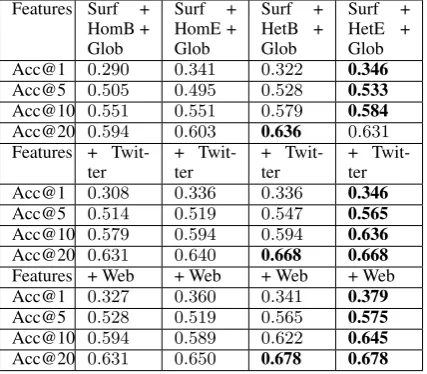
We integrate the cross source information from Twitter, and the cross genre information from web documents into Weibo tweets for information net-work construction, and extract a new set of se-mantic features. Table 6 shows that further gains can be achieved. Notice that integrating tweets from Twitter mainly improves the ranking for top
kwherek >1. This is because Weibo dominates
Features Surf + HomB + Glob
Surf + HomE + Glob
Surf + HetB + Glob
Surf + HetE + Glob Acc@1 0.290 0.341 0.322 0.346 Acc@5 0.505 0.495 0.528 0.533 Acc@10 0.551 0.551 0.579 0.584 Acc@20 0.594 0.603 0.636 0.631 Features +
[image:8.595.74.288.63.250.2]Twit-ter + Twit-ter + Twit-ter + Twit-ter Acc@1 0.308 0.336 0.336 0.346 Acc@5 0.514 0.519 0.547 0.565 Acc@10 0.579 0.594 0.594 0.636 Acc@20 0.631 0.640 0.668 0.668 Features + Web + Web + Web + Web Acc@1 0.327 0.360 0.341 0.379 Acc@5 0.528 0.519 0.565 0.575 Acc@10 0.594 0.589 0.622 0.645 Acc@20 0.631 0.650 0.678 0.678 Table 6: The System Performance of Integrating Cross Source and Cross Genre Information.
[image:8.595.307.525.368.473.2]5.2.3 Effects of Social Features
Table 7 shows that adding social features can im-prove the best performance achieved so far. This is because a group of people with close relationships may share similar opinion. As an example, two tweets “...of course the reputation of Buhou is a little too high! //@User1: //@User2: Chongqing event tells us...)” and “...do not follow Bo Xi-lai...@User1...) are from two users in the same social group.One includes a morph “Buhou” and the other includes its target “Bo Xilai”.
Features Surf + HomB + Glob + Twitter + Web
Surf + HomE + Glob + Twitter + Web
Surf + HetB + Glob + Twitter + Web
Surf + HetE + Glob + Twitter + Web Acc@1 0.327 0.360 0.341 0.379 Acc@5 0.528 0.519 0.565 0.575 Acc@10 0.594 0.589 0.622 0.645 Acc@20 0.631 0.650 0.678 0.678 Features + Social + Social + Social + Social Acc@1 0.336 0.369 0.365 0.379 Acc@5 0.537 0.547 0.589 0.594 Acc@10 0.594 0.601 0.645 0.659 Acc@20 0.645 0.664 0.701 0.701 Table 7: The Effects of Social Features.
5.3 Effects of Candidate Detection
The performance with and without candidate de-tection step (using all features) is shown in Ta-ble 8. The gain is small since the combination of all features in the learning to rank framework can already well capture the relationship between a morph and a target candidate. Nevertheless, the temporal distribution assumption is effective. It helps to filter out 80% of unrelated targets and
speed up the system5 times, while retain 98.5%
of the morph candidates that can be detected.
System Acc@1 Acc@5 Acc@10 Acc@20 Without 0.365 0.579 0.645 0.696 With 0.379 0.594 0.659 0.701
Table 8: The Effects of Temporal Constraint
We also attempted using topic modeling ap-proach to detect target candidates. Due to the large amount of data, we first split the data set on a daily basis, then applied Probabilistic Latent Semantic Analysis (PLSA) (Hofmann, 1999). Named enti-ties which co-occur at leastδtimes with a morph
query in the same topic are selected as its target candidates. As shown in Table9 (K is the num-ber of predefined topics), PLSA is not quite effec-tive mainly because traditional topic modeling ap-proaches do not perform well on short texts from social media. Therefore, in this paper we choose a simple method based on temporal distribution to detect target candidates.
Method All Temporal PLSA( PLSA( K= 5 K= 5 δ= 1) δ= 2) Acc 0.935 0.921 0.935 0.925 No. 8,111 1,964 6,380 4,776 Method PLSA( PLSA( PLSA( PLSA(
K= 10 K= 10 K= 20 K= 20 δ= 1) δ= 2) δ= 1) δ= 2) Acc 0.935 0.907 0.888 0.757 No. 5,117 3,138 3,702 1,664 Table 9: Accuracy of Target Candidate Detection
5.4 Discussions
Compared with the standard alias detection (“Surf+HomB”) approach (Hsiung et al., 2005), our proposed approach achieves significantly bet-ter performance (99.9% confidence level by the Wilcoxon Matched-Pairs Signed-Ranks Test for Acc@1). We further explore two types of factors which may affect the system performance as fol-lows.
One important aspect affecting the resolution performance is the morph & non-morph ambigu-ity. We categorize a morph query as “Unique” if the string is mainly used as a morph when it oc-curs, such as “薄督(Bodu)” which is used to
[image:8.595.74.287.459.605.2]category have much better resolution performance than those in “Common” category.
Category Number Acc@1 Acc@5 Acc@10 Acc@20 Unique 72 0.479 0.715 0.771 0.819 Common 35 0.171 0.343 0.40 0.429
Table 10: Performance of Two Categories
We also investigate the effects of popularity of morphs on the resolution performance. We split the queries into5bins with equal size based on the
non-descending frequency, and evaluate Acc@1 separately. As shown in Table11, we can see that the popularity is not highly correlated with the per-formance.
Rank 0 ∼
20%
20%∼
40%
40%∼
60%
60%∼
80%
80%∼
100% All 0.333 0.476 0.341 0.429 0.318 Unique 0.321 0.679 0.379 0.571 0.483 Common 0.214 0.214 0.071 0.071 0.286
Table 11: Effects of Popularity of Morphs
6 Related Work
To analyze social media behavior under active censorship, (Bamman et al., 2012) automatically discovered politically sensitive terms from Chi-nese tweets based on message deletion analysis. In contrast, our work goes beyond target idendi-fication by resolving implicit morphs to their real targets.
Our work is closely related to alias detec-tion (Hsiung et al., 2005; Pantel, 2006; Bollegala et al., 2011; Holzer et al., 2005). We demon-strated that state-of-the-art alias detection meth-ods did not perform well on morph resolution. In this paper we exploit cross-genre information and social correlation to measure semantic similarity. (Yang et al., 2011; Huang et al., 2012) also showed the effectiveness of exploiting information from formal web documents to enhance tweet summa-rization and tweet ranking.
Other similar research lines are the TAC-KBP Entity Linking (EL) (Ji et al., 2010; Ji et al., 2011), which links a named entity in news and web docu-ments to an appropriate knowledge base (KB) en-try, the task of mining name translation pairs from comparable corpora (Udupa et al., 2009; Ji, 2009; Fung and Yee, 1998; Rapp, 1999; Shao and Ng, 2004; Hassan et al., 2007) and the link predic-tion problem (Adamic and Adar, 2001; Liben-Nowell and Kleinberg, 2003; Sun et al., 2011b;
Hasan et al., 2006; Wang et al., 2007; Sun et al., 2011a). Most of the work focused on unstruc-tured or strucunstruc-tured data with clean and rich re-lations (e.g. DBLP). In contrast, our work con-structs heterogeneous information networks from unstructured, noisy multi-genre text without ex-plicit entity attributes.
7 Conclusion and Future Work
To the best of our knowledge, this is the first work of resolving implicit information morphs from the data under active censorship. Our promising re-sults can well serve as a benchmark for this new problem. Both of the Meta-path based and so-cial correlation based semantic similarity mea-surements are proven powerful and complemen-tary.
In this paper we have focused on entity morphs. In the future we will extend our method to dis-cover other types of information morphs, such as events and nominal mentions. In addition, auto-matic identification of candidate morphs is another challenging task, especially when the mentions are ambiguous and can also refer to other real enti-ties. Our ongoing work includes identifying can-didate morphs from scratch, as well as discovering morphs for a given target based on anomaly anal-ysis and textual coherence modeling.
Acknowledgments
References
Lada A. Adamic and Eytan Adar. 2001. Friends and neighbors on the web. SOCIAL NETWORKS, 25:211–230.
Aris Anagnostopoulos, Ravi Kumar, and Mohammad Mahdian. 2008. Influence and correlation in social networks. InKDD, pages 7–15.
David Bamman, Brendan O’Connor, and Noah A. Smith. 2012. Censorship and deletion practices in chinese social media. First Monday, 17(3).
Patrick Barwise and Se´an Meehan. 2010. The one thing you must get right when building a brand.
Harvard Business Review, 88(12):80–84.
D. Bollegala, Y. Matsuo, and M. Ishizuka. 2011. Au-tomatic discovery of personal name aliases from the web. Knowledge and Data Engineering, IEEE Transactions on, 23(6):831–844.
Pi-Chuan Chang, Michel Galley, and Christopher D. Manning. 2008. Optimizing chinese word segmen-tation for machine translation performance. In Pro-ceedings of the Third Workshop on Statistical Ma-chine Translation, StatMT ’08, pages 224–232. Pascale Fung and Lo Yuen Yee. 1998. An ir approach
for translating new words from nonparallel, com-parable texts. In Proceedings of the 36th Annual Meeting of the Association for Computational Lin-guistics and 17th International Conference on Com-putational Linguistics - Volume 1, ACL ’98, pages 414–420.
Mohammad Al Hasan, Vineet Chaoji, Saeed Salem, and Mohammed Zaki. 2006. Link prediction using supervised learning. InIn Proc. of SDM 06 work-shop on Link Analysis, Counterterrorism and Secu-rity.
Ahmed Hassan, Haytham Fahmy, and Hany Has-san. 2007. Improving named entity translation by exploiting comparable and parallel corpora. In
RANLP.
Daniel S. Hirschberg. 1977. Algorithms for the longest common subsequence problem. J. ACM, 24(4):664–675.
Thomas Hofmann. 1999. Probabilistic latent semantic indexing. InProceedings of the 22nd annual inter-national ACM SIGIR conference on Research and development in information retrieval, SIGIR ’99, pages 50–57.
Ralf Holzer, Bradley Malin, and Latanya Sweeney. 2005. Email alias detection using social network analysis. In Conference on Knowledge Discovery in Data: Proceedings of the 3 rd international work-shop on Link discovery, volume 21, pages 52–57. Paul Hsiung, Andrew Moore, Daniel Neill, and Jeff
Schneider. 2005. Alias detection in link data sets. In Proceedings of the International Conference on Intelligence Analysis, May.
Hongzhao Huang, Arkaitz Zubiaga, Heng Ji, Hongbo Deng, Dong Wang, Hieu Khac Le, Tarek F. Ab-delzaher, Jiawei Han, Alice Leung, John Hancock, and Clare R. Voss. 2012. Tweet ranking based on heterogeneous networks. InCOLING, pages 1239– 1256.
Heng Ji and Ralph Grishman. 2008. Refining event ex-traction through cross-document inference. In Pro-ceedings of ACL, pages 254–262.
H. Ji, R. Grishman, H.T. Dang, K. Griffitt, and J. El-lis. 2010. Overview of the tac 2010 knowledge base population track. InText Analysis Conference (TAC) 2010.
H. Ji, R. Grishman, and H.T. Dang. 2011. Overview of the tac 2011 knowledge base population track. In
Text Analysis Conference (TAC) 2011.
Heng Ji. 2009. Mining name translations from com-parable corpora by creating bilingual information networks. In Proceedings of the 2nd Workshop on Building and Using Comparable Corpora: from Parallel to Non-parallel Corpora, BUCC ’09, pages 34–37.
David Liben-Nowell and Jon Kleinberg. 2003. The link prediction problem for social networks. In
Proceedings of the twelfth international conference on Information and knowledge management, CIKM ’03, pages 556–559.
Ching-Yung Lin, Lynn Wu, Zhen Wen, Hanghang Tong, Vicky Griffiths-Fisher, Lei Shi, and David Lubensky. 2012. Social network analysis in enter-prise.Proceedings of the IEEE, 100(9):2759–2776. Vincent Ng. 2010. Supervised noun phrase
corefer-ence research: the first fifteen years. InProceedings of the 48th Annual Meeting of the Association for Computational Linguistics, ACL ’10, pages 1396– 1411.
Patrick Pantel. 2006. Alias detection in malicious en-vironments. InAAAI Fall Symposium on Capturing and Using Patterns for Evidence Detection, pages 14–20.
Reinhard Rapp. 1999. Automatic identification of word translations from unrelated english and german corpora. In Proceedings of the 37th annual meet-ing of the Association for Computational Lmeet-inguistics on Computational Linguistics, ACL ’99, pages 519– 526.
Li Shao and Hwee Tou Ng. 2004. Mining new word translations from comparable corpora. In Proceed-ings of the 20th international conference on Compu-tational Linguistics, COLING ’04.
Yizhou Sun, Jiawei Han, Xifeng Yan, Philip S. Yu, and Tianyi Wu. 2011b. Pathsim: Meta path-based top-k similarity search in heterogeneous information net-works. PVLDB, 4(11):992–1003.
Kristina Toutanova, Dan Klein, Christopher D. Man-ning, and Yoram Singer. 2003. Feature-rich part-of-speech tagging with a cyclic dependency network. InProceedings of the 2003 Conference of the North American Chapter of the Association for Computa-tional Linguistics on Human Language Technology - Volume 1, NAACL ’03, pages 173–180.
Raghavendra Udupa, K. Saravanan, A. Kumaran, and Jagadeesh Jagarlamudi. 2009. Mint: a method for effective and scalable mining of named entity transliterations from large comparable corpora. In
Proceedings of the 12th Conference of the European Chapter of the Association for Computational Lin-guistics, EACL ’09, pages 799–807.
Robert A. Wagner and Michael J. Fischer. 1974. The string-to-string correction problem. J. ACM, 21(1):168–173.
Chao Wang, Venu Satuluri, and Srinivasan Parthasarathy. 2007. Local probabilistic mod-els for link prediction. InProceedings of the 2007 Seventh IEEE International Conference on Data Mining, ICDM ’07, pages 322–331.
Zhen Wen and Ching-Yung Lin. 2010. On the qual-ity of inferring interests from social neighbors. In
KDD, pages 373–382.
Zi Yang, Keke Cai, Jie Tang, Li Zhang, Zhong Su, and Juanzi Li. 2011. Social context summarization. In
Proceedings of the 34th international ACM SIGIR conference on Research and development in Infor-mation Retrieval, SIGIR ’11, pages 255–264.