Printed in Great Britain
INVOLVEMENT OF CYCLIC GMP IN THE RELEASE OF
STEREOTYPED BEHAVIOUR PATTERNS IN MOTHS BY
A PEPTIDE HORMONE
BY JAMES W. TRUMAN, SUSANNE M. MUMBY AND SUSAN K. WELCH
Department of Zoology, University of Washington, Seattle, WA 98195, U.S.A.
(Received 9 April 1979)
SUMMARY
A peptide hormone, the eclosion hormone, triggers two behavioural patterns - the pre-eclosion and eclosion patterns - when injected into pharate silkmoths. Injection of cyclic nucleotides caused the same behaviou-ral responses with cGMP being 10 to 100 times more potent than cAMP. Exogenous cGMP also acted directly on the isolated nervous system to evoke the characteristic motor programmes. Protection of endogenous cyclic nucleotides by pretreatment of moths with a phosphodiesterase inhibitor, theophylline, markedly enhanced the sensitivity of the moths to the hormone. Injection of partially purified hormone preparations was followed by an in-crease in nervous system cGMP but not cAMP. The inin-crease preceded the behavioural response to the hormone. When various doses of hormone were tested, the behavioural effectiveness of each dose was correlated with its ability to cause a cGMP increase. It was concluded that the behavioural effects of the eclosion hormone are mediated through an increase in cGMP in the nervous system.
INTRODUCTION
202 J. W. TRUMAN AND OTHERS
have shown that the peptide needs to be present in the bathing medium for only a few minutes in order to trigger these programmes (Truman, 1978). Thus, the hor-mone appears to cause rapid changes in the CNS which result in persistent alterations in nervous system function.
Preliminary studies utilizing crude hormone extracts have indicated that the trig-gering of the motor programmes involves changes in cyclic nucleotides and that cyclic 3',5'-adenosine monophosphate (cAMP) might be the mediating agent (Truman, Fallon & Wyatt, 1976). We report here subsequent data with purified hormone pre-parations which suggest that cyclic 3',5'-guanosine monophosphate (cGMP) is the nucleotide involved in the action of the eclosion hormone on the insect CNS.
MATERIALS AND METHODS Experimental animals
Diapausing pupae of Hyalophora cecropia were obtained from Entomological Research Enterprises, East Lansing, Michigan, and stored at 5 °C. Diapause was broken by transferring pupae to 23 °C, and fully developed 'pharate' adult moths (Hinton, 1946) were ready to emerge about 4 weeks later. The moths become respon-sive to eclosion hormone only late in adult development (Truman, 1976) and sensitive animals could be easily selected on the basis of pigmentation and the extent of moul-ting fluid rescrption (Truman, 1978).
Abdomens isolated from sensitive pharate animals respond to injection of eclosion hormone by performance of both the pre-eclosion and eclosion programmes (Truman, 1971, 1978). The abdomens were isolated by clamping a haemostat between the thorax and abdomen of the insect and discarding the head and thorax. Isolated abdomens stored at 4 °C for up to 10 days were fully responsive to eclosion hormone injection.
Behavioural observations
The behaviour of isolated abdomens was monitored as previously described (Tru-man, 1971, 1978). A thread was waxed to the tip of the abdominal cuticle and attached to one arm of a lever which wrote on a revolving, smoked kymograph drum. This apparatus recorded the frequency of abdominal movements and also the time that the cuticle was shed by the abdomen. The behaviour of the abdomens was also visually monitored at intervals.
Recording from the isolated CNS
Preparation of eclosion hormone
Partially purified eclosion hormone was prepared in two ways. In the first method, a boiling water extract from the heads of pharate Manduca sexta moths was dialysed and then subjected to molecular sieve and ion exchange chromatography as described by Reynolds & Truman (1979). This procedure resulted in a yield of about 1 % and a 400-fold purification of the activity over that in the initial extract. The second method used corpora cardiaca (the brain neurohaemal organs) from pharate moths as starting material. Aqueous homogenates of corpora cardiaca were subjected to 80 °C for 10 min, centrifuged, and the resultant supernatant in o-i N-HC1 passed through a column of Sephadex G-50. The active fractions yielded by this second method were of higher specific activity than material obtained by the first. A unit of eclosion hormone! activity was defined as that activity equivalent to the average level found in the corpora cardi-aca of moths immediately prior to eclosion (Reynolds & Truman, 1979). Hormone prepared by the first method was used for determination of cAMP titres and the ini-tial cGMP measurements. All subsequent experiments utilized hormone prepared by the second method. In its purest form the hormone proved to be somewhat labile. Its stability was enhanced by storing and injecting the hormone in a solution of 1 % bovine serum albumin (BSA).
Determination of cyclic nucleotide levels
Cyclic nucleotide determinations were carried out on nervous systems removed from isolated abdomens of male H. cecropia. At various times after injection of hor-mone, the abdomens were rapidly opened along the anterior margin, and the midgut and rectal sac removed. They were then slit along the dorsal midline, pinned out, flooded with cold saline (Weevers, 1966), and the ventral chain of four ganglia removed.
The dissected nerve cords were frozen immediately on dry ice and stored at — 70 °C. The dissection procedure required less than 2 min per abdomen.
Cyclic nucleotides were extracted from the nervous system by homogenization in ice-cold 1 N-HCl/ethanol (1:100). The acid-ethanol extract from individual nerve cords was combined with two washes of the homogenizer (total volume of about 1 ml) and centrifuged at 1300 g for 10 min to sediment protein and cell debris. The pellet was washed and the combined supernatant fractions were evaporated to dryness under a stream of filtered air. The residue was resuspended in 0-05 M sodium acetate buffer (0-5 ml at pH 4 for cAMP determinations; 0-3 ml at pH 6-2 for cGMP measurements).
For the cAMP determinations the extracted cyclic nucleotides were then separated chromatographically through Dowex AGi-x8 columns by step elution with formic acid (Fallon & Wyatt, 1975). The 2 N formic acid fraction (which contained the cAMP) was lyophilized and the cAMP content of the residue measured by a binding protein assay (Brown, Ekins & Albano, 1972).
204 J- W. TRUMAN AND OTHERS
sodium acetate buffer were acetylated with acetic anhydride. Two o-i ml aliquots of each extract were then assayed using the RIA kit. We were able to detect as little as 2-5 f-mole (1 f-mole = io~ls mole) per acetylated sample with this assay.
In order to determine the loss of cyclic nucleotides during the extraction procedure, trace amounts of 8H-labelled cyclic nucleotides were added at the start of the extrac-tion. The radioactivity remaining in the extract at the end of the procedure was expressed as the percentage of the radioactivity added, and designated 'recovery'. The measured levels of cyclic nucleotides in the samples were corrected for recovery, which varied between 60 and 100%.
The protein content of the abdominal nervous system, as measured by the Lowry method (Lowry et al. 1951), varied by more than threefold. This difference was due primarily to variations in the thickness of the connective tissue pad along the dorsal surface of the CNS. This pad could not be removed prior to freezing the sample without a time-consuming dissection. This variability in the size of the pad made the use of total protein of the sample an unreliable standard with which to compare the cyclic nucleotide content. Consequently, the quantity of cyclic nucleotides is expressed on a per nervous system basis.
The pHJcAMP and the cGMP RIA kit were obtained from New England Nuclear. All other chemicals were purchased from Sigma Chemical Co.
RESULTS
Behavioural response to cyclic nucleotides and to phosphodiesterase inhibitors
Various compounds were tested for their ability to mimic the eclosion hormone
in vivo. Fig. 1 a shows a kymograph record of a typical behavioural response of an
intact, pharate H. cecropia to the eclosion hormone. After a latency of 15 min, the animal displayed the active and quiet periods characteristic of the pre-eclosion beha-viour, followed by the eclosion behaviour. Isolated pharate abdomens gave similar responses to the hormone (Fig. 1 b; Truman, 1971, 1978) and were used in the present study to ensure that behavioural responses were the direct result of the treatments rather than indirectly triggered through the release of hormone from the brain.
Fig. 2 summarizes the responses of isolated abdomens to three compounds which block the metabolism of cyclic nucleotides by the inhibition of phosphodiesterase in a number of species. Each of the methylxanthine derivatives was able to release the pre-eclosion and eclosion behaviours. Fifty per cent of the abdomens responded to 7 x io~7 mole of theophylline. Caffeine was slightly less active and isobutylmethyl-xanthine (IBMX) about 100 times more active than theophylline. The significance of the relative potencies is considered in the Discussion.
(a)
Fig. 1. Tracings of kymograph records of the abdominal movements of pharate H. cecropia moths after injection with various materials (arrow) (a), intact animal injected with 1 unit of eclosion hormone; (6), isolated abdomen injected with 1 unit of hormone; (c), (d), isolated abdomens injected with io~' mole of cGMP after pretreatment with theophylline. Dot represents the start of eclosion movements. Bar equals 1 h.
100
S 80 o
I
c o
60
g> 4 0 o •5
* 20
10" 10"7
Amount irOected (mole/abdomen)
[image:5.451.69.357.208.407.2]10"
Fig. 2. The behavioural responses of isolated H. cecropia abdomens to injection of various doses of methylxanthine derivatives. Triangles, IBMX. Circles, theophylline. Squares, caffeine. Each point is based on approximately 10 abdomens.
100 r 4
2 80
o '3 o
.S
o
•5
60
40
20
0 • —
\Q-> 10- 8 10"7 10"6
Injected cyclic nucleotide (mole/abdomen)
10"
[image:5.451.59.380.448.612.2]Nucleotide injected*
cGMP cAMP cCMP cTMP cIMP
S'-GMP
Numl
1 0 1 0
1 0
IO
IO
IO
[image:6.451.91.359.71.176.2]206 J. W. TRUMAN AND OTHERS
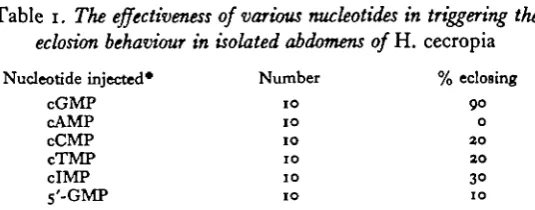
Table i. The effectiveness of various nucleotides in triggering the
eclosion behaviour in isolated abdomens of H. cecropia
% eclosing 90
o 20 20 30 10
• Abdomens were injected with 2 x io~T mole of theophylline 10 min before injection of the nucleo-tides; io~T mole of each nucleotide was injected.
before challenging the abdomens with the nucleotides. Under these conditions both cGMP (Fig. ic, d) and cAMP (example not shown) treatments were followed after about 15-20 min by the active and quiet phases of the pre-eclosion behaviour and then by eclosion. As seen in Fig. 3, a dose of i-6 x io"8 mole of cGMP elicited an eclosion response in 50% of the abdomens. Assuming a blood volume in the abdomen of approximately 1 ml, this represents a blood concentration of I ^ X I O ^ M . Fig. 3 also shows that injected cAMP was about 100 times less potent than cGMP in trigger-ing the behavioural sequence. The data in Fig. 3 were collected in September 1978, using animals sent from Michigan. A small-scale repeat of the experiment in June 1979 with H. cecropia obtained from The Cecropia Company, Edwardsville, Illinois, yielded dose-response curves that were shifted to the left for both cyclic nucleotides with cGMP being about 10 times more active than cAMP. At this time it is not known whether the differences between the two sets of data are due to the time of year or to the strain of H. cecropia which was used. In both cases, however, cGMP was sub-stantially more active than cAMP.
The specificity of the eclosion response to exogenous nucleotides was further exa-mined by injecting a range of compounds into isolated abdomens. As seen in Table 1, at a dosage level of io~7 mole, cGMP was more effective in stimulating eclosion beha-viour than the other four cyclic nucleotides tested. 5'-GMP was only slightly active.
Response of the isolated CNS to cGMP
The above results show that cGMP is an effective mimic of the eclosion hormone when injected into isolated abdomens. Since the eclosion hormone exerts its effects through a direct action on the moth CNS (Truman, 1978), it was important to esta-blish whether systemically administered cGMP could have a direct central action. The CNS was removed from abdomens of H. cecropia and set up for recording as described in Materials and Methods. Isolated nervous systems were bathed in 2 x io~* M theophylline, the estimated concentration used in the pretreatment of abdomens as described above. In three preparations that received only theophylline, spontaneous motor activity consisted of tonic firing of 1 or 2 units and occasional 'rotational' bursts during the 3-6 h recording period. None showed the temporal patterning of the pre-eclosion programme or the characteristic eclosion bursts.
it ...J •„ jL-L..:.. ,,i,L ^ , . , ^ . ^ .
L l . l
! N M L
.MllllllllLUllLUJl
[image:7.451.61.384.44.219.2]1 UlUJLiLllllLl I i i i l l i lLlllJ-iiill.il
Fig. 4. Continuous integrated record of the spontaneous motor activity generated by an isola-ted abdominal CNS in response to cGMP. (A) Exchange bathing media with saline containing 2 x io~* M theophylline; (B) addition of cGMP for a bath concentration of 5 x io~* M; (C) rotational patterned burst that marked the beginning of the pre-eclosion programme; (D) start of eclosion bursts. Horizontal bar equals 10 min. Inset shows placement of recording electrode.
100
80
60
u 40
I
o •5 20
0
-001 0 1 10
Amount of hormone injected (units)
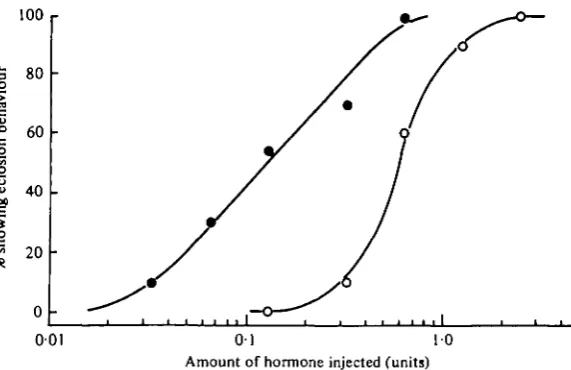
Fig. 5. Dose-response curves showing the effect of pretreatment with phosphodiesterase inhibitors on the behavioural response of isolated abdomens to eclosion hormone injections. Open circles, no pretreatment. Solid circles, injected with 2 x 10"' mole of theophylline 10 min prior to hormone administration. Each point represents at least 10 abdomens.
[image:7.451.71.357.295.480.2]208 J. W. TRUMAN AND OTHERS
nervous system to exogenous cyclic GMP was identical to its response to the natural peptide hormone (Truman, 1978).
Enhancement of eclosion hormone responses by phosphodiesterase inhibitors
If the eclosion hormone acts through an increase in cGMP, then the inhibition of breakdown of endogenous cGMP by a phosphodiesterase inhibitor should enhance the effectiveness of the hormone, since higher levels of intracellular cyclic nucleotides should be attained. A preliminary study on the moth Antheraea pernyi indicated that theophylline enhanced the response to the hormone (Truman et al. 1976). To deter-mine if phosphodiesterase inhibitors also had such an effect in H. cecropia, we injected isolated abdomens with 2 x io~7 mole of theophylline followed 10 min later with various doses of eclosion hormone. As seen in Fig. 5, pretreatment with theophylline markedly potentiated the effect of low doses of hormone. In the absence of theophylline, a dose of o-6 units of hormone was required to cause eclosion in 50% of the abdomens. In the presence of theophylline, the same response was elicited with a fourfold lower dosage. Thus, when present together, theophylline and the hormone act synergisti-cally to produce a response that is greater than the sum of the responses to each one given alone.
Changes in CNS cyclic nucleotide levels after eclosion hormone administration
When corpora cardiaca extracts, which contain the eclosion hormone, were injected into isolated abdomens, the CNS showed a twofold increase in cAMP levels (Truman
et al. 1976). These measurements were repeated when the partially purified
pre-parations of the hormone became available. In the unstimulated abdomen the level of cAMP was 1-2 p-mole per abdominal CNS. Following injection of sufficient hormone to cause a full behavioural response (0-85-1-3 units) the level of cAMP remained essen-tially unchanged for 20 min after the injection (Fig. 6 A) and was thus unchanged during the beginning of the behaviour (cf. Fig. 1B; Truman, 1971, 1978). By contrast, when a crude corpora cardiaca extract containing similar levels of hormone activity was used, the CNS showed cAMP increases similar to those reported earlier (Fig. 6 A). Thus, it appears that the eclosion hormone was not the material in the crude extract that was responsible for the cAMP increase.
'o 0.
s
CNSc A 300-200 100 0 -•_ « > t
* •1-*-i 1-*-i A A i i ^ 300 o | 200
S3
in g 100 ou10 20 0 10 Time after hormone injection (min)
[image:9.451.67.363.79.218.2]20 30
Fig. 6. Changes in cyclic nucleotide levels in the CNS after injection of eclosion hormone into isolated abdomens. Levels are expressed relative to the average values measured at time = o. Solid circles, partially purified eclosion hormone. Open triangles, crude extract from corpora cardiaca. (A) cAMP; each symbol represents a determination made on an extract prepared from 3 to 5 nervous systems. (B) cGMP: symbols are means±S.E. from determinations on 7-10 individual nervous systems.
2 400 o u o
2
300 200 100 . Arfi
100I
2 c o '3 O Tj a> 00 > o •5 500 1 3 0-39 1-3 2-6 T + 013 Hormone dosage (units)
100
cGMP increase (fmole)
200
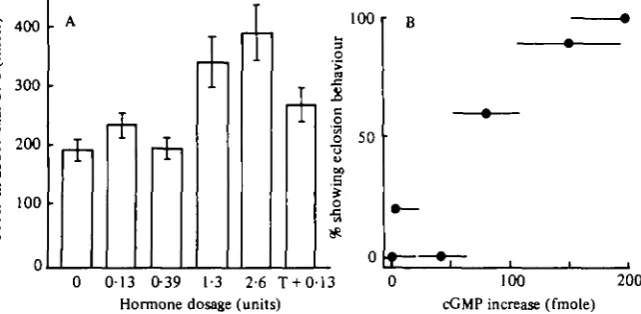
Fig. 7. Relationship of nervous system cGMP to various doses of eclosion hormone. (A) The mean (±s.E.) cGMP level in CNS at 10 min after injection of isolated abdomens with various doses of eclosion hormone in 1 % BSA carrier. T., preinjection with % x io~' mole of theophylline. Each bar represents data from 10 to 11 nervous systems. The values for 1-3 and a-6 units are significantly different from the o value at the o-io > P > o-os and P = 0-05
levels respectively. (B) Comparison of the effectiveness of various doses of hormone in triggering the eclosion behaviour of isolated abdomens and in stimulating an increase in CNS cyclic GMP. Symbols are the mean ± S . E . Data for the behavioural effectiveness of the treatments are from Fig. 5.
[image:9.451.62.383.297.454.2]2io J. W. TRUMAN AND OTHERS
frozen and assayed for cGMP as described in Materials and Methods. Fig. 7A shows that low doses of hormone (o-13-0-39 units) had little effect on CNS cGMP levels. Statistically significant increases were seen at doses of 1-3 units (o-i > P > 0-05, *-test) and 2-6 units (P = 0-05). These treatments induced eclosion behaviour in 90% and 100% respectively of replicate groups of H. cecropia abdomens (Fig. 5)
Abdomens injected with theophylline followed 10 min later by 0-13 units of hormone, a treatment that results in about 55% eclosions (Fig. 5), showed a 40% increase over control levels.
Fig. 7 B contrasts the effectiveness of a particular dose of hormone in releasing the eclosion programme (from Fig. 5) with the ability of that dose to cause an increase in CNS cGMP levels. The two responses had similar thresholds, and were highly correlated with each other.
DISCUSSION
Cyclic nucleotides play an important role in mediating the action of various peptide hormones in both vertebrates and invertebrates. Although in most systems cAMP is of predominant importance (Butcher, Robinson & Sutherland, 1972), cGMP has also been implicated in the action of certain hormones (Goldberg & Haddox, 1977). Considering the role of cyclic nucleotides in the action of peptide hormones in many tissues, it is not surprising that they may also mediate the behavioural actions of this class of hormones. Evidence for the involvement of these chemicals in the behavioural responses to peptides has already been reported for the peptide modulation of bursting in cell R-15 in Aplysia (Treistman & Levitan, 1976), and for the behavioural actions of the eclosion hormone (Truman et al. 1976).
A number of lines of evidence implicate cyclic nucleotides in the behavioural re-sponse of the H. cecropia CNS to the eclosion hormone. Inhibitors of phosphodiester-ase, the enzyme that degrades cyclic nucleotides, mimic the behavioural effects of eclosion hormone in isolated abdomens. The potency of the 3-methylxanthine deri-vatives in mimicking the hormone was IBMX > theophylline > caffeine. Albin et al. (1975) have shown that theophylline is slightly more effective than caffeine in inhibiting phosphodiesterase from the moth, Manduca sexta. Beavo et al. (1970) reported the same relative potencies for this series of xanthine derivatives as cAMP phosphodi-esterase inhibitors in epididymal fat cells of the rat. They also noted a close agreement between the potencies of these compounds as phosphodiesterase inhibitors and their relative abilities to stimulate lipolysis in fat cells. The parallel order of effectiveness seen in the ability of these compounds to mimic the eclosion hormone suggests that this activity results from their elevation of cyclic nucleotide levels.
material in the extract. This material could be the glucagon-like activity from moth corpora cardiaca reported by Tager et al. (1976).
The data reported above implicate cGMP rather than cAMP in the early action of the eclosion hormone. Injection of cGMP into abdomens that have been pretreated with theophylline released behavioural responses identical to those seen after admini-stration of hormone (Fig. 1). Cyclic GMP was 10 to 100 times more potent than cAMP and also 3-5 times more potent than other cyclic nucleotides in eliciting these responses. This effect was specific for the cyclic derivative of GMP since 5'-GMP had only slight activity. Cyclic GMP was also effective in triggering the pre-eclosion and eclosion motor programmes from the isolated CNS, indicating that its effects were mediated through a direct action on the nervous system.
The increase in nervous system cGMP after eclosion hormone treatment provides strong evidence for the involvement of this compound. Cyclic GMP doubled within 10 min of hormone injection (Fig. 6B). This elevation in cGMP is the earliest known effect of the eclosion hormone and precedes the start of the pre-eclosion behaviour by 5-10 min. The direct correlation between the behavioural effectiveness of a dose of hormone and its ability to elevate cGMP levels further suggestions an intimate relationship between the two processes.
Although the preparations of eclosion hormone used in these experiments were of much higher specific activity than hormone in crude corpora cardiaca extracts, they did not contain electrophoretically pure hormone. It is thus possible that the increase in cGMP seen in the CNS of abdomens after injection was due to some material other than hormone. We feel this possibility is remote because similar increases were obtained using hormone that was purified through two different preparative schemes. Also, the similar thresholds for the cGMP and the behavioural responses (Fig. 7B) suggest that they are caused by the same material. Lastly, in recent, preliminary experiments, hormone purified from corpora cardiaca by gel filtration chromatography and narrow-range isoelectrofocusing evoked increases in nervous system cGMP similar to those shown in Fig. 6B (J. W. Truman and S. M. Mumby, unpublished). The results outlined above support the conclusion that the eclosion hormone pro-duces an increase in cGMP in the CNS of H. cecropia. Moreover, it appears that the action of the hormone to induce persistent changes in the functioning of the nervous system is mediated through this increase.
This work was supported by grants from NIH (5 ROi NS13079 and 1 KO4 NS00193) and from NSF (PC M77-24878). We thank Dr Lynn M. Riddiford and Mr Lawrence Schwartz for their comments on the manuscript. We are grateful for the technical assistance of Ms Kate Loughney and Dena Brownstein during the early phases of this study.
REFERENCES
ALBIN, E. E., DAVISON, S. J. & NEWBURO, R. W. (1975). Properties of cyclic nucleotide phosphodiester-ase in the central nervous system of Manduca texta. Biochim. biophys. Ada 377i 364-380.
2i2 J. W. TRUMAN AND OTHERS
BROWN, B. L., EKINS, R. P. & ALBANO, J. D. M. (1972). Saturation assay for cyclic AMP using endo-genous binding protein. Adv. Cyclic Nucleotide Res. 2, 25-40.
BUTCHER, R. W., ROBINSON, G. A. & SUTHERLAND, E. W. (1972). Cyclic AMP and hormone action.
Biochemical Action of Hormones, vol. 2 (ed. G. Litwack), pp. 21-54. New York: Academic Press. FALLON, A. M. & WYATT, G. R. (1975). An improved assay for cyclic GMP using an insect binding
protein. Anal. Biochem. 63, 614-619.
GOLDBERG, N. D. & HADDOX, M. K. (1977). Cyclic GMP metabolism and involvement in biological regulation. Ann. Rev. Biochem. 46, 823-896.
HINTON, H. E. (1946). Concealed phases in the metamorphosis of insects. Nature, Lond. 157, 552-
553-LOWRY, O. H., ROSEBROUOH, N. J., FARR, A. L. & RANDALL, R. J. (1951). Protein measurement with
the Folin phenol reagent. J. Biol. Chem. 193, 265-275.
REYNOLDS, S. E. (1977). Control of cuticle extensibility in the wings of adult Manduca at the time of eclosion: effects of eclosion hormone and bursicon. J. exp. Biol. 70, 27-39.
REYNOLDS, S. E. & TRUMAN, J. W. (1979). Eclosion hormone. In Insect {Peptide) Neurohormones (ed. T. Miller). New York: Springer-Verlag. (In the Press.)
STETNER, A. L., PARKER, C. W. & KIPNIS, D. M. (1972). Radioimmunoassay for cyclic nucleotides. I.
Preparation of antibodies and iodinated cyclic nucleotides. J. biol. Chem. 347, 1106-1113.
TAOER, H. S., MARKESE, J., KRAMER, K. J., SPEIRS, R. D. & CHILDS, C. N. (1976). Glucagon-like and insulin-Like hormones of insect neurosecretory system. Biochem. J. 156, 515-520.
TREISTMAN, S. N. & LEVITAN, I. B. (1976). Alteration of electrical activity in molluscan neurons by cyclic nucleotide and peptide factors. Nature, Lond. 261, 62-64.
TRUMAN, J. W. (1971). Physiology of insect ecdysis. I. The eclosion behaviour of saturniid moths and its hormonal release. J. exp. Biol. 54, 805-814.
TRUMAN, J. W. (1976). Development and hormonal release of adult behavior patterns in silkmoths. J. comp. Physiol. 107, 39-48.
TRUMAN, J. W. (1978). Hormonal release of stereotyped motor programmes from the isolated nervous system of the cecropia silkmoth. J. exp. Biol. 74, 151-173.
TRUMAN, J. W., FALLON, A. M. & WYATT, G. R. (1976). Hormonal release of programmed behavior in silkmoths: probable mediation by cyclic AMP. Science, N.Y. 194, 1432-1434.