New Technologies for Old Germanic. Resources and Research on Parallel
Bibles in Older Continental Western Germanic
Christian Chiarcos, Maria Sukhareva, Roland Mittmann, Timothy Price, Jens Chobotsky, and Gaye Detmold
Goethe University Frankfurt, Germany
{lastname}@em.uni-frankfurt.de
Abstract
We provide an overview of on-going ef-forts to facilitate the study of older Ger-manic languages currently pursued at the Goethe-University Frankfurt, Germany. We describe created resources, such as a parallel corpus of Germanic Bibles and a morphosyntactically annotated corpus of Old High German (OHG) and Old Saxon, a lexicon of OHG in XML and a multi-lingual etymological database. We discuss NLP algorithms operating on this data, and their relevance for research in the Hu-manities.
RDF and Linked Data represent new and promising aspects in our research, cur-rently applied to establish cross-references between etymological dictionaries, infer new information from their symmetric clo-sure and to formalize linguistic annota-tions in a corpus and grammatical cate-gories in a lexicon in an interoperable way.
1 Background
We describe on-going efforts at the Goethe Uni-versity Frankfurt on the study of older Continen-tal Western Germanic languages, in particular, Old High German (OHG, ancestor of German), Old Saxon (OS, ancestor of Low German) and (to a lesser extent) Old Low Franconian (OLF, ancestor of Dutch) and their relation to Old English (OE), Gothic, German and other Germanic languages as well as the relation of OHG and OS religious texts to their Latin sources. This line of research is con-ducted in the context of two larger efforts, the Old German Reference Corpus and the LOEWE clus-ter “Digital Humanities”, in collaboration with the Applied Computational Linguistics group at the Goethe-Universitt Frankfurt.
The Old German Reference Corpus is a DFG-funded project that emerged from the Deutsch Di-achron Digital (DDD) initiative, conducted in co-operation between HU Berlin, U Frankfurt and U Jena, and aims to provide a morphosyntacti-cally annotated, exhaustive reference corpus of Old High German and Old Saxon. The LOEWE cluster “Digital Humanities”,1 funded through a
programm of the State of Hessen, is a collabo-ration between U Frankfurt, TU Darmstadt and Freies Deutsches Hochstift Frankfurt aiming to develop methodologies and infrastructures to fa-cilitate information-technological support of re-search in the humanities.
The collaboration between the humanities and NLP described here is guided by different, though converging interests: For thehumanities, the lan-guage resources, annotations, alignment and tools created in collaboration with NLP researchers represent novel instruments complementing tradi-tional philological approaches, e.g., to investigate emergence and decay of syntactic patterns.
From an NLP perspective, the Germanic lan-guages provide a test-bed to develop strategies for novel algorithms for alignment and annotation projection. In particular, the abundance of parallel (Bible) texts for all major language stages of most Germanic languages, the excellent NLP support for modern Germanic languages, and the availabil-ity of a considerable body of annotated historical texts allow us to study the impact of the factor ofdiachronic relatednesswhen building resources for low-resource languages.
2 Corpus Data
Along with annotated corpora provided by third parties (Tab. 1), two important data sets have been constructed in the course of our research. These include a massive, verse-aligned Bibles corpus
1http://www.digital-humanities-hessen.de
covering all Germanic languages, and the Old Ger-man Reference Corpus. In additional, a thematical alignment of quasi-parallel text within and across biblical texts was extrapolated from the literature.
2.1 Germanic parallel Bible corpus
Bible data represents the majority of parallel data available for historical Germanic languages, and for the case of OS and OHG, gospel harmonies represent even the majority of data currently known. Hence, we began compiling a corpus of Bible texts, excerpts and fragments for all Ger-manic languages marked up with IDs for verses (if possible), chapters and books. For data represen-tation, we employed an XML version of the CES-scheme developed by (Resnik et al., 1997). Hav-ing outgrown the scale of Resnik’s earlier project by far, we are currently in transition to TEI P5 XML format. At the moment, 271 texts with about 38.4M tokens have already been processed (Tab. 2). Copyright prevents redistributing most of this data under a free or an academic license, but we plan to share the extraction and conversion scripts we used. . Except for automatically parsed Bibles in modern English, German and Swedish, the texts in this collection are not annotated. Where anno-tations are available from other corpora (Tab. 1), however, these were aligned with our Bibles.
2.2 Old German Reference Corpus
The Old German Reference Corpus ( Referenzkor-pus Altdeutsch) (Mittmann, 2013) is a joint project in cooperation between HU Berlin, U Frankfurt and U Jena, conducted in the wider context of the Deutsch Diachron Digital (DDD) initiative. The DDD initiative aims to provide deeply-annotated reference corpora of different historical stages of German. The Old German Reference Corpus com-prises all preserved texts from the oldest stages of continental Western Germanic (OHG and OS) dat-ing from ca. 750 to 1050 CE, 650,000 tokens in total. Among the largest coherent subcorpora are Tatian (OHG), Otfrid of Weissenburg (OHG) and the Heliand (OS). From these, only Tatian can be verse-aligned with the gospels (and is included in Tab. 1 and 2), while the Heliand and Otfrid are free renderings of the gospels. For these, the literature provides a section-level alignment only.
The DDD builds on the earlier efforts of the TITUS project (Thesaurus of Indo-European Text and Language Materials,Thesaurus Indogerman-ischer Text- und Sprachmaterialien) that
pro-vided digitized editions of texts in old Germanic languages as well as other Indo-European and selected non-Indo-European languages (Gippert, 2011).2
The annotations are mostly derived from the lit-erature and existing glossaries that provide gram-matical information for all known OHG and OS words, together with their exact source. These have been digitized, automatically applied to the text, manually refined using the annotation soft-ware ELAN,3 augmented with metadata, and
fi-nally published via the ANNIS database (Linde and Mittmann, 2013).
The annotated corpus is published under a CC-BY-SA license overhttp://www.laudatio. org, where ELAN and relANNIS files are pro-vided. So far, the OHG Tatian is available, further data sets are currently in preparation.
2.3 Thematical alignment within and across biblical texts
Translations of religious texts are well-suited for language comparison as well as NLP experiments exploiting parallel data as they are not only faith-fully translated, but also, they come with a verse-level alignment which can serve as a basis for sta-tistical word-level alignment, using, e.g., GIZA++ (Och and Ney, 2003). Where such a verse-level is not explicitly given, it can be automatically iden-tified for actual translations. However, for inde-pendent compositions such as gospel harmonies, alignment is harder to identify and can only be es-tablished at the level of sections. In addition, sim-ilar links also existbetweendifferent parts of the Bible, e.g., parallel passages in different gospels.
For these, an index providing a coarse-grained thematical alignment at the level of sections was extrapolated from the literature. This index can be exploited to increase the coverage of the align-ment: where no exact translation is available (his-torical language data is often fragmentary), a the-matically matching section is retrieved. Further-more, consulting the verse under consideration to-gether with renderings of quasiparallel parts of the same text allows historical linguists to grasp the degree of grammatical variability for the phenom-ena they are interested in. Language comparison can thus be particularly well accomodated if
mul-2http://titus.uni-frankfurt.de/texte/
texte2.htm#ahdand#asachs
language period syntax tok. corpus
English
Modern 19th CS 21K (Kroch et al., 2010)
British 18th CS 32K (Kroch et al., 2010)
Early 17th CS 22K (Kroch et al., 2004)
Modern 16th CS 21K (Kroch et al., 2004)
Middle 14th CS 66K (Kroch and Taylor, 2000)
Old 10th CS 78K (Taylor et al., 2003b)
DS 7K (Haug and Jøhndal, 2008)
Icelandic Middle 16th CS 40K (R¨ognvaldsson et al., 2012)
High Early Mod.16th CS 27K (Light, 2013)
German Old 9th CH 41K Sect. 2.2
[image:3.595.306.526.61.290.2]Gothic 4th DS 56K (Haug and Jøhndal, 2008)
Table 1: Verse-aligned older Germanic Bible texts from various corpora with manual annotations for morphosyntax and syntax (CH chunks, CS con-stituents, DS dependencies)
after 1800- 1600- 1400- 1100- before 1900 1900 1800 1600 1400 1100
Insular West Germanic
English 2 2 2 6 3 (+2) 1
Pidgin/Creol 2
Scots (6) (1)
Frisian 2 (+8) (12) Continental West Germanic
Dutch 4 1 5 (1)
L. Franconian (47) 21 Afrikaans 3
German 3 1 (19) 1 (+4) 1 (+1) 1 dialects 3 (+2)
Yiddish 1
Low German 3 (+18) (66) (2) 1 Plautdietsch 2
Danish 1 North & East Germanic
Swedish 3 (3) (1)
Bokm˚al 2 Nynorsk 2
Icelandic 1 1
Faroese 1
Norn (2)
Gothic 1
[image:3.595.78.285.63.181.2]tokens 21.8M 3.2M 2.7M 9.2M 1.2M 0.2M
Table 2: Verse-aligned texts in the Germanic par-allel Bible corpus (parentheses indicate marginal fragments with less than 50,000 tokens)
tiple versions of the same passage in the same lan-guage can be provided.
To exploit redundancy and to enlarge the num-ber of parallel and quasi-parallel passages for a given phenomenon searched in the corpus, cross-references within the Bible and between the Bible and derived texts have been identified. For ex-ample, coarse-grained thematical alignment be-tween different gospels is provided by the Euse-bian Canon Tables and their subordinate Ammo-nian sections and are extendable to the Latin Ta-tian. For OS Heliand, a free adaptation of gospels, we have only a section-level thematical alignment with Tatian provided by Sievers (1872).
Information on these cross-references has been digitized and employed to create an interlinked in-dex of thematically similar sections in the gospels and the OS and OHG gospel harmonies. Our Bible
West Germanic other reconstr. lexicon OE OHG OS OLF OFr ON Got PGmc PIE
entries (XML, in K)
25 24 9 2 13 12 5 9 7
triples (RDF, in M)
1.2 1.6 .6 .2 .6 .7 .4 .2 .2 lemon:Words & links (in K)
OE 25 1
OHG 2 26 7 2 3 1
OS 1 4 9 1 2 1
ON 1 1 14
Got 1 1 1 1 6
PGmc 5 3 3 1 2 4 2 8
PIE 2 1 1 1 1 1 1 8
German 16 23 8 4 10 12 7 6 3
English 10 4 2 5 9 2
symmetric closure of etym. links (triplesper lang.in K) +11 +14 +11 +5 +9 +8 +5 +21 +9 links to (L)LOD data sets (triplesper data setin K)
OLiA 24 22 8 2 12 11 5 8 7
lexvo 132 186 82 21 68 82 49 14 15
Glottolog 15 11 8 3 7 11 6 9 13
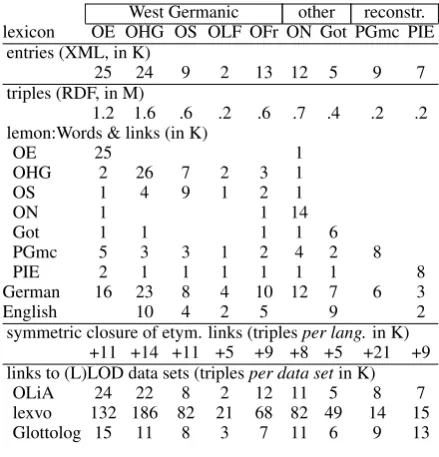
Table 3: Statistics on the etymological dictio-naries, including Old Low Franconian (OLF), Old Frisian (OFr), Old Norse (ON), Gothic (Got), Proto-Germanic (PGmc) and Proto-Indo-European (PIE)
data is thus accompanied with an index that links disparate texts from different time periods and in distinctive styles and variant languages on the ba-sis of thematical similarity as identified in the liter-ature. For gospels and gospel harmonies, we iden-tified 4560 inter-text groups made up of the related chunks between all the originals and languages in-volved that represents the basis for a more fine-grained level of alignment (Price, 2012).
3 Linked Lexicon Data
A large lexical database of etymologically linked dictionaries of old Germanic languages (OS, OHG, OE, Gothic, Old Norse, Old Frisian, Old Low Franconian, Germanic; also Proto-Indo-European) has been developed in the con-text of the LOEWE cluster ‘Digital Humanities’ at the U Frankfurt. Building on the etymologi-cal and translational dictionaries of Old Germanic languages by Gerhard K¨obler,4the project
‘Histor-ical Linguistic Database’ developed user-friendly means of comparing etymologically related forms between historical dialects and their daughter lan-guages (Price, 2012). The original PDF data were converted into an XML representation, cross-references have been resolved and the results are
4http://www.koeblergerhard.de/
imported into an XML database. A web interface has been developed, that transforms user queries into XQuery and visualizes the results in a conve-nient way using XSLT.
To provide a machine-readable representation of the etymological dictionaries, anRDF version
has been compiled. Applying the Linked Data paradigm (Bizer et al., 2009) to etymological lex-icons is particularly promising as they are char-acterized by a heavy linkage across different lan-guages, so that etymological lexicons for differ-ent languages are very likely to complemdiffer-ent each other. RDF provides the means to represent the cross-language linking using a uniform formalism, and subsequently, to facilitate information aggre-gation over multiple etymological lexicons as well as language-specific lexical resources.
We converted the K¨obler lexicons to RDF in conformance to the Lemon model (McCrae et al., 2011), an LMF-based vocabulary to repre-sent machine-readable lexicons by using Semantic Web standards. This conversion followed the three main objectives:
(i) linkability: XML-based query languages such as XQuery and XPath, used to create the user interface to the lexicons, limit our lexicon to a tree-structure representation. However, as our lex-icons complement each other, it would be desir-able to provide explicit cross-references between these entries, and to allow them to be queried jointly. Within the RDF data model, the relations within and beyond a single lexicon can be repre-sented and queried with equal ease, surmounting constraint imposed by XML.
(ii) interoperability: Instead of resource-specific abbreviations for languages and gram-matical categories, we represent linguistic information and meta data by reference to community-maintained vocabularies publicly available as part of the (Linguistic) Linked Open Data cloud, namely lexvo (de Melo, to appear, ISO 639-3 language codes), Glottolog (Nordhoff and Hammarstr¨om, 2011, language families) and OLiA (Chiarcos, 2008, linguistic categories). Reusing vocabularies shared among many parties over the Web of Data has the advantage that resources dealing with related phenomena in the same language can be easily identified and their information integrated without additional conversion steps.
(iii) inference: The original lexicons were dis-tributed in individual PDF files, and the XML rep-resentation was created as a faithful reprep-resentation of their content, augmented with markup for rele-vant linguistic features. These files, however, pro-vided complementary information, so that, say, a lexicon entry in the OS dictionary provided a ref-erence to an etymological corresponding OHG en-try, but this reference was not found in the OHG dictionary. Such gaps can be easily detected (and filled) through symmetric closure in the RDF data model.
The results of this conversion are summarized in Tab. 3. In the original XML (first row), every en-try corresponds to a lemma of the language under consideration, with different etymologies (and/or senses) being associated with it. In RDF (second row), each of these homographs (together with its definition number) is defined as alemon:Word with a homography relation with the homograph set (represented by alemon:Wordwithout defi-nition number). The number oflemon:Words is thus slightly higher than the number of en-tries in the original dictionaries. Differently from the XML, however, information from different data sets can be easily aggregated, and triples originating from one document can be comple-mented with triples from another, shown here for the symmetric closure of etymological relations (third row) that can be easily generated using a simple SPARQL pattern likeCONSTRUCT { ?o ?p ?s } WHERE {?s ?p ?o}. The last row shows links to other data sets from the (Linguis-tic) Linked Open Data cloud. Most original en-tries were complemented with grammatical infor-mation using different (and not fully consistent) abbreviations. For the most frequent abbrevia-tions used, a link to the corresponding OLiA con-cept was generated. These definitions are thus
language period scheme corpus reference
English
Modern PTB (Taylor et al., 2003a; Kroch et al., 2010) Early Mod. PPCEME (Kroch et al., 2004)
Middle PPME2 (Kroch and Taylor, 2000) Old YCOE (Taylor et al., 2003b)
PROIEL (Taylor et al., 2003b)
High German
Modern STTS (Schiller et al., 1999) Early Mod. PCENHG (Light, 2013)
Old T-CODEXSect. 2.2 (Petrova et al., 2009)
Dutch Modern Alpino (Bouma et al., 2001) Old Norse Menota (Haugen et al., 2008) Danish Modern EAGLES (Leech and Wilson, 1996) Swedish Modern Mamba (Nivre et al., 2006) Icelandic IcePaHC (R¨ognvaldsson et al., 2012)
Gothic PROIEL (Haug and Jøhndal, 2008)
(a) Morphosyntactic annotations
language period scheme corpus reference
English
Modern Stanford depsPTB (Taylor et al., 2003a; Kroch et al., 2010)(De Marneffe and Manning, 2008) Penn2Malt deps (Johansson and Nugues, 2007) Early Mod. PPCEME (Kroch et al., 2004)
Middle PPME2 (Kroch and Taylor, 2000) Old YCOE (Taylor et al., 2003b)
PROIEL (Taylor et al., 2003b)
High German Modern
TIGER (Brants et al., 2004) T¨uba-D/Z (Telljohann et al., 2003)
NEGRA (Skut et al., 1997) Early Mod. PCENHG (Light, 2013)
Dutch Modern Alpino (Bouma et al., 2001) Swedish Modern Mamba (Nivre et al., 2006) Icelandic IcePaHC (R¨ognvaldsson et al., 2012)
Gothic PROIEL (Haug and Jøhndal, 2008)
(b) Syntactic annotations
Table 4: List of annotation schemes represented as OWL2/DL ontologies and relevant Germanic corpora
4 NLP methods applied
We sketch selected NLP applications developed on the data described before, the automated phrase-level alignment of quasi-parallel text, and two experiments on annotation projection on parallel text. All of these experiments are still in a rela-tively early stage.
4.1 Automated phrase-level alignment of quasi-parallel text
The needs of historical lingustics demand a more fine-grained alignment than the currently avail-able thematical alignment of Heliand with Ta-tian and the gospels. We thus investigate parallel phrase detection between Heliand (OS) and Tatian (OHG), resp., Heliand and the West Saxon gospels (OE).
To identify cognate phrases, we explore 6 types of similarity metricsδ(wOS, wOHG)for every OS wordwOSand its potential OHG cognatewOHG.
1. geometry δg= difference between the relative positions ofwOSandwOHG.
2. identity δi(wOS, wOHG) = 1 iff wOHG =
wOS(0 otherwise)
3. lexicon δlex(wOS, wOHG) = 1iffwOHG ∈
W (0 otherwise) where W is a set of possible OHG translations forwOSsuggested by a lexicon, i.e., either
direct etymological link in (the symmetric closure of) the etymological dictionaries, or
indirect shared German gloss in the etymo-logical dictionaries
4. orthography similarity measure based on character replacement likelihood:
relative Levenshtein similarity
δlev(wOS, wOHG) = 1 − |wOS|+ld|wOHG| whereldis the standard Levenstein distance and |wOS| and |wOHG| are the number of characters in each word.
statistical character replacement probability as approximated by a character-based statisti-cal machine translation system (Neubig et al., 2012)
5. normalization δnorm(wOS, wOHG) =
δi(wOS0 , wOHG), withw0OSbeing the OHG ‘nor-malization’ of the originalwOS. Here, normaliza-tion uses a weighted Levenshtein distance and a fixed list of OHG target words (Bollmann et al., 2011).
6. cooccurrences δp(wOS, wOHG) =
P(wOS|wOHG)P(wOHG|wOS), calculated on thematically aligned sections from both texts. For any two thematically aligned OS and OHG word vectors, we thus span up a similarity ma-trix between both word vectors on the basis of these metrics. On the matrices, different opera-tions can be applied to calculate similarity derived metrics, including point-wise multiplication or ad-dition, thresholds and a smoothing operator, that aligns words due to the similarity of its neighbors. The resulting matrix is then decoded by a greedy algorithm that aligns the words with the highest score, and then iterates for the remaining words.
dynam-ically define an alignment function and that pro-vides a graphical visualization of the result. Dur-ing a partial qualitative evaluation a historical lin-guist was asked to compare the results of align-ment based on various metrics applied to a small text passage. He took into consideration the over-all match of the topic of the aligned passages as well as the number of parallel passages that the metrics failed to align. Eventually, it was indi-cated that the best results can be achieved by com-bining multiple metrics. A combination of either direct lexicon-based or normalization-based align-ment and geometrical alignalign-ment appears to be par-ticularly promising. Yet, systematic experiments to automatically explore this feature space are still being prepared and depend on the availability of a gold alignment for selected verses.
4.2 Projecting dependency relations
As shown in Tab. 1, we only possess shallow syn-tactic annotations of OHG (and OS) text. We are thus particularly interested in establishing richer syntactic annotations. A challenging aspect in this respect is the limited availability of parallel train-ing data for historical language stages. However, due to diachronic relatedness, we may expect that syntactic patterns of Old Germanic languages are preserved in their modern descendants. Such an approach requires a consistent hyperlemmatiza-tion, e.g., against a modern language
We tested this idea on Bible texts from four cor-pora with closely related annotation schemes for syntax (Tab. 1, corpora with CS-syntax): Icelandic (IS), Early Modern High German (DE), Mid-dle English (ME) and Old English (OE). These schemes originate in the Penn Treebank scheme (Taylor et al., 2003a), and we thus parsed a mod-ern English Bible with a parser trained on the Penn Treebank. As older Germanic languages are char-acterized by a higher degree of word order flexi-bility than Modern English, we converted histor-ical and modern annotations to dependency rela-tions using standard tools for this task (Johans-son and Nugues, 2007). Word-alignment was ob-tained with GIZA++ and 1:1 alignment was en-forced using the translation table. Then, we pro-jected dependency relations and the English words as hyperlemmas for the historical texts. The his-torical texts had comparable POS annotation that was only slightly normalized across the corpora as it preserved more morphological information than
Modern English POS tags.
On these projections, a fragment-aware parser was trained using the English (hyper)lemmas and the original POS tags (Spreyer and Kuhn, 2009). We limited the amount of parallel data available to a training set of 437 sentences per language and a test set of 174 per language. Our hypothesis was that in this setting, (projected) training data from related languages can be used in place of train-ing data for the language under consideration, if
the amount of data is sufficientandthe languages are sufficiently closely related. Furthermore, we assumed that with an increasing number of lan-guages considered (and thus training set size), the quality of the projected annotations would contin-uously improveas long asthe languages are suffi-ciently closely related.
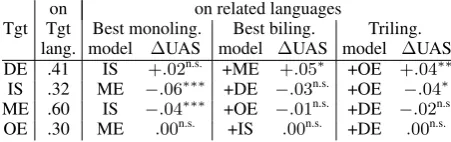
For evaluation, we employed the unlabeled at-tachment score (UAS) (Collins et al., 1999) on the test data and compared with the (dependency version of) the original annotation in these cor-pora. Tab. 5 compares the performance of a parser trained on target language data with parsers trained on (hyperlemmatized) related languages. The scores in the second column are the baseline UAS where the parser was applied to the same language as it was trained on. The third column shows the difference with the parser applied to a language but trained on projections into another language. The fourth and the fifth column pro-vides the results of the parser trained on one or two additional related languages respectively.
The results showed that, among the West Ger-manic languages (but not IS), a parser trained on two or more related languages can reach the same performance or even outperforms a parser trained on the target language. Furthermore, a parser trained on (projected) annotations from two or more related languages is likely to outperform a parser trained on a single related language. Ac-cordingly, in absence of parallel texts for the target language, the parser can be successfully trained on annotation projections from two or more related languages. It should be noted, however, that the overall performance of the parser was relatively poor. This may be, however, an artifact of the great grammatical divergency between Modern English (and, to a limited degree, ME: reduced morphol-ogy, strict word order) and older Germanic lan-guages (rich morphology, flexible word order).
inclusion of richer morphological features, projec-tions from other languages and evaluation against another set of dependency (DS) annotations for Gothic and Old English (Tab. 1), for which related annotation schemes for Latin, Greek and Czech are available – all of these languages are charac-terized by rich morphology and flexible syntax.
on on related languages
Tgt Tgt Best monoling. Best biling. Triling. lang. model ∆UAS model ∆UAS model ∆UAS DE .41 IS +.02n.s. +ME +.05∗ +OE +.04∗∗
IS .32 ME −.06∗∗∗ +DE −.03n.s. +OE −.04∗
ME .60 IS −.04∗∗∗ +OE −.01n.s. +DE −.02n.s.
[image:7.595.71.297.170.241.2]OE .30 ME .00n.s. +IS .00n.s. +DE .00n.s.
Table 5: Performance of parsing models (UAS dif-ference vs. 2nd col. with χ2: ∗ p < .05, ∗∗ p < .01,∗∗∗p < .005)
4.3 Harmonization of grammatical features
Another line of studies addresses the projection of grammatical features as represented in POS tags and dependency labels. Unfortunately, modern and historical language stages are annotated ac-cording to a great variety of annotation schemes which can not be trivially mapped to a general-ization without substantial loss of information (as, e.g., in the approach by Petrov et al., 2012). For processing of multilingual corpora the problem of heteroginity of linguistic annotations is very acute. Above, we described an experiment that used PTB style annotations only. This limitation was im-posed by the annotation schema of the target cor-pora that had PTB style syntactic annotations.
We thus follow Chiarcos (2008) and represent the most relevant Germanic annotation schemes as OWL2/DL ontologies, and link these to an overarching Reference Model. Unlike a tagset, whose string-based annotations require disjoint categories at a fixed level of granularity, this ontology-based approach allows to decompose the semantics of annotations and consider all aspects independently. For example, a tagger may cor-rectly identify plural agreement but incorcor-rectly as-sume that it pertains a noun, as in the Penn Tree-bank tagNNS. In the original tagset, a correspond-ing tag for, say, adjectives, does not exist, but us-ing the ontology, a plural adjective could neverthe-less be represented in the form of different RDF triples. With lexicon data being available in RDF and linked to the OLiA Reference Model, as well (Sect. 3), the incorrect word class can be
spot-ted, and correcspot-ted, but the agreement information could remain unaffected.
These annotations have also been successfully employed in ensemble combination architectures, where information from different sources (say, NLP tools) was integrated on the basis of the Reference Model and disambiguated using onto-logical axioms (Chiarcos, 2010; Pareja-Lora and Aguado de Cea, 2010). In an annotation pro-jection scenario, these sources could be projec-tions from different languages annotated accord-ing to different schemes, e.g., German, English, Swedish or Latin. These experiments are currently being conducted, but Annotation Models for sev-eral schemes are already available (Tab. 4).
5 Digital Humanities
Our ultimate goal is to facilitate studies of histori-cal and empirihistori-cal linguists and philologists.
One research question under consideration is whether the Heliand influenced Luther (Price, 2012), who, apparently, possessed one copy. Based on a thorough comparison of thematically aligned passages, evidence for or against this hy-pothesis may be gathered, and this investigation can be simplified by limiting the search to parallel phrases automatically identified (Sect. 4.1).
Another research question pertains to divergen-cies between, e.g., OHG texts and their Latin source. As most OHG material is translated in a literal fashion, and the word order was relatively flexible, the OHG syntax may have been adjusted to mirror the Latin original. Research of OHG syntax thus concentrates on passages where OHG syntax differs from the Latin source (Hinterh¨olzl and Petrova, 2009).
by stylistic or pragmatic reasons as well as by per-sonal preferences of the translator.
This line of research is currently supported through automated word-level alignment between the OHG and Latin versions of Tatian. We built a parallel corpus using GIZA++ and used the TreeAligner (Lundborg et al., 2007) for search and evaluation. On this basis, a philological compari-son of OHG Tatian and its Latin source is being conducted. More helpful, however, would be a comparison of different syntactic patterns in OHG and Latin which motivates our experiments in an-notation projection (Sect. 4.2).
Finally, our experiments in the ontology-based harmonization of different annotation schemes (Sect. 4.3) will facilitate subsequent typological and linguistic comparison across corpora with manual annotations for syntax and/or morphology according to different schemes.
6 Summary
We sketched major research directions on the de-velopment of resources, NLP tools and algorithms to facilitate the study Old Germanic languages currently pursued at the Goethe-University Frank-furt in the context of two related research initia-tives, the LOEWE cluster ‘Digital Humanities’ and the project ‘Old German Reference corpus’.
Our efforts resulted in the creation of the fol-lowing resources:
• a massive parallel corpus of TEI-conformant Bibles including all con-temporary Germanic languages as well as early stages of Germanic languages (Sect. 2.1).
• an exhaustive, morphosyntactically anno-tated corpus of OHG and OS with mor-phosyntactic annotations. Annotations were automatically derived from glossaries and manually refined (Sect. 2.2).
• an index providing athematical alignment
of the four gospels with each other as well as with OHG and OS gospel harmonies (Sect. 2.3). This high quality alignment provides a solid basis for further more fine-grained au-tomatic alignment (Sect. 4.1).
• XML versions of lexical resources, includ-ing etymological dictionaries of Old Ger-manic languages (Sect. 3)
• an RDF-based linked etymological database of Old Germanic languages compiled from the latter (Sect. 3)
• a Linked Data representation of annotation schemes for corpora, NLP tools and gram-matical features in the linked lexicon data (Sect. 3, 4.3)
The resources created provide an excellent test-bed for various NLP algorithms, particularly for experiments on alignment and annotation projec-tion techniques: We developed different metrics for quasi-parallel alignment applied to the cor-pus of gospel harmonies (Sect. 4.1). For subse-quent analysis, evaluation and refinement by his-torical linguists, we provide a graphical visualiza-tion and user interface in a form of a webpage. This is an on-going project and further research will aim at refining metrics and their combination. Our massive parallel corpus is a perfect prereq-uisite forannotation projection(Sect. 4.2). Our experiments on annotation projections and cross-lingual parser adaptation showed that it is possible to use (hyperlemmatized) training data from mul-tiple closely related languagesin place of training data for the language under consideration, and on small sets of parallel training data available, this did not lead to a significant loss of performance. The only exception in the experiment (IS) is also most remote from the other languages considered. A severe limitation of this experiment was that it required operating on (variants of) the same an-notation scheme. Another line of our research is focused on researching of ways to surmount such restrictions. We thus adopt a modular approach with annotation schemes linked to the OLiA Ref-erence Model to harmonize annotations and gram-matical features from lexicons (Sect. 4.3).
Finally, applications of these algorithms and re-sources in research questions in philology, histor-ical linguistics and comparative linguistics were sketched in Sect. 5.
Acknowledgements
The research of Christian Chiarcos, Maria Sukhareva, Tim Price, Gaye Detmold, and Jens Chobotsky described in this paper was supported by the research cluster ‘Digital Humanities’ at the Goethe-University Frankfurt, funded through the LOEWE programme of the federal state of Hes-sia. The research of Roland Mittmann was con-ducted in the project ‘Old German Reference cor-pus’, funded by the Deutsche Forschungsgemein-schaft (DFG).
References
Christian Bizer, Tom Heath, and Tim Berners-Lee. 2009. Linked Data – The story so far. International Journal on Semantic Web and Information Systems (IJSWIS), 5(3):1–22.
Marcel Bollmann, Florian Petran, and Stefanie Dip-per. 2011. Rule-based normalization of historical texts. InProceedings of the Workshop on Language Technologies for Digital Humanities and Cultural Heritage (LaTeCH-2011), pages 34–42, Hissar, Bul-garia, September.
Gosse Bouma, Gertjan Van Noord, and Robert Malouf. 2001. Alpino: Wide-coverage computational analy-sis of Dutch. Language and Computers, 37(1):45– 59.
Sabine Brants, Stefanie Dipper, Peter Eisenberg, Sil-via Hansen-Schirra, Esther K¨onig, Wolfgang Lezius, Christian Rohrer, George Smith, and Hans Uszkor-eit. 2004. Tiger: Linguistic interpretation of a ger-man corpus. Research on Language and Computa-tion, 2(4):597–620.
Christian Chiarcos. 2008. An ontology of linguistic annotations.LDV Forum, 23(1):1–16.
Christian Chiarcos. 2010. Towards robust multi-tool tagging. An OWL/DL-based approach. InProc. of the 48th Annual Meeting of the Association for Com-putational Linguistics (ACL-2010), pages 659–670, Uppsala, Sweden.
Michael Collins, Lance Ramshaw, Jan Hajiˇc, and Christoph Tillmann. 1999. A statistical parser for Czech. InProc. of the 37th Annual Meeting of the Association for Computational Linguistics (ACL-1999), pages 505–512, Maryland, June.
Marie-Catherine De Marneffe and Christopher D Man-ning. 2008. The Stanford typed dependencies rep-resentation. In Proceedings of the COLING-2008 Workshop on Cross-Framework and Cross-Domain Parser Evaluation, pages 1–8.
Gerard de Melo. to appear. Lexvo.org: Language-related information for the linguistic linked data cloud. Semantic Web Journal, pages 1–7.
Judith Eckle-Kohler, John McCrae, and Christian Chiarcos. to appear. lemonUby – A large, in-terlinked, syntactically-rich resource for ontologies. Semantic Web Journal: Multilingual Linked Open Data.
Jost Gippert. 2011. The TITUS Project. 25 years of corpus building in ancient languages. In Per-spektiven einer corpusbasierten historischen Lin-guistik und Philologie. Internationale Tagung des Akademienvorhabens “Alt¨agyptisches W¨orterbuch” an der Berlin-Brandenburgischen Akademie der Wissenschaften, pages 169–192, Berlin, December. Dag TT Haug and Marius Jøhndal. 2008.
Creat-ing a parallel treebank of the old Indo-European bible translations. InProceedings of the Language Technology for Cultural Heritage Data Workshop (LaTeCH 2008), pages 27–34, Marrakech, Morocco, June.
Odd Einar Haugen, Tone Merete Bruvik, Matthew Driscoll, Karl G Johansson, Rune Kyrkjebø, and Tarrin Wills. 2008. The Menota handbook: Guide-lines for the electronic encoding of Medieval Nordic primary sources.
Roland Hinterh¨olzl and Svetlana Petrova. 2009. In-formation Structure and Language Change: New Approaches to Word Order Variation in Germanic. Mouton de Gruyter.
Richard Johansson and Pierre Nugues. 2007. Ex-tended constituent-to-dependency conversion for English. In Proceedings of the 16th Nordic Con-ference on Computational Linguistics (NoDaLiDa-2007), pages 105–112, Tartu, Estonia, May. Anthony Kroch and Ann Taylor. 2000. The
Penn-Helsinki Parsed Corpus of Middle English (PPCME2). Department of Linguistics, University of Pennsylvania. CD-ROM.
Anthony Kroch, Beatrice Santorini, and Lauren Delfs. 2004. The Penn-Helsinki Parsed Corpus of Early Modern English (PPCEME). Department of Lin-guistics, University of Pennsylvania. CD-ROM. Anthony Kroch, Beatrice Santorini, and Ariel Diertani.
2010. The Penn-Helsinki Parsed Corpus of Modern British English (PPCMBE). Department of Linguis-tics, University of Pennsylvania. CD-ROM.
Geoffrey Leech and Andrew Wilson. 1996. EAGLES guidelines: Recommendations for the morphosyn-tactic annotation of corpora.
Caitlin Light. 2013. Parsed Corpus of Early New High German (PCENHG), v. 0.5. Uni-versity of Pennsylvania,http://enhgcorpus. wikispaces.com/.
Scheible, and Richard J. Whitt, editors, New Meth-ods in Historical Corpus Linguistics = Korpuslin-guistik und interdiziplinre Perspektiven auf Sprache – Corpus linguistics and Interdisciplinary perspec-tives on language (CLIP), volume 3 of Korpuslin-guistik und interdiziplinre Perspektiven auf Sprache – Corpus linguistics and Interdisciplinary perspec-tives on language (CLIP), T¨ubingen. Narr.
Joakim Lundborg, Torsten Marek, Ma¨el Mettler, and Martin Volk. 2007. Using the Stockholm TreeAligner. In Proceedings of the 6th Workshop on Treebanks and Linguistic Theories (TLT-2007), pages 73–78.
John McCrae, Dennis Spohr, and Philipp Cimiano. 2011. Linking lexical resources and ontologies on the semantic web with lemon. In The Semantic Web: Research and Applications, pages 245–259. Springer.
Roland Mittmann. 2013. Digitalisierung historischer Glossare zur automatisierten Vorannotation von Textkorpora am Beispiel des Altdeutschen. Journal for Language Technology and Computational Lin-guistics (JLCL), 27(2):39–52.
Graham Neubig, Taro Watanabe, Shinsuke Mori, and Tatsuya Kawahara. 2012. Machine translation with-out words through substring alignment. InProc. of the 50th Annual Meeting of the Association for Com-putational Linguistics (ACL-2012), pages 165–174, Jeju Island, Korea, July.
Joakim Nivre, Jens Nilsson, and Johan Hall. 2006. Tal-banken05: A Swedish treebank with phrase struc-ture and dependency annotation. InProc. of the 5th International Conference on Language Resources and Evaluation (LREC-2006), pages 1392–1395. Sebastian Nordhoff and Harald Hammarstr¨om. 2011.
Glottolog/langdoc: Defining dialects, languages, and language families as collections of resources. In Proceedings of the First International Workshop on Linked Science 2011 (LISC-2011).
Franz Josef Och and Hermann Ney. 2003. A sys-tematic comparison of various statistical alignment models. Computational Linguistics, 29(1):19–51. Antonio Pareja-Lora and Guadalupe Aguado de Cea.
2010. Ontology-based interoperation of linguistic tools for an improved lemma annotation in Span-ish. InProc. of the 6th International Conference on Language Resources and Evaluation (LREC-2010), Valetta, Malta, May.
Slav Petrov, Dipanjan Das, and Ryan McDonald. 2012. A universal part-of-speech tagset. InProc. of the 8th International Conference on Language Resources and Evaluation (LREC-2012), pages 2089–2096, Is-tanbul, Turkey.
Svetlana Petrova, Michael Solf, Julia Ritz, Christian Chiarcos, and Amir Zeldes. 2009. Building and
using a richly annotated interlinear diachronic cor-pus: The case of Old High German Tatian. TAL, 50(2):47–71.
Timothy Blaine Price. 2012. Multi-faceted alignment: Toward automatic detection of textual similarity in gospel-derived texts. InProceedings of Historical Corpora 2012, Frankfurt, Germany.
Philip Resnik, Mari Broman Olsen, and Mona Diab. 1997. Creating a parallel corpus from the book of 2000 tongues. InProc. of the Text Encoding Initia-tive 10th Anniversary User Conference (TEI-10). Eir´ıkur R¨ognvaldsson, Anton Karl Ingason, Einar Freyr
Sigurdsson, and Joel Wallenberg. 2012. The Ice-landic Parsed Historical Corpus (IcePaHC). InProc. of the 8th International Conference on Language Resources and Evaluation (LREC-2012), Istanbul, Turkey, May.
Anne Schiller, Simone Teufel, Christine St¨ockert, and Christine Thielen. 1999. Guidelines f¨ur das Tagging deutscher Textcorpora mit STTS. Technical report, Universit¨aten Stuttgart und T¨ubingen.
Wojciech Skut, Brigitte Krenn, Thorsten Brants, and Hans Uszkoreit. 1997. An annotation scheme for free word order languages. InProc. of the 5th Con-ference on Applied Natural Language Processing, pages 88–95.
Kathrin Spreyer and Jonas Kuhn. 2009. Data-driven dependency parsing of new languages using incom-plete and noisy training data. In Proc. of the 13th Conference on Computational Natural Lan-guage Learning (CoNLL-2009), pages 12–20, Boul-der, CO, June.
Ann Taylor, Mitchell Marcus, and Beatrice Santorini. 2003a. The Penn Treebank: An overview. In Anne Abeill, editor, Treebanks, pages 5–22. Springer, Dordrecht.
Ann Taylor, Anthony Warner, Susan Pintzuk, and Frank Beths. 2003b. The York-Toronto-Helsinki parsed corpus of Old English prose.