Proceedings of the 2019 Conference on Empirical Methods in Natural Language Processing 5969
Query-focused Sentence Compression in Linear Time
Abram HandlerandBrendan O’Connor
College of Information and Computer Sciences University of Massachusetts Amherst
{ahandler,brenocon}@cs.umass.edu
Abstract
Search applications often display shortened sentences which must contain certain query terms and must fit within the space constraints of a user interface. This work introduces a new transition-based sentence compression technique developed for such settings. Our query-focused method constructs length and lexically constrained compressions in linear time, by growing a subgraph in the depen-dency parse of a sentence. This theoretically efficient approach achieves an 11x empirical speedup over baseline ILP methods, while bet-ter reconstructing gold constrained shorten-ings. Such speedups help query-focused ap-plications, because users are measurably hin-dered by interface lags. Additionally, our tech-nique does not require an ILP solver or a GPU.
1 Introduction
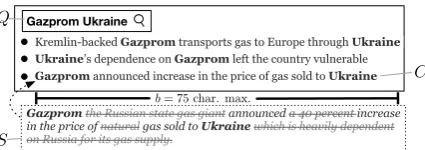
Traditional study of extractive sentence com-pression seeks to create short, readable, single-sentence summaries which retain the most “im-portant” information from source sentences. But search user interfaces often require compressions which must include a user’s query terms and must not exceed some maximum length, permitted by screen space. Figure1shows an example.
This study examines the English-language com-pression problem with such length and lexical re-quirements. In our constrained compression set-ting, a source sentenceS is shortened to a com-pression C which (1) must include all tokens in a set of query terms Q and (2) must be no longer than a maximum budgeted character length,
b∈Z+. Formally, constrained compression maps
(S, Q, b)→ C, such thatCrespectsQandb. We describe this task as query-focused compression because Q places a hard requirement on words fromSwhich must be included inC.
Gazprom the Russian state gas giant announced a 40 percent increase in the price ofnatural gas sold to Ukraine which is heavily dependent on Russia for its gas supply.
Gazprom announced increase in the price of gas sold to Ukraine Ukraine’s dependence on Gazprom left the country vulnerable Kremlin-backed Gazprom transports gas to Europe through Ukraine Gazprom Ukraine
S Q
C
[image:1.595.309.522.220.295.2]b= 75 char. max.
Figure 1: A search user interface (boxed, top) returns a snippet consisting of three compressions which must contain a users’ queryQ (bold) and must not exceed
b =75 characters in length. The third compressionC
was derived from source sentenceS(italics, bottom).
Existing techniques are poorly suited to con-strained compression. While methods based on integer linear programming (ILP) can trivially ac-commodate such length and lexical restrictions
(Clarke and Lapata, 2008; Filippova and Altun,
2013; Wang et al., 2017), these approaches rely
on slow third-party solvers to optimize an NP-hard integer linear programming objective, caus-ing user wait time. An alternative LSTM tag-ging approach (Filippova et al.,2015) does not al-low practitioners to specify length or lexical con-straints, and requires an expensive graphics pro-cessing unit (GPU) to achieve low runtime latency (access to GPUs is a barrier in fields like social science and journalism). These deficits prevent application of existing compression techniques in search user interfaces (Marchionini,2006;Hearst,
2009), where length, lexical and latency require-ments are paramount. We thus present a new state-ful method for query-focused compression.
Our approach is theoretically and empirically faster than ILP-based techniques, and more accu-rately reconstructs gold standard compressions.
2 Related work
Approach Complexity Constrained
ILP exponential yes
LSTM tagger linear no
[image:2.595.74.296.62.117.2]VERTEX ADDITION linear yes
Table 1: Our VERTEX ADDITIONtechnique (§3) con-structs constrained compressions in linear time. Prior work (§2) has higher computational complexity (ILP) or does not respect hard constraints (LSTM tagger).
(Knight and Marcu, 2000; Clarke and Lapata,
2008;Filippova et al.,2015;Wang et al.,2017).1 To our knowledge, this work is the first to consider extractive compression under hard length and lex-ical constraints.
We compare our VERTEX ADDITIONapproach to ILP-based compression methods (Clarke and
Lapata, 2008; Filippova and Altun, 2013; Wang
et al., 2017), which shorten sentences using an
integer linear programming objective. ILP meth-ods can easily accommodate lexical and budget re-strictions via additional optimization constraints, but require worst-case exponential computation.2
Finally, compression methods based on LSTM taggers (Filippova et al., 2015) cannot currently enforce lexical or length requirements. Future work might address this limitation by apply-ing and modifyapply-ing constrained generation tech-niques (Kikuchi et al.,2016;Post and Vilar,2018;
Gehrmann et al.,2018).
3 Compression viaVERTEX ADDITION
We present a new transition-based method for shortening sentences under lexical and length constraints, inspired by similar approaches in transition-based parsing (Nivre, 2003). We de-scribe our technique as VERTEX ADDITION be-cause it constructs a shortening bygrowinga (pos-sibly disconnected) subgraph in the dependency parse of a sentence, one vertex at a time. This approach can construct constrained compressions with a linear algorithm, leading to 11x lower la-tency than ILP techniques (§4). To our knowl-edge, our method is also the first to construct
1Some methods compress via generation instead of
dele-tion (Rush et al.,2015;Mallinson et al.,2018). Our extrac-tive method is intended for practical, interpretable and trust-worthy search systems (Chuang et al.,2012). Users might not trust abstractive summaries (Zhang and Cranshaw,2018), particularly in cases with semantic error.
2ILPs are exponential in |V| when selecting tokens
(Clarke and Lapata,2008) and exponential in|E|when
se-lecting edges (Filippova et al.,2015).
compressions byaddingvertexes rather than prun-ingsubtrees in a parse (Knight and Marcu,2000;
Almeida and Martins, 2013; Filippova and
Al-fonseca, 2015). We assume a boolean relevance
model: Smust containQ. We leave more sophis-ticated relevance models for future work.
3.1 Formal description
VERTEX ADDITION builds a compression by
maintaining a state(Ci, Pi)whereCi ⊆S is a set
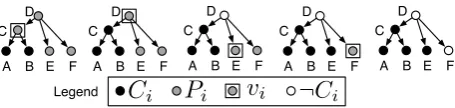
of added candidates,Pi⊆Sis a priority queue of vertexes, andiindexes a timestep during compres-sion. Figure2shows a step-by-step example.
During initialization, we setC0←QandP0 ← S\Q. Then, at each timestep, we pop some candi-datevi =h(Pi)from the head ofPiand evaluate vi for inclusion inCi. (Neighbors ofCi inPiget higher priority than non-neighbors; we break ties in left-to-right order, by sentence position). If we acceptvi, thenCi+1 ←Ci∪vi; if not,Ci+1 ←Ci.
(Acceptance decisions are detailed in §4.3.) We continue adding vertexes to C until either Pi is
empty orCi is bcharacters long.3 The appendix includes a formal algorithm.
VERTEX ADDITIONis linear in the token length of S because we pop and evaluate some vertex fromPiat each timestep, afterP0 ← S\Q.
Ad-ditionally, because (1) we never accept vi if the
length of Ci ∪vi is more than b, and (2) we set
C0←Q, our method respectsQandb.
A B
C D
E F
A B
C D
E F A B
C D
E F A B
C D
E F
A B
C D
E F
Legend
C
iP
iv
i¬
C
iFigure 2: A dependency parse of a sentenceS, shown across five timesteps ofVERTEX ADDITION(from left to right). Each node in the parse is a vertex in S. Our stateful method produces the final compression {A,C,B,E}(rightmost). At each timestep, each candi-dateviis boxed; rejected candidates¬Ciare unshaded.
4 Evaluation
We observe the latency, readability and token-level F1 score ofVERTEX ADDITION, using a standard dataset (Filippova and Altun,2013). We compare our method to an ILP baseline (§2) because ILP methods are the only known technique for con-strained compression. All methods have similar
[image:2.595.310.538.479.533.2]compression ratios (shown in appendix), a well-known evaluation requirement (Napoles et al.,
2011). We evaluate the significance of differ-ences betweenVERTEX ADDITIONLRand theILP
with bootstrap sampling (Berg-Kirkpatrick et al.,
2012). All differences are significant(p < .01).
4.1 Constrained compression experiment
In order to evaluate different approaches to con-strained compression, we require a dataset of sen-tences, constraints and known-good shortenings, which respect the constraints. This means we need tuples (S, Q, b, Cg), where Cg is a known-good
compression ofSwhich respectsQandb(§1). To support large-scale automatic evaluation, we reinterpret a standard compression corpus (
Filip-pova and Altun,2013) as a collection of input
sen-tences and constrained compressions. The original dataset contains pairs of sentencesSand compres-sionsCg, generated using news headlines. For our experiment, we setbequal to the character length of the gold compression Cg. We then sample a
small number of nouns4 fromCg to form a query setQ, approximating both the observed number of tokens and observed parts of speech in real-world search (Jansen et al.,2000;Barr et al.,2008). Sam-pled Q include reasonable queries like “police, Syracuse”, “NHS” and “Hughes, manager, QPR”. By sampling queries and defining budgets in this manner, we create 198,570 training tuples and 9949 test tuples, each of the form (S, Q, b, Cg).
Filippova and Altun (2013) define the train/test
split. We re-tokenize, parse and tag with CoreNLP v3.8.0 (Manning et al.,2014). We reserve 25,000 training tuples as a validation set.
4.2 Model:ILP
We compare our system to a baselineILPmethod, presented inFilippova and Altun(2013). This ap-proach represents each edge in a syntax tree with a vector of real-valued features, then learns fea-ture weights using a strucfea-tured perceptron trained on a corpus of (S, Cg) pairs.5 Learned weights
are used to compute a global compression objec-tive, subject to structural constraints which ensure
Cis a valid tree. This baseline can easily perform
41 to 3 nouns; cardinality chosen uniformly at random.
5
Another ILP (Wang et al., 2017) sets weights using a LSTM, achieving similar in-domain performance. This method requires a multi-stage computational process (i.e. run LSTMthenILP) that is poorly-suited to query-focused set-tings, where low latency is crucial.
constrained compression: at test time, we add op-timization constraints specifying that C must in-cludeQ, and not exceed lengthb.
To our knowledge, a public implementation of this method does not exist. We reimplement from scratch usingGurobi Optimization(2018), achiev-ing a test-time, token-level F1 score of 0.76 on the unconstrained compression task, lower than the result (F1 = 84.3) reported by the original au-thors. There are some important differences be-tween our reimplementation and original approach (described in detail in the appendix). SinceVER
-TEX ADDITION requires Q and b, we can only compare it to the ILP on theconstrained (rather than traditional, unconstrained) compression task.
4.3 Models: VERTEX ADDITION
Vertex addition accepts or rejects some candi-date vertex vi at each timestepi. We learn such decisions yi ∈ {0,1} using a corpus of tuples (S, Q, b, Cg) (§4.1). Given such a tuple, we can
always execute an oracle path shorteningS toCg
by first initializingVERTEX ADDITION and then, at each timestep: (1) choosingvi =h(Pi)and (2)
adding vi to Ci iff vi ∈ Cg. We set yi = 1 if
vi ∈ Cg; we set yi = 0 if vi ∈/ Cg. We then use decisions from oracle paths to train two mod-els of inclusion decisions,p(yi = 1|vi, Ci, Pi, S). At test time, we acceptvi ifp(yi > .5).
Model One.OurVERTEX ADDITIONN Nmodel
broadly follows neural approaches to transition-based parsing (e.g. Chen and Manning (2014)): we predictyiusing a LSTM classifier with a stan-dard max-pooling architecture (Conneau et al.,
2017), implemented with a common neural frame-work (Gardner et al.,2017). Our classifier main-tains four vocabulary embeddings matrixes, corre-sponding to the four disjoint subsets Ci ∪ ¬Ci∪ Pi∪{vi}=V. Each LSTM input vectorxtcomes from the appropriate embedding forvt ∈ V, de-pending on the state of the compression system at timestep i. The appendix details network tuning and optimization.
Model Two. OurVERTEX ADDITIONLRmodel
uses binary logistic regression,6 with 3 classes of features.
Edge features describe the properties of the edge (u, vi) between vi ∈ Pi andu ∈ Ci. We
6We implement with Python 3 using scikit-learn (
Pe-dregosa et al.,2011). We tune the inverse regularization
Approach F1 SLOR ∗Latency
RANDOM(lower bound) 0.653 0.377 0.5
ABLATED(edge only) 0.827 0.669 3.7 VERTEX ADDITIONN N 0.873 0.728 2929.1(CPU)
ILP 0.852 0.756 44.0
[image:4.595.179.419.60.151.2]VERTEX ADDITIONLR 0.881 0.745 4.1
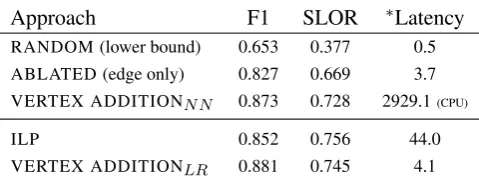
Table 2: Test results for constrained compression. ∗Latency is the geometric mean of observed runtimes (in milliseconds per sentence). VERTEX ADDITIONLR achieves the highest F1, and also runs 10.73 times faster than theILP. Differences between all scores forVERTEX ADDITIONLRandILPare significant(p < .01).
use the edge-based feature function from
Filip-pova and Altun(2013), described in detail in the
appendix. This allows us to compare the perfor-mance of a vertex addition method based on lo-cal decisions with an ILP method that optimizes a global objective (§4.5), using the same feature set. Stateful features represent the relationship be-tween vi and the compression Ci at timestep i.
Stateful features include information such as the position ofviin the sentence, relative to the right-most and left-right-most vertex inCi, as well as
history-based information such as the fraction of the char-acter budget used so far. Such features allow the model to reason about which sort ofvi should be
added, givenQ,SandCi.
Interaction features are formed by crossing all stateful features with the type of the dependency edge governingvi, as well as with indicators iden-tifying ifugovernsvi, ifvigovernsuor if there is
no edge(u, vi)in the parse.
4.4 Metrics: F1, Latency and SLOR
We measure the token-level F1 score of each com-pression method against gold comcom-pressions in the test set. F1 is the standard automatic evaluation metric for extractive compression (Filippova et al.,
2015;Klerke et al.,2016;Wang et al.,2017). In addition to measuring F1, researchers of-ten evaluate compression systems with human
im-portanceandreadabilityjudgements (Knight and
Marcu,2000;Filippova et al.,2015). In our setting
Qdetermines the “important” information fromS, so importance evaluations are inappropriate. To check readability, we use the automated readabil-ity metric SLOR (Lau et al.,2015), which corre-lates with human judgements (Kann et al.,2018).
We evaluate theoretical gains from VERTEX ADDITION (Table 1) by measuring empirical la-tency. For each compression method, we sample and compressN = 300,000sentences, and record
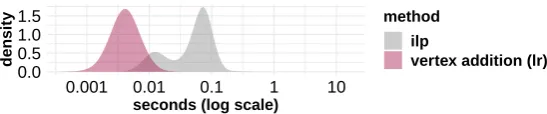
the runtime (in milliseconds per sentence). We observe that runtimes are distributed log-normally (Figure 3), and we thus summarize each sample using the geometric mean. ILP andVERTEX AD
-DITIONLR share edge feature extraction code to support to fair comparison. We testVERTEX AD
-DITIONN N using a CPU: the method is too slow
for use in search applications in areas without ac-cess to specialized hardware (Table 2). The ap-pendix further details latency and SLOR experi-ments.
4.5 Analysis:ABLATED&RANDOM
For comparison, we implement anABLATED ver-tex addition method, which learns inclusion deci-sions using only edge features fromFilippova and
Altun(2013).ABLATEDhas a lower F1 score than
ILP, which uses the same edge-level information to
optimize a global objective: adding stateful and in-teraction features (i.e.VERTEX ADDITIONLR)
im-proves F1 score. Nonetheless, strong performance from ABLATED hints that edge-level information alone (e.g. dependency type) can mostly guide ac-ceptance decisions.
We also evaluate a RANDOM baseline, which accepts eachvi randomly in proportion top(yi =
1)across training data. RANDOMachieves reason-able F1 because (1) C0 = Q ∈ Cg and (2) F1
correlates with compression rate (Napoles et al.,
2011), andbis set to the length ofCg.
5 Future work: practical compression
0.0 0.5 1.0 1.5
0.001 0.01 0.1 1 10
seconds (log scale)
density
method ilp
[image:5.595.160.434.64.121.2]vertex addition (lr)
Figure 3: Density plot of log transformed latencies for VERTEXADDITIONLR (left) andILP (right). Theoret-ical gains (Table1) create real speedups. TheILP shows greater runtime variance, possibly reflecting varying approaches fromGurobi Optimization(2018).
To begin, both our technique and our evalua-tion ignore the convenevalua-tions of search user inter-faces, which typically display missing words us-ing ellipses. This convention is important, be-cause it allows snippet systems to transparently show users which words have been removed from a sentence. However, we observe that some well-formed compressions are difficult to read when displayed in this format. For instance the sentence “Aristide quickly fled Haiti in September 1991” can be shortened to the well-formed compres-sion “Aristide fled in 1991.” But this comprescompres-sion does not read fluidly when using ellipses (“Aris-tide...fled...in...1991”). Human experiments aimed at enumerating the desirable and undesirable prop-erties of compressions displayed in ellipse format (e.g. compressions should minimize number of el-lipses?) could help guide user-focused snippet al-gorithms in future work.
Our method also assumes access to a reliable, dependency parse, and ignores any latency penal-ties incurred from parsing. In practical settings, both assumptions are unreasonable. Like other NLP tools, dependency parsers often perform poorly on out-of-domain text (Bamman, 2017), and users looking to quickly investigate a new cor-pus might not wish to wait for a parser. Faster ap-proaches based on low-latency part-of-speech tag-ging, or more cautious approaches based on syn-tactic uncertainty (Keith et al., 2018), each offer exciting possibilities for additional research.
Our approach also assumes that a user already knows a reasonableband reasonableQfor a given sentenceS.7 However, in some cases, there is no well-formed shortening of which respects the re-quirements. For instance, if Q=“Kennedy” and
b=15 there is no reasonable shortening for the toy sentence “Kennedy kept running”, because the compressions “Kennedy kept” and “Kennedy run-ning” are not well-formed. We look forward to
7Recall that we simulate b and Q based on the well-formed shorteningCg, see§4.1.
investigating which(Q, S, b)triples will never re-turn well-formed compressions in later work.
Finally, some shortened sentences will modify the meaning of a sentence, but we ignore this im-portant complication in this initial study. In the fu-ture, we hope to apply ongoing research into tex-tual entailment (Bowman et al.,2015;Pavlick and
Callison-Burch,2016;McCoy and Linzen,2018)
to develop semantically-informed approaches to the task.
6 Conclusion
We introduce a query-focused VERTEX ADDI
-TIONLR method for search user interfaces, with
much lower theoretical complexity (and empirical runtimes) than baseline techniques. In search ap-plications, such gains are non-trivial: real users are measurably hindered by interface lags (Nielsen,
1993;Liu and Heer,2014). We hope that our fast,
query-focused method better enables snippet cre-ation at the “pace of human thought” (Heer and
Shneiderman,2012).
Acknowledgments
Thanks to Javier Burroni and Nick Eubank for suggesting ways to optimize and measure perfor-mance of Python code. Thanks to Jeffrey Flani-gan, Katie Keith and the UMass NLP reading group for feedback. This work was partially sup-ported by IIS-1814955.
Appendix
The appendix is available with the arXiv version of this paper: https://arxiv.org/abs/ 1904.09051
References
David Bamman. 2017. Natural language processing for the long tail. InDigital Humanities.
Cory Barr, Rosie Jones, and Moira Regelson. 2008. The linguistic structure of english web-search queries. InEMNLP.
Taylor Berg-Kirkpatrick, David Burkett, and Dan Klein. 2012. An empirical investigation of statistical significance in NLP. InEMNLP.
James Bergstra and Yoshua Bengio. 2012. Random search for hyper-parameter optimization. Journal of Machine Learning Research, 13:281–305.
Samuel R. Bowman, Gabor Angeli, Christopher Potts, and Christopher D. Manning. 2015. A large anno-tated corpus for learning natural language inference.
InEMNLP.
Ted Briscoe, John Carroll, and Rebecca Watson. 2006. The second release of the RASP system. In Pro-ceedings of the COLING/ACL 2006 Interactive Pre-sentation Sessions.
Danqi Chen and Christopher Manning. 2014. A fast and accurate dependency parser using neural net-works. InEMNLP.
Jason Chuang, Daniel Ramage, Christopher D. Man-ning, and Jeffrey Heer. 2012. Interpretation and trust: Designing model-driven visualizations for text analysis. InCHI.
James Clarke and Mirella Lapata. 2008. Global in-ference for sentence compression: An integer linear programming approach. Journal of Artificial Intelli-gence Research, 31:399–429.
Alexis Conneau, Douwe Kiela, Holger Schwenk, Lo¨ıc Barrault, and Antoine Bordes. 2017. Supervised learning of universal sentence representations from natural language inference data. InEMNLP.
John Duchi, Elad Hazan, and Yoram Singer. 2011. Adaptive subgradient methods for online learning and stochastic optimization. Journal of Machine Learning Research, 12(Jul):2121–2159.
Katja Filippova and Enrique Alfonseca. 2015. Fast k-best sentence compression. arXiv preprint arXiv:1510.08418.
Katja Filippova, Enrique Alfonseca, Carlos A Col-menares, Lukasz Kaiser, and Oriol Vinyals. 2015. Sentence compression by deletion with LSTMs. In EMNLP.
Katja Filippova and Yasemin Altun. 2013. Over-coming the lack of parallel data in sentence com-pression. In EMNLP. https://github.com/google-research-datasets/sentence-compression.
Katja Filippova and Michael Strube. 2008. Depen-dency tree based sentence compression. In Proceed-ings of the Fifth International Natural Language Generation Conference.
Matt Gardner, Joel Grus, Mark Neumann, Oyvind Tafjord, Pradeep Dasigi, Nelson F. Liu, Matthew Peters, Michael Schmitz, and Luke S. Zettlemoyer. 2017. AllenNLP: A deep semantic natural language processing platform.
Sebastian Gehrmann, Yuntian Deng, and Alexander Rush. 2018. Bottom-up abstractive summarization. InEMNLP.
LLC Gurobi Optimization. 2018. Gurobi optimizer reference manual (v8).
Kenneth Heafield. 2011. KenLM: faster and smaller language model queries. In EMNLP: Sixth Work-shop on Statistical Machine Translation.
Marti Hearst. 2009. Search user interfaces. Cam-bridge University Press, CamCam-bridge New York.
Jeffrey Heer and Ben Shneiderman. 2012. Interactive dynamics for visual analysis. Queue, 10(2).
Bernard J. Jansen, Amanda Spink, and Tefko Sarace-vic. 2000. Real life, real users, and real needs: a study and analysis of user queries on the web. Infor-mation Processing and Management, 36:207–227.
Katharina Kann, Sascha Rothe, and Katja Filippova. 2018. Sentence-Level Fluency Evaluation: Refer-ences Help, But Can Be Spared! InCoNLL 2018.
Katherine Keith, Su Lin Blodgett, and Brendan O’Connor. 2018. Monte Carlo syntax marginals for exploring and using dependency parses. InNAACL.
Yuta Kikuchi, Graham Neubig, Ryohei Sasano, Hiroya Takamura, and Manabu Okumura. 2016. Control-ling output length in neural encoder-decoders. In EMNLP.
Sigrid Klerke, Yoav Goldberg, and Anders Søgaard. 2016. Improving sentence compression by learning to predict gaze. InNAACL.
Kevin Knight and Daniel Marcu. 2000. Statistics-based summarization - step one: Sentence compres-sion. InAAAI.
Jey Han Lau, Alexander Clark, and Shalom Lap-pin. 2015. Unsupervised prediction of acceptability judgements. InACL.
Zhicheng Liu and Jeffrey Heer. 2014. The effects of interactive latency on exploratory visual analysis. IEEE Transactions on Visualization and Computer Graphics, 20:2122–2131.
Jonathan Mallinson, Rico Sennrich, and Mirella Lap-ata. 2018. Sentence Compression for Arbitrary Lan-guages via Multilingual Pivoting. InEMNLP.
Gary Marchionini. 2006. Exploratory search: From finding to understanding. Commun. ACM, 49(4).
Marie-Catherine de Marneffe, Bill MacCartney, and Christopher D. Manning. 2006. Generating typed dependency parses from phrase structure parses. In LREC.
Thomas R. McCoy and Tal Linzen. 2018. Non-entailed subsequences as a challenge for natural language in-ference. InProceedings of the Society for Computa-tion in Linguistics.
Courtney Napoles, Benjamin Van Durme, and Chris Callison-Burch. 2011. Evaluating sentence com-pression: Pitfalls and suggested remedies. In Pro-ceedings of the Workshop on Monolingual Text-To-Text Generation.
Jakob Nielsen. 1993. Usability Engineering. Mor-gan Kaufmann Publishers Inc., San Francisco, CA, USA.
Joakim Nivre. 2003. An efficient algorithm for projec-tive dependency parsing. In International Confer-ence on Parsing Technologies.
Joakim Nivre, Marie-Catherine de Marneffe, Filip Ginter, Yoav Goldberg, Jan Hajic, Christopher D. Manning, Ryan T. McDonald, Slav Petrov, Sampo Pyysalo, Natalia Silveira, Reut Tsarfaty, and Daniel Zeman. 2016. Universal Dependencies v1: A multi-lingual treebank collection. InLREC.
Ellie Pavlick and Chris Callison-Burch. 2016. So-called non-subsective adjectives. In*SEM.
Fabian Pedregosa, Ga¨el Varoquaux, Alexandre Gram-fort, Vincent Michel, Bertrand Thirion, Olivier Grisel, Mathieu Blondel, Peter Prettenhofer, Ron Weiss, Vincent Dubourg, Jake Vanderplas, Alexan-dre Passos, David Cournapeau, Matthieu Brucher, Matthieu Perrot, and ´Edouard Duchesnay. 2011. Scikit-learn: Machine learning in python. Journal of Machine Learning Research, 12:2825–2830.
Matt Post and David Vilar. 2018. Fast lexically con-strained decoding with dynamic beam allocation for neural machine translation. InNAACL.
Alexander M. Rush, Sumit Chopra, and Jason Weston. 2015. A neural attention model for abstractive sen-tence summarization. InEMNLP.
Sebastian Schuster and Christopher D. Manning. 2016. Enhanced english universal dependencies: An im-proved representation for natural language under-standing tasks. InLREC.
Anastasios Tombros and Mark Sanderson. 1998. Ad-vantages of query biased summaries in information retrieval. InSIGIR.
Liangguo Wang, Jing Jiang, Hai Leong Chieu, Chen Hui Ong, Dandan Song, and Lejian Liao. 2017. Can syntax help? Improving an LSTM-based sentence compression model for new domains. In ACL.