Towards a Universal Sentiment Classifier in Multiple languages
Kui Xu and Xiaojun Wan
Institute of Computer Science and Technology, Peking University The MOE Key Laboratory of Computational Linguistics, Peking University
{kuixu, wanxiaojun}@pku.edu.cn
Abstract
Existing sentiment classifiers usually work for only one specific language, and differ-ent classification models are used in dif-ferent languages. In this paper we aim to build a universal sentiment classifier with a single classification model in multiple different languages. In order to achieve this goal, we propose to learn multilingual sentiment-aware word embeddings simul-taneously based only on the labeled re-views in English and unlabeled parallel data available in a few language pairs. It is not required that the parallel data ex-ist between English and any other lan-guage, because the sentiment information can be transferred into any language vi-a pivot lvi-anguvi-ages. We present the evvi-al- eval-uation results of our universal sentiment classifier in five languages, and the results are very promising even when the parallel data between English and the target lan-guages are not used. Furthermore, the u-niversal single classifier is compared with a few cross-language sentiment classifiers relying on direct parallel data between the source and target languages, and the re-sults show that the performance of our uni-versal sentiment classifier is very promis-ing compared to that of different cross-language classifiers in multiple target lan-guages.
1 Introduction
Nowadays, a large amount of user-generated con-tent (UGC) appears online everyday, such as tweets, comments and product reviews. Sentiment classification on these data has become a popular research topic over the past few years (Pang et al.,
2002;Blitzer et al.,2007;Agarwal et al.,2011; Li-u,2012). Distributed representations of words or word embeddings have been widely explored, and have proved its great usability for the sentimen-t classificasentimen-tion sentimen-task (Tang esentimen-t al.,2014;Zhou et al., 2015;Xu et al.,2015;Bollegala et al.,2016; Fer-reira et al.,2016).
Most existing sentiment classifiers rely on la-beled training data and the data are usually language-dependent. In other words, a sentiment classifier is learned from a labeled dataset in a spe-cific language and this sentiment classifier can be used for sentiment classification in this language. However, labeled training data for sentiment clas-sification are not available or not easy to obtain in many languages in the world (e.g., Malaysian, Mongolian, Uighur). Without reliable labeled da-ta, it is hard to build a sentiment classifier in these resource-poor languages.
Fortunately, there are a few studies investigating the task of cross-language sentiment classification (Banea et al.,2008;Wan,2009;Meng et al.,2012; Xiao and Guo,2013;Gao et al.,2015;Chen et al., 2015;Zhou et al.,2015;Li et al.,2017;Zhou et al., 2016a,b), which aims to make use of the labeled data in a source language (English in most cas-es) to build a sentiment classifier in a target lan-guage. However, cross-language sentiment classi-fication methods rely on parallel data between the source and target languages1 In a resource-poor language, the parallel data between this language and the source language may not be available or is not easy to obtain. In this circumstance, previ-ous cross-language sentiment classification meth-1Note that a few methods rely on a machine
transla-tion system to produce parallel data between the two lan-guages, while the machine translation system is built on a large amount of parallel data between the two languages. In this sense, the methods rely on both the parallel data for ma-chine translation and the pseudo parallel data produced by machine translation systems.
ods will fail to work.
Another shortcoming of previous cross-language sentiment classification researches is that we have to build an individual cross-language sentiment classifier for each target language, even when we want to perform sentiment classification in a couple of languages at the same time.
In this study, instead of building a sentiment classifier for each target language, we aim to build a universal sentiment classifier in multiple lan-guages and this universal sentiment classifier on-ly learns one single sentiment classification model and it can be applied for sentiment classification in many languages.
In order to achieve this goal, we propose an ap-proach to learn multilingual sentiment-aware word embeddings simultaneously based only on the la-beled reviews in English and unlala-beled parallel da-ta available in a few language pairs. As mentioned earlier, in some resource-poor languages, there do not exist direct parallel data between these lan-guages and the source English language. In order to address this problem, we propose a pivot-based model to transfer the sentiment information from the source language to any resource-poor language via pivot languages. Finally, a universal sentimen-t classifier can be builsentimen-t because sentimen-the mulsentimen-tilingual word embeddings are in the same semantic space. We build three different models (Bilingual Model, Pivot-Driven Bilingual Model and Univer-sal Multilingual Model) and compare them em-pirically in order to answer two questions in this paper: 1) Can pivot-based models learn bilingual sentiment-aware word embeddings effectively? 2) Can an effective universal sentiment classifier be built for multiple languages?
Without loss of generality, we present and com-pare the evaluation results of the models in five languages. Evaluation results show that pivot-driven bilingual models perform as well as the bilingual model using direct parallel data, which lays the solid foundation of our universal mod-el. Moreover, it is very promising that our univer-sal sentiment classifier can work well in five lan-guages, and it can achieve very promising classifi-cation results as compared to several typical cross-language sentiment classification models.
The main contributions of our study in this pa-per are summarized as follows:
• We are the first to build a universal sentimen-t classifier in mulsentimen-tiple languages by learning
multilingual sentiment-aware word embed-dings, which can not be addressed by previ-ous researches on cross-language sentiment classification.
• We propose pivot-based models to bridge two languages in which there do not exist parallel data, and thus the sentiment information can be transferred to any target language.
• Evaluation results on five languages demon-strate the efficacy of our proposed pivot-based models and the universal sentimen-t classifier.
2 Our Approach
In order to build a universal sentiment classifi-er, we propose an approach to learn multilingual sentiment-aware word embeddings simultaneous-ly, and then train a universal sentiment classifica-tion model in the embedding space by averaging the word embeddings in a document as the doc-ument representation. Note that in this study, we focus on only using the labeled data in English and do not make use of any labeled data in other lan-guages, which makes the task more challenging2. Formally, we aims to build a single sentiment clas-sifier which can perform sentiment classification in many languages {S, T1, T2, ..., TN}, where S
refers to English language, andT1 toTN refer to
otherN languages.
In our approach, the multilingual sentiment-aware word embeddings play the key role in building the universal sentiment classifier, and now the question is how to learn the multilingual sentiment-aware word embeddings? Inspired by previous studies on cross-lingual sentiment clas-sification and bilingual word embedding learn-ing, we can leverage the labeled data in S (i.e., English) and unlabeled parallel data between S
and languageTto learn bilingual sentiment-aware word embeddings in both English andTlanguages with a bilingual model. However, such unlabeled parallel data are not always easy to obtain for all other languages. For a specific languageT, if the unlabeled parallel data between T and S do not exist, the bilingual model cannot be applied. In order to address this problem, we propose a pivot-driven bilingual model to leverage pivot languages 2Note that the labeled data in other languages can be
to bridge T andS. We choose a pivot language
P where the parallel data between P andS, and the parallel data betweenP andT are easy to ob-tain, and then leverage them to learn the multi-lingual sentiment-aware word embeddings in the three languagesP,T andS. Furthermore, we can leverage more parallel data between multiple lan-guages, some of which are parallel data betweenS
and other languages, and some of which are par-allel data within other languages, to build an uni-versal multilingual model. The sentiment informa-tion will be directly or indirectly transfered to each language as well, and thus we obtain multilingual sentiment-aware word embeddings in many lan-guages.
The bilingual model, pivot-driven bilingual model and universal multilingual model will be described in next sections, respectively.
2.1 Bilingual Model
The bilingual model tries to induce bilingual word embeddings from a parallel corpus, and in the meantime make similar words from the two lan-guages share adjacent vector representations in the same vector space.
Formally, we assume a source languageSwith
|S|words and a target languageT with|T|words. We usesandtto represent a word fromS andT, respectively. Given the bilingual parallel corpusC
between languageSandT, it can be divided into a corpusCS in languageSand a corpusCT in
lan-guageT. And we use a notationS−T to indicate a parallel corpus between languagesSandT.
Previous studies have proposed some bilingual models for learning bilingual word embeddings, so we extend the well-behaved BiSkip model (Lu-ong et al., 2015) to Bilingual Model (BM). This model requires word alignment information, and in this study word alignment is automatically ob-tained from parallel sentences by using a word alignment tool.
In our bilingual model, every word s in lan-guageS is required to predict the adjacent words of itself and the aligned wordt in the target lan-guage T. For corpus CS, the monolingual
con-straint on itself (CS → CS) is:
Obj(CS|CS) =
X
s∈CS
X
w∈adj(s)
logp(w|s), (1)
and the cross-lingual constraint onCT (CS → CT)
is:
Obj(CT|CS) =
X
s∈CS
X
w∈adj(t),s↔t
logp(w|s) (2)
where s↔t means word s(∈ CS) is aligned to
wordt(∈ CT)andadj(s)oradj(t)mean the
adja-cent words of wordsort.
Similarly, for corpusCT we can obtain:
Obj(CT|CT) =
X
t∈CT
X
w∈adj(t)
logp(w|t), (3)
and
Obj(CS|CT) =
X
t∈CT
X
w∈adj(s),t↔s
logp(w|t) (4)
Combining equations 1, 2,3 and4, we get the objective for obtaining bilingual word embeddings from parallel corpus:
Obj(C) =α1Obj(CS|CS) +α2Obj(CT|CS)
+α3Obj(CT|CT) +α4Obj(CS|CT)
whereα1, α2, α3andα4are scalar parameters.
We still have to incorporate the sentiment infor-mation into the bilingual word embeddings. Sim-ilar to previous studies (Zhou et al., 2015), we make use of the sentiment polarity of texts as su-pervision in the learning process. Given a labeled sentimental corpusCL3, we useS∗ to represent a
sentence in CL and w as a word in S∗. And xT
is a sum of word embeddings in S∗. We simply
adopt the logistic regression classifier to enforce the sentiment constraint, and thus make the bilin-gual word embeddings absorb the corresponding sentiment information. The objective function is:
L(CL) =
X
S∗∈CL
ylogσ(W xT +b)
+ (1−y) logσ(1−(W xT +b)) (5)
where y is the label of the sentence S∗, W is a
weight vector andbis a bias.
The overall objective function for inducing bilingual sentiment-aware word embeddings is to maximize:
Obj(C) +L(CL)
3Note that the labeled corpus is usually provided in the
2.2 Pivot-Driven Bilingual Model
For some resource-poor target language T, it is quite expensive to get direct parallel corpus be-tweenT and the source languageS. Without such parallel corpus, it is not possible to apply the above bilingual model to learn bilingual sentiment-aware word embeddings. In order to address this prob-lem we propose our Pivot-Driven Bilingual Mod-el (PDBM) by using a pivot language to bridge
T and S. The model is inspired by (Wu and Wang, 2007), in which pivot languages are used for phrase-based SMT. A pivot languageP is cho-sen if the parallel corpus between P andS, and the parallel corpus between P andT are easy to obtain. Given two parallel corpora:S-PandP-T, our PDBM model tries to get the trilingual word embeddings by putting constrains on the two cor-pora. Under the well-designed constraint, the piv-ot languageP can pass the sentiment information from the source languageSto the target language
T. Similarly, we further assume the pivot language
Pwith|P|words, and useCPto denote the corpus
in languageP.
We design constraints on the two parallel corpo-raS-P andP-T, instead of direct constraints on
SandT. Derived from the BM model, we can get three monolingual constraintsCS→ CS,CT→CT,
CP→CP and four bilingual constraints CS→CP,
CT→CP, CP→CS andCP→CT. The final
objec-tive function for learning the trilingual word em-beddings can be summarized as:
Objp(C) =β1Obj(CS|CS) +β2Obj(CS|CP)
+β3Obj(CT|CT) +β4Obj(CT|CP)
+β5Obj(CP|CS) +β6Obj(CP|CT)
+β7Obj(CP|CP)
whereβ1, β2, β3, β4, β5, β6, β7 are scalar
parame-ters. Similarly, the objective for enforcing the sen-timent constraint is the same as equation5, so we combine them together to get the overall objective function:
Objp(C) +L(CL)
Through the pivot language, the sentiment in-formation can be passed from a source language to a target language by maximizing the above ob-jective function.
2.3 Universal Multilingual Model
The bilingual model and the pivot-driven bilin-gual model lay the foundations of build a univer-sal multilingual model for sentiment classification in many languages. Given a source language S
and a few other languages {T1, T2, ..., TN}. If
there exist parallel data between a languageTiand
S, then the bilingual sentiment-aware word em-beddings can be learned by the bilingual model. If the parallel data between languages Ti and S
are not available, a pivot language can be select-ed and the pivot-driven model can be appliselect-ed to learn the trilingual sentiment-aware word embed-dings. Even when a single pivot language cannot be found for languagesTi andS, we still can find
two or more pivot languages{P1, P2, ..., PM} to
form a pivot chain and the sentiment information in the source language can be passed through the pivot chain (S−P1−...−PM −Ti) to the target
language.
Therefore, in this model, we will make use of all parallel corpora between any pair of lan-guages (including parallel corpora between the source language and any other language, and par-allel corpora between other languages) and learn the sentiment-aware word embeddings in all the languages simultaneously. The monolingual jective in each language and the cross-lingual ob-jective for any available parallel corpus are de-fined in the same way as in the above models, and we sum all the objectives and denote it as
Objuniversal(C), and this objective is then
com-bined with the sentiment constraint as follows:
Objuniversal(C) +L(CL)
By maximizing the above objective function, the sentiment-aware word embeddings in all the languages will be learned.
3 Evaluations
3.1 Dataset
Particularly, we use the multilingual multi-domain Amazon review dataset 4 provided by (Prettenhofer and Stein, 2010) and the NLPC-C2013 dataset5. The review dataset provided by (Prettenhofer and Stein,2010) contains labeled da-ta in four languages: English, German, French and Japanese, and the NLPCC2013 dataset further provides labeled data in Chinese. The reviews in each language are divided into three domains:dvd, musicandbooks. Each domain of product reviews contains a balanced training set and test set, each of which consists of 1000 positive and 1000 nega-tive reviews for each language except for Chinese. While for Chinese language, the test set consists of 2000 positive and 2000 negative reviews. We only use English training data as the labeled data in the experiments.
We further obtain unlabeled parallel data from Europarl v7 6 (Koehn, 2004) (Eu v7) and The United Nations Parallel Corpus v1.0 7 (Ziems-ki et al., 2016) (UN v1.0). The Europarl cor-pus contains bilingual parallel corcor-pus between En-glish and other 20 Europe languages. The Unit-ed Nations Parallel Corpus is composUnit-ed of offi-cial records and other parliamentary documents of the United Nations that are in the public domain. These documents are mostly available in the six official languages of the United Nations. Besides, we use thecldc-2009-0048Chinese-English (
CN-EN) news parallel corpus and Japanese-English Bilingual Corpus of Wikipedia’s Kyoto Articles Version 2.019(JP-EN), which is created manually by translating Japanese Wikipedia articles (related to Kyoto) into English. In addition, CJWikiCor-pus (CN-JP) is a Chinese-Japanese Parallel Cor-pus Constructed from Wikipedia10
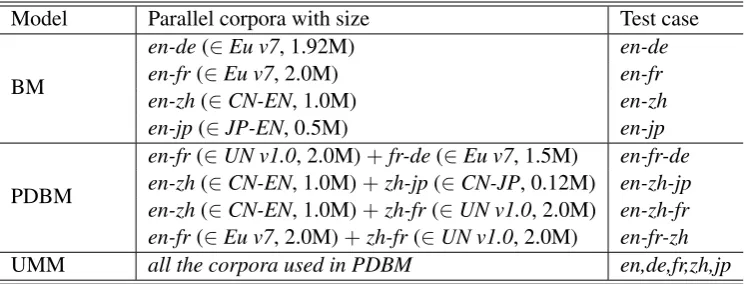
For the the BM model, we useen-de(∈Eu v7) anden-fr(∈Eu v7),en-zh (∈CN-EN), anden-jp (∈JP-EN).
For the PDBM model, we useen-fr(∈UN v1.0) withfr-de(∈Eu v7) to get the caseen-fr-de(fr act-s aact-s a pivot),en-zh(∈CN-EN) withzh-jp(∈ CN-JP) to build the caseen-zh-jp(zhacts as a pivot), en-zh(∈CN-EN) withzh-fr(∈UN v1.0) to build en-zh-fr (zhacts as a pivot), and en-fr (∈Eu v7) 4
https://www.uni-weimar.de/medien/webis/corpora/corpus-webis-cls-10/
5http://tcci.ccf.org.cn/conference/2013/pages/page04 evares.html 6http://www.statmt.org/europarl/v7/
7https://conferences.unite.un.org/UNCorpus/
8http://www.chineseldc.org/resource info.php?rid=141 9http://alaginrc.nict.go.jp/WikiCorpus/index E.html 10http://lotus.kuee.kyoto-u.ac.jp/ chu/resource/wiki zh ja.tgz
with zh-fr (∈ UN v1.0) to builden-fr-zh (fr acts as a pivot). Note that any pivot language can be selected if the parallel corpora between the piv-ot language and piv-other languages can be obtained, but in our experiments, we only use one pivot lan-guage in each test case to validate the feasibility of our proposed model. In practice, a popular lan-guage (such as English, Chinese) can be used as the pivot because it can act as a link between two unpopular languages.
While for the UMM model, we use all the cor-pora used in PDBM to build a universal model. All the details can be found in Table1.
3.2 Comparison Methods
In addition to the comparison between our mod-els, we further compare them with popular cross-lingual (CL) sentiment classification methods.
For comparison in German, French and Japanese, we adopt a few typical CL classifica-tion methods, and the results are directly borrowed from the corresponding published papers:
MT-BOW: It is a simple model to train a lin-ear classifier based on the bag-of-words features, and it uses a machine translator to translate the test data into the source language (Prettenhofer and Stein,2010) .
CL-SCL: It is the cross-lingual structural corre-spondence learning algorithm proposed by (Pret-tenhofer and Stein, 2010) and the features in the two languages are mapped to a unified space.
BSE: It is introduced in (Tang and Wan,2014) by forcing the representations of words from both the source and target languages to share the same feature space. In this way, bilingual word embed-dings are learned for cross-lingual sentiment clas-sification.
CR-RL: It is the bilingual word representation learning method of (Xiao and Guo,2013). It learns different representations for words in different lan-guages. Part of the word vector is shared among different languages and the rest is language depen-dent. The document representation is calculated by taking average over all words in the document.
Bi-PV: It extends the paragraph vector model into bilingual setting by sharing the document rep-resentation of a pair of parallel documents (Pham et al.,2015).
For comparison in Chinese, we adopt several typical CL classification methods:
regres-Model Parallel corpora with size Test case
BM
en-de(∈Eu v7, 1.92M) en-de en-fr(∈Eu v7, 2.0M) en-fr en-zh(∈CN-EN, 1.0M) en-zh en-jp(∈JP-EN, 0.5M) en-jp
PDBM
[image:6.595.113.487.62.204.2]en-fr(∈UN v1.0, 2.0M)+fr-de(∈Eu v7, 1.5M) en-fr-de en-zh(∈CN-EN, 1.0M)+zh-jp(∈CN-JP, 0.12M) en-zh-jp en-zh(∈CN-EN, 1.0M)+zh-fr(∈UN v1.0, 2.0M) en-zh-fr en-fr(∈Eu v7, 2.0M)+zh-fr(∈UN v1.0, 2.0M) en-fr-zh UMM all the corpora used in PDBM en,de,fr,zh,jp
Table 1: Parallel corpora used in our models.
sion and SVM to learn different classifiers based on the translated Chinese training data. Bag of words features are used for classification.
Bi-PV: The same as that described above.
BSWE: It uses the bilingual sentiment word embedding algorithm based on denoising autoen-coders (Zhou et al.,2015) to learns word represen-tations. Each document is then represented by the sentiment words and the corresponding negation words.
3.3 Settings and Preprocessing
We utilizecdec(Dyer et al.,2010) as an alignment tool to get word-level alignment, and we also use it to lowercase the characters in western languages. We use thestanford-segmenter11to segment Chi-nese words, and useMecab12to segment Japanese words. TheSnowNLP 13is used to convert tradi-tional words to simplified ones. Besides, we re-move all the irregular characters (e.g., c, £, ♥) in the texts.
For all the three models, we use stochastic gra-dient descent (SGD) for learning, with a default learning rate of 0.025, negative sampling with 30 samples, skip-gram with context window of size 5, and a subsampling rate of value 1e-4. The em-bedding size is set to 400. The training epochs are all set to 10. All the parameters ofα andβ
used in the three models are simply set to 1. The word embeddings in a document are averaged to get the document representation, and then the lo-gistic regression classier is adopted for sentiment classification.
11http://nlp.stanford.edu/software/segmenter.shtml 12http://taku910.github.io/mecab/
13https://github.com/isnowfy/snownlp
3.4 Results
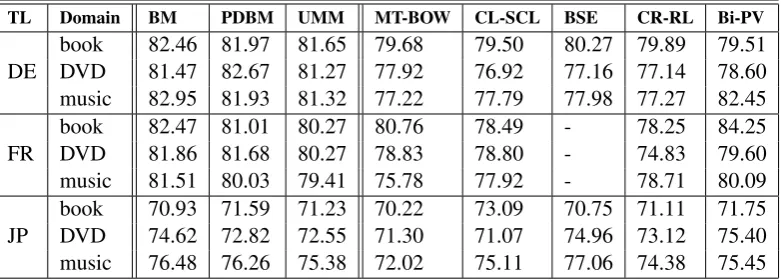
The sentiment classification results of our three models and the CL classification methods in the three domains and in the German, French and Japanese languages are presented in Table 2. The results in the Chinese language are presented in Table 3. Note that the results of the CL methods are not reported on English test sets, and we only compare our three models on English test sets in Table 3.
TL Domain BM PDBM UMM MT-BOW CL-SCL BSE CR-RL Bi-PV
DE bookDVD 82.46 81.97 81.65 79.6881.47 82.67 81.27 77.92 79.5076.92 80.27 79.8977.16 77.14 79.5178.60 music 82.95 81.93 81.32 77.22 77.79 77.98 77.27 82.45
FR bookDVD 82.47 81.01 80.27 80.7681.86 81.68 80.27 78.83 78.4978.80 -- 78.2574.83 84.2579.60 music 81.51 80.03 79.41 75.78 77.92 - 78.71 80.09
JP bookDVD 70.93 71.59 71.23 70.2274.62 72.82 72.55 71.30 73.0971.07 70.75 71.1174.96 73.12 71.7575.40 music 76.48 76.26 75.38 72.02 75.11 77.06 74.38 75.45
Table 2: Comparison results (accuracy) on DE (German), FR (French) and JP (Japanese).
TL Domain BM PDBM UMM MT-LR MT-SVM Bi-PV BSWE
CN bookDVD 79.7 77.881.7 80.9 78.479.8 76.579.6 77.981.4 78.582.0 81.181.6 music 79.2 77.3 75.8 74.1 70.7 75.3 79.4
EN bookDVD 81.6 80.581.7 80.8 80.279.5 -- -- -- -
-music 76.8 78.8 77.9 - - -
-Table 3: Comparison results (accuracy) on CN (Chinese) and EN (English).
and en-jp, but relies on pivot-based methods for bridging language gaps. We also find that the d-ifferent parallel corpora used by the UMM model are of different quality and genres, and if they are used at the same time, they may have some neg-ative influence on each other and thus the learned word embeddings are not always better than the BM and PDBM models using only one or two par-allel corpora. What’s more, the available parpar-allel data in different language pairs are of various sizes (0.12M∼2.0M). Considering all these issues, the results of UMM are promising because the learned single sentiment classifier can work generally well in multiple languages. We believe that if more high-quality and balanced parallel data are used, the performance of the universal sentiment classi-fier will be improved.
Second, we compare our models with typical CL classification methods. In Table 2, we can see our models can outperform MT-BOW, CL-SCL, and CR-RL in most test cases, and outperform BSE in the German language. Our models can achieve very close results with the other sophisti-cated CL methods, including Bi-PV. In Table 3, we can see our models can generally outperform MT-LR and MT-SVM, and achieve very competitive results with other strong CL methods, including Bi-PV and BSWE. Most CL classification
meth-ods rely on commercial machine translation sys-tems (e.g. Google Translate) for translating the reviews (including the training reviews, the test reviews and additional unlabeled reviews) to get parallel data. Compared with the large amount of parallel data used by commercial machine transla-tion systems, the parallel data used by our models are of a very small size. Though our models are simply based on word embeddings, and the paral-lel data used by our models are in a small scale, the performance achieved by our models are very competitive.
In Figure 1, we show the visualization of word embeddings learned by the UMM model for some example words. We can see that similar sentiment words in different languages appear nearby with each other. The figure demonstrate that the UMM model are successful in learning sentiment-aware word embeddings in multiple languages.
4 Related Work
[image:7.595.105.496.63.203.2]OLNH DLPH
GLVOLNH
GlWHVWH KDVVH
ORYH /DPRXU
[image:8.595.100.280.77.211.2]YHU\ VHKU
Figure 1: Visualization of word embeddings in UMM (Chinese, Japanese, English, French, Ger-man). The similar words are marked in the same color.
language to the target language (Banea et al., 2008; Wan, 2009; Gao et al., 2015;Chen et al., 2015), and some other studies tried to build a unified feature/semantic space in both two lan-guages(Prettenhofer and Stein, 2010; Xiao and Guo, 2013;Zhou et al., 2015, 2016b,a; Li et al., 2017). In the latter case, the sentiment classifier learned in the source language can be used for sen-timent classification in both languages. Particular-ly,Wan(2009) used machine translation to trans-late the source language to the target language to bridge the gap and applied the co-training ap-proach. Prettenhofer and Stein (2010) provided a CL-SCL model based on structural correspon-dence learning (SCL) for sentiment classification. Lu et al. (2011) explored to increase the labeled data in both the source and target languages by applying an extra unlabeled parallel data. Xi-ao and Guo (2013) expected to get cross-lingual discriminative word embeddings to perform the multiple document classification tasks. Their in-tuitive thought is based on a delicate log-losses function, which aims to increase the probabili-ty of the documents with their labels. Like Lu et al. (2011), Meng et al. (2012) also proposed their cross-lingual mixture model to leverage an unlabeled parallel dataset. They intended to learn the previously unseen sentimental words from the big parallel corpus. Some studies have attempt-ed to address multi-lingual sentiment classification (Deriu et al.,2017), but different from our study, they directly leverage training data in multiple lan-guages, by assuming the training data can be
ob-tained directly or in a distant supervision way in each language, and they did not consider the re-source or data transfer problem at all.
Word embeddings have shown its great practi-cable usability in plenty of natural language pro-cessing tasks, such as information retrieval (Diaz et al.,2016;Zuccon et al., 2015), machine trans-lation (Shi et al., 2016;Zhang et al., 2014), sen-timent analysis (Ren et al.,2016;Xu et al.,2015; Tang et al.,2014) and so on. Bilingual word em-beddings have been induced for cross-lingual NLP tasks (Vuli´c and Moens, 2015;Guo et al., 2014; Zou et al., 2013;Tang et al., 2014; Luong et al., 2015;Zhou et al.,2015). In particular,Luong et al. (2015) proposed the BiSkip model to induce bilin-gual word embeddings, which is extended from the monolingual skip-gram model inword2vecto a bilingual model. They added constraint mu-tually on both the source language and the tar-get language, while the monolingual model only has constraint on a single language. Zhou et al. (2015) proposed an approach to learning bilin-gual sentiment word embeddings by using sen-timent information of text as supervision, based on labeled corpora and their translations. Ferreira et al.(2016) used a single optimization problem by combining a co-regularizer for the bilingual em-beddings with a task-specific loss. However, these methods for inducing bilingual word embeddings usually rely on directly parallel corpus.
5 Conclusion and Future Work
In this paper, we proposed an approach to build a universal sentiment classifier in multiple lan-guages. Particularly we proposed a pivot-based model to transfer the sentiment information from the source language to any resource-poor lan-guage via pivot lanlan-guages. Evaluation results show that the pivot-based model can learn bilin-gual sentiment-aware word embeddings as well as the bilingual model using direct parallel data. Moreover, the universal sentiment classifier built in the five languages can achieve promising result-s.
Acknowledgments
This work was supported by NSFC (61331011), 863 Program of China (2015AA015403) and Key Laboratory of Science, Technology and Standard in Press Industry (Key Laboratory of Intelligent Press Media Technology). We thank the anony-mous reviewers for helpful comments. Xiaojun Wan is the corresponding author.
References
Apoorv Agarwal, Boyi Xie, Ilia Vovsha, Owen Ram-bow, and Rebecca Passonneau. 2011. Sentiment analysis of twitter data. InProceedings of the work-shop on languages in social media, pages 30–38. Association for Computational Linguistics.
Carmen Banea, Rada Mihalcea, Janyce Wiebe, and Samer Hassan. 2008. Multilingual subjectivity anal-ysis using machine translation. In Proceedings of the Conference on Empirical Methods in Natural Language Processing, pages 127–135. Association for Computational Linguistics.
John Blitzer, Mark Dredze, Fernando Pereira, et al. 2007. Biographies, bollywood, boom-boxes and blenders: Domain adaptation for sentiment classi-fication. InAssociation for Computational Linguis-tics, volume 7, pages 440–447.
Danushka Bollegala, Tingting Mu, and J Y Goulermas. 2016. Cross-domain sentiment classification using sentiment sensitive embeddings. IEEE Transaction-s on Knowledge and Data Engineering, 28(2):398– 410.
Qiang Chen, Wenjie Li, Yu Lei, Xule Liu, and Yanxi-ang He. 2015. Learning to adapt credible knowledge in cross-lingual sentiment analysis. In Association for Computational Linguistics, pages 419–429. Jan Deriu, Aurelien Lucchi, Valeria De Luca,
Aliak-sei Severyn, Simon M¨uller, Mark Cieliebak, Thomas Hofmann, and Martin Jaggi. 2017. Leveraging large amounts of weakly supervised data for multi-language sentiment classification. InProceedings of the 26th International Conference on World Wide Web, pages 1045–1052. International World Wide Web Conferences Steering Committee.
Fernando Diaz, Bhaskar Mitra, and Nick Craswell. 2016. Query expansion with locally-trained word embeddings. Association for Computational Lin-guistics, pages 367–377.
Chris Dyer, Jonathan Weese, Hendra Setiawan, Adam Lopez, Ferhan Ture, Vladimir Eidelman, Juri Gan-itkevitch, Phil Blunsom, and Philip Resnik. 2010. cdec: a decoder, alignment, and learning framework for finite-state and context-free translation model-s. In ACL 2010, Proceedings of the Meeting of the Association for Computational Linguistics, July
11-16, 2010, Uppsala, Sweden, System Demonstra-tions, pages 7–12.
Daniel C. Ferreira, Andr F. T. Martins, and Mariana S. C. Almeida. 2016. Jointly learning to embed and predict with multiple languages. In Meeting of the Association for Computational Linguistics, pages 2019–2028.
Dehong Gao, Furu Wei, Wenjie Li, Xiaohua Liu, and Ming Zhou. 2015. Cross-lingual sentiment lexicon learning with bilingual word graph label propaga-tion. Computational Linguistics.
Jiang Guo, Wanxiang Che, Haifeng Wang, and Ting Li-u. 2014. Learning sense-specific word embeddings by exploiting bilingual resources. InInternational Conference on Computational LinguisticsCOLING, pages 497–507.
Philipp Koehn. 2004. A parallel corpus for statistical machine translation.Proceedings of the Third Work-shop on Statistical Machine Translation, (1):3–4.
Nana Li, Shuangfei Zhai, Zhongfei Zhang, and Boy-ing Liu. 2017. Structural correspondence learnBoy-ing for cross-lingual sentiment classification with one-to-many mappings. pages 3490–3496.
Bing Liu. 2012. Sentiment analysis and opinion min-ing. Synthesis lectures on human language tech-nologies, 5(1):1–167.
Bin Lu, Chenhao Tan, Claire Cardie, and Benjamin K Tsou. 2011. Joint bilingual sentiment classifica-tion with unlabeled parallel corpora. In Proceed-ings of the 49th Annual Meeting of the Association for Computational Linguistics: Human Language Technologies-Volume 1, pages 320–330. Association for Computational Linguistics.
Thang Luong, Hieu Pham, and Christopher D. Man-ning. 2015. Bilingual word representations with monolingual quality in mind. InThe Workshop on Vector Space Modeling for Natural Language Pro-cessing, pages 151–159.
Xinfan Meng, Furu Wei, Xiaohua Liu, Ming Zhou, Ge Xu, and Houfeng Wang. 2012. Cross-lingual mixture model for sentiment classification. In Meet-ing of the Association for Computational LMeet-inguistic- Linguistic-s: Long Papers, pages 572–581.
Bo Pang, Lillian Lee, and Shivakumar Vaithyanathan. 2002. Thumbs up?: sentiment classification using machine learning techniques. InProceedings of the ACL-02 conference on Empirical methods in natural language processing-Volume 10, pages 79–86. As-sociation for Computational Linguistics.
Peter Prettenhofer and Benno Stein. 2010. Cross-language text classification using structural corre-spondence learning. InACL 2010, Proceedings of the Meeting of the Association for Computation-al Linguistics, July 11-16, 2010, UppsComputation-ala, Sweden, pages 1118–1127.
Yafeng Ren, Ruimin Wang, and Donghong Ji. 2016. A topic-enhanced word embedding for twitter senti-ment classification. Information Sciences, 369:188– 198.
Chen Shi, Shujie Liu, Shuo Ren, Shi Feng, Mu Li, Ming Zhou, Xu Sun, and Houfeng Wang. 2016. Knowledge-based semantic embedding for machine translation. pages 2245–2254.
Duyu Tang, Furu Wei, Nan Yang, Ming Zhou, Ting Li-u, and Bing Qin. 2014. Learning sentiment-specific word embedding for twitter sentiment classification. pages 1555–1565.
Xuewei Tang and Xiaojun Wan. 2014. Learning bilin-gual embedding model for cross-language senti-ment classification. In Proceedings of the 2014 IEEE/WIC/ACM International Joint Conferences on Web Intelligence (WI) and Intelligent Agent Tech-nologies (IAT)-Volume 02, pages 134–141. IEEE Computer Society.
Ivan Vuli´c and Marie-Francine Moens. 2015. Monolin-gual and cross-linMonolin-gual information retrieval models based on (bilingual) word embeddings. In Proceed-ings of the 38th International ACM SIGIR Confer-ence on Research and Development in Information Retrieval, pages 363–372. ACM.
Xiaojun Wan. 2009. Co-training for cross-lingual sen-timent classification. InACL 2009, Proceedings of the Meeting of the Association for Computational Linguistics and the International Joint Conference on Natural Language Processing of the Afnlp, 2-7 August 2009, Singapore, pages 235–243.
Hua Wu and Haifeng Wang. 2007. Pivot language ap-proach for phrase-based statistical machine transla-tion. Machine Translation, 21(3):165–181.
Min Xiao and Yuhong Guo. 2013. Semi-supervised representation learning for cross-lingual text clas-sification. In Conference on Empirical Methods in Natural Language Processing, pages 1465–1475.
Ruifeng Xu, Tao Chen, Yunqing Xia, Qin Lu, Bin Liu, and Xuan Wang. 2015. Word embedding composi-tion for data imbalances in sentiment and emocomposi-tion classification. Cognitive Computation, 7(2):226– 240.
Jiajun Zhang, Shujie Liu, Mu Li, Ming Zhou, Chengqing Zong, et al. 2014. Bilingually-constrained phrase embeddings for machine trans-lation. pages 111–121.
Huiwei Zhou, Long Chen, Fulin Shi, and Degen Huang. 2015. Learning bilingual sentiment word embeddings for cross-language sentiment classifica-tion. InAssociation for Computational Linguistics, pages 430–440.
Xinjie Zhou, Xiaojun Wan, and Jianguo Xiao. 2016a. Attention-based lstm network for cross-lingual sen-timent classification.
Xinjie Zhou, Xiaojun Wan, and Jianguo Xiao. 2016b. Cross-lingual sentiment classification with bilingual document representation learning. InMeeting of the Association for Computational Linguistics, pages 1403–1412.
Micha Ziemski, Marcin Junczys-Dowmunt, and Bruno Pouliquen. 2016. The united nations parallel corpus v1.0. InLrec.
Will Y Zou, Richard Socher, Daniel M Cer, and Christopher D Manning. 2013. Bilingual word embeddings for phrase-based machine translation. pages 1393–1398.