Modeling Relation Paths for Representation Learning of Knowledge Bases
Yankai Lin1, Zhiyuan Liu1∗, Huanbo Luan1, Maosong Sun1, Siwei Rao2, Song Liu2 1Department of Computer Science and Technology, State Key Lab on Intelligent Technology and Systems,
National Lab for Information Science and Technology, Tsinghua University, Beijing, China 2 Samsung R&D Institute of China, Beijing, China
Abstract
Representation learning of knowledge bases aims to embed both entities and relations into a low-dimensional space. Most existing methods only consider direct relations in representation learning. We argue that multiple-step relation paths also contain rich inference patterns be-tween entities, and propose a path-based representation learning model. This model considers relation paths as translations between entities for representation learn-ing, and addresses two key challenges: (1) Since not all relation paths are reliable, we design a path-constraint resource allo-cation algorithm to measure the reliability of relation paths. (2) We represent relation paths via semantic composition of relation embeddings. Experimental results on real-world datasets show that, as com-pared with baselines, our model achieves significant and consistent improvements on knowledge base completion and re-lation extraction from text. The source code of this paper can be obtained from https://github.com/mrlyk423/ relation_extraction.
1 Introduction
People have recently built many large-scale knowledge bases (KBs) such as Freebase, DBpe-dia and YAGO. These KBs consist of facts about the real world, mostly in the form of triples, e.g., (Steve Jobs, FounderOf, Apple Inc.). KBs are important resources for many applications such as question answering and Web search. Although typical KBs are large in size, usually containing thousands of relation types, millions of entities and billions of facts (triples), they are far from
∗Corresponding author: Z. Liu ([email protected])
complete. Hence, many efforts have been invested in relation extraction to enrich KBs.
Recent studies reveal that, neural-based repre-sentation learning methods are scalable and ef-fective to encode relational knowledge with low-dimensional representations of both entities and relations, which can be further used to extract unknown relational facts. TransE (Bordes et al., 2013) is a typical method in the neural-based ap-proach, which learns vectors (i.e., embeddings) for both entities and relations. The basic idea behind TransE is that, the relationship between two enti-ties corresponds to a translation between the em-beddings of the entities, that is,h+r ≈ t when the triple (h, r, t) holds. Since TransE has issues when modeling 1-to-N, N-to-1 and N-to-N rela-tions, various methods such as TransH (Wang et al., 2014) and TransR (Lin et al., 2015) are pro-posed to assign an entity with different represen-tations when involved in various relations.
Despite their success in modeling relational facts, TransE and its extensions only take di-rect relations between entities into considera-tion. It is known that there are also substan-tial multiple-step relation paths between entities indicating their semantic relationships. The re-lation paths reflect complicated inference pat-terns among relations in KBs. For example, the relation path h −−−−−−−−→BornInCity e1 −−−−−−−−→CityInState
e2 −−−−−−−−−−−→StateInCountry t indicates the relation Nationality between h and t, i.e., (h, Nationality,t).
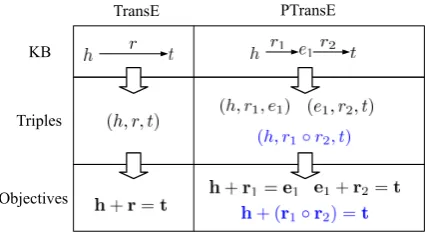
In this paper, we aim at extending TransE to model relation paths for representation learning of KBs, and propose path-based TransE (PTransE). In PTransE, in addition to direct connected rela-tional facts, we also build triples from KBs us-ing entity pairs connected with relation paths. As shown in Figure 1, TransE only considers direct relations between entities, e.g., h −→r t, builds a triple (h, r, t), and optimizes the
tive h + r = t. PTransE generalizes TransE by regarding multiple-step relation paths as con-nections between entities. Take the 2-step path
h −→r1 e
1 −→r2 tfor example as shown in Figure 1. Besides building triples (h, r1, e1) and(e1, r2, t) for learning as in TransE, PTransE also builds a triple (h, r1 ◦r2, t), and optimizes the objective
h+ (r1◦r2) =t, where◦is an operation to join the relationsr1andr2together into a unified rela-tion path representarela-tion.
TransE PTransE
KB
Triples
[image:2.595.76.289.212.329.2]Objectives
Figure 1: TransE and PTransE.
As compared with TransE, PTransE takes rich relation paths in KBs for learning. There are two critical challenges that make PTransE nontrivial to learn from relation paths:
Relation Path Reliability. Not all relation paths are meaningful and reliable for learning. For example, there is often a relation pathh −−−−−→Friend e1 −−−−−−−−→Profession t, but actually it does not indicate any semantic relationship betweenhandt. Hence, it is inappropriate to consider all relation paths in our model. In experiments, we find that those re-lation paths that lead to lots of possible tail enti-ties are mostly unreliable for the entity pair. In this paper, we propose a path-constraint resource allocation algorithm to measure the reliability of relation paths. Afterwards, we select the reliable relation paths for representation learning.
Relation Path Representation. In order to take relation paths into consideration, relation paths should also be represented in a low-dimensional space. It is straightforward that the semantic meaning of a relation path depends on all relations in this path. Given a relation pathp= (r1, . . . , rl)
, we will define and learn a binary operation func-tion (◦) to obtain the path embedding p by re-cursively composing multiple relations, i.e.,p =
r1◦. . .◦rl.
With relation path selection and representation, PTransE learns entity and relation embeddings by
regarding relation paths as translations between the corresponding entities. In experiments, we select a typical KB, Freebase, to build datasets and carry out evaluation on three tasks, including entity prediction, relation prediction and relation extraction from text. Experimental results show that, PTransE significantly outperforms TransE and other baseline methods on all three tasks.
2 Our Model
In this section, we introduce path-based TransE (PTransE) that learns representations of entities and relations considering relation paths. In TransE and PTransE, we have entity set E and relation set R, and learn to encode both entities and re-lations inRk. Given a KB represented by a set of
triplesS ={(h, r, t)}with each triple composed of two entitiesh, t ∈Eand their relationr ∈R. Our model is expected to return a low energy score when the relation holds, and a high one otherwise.
2.1 TransE and PTransE
For each triple(h, r, t), TransE regards the relation as a translation vectorrbetween two entity vectors
handt. The energy function is defined as
E(h, r, t) =||h+r−t||, (1) which is expected to get a low score when(h, r, t)
holds, and high otherwise.
TransE only learns from direct relations be-tween entities but ignores multiple-step relation paths, which also contain rich inference patterns between entities. PTransE take relation paths into consideration for representation learning.
Suppose there are multiple relation paths
P(h, t) = {p1, . . . , pN} connecting two entities
handt, where relation pathp= (r1, . . . , rl)
indi-catesh −→r1 . . . −→rl t. For each triple(h, r, t), the
energy function is defined as
G(h, r, t) =E(h, r, t) +E(h, P, t), (2) whereE(h, r, t)models correlations between rela-tions and entities with direct relation triples, as de-fined in Equation (1).E(h, P, t)models the infer-ence correlations between relations with multiple-step relation path triples, which is defined as
E(h, P, t) = Z1 X
p∈P(h,t)
R(p|h, t)E(h, p, t), (3)
P
p∈P(h,t)R(p|h, t)is a normalization factor, and
E(h, p, t) is the energy function of the triple
(h, p, t).
For the energy of each triple(h, p, t), the com-ponentR(p|h, t)concerns about relation path reli-ability, andE(h, p, t)concerns about relation path representation. We introduce the two components in detail as follows.
2.2 Relation Path Reliability
We propose a path-constraint resource allocation (PCRA) algorithm to measure the reliability of a relation path. Resource allocation over networks was originally proposed for personalized recom-mendation (Zhou et al., 2007), and has been suc-cessfully used in information retrieval for measur-ing relatedness between two objects (L¨u and Zhou, 2011). Here we extend it to PCRA to measure the reliability of relation paths. The basic idea is, we assume that a certain amount of resource is associ-ated with the head entityh, and will flow following the given pathp. We use the resource amount that eventually flows to the tail entitytto measure the reliability of the pathpas a meaningful connection betweenhandt.
Formally, for a path triple(h, p, t), we compute the resource amount flowing fromhtotgiven the pathp = (r1, . . . , rl)as follows. Starting fromh
and following the relation pathp, we can write the flowing path asS0 −→r1 S1 −→r2 . . . −→rl Sl, where
S0 =handt∈Sl.
For any entitym∈Si, we denote its direct
pre-decessors along relationri inSi−1 asSi−1(·, m). The resource flowing tomis defined as
Rp(m) =
X
n∈Si−1(·,m) 1
|Si(n,·)|Rp(n), (4)
whereSi(n,·)is the direct successors ofn∈Si−1 following the relationri, andRp(n)is the resource
obtained from the entityn.
For each relation path p, we set the initial re-source in h as Rp(h) = 1. By performing
re-source allocation recursively from h through the path p, the tail entity teventually obtains the re-sourceRp(t)which indicates how much
informa-tion of the head entityhcan be well translated. We useRp(t)to measure the reliability of the pathp
given(h, t), i.e.,R(p|h, t) =Rp(t).
2.3 Relation Path Representation
Besides relation path reliability, we also need to define energy functionE(h, p, t)for the path triple
(h, p, t) in Equation (2). Similar with the en-ergy function of TransE in Equation (1), we will also represent the relation pathpin the embedding space.
United State Californi
a San
Francisco Steve
Jobs
Composition
[image:3.595.311.521.133.227.2]BornInCity CityInState StateInCountry
Figure 2: Path representations are computed by se-mantic composition of relation embeddings.
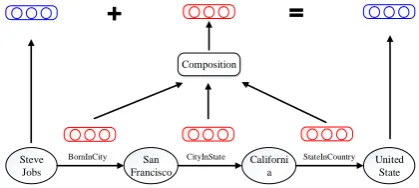
The semantic meaning of a relation path con-siderably relies on its involved relations. It is thus reasonable for us to build path embeddings via se-mantic composition of relation embeddings. As illustrated in Figure 2, the path embedding p is composed by the embeddings of BorninCity, CityInStateandStateInCountry.
Formally, for a pathp= (r1, . . . , rl), we define
a composition operation◦and obtain path embed-ding asp=r1◦. . .◦rl. In this paper, we consider
three types of composition operation:
Addition (ADD). The addition operation ob-tains the vector of a path by summing up the vec-tors of all relations, which is formalized as
p=r1+. . .+rl. (5)
Multiplication (MUL).The multiplication op-eration obtains the vector of a path as the cumula-tive product of the vectors of all relations, which is formalized as
p=r1·. . .·rl. (6)
Both addition and multiplication operations are simple and have been extensively investigated in semantic composition of phrases and sentences (Mitchell and Lapata, 2008).
Recurrent Neural Network (RNN).RNN is a recent neural-based model for semantic composi-tion (Mikolov et al., 2010). The composicomposi-tion op-eration is realized using a matrix W:
ci=f(W[ci−1;ri]), (7)
vec-tors. By settingc1 =r1and recursively perform-ing RNN followperform-ing the relation path, we will fi-nally obtain p = cn. RNN has also been used
for representation learning of relation paths in KBs (Neelakantan et al., 2015).
For a multiple-step relation path triple(h, p, t), we could have followed TransE and define the energy function as E(h, p, t) = ||h +p −t||. However, since we have minimized||h+r−t||
with the direct relation triple(h, r, t)to make sure
r≈t−h, we may directly define the energy func-tion of(h, p, t)as
E(h, p, t) =||p−(t−h)||=||p−r||=E(p, r),
(8) which is expected to be a low score when the multiple-relation pathpis consistent with the di-rect relationr, and high otherwise, without using entity embeddings.
2.4 Objective Formalization
We formalize the optimization objective of PTransE as
L(S) = X
(h,r,t)∈S
L(h, r, t)+ 1Z X
p∈P(h,t)
R(p|h, t)L(p, r).
(9)
Following TransE, L(h, r, t) and L(p, r) are margin-based loss functions with respect to the triple(h, r, t)and the pair(p, r):
L(h, r, t) = X
(h0,r0,t0)∈S−
[γ+E(h, r, t)−E(h0, r0, t0)]+,
(10)
and
L(p, r) = X
(h,r0,t)∈S−
[γ+E(p, r)−E(p, r0)]
+, (11)
where[x]+= max(0, x)returns the maximum be-tween0andx,γis the margin,Sis the set of valid triples existing in a KB andS−is the set of invalid triples. The objective will favor lower scores for valid triples as compared with invalid triples.
The invalid triple set with respect to(h, r, t)is defined as
S−={(h0, r, t)}∪{(h, r0, t)}∪{(h, r, t0)}. (12)
That is, the set of invalid triples is composed of the original valid triple(h, r, t) with one of three components replaced.
2.5 Optimization and Implementation Details
For optimization, we employ stochastic gradient descent (SGD) to minimize the loss function. We randomly select a valid triple from the training set iteratively for learning. In the implementation, we also enforce constraints on the norms of the em-beddingsh,r,t. That is, we set
khk2 ≤1, krk2 ≤1, ktk2 ≤1. ∀h, r, t. (13) There are also some implementation details that will significantly influence the performance of representation learning, which are introduced as follows.
Reverse Relation Addition.In some cases, we are interested in the reverse version of a relation, which may not be presented in KBs. For exam-ple, according to the relation pathe1 −−−−−−−−→BornInCity
e2 ←−−−−−−−−−−CityOfCountry e3 we expect to infer the fact that(e1,Nationality, e3). In this paper, how-ever, we only consider the relation paths follow-ing one direction. Hence, we add reverse relations for each relation in KBs. That is, for each triple
(h, r, t)we build another (t, r−1, h). In this way, our method can consider the above-mentioned path ase1 −−−−−−−−→BornInCity e2 CityOfCountry
−1 −−−−−−−−−−−−→ e3 for learning.
Path Selection Limitation. There are usually large amount of relations and facts about each en-tity pair. It will be impractical to enumerate all possible relation paths between head and tail en-tities. For example, if each entity refers to more than 100relations on average, which is common in Freebase, there will be billions of4-step paths. Even for 2-step or 3-step paths, it will be time-consuming to consider all of them without limita-tion. For computational efficiency, in this paper we restrict the length of paths to at most 3-steps and consider those relation paths with the reliabil-ity score larger than0.01.
2.6 Complexity Analysis
We denote Ne as the number of entities, Nr as
the number of relations and K as the vector di-mension. The model parameter size of PTransE is(NeK +NrK), which is the same as TransE.
length of relation paths. For each iteration in opti-mization, the complexity of TransE isO(SK)and the complexity of PTransE isO(SKP L)for ADD and MUL, andO(SK2P L)for RNN.
3 Experiments and Analysis
3.1 Data Sets and Experimental Setting
We evaluate our method on a typical large-scale KB Freebase (Bollacker et al., 2008). In this pa-per, we adopt two datasets extracted from Free-base, i.e., FB15K and FB40K. The statistics of the datasets are listed in Table 1.
Table 1: Statistics of data sets.
Dataset #Rel #Ent #Train #Valid # Test FB15K 1,345 14,951 483,142 50,000 59,071 FB40K 1,336 39,528 370,648 67,946 96,678
We evaluate the performance of PTransE and other baselines by predicting whether testing triples hold. We consider two scenarios: (1) Knowledge base completion, aiming to predict the missing entities or relations in given triples only based on existing KBs. (2) Relation extraction from texts, aiming to extract relations between en-tities based on information from both plain texts and KBs.
3.2 Knowledge Base Completion
The task of knowledge base completion is to com-plete the triple(h, r, t)when one ofh, t, ris miss-ing. The task has been used for evaluation in (Bor-des et al., 2011; Bor(Bor-des et al., 2012; Bor(Bor-des et al., 2013). We conduct the evaluation on FB15K, which has483,142relational triples and1,345 re-lation types, among which there are rich inference and reasoning patterns.
In the testing phase, for each testing triple
(h, r, t), we define the following score function for prediction
S(h, r, t) =G(h, r, t) +G(t, r−1, h), (14) and the score functionG(h, r, t)is further defined as
G(h, r, t) =||h+r−t||+ 1
Z
X
p∈P(h,t)
Pr(r|p)R(p|h, t)||p−r||.
(15) The score function is similar to the energy func-tion defined in Secfunc-tion 2.1. The difference is that,
here we consider the reliability of a pathpis also related to the inference strength givenr, which is quantified asPr(r|p) = Pr(r, p)/Pr(p)obtained from the training data.
We divide the stage into two sub-tasks, i.e., en-tity prediction and relation prediction.
3.2.1 Entity Prediction
In the sub-task of entity prediction, we follow the setting in (Bordes et al., 2013). For each test-ing triple with misstest-ing head or tail entity, vari-ous methods are asked to compute the scores of
G(h, r, t)for all candidate entities and rank them in descending order.
We use two measures as our evaluation metrics: the mean of correct entity ranks and the proportion of valid entities ranked in top-10 (Hits@10). As mentioned in (Bordes et al., 2013), the measures are desirable but flawed when an invalid triple ends up being valid in KBs. For example, when the testing triple is (Obama, PresidentOf, USA) with the head entityObamais missing, the head entity Lincoln may be regarded invalid for prediction, but in fact it is valid in KBs. The eval-uation metrics will under-estimate those methods that rank these triples high. Hence, we can filter out all these valid triples in KBs before ranking. The first evaluation setting was named as “Raw” and the second one as “Filter”.
For comparison, we select all methods in (Bor-des et al., 2013; Wang et al., 2014) as our base-lines and use their reported results directly since the evaluation dataset is identical.
Ideally, PTransE has to find all possible relation paths between the given entity and each candidate entity. However, it is time consuming and imprac-tical, because we need to iterate all candidate en-tities in|E|for each testing triple. Here we adopt a re-ranking method: we first rank all candidate entities according to the scores from TransE, and then re-rank top-500 candidates according to the scores from PTransE.
For PTransE, we find the best hyperparameters according to the mean rank in validation set. The optimal configurations of PTransE we used are
λ = 0.001, γ = 1, k = 100 and takingL1 as dissimilarity. For training, we limit the number of epochs over all the training triples to500.
Table 2: Evaluation results on entity prediction.
Metric RawMean RankFilter Hits@10 (Raw Filter%)
RESCAL 828 683 28.4 44.1
SE 273 162 28.8 39.8
SME (linear) 274 154 30.7 40.8 SME (bilinear) 284 158 31.3 41.3
LFM 283 164 26.0 33.1
TransE 243 125 34.9 47.1
TransH 212 87 45.7 64.4
TransR 198 77 48.2 68.7
TransE (Our) 205 63 47.9 70.2 PTransE (ADD, 2-step) 200 54 51.8 83.4 PTransE (MUL, 2-step) 216 67 47.4 77.7 PTransE (RNN, 2-step) 242 92 50.6 82.2 PTransE (ADD, 3-step) 207 58 51.4 84.6
(Bordes et al., 2012), LFM (Jenatton et al., 2012), TransE (Bordes et al., 2013) (original version and our implementation considering reverse relations), TransH (Wang et al., 2014), and TransR (Lin et al., 2015).
For PTransE, we consider three composition op-erations for relation path representation: addition (ADD), multiplication (MUL) and recurrent neu-ral networks (RNN). We also consider relation paths with at most 2-steps and 3-steps. With the same configurations of PTransE, our TransE im-plementation achieves much better performance than that reported in (Bordes et al., 2013).
From Table 2 we observe that: (1) PTransE significantly and consistently outperforms other baselines including TransE. It indicates that rela-tion paths provide a good supplement for repre-sentation learning of KBs, which have been suc-cessfully encoded by PTransE. For example, since bothGeorge W. BushandAbraham Lincolnwere presidents ofthe United States, they exhibit simi-lar embeddings in TransE. This may lead to con-fusion for TransE to predict the spouse of Laura Bush. In contrast, since PTransE models rela-tion paths, it can take advantage of the relarela-tion paths between George W. Bush andLaura Bush, and leads to more accurate prediction. (2) For PTransE, the addition operation outperforms other composition operations in both Mean Rank and Hits@10. The reason is that, the addition opera-tion is compatible with the learning objectives of both TransE and PTransE. Takeh −→r1 e
1 −→r2 tfor example. The optimization objectives of two di-rect relationsh+r1 = e1 ande1+r2 = t can easily derive the path objectiveh+r1+r2 =t. (3) PTransE of considering relation paths with at most 2-step and 3-step achieve comparable results.
This indicates that it may be unnecessary to con-sider those relation paths that are too long.
As defined in (Bordes et al., 2013), relations in KBs can be divided into various types according to their mapping properties such as 1, 1-to-N, N-to-1 and N-to-N. Here we demonstrate the performance of PTransE and some baselines with respect to different types of relations in Table 3. It is observed that, on all mapping types of re-lations, PTransE consistently achieves significant improvement as compared with TransE.
3.2.2 Relation Prediction
Relation prediction aims to predict relations given two entities. We also use FB15K for evaluation. In this sub-task, we can use the score function of PTransE to rank candidate relations instead of re-ranking like in entity prediction.
Since our implementation of TransE has achieved the best performance among all base-lines for entity prediction, here we only com-pare PTransE with TransE due to limited space. Evaluation results are shown in Table 4, where we report Hits@1 instead of Hits@10 for com-parison, because Hits@10 for both TransE and PTransE exceeds 95%. In this table, we report the performance of TransE without reverse rela-tions (TransE), with reverse relarela-tions (+Rev) and considering relation paths for testing like that in PTransE (+Rev+Path). We report the performance of PTransE with only considering relation paths (-TransE), only considering the part in Equation (1) (-Path) and considering both (PTransE).
The optimal configurations of PTransE for re-lation prediction are identical to those for entity prediction:λ= 0.001,γ = 1,k= 100and taking
L1as dissimilarity.
rela-Table 3: Evaluation results on FB15K by mapping properties of relations. (%)
Tasks Predicting Head Entities (Hits@10) Predicting Tail Entities (Hits@10) Relation Category 1-to-1 1-to-N N-to-1 N-to-N 1-to-1 1-to-N N-to-1 N-to-N
SE 35.6 62.6 17.2 37.5 34.9 14.6 68.3 41.3
SME (linear) 35.1 53.7 19.0 40.3 32.7 14.9 61.6 43.3 SME (bilinear) 30.9 69.6 19.9 38.6 28.2 13.1 76.0 41.8 TransE 43.7 65.7 18.2 47.2 43.7 19.7 66.7 50.0 TransH 66.8 87.6 28.7 64.5 65.5 39.8 83.3 67.2 TransR 78.8 89.2 34.1 69.2 79.2 37.4 90.4 72.1 TransE (Our) 74.6 86.6 43.7 70.6 71.5 49.0 85.0 72.9 PTransE (ADD, 2-step) 91.0 92.8 60.9 83.8 91.2 74.0 88.9 86.4 PTransE (MUL, 2-step) 89.0 86.8 57.6 79.8 87.8 71.4 72.2 80.4 PTransE (RNN, 2-step) 88.9 84.0 56.3 84.5 88.8 68.4 81.5 86.7 PTrasnE (ADD, 3-step) 90.1 92.0 58.7 86.1 90.7 70.7 87.5 88.7
[image:7.595.73.523.84.265.2]tion paths. As compared with TransE, the inferior of PTransE-TransE also indicates that entity repre-sentations are informative and crucial for relation prediction.
Table 4: Evaluation results on relation prediction.
Metric RawMean RankFilter RawHits@1 (Filter%)
TransE (Our) 2.8 2.5 65.1 84.3
+Rev 2.6 2.3 67.1 86.7
+Rev+Path 2.4 1.9 65.2 89.0
PTransE (ADD, 2-step) 1.7 1.2 69.5 93.6
-TransE 135.8 135.3 51.4 78.0
-Path 2.0 1.6 69.7 89.0
PTransE (MUL, 2-step) 2.5 2.0 66.3 89.0 PTransE (RNN, 2-step) 1.9 1.4 68.3 93.2 PTransE (ADD, 3-step) 1.8 1.4 68.5 94.0
3.3 Relation Extraction from Text
Relation extraction from text aims to extract re-lational facts from plain text to enrich existing KBs. Many works regard large-scale KBs as dis-tant supervision to annotate sentences as training instances and build relation classifiers according to features extracted from the sentences (Mintz et al., 2009; Riedel et al., 2010; Hoffmann et al., 2011; Surdeanu et al., 2012). All these methods reason new facts only based on plain text. TransE was used to enrich a text-based model and achieved a significant improvement (Weston et al., 2013), and so do TransH (Wang et al., 2014) and TransR (Lin et al., 2015). In this task, we explore the effective-ness of PTransE for relation extraction from text.
We use New York Times corpus (NYT) released by (Riedel et al., 2010) as training and testing data. NYT aligns Freebase with the articles in New York Times, and extracts sentence-level features such
as part-of-speech tags, dependency tree paths for each mention. There are 53 relations (including non-relation denoted asNA) and121,034training mentions. We use FB40K as the KB, consisting all entities mentioned in NYT and1,336relations.
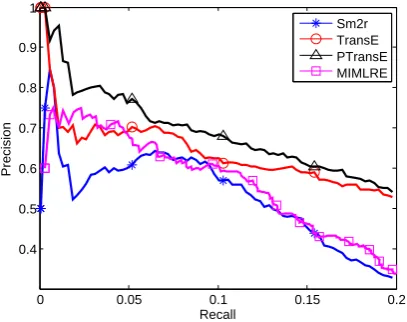
In the experiments, we implemented the text-based model Sm2r presented in (Weston et al., 2013). We combine the ranking scores from the text-based model with those from KB rep-resentations to rank testing triples, and gener-ate precision-recall curves for both TransE and PTransE. For learning of TransE and PTransE, we set the dimensions of entities/relations embed-dings k = 50, the learning rate λ = 0.001, the margin γ = 1.0 and dissimilarity metric as L1. We also compare with MIMLRE (Surdeanu et al., 2012) which is the state-of-art method using dis-tant supervision. The evaluation curves are shown in Figure 3.
0 0.05 0.1 0.15 0.2 0.4
0.5 0.6 0.7 0.8 0.9 1
Recall
Precision
Sm2r TransE PTransE MIMLRE
[image:7.595.72.293.372.486.2] [image:7.595.310.514.563.724.2]From Figure 3 we can observe that, by combin-ing with the text-based model Sm2r, the precision of PTransE significantly outperforms TransE espe-cially for the top-ranked triples. This indicates that encoding relation paths is also useful for relation extraction from text.
Note that TransE used here does not consider reverse relations and relation paths because the performance does not change much. We analyze the reason as follows. In the task of knowledge base completion, each testing triple has at least one valid relation. In contrast, many testing triples in this task correspond to non-relation (NA), and there are usually several relation paths between two entities in these non-relation triples. TransE does not encode relation paths during the training phase like PTransE, which results in worse perfor-mance for predicting non-relation when consider-ing relation paths in the testconsider-ing phase, and com-pensates the improvement on those triples that do have relations. This indicates it is non-trivial to encode relation paths, and also confirms the effec-tiveness of PTransE.
3.4 Case Study of Relation Inference
We have shown that PTransE can achieve high per-formance for knowledge base completion and re-lation extraction from text. In this section, we present some examples of relation inference ac-cording to relation paths.
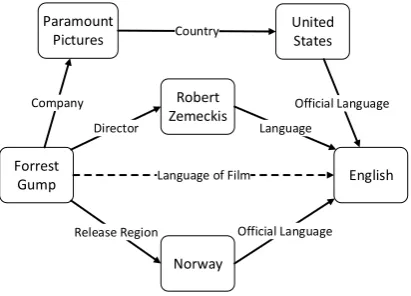
According to the learning results of PTransE, we can find new facts from KBs. As shown in Figure 4, two entities Forrest Gump andEnglish are connected by three relation paths, which give us more confidence to predict the relation between the two entities toLanguageOfFilm.
Forrest Gump
Robert Zemeckis
United States
Norway Paramount
Pictures
English
Release Region Director
Official Language
Official Language Country
Company
[image:8.595.79.285.572.720.2]Language of Film Language
Figure 4: An inference example in Freebase.
4 Related Work
Recent years have witnessed great advances of modeling multi-relational data such as social net-works and KBs. Many net-works cope with rela-tional learning as a multi-relarela-tional representation learning problem, encoding both entities and re-lations in a low-dimensional latent space, based on Bayesian clustering (Kemp et al., 2006; Miller et al., 2009; Sutskever et al., 2009; Zhu, 2012), energy-based models (Bordes et al., 2011; Chen et al., 2013; Socher et al., 2013; Bordes et al., 2013; Bordes et al., 2014), matrix factorization (Singh and Gordon, 2008; Nickel et al., 2011; Nickel et al., 2012) . Among existing representation mod-els, TransE (Bordes et al., 2013) regards a relation as translation between head and tail entities for optimization, which achieves a good trade-off be-tween prediction accuracy and computational effi-ciency. All existing representation learning meth-ods of knowledge bases only use direct relations between entities, ignoring rich information in re-lation paths.
Relation paths have already been widely con-sidered in social networks and recommender sys-tems. Most of these works regard each relation and path as discrete symbols, and deal with them us-ing graph-based algorithms, such as random walks with restart (Tong et al., 2006). Relation paths have also been used for inference on large-scale KBs, such as Path Ranking algorithm (PRA) (Lao and Cohen, 2010), which has been adopted for ex-pert finding (Lao and Cohen, 2010) and informa-tion retrieval (Lao et al., 2012). PRA has also been used for relation extraction based on KB structure (Lao et al., 2011; Gardner et al., 2013). (Nee-lakantan et al., 2015) further learns a recurrent neural network (RNN) to represent unseen rela-tion paths according to involved relarela-tions. We note that, these methods focus on modeling rela-tion paths for relarela-tion extracrela-tion without consid-ering any information of entities. In contrast, by successfully integrating the merits of modeling en-tities and relation paths, PTransE can learn supe-rior representations of both entities and relations for knowledge graph completion and relation ex-traction as shown in our experiments.
5 Conclusion and Future Work
in a low-dimensional space. To take advantages of relation paths, we propose path-constraint re-source allocation to measure relation path reliabil-ity, and employ semantic composition of relations to represent paths for optimization. We evaluate PTransE on knowledge base completion and re-lation extraction from text. Experimental results show that PTransE achieves consistent and signif-icant improvements as compared with TransE and other baselines.
In future, we will explore the following research directions: (1) This paper only considers the infer-ence patterns between direct relations and relation paths between two entities for learning. There are much complicated patterns among relations. For example, the inference formQueen(e) =====Inference⇒
Female(e) cannot be handled by PTransE. We may take advantages of first-order logic to encode these inference patterns for representation learn-ing. (2) There are some extensions for TransE, e.g., TransH and TransR. It is non-trivial for them to adopt the idea of PTransE, and we will explore to extend PTransE to these models to better deal with complicated scenarios of KBs.
6 Acknowledgments
Zhiyuan Liu and Maosong Sun are supported by the 973 Program (No. 2014CB340501) and the National Natural Science Foundation of China (NSFC No. 61133012) and Tsinghua-Samsung Joint Lab. Huanbo Luan is supported by the National Natural Science Foundation of China (NSFC No. 61303075). We sincerely thank Yan-song Feng for insightful discussions, and thank all anonymous reviewers for their constructive com-ments.
References
Kurt Bollacker, Colin Evans, Praveen Paritosh, Tim Sturge, and Jamie Taylor. 2008. Freebase: a col-laboratively created graph database for structuring human knowledge. In Proceedings of KDD, pages 1247–1250.
Antoine Bordes, Jason Weston, Ronan Collobert, Yoshua Bengio, et al. 2011. Learning structured embeddings of knowledge bases. InProceedings of AAAI, pages 301–306.
Antoine Bordes, Xavier Glorot, Jason Weston, and Yoshua Bengio. 2012. Joint learning of words and meaning representations for open-text seman-tic parsing. InProceedings of AISTATS, pages 127– 135.
Antoine Bordes, Nicolas Usunier, Alberto Garcia-Duran, Jason Weston, and Oksana Yakhnenko. 2013. Translating embeddings for modeling multi-relational data. In Proceedings of NIPS, pages 2787–2795.
Antoine Bordes, Xavier Glorot, Jason Weston, and Yoshua Bengio. 2014. A semantic matching en-ergy function for learning with multi-relational data.
Machine Learning, 94(2):233–259.
Danqi Chen, Richard Socher, Christopher D Manning, and Andrew Y Ng. 2013. Learning new facts from knowledge bases with neural tensor networks and semantic word vectors.Proceedings of ICLR. Matt Gardner, Partha Pratim Talukdar, Bryan Kisiel,
and Tom M Mitchell. 2013. Improving learning and inference in a large knowledge-base using latent syntactic cues. In Proceedings of EMNLP, pages 833–838.
Raphael Hoffmann, Congle Zhang, Xiao Ling, Luke Zettlemoyer, and Daniel S Weld. 2011. Knowledge-based weak supervision for information extraction of overlapping relations. In Proceedings of ACL-HLT, pages 541–550.
Rodolphe Jenatton, Nicolas L Roux, Antoine Bordes, and Guillaume R Obozinski. 2012. A latent factor model for highly multi-relational data. In Proceed-ings of NIPS, pages 3167–3175.
Charles Kemp, Joshua B Tenenbaum, Thomas L Grif-fiths, Takeshi Yamada, and Naonori Ueda. 2006. Learning systems of concepts with an infinite rela-tional model. In Proceedings of AAAI, volume 3, page 5.
Ni Lao and William W Cohen. 2010. Relational re-trieval using a combination of path-constrained ran-dom walks.Machine learning, 81(1):53–67. Ni Lao, Tom Mitchell, and William W Cohen. 2011.
Random walk inference and learning in a large scale knowledge base. InProceedings of EMNLP, pages 529–539.
Ni Lao, Amarnag Subramanya, Fernando Pereira, and William W Cohen. 2012. Reading the web with learned syntactic-semantic inference rules. In Pro-ceedings of EMNLP-CoNLL, pages 1017–1026. Yankai Lin, Zhiyuan Liu, Maosong Sun, Yang Liu, and
Xuan Zhu. 2015. Learning entity and relation em-beddings for knowledge graph completion. In Pro-ceedings of AAAI, pages 2181–2187.
Kurt Miller, Michael I Jordan, and Thomas L Griffiths. 2009. Nonparametric latent feature models for link prediction. In Proceedings of NIPS, pages 1276– 1284.
Mike Mintz, Steven Bills, Rion Snow, and Dan Juraf-sky. 2009. Distant supervision for relation extrac-tion without labeled data. In Proceedings of ACL-IJCNLP, pages 1003–1011.
Jeff Mitchell and Mirella Lapata. 2008. Vector-based models of semantic composition. InProceedings of ACL, pages 236–244.
Arvind Neelakantan, Benjamin Roth, and Andrew Mc-Callum. 2015. Compositional vector space models for knowledge base inference. In2015 AAAI Spring Symposium Series.
Maximilian Nickel, Volker Tresp, and Hans-Peter Kriegel. 2011. A three-way model for collective learning on multi-relational data. InProceedings of ICML, pages 809–816.
Maximilian Nickel, Volker Tresp, and Hans-Peter Kriegel. 2012. Factorizing yago: scalable machine learning for linked data. In Proceedings of WWW, pages 271–280.
Sebastian Riedel, Limin Yao, and Andrew McCallum. 2010. Modeling relations and their mentions with-out labeled text. InProceedings of ECML-PKDD, pages 148–163.
Ajit P Singh and Geoffrey J Gordon. 2008. Relational learning via collective matrix factorization. In Pro-ceedings of KDD, pages 650–658.
Richard Socher, Danqi Chen, Christopher D Manning, and Andrew Ng. 2013. Reasoning with neural ten-sor networks for knowledge base completion. In
Proceedings of NIPS, pages 926–934.
Mihai Surdeanu, Julie Tibshirani, Ramesh Nallapati, and Christopher D Manning. 2012. Multi-instance multi-label learning for relation extraction. In Pro-ceedings of EMNLP, pages 455–465.
Ilya Sutskever, Joshua B Tenenbaum, and Ruslan Salakhutdinov. 2009. Modelling relational data us-ing bayesian clustered tensor factorization. In Pro-ceedings of NIPS, pages 1821–1828.
Hanghang Tong, Christos Faloutsos, and Jia-Yu Pan. 2006. Fast random walk with restart and its applica-tions. InProceedings of ICDM, pages 613–622. Zhen Wang, Jianwen Zhang, Jianlin Feng, and Zheng
Chen. 2014. Knowledge graph embedding by trans-lating on hyperplanes. In Proceedings of AAAI, pages 1112–1119.
Jason Weston, Antoine Bordes, Oksana Yakhnenko, and Nicolas Usunier. 2013. Connecting language and knowledge bases with embedding models for re-lation extraction. InProceedings of EMNLP, pages 1366–1371.
Tao Zhou, Jie Ren, Mat´uˇs Medo, and Yi-Cheng Zhang. 2007. Bipartite network projection and personal rec-ommendation. Physical Review E, 76(4):046115. Jun Zhu. 2012. Max-margin nonparametric latent