Deep Reinforcement Learning with a Combinatorial Action Space for
Predicting Popular Reddit Threads
Ji He∗, Mari Ostendorf∗, Xiaodong He†, Jianshu Chen†, Jianfeng Gao†, Lihong Li†, Li Deng† ∗Department of Electrical Engineering, University of Washington, Seattle, WA 98195, USA
{jvking, ostendor}@uw.edu †Microsoft Research, Redmond, WA 98052, USA
{xiaohe, jianshuc, jfgao, lihongli, deng}@microsoft.com
Abstract
We introduce an online popularity prediction and tracking task as a benchmark task for rein-forcement learning with a combinatorial, nat-ural language action space. A specified num-ber of discussion threads predicted to be pop-ular are recommended, chosen from a fixed window of recent comments to track. Novel deep reinforcement learning architectures are studied for effective modeling of the value function associated with actions comprised ofinterdependentsub-actions. The proposed model, which represents dependence between sub-actions through a bi-directional LSTM, gives the best performance across different ex-perimental configurations and domains, and it also generalizes well with varying numbers of recommendation requests.
1 Introduction
This paper is concerned with learning policies for sequential decision-making tasks, where a system takes actions given options characterized by natu-ral language with the goal of maximizing a long-term reward. More specifically, we consider tasks with a combinatorial action space, where each ac-tion is a set of multiple interdependent sub-acac-tions. The problem of a combinatorial natural language ac-tion space arises in many applicaac-tions. For example, in real-time news feed recommendation, a user may want to read diverse topics of interest, and an ac-tion (i.e. recommendaac-tion) from the computer agent would consist of a set of news articles that are not all similar in topics (Yue and Guestrin, 2011). In adver-tisement placement, an action is a selection of
sev-eral ads to display, and bundling with complemen-tary products might receive higher click-through-rate than displaying all similar popular products.
In this work, we consider Reddit popularity pre-diction, which is similar to newsfeed recommenda-tion but different in two respects. First, our goal is not to make recommendations based on an indi-vidual’s preferences, but instead based on the antic-ipated long-term interest level of a broad group of readers from a target community. Second, we try to predict rather than detect popularity. Unlike individ-ual interests, community interest level is not often immediately clear; there is a time lag before the level of interest starts to take off. Here, the goal is for the recommendation system to identify and track writ-ten documents (e.g. news articles, comments in dis-cussion forum threads, or scientific articles) in real time – attempting to identify hot updates before they become hot to keep the reader at the leading edge. The premise is that the user’s bandwidth is limited, and only a limited number of things can be recom-mended out of several possibilities. In our experi-mental work, we use discussion forum text, where the recommendations correspond to recent posts or comments, assessing interest based on community response as observed in “likes” or other positive re-actions to those comments. For training purposes, we can use community response measured at a time much later than the original post or publication. This problem is well-suited to the reinforcement learn-ing paradigm, since the reward (the level of com-munity uptake or positive response) is not immedi-ately known, so the system needs to learn a mecha-nism for estimating future reactions. Different from
typical reinforcement learning, the action space is combinatorial since an action corresponds to a set of comments (sub-actions) chosen from a larger set of candidates. A sub-action is a written comment (or document, for another variant of this task).
Two challenges associated with this problem in-clude the potentially high computational complexity of the combinatorial action space and the develop-ment of a framework for estimating the long-term reward (the Q-value in reinforcement learning) from a combination of sub-actions characterized by nat-ural language. Here, we focus on the second prob-lem, exploring different deep neural network archi-tectures in an effort to efficiently account for the po-tential redundancy and/or temporal dependency of different sub-actions in relation to the state space. We sidestep the computational complexity issue (for now) by working with a task where the number of combinations is not too large and by further reduc-ing costs by random samplreduc-ing.
There are two main contributions in this paper. First, we propose a novel reinforcement learning task with both states and combinatorial actions de-fined by natural language,1 which is introduced in
section 2. This task, which is based on comment popularity prediction using data from the Reddit dis-cussion forum, can serve as a benchmark in social media recommendation and trend spotting. The sec-ond contribution is the development of a novel deep reinforcement learning architecture for handling a combinatorial action space associated with natural language. Prior work related to both the task and deep reinforcement learning is reviewed in section 3, Details for the new models and baseline architec-tures are described in section 4. Experimental re-sults in section 5 show the proposed methods outper-form baseline models and that a bidirectional LSTM is effective for characterizing the combined utility of sub-actions. A brief summary of findings and open questions are in section 6.
2 Popularity Prediction and Tracking
Our experiments are based on Reddit2, one of the
world’s largest public discussion forums. On
Red-1Simulator code and Reddit discussion identifiers are re-leased at https://github.com/jvking/reddit-RL-simulator
[image:2.612.329.525.54.210.2]2http://www.reddit.com
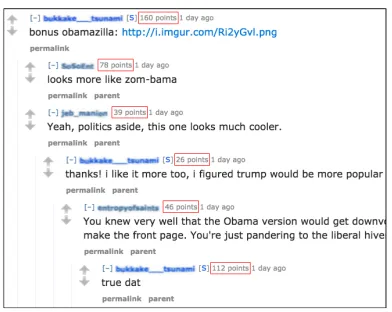
Figure 1: A snapshot of the top of a Reddit discussion tree, where karma scores are shown in red boxes.
dit, registered users initiate a post and people re-spond with comments, either to the original post or one of its associated comments. Together, the com-ments and the original post form a discussion tree, which grows as new comments are contributed. It has been show that discussions tend to have a hier-archical topic structure (Weninger et al., 2013), i.e. different branches of the discussion reflect narrow-ing of higher level topics. Reddit discussions are grouped into different domains, called subreddits, according to different topics or themes. Depending on the popularity of the subreddit, a post can receive hundreds of comments.
Popularity prediction and tracking in the Reddit setting is used in this paper for studying reinforce-ment learning to model long-term rewards in a com-binatorial action space. At each time step, the state corresponds to the collection of comments previ-ously recommended. The system aims at automat-ically picking a few lines of the discussion to follow from the new set of comments in a given window, which is a combinatorial action. Thread popular-ity tracking can be thought of as a proxy task for news or scientific article recommendation. It has the advantages that “documents” (comments) are rela-tively short and that the long-term reward can be characterized by Reddit voting scores, which makes this task easier to work with for algorithm develop-ment than these larger related tasks.
In this work, we only consider new comments as-sociated with the threads of the discussion that we are currently following to limit the number of pos-sible sub-actions at each time step and with the as-sumption that prior context is needed to interpret the comments. In other words, the new recommendation should focus on comments that are in the subtrees of previously recommended comments. (A variant re-laxing this restriction is suggested in the conclusion section.) Typically, one would expect some inter-dependencies between comments made in the same window if they fall under the same subtree, because they correspond to a reply to the same parent. In addition, there may be some temporal dependency, since one sub-action may be a comment on the other. These dependencies will affect the combined utility of the sub-actions.
According to our experiments, the performance is significantly worse when we learn a myopic policy compared to reinforcement learning with the same feature set. This shows that long-term dependency indeed matters, as illustrated in Figure 1. This serves as a justification that reinforcement learning is an appropriate approach for modeling popularity of a discussion thread.
3 Related Work
There is a large body of work on reinforcement learning. Among those of most interest here are deep reinforcement learning methods that leverage neural networks because of their success in handling
large discrete state/action spaces. Early work such as TD-gammon used a neural network to approxi-mate the state value function (Tesauro, 1995). Re-cent advances in deep learning (LeCun et al., 2015; Deng and Yu, 2014; Hinton et al., 2012; Krizhevsky et al., 2012; Sordoni et al., 2015) inspired significant progress by combining deep learning with reinforce-ment learning (Mnih et al., 2015; Silver et al., 2016; Lillicrap et al., 2016; Duan et al., 2016). In natu-ral language processing, reinforcement learning has been applied successfully to dialogue systems that generate natural language and converse with a hu-man user (Scheffler and Young, 2002; Singh et al., 1999; Wen et al., 2016). There has also been in-terest in mapping text instructions to sequences of executable actions and extracting textual knowledge to improve game control performance (Branavan et al., 2009; Branavan et al., 2011).
Recently, Narasimhan et al. (2015) studied the task of text-based games with a deep Q-learning framework. He et al. (2016) proposed to use a sepa-rate deep network for handling natural language ac-tions and to model Q-values via state-action interac-tion. Nogueira and Cho (2016) have also proposed a goal-driven web navigation task for language-based sequential decision making. Narasimhan et al. (2016) applied reinforcement learning for acquir-ing and incorporatacquir-ing external evidence to improve information extraction accuracy. The study that we present with Reddit popularity tracking differs from these other text-based reinforcement learning tasks in that the language in both state and action spaces is unconstrained and quite rich.
Hinton, 2004), with certain independence assump-tions between a next-state component and a sub-action. As for a bandits setting, Yue and Guestrin (2011) considered diversification of multi-item rec-ommendation, but their methodology is limited to using linear approximation with hand-crafted fea-tures.
The task explored in our paper – detecting and tracking popular threads in a discussion – is some-what related to topic detection and tracking (Allan, 2012; Mathioudakis and Koudas, 2010), but it dif-fers in that the goal is not to track topics based on frequency, but rather based on reader response. Thus, our work is more closely related to popu-larity prediction for social media and online news. These studies have explored a variety of definitions (or measurements) of popularity, including: the vol-ume of comments in response to blog posts (Yano and Smith, 2010) and news articles (Tasgkias et al., 2009; Tatar et al., 2011), the number of Twitter shares of news articles (Bandari et al., 2012), the number of reshares on Facebook (Cheng et al., 2014) and retweets on Twitter (Suh et al., 2010; Hong et al., 2011; Tan et al., 2014; Zhao et al., 2015), the rate of posts related to a source rumor (Lukasik et al., 2015), and the difference in the number of reader up and down votes on posts and comments in Reddit discussion forums (Lakkaraju et al., 2013; Jaech et al., 2015). An advantage of working with the Red-dit data is that both positive and negative reactions are accounted for in the karma score. Of the prior work on Reddit, the task explored here is most simi-lar to (Jaech et al., 2015) in that it involves choosing relatively high karma comments (or threads) from a time-limited set rather than directly predicting com-ment (or post) karma. Prior work on popularity prediction used supervised learning; this is the first work that frames tracking hot topics in social media with deep reinforcement learning.
4 Characterizing a combinatorial action space
4.1 Notation
In this sequential decision making problem, at each time stept, the agent receives a text string that
de-scribes the statest∈ S (i.e., “state-text”) and picks
a text string that describes the action at ∈ A (i.e.,
“action-text”), whereS andAdenote the state and action spaces, respectively. Here, we assume at is
chosen from a set of given candidates. In our case both S and A are described by natural language. Given the state-text and action-texts, the agent aims to select the best action in order to maximize its long-term reward. Then the environment state is up-datedst+1=s0according to a probabilityp(s0|s, a),
and the agent receives a rewardrt+1 for that
partic-ular transition. We define the action-value function (i.e. the Q-function) Q(s, a)as the expected return
starting fromsand taking the actiona:
Q(s, a) =E (+∞
X
l=0
γlrt+1+l|st=s, at=a
)
where γ ∈ (0,1) denotes a discount factor. The
Q-function associated with an optimal policy can be found by the Q-learning algorithm (Watkins and Dayan, 1992):
Q(st, at)←Q(st, at)+
ηt· rt+1+γ·max
a Q(st+1, a)−Q(st, at)
whereηtis a learning rate parameter.
The set of comments that are being tracked at time steptis denoted asMt. All previously tracked
com-ments, as well as the post (root node of the tree), is considered as state st (st = {M0, M1,· · · , Mt}),
and we initialize s0 = M0 to be the post. An
action is taken when a total of N new comments
{ct,1, ct,2,· · · , ct,N}appear as nodes in the subtree
ofMt, and the agent picks a set ofK comments to
be tracked in the next time stept+ 1. Thus we have:
at={c1t, c2t,· · ·, cKt }, cit∈ {ct,1, ct,2,· · ·, ct,N}
andcit6=cjt ifi6=j (1)
andMt+1 = at. At the same time, by taking
ac-tionatat statest, the rewardrt+1is the accumulated
karma scores, i.e. sum over all comments inMt+1.
Note that the reward signal is used in online train-ing, while at model deployment (testing stage), the scores are only used as an evaluation metric.
discussion trees into separate training and testing sets, so that texts seen by the agent in training and testing are from the same domain but different dis-cussions. For each episode, depending on whether training/testing, the simulator randomly picks a dis-cussion tree, and presents the agent with the current state andN new comments.
4.2 Q-function alternatives
With the real-time setting, it is clear that actionat
will affect the next state st+1 and furthermore the
future expected reward. The actionatconsists ofK
comments (sub-actions), making modeling Q-values
Q(st, at) difficult. To handle a large state space,
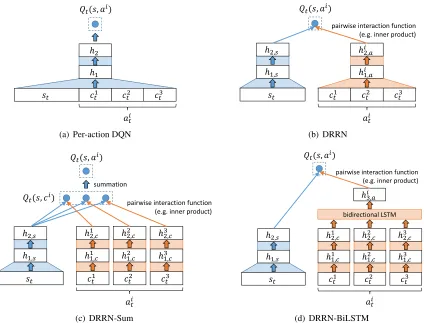
Mnih et al. (2015) proposed a Deep Q-Network (DQN). In case of a large action space, we may use both state and action representations as input to a deep neural network. It is shown that the Deep Reinforcement Relevance Network (DRRN, Figure 2(b)), i.e. two separate deep neural networks for modeling state embedding and action embedding, performs better than per-action DQN (PA-DQN in Figure 2(a)), as well as other DQN variants for deal-ing with natural language action spaces (He et al., 2016).
Our baseline models include Linear, PA-DQN and DRRN. We concatenate the K sub-actions/comments to form the action representation. The Linear and PA-DQN (Figure 2(a)) take as input a concatenation of state and action representations, and model a single Q-valueQ(st, at)using linear or
DNN function approximations. The DRRN consists of a pair of DNNs, one for the state-text embedding and the other for action-text embeddings, which are then used to compute Q(st, at) via a pairwise
interaction function (Figure 2(b)).
One simple alternative approach by utilizing this combinatorial structure is to compute an embedding for each sub-actioncit. We can then model the value
in picking a particular sub-action,Q(st, cit), through
a pairwise interaction between the state and this sub-action. Q(st, cit) represents the expected
accumu-lated future rewards by including this sub-action. The agent then greedily picks the top-Ksub-actions
with highest values to achieve the highestQ(st, at).
In this approach, we are assuming the long-term re-wards associated with sub-actions are independent of each other. More specifically, greedily picking
the top-K sub-actions is equivalent to maximizing
the following action-value function:
Q(st, at) = K
X
i=1
Q(st, cit) (2)
while satisfying (1). We call this proposed method DRRN-Sum, and its architecture is shown in Figure 2(c). Similarly as in DRRN, we use two networks to embed state and actions separately. However, for different sub-actions, we keep the network param-eters tied. We also use the same top layer dimen-sion and the same pairwise interaction function for all sub-actions.
In the case of a linear additive interaction, such as an inner product or bilinear operation, Equation (2) is equivalent to computing the interaction be-tween the state embedding and an action embed-ding, where the action embedding is obtained lin-early by summing over K sub-action embeddings.
When sub-actions have strong correlation, this in-dependence assumption is invalid and can result in a poor estimation ofQ(st, at). For example, most
people are interested in the total information stored in the combined action at. Due to content
redun-dancy in the sub-actions c1t, c2t,· · · , cKt , we expect Q(st, at)to be smaller thanPiQ(st, cit).
To come up with a general model for handling a combinatorial action-value function, we further pro-pose the DRRN-BiLSTM (Figure 2(d)). In this ar-chitecture, we use a DNN to generate an embedding for each comment. Then a Bidirectional Long Short-Term Memory (Graves and Schmidhuber, 2005) is used to combine a sequence ofK comment
embed-dings. As the Bidirectional LSTM has a larger ca-pacity due to its nonlinear structure, we expect it will capture more details on how the embeddings for the sub-actions combine into an action embedding. Note that both of our proposed methods (DRRN-Sum and DRRN-BiLSTM) can handle a varying value ofK, while for the DQN and DRRN baselines, we need to use a fixedKin training and testing.
5 Experiments
5.1 Datasets and Experimental Configurations
𝑠 𝑐 𝑐 𝑐 𝑎 ℎ
ℎ 𝑄 (𝑠, 𝑎 )
𝑠 𝑐 𝑐 𝑐
𝑎 ℎ ,
ℎ ,
𝑄 (𝑠, 𝑎 )
ℎ , ℎ ,
pairwise interaction function (e.g. inner product)
(a) Per-action DQN
𝑠 𝑐 𝑐 𝑐
𝑎 ℎ
ℎ 𝑄 (𝑠, 𝑎 )
𝑠 𝑐 𝑐 𝑐
𝑎
ℎ,
ℎ,
𝑄 (𝑠, 𝑎 )
ℎ,
ℎ ,
pairwise interaction function (e.g. inner product)
(b) DRRN
𝑠 𝑐 𝑐 𝑐
𝑎 ℎ,
ℎ ,
𝑄 (𝑠, 𝑎 )
ℎ ,
ℎ ,
pairwise interaction function (e.g. inner product)
ℎ,
ℎ,
ℎ,
ℎ,
𝑄 (𝑠, 𝑐 )
summation
(c) DRRN-Sum
𝑠 𝑐 𝑐 𝑐
𝑎 ℎ ,
ℎ ,
𝑄 (𝑠, 𝑎 )
ℎ, ℎ ,
pairwise interaction function (e.g. inner product)
ℎ, ℎ ,
ℎ, ℎ , ℎ ,
bidirectional LSTM
bidirectional LSTM
ℎ ℎ ℎ
ℎ ℎ ℎ
output
input
[image:6.612.91.515.60.383.2](d) DRRN-BiLSTM Figure 2:Different deep Q-learning architectures
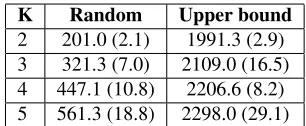
topics and genres. In our experiments, in order to have long enough discussion threads, we filter out discussion trees with fewer than 100 comments. For each subreddit, we randomly partition 90% of the data for online training, and 10% of the data for test-ing (deployment). The basic subreddit statistics are shown in Table 1. We report the random policy per-formances and heuristic upper bound perper-formances (averaged over 10,000 episodes) in Table 2 and Ta-ble 3.3 The upper bound performances are obtained
using stabilized karma scores and offline constructed tree structure. The mean and standard deviation are obtained by 5 independent runs.
In all our experiments we setN = 10. Explicitly
representing allN-choose-K actions requires a lot
of memory and does not scale up. We therefore use a variant of Q-learning: when taking the max over
3Upper bounds are estimated by greedily searching through each discussion tree to findK max karma discussion threads
(overlapped comments are counted only once). This upper bound may not be attainable in a real-time setting.
Subreddit # Posts (in k) # Comments (in M)
askscience 0.94 0.32
askmen 4.45 1.06
todayilearned 9.44 5.11
worldnews 9.88 5.99
[image:6.612.311.544.439.514.2]nfl 11.73 6.12
Table 1:Basic statistics of filtered subreddit data sets
Subreddit Random Upper bound
askscience 321.3 (7.0) 2109.0 (16.5) askmen 132.4 (0.7) 651.4 (2.8) todayilearned 390.3 (5.7) 2679.6 (30.1) worldnews 205.8 (4.5) 1853.4 (44.4) nfl 237.1 (1.4) 1338.2 (13.2)
Table 2: Mean and standard deviation of random and upper-bound performance (withN = 10, K = 3) across different
[image:6.612.331.522.571.651.2]K Random Upper bound
[image:7.612.311.542.55.242.2]2 201.0 (2.1) 1991.3 (2.9) 3 321.3 (7.0) 2109.0 (16.5) 4 447.1 (10.8) 2206.6 (8.2) 5 561.3 (18.8) 2298.0 (29.1)
Table 3: Mean and standard deviation of random and upper-bound performance on askscience, withN = 10and K = 2,3,4,5.
possible next-actions, we instead randomly subsam-plem0 actions and take the max over them. We set m0 = 10throughout our experiments. This heuristic
technique works well in our experiments.
For text preprocessing we remove punctuation and lowercase capital letters. For each statest and
comment cit, we use a bag-of-words representation
with the same vocabulary in all networks. The vo-cabulary contains the most frequent 5,000 words; the out-of-vocabulary rate is 7.1%.
In terms of the Q-learning agent, fully-connected neural networks are used for text embeddings. The network has L = 2 hidden layers, each with
20 nodes, and model parameters are initialized with small random numbers. -greedy is used for
exploration-exploitation, and we keep = 0.1
throughout online training and testing. We pick the discount factorγ = 0.9. During online training, we
use experience replay (Lin, 1992) and the memory size is set to 10,000 tuples of(st, at, rt+1, st+1). For
each experience replay, 500 episodes are generated and stored in a first-in-first-out fashion, and multi-ple epochs are trained for each model. Minibatch stochastic gradient descent is implemented with a batch size of 100. The learning rate is kept constant:
ηt= 0.000001.
The proposed methods are compared with three baseline models: Linear, per-action DQN (PA-DQN), and DRRN. For both Linear and PA-DQN, the state and comments are concatenated as an in-put. For the DRRN, the state and comments are sent through two separate deep neural networks. How-ever, in our baselines, we do not explicitly model how values associated with each comment are com-bined to form the action value. For the DRRN baseline and proposed methods (DRRN-Sum and DRRN-BiLSTM), we use an inner product as the pairwise interaction function.
0 5 10 15
Number of replays
300 400 500 600 700 800 900
Rewards Random
[image:7.612.108.261.56.119.2]Linear PA-DQN DRRN DRRN-Sum DRRN-BiLstm
Figure 3:Learning curves of baselines and proposed methods on “askscience”
5.2 Experimental Results
In Figure 3 we provide learning curves of differ-ent models on the askscience subreddit during on-line learning. In this experiment, we set N = 10, K = 3. Each curve is obtained by averaging
over 3 independent runs, and the error bars are also shown. All models start with random performance, and converge after approximately 15 experience re-plays. The DRRN-Sum converges as fast as baseline models, with better converged performance. DRRN-BiLSTM converges slower than other methods, but with the best converged performance.
After we train all the models on the training set, we fix the model parameters and apply (deploy) on the test set, where the models predict which action to take but no reward is shown until evaluation. The test performance is averaged over 1000 episodes, and we report mean and standard deviation over 5 independent runs.
On askscience, we try multiple settings withN = 10, K = 2,3,4,5and the results are shown in Ta-ble 4. Both DRRN-Sum and DRRN-BiLSTM con-sistently outperform baseline methods. The DRRN-BiLSTM performs better with larger K, probably due to the greater chance of redundancy in combin-ing more sub-actions.
We also perform online training and test across different subreddits. With N = 10, K = 3, the
K Linear PA-DQN DRRN DRRN-Sum DRRN-BiLSTM
2 553.3 (2.8) 556.8 (14.5) 553.0 (17.5) 569.6 (18.4) 573.2 (12.9)
3 656.2 (22.5) 668.3 (19.9) 694.9 (15.5) 704.3 (20.1) 711.1 (8.7)
4 812.5 (23.4) 818.0 (29.9) 828.2 (27.5) 829.9 (13.2) 854.7 (16.0)
[image:8.612.126.482.56.120.2]5 861.6 (28.3) 884.3 (11.4) 921.8 (10.7) 942.3 (19.1) 980.9 (21.1)
Table 4:On askscience, average karma scores and standard deviation of baselines and proposed methods (withN= 10)
0 20 40 60 80 100 120 140
askscience askmen todayilearned worldnews nfl
Ave
rag
e
rew
ard
(K
arm
a
sco
res)
[image:8.612.83.530.144.303.2]Linear PA-DQN DRRN DRRN-Sum DRRN-BiLSTM
Figure 4:Average karma score gains over the linear baseline and standard deviation across different subreddits (withN= 10, K= 3).
K DRRN-Sum DRRN-BiLSTM
2 538.5 (18.9) 551.2 (10.5)
4 819.1 (14.7) 829.9 (11.1)
5 921.6 (15.6) 951.3 (15.7)
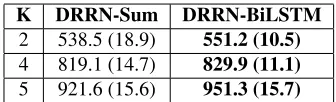
Table 5:On askscience, average karma scores and standard de-viation of proposed methods trained withK = 3and test with differentK’s
averaged over 1000 episodes, and we report mean and standard deviation over 5 independent runs. The findings are consistent with those for askscience. Since different subreddits may have very different karma scores distributions and language style, this suggests the algorithms apply to different text gen-res.
In actual model deployment, a possible scenario is that users may have different requests. For exam-ple, a user may ask the agent to provideK = 2
dis-cussion threads on one day, due to limited reading time, and ask the agent to provide K = 5
discus-sion threads on the other day. For the baseline mod-els (Linear, PA-DQN, DRRN), we will need to train separate models for different K’s. The proposed methods (DRRN-Sum and DRRN-BiLSTM), on the other hand, can easily handle a varyingK. To test
whether the performance indeed generalizes well,
we train proposed models on askscience withN = 10, K = 3and test them withN = 10, K ∈2,4,5,
as shown in Table 5. Compared to the proposed models that are specifically trained for these K’s (Table 4), the generalized test performance indeed degrades, as expected. However, in many cases, our proposed methods still outperform all three base-lines (Linear, PA-DQN and DRRN) that are trained specifically for theseK’s. This shows that the
pro-posed methods can generalize to varyingK’s even
if it is trained on a particular value ofK.
In Table 6, we show an anecdotal example with state and sub-actions. The two sub-actions are strongly correlated and have redundant information. By combining the second sub-action compared to choosing just the first sub-action alone, DRRN-Sum and DRRN-BiLSTM predict 86% and 26% relative increase in action-value, respectively. Since these two sub-actions are highly redundant, we hypothe-size DRRN-BiLSTM is better than DRRN-Sum at capturing interdependency between sub-actions.
6 Conclusion
[image:8.612.101.269.351.402.2]State text (partially shown)
Are there any cosmological phenomena that we strongly suspect will occur, but the universe just isn’t old enough for them to have happened yet?
Comments (sub-actions) (partially shown)
[1] White dwarf stars will eventually stop emitting light and become black dwarfs. [2] Yes, there are quite a few, such as: White dwarfs will cool down to black dwarfs.
Table 6:An example state and its sub-actions
are all described by natural language so the task is useful for language studies. We then develop novel deep Q-learning architectures to better model the state-action value function with a combinatorial ac-tion space. The proposed DRRN-BiLSTM method not only performs better across different experimen-tal configurations and domains, but it also general-izes well for scenarios where the user can request changes in the number tracked.
This work represents a first step towards address-ing the popularity prediction and trackaddress-ing problem. While performance of the system beats several base-lines, it still falls far short of the oracle result. Prior work has shown that timing is an important factor in predicting popularity (Lampe and Resnick, 2004; Jaech et al., 2015), and all the proposed models would benefit from incorporating this information. Another variant might consider short-term reactions to a comment, if any, in the update window. It would also be of interest to explore implementations of backtracking in the sub-action space (incurring a cost), in order to recommend comments that were not selected earlier but have become highly popular. Lastly, it will be important to study principled solu-tions for handling the computational complexity of the combinatorial action space.
References
J. Allan. 2012. Topic detection and tracking: event-based information organization, volume 12. Springer Science & Business Media.
Roja Bandari, Sitaram Asur, and Bernardo Huberman. 2012. The pulse of news in social media: forecasting popularity. In Proc. Int. AAAI Conf. Web and Social Media (ICWSM).
S.R.K. Branavan, H. Chen, L. Zettlemoyer, and R. Barzi-lay. 2009. Reinforcement learning for mapping in-structions to actions. InProc. of the Joint Conference
of the 47th Annual Meeting of the ACL and the 4th IJCNLP, pages 82–90, August.
S.R.K. Branavan, D. Silver, and R. Barzilay. 2011. Learning to win by reading manuals in a Monte-Carlo framework. InProc. of the Annual Meeting of the As-sociation for Computational Linguistics: Human Lan-guage Technologies-Volume 1, pages 268–277. Asso-ciation for Computational Linguistics.
Justin Cheng, Lada Adamic, P. Alex Dow, Jon Kleinberg, and Jure Leskovec. 2014. Can cascades be predicted? InProc. Int. Conf. World Wide Web (WWW).
L. Deng and D. Yu. 2014. Deep learning: Methods and applications. Foundations and Trends in Signal Pro-cessing, 7(3–4):197–387.
Y. Duan, X. Chen, R. Houthooft, J. Schulman, and P. Abbeel. 2016. Benchmarking deep reinforcement learning for continuous control. InProceedings of the 33rd International Conference on Machine Learning (ICML).
G. Dulac-Arnold, R. Evans, H. van Hasselt, P. Sunehag, T. Lillicrap, and J. Hunt. 2016. Deep reinforcement learning in large discrete action spaces. arXiv preprint arXiv:1512.07679.
A. Graves and J. Schmidhuber. 2005. Framewise phoneme classification with bidirectional LSTM and other neural network architectures. Neural Networks, 18(5):602–610.
C. Guestrin, D. Koller, and R. Parr. 2001. Multiagent planning with factored MDPs. In NIPS, volume 1, pages 1523–1530.
M. Hausknecht and P. Stone. 2016. Deep reinforcement learning in parameterized action space. In Interna-tional Conference on Learning Representations. J. He, J. Chen, X. He, J. Gao, L. Li, L. Deng, and M.
Os-tendorf. 2016. Deep reinforcement learning with a natural language action space. InProc. Annu. Meeting Assoc. for Computational Linguistics (ACL).
G. Hinton, L. Deng, D. Yu, G. E. Dahl, A. Mohamed, N. Jaitly, A. Senior, V. Vanhoucke, P. Nguyen, T. N. Sainath, and B. Kingsbury. 2012. Deep neural net-works for acoustic modeling in speech recognition: The shared views of four research groups. IEEE Sig-nal Process. Mag., 29(6):82–97.
Liangjie Hong, Ovidiu Dan, and Brian Davison. 2011. Predicting popular messages in Twitter. InProc. Int. Conf. World Wide Web (WWW), pages 57–58.
A. Jaech, V. Zayats, H. Fang, M. Ostendorf, and H. Ha-jishirzi. 2015. Talking to the crowd: What do people react to in online discussions? InProc. of the Confer-ence on Empirical Methods in Natural Language Pro-cessing, pages 2026–2031, September.
Himabindu Lakkaraju, Julian McAuley, and Jure Leskovec. 2013. What’s in a name? Understanding the interplay between titles, content, and communities in social media. InProc. Int. AAAI Conf. Web and So-cial Media (ICWSM).
C. Lampe and P. Resnick. 2004. Slash(dot) and burn: distributed moderation in a large online conversation space. In Proceedings of the SIGCHI Conference on Human Factors in Computing Systems, pages 543– 550.
Y. LeCun, Y. Bengio, and G. Hinton. 2015. Deep learn-ing. Nature, 521(7553):436–444.
T. P Lillicrap, J. J Hunt, A. Pritzel, N. Heess, T. Erez, Y. Tassa, D. Silver, and D. Wierstra. 2016. Continu-ous control with deep reinforcement learning. In In-ternational Conference on Learning Representations. L-J Lin. 1992. Self-improving reactive agents based on
reinforcement learning, planning and teaching. Ma-chine Learning, 8(3–4):293–321.
Michal Lukasik, Trevor Cohn, and Kalina Bontcheva. 2015. Point process modelling of rumour dynamics in social media. In Proc. Annu. Meeting Assoc. for Computational Linguistics (ACL).
M. Mathioudakis and N. Koudas. 2010. Twittermonitor: trend detection over the twitter stream. InProceedings of the 2010 ACM SIGMOD International Conference on Management of data, pages 1155–1158. ACM. V. Mnih, K. Kavukcuoglu, D. Silver, A. A Rusu, J.
Ve-ness, M. G Bellemare, A. Graves, M. Riedmiller, A. K Fidjeland, G. Ostrovski, et al. 2015. Human-level control through deep reinforcement learning. Nature, 518(7540):529–533.
K. Narasimhan, T. Kulkarni, and R. Barzilay. 2015. Lan-guage understanding for text-based games using deep reinforcement learning. InProc. of the 2015 Confer-ence on Empirical Methods in Natural Language Pro-cessing, pages 1–11, September.
K. Narasimhan, A. Yala, and R. Barzilay. 2016. Im-proving information extraction by acquiring external evidence with reinforcement learning. arXiv preprint arXiv:1603.07954.
R. Nogueira and K. Cho. 2016. Webnav: A new large-scale task for natural language based sequential deci-sion making. arXiv preprint arXiv:1602.02261. B. Sallans and G. E Hinton. 2004. Reinforcement
learn-ing with factored states and actions. The Journal of Machine Learning Research, 5:1063–1088.
K. Scheffler and S. Young. 2002. Automatic learning of dialogue strategy using dialogue simulation and re-inforcement learning. In Proc. of the second Inter-national Conference on Human Language Technology Research, pages 12–19.
D. Silver, A. Huang, C. J Maddison, A. Guez, L. Sifre, G. Van Den Driessche, J. Schrittwieser, I. Antonoglou, V. Panneershelvam, M. Lanctot, et al. 2016. Master-ing the game of Go with deep neural networks and tree search.Nature, 529(7587):484–489.
S. P Singh, M. J Kearns, D. J Litman, and M. A Walker. 1999. Reinforcement learning for spoken dialogue systems. InNIPS, pages 956–962.
A. Sordoni, M. Galley, M. Auli, C. Brockett, Y. Ji, M. Mitchell, J.-Y. Nie, J. Gao, and B. Dolan. 2015. A neural network approach to context-sensitive gen-eration of conversational responses. InNAACL-HLT 2015.
B. Suh, L. Hong, P. Pirolli, and E. H. Chi. 2010. Want to be retweeted? Large scale analytics on factors impact-ing retweet in twitter network. InProc. IEEE Inter. Conf. on Social Computing (SocialCom), pages 177– 184.
Chenhao Tan, Lillian Lee, and Bo Pang. 2014. The ef-fect of wording on message propagation: Topic- and author-controlled natural experiments on Twitter. In
Proc. Annu. Meeting Assoc. for Computational Lin-guistics (ACL), pages 175–186.
Manos Tasgkias, Wouter Weerkamp, and Maarten de Ri-jke. 2009. Predicting the volume of comments on on-line news stories. InProc. CIKM, pages 1765–1768. Alexandru Tatar, Jeremie Leguay, Panayotis Antoniadis,
Arnaud Limbourg, Marcelo Dias de Amorim, and Serge Fdida. 2011. Predicting the polularity of online articles based on user comments. InProc. Inter. Conf. on Web Intelligence, Mining and Semantics (WIMS), pages 67:1–67:8.
G. Tesauro. 1995. Temporal difference learning and TD-gammon. Communications of the ACM, 38(3):58–68. C. JCH Watkins and P. Dayan. 1992. Q-learning.
Ma-chine learning, 8(3-4):279–292.
T.-H. Wen, M. Gasic, N. Mrksic, L. M Rojas-Barahona, P.-H. Su, S. Ultes, D. Vandyke, and S. Young. 2016. A network-based end-to-end trainable task-oriented dia-logue system. arXiv preprint arXiv:1604.04562. T. Weninger, X. A. Zhu, and J. Han. 2013. An
explo-ration of discussion threads in social news sites: A case study of the reddit community. In Advances in So-cial Networks Analysis and Mining (ASONAM), 2013 IEEE/ACM International Conference on, pages 579– 583. IEEE.
Tae Yano and Noah A. Smith. 2010. What’s worthy of comment? Content and comment volume in political blogs. In Proc. Int. AAAI Conf. Weblogs and Social Media (ICWSM).
Y. Yue and C. Guestrin. 2011. Linear submodular ban-dits and their application to diversified retrieval. In