Morphological Segmentation Inside-Out
Ryan Cotterell
Department of Computer Science Johns Hopkins University [email protected]
Arun Kumar
Faculty of Arts and Humanities Universitat Oberta de Catalunya
Hinrich Sch¨utze
CIS LMU Munich
Abstract
Morphological segmentation has traditionally been modeled with non-hierarchical models, which yield flat segmentations as output. In many cases, however, proper morphologi-cal analysis requires hierarchimorphologi-cal structure— especially in the case of derivational morphol-ogy. In this work, we introduce a discrimina-tive joint model of morphological segmenta-tion along with the orthographic changes that occur during word formation. To the best of our knowledge, this is the first attempt to approach discriminative segmentation with a context-free model. Additionally, we release an annotated treebank of 7454 English words with constituency parses, encouraging future research in this area.
1 Introduction
In NLP, supervised morphological segmentation has typically been viewed as either a sequence labeling or a segmentation task (Ruokolainen et al., 2016). In contrast, we consider a hierarchical approach, em-ploying a context-free grammar (CFG). CFGs pro-vide a richer model of morphology: they capture (i) the intuition that words themselves have internal constituents, which belong to different categories, as well as (ii) the order in which affixes are at-tached. Moreover, many morphological processes, e.g., compounding and reduplication, are best mod-eled as hierarchical; thus, context-free models are expressively more appropriate.
The purpose of morphological segmentation is to decompose words into smaller units, known as mor-phemes, which are typically taken to be the smallest
meaning bearing units in language. This work con-cerns itself with modeling hierarchical structure over these morphemes. Note a simple flat morphological segmentation can also be straightforwardly derived from the CFG parse tree. Segmentations have found use in a diverse set of NLP applications, e.g., auto-matic speech recognition (Afify et al., 2006), key-word spotting (Narasimhan et al., 2014), machine translation (Clifton and Sarkar, 2011) and parsing (Seeker and C¸etino˘glu, 2015). In contrast to prior work, we focus oncanonical segmentation, i.e., we seek to jointly model orthographic changes and seg-mentation. For instance, the canonical segmentation of untestably is un+test+able+ly, where we map
ablytoable+ly, restoring the lettersle.
We make two contributions: (i) We introduce a joint model for canonical segmentation with a CFG backbone. We experimentally show that this model outperforms a semi-Markov model on flat segmenta-tion. (ii) We release the first morphology treebank, consisting of 7454 English word types, each anno-tated with a full constituency parse.
2 The Case For Hierarchical Structure
Why should we analyze morphology hierarchically? It is true that we can model much of morphol-ogy with finite-state machinery (Beesley and Kart-tunen, 2003), but there are, nevertheless, many cases where hierarchical structure appears requi-site. For instance, the flat segmentation of the word
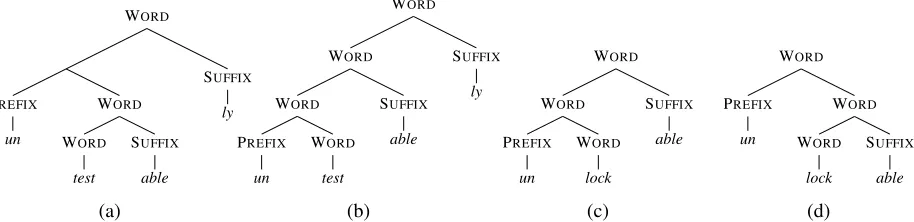
untestably7→un+test+able+lyis missing important information about how the word was derived. The correctparse[[un[[test]able]]ly], on the other hand, does tell us that this is the order in which the
WORD
PREFIX
un
WORD
WORD
test
SUFFIX
able
SUFFIX
ly
(a)
WORD
WORD
WORD
PREFIX
un
WORD
test
SUFFIX
able
SUFFIX
ly
(b)
WORD
WORD
PREFIX
un
WORD
lock
SUFFIX
able
(c)
WORD
PREFIX
un
WORD
WORD
lock
SUFFIX
able
[image:2.612.78.535.67.178.2](d)
Figure 1: Canonical segmentation parse trees foruntestablyandunlockable. For both words, the scope of
unis ambiguous. Arguably, (a) is the only correct parse tree foruntestably; the reading associated with (b) is hard to get. On the other hand, unlockable is truly ambiguous between “able to be unlocked” (c) and “unable to be locked” (d).
plex form was derived:
test7−−→able testable7−→un untestable7−→ly untestably.
This gives us clear insight into the structure of the lexicon—we should expect that the segmenttestable
exists as an independent word, butablydoes not. Moreover, a flat segmentation is often semanti-cally ambiguous. There are two potentially valid readings ofuntestably depending on how the nega-tive prefixunscopes. The correct tree (see Figure 1) yields the reading “in the manner of not able to be tested”. A second—likely infelicitous reading— where the segmentuntestforms a constituent yields the reading “in a manner of being able to untest”. Recovering the hierarchical structure allows us to se-lect the correct reading; note there are even cases of true ambiguity; e.g., unlockable has two readings: “unable to be locked” and “able to be unlocked”.
Theoretical linguists often implicitly assume a context-free treatment of word formation, e.g., by employing brackets to indicate different levels of affixation. Others have explicitly modeled word-internal structure with grammars (Selkirk, 1982; Marvin, 2002).
3 Parsing the Lexicon
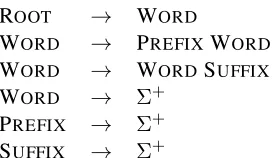
A novel component of this work is the development of a discriminative parser (Finkel et al., 2008; Hall et al., 2014) for morphology. The goal is to define a probability distribution over all trees that could arise from the input word, after reversal of orthographic and phonological processes. We employ the simple
grammar shown in Table 1. Despite its simplicity, it models theorder in which morphemes are attached. More formally, our goal is to map a surface form
w(e.g.,w=untestably) into its underlying canonical formu(e.g.,u=untestablely) and then into a parse
treetover its morphemes. We assumeu, w ∈ Σ∗,
for some discrete alphabet Σ.1 Note that a parse tree over the string implicitly defines a flat segmen-tation given our grammar—one can simply extract the characters spanned by all preterminals in the re-sulting tree. Before describing the joint model in detail, we first consider its pieces individually. 3.1 Restoring Orthographic Changes
To extract a canonical segmentation (Naradowsky and Goldwater, 2009; Cotterell et al., 2016), we re-store orthographic changes that occur during word formation. To this end, we define the score function, scoreη(u, w) =
X
a∈A(u,w)
expg(u, a, w)>η, (1)
whereA(u, w)is the set of all monotonic alignments
between the stringsuandw. The goal is for scoreη
to assign higher values to better matched pairs, e.g., (w=untestably,u=untestablely).
We have left these out of the equation for simplic-ity, but we refer to the reader Dreyer et al. (2008) for a more thorough exposition. To ensure that the par-tition functionZη(w)is finite, we cap the maximum
string lengthu, which yields
Zη(w) = X
u0∈Σ|w|+k
expg(u0, w)>η, (2)
1For efficiency, we assumeu
ROOT → WORD
WORD → PREFIX WORD WORD → WORDSUFFIX WORD → Σ+
PREFIX → Σ+
[image:3.612.118.257.56.135.2]SUFFIX → Σ+
Table 1: The context-free grammar used in this work to model word formation. The productions closely resemble those of Johnson et al. (2006)’s Adaptor Grammar.
where|w|+kis the maximum length foru.
For ease of computation, we can encode this function as a weighted finite-state machine (WFST) (Mohri et al., 2002). This requires, however, that the feature functiong factors over the topology of the finite-state encoding. Since our model conditions on the wordw, the feature function g can extract fea-tures from any part of this string. Features on the output string,u, however, are more restricted. In this
work, we employ a bigram model over output char-acters. This implies that each state remembers ex-actly one character, the previous one. See Cotterell et al. (2014) for details. We can compute the score for two stringsuandwusing a weighted
generaliza-tion of the Levenshtein algorithm. Computing the partition function requires a different dynamic pro-gram, which runs inO(|w|2 · |Σ|2)time. Note that since|Σ| ≈26(lower case English letters), it takes
roughly262 = 676times longer to compute the par-tition function than to score a pair of strings.
Our model includes several simple feature tem-plates, including features that fire on individual edit actions as well as conjunctions of edit actions and characters in the surrounding context. See Cotterell et al. (2016) for details.
3.2 Morphological Analysis as Parsing
Next, we need to score an underlying canonical form (e.g., u=untestablely) together with a parse tree (e.g., t=[[un[[test]able]]ly]). Thus, we define
the parser score
scoreω(t, u) = exp
X
π∈Π(t)
f(π, u)>ω
, (3)
where Π(t) is the set of anchored productions in
the treet. An anchored productionπ is a grammar
rule in Chomsky normal form attached to a span, e.g., Ai,k → Bi,jCj+1,k. Eachπ is then assigned
a weight by the linear function f(π, u)>ω, where
the functionf extracts relevant features from the an-chored production as well as the corresponding span of the underlying form u. This model is typically
referred to as a weighted CFG (WCFG) (Smith and Johnson, 2007) or a CRF parser.
Luckily, we can exploit the structure of the prob-lem to efficiently compute the partition function,
Zω(u) = X
t∈T(u)
exp
X
π∈Π(t)
f(π, u)>ω
, (4)
where T(u) is the set of all trees under the
gram-mar that have yieldu. Specifically, we make use of
the inside algorithm, which is just CKY (Aho and Ullman, 1979) in the (+,×) semiring (Goodman,
1998), which runs inO(|G| · |u|3)time, where|G|is
the size of the grammar.
Forf, we define three span features: (i) indicator features on the span’s segment, (ii) an indicator fea-ture that fires if the segment appears in an external corpus2and (iii) the conjunction of the segment with the label (e.g., PREFIX) of the subtree root. Follow-ing Hall et al. (2014), we employ an indicator feature for each production as well as production backoff features.
4 A Joint Model
Our complete model is a joint CRF (Koller and Friedman, 2009) where each of the above scores are factors. We define the likelihood as
pθ(t, u|w) = 1
Zθscoreω
(t, u)·scoreη(u, w), (5)
whereθ={ω,η}is the parameter vector and
Zθ =
X
u0∈Σ∗
X
t0∈Tu0
scoreω(t0, u0)·scoreη(u0, w) (6)
is the partition function and Tu0 is set of all parse trees for the stringu0. We see now that both WFST
and WCFG are just structured factors in the model.
The joint approach has the advantage that it allows both factors to work together to influence the choice of the underlying formu. This is useful as the parser
now has access to which words are attested in the language; this helps guide the relatively weak trans-duction model. On the downside, the partition func-tionZθ now involves a sum overbothall strings in Σ|w|+kandall possible parses of each string!
Infer-ence in this joint model is intractable, so we resort to approximate methods.
4.1 Learning and Inference
We use stochastic gradient descent to opti-mize the log-probability of the training data
PN
i=1logpθ(t(i), u(i)|w(i)); this requires the
com-putation of the gradient of the partition function ∇θlogZθ, which is intractable. As in all CRFs, this
gradient is in fact an expectation:
∇θlogZθ = (7)
E(u,t)∼pθ[log (scoreω(t, u)·scoreη(u, w))].
To approximate this expectation, we use an impor-tance sampling routine. Roughly speaking, we ap-proximate the hard-to-sample-from distribution pθ
by taking samples from an easy-to-sample-from pro-posal distributionq. We then reweightthe samples
using theunnormalizedscore frompθ. Due to a lack
of space, we omit the derivation of the approximate gradient.
4.2 Decoding
We also decode by importance sampling. Givenw,
we sample canonical formsuand then run the CKY
algorithm to get the highest scoring tree.
5 Related Work
We believe our attempt to train discriminative gram-mars for morphology is novel. Nevertheless, other researchers have described parsers for morphology. Most of this work is unsupervised: Johnson et al. (2007) applied a Bayesian PCFG to unsupervised morphological segmentation. Similarly, Adaptor Grammars (Johnson et al., 2006), a non-parametric Bayesian generalization of PCFGs, have been ap-plied to the unsupervised version of the task (Botha and Blunsom, 2013; Sirts and Goldwater, 2013). Relatedly, Schmid (2005) performed unsupervised
disambiguation of a German morphological ana-lyzer (Schmid et al., 2004) using a PCFG, using the inside-outside algorithm (Baker, 1979). Also, dis-criminative parsing approaches have been applied to the related problem of Chinese word segmentation (Zhang et al., 2014).
6 Morphological Treebank
Supervised morphological segmentation has histor-ically been treated as a segmentation problem, de-void of hierarchical structure. A core reason behind this is that—to the best of our knowledge—there are no hierarchically annotated corpora for the task. To remedy this, we provide tree annotations for a sub-set of the English portion of CELEX (Baayen et al., 1993). We reannotated 7454 English types with a full constituency parse.3 The resource will be freely available for future research.
6.1 Annotation Guidelines
The annotation of the morphology treebank was guided by three core principles. The first princi-ple concerns productivity: we exclusively anno-tateproductive morphology. In the context of mor-phology, productivity refers to the degree that na-tive speakers acna-tively employ the affix to create new words (Aronoff, 1976). We believe that for NLP ap-plications, we should focus on productive affixation. Indeed, this sets our corpus apart from many existing morphologically annotated corpora such as CELEX. For example, CELEX containswarmth7→warm+th,
but th is not a productive suffix and cannot be used to create new words. Thus, we do not want to analyze hearth7→hear+th or, in general, allow
wug7→wug+th. Second, we annotate for semantic
coherence. When there are several candidate parses, we choose the one that is best compatible with the compositional semantics of the derived form.
Interestingly, multiple trees can be considered valid depending on the linguistic tier of interest. Consider the wordunhappier. From a semantic per-spective, we have the parse [[un[happy]]er] which gives us the correct meaning “not happy to a greater degree”. However, since the suffixeronly attaches to mono- and bisyllabic words, we get [un[[happy]
er]] from a phonological perspective. In the
Segmentation Tree
Morph.F1 Edit Acc. Const. F1
Flat 78.89 (0.9) 0.72 (0.04) 72.88 (1.21) N/A
[image:5.612.168.449.55.115.2]Hier 85.55(0.6) 0.55(0.03) 73.19(1.09) 79.01 (0.5)
Table 2: Results for the 10 splits of the treebank. Segmentation quality is measured by morphemeF1, edit distance and accuracy; tree quality by constituentF1.
tics literature, this problem is known as the brack-eting paradox (Pesetsky, 1985; Embick, 2015). We annotate exclusively at the syntactic-semantic tier.
Thirdly, in the context of derivational morphol-ogy, we force spans to be words themselves. Since derivational morphology—by definition— forms new words from existing words (Lieber and ˇStekauer, 2014), it follows that each span rooted with WORD or ROOT in the correct parse corre-sponds to a word in the lexicon. For example, consider unlickable. The correct parse, under our scheme, is [un[[lick]able]]. Each of the spans (lick,
lickable andunlickable) exists as a word. By con-trast, the parse [[un [lick]] able] contains the span
unlick, which is not a word in the lexicon. The span in the segmented form may involve changes, e.g., [un[[achieve]able]], whereachieveableis not a word, butachievable(after deletinge) is.
7 Experiments
We run a simple experiment to show the empiri-cal utility of parsing words—we compare a WCFG-based canonical segmenter with the semi-Markov segmenter introduced in Cotterell et al. (2016). We divide the corpus into 10 distinct train/dev/test splits with 5454 words for train and 1000 for each of dev and test. We report three evaluation metrics: full form accuracy, morphemeF1 (Van den Bosch and Daelemans, 1999) and average edit distance to the gold segmentation with boundaries marked by a dis-tinguished symbol. For the WCFG model, we also report constituent F1—typical for sentential con-stituency parsing— as a baseline for future systems. This F1 measures how well we predict the whole tree (not just a segmentation). For all models, we use
L2regularization and run 100 epochs of ADAGRAD (Duchi et al., 2011) with early stopping. We tune the regularization coefficient by grid search considering
λ∈ {0.0,0.1,0.2,0.3,0.4,0.5}.
7.1 Results and Discussion
Table 2 shows the results. The hierarchical WCFG model outperforms the flat semi-Markov model on all metrics on the segmentation task. This shows that modeling structure among the morphemes, indeed, does help segmentation. The largest improvements are found under the morpheme F1 metric (≈ 6.5 points). In contrast, accuracy improves by < 1%.
Edit distance is in between with an improvement of
0.2 characters. Accuracy, in general, is an all or
nothing metric since it requires getting every canon-ical segment correct. Morpheme F1, on the other hand, gives us partial credit. Thus, what this shows us is that the WCFG gets a lot more of the mor-phemes in the held-out set correct, even if it only gets a few complete forms correct. We provide ad-ditional results evaluating the entire tree with con-stituencyF1as a future baseline.
8 Conclusion
We presented a discriminative CFG-based model for canonical morphological segmentation and showed empirical improvements on its ability to seg-ment words under three metrics. We argue that our hierarchical approach to modeling mor-phemes is more often appropriate than the tradi-tional flat segmentation. Additradi-tionally, we have annotated 7454 words with a morphological con-stituency parse. The corpus is available online athttp://ryancotterell.github.io/data/ morphological-treebank to allow for exact comparison and to spark future research.
Acknowledgements
References
Mohamed Afify, Ruhi Sarikaya, Hong-Kwang Jeff Kuo, Laurent Besacier, and Yuqing Gao. 2006. On the use of morphological analysis for dialectal Arabic speech recognition. InINTERSPEECH.
Alfred W Aho and Jeffrey Ullman. 1979. Introduc-tion to Automata theory, Languages and ComputaIntroduc-tion. Addison-Wesley.
Mark Aronoff. 1976. Word Formation in Generative Grammar. MIT Press.
R Harald Baayen, Richard Piepenbrock, and Rijn van H. 1993. The CELEX lexical data base on CD-ROM. James K Baker. 1979. Trainable grammars for speech
recognition. The Journal of the Acoustical Society of America, 65(S1):S132–S132.
Kenneth R Beesley and Lauri Karttunen. 2003. Finite-state Morphology: Xerox Tools and Techniques. CSLI, Stanford.
Jan A Botha and Phil Blunsom. 2013. Adaptor gram-mars for learning non-concatenative morphology. In
EMNLP, pages 345–356.
Ann Clifton and Anoop Sarkar. 2011. Combin-ing morpheme-based machine translation with post-processing morpheme prediction. InACL.
Ryan Cotterell, Nanyun Peng, and Jason Eisner. 2014. Stochastic contextual edit distance and probabilistic FSTs. InACL.
Ryan Cotterell, Tim Vieira, and Hinrich Sch¨utze. 2016. A joint model of orthography and morphological seg-mentation. InNAACL.
Markus Dreyer, Jason R Smith, and Jason Eisner. 2008. Latent-variable modeling of string transductions with finite-state methods. InEMNLP.
John Duchi, Elad Hazan, and Yoram Singer. 2011. Adaptive subgradient methods for online learning and stochastic optimization. JMLR, 12:2121–2159. David Embick. 2015. The Morpheme: A Theoretical
Introduction, volume 31. Walter de Gruyter GmbH & Co KG.
Jenny Rose Finkel, Alex Kleeman, and Christopher D Manning. 2008. Efficient, feature-based, conditional random field parsing. InACL, volume 46, pages 959– 967.
Joshua Goodman. 1998. Parsing Inside-out. Ph.D. the-sis, Harvard University.
David Leo Wright Hall, Greg Durrett, and Dan Klein. 2014. Less grammar, more features. InACL, pages 228–237.
Mark Johnson, Thomas L Griffiths, and Sharon Goldwa-ter. 2006. Adaptor grammars: A framework for spec-ifying compositional nonparametric Bayesian models. InNIPS, pages 641–648.
Mark Johnson, Thomas L Griffiths, and Sharon Goldwa-ter. 2007. Bayesian inference for PCFGs via Markov Chain Monte Carlo. InHLT-NAACL, pages 139–146. Daphne Koller and Nir Friedman. 2009. Probabilistic
Graphical Models: Principles and Techniques. MIT press.
Rochelle Lieber and Pavol ˇStekauer. 2014. The Oxford Handbook of Derivational Morphology. Oxford Uni-versity Press, USA.
Tatjana Marvin. 2002. Topics in the Stress and Syntax of Words. Ph.D. thesis, Massachusetts Institute of Tech-nology.
Mehryar Mohri, Fernando Pereira, and Michael Ri-ley. 2002. Weighted finite-state transducers in speech recognition. Computer Speech & Language, 16(1):69–88.
Jason Naradowsky and Sharon Goldwater. 2009. Im-proving morphology induction by learning spelling rules. InIJCAI.
Karthik Narasimhan, Damianos Karakos, Richard Schwartz, Stavros Tsakalidis, and Regina Barzilay. 2014. Morphological segmentation for keyword spot-ting. InEMNLP.
David Pesetsky. 1985. Morphology and logical form.
Linguistic Inquiry, 16(2):193–246.
Teemu Ruokolainen, Oskar Kohonen, Kairit Sirts, Stig-Arne Gr¨onroos, Mikko Kurimo, and Sami Virpioja. 2016. Comparative study of minimally supervised morphological segmentation. Computational Linguis-tics.
Helmut Schmid, Arne Fitschen, and Ulrich Heid. 2004. SMOR: A German computational morphology cover-ing derivation, composition and inflection. InLREC. Helmut Schmid. 2005. Disambiguation of
morpholog-ical structure using a PCFG. InEMNLP, pages 515– 522. Association for Computational Linguistics. Wolfgang Seeker and ¨Ozlem C¸etino˘glu. 2015. A
graph-based lattice dependency parser for joint morphologi-cal segmentation and syntactic analysis. TACL. Elisabeth Selkirk. 1982.The Syntax of Words. Number 7
in Linguistic Inquiry Monograph Series. MIT Press. Kairit Sirts and Sharon Goldwater. 2013.
Minimally-supervised morphological segmentation using adaptor grammars. TACL, 1:255–266.
Noah A Smith and Mark Johnson. 2007. Weighted and probabilistic context-free grammars are equally ex-pressive. Computational Linguistics, 33(4):477–491. Antal Van den Bosch and Walter Daelemans. 1999.
Memory-based morphological analysis. InACL. Meishan Zhang, Yue Zhang, Wanxiang Che, and Ting