Abstract— An attempt has been made in this paper to assess the capabilities of Indian automotive vendors with respect their technology up-gradation strategies adopted and to study the role, which their customer companies have played in nurturing their skills and capabilities. A structured questionnaire was developed for collecting data, which included questions related with capabilities of the organizations for adapting technology, involvement in product design for the customer, sincerity of donor company, technological strength acquired through tie up, organizational resistance to change, and customer support. Characteristics of different clusters of vendors were brought out using hierarchical cluster analysis. Four different valid clusters were synthesized based upon their characteristics and type of tie up. Firms with in-house research and development efforts to accomplish paradigm shifts, appear more successful. Very few vendors belonging to cluster 2 and 3 would retain the Tier-1 status in India, and they may have to shift to Tier-II status. It has been further investigated how vendors belonging to different clusters try to enhance their technological capabilities and what expectations does vehicle manufacturers have from them.
Index Terms—Technology acquisition, Technology adaptation, Vendors, Less developed countries (LDCs), Multinational companies (MNCs)
I. INTRODUCTION
For automobile makers, the world over, the trend is to push more and more responsibility into vendor’s plate, with top quality parts reaching the assembly line, just in time and the automobile maker almost restricting himself to the role of endorsement by brand. OEMs are restructuring the assembler-vendor relations and adopting modular assembly system. The concept today is for Tier I vendors to be involved designing complex subassemblies such as dashboards, rear axles and seats etc. Modular approach is preferred because it
Manuscript received May 01, 2007.
Arvind Bhardwaj is with the Dr. B R Ambedkar National Institute of Technology Jalandhar India. 91-181-2690430 e-mail: [email protected] S K Sharma is with National Institute of Technology Kurukshetra. 91-1744-238899.
Sushil is with Indian Institute of Technology Delhi India. 91-011-26512387. e-mail: [email protected]
Vishal S Sharma is with Dr. B R Ambedkar National Institute of Technology Jalandhar India.
requires low investments, reduced time-to market and greater flexibility for design changes. As OEMs spread their activities around the globe, vendors have developed policies of “follow sourcing”, producing components and complete functions wherever their customers set up base. OEMs do indeed try to source production of all components on an exclusive basis to a reduced number of vendors (Barnes and Kaplinsky 2000). Ever since India's independence, the car market was dominated by two localized versions of ancient designs - Ambassador and Fiat. At that time, any Indian firm that wanted to acquire foreign technology or products needed a license/permit from the government. The hurdle of getting license resulted in creating a low volume high cost car industry that was inefficient, and technologically obsolete. A new era in the Indian automotive industry began in1980s, with some attempts by Indian government for reforming the industry. Government of India entered into joint venture with Suzuki of Japan and launched a company by the name ‘Maruti Udyog Limited’. The automobile industry further picked up since 1991 with the stepping in of auto majors like Ford, General Motors, Volvo, Hyundai, Daewoo & Mercedez etc. The absence of Tier-1 sector in India prompted most new vehicle manufacturers to bring in their own Tier-1 vendors to set subsidiaries. Since then big vendors like Delphi of General Motors, Visteon of Ford and Denso of Toyota and many more have set up their base in India. It has therefore become imperative for the vendors to adapt themselves in accordance with the changing conditions. Competitiveness in a de-regulated regime would, however, depend upon the ability of the firm to bring about technological paradigm shifts. New firms, which depended on intra-firm transfer of technology, and firms with in-house R&D efforts, to accomplish paradigm shifts, appear more successful.
Three major sources through which vendors in India have been upgrading their technology are i) Financial and/or technical collaborations ii) Customer support iii) In-house developments. Different vendors try to enhance their technological status and capabilities through a mixture of different alternatives. An attempt has been made in this paper to assess the capabilities of Indian automotive vendors with respect their technology up-gradation strategies adopted and to study the role, which their customer companies have played in nurturing their skills and capabilities. Characteristics of different clusters of vendors have been brought out using hierarchical cluster analysis.
Analysis and Clusterisation of Indian Automotive
Vendors Using Hierarchical Cluster Analysis
Variables related with factors such as characteristics of vendors, donor company’s attitude and customer company’s role have been used as input for the clustering purpose. Four different valid clusters have been synthesized, which are based upon characteristics and type of tie-up. Three different case studies have been taken up to verify the characteristics associated with different clusters.
II. GENERAL LITERATURE ON TECHNOLOGY UP-GRADATION IN LDCS
MNCs are highly motivated to transfer technology to LDCs. However what they transfer does not always meet the needs and objectives in LDCs [1]. Capital intensive rather than labour intensive technologies are often transferred to LDCs [2]. It is observed that planners in LDCs view technology as constant and therefore do not consider it as planning variable. Also legal bindings on receptors reduce the willingness to innovate and produce indigenous technology [3]. Technology acquisition and its integration in the receiving firm often faces a number of problems such as a lack of sufficient leadership after acquisition, or resistance to the acquisition from employees [4]. Research has shown that small and medium sized enterprises (SMEs) play an important role in the economic development of countries worldwide [5]. However, in order for SMEs to survive for more than a few years in markets where there are large competitors, they must nullify their size disadvantages either by forming alliances with similar firms to increase the rate of market penetration and reduce financial risk, or by utilizing technology to overcome diseconomies of scale and to produce innovations which differentiate themselves significantly from larger competitors. Acquisitions often fail because they are poorly integrated within the firm [4]. The literature on technology transfer also often points to acquired technologies failing because they were mismanaged. A common theme in those scenarios is that the new technology did not get sufficient support to be successfully developed. Ideas brought in from outside often suffer from rejection by in-house scientists and managers [6], [7]. This leads to poor atmosphere for integration [7]. Project support in terms of resources and attitudinal support for the innovation effort have been argued to be critical to technology transfer being effective [8].
III. METHODOLOGY ADOPTED
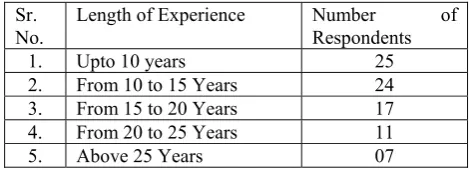
[image:2.595.311.546.118.203.2]A questionnaire was developed, which included questions related with capabilities of the organizations for adapting technology, involvement in product design for the customer, sincerity of donor company, technological strength acquired through tie up, organizational resistance to change, customer support and innovation culture. A detail of the variables is given in Table 6. Questionnaire was administered through 84 respondents from 44 vendor organizations. Length of experience of the respondents is given in Table 1, with the average experience 16.8 years.
Table 1. Experience of Respondents and their Numbers Sr.
No.
Length of Experience Number of Respondents
1. Upto 10 years 25
2. From 10 to 15 Years 24
3. From 15 to 20 Years 17
4. From 20 to 25 Years 11
5. Above 25 Years 07
Average Length of Experience of Respondents: 16.8 years Total Number of Respondents: 84
Likert five point scale varying from very high, high, medium, low and very low was used for analysis. Data collected was quantified using a linear scale varying from 0.1 to 0.9. Respondents and the organizations to which they belonged were grouped with the help of hierarchical cluster analysis. Common characteristics of the different clusters of vendors were worked out by analyzing the mean values of different variables for different clusters. Also the comparison of important characteristics between the vendors has been presented in the Table 3. Conclusions have been drawn based upon the data collected through questionnaire study.
IV. CLUSTER ANALYSIS
It was intended to search for natural groupings of the vendors in the form of clusters and hence hierarchical cluster analysis was performed for this purpose. Searching the data for a structure of natural groupings is an important exploratory technique. Rudimentary, exploratory procedures are often quiet helpful in understanding the complex nature of multivariate relationships. Grouping can provide informal means for assessing dimensionality, identifying common characteristics of the objects on the basis of some means of classifying variables. Quantified data collected through questionnaire was further used as input for cluster analysis. Euclidean (straight line) distance and single linkage method has been used for the present analysis. The Euclidean distance d(x,y) between two p-dimensional observations (items) x = [x1,x2,…,xp] and y = [y1,y2,…,yp] is given as
d(x,y) = √{(x1-y1)2 + (x2-y2)2 + …………+ (xp-yp)2} Clusters U and V are merged to get the cluster (UV). The distance between (UV) and any other cluster W are computed by
D(UV)W = min{dUV,dVW}
Here quantities dUW and dVW are the distances between the nearest neighbors of the clusters U and W and clusters V and W respectively.
Table 2. Organizations in each cluster Cluster
No.
No. of Respondents
No. of Organizations in
each cluster
1 37 17
2 24 14
3 11 7
4 12 6
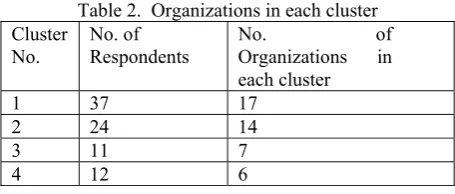
[image:3.595.40.289.273.458.2]Table 2 gives the description of the number of respondents in each cluster and organizations to which they belonged. The common characteristics of the organizations placed in each cluster were further synthesized and are being presented in Table 3.
Table 3. Identification and Description of Clusters Cluster
No.
Description
1 OEMs to vehicle manufacturers (Tier 1 Status), have capabilities for manufacturing sub-assemblies.
2 These organizations have high capability for developing and adapting manufacturing processes but not for designing components and they have very low involvement in product design for their customer company.
3 These organizations did not benefit much from technology acquisition, as the partnership was mostly passive in nature.
4 Have high capabilities for product design and involve themselves in designing components/products.
On analyzing the clusters, it is found that in the first cluster, 33 out of 37 respondents belong to organizations, which are joint venture type. These organizations acquired technology by partnering with other organizations through equity participation. All these vendors are OEMs (Original Equipment Manufacturers) to various vehicle manufacturers and are Tier-1 vendors. They have world-class technology available with them and have technological capabilities enough to supply not only components but even complete sub-assemblies to the vehicle manufacturers.
In second cluster, 21 out 24 respondents belong to the vendor organizations, which acquired technology mostly through license arrangements (Technical Assistance Agreements). These organizations are forward looking and have medium level of technological capabilities. They entered into technical agreements with the sole purpose of enhancing their technological capabilities and not under pressure from their customer company. These organizations have taken full advantage of the technology acquisition and derived benefits out of it. They have diversified their products by getting latest know how because of technical tie ups. However they are not able to get sufficient know-why about the engineering designs of the components. These organizations have sufficient capability for developing and adapting manufacturing
processes but not for designing components and they have very low involvement in product design for their customer company. Third cluster of respondents belongs to the organizations, which have also acquired technology through license arrangements (Technical Assistance Agreements). These are the organizations, which have entered into license arrangements merely to satisfy the condition laid down by the customer company. These vendors entered into license agreements with the original vendor of the joint venture partner of their customer company. All these vendors are supplying components to 100% FDI type vehicle manufacturers. As a part of their policy, these FDI type of vehicle manufacturers generally impose a condition upon these vendors to enter into agreement/tie-up with their original world-wide vendor, which has the patent/rights of the designs of the components. During our discussions, it was found that these vendors have sufficient technical expertise available with them especially in manufacturing technology and they are not making use of the technical tie-ups, which are mostly dummy in nature. These tie-ups come into existence merely to satisfy the customer, and pay royalties to the donor vendor.
Fourth cluster of respondents belong to the organizations which are mostly Joint Venture type or FDI type (Foreign Direct Investment, 100% ownership) and are manufacturing proprietary components e.g. spark plugs, tyres, air-conditioners, oil filters etc. These organizations are very much similar to the organizations of first cluster with the difference that they have higher capabilities for designing components of their own and they involve themselves in designing products for the vehicle manufacturers. This cluster has highest similarity with the first cluster as shown in Table 4. These organizations have higher technological capabilities and have sufficient involvement in product design activity for their customer company.
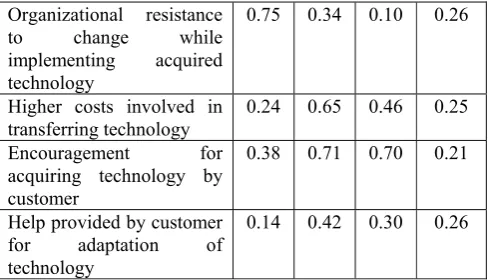
Table 4 gives the Euclidian distance between all the four clusters. It can be seen that the distance between cluster No. 1 and 4 is 1.48 and distance between cluster No. 2 and 3 is 1.25. It can therefore be concluded that clusters 2 and 3 are very much similar whereas clusters 1 and 4 also close to each other. Cluster wise univariate analysis of variables also proves this fact as shown in Table 6. Clusters No. 2 and 3 are similar because organizations in both these clusters have acquired technology through license arrangements and these organizations are small/medium scale. Organizations in cluster 1 and 4 are similar because they all have world-class technology available with them. Organizations of cluster1 have acquired technology through joint ventures whereas organizations of cluster 4 are mostly FDI (Foreign Direct Investment) type.
Table 5 shows that characteristics of vendors belonging to cluster 2 and 3 have clear-cut convergence with respect to following variables:
• Capability for developing/adapting process technology (High)
• Involvement by customer in product development (Low)
• Openness of donor for providing information and help (Medium)
• Encouragement for acquiring technology by customer (High)
• Capabilities of R&D Department for developing/adapting technology (Low)
Rapid product obsolescence due to newer, more attractive products or entirely new substitutes lead to shorter product life cycles. This changing landscape of the market puts pressure on the automobile vehicle manufacturers and their vendors to re-look at their product development processes. The traditional model of sequential product development has been found inadequate to respond to these dynamics. It is, therefore, very much expected from the vendors to have facilities to be a part of the product design process for their vehicle manufacturers. It can be observed that capability of the vendors for developing/adapting process technology lie in the high range, which is a healthy sign for the industry. However the capabilities for new product development and involvement in product development for the customers lie in low range for the vendors belonging to both the clusters 2 and 3. Involvement of vendors in the process of new product development has yielded favorable results in the developed countries. But the extent of involvement of vendors and their capabilities to adapt and absorb the technology is very limited in Indian context. With the increasing change in models being introduced by the vehicle manufacturers, only a very few of the present Indian vendors would be able to retain the Tier-I status. Others will have to leap-frog in order to retain their Tier-I status. Major expectations of the vehicle manufacturers from vendors as shown in Fig. 1 are: i) adaptation in the design of components, ii) capabilities for producing complete units, iii) reducing cost of product, iv) meeting the deadlines, v) flexibility for adjusting to the changing business environment, and vi) acquiring quality certifications.
[image:4.595.45.294.560.776.2]Fig. 1 Expectations of Vehicle Manufacturers from Vendors Meeting all these expectations perfectly is not an easy task for the Indian vendors, who had been working in almost monopolistic conditions till early 1990s, when their profits were assured and every year they could afford to enhance the cost. It is observed that clusters 1 and 4 are quite similar to each other because the organizations of cluster 1 predominantly acquired technology by entering into joint ventures and those belonging to cluster 4 being FDI type organizations have the technology of their own parent organization. Both type of organizations have similar characteristics in certain fields whereas they diverge in some other aspects. Following are some of the converging characteristics for the vendors belonging to cluster 1 and 4.
• Capability for developing/adapting process technology
• Openness of donor for providing information and help
• Gaining technological strength by Tie-Up
• Higher costs involved in transferring technology
• Encouragement for acquiring technology by customer
• Flexibility of machinery
Further it is observed that characteristics of vendors belonging to cluster 1 and 4 diverge on account of the observation that FDI companies have higher values for all the variables mentioned below:
i) Capabilities for product design as per requirements of the customer company.
ii) Involvement in new product design for the customer company.
iii) Transfer of Know-Why part of technology. iv) Organizational resistance to change.
v) Flexibility of workforce for adapting to changing conditions.
In order to follow the trend, which is being followed by leading vehicle manufacturers the world over, the Indian vehicle manufacturers would need Tier-I world-class vendors, which can design and supply complex subassemblies such as dashboards, rear axles, seats etc. However, barring a few FDI type world-class vendors belonging to cluster 4, very few Indian vendors can claim to have such capabilities. Some of the vehicle manufacturers such as Ford, GM and Hyundai have already brought their world class vendors with them, which has posed a great challenge for the Indian vendors. Indian vehicle manufacturers will have to uplift their old time vendors especially which belong to cluster 1 to the level of world-class Tier-I status.
V. OBJECTIVES OF THE ORGANIZATIONS FOR ACQUIRING TECHNOLOGY
Respondents were asked to fill the first three priorities for the objectives of technology acquisition. There were total 84 respondents from vendor organizations. 28 out of 84 respondents referred “To have access to advanced technology”
Reducing Cost of Product Every Year With Improved Quality Getting
Certifications Like TS 16949,
ISO 14001 etc
Perfectly
Meeting The Deadlines for Supplies Flexibility for
Adjusting to the Changing
Business
Capabilities for Designing the Components Capabilities for
Producing Complete Sub-Assemblies
Keeping Perfect Documentatio
n
Capacity for Heavy Investments Vendors
as the first priority, 24 referred it as second objective and 22 referred it as third. Hence 74 out of 84 respondents from vendors have referred it as either first, second or third objective. Referring to objective “To improve quality of product”, 23 out of 84 respondents referred it as first objective, 23 as second and 24 have referred it as third objective. For objective “To improve the image of your organization amongst competitors”, 15 out of 84 have referred it as their first objective, 18 referred it as second and 13 have referred it as third objective. On the whole, it can be observed that “To have access to advanced technology” is the most important objective, followed by “To improve quality of product” at second place and “To improve the image of organization amongst competitors” as the third important objective. “To fulfill the condition laid down by the customer company” is also an important objective, which has come at fourth place. This objective is important especially in case of vendors belonging to cluster 3 for the reasons explained earlier. The objective “For achieving higher production efficiency”, was placed at fifth place.
Table 5. Objectives for Acquiring Technology Sr.
No.
Objectives Overall Priority
1. To have access to advanced technology First 2. To improve quality of product Second 3. To improve the image of your
organization amongst competitors
Third 4. To fulfill the condition laid down by the
customer company
Fourth 5. For achieving higher production
efficiency
[image:5.595.306.551.84.224.2]Fifth
Table 6. Results of Cluster wise Univariate Analysis
Mapping of variable on Continuum
Description of Variable
1 2 3 4 Capability for
developing/adapting product technology
0.48 0.30 0.11 0.81
Capability for developing/adapting
process technology
0.85 0.72 0.60 0.80
Involvement by customer in product development
0.33 0.14 0.13 0.75 Openness of donor for
providing information and help
0.76 0.48 0.37 0.78
Transfer of Know-Why about technology i.e. Complete Engg. Designs
0.42 0.23 0.17 0.76
Gaining technological strength by Tie-Up
0.73 0.51
0.22 0.78 Overall sincerity of donor
company (CV8)
0.74 0.53 0.22 0.85
Organizational resistance to change while implementing acquired technology
0.75 0.34 0.10 0.26
Higher costs involved in transferring technology
0.24 0.65 0.46 0.25 Encouragement for
acquiring technology by customer
0.38 0.71 0.70 0.21
Help provided by customer for adaptation of technology
0.14 0.42 0.30 0.26
VI. DISCUSSION:
1. Four valid clusters of vendors having different capabilities and characteristics have been identified. First cluster comprise of OEM vendors that have acquired world-class technology through joint ventures and have capabilities for manufacturing complete sub-assemblies. Second cluster of vendors have also acquired technology through license arrangements. They entered into tie-ups through their own initiatives and not under compulsion from customer company. They were benefited from active technology transfer through from the donor company. Third cluster of vendors acquired through license arrangements only to satisfy their customer company. These organizations did not benefit much from technology acquisition, as the partnership was mostly passive in nature. Fourth cluster comprised of FDI (Foreign Direct Investment) type vendors having world-class technology with them. These vendors have capabilities for product design and involve them in designing components/products for their customers. 2. Vendors, especially belonging to cluster 2 and 3 (with
license agreements), need to set up their design center and increase design capabilities so that they have the capabilities for designing the products independently as it are going to be a strong requirement for all the Tier-I vendors in near future. These vendors heavily depend upon the technology providers for any design work and adaptations to be carried out.
3. Vendors belonging to cluster 3 (license agreement as a result of compulsion) differ from vendors belonging to cluster 2 (license agreement for technology up-gradation) in following respects: i) very low interaction with the donor company, ii) low overall sincerity of the donor company, iii) tie-up did not result in significant technology up-gradation, and iv) major objective of tie-up was only to satisfy their customer company. 4. Extent of involvement of vendors in the new product
work and majority of vendors having these capabilities belong to cluster 4.
5. Sending employees for training and up-gradation of their skills is a regular feature of the vendors belonging to cluster 1 and 4 i.e. JVs and FDI type vendors, whereas its level is much lower for vendors belonging to cluster 2 i.e. those which have entered into TAAs with their own willingness and it is lowest for vendors belonging to cluster 3 i.e. those which entered into TAAs in order to fulfill condition from their customer.
6. Involvement of donor companies and their commitment towards transferring technology and level of their subsequent help for problem solving is much higher in case of joint ventures as compared with TAAs. Therefore any vendor acquiring technology through TAAs must weigh its internal capabilities before entering into TAA. In fact success of TAAs depends upon how recipient company judiciously adapts the technology before implementing.
7. Certifications like QS 9000 and TS 16949 have played an important role in establishing the systems and streamlining the documentation of the vendors and have reduced the communication gaps between vendors and vehicle manufacturers, which earlier used to be there in the absence of these certifications.
8. It is observed that mostly the donor companies are reluctant to divulge the details of the engineering designs of the product/components. What they transfer is only the process design of the product/components along with drawings of the components/assemblies and empirical standards for functions like Production, Quality and Design and Testing etc. This all forms a part of know-how for technology, but important know-why regarding these aspects is not transferred.
9. Building core competencies in process technology, and subsequent indigenization in shortest period of time and then acquiring product design and testing capabilities should be the aim of organizations to stay ahead in competition and emerge as technology leader in Indian automotive market.
VII. CONCLUSIONS
The study has helped in significantly contributing towards synthesizing and crystallizing the important factors that help the vendors to enhance its technological capabilities in partnership with vehicle manufacturers and donors of technology. Four valid clusters of vendors have been identified and their characteristics have been discussed. It has become imperative for the vendors to adapt themselves in accordance with the changing conditions. Competitiveness in a de-regulated regime would, however, depend upon the ability of the firm to bring about technological paradigm shifts. Firms
with in-house research and development efforts to accomplish paradigm shifts, appear more successful. Very few vendors belonging to cluster 2 and 3 would retain the Tier-1 status in India as the scale of investment is going to be one of the key factors for retaining the same. They may have to shift to Tier-II status. This requires a change in attitude on the part of vendors as this could be perceived as loss of prestige for them.
ACKNOWLEDGMENT
Authors are highly thankful to the concerned persons belonging to the organizations for which case studies have been conducted and who spared their invaluable time and gave their views during the interviews. Authors are also highly indebted to the top management of these organizations, for allowing them to interact with their employees.
REFERENCES
[1] Y.L. Doz, and C.K. Prahalad. (1980). How MNCs Cope with Host Government Intervention. Harvard Business Review. pp.149-157.
[2] B.S. Prasad. (1986).Technology Transfer, The Approach of a Dutch Multinational. Technovation. 4(1). pp.3-15.
[3] C.C. Coughlin. (1983). An Economic Analysis of Yugoslav Joint Ventures. Journal of World Trade Law. 17(1). pp.12-33.
[4] P. Haspeslagh and D. Jemison. (1991). Managing Acquisitions: Creating Value through Corporate Renewal. The Free Press. New York. [5] M. Jones and R. Jain. (2002). Technology transfer for SMEs: Challenges
and barriers. International Journal Of Technology Transfer and Commercialization. 1(½).
[6] G. Cutler. (1991). Acquiring technology from outside.
Research-Technology Management. 34(3). pp.11-18.
[7] R Katz and T Allen. (1982). Investigating the ‘Not Invented Here’, (NIH) syndrome: a look at performance, tenure, and communication patterns of 50 R&D project groups. Research Management. 12(l). pp.7-19. [8] Badawy M. (1991). Technology and strategic advantages: managing