Coreference Resolution Evaluation for Higher Level Applications
Don Tuggener
Unversity of Zurich
Institute of Computational Linguistics [email protected]
Abstract
This paper presents an evaluation frame-work for coreference resolution geared to-wards interpretability for higher-level ap-plications. Three application scenarios for coreference resolution are outlined and metrics for them are devised. The metrics provide detailed system analysis and aim at measuring the potential benefit of using coreference systems in preprocessing.
1 Introduction
Coreference Resolution is often described as an important preprocessing step for higher-level ap-plications. However, the commonly used coref-erence evaluation metrics (MUC, BCUB, CEAF, BLANC) treat coreference as a generic clustering problem and perform cluster similarity measures to evaluate coreference system outputs. Mentions are seen as unsorted generic items rather than lin-early ordered linguistic objects (Chen and Ng, 2013). This makes it arguably hard to interpret the scores and assess the potential benefit of using a coreference system as a preprocessing step.
Therefore, this paper proposes an evaluation framework for coreference systems which aims at bridging the gap between coreference system de-velopment, evaluation, and higher level applica-tions. For this purpose, we outline three types of application scenarios which coreference resolu-tion can benefit and devise metrics for them which are easy to interpret and provide detailed system output analysis based on any available mention feature.
2 Basic Concepts
Like other coreference metrics, we adapt the con-cepts of Recall and Precision from evaluation in Information Retrieval (IR) to compare mentions
in a system output (the response) to the anno-tated mentions in a gold standard (the key). To stay close to the originally clear definitions of Re-call and Precision in IR, ReRe-call is aimed at iden-tifying how many of the annotated key mentions are correctly resolved by a system, and Precision will measurethe correctness of the returned sys-tem mentions.
However, if we define Recall as tp+tpfn, the de-nominator will not include key mentions that have been put in the wrong coreference chain, and will not denote all mentions in the key. Therefore, borrowing nomenclature from (Durrett and Klein, 2013), we introduce an additional error class, wrong linkage (wl), which signifies key mentions that have been linked to incorrect antecedents. Re-call can then be defined as tp+wltp+fn and Precision astp+wltp+fp. Recall then extends over all key men-tions, and Precision calculation includes all sys-tem mentions.
Furthermore, including wrong linkage in the Recall equation prevents it from inflating com-pared to Precision when a large number of key mentions are incorrectly resolved. Evaluation is also sensitive to the anaphoricity detection problem. For example, an incorrectly resolved anaphoric“it” pronoun is counted aswrong link-ageand thus also affects Recall, while a resolved pleonastic“it” pronoun is considered afalse posi-tivewhich is only penalized by Precision. Beside the “it” pronoun, this is of particular relevance for noun markables, as determining their referential status is a non-trivial subtask in coreference res-olution.
As we evaluate each mention individually, we are able to measure performance regarding any feature type of a mention, e.g. PoS, number, gen-der, semantic class etc. We will focus on men-tion types based on PoS tags (i.e. pronouns, nouns etc.), as they are often the building blocks of coref-erence systems. Furthermore, mention type based
performance analysis is informative for higher-level applications, as they might be specifically in-terested in certain mention types.
3 Application Scenarios
Next, we will outline three higher-level applica-tion types which consume coreference and devise relevant metrics for them.
3.1 Models of entity distributions
The first application scenario subsumes models that investigate distributions and patterns of en-tity occurrences in discourse. For example, Cen-tering theory (Grosz et al., 1995) and the thereof derived entity grid model (Barzilay and Lapata, 2008; Elsner and Charniak, 2011) record transi-tions of grammatical functransi-tions that entities occur with in coherent discourse. These models can benefit from coreference resolution if entities are pronominalized or occur as a non-string matching nominal mentions.
Another application which tracks sequences of entity occurrences is event sequence modeling. Such models investigate prototypical sequences of events to derive event schemes or templates of suc-cessive events (Lee et al., 2012; Irwin et al., 2011; Kuo and Chen, 2007). Here, coreference res-olution can help link pronominalized arguments of events to their previous mention and, thereby, maintain the event argument sequence.
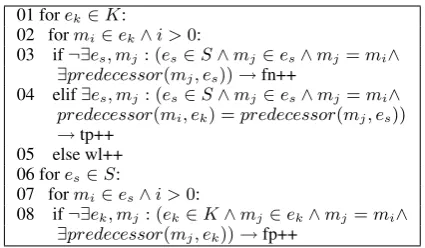
The outlined applications in this scenario pri-marily rely on the identification of correct and gapless sequences of entity occurrences. We can approximate this requirement in a metric by re-quiring the immediate antecedent of a mention in a response chain to be the immediate antecedent of that mention in the key chain.
Note that this restriction deems mentions as in-correct, if they skip an antecedent but are resolved to another antecedent in the correct chain. For ex-ample, given a key [A-B-C-D], mention D in a re-sponse [A-B-D] would not be considered correct, as the immediate antecedent is not the same as in the key. The original sequence of the entity’s oc-currence is broken between mention B and D in the response, as mention C is missing.
We use the following algorithm (table 1) to cal-culate Recall and Precision for evaluating imme-diate antecedents. LetKbe the key and Sbe the system response. Letebe an entity denoted bymn
mentions.
01 forek∈K:
02 formi∈ek∧i >0:
03 if¬∃es, mj: (es∈S∧mj∈es∧mj=mi∧ ∃predecessor(mj, es))→fn++
04 elif∃es, mj: (es∈S∧mj∈es∧mj=mi∧
predecessor(mi, ek) =predecessor(mj, es)) →tp++
05 else wl++ 06 fores∈S:
07 formi∈es∧i >0:
[image:2.595.310.523.60.184.2]08 if¬∃ek, mj: (ek∈K∧mj∈ek∧mj=mi∧ ∃predecessor(mj, ek))→fp++
Table 1: Algorithm for calculating Recall and Pre-cision.
We traverse the key K and each entity ek in
it1. We evaluate each mentionmiinek, except for the first one (line 2), as we investigate coreference links. If no response chain exists that contains
mi and its predecessor, we count mi as a false
negative (line 3). This condition subsumes the case wheremiis not in the response, and the case
wheremiis the first mention of a response chain.
In the latter case, the system has deemedmito be
non-anaphoric (i.e. the starter of a chain), while it is anaphoric in the key2. We check whether the immediate predecessor ofmi in the key chainek
is also the immediate predecessor ofmj in the
re-sponse chaines(line 4). If true, we countmias a
true positive, or as wrong linkage otherwise. We traverse the response chains to detect spu-rious system mentions, i.e. mentions not in the key, and count them as false positives, i.e. non-anaphoric markables that have been resolved by the system (lines 6-8). Here, we also count men-tions in the response, which have no predecessor in a key chain, as false positives. If a mention in the response chain is the chain starter in a key chain, it means that the system has falsely deemed it to be anaphoric and we regard it as a false posi-tive3.
3.2 Inferred local entities
The second application scenario relies on corefer-ence resolution to infer local nominal antecedents. For example, in Summarization, a target sentence may contain a pronoun which should be replaced by a nominal antecedent to avoid ambiguities and ensure coherence in the summary. Machine Trans-1We disregard singleton entities, as it is not clear what
benefit a higher level application could gain from them.
2(Durrett and Klein, 2013) call this errorfalse new (FN). 3This error is calledfalse anaphoric (FA)by (Durrett and
lation can benefit from pronoun resolution in lan-guage pairs where nouns have grammatical gen-der. In such language pairs, the gender of a pro-noun antecedent has to be retrieved in the source language in order to insert the pronoun with the correct gender in the target language.
In these applications, it is not sufficient to link pronouns to other pronouns of the same corefer-ence chain because they do not help infer the un-derlying entity. Therefore, in our metric, we re-quire the closest preceding nominal antecedent of a mention in a response chain to be an antecedent in the key chain.
The algorithm for calculation of Recall and Pre-cision is similar to the one in table 1. We modify lines 3 and 4 to require the closest nominal an-tecedent ofmi in the response chain es to be an
antecedent ofmj in the corresponding key chain
ek, wheremj =mi, i.e.:
∃mh ∈ es : is closest noun(mh, mi) ∧
∃ek, mj, ml : (ek ∈ K ∧ mj ∈ ek ∧ mj =
mi∧ml∈ek∧l < j∧ml =mh)→tp++
Note that we cannot process chains without a nominal mention in this scenario4. Therefore, we skip evaluation for such ek ∈ K. We still want
to find incorrectly inferred nominal antecedents of anaphoric mentions, i.e. mentions ines ∈ S that
have been assigned a nominal antecedent in the re-sponse but have none in the key and count them as wrong linkage, as they infer an incorrect nominal antecedent. Therefore, we traverse alles∈S and
add to the algorithm:
∀mi ∈ es : ¬is noun(mi) ∧ ∃mh ∈ es :
is noun(mh) ∧ ∃ek, mj : (ek ∈ K ∧ mj ∈
ek∧mj = mi∧ ¬∃ml ∈ ek :is noun(ml))→
wl++
3.3 Finding contexts for a specific entity
The last scenario we consider covers applications that are primarily query driven. Such applications search for references to a given entity and analyze or extract its occurrence contexts. For example, Sentiment Analysis searches large text collections for occurrences of a target entity and then derives polarity information from its contexts. Biomedical relation mining looks for interaction contexts of specific genes or proteins etc.
4We found that 476 of 4532 key chains (10.05%) do not
contain a nominal mention. Furthermore, we do not treat cataphora (i.e. pronouns at chain start) in this scenario. We found that 241 (5.31%) of the key chains start with cataphoric pronouns.
For these applications, references to relevant en-tities have to be accessible by queries. For ex-ample, if a sentiment system investigates polarity contexts of the entity “Barack Obama”, given a key chain [Obama - the president - he], a response chain [the president - he] is not sufficient, because the higher level application is not looking for in-stances of the generic “president” entity.
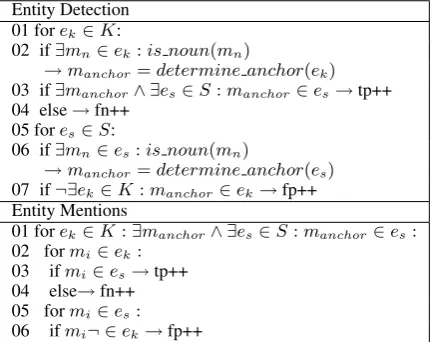
Therefore, we determine ananchor mentionfor each coreference chain which represents the most likely unique surface form an entity occurs with. As a simple approximation, we choose the first nominal mention of a coreference chain to be the anchor of the entity, because first mentions of enti-ties introduce them to discourse and are, therefore, generally informative, unambiguous, semantically extensive and are likely to contain surface forms a higher level application will query.
Entity Detection 01 forek∈K:
02 if∃mn∈ek:is noun(mn)
→manchor=determine anchor(ek) 03 if∃manchor∧ ∃es∈S:manchor∈es→tp++ 04 else→fn++
05 fores∈S:
06 if∃mn∈es:is noun(mn)
→manchor=determine anchor(es) 07 if¬∃ek∈K:manchor∈ek→fp++ Entity Mentions
01 forek∈K:∃manchor∧ ∃es∈S:manchor∈es: 02 formi∈ek:
[image:3.595.309.526.322.493.2]03 ifmi∈es→tp++ 04 else→fn++ 05 formi∈es: 06 ifmi¬ ∈ek→fp++
Table 2: Algorithm for calculating Recall and Pre-cision using anchor mentions.
To calculate Recall and Precision, we align coreference chains in the responses to those in the key via their anchors and then measure how many (in)correct references to that anchor the corefer-ence systems find (table 2). We divide evaluation into entity detection (ED), which measures how many of the anchor mentions a system identifies. We then measure the quality of the entity men-tions(EM) for only those entities which have been aligned through their anchors.
compari-son. Where applicable, we obtain the named en-tity class of the enen-tity and measure performance for each such class.
4 Evaluation
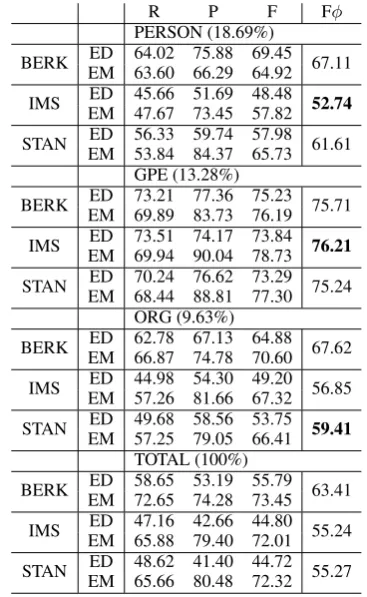
We apply our metrics to three available corefer-ence systems, namely the Berkley system (Dur-rett and Klein, 2013), the IMS system (Bj¨orkelund and Farkas, 2012), and the Stanford system (Lee et al., 2013) and their responses for the CoNLL 2012 shared task test set for English (Pradhan et al., 2012). Tables 3 and 4 report the results.
Immediate antecedent Inferred antecedent
R P F R P F
BERK (Durrett and Klein, 2013)
NOUN 45.06 47.06 46.04 55.54 60.37 57.85 PRP 67.66 64.87 66.24 48.92 53.62 51.16 PRP$ 74.49 74.32 74.41 61.95 66.80 64.28 TOTAL 56.60 56.91 56.76 52.94 58.04 55.37
IMS (Bj¨orkelund and Farkas, 2012)
NOUN 38.01 43.09 40.39 46.90 54.96 50.61
PRP 69.06 68.64 68.85 43.04 57.42 49.20
PRP$ 72.57 72.11 72.34 51.51 63.54 56.90 TOTAL 53.55 57.55 55.48 45.27 56.47 50.25
STAN (Lee et al., 2013)
[image:4.595.323.507.220.519.2]NOUN 38.51 42.92 40.60 50.03 57.62 53.56 PRP 65.55 61.09 63.25 36.67 45.97 40.80 PRP$ 66.12 65.70 65.91 40.64 52.38 45.77 TOTAL 51.70 52.69 52.19 43.01 51.73 46.97
Table 3: Antecedent based evaluation
We note that the system ranking based on the MELA score5 is retained by our metrics. MELA rates the Berkley system best (61.62), followed by the IMS system (57.42), and then the Stanford sys-tem (55.69).
Beside detailed analysis based on PoS tags, our metrics reveal interesting nuances. Somewhat ex-pectedly, noun resolution is worse when the imme-diate antecedent is evaluated, than if the next nom-inal antecedent is analyzed. Symmetrically in-verse, pronouns achieve higher scores when their direct antecedent is measured, as compared to when the next nominal antecedent has to be cor-rect.
Our evaluation shows that the IMS system achieves a higher score for pronouns than the Berkley system when immediate antecedents are measured and has a higher Precision for pronouns regarding the inferred antecedents. The Berkley system performs best mainly due to Recall. For e.g. personal pronouns (PRP), Berkley has the
5MUC+BCUB+CEAF E 3
following counts for the inferred antecedents: tp=2687, wl=1935, fn=871, fp=389, while IMS shows tp=2243, wl=1376,fn=1592, fp=287. This indicates that the IMS Recall is lower because of the high false negative count, rather than being due to too many wrong linkages.
Finally, table 4 suggests that the IMS systems performs significantly worse in the PERSON class than the other systems and is outperformed by the Stanford system in the ORG class, but performs best in the GPE class.
R P F Fφ
PERSON (18.69%)
BERK ED 64.02 75.88 69.45 67.11EM 63.60 66.29 64.92
IMS EM 47.67 73.45 57.82ED 45.66 51.69 48.48 52.74
STAN ED 56.33 59.74 57.98 61.61EM 53.84 84.37 65.73 GPE (13.28%)
BERK ED 73.21 77.36 75.23 75.71EM 69.89 83.73 76.19
IMS EM 69.94 90.04 78.73ED 73.51 74.17 73.84 76.21
STAN ED 70.24 76.62 73.29 75.24EM 68.44 88.81 77.30 ORG (9.63%)
BERK ED 62.78 67.13 64.88 67.62EM 66.87 74.78 70.60
IMS EM 57.26 81.66 67.32ED 44.98 54.30 49.20 56.85
STAN ED 49.68 58.56 53.75EM 57.25 79.05 66.41 59.41
TOTAL (100%)
BERK ED 58.65 53.19 55.79 63.41EM 72.65 74.28 73.45
IMS EM 65.88 79.40 72.01ED 47.16 42.66 44.80 55.24
STAN ED 48.62 41.40 44.72 55.27EM 65.66 80.48 72.32
Table 4: Anchor mention based evaluation
5 Conclusion
We have presented a simple evaluation framework for coreference evaluation with higher level ap-plications in mind. The metrics allow specific performance measurement regarding different an-tecedent requirements and any mention feature, such as PoS type, lemma, or named entity class, which can aid system development and compari-son. Furthermore, the metrics do not alter system rankings compared to the commonly used evalua-tion approach6.
6The scorers are freely available on our website:
[image:4.595.72.292.244.425.2]References
Regina Barzilay and Mirella Lapata. 2008. Modeling local coherence: An entity-based approach. Com-put. Linguist., 34(1):1–34, March.
Anders Bj¨orkelund and Rich´ard Farkas. 2012. Data-driven multilingual coreference resolution using re-solver stacking. InJoint Conference on EMNLP and CoNLL - Shared Task, CoNLL ’12, pages 49–55, Stroudsburg, PA, USA. Association for Computa-tional Linguistics.
Chen Chen and Vincent Ng. 2013. Linguistically aware coreference evaluation metrics. In Proceed-ings of the 6th International Joint Conference on Natural Language Processing, pages 1366–1374.
Greg Durrett and Dan Klein. 2013. Easy victories and uphill battles in coreference resolution. In Proceed-ings of the Conference on Empirical Methods in Nat-ural Language Processing, Seattle, Washington, Oc-tober. Association for Computational Linguistics.
Micha Elsner and Eugene Charniak. 2011. Extending the entity grid with entity-specific features. In Pro-ceedings of the 49th Annual Meeting of the Associ-ation for ComputAssoci-ational Linguistics: Human Lan-guage Technologies: short papers - Volume 2, HLT ’11, pages 125–129, Stroudsburg, PA, USA. Associ-ation for ComputAssoci-ational Linguistics.
Barbara J. Grosz, Scott Weinstein, and Aravind K. Joshi. 1995. Centering: a framework for modeling the local coherence of discourse.Comput. Linguist., 21(2):203–225, June.
Joseph Irwin, Mamoru Komachi, and Yuji Matsumoto. 2011. Narrative schema as world knowledge for coreference resolution. In Proceedings of the Fif-teenth Conference on Computational Natural Lan-guage Learning: Shared Task, CONLL Shared Task ’11, pages 86–92, Stroudsburg, PA, USA. Associa-tion for ComputaAssocia-tional Linguistics.
June-Jei Kuo and Hsin-Hsi Chen. 2007. Cross-document event clustering using knowledge mining from co-reference chains. Inf. Process. Manage., 43(2):327–343, March.
Heeyoung Lee, Marta Recasens, Angel Chang, Mihai Surdeanu, and Dan Jurafsky. 2012. Joint entity and event coreference resolution across documents. In Proceedings of the 2012 Joint Conference on Empirical Methods in Natural Language Process-ing and Computational Natural Language LearnProcess-ing, EMNLP-CoNLL ’12, pages 489–500, Stroudsburg, PA, USA. Association for Computational Linguis-tics.
Heeyoung Lee, Angel Chang, Yves Peirsman, Nathanael Chambers, Mihai Surdeanu, and Dan Ju-rafsky. 2013. Deterministic coreference resolu-tion based on entity-centric, precision-ranked rules.
Computational Linguistics, 39(4).