http://www.scirp.org/journal/ae ISSN Online: 2331-2017
ISSN Print: 2331-1991
DOI: 10.4236/ae.2018.62011 Apr. 27, 2018 148 Advances in Entomology
Assessment of Constraints to the
Adoption of Technologies Promoted
by the Integrated Pest Management
Training Program in Cotton-Based
Cropping Systems in Western
Burkina Faso
Souleymane Nacro
1, Karim Sama
21Programme de GIPD s/c FAO, Ouagadougou, Burkina Faso
2Université Polytechnique de Bobo-Dioulasso, Bobo Dioulasso, Burkina Faso
Abstract
Our study was conducted from August 2008 to March 2009 in the Houet province, western Burkina Faso. It consisted in the assessment of the con-straints to the adoption by cotton growers of technologies promoted by the IPM program through Farmers’ Field Schools in cotton-cereals-livestock sys-tems. We did so by surveying a sample of 185 farmers trained in IPM and by describing farmers’ practices before and after the training in IPM. The results showed that the average dose of organic manure, NPK and urea used by fa-mers after their training were respectively 3.8 tons/ha, 163 kg/ha and 65 kg /ha as compared with 2.4 tons/ha, 140 kg/ha and 51 kg/ha before the training. Regarding the use of pesticides, 94.6% of farmers used protection equipment during the sprayings after the training against 21.6% of them before the training. However, the average number of sprays did not vary significantly. It was 6 before the training and only 5 after. The botanical pesticides were used by 31% of farmers after the training as compared with 0% of users before the training in IPM. The training did not affect much crop yields. The constraints identified and classified according to their relative importance included the lack of agricultural equipment, and animals for ploughing, difficulties in in-puts access, labor shortage, the lack of organic manure, and marketing prob-lems. These technical, social and economic constraints have been analyzed and recommendations have been made to work them out.
How to cite this paper: Nacro, S. and Sama, K. (2018) Assessment of Constraints to the Adoption of Technologies Promoted by the Integrated Pest Management Train-ing Program in Cotton-Based CroppTrain-ing Systems in Western Burkina Faso. Ad-vances in Entomology, 6, 148-159.
https://doi.org/10.4236/ae.2018.62011
Received: March 30, 2018 Accepted: April 24, 2018 Published: April 27, 2018
Copyright © 2018 by authors and Scientific Research Publishing Inc. This work is licensed under the Creative Commons Attribution International License (CC BY 4.0).
DOI: 10.4236/ae.2018.62011 149 Advances in Entomology
Keywords
IPM, Cotton-Cereals-Livestock, Production Systems, Botanicals, Farmers’ Field Schools, Constraints
1. Introduction
Cotton is the second export product of Burkina Faso. With a production of 720,000 metric tons of seed cotton in 2006, Burkina Faso remains the top Afri-can producer. About 200,000 agricultural households make directly their living on cotton growing and almost 3,000,000 Burkinabé benefit indirectly from this sub-sector [1]. However, cotton is subject to many enemies in the field and the insect pests are responsible for a significant yield loss. Farmers use exclusively chemical pesticides to control these insect pests. Consequently, the amount of pesticides used is constantly increasing as the cotton production is expanding. For example, in Burkina Faso, the quantity of insecticides used to control cotton insect pests amounted 1,750,000 liters in 1998 [2]. This practice threatens agri-cultural ecosystems and human and animal health. The World Health Organiza-tion (WHO) estimates that 20,000 is the number of accidental deaths per year resulting from pesticide poisoning worldwide, most of them occurring in devel-oping countries [3]. Thus, the use of sustainable control methods to manage pests is by far the best approach. The use of chemical pesticides should be envi-saged as the last resort.
DOI: 10.4236/ae.2018.62011 150 Advances in Entomology the IPM program disseminates appropriate and simple technologies that can help increase agricultural productivity. Three years after the start of the training of cotton growers in the Houet province, there was a need to assess the level of adoption of the technologies promoted by the program and to evaluate the main constraints to the implementation of these technologies.
Our study aims therefore at assessing the main constraints to the adoption of the agricultural technologies that were exposed to farmers during their training in the Houet province.
2. Material and Methods
2.1. Study Area and Training Main Content
This study was conducted in the cotton belt of Burkina Faso, in the Houet prov-ince whose capital city is Bobo-Dioulasso, western Burkina Faso. The geograph-ical coordinates of the province are 11˚33' north latitude and 4˚25' west longi-tude.
Our study was conducted in Bama and Bobo-Dioulasso departments, 2 out of 13 departments of the province. Yearly average rainfalls vary from 800 mm to 1200 mm. The coolest month of the year is December (21˚C) while the hottest month is October (30˚C). Average relative humidity varies from 50% in Decem-ber to 80% in August.
All the trainings were conducted each year from June to November. The main content of each training was as follow:
• soil management and preparation; • feed plants management;
• sowing and weeding;
• pests and diseases associated with crops and their management; • insect pests and plant diseases scouting;
• analysis of agro-ecosystem; • post-harvest technologies; • economical analysis.
2.2. Data Collection
A tracking sheet of trained growers was prepared and used to collect data on the agricultural practices used by farmers before and after the training.
2.3. Farmers’ Survey
DOI: 10.4236/ae.2018.62011 151 Advances in Entomology
2.4. Yield Measurement
Cotton and corn yields were estimated three consecutive years before (2003, 2004 and, 2005) and after the training (2006, 2007 and, 2008). Both farm area and yield were collected from each surveyed farmer.
2.5. Data Analysis
Data on agricultural inputs were analyzed using Microsoft EXCEL 2007. Prior to analysis, each constraint was assigned a score that reflected its importance. The Principal Component Analysis (PCA) and the Hierarchical Clustering were per-formed using XLSTAT 2010.
3. Results
3.1. Fertilizer Management
3.1.1. Organic Fertilizer Management
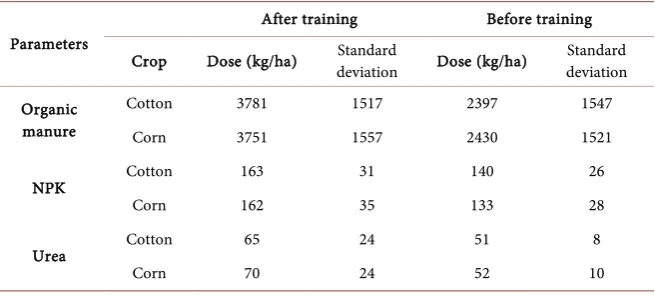
As many as 91.9 % of the surveyed farmers used organic manure after the train-ing against 57.3 % before the traintrain-ing. The average dose of organic manure used on cotton and corn after training was 3.8 tons against an average of 2.4 tons/ha before the training (Table 1). Our results showed that for both cotton and corn, only 24.75% of farmers used organic manure from pits after the training as compared with 1.8% of them before the training.
3.1.2. Mineral Fertilizers’ Management
The average dose of NPK used on cotton was 163 kg/ha after the training against 140 kg/ha before the training. For corn, the average dose was 162 kg/ha after training as compared with 133 kg/ha before the training (Table 1).
The average dose of urea used on cotton was 65 kg/ha after training against 51 kg/ha before training (Table 1). On corn, the average dose of urea was 70 kg/ha after training as compared with 52 kg/ha before training.
3.1.3. Insecticides Management
[image:4.595.210.538.576.730.2]The doses of insecticides used on cotton were slightly the same before and after
Table 1. Summary of average doses of organic and mineral fertilizer used before and after the training.
Parameters
After training Before training
Crop Dose (kg/ha) Standard deviation Dose (kg/ha) deviation Standard
Organic manure
Cotton 3781 1517 2397 1547 Corn 3751 1557 2430 1521
NPK Cotton 163 31 140 26
Corn 162 35 133 28
Urea Cotton 65 24 51 8
DOI: 10.4236/ae.2018.62011 152 Advances in Entomology training means an average of 1 l/ha. The use of botanical pesticides was one of the new practices that were recommended by the IPM program. Our results showed that 31% of farmers used botanical insecticides after the training. These botanicals were mainly made of solutions obtained from neem leaves or seeds. The IPM program also recommends that farmers observe weekly their fields in order to make sound decisions. When this was done, the number of chemical sprayings dropped from 6 (before the training) to 5 (after the training) (Figure 1).
Furthermore, our investigation has allowed to prepare the list of the different types of insecticides used by cotton growers before and after the training. So, in addition to Endosulfan (350 g/l), Cypermethrin (36 g/l) and Profenofos, another active ingredient such as Acetamiprid was also used.
3.1.4. Insecticide Use Safety
The World Health Organization (WHO), reported that 20,000 is the number of accidental deaths per year resulting from pesticide poisoning worldwide and the majority of these deaths occurs in developing countries [3]. With this in mind, the IPM program recommends a safe use of pesticides before, during and after the spraying of pesticides.
Our results showed that regarding the specific issue of pesticide storage before use, 84.9% of trained farmers stocked them in a store before use whereas before training they were only 20.5% (Figure 2).
[image:5.595.211.532.538.690.2]Before the training, 67% of farmers used to keep pesticides in their homes while after training, they were only 4.3% to do so. Regarding the use of protec-tive equipment during the sprayings, our results showed that 94.6% of farmers were protected after receiving this training, whereas before the training they were only 21.6% (Figure 3). The containers were buried by 65.4% of the farmers after the training against 12.43% before the training. Before the training, 3.24% of farmers against 20% of them after the training burnt the containers (Figure 4). After the training, 11.35% of farmers threw away the containers in the nature against 81.08% before the training.
DOI: 10.4236/ae.2018.62011 153 Advances in Entomology
[image:6.595.211.538.229.352.2]Figure 2. Distribution of farmers according to pesticide storage before use, Burkina Faso, 2009.
Figure 3. Distribution of famers based on the use of protective equipment, Burkina Faso, 2009.
Figure 4. Distribution of farmers according to the destination of the packaging after the use of the products, Burkina Faso, 2009.
3.1.5. Yields
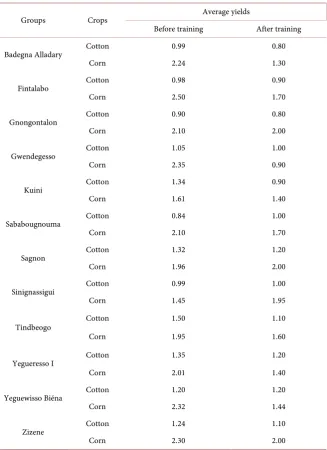
[image:6.595.210.535.398.518.2]DOI: 10.4236/ae.2018.62011 154 Advances in Entomology
Table 2. Summary of average yields reported by different groups before and after the training.
Groups Crops Average yields
Before training After training
Badegna Alladary Cotton 0.99 0.80
Corn 2.24 1.30
Fintalabo Cotton 0.98 0.90
Corn 2.50 1.70
Gnongontalon Cotton 0.90 0.80
Corn 2.10 2.00
Gwendegesso Cotton 1.05 1.00
Corn 2.35 0.90
Kuini Cotton 1.34 0.90
Corn 1.61 1.40
Sababougnouma Cotton 0.84 1.00
Corn 2.10 1.70
Sagnon Cotton 1.32 1.20
Corn 1.96 2.00
Sinignassigui Cotton 0.99 1.00
Corn 1.45 1.95
Tindbeogo Cotton 1.50 1.10
Corn 1.95 1.60
Yegueresso I Cotton 1.35 1.20
Corn 2.01 1.40
Yeguewisso Biéna Cotton 1.20 1.20
Corn 2.32 1.44
Zizene Cotton 1.24 1.10
Corn 2.30 2.00
3.1.6. Constraints Assessment
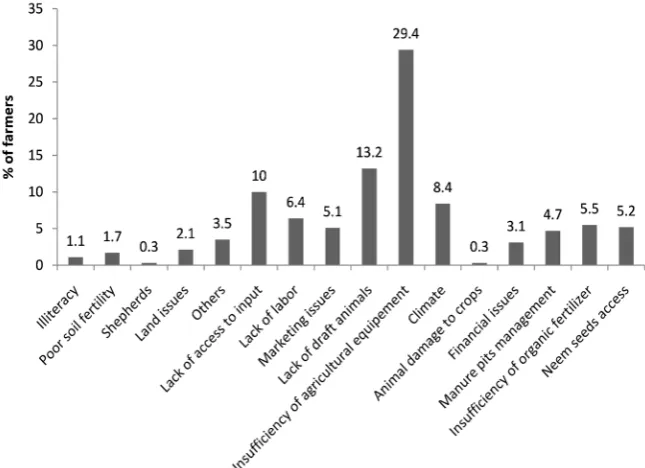
We identified eight main constraints to the adoption of the technologies pro-moted by the IPM Program. Figure 5 shows the proportion of farmers for each main constraint. The top constraint was the insufficiency of agricultural equip-ment (for ploughing, fertilizer application, organic manure and harvest trans-portation in the fields and at home, pits digging and pesticides sprayings). This constraint appeared with a frequency of 29.4%.
DOI: 10.4236/ae.2018.62011 155 Advances in Entomology
Figure 5. Proportion of farmers associated with the constraints to the adoption of tech-nologies promoted by the IPM program, Burkina Faso, 2009.
5.5%. Marketing and the problem of neem seeds availability for botanical pesti-cides were also mentioned as constraints by 5.2% and 5.1% respectively. The re-maining constraints were mentioned by less than 5% of the farmers.
Numbers were assigned to the constraints randomly (Figure 6). The insuffi-ciency of agricultural equipment (C1), the lack of labor (C4), land constraints (C7), illiteracy (C8) and the lack of draft animals (C9) appear to be related ac-cording to Figure 6. Inputs access constraint (C2), the lack of organic fertilizer (C3) and products marketing issue (C5) could form another class; the same thing could be applied to climatic constraints (C6) and the problem of neem seeds supply (C10). An ascending hierarchical classification was done and has allowed the drawing of a dendrogram (Figure 7).
According to the dendrogram (Figure 7), three classes of constraints have been identified: class 1, class 2 and class 3. Class 1 included 45% of the farmers, 47% of them were in class 2 and 8% in class 3. The majority of farmers surveyed were in class 2.
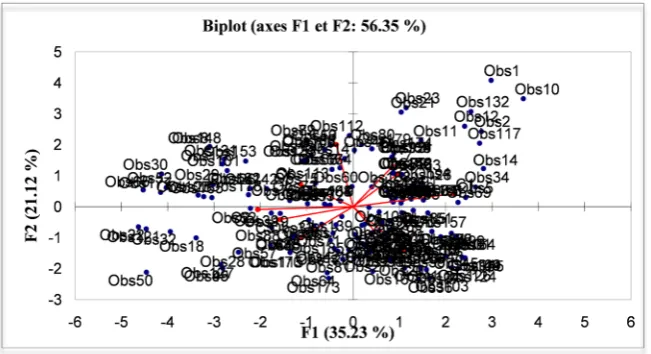
Figure 8 presents the distribution of the constraints and the farmers on the axes F1 and F2. This confirms the results of Figure 6 and Figure 7 by highlight-ing the close relationship between farmers and the constraints (variables). In-deed, constraints C2, C3 and C5 were in the class 3 where the lowest proportion of farmers was recorded. Constraints C6 and C10, were associated with farmers of class 1. Five constraints including C1, C4, C7, C8 and C9 were found in class 2 with 47% of farmers.
DOI: 10.4236/ae.2018.62011 156 Advances in Entomology
[image:9.595.210.536.312.474.2]Figure 6. Constraints grouped into classes by Hierarchical Ascending Classification, Bur-kina Faso, 2009.
Figure 7. Dendrogram of the distribution of the constraints on the F1 and F2 axes by the Principal Component Analysis, Burkina Faso, 2009.
[image:9.595.211.537.516.693.2]DOI: 10.4236/ae.2018.62011 157 Advances in Entomology
4. Discussion
The improvement of farming in general depends on several agricultural practic-es that the IPM program has promoted. Soil fertility was asspractic-essed by [5] through the description of the main chemical characteristics in western Burkina Faso that includes the Houet province. This study reported that the majority of soils in this region had low organic matter levels with values ranging from less than 1% to 1.5%. The causes of such poor soils in the region could be due to the aban-donment of soil fallowing in the region due to land pressure, the absence or low use of organic manure and the low level of crop residues left in the fields after harvest. For these reasons, the IPM program has made the use of organic ma-nure a prerequisite for the improvement of the agricultural productivity in the cotton belt of Burkina Faso. This message, according to our results has been heard by approximately 91.9% of the farmers after they have participated in the season-long training. Before the training, only 57.3% of the farmers used organic manure. However, even with this improvement, the average dose used by trained farmers, 3.8 tons/ha still remains below the recommended dose of 5 tons/ha. This result raises the issue of organic manure production. Composting of crop residues could be a solution to this problem. However, composting seems tech-nically difficult. Indeed, our results showed that for both cotton and corn, only 24.75% of farmers used organic manure from pits after the training as compared to 1.8% of farmers before the training. The implementation of these pits is diffi-cult because of the insufficiency of proper equipment and the high labor demand for digging in addition to the problems of pit maintenance.
DOI: 10.4236/ae.2018.62011 158 Advances in Entomology farmers receive from the cotton company depends on the area that is under cul-tivation with cotton. In other terms, the larger the area dedicated to cotton, the more likely farmers will get a high quantity of chemical fertilizers as a loan.
The training did not affect significantly the quantity of insecticides used by farmers. But the average number of sprays dropped from 6 to 5. Indeed, the IPM program recommends that pesticide application be based on field monitoring. Botanical pesticides are promoted by the IPM program as an alternative to chemical pesticides. Thus, 31% of farmers used neem extractions to spray their cotton on small areas (less than 0.5 ha). This modest result could be explained by the fact that chemical insecticides are given to farmers as a loan and they will pay them back whether or not they use them. Neem seeds are not yet commercially available and definitely farmers are careful, because the pressure of pests asso-ciated with cotton is so high and unpredictable, that they will not take a big risk by using largely botanical pesticides. The training has also produced good effects on the safety use of chemical pesticides. However it is encouraging that the per-centage of farmers that properly handled chemical pesticides significantly in-creased after the training. In fact, the IPM training has led to profound changes in cotton production in the Houet province.
The results showed that training in IPM had almost no effects on yields. However, according to [3], several developing countries experienced successfully IPM projects. This is the case of Zimbabwe where average yield of 1.5 tons/ha of grain cotton was reported in IPM plots as compared to 0.7 ton/ha in non-IMP plots. During our study, contrary to the three years before the training and also the years 2006 and 2008 after the training, the year 2007 has been characterized by floods and severe droughts pockets in Burkina Faso and particularly in the Houet province where we conducted our study. This situation has negatively af-fected yields during this year. Also, we estimated the average yield after the training by considering the years 2006, 2007 and 2008. This is why most of the groups have obtained low yields after training compared to yields before the training. Indeed, the adoption and success of the technologies promoted by the IPM program are limited by the many constraints that minimize the positive ef-fects on yields after the training. Agricultural equipment was identified by far-mers as the top (29.4% of all constraints) constraint. Small-scale cotton farfar-mers have very limited debt capacity and the pay back of the inputs represents 41% of their total incomes. Thus, only 10% of this is reinvested in equipment [6]. The consequences of this constraint plus those of minor constraints negatively affect the adoption of the technologies promoted by the IPM program.
5. Conclusions and Recommendations
un-DOI: 10.4236/ae.2018.62011 159 Advances in Entomology solved. For these constraints to be resolved, all stakeholders need to work to-gether.
Acknowledgements
We thank Mrs. Marie Noëlle Koyara, FAO Representative in Burkina Faso for allowing the publication of these results. This study was funded by the All ACP cotton intensification and diversification cropping systems project. We thank Dr. Caterina Batello from FAO, Rome for providing the necessary funds for this work. The first draft of this manuscript was reviewed by Dr. E.A. Heinrichs. We also thank Célestin Kaboré and Bernard Oula Ouattara for their assistance in the gathering of the data.
References
[1] Hauchard, V. (2005) Cotton Cropping and Soils Degradation in the Mouhoun Re-gion of Burkina Faso. Ph.D. Thesis, Reims University, Champagne Ardennes, France, 428 p.
[2] Sanou, M. (2008) Effects of Extracts and Oil of Different Local Ecotypes of Azadi-rachta indica A. Juss (Meliaceae) in the Management of Insect Pests of Cotton at Farakô-Ba (Burkina Faso). M.Sc. Thesis, Abdou Moumouni University, Niamey, Niger, 60 p.
[3] Gnamou, A. (2004) Evaluation of the Constraints Associated with the Adoption of the Technologies Released by the National Integrated Plant Production and Pest Management of Rice in the Kou Valley: Proposition of Solutions. M.Sc. Thesis, Po-lytechnic University of Bobo-Dioulasso, Bobo-Dioulasso, 79 p.
[4] FAO (2006) Sub-Regional Participatory Training in Integrated Pest Management through Farmers’ Field Schools for Benin. FAO, Burkina Faso and Mali. 54 p. [5] Dakouo, D. (1991) The Maintain of Soil Fertility in the Cropping Systems with
In-termediate Motorization. Case of the Cotton Belt of Western Burkina Faso. INERA/Cotton Research Program Cotton-ESFIMA, Bobo-Dioulasso, Burkina Faso, 49 p.