A Gender Recognition System from Facial Image
Md. Nurul Ahad Tawhid
Institute of Information Technology University of Dhaka
Dhaka, Bangladesh
Emon Kumar Dey
Institute of Information Technology University of Dhaka
Dhaka, Bangladesh
ABSTRACT
Automatic gender classification from facial image has become an attractive research area in the field of machine learning. Various methods have already been proposed for gender recognition in both controlled and uncontrolled situations. Problem arises in uncon-trolled situation when there are high rate of noises, lack of illumina-tion etc. To mitigate the problems, we have proposed a framework where we applied a pre-processing to enhance the images using Bi-lateral Histogram Equalization (BHEP) algorithm and applied the proposed framework in LFW, Adience and color FERET dataset yielding 94.29%, 84.86% and 98.30% accuracies. Confusion ma-trix, Precision, Recall, F-measure, True Positive Rate (TPR), True Negative Rate (TNR) etc. also shows that our proposed method per-forms better than the existing state of the arts.
Keywords
Gender recognition, image enhancement, BHEP, image pre-processing, image enhancement, feature extraction
1. INTRODUCTION
Gender recognition from face images is one of the fundamental re-search area in computer vision. Automated gender recognition is important in many application area such as human computer inter-action, biometric, surveillance, demographic statistics etc. Human face contains important visual information for gender perception. It is challenging for a machine to identify these visual information which separate male faces from female faces. Researches are going on so that a machine can achieve human level accuracy.
Various methods have been proposed for classifying gender from several controlled and uncontrolled dataset. It is more challenging in uncontrolled situations. Beside these some face images are so confusing, in most of the time a human is also fail to detect the gender from the image. So there is a wide scope for improving the performances of gender recognition approaches.
Various neural network approaches were employed in early 1990s for gender recognitions. Using a fully connected two layer network namely SEXNET, Golomb et. al [7] achieved 91.9% accuracy using 90 facial images in a controlled situation. Baluja et al. [4] proposed a method using boosting pixel comparison of face images. They used FERET database [20] and Support Vector Machine (SVM) for classification on images of 20×20 pixels. Makinen et al. [16] also proposed a method by considering FERET database. Images of FERET dataset are captured under controlled environment such
as; frontal faces, consistent lighting etc. In real time scenario it is necessary to detect gender in uncontrolled situation which is chal-lenging. Concerning this, Shakhnarovich et al. [24] took over 3,500 facial images from websites which are captured on uncontrolled sit-uations. They applied Haar-like features extraction method. Using Adaboost and SVM classifier they got 79% and 75.5% accuracies respectively. Labeled Face in the Wild (LFW) dataset [10] contain-ing more than 13,000 face images was developed for studycontain-ing the problem of unconstrained face recognition. Caifeng Shan [25] ap-plied his gender recognition method in 7,443 images from LFW dataset and found 94.81% accuracy. He applied boosted Local Bi-nary Pattern Histogram as features and SVM for classification by not considering 5,790 difficult images of LFW dataset.
suppress the noises. Using SVM classifier they achieved 79.88% accuracy on Adience dataset. Table 1 summarizes several gender recognition methods and their accuracy on different databases. Recently Deep Convolutional Neural Network (CNN) are being applied on face and gender recognition [15, 33]. Different CNN architectures have already been proposed for this purpose. In this paper we will propose an approach for classifying gender from fa-cial images using the feature extraction method tCENTRIST. The contribution of this paper are as follows:
(1) We have introduced an automated system for gender recogni-tion from facial images.
(2) For enhancing the input image, we have used Bilateral His-togram Equalization (BHEP) [2]
(3) We have adopted tCENTRIST for extracting features from the input images.
The rest of the paper is organized as follows: Section 2 describes the background studies, section 3 describes the proposed system ar-chitecture of gender detection, section 4 describes the experimental results and finally section 5 concludes the paper.
2. BACKGROUND STUDIES
Different methods have been proposed for extracting features from face images and to train the system for identifying gender. We have experimented on different feature extraction methods and adopted tCENTRIST for our proposed system. In the following subsections we will briefly describe some necessary topics related to our pro-posed system.
2.1 CENTRIST
Based on the concept of Census Transform (CT) by R. Zabih et al. [30], J. Wu et al. proposed a non-parametric local transform tech-nique named CENTRIST [29]. To capture the image structure, it produces an eight bit string (CT values) for a pixel by comparing its intensity value with eight neighbouring pixels. The main difference with LBP is that LBP performs interpolation while considering the corner pixels but CENTRIST considers the corner pixel as is. An example of CT calculation is given in Figure 2.1.
CENTRIST uses histogram of the CT values of image blocks for an image to capture both the local and global information. They also used Spatial Pyramid Matching (SPM) [14] scheme based spa-tial representation to capture the global structure of an image. That scheme divides an image into sub regions and integrate correspon-dence result of those regions, which improves recognition.
2.2 tCENTRIST
Ternary CENTRIST (tCENTRIST) is a fusion of LTP and CEN-TRIST. It uses LTP in place of LBP of CENCEN-TRIST. To capture the global structure tCENTRIST uses spatial representation based on SPM. For each block of Spatial Pyramid (SP), tCENTRIST cal-culates Local Ternary Pattern (LTP) and two histograms are con-structed - one for upper code and another for lower code of LTP. Those two histograms are then concatenated to build a single his-togram. Finally, histograms for all blocks are combined and Princi-pal Component Analysis (PCA) is applied for dimension reduction which gives the final feature vector for an image. Algorithm 1 de-scribes this process.
Algorithm 1tCENTRIST Algorithm
Require: imageIin
Ensure: Feature vectors ofIin
1: ifIinis coloredthen
2: R←−ConvertIingray
3: else
4: R←−Iin
5: end if
6: Calculate level 2Spatial Pyramid (SP)forR
7: foreach block of SPdo
8: CalculateLTP
9: Construct histogram ofLTP
10: end for
11: Concatenate all histograms and applyPCAto extractMfeature vector from each block
12: CombineNblocks to constructM×Nfeature for each image.
3. PROPOSED METHOD
High performance gender recognition methods depend on face de-tection, facial image preprocessing, feature extraction and finally classification[17]. We have used LFW, audience and color FERET dataset in this research where LFW face images are 100×100 size, audience face images are 816×816 size and color FERET face im-ages are 150×150 size. Before extracting features we preprocessed the training and testing images by using Bilateral Histogram Equal-ization [2] for enhancing the images and then tCENTRIST is used for extracting the prominent features. Extracted features from the enhanced images are then used for training the system. Linear SVM classifier has been used for classification purpose.
3.1 Image Enhancement
Several distinctive properties such as line, corners, spots, edges can be used as features for classifying face images. To clearly visualize the properties, several image enhancement technique can be used. Histogram Equalization (HE) [8], Brightness Pre-serving Bi-Histogram Equalization (BBHE) [13], Dualistic Sub-Image Histogram Equalization (DSIHE) [28], Recursively Sepa-rated and Weighted Histogram Equalization (RSWHE) [13], Adap-tive Gamma Correction with Weighted Distribution (AGCWD) [11] etc. are widely used in this area. Histogram Equalization is a popular image enhancement technique but sometimes it over en-hance the image and performance degrades in some classifications. BBHE was proposed to mitigate the mean shift problem of (HE) but BBHE fails in the situation for non-symmetric distribution. ACGWD transform each and every pixel of an image based on the highest pixel intensity in the histogram. So, over enhancement does not occur but it fails to show better result in case of law contrast input image. We have used Bilateral Histogram Equalization with Preprocessing (BHEP) [2] for enhancing the input image proposed by Feroz et. al. BHEP shows better results on low contrast images. It reduce the artifacts of the outliers. They choose harmonic mean to divide the image into two parts for enhancing the image and ex-plained the reason behind choosing the harmonic mean for dividing the image into two parts with proper example. Algorithm 2 shows the detail procedure of BHEP.
3.2 Feature Extraction and dimension reduction
Table 1. Several existing gender recognition methods and their accuracy
Ref Feature Dataset No. of Sample Accuracy
[7] Neural Network Personal 90 91.90%
[25] Boosted LBP LFW 7443 94.81%
[24] Haar Features Web Images 3500 79.00%
[21] NABP LFW 13000 92.74%
[32] Fisher Vector encoding LFW 13233 92.50% Color FERET 1762 98.00%
[3] MSLBP Adience 13649 79.88%
FERET 1762 95.19%
Fig. 1. Example of Census Transform (CT).
Algorithm 2BHEP Algorithm
Require: imageIin
Ensure: imageIout
1: ifIinis coloredthen
2: Iyuv←−ConvertIinfromRGBtoYUV
3: R←−Y channel ofIyuv
4: else
5: R←−Iin
6: end if
7: RHin←−Calculate histogram of R
8: DivideRHinintoRHLandRHUusing Harmonic Mean
9: Apply HE separately onRHLandRHU
10: Rout←−RHL
L RHU
11: ifIinis coloredthen
12: Rout←−CombineRoutwith U and V channels
13: Iout←−ConvertRoutfrom YUV to RGB
14: end if
15: Iout←−Rout
We also appled PCA for reducing the dimensionality of image fea-tures. Figure 2 shows the steps of our proposed method.
3.3 Classifier Training
After extracting features from the enhanced input image a classifier is used for making decision. In this system we have used Support Vector Machine (SVM) for classifying the features of input images because of its wide applicability for classification and high perfor-mance.
4. EXPERIMENTAL SETUP
In this section we will firstly describe about our datasets. We have used three different datasets to evaluate our proposed system. Af-ter that experimental results with experimental settings and detail training and testing procedures will be described.
4.1 Dataset
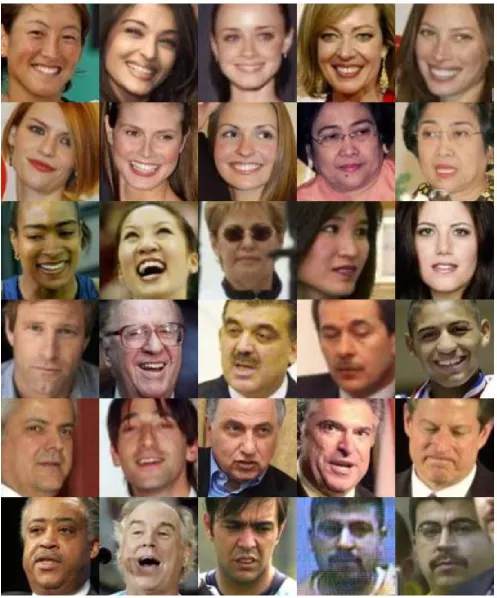
In order to evaluate the performance of our proposed method, firstly we have used Labeled Face in the Wild (LFW) dataset [10]. This database contains 13,230 face images of 5,749 different persons. Among them 4,263 are male and 1,486 female. Images of this database is also gender imbalanced containing 10,256 male and 2,976 female samples. All the images were collected from web which are captured in uncontrolled situations. Some sample images from LFW dataset are given in Figure 3.
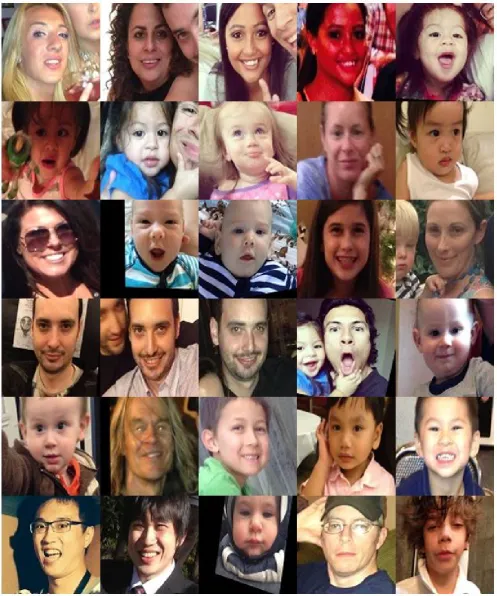
We have also used a relatively newly resealed adience dataset [6] to evaluate the result of our proposed method. The original dataset contains 26,580 face images of 2,284 different person. We have used the front version of this dataset which consist of total 13,649 images where 5772 images are for male face and 7788 are female faces. We considered the gender for all age categories. Table 2 summarize the description of used adience dataset. Figure 4 shows some sample images from adience dataset.
Finally, Color FERET dataset [19] is used for evaluating our sys-tem. Color FERET dataset consist of 1199 different subject. Total 2712 facial images are used. All images captured under controlled environment but they are different in ethnicities, facial expression, makeup, illumination condition etc. We have cropped the facial por-tion using Viola and Jones method. Figure 5 shows some example images from Color FERET dataset.
4.2 Training and Testing
Fig. 2. Proposed method for Gender Identification.
Table 2. Summery of adience dataset [6] Front version (faces in the range of±5oyaw from frontal)
Age Range 0-2 4-6 8-13 15-20 25-32 38-43 48-53 60- Total
Male 557 691 738 501 1,602 875 273 272 5,824
Female 492 911 956 630 1,692 732 295 309 6,455
T. Gnd. 1,049 1,602 1,694 1,131 3,294 1,607 568 581 13,649 Total 1,843 1,602 1,700 1,132 3,335 1,607 572 585
faces) are used for testing for each time. Support Vector Machine (SVM) is used for classification.
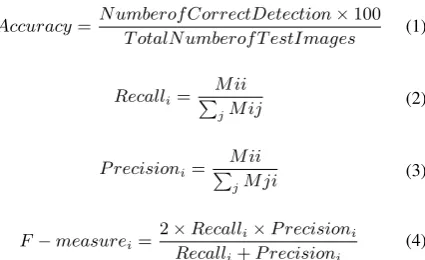
We also considered the overall accuracy, Recall, Precision, F-Measure to calculate the performance which are defined in Equa-tions 1-4.
Accuracy=N umberof CorrectDetection×100 T otalN umberof T estImages (1)
Recalli=
M ii P
jM ij
(2)
P recisioni=
M ii P
jM ji
(3)
F−measurei=
2×Recalli×P recisioni
Recalli+P recisioni
(4)
here, Mii = Number of correct detection of class i as class i; Mij = Total number of detection of class i as class i and j; Mji = Num-ber of detection of class j detected as class i and j. F-measure used for measuring the regression performances which is the harmonic mean of Precision and Recall value. Large value of F-measure in-dicates higher accuracy.
5. RESULTS AND DISCUSSION
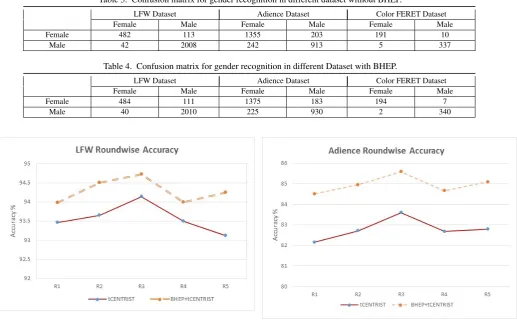
We have proposed a system for gender identification from facial images. We applied tCENTRIST for feature extraction and com-pare the result of the proposed method with other feature extraction techniques. Table 5 shows the confusion matrix of gender detection system without BHEP and Table 5 shows the result using prepro-cessing. The numbers are putted by making average of total 5 round test.
[image:4.595.307.566.291.337.2]Table 5 illustrate that our proposed method correctly identifies 482 female and 2008 male among 595 females and 2050 males in LFW database. 113 female and 42 males are misclassified. Again 1355 among 1558 female and 913 among 1155 male faces are correctly identified in Adience dataset. 203 female and 242 male faces are misclassified. In Color FERET dataset our system identified 191 female and 337 male correctly in each rounds among 201 female
Table 5. Percentages of accuracies on different datasets in various situations.
Feature extraction using tCENTRIST Accuracy (%)
LFW Adience Color FERET Proposed method without BHEP 93.75 82.79 97.24
Proposed method with BHEP 94.29 84.99 98.30
and 342 male face without applying BHEP before feature extrac-tion.
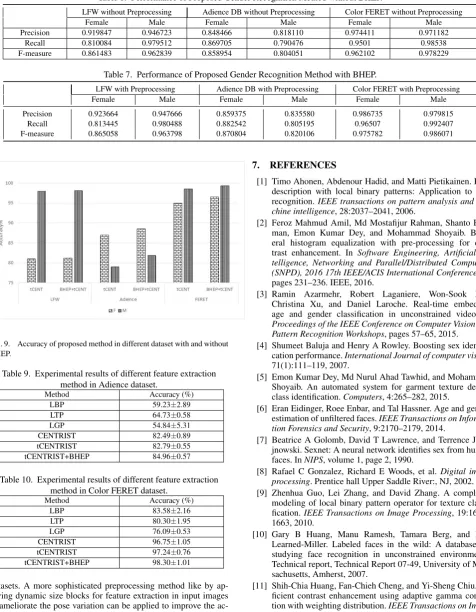
From Table 5 we can see that using BHEP, accuracy in LFW dataset almost remains same whereas Adience dataset shows a signification improvement in terms of accuracy.
From Table 5 it is clear that in each case our proposed method out-perform state of the arts. Applying BHEP we found better accura-cies on each dataset. Extracting features using tCENTRIST shows 93.75% accuracy and with BHEP it increases to 94.29% in LFW dataset which is better than [32]. Again in Adience dataset pro-posed method shows better accuracy than [3] in both cases. Our method found 97.24% and 98.30% accuracies in Color FERET dataset without using BHEP and with BHEP respectively. Al-though, in [32], the author claimed 98.0% accuracy, they used Color FERET 700 dataset which consider only selected 700 images from the original dataset. But we have experimented on all 2712 images of original Color FERET dataset and found better accura-cies using our proposed system. We have performed 5 fold cross validation.
Table 6 shows the Precision, Recall and F-measure for LFW, Adi-ence and FERET dataset without pre-processing and extracting fea-tures using tCENTRIST. Table 7 shows that the result improves when we applied BHEP before feature extraction.
[image:4.595.79.292.331.461.2]Table 3. Confusion matrix for gender recognition in different dataset without BHEP.
LFW Dataset Adience Dataset Color FERET Dataset
Female Male Female Male Female Male
Female 482 113 1355 203 191 10
Male 42 2008 242 913 5 337
Table 4. Confusion matrix for gender recognition in different Dataset with BHEP.
LFW Dataset Adience Dataset Color FERET Dataset
Female Male Female Male Female Male
Female 484 111 1375 183 194 7
Male 40 2010 225 930 2 340
[image:8.595.314.568.427.605.2]Fig. 6. Round wise accuracy in LFW dataset.
Table 8. Experimental results of different feature extraction method in LFW dataset.
Method Accuracy (%) LBP 82.21±1.05 LTP 83.73±0.59 LGP 79.71±0.83 CENTRIST 92.75±1.33 tCENTRIST 93.57±0.59 tCENTRIST+BHEP 94.29±0.60
traction improve the performance. We can notice that percentages of accuracy in LFW and Adience dataset are better than FERET dataset after use of BHEP. This is because, FERET dataset cap-tured on controlled environment and it contain less illumination and inconsistent lighting problem. LFW and Adience dataset are real life dataset. BHEP corrected the images which were captured on low lighting condition, thus rate of accuracy increased in these two dataset.
6. CONCLUSIONS
In this paper we have proposed a framework for gender recogni-tion in both constrained and unconstrained environment. We have used an image enhancement technique BHEP for preprocessing and feature extraction method tCENTRIST. Using three differ-ent dataset LFW, Adience and FERET we have shown that our proposed framework performs better than several state of the art
Fig. 7. Round wise accuracy in Adience Dataset.
Fig. 8. Round wise accuracy in Color FERET Dataset.
Table 6. Performance of Proposed Gender Recognition Method without BHEP.
LFW without Preprocessing Adience DB without Preprocessing Color FERET without Preprocessing
Female Male Female Male Female Male
Precision 0.919847 0.946723 0.848466 0.818110 0.974411 0.971182 Recall 0.810084 0.979512 0.869705 0.790476 0.9501 0.98538 F-measure 0.861483 0.962839 0.858954 0.804051 0.962102 0.978229
Table 7. Performance of Proposed Gender Recognition Method with BHEP.
LFW with Preprocessing Adience DB with Preprocessing Color FERET with Preprocessing
Female Male Female Male Female Male
Precision 0.923664 0.947666 0.859375 0.835580 0.986735 0.979815 Recall 0.813445 0.980488 0.882542 0.805195 0.96507 0.992407 F-measure 0.865058 0.963798 0.870804 0.820106 0.975782 0.986071
Fig. 9. Accuracy of proposed method in different dataset with and without BHEP.
Table 9. Experimental results of different feature extraction method in Adience dataset.
Method Accuracy (%) LBP 59.23±2.89 LTP 64.73±0.58 LGP 54.84±5.31 CENTRIST 82.49±0.89 tCENTRIST 82.79±0.55 tCENTRIST+BHEP 84.96±0.57
Table 10. Experimental results of different feature extraction method in Color FERET dataset.
Method Accuracy (%) LBP 83.58±2.16 LTP 80.30±1.95 LGP 76.09±0.53 CENTRIST 96.75±1.05 tCENTRIST 97.24±0.76 tCENTRIST+BHEP 98.30±1.01
datasets. A more sophisticated preprocessing method like by ap-plying dynamic size blocks for feature extraction in input images to ameliorate the pose variation can be applied to improve the ac-curacies of current state of the art methods.
7. REFERENCES
[1] Timo Ahonen, Abdenour Hadid, and Matti Pietikainen. Face description with local binary patterns: Application to face recognition.IEEE transactions on pattern analysis and ma-chine intelligence, 28:2037–2041, 2006.
[2] Feroz Mahmud Amil, Md Mostafijur Rahman, Shanto Rah-man, Emon Kumar Dey, and Mohammad Shoyaib. Bilat-eral histogram equalization with pre-processing for con-trast enhancement. In Software Engineering, Artificial In-telligence, Networking and Parallel/Distributed Computing (SNPD), 2016 17th IEEE/ACIS International Conference on, pages 231–236. IEEE, 2016.
[3] Ramin Azarmehr, Robert Laganiere, Won-Sook Lee, Christina Xu, and Daniel Laroche. Real-time embedded age and gender classification in unconstrained video. In Proceedings of the IEEE Conference on Computer Vision and Pattern Recognition Workshops, pages 57–65, 2015. [4] Shumeet Baluja and Henry A Rowley. Boosting sex
identifi-cation performance.International Journal of computer vision, 71(1):111–119, 2007.
[5] Emon Kumar Dey, Md Nurul Ahad Tawhid, and Mohammad Shoyaib. An automated system for garment texture design class identification.Computers, 4:265–282, 2015.
[6] Eran Eidinger, Roee Enbar, and Tal Hassner. Age and gender estimation of unfiltered faces.IEEE Transactions on Informa-tion Forensics and Security, 9:2170–2179, 2014.
[7] Beatrice A Golomb, David T Lawrence, and Terrence J Se-jnowski. Sexnet: A neural network identifies sex from human faces. InNIPS, volume 1, page 2, 1990.
[8] Rafael C Gonzalez, Richard E Woods, et al.Digital image processing. Prentice hall Upper Saddle River:, NJ, 2002. [9] Zhenhua Guo, Lei Zhang, and David Zhang. A completed
modeling of local binary pattern operator for texture classi-fication.IEEE Transactions on Image Processing, 19:1657– 1663, 2010.
[10] Gary B Huang, Manu Ramesh, Tamara Berg, and Erik Learned-Miller. Labeled faces in the wild: A database for studying face recognition in unconstrained environments. Technical report, Technical Report 07-49, University of Mas-sachusetts, Amherst, 2007.
[12] Bongjin Jun, Inho Choi, and Daijin Kim. Local transform fea-tures and hybridization for accurate face and human detection. IEEE transactions on pattern analysis and machine intelli-gence, 35:1423–1436, 2013.
[13] Yeong-Taeg Kim. Contrast enhancement using brightness preserving bi-histogram equalization.IEEE transactions on Consumer Electronics, 43:1–8, 1997.
[14] Svetlana Lazebnik, Cordelia Schmid, and Jean Ponce. Be-yond bags of features: Spatial pyramid matching for recog-nizing natural scene categories. In2006 IEEE Computer Soci-ety Conference on Computer Vision and Pattern Recognition (CVPR’06), pages 2169–2178. IEEE, 2006.
[15] Gil Levi and Tal Hassner. Age and gender classification us-ing convolutional neural networks. In Proceedings of the IEEE Conference on Computer Vision and Pattern Recogni-tion Workshops, pages 34–42, 2015.
[16] Erno Makinen and Roope Raisamo. Evaluation of gen-der classification methods with automatically detected and aligned faces. IEEE Transactions on Pattern Analysis and Machine Intelligence, 30:541–547, 2008.
[17] Choon Boon Ng, Yong Haur Tay, and Bok Min Goi. Vision-based human gender recognition: A survey.arXiv preprint arXiv:1204.1611, 2012.
[18] Timo Ojala, Matti Pietikainen, and Topi Maenpaa. Multires-olution gray-scale and rotation invariant texture classifica-tion with local binary patterns.IEEE Transactions on pattern analysis and machine intelligence, 24:971–987, 2002. [19] P Jonathon Phillips, Hyeonjoon Moon, Syed A Rizvi, and
Patrick J Rauss. The feret evaluation methodology for face-recognition algorithms.IEEE Transactions on pattern analy-sis and machine intelligence, 22:1090–1104, 2000.
[20] P Jonathon Phillips, Harry Wechsler, Jeffery Huang, and Patrick J Rauss. The feret database and evaluation procedure for face-recognition algorithms.Image and vision computing, 16:295–306, 1998.
[21] M. M. Rahman, S. Rahman, M. Kamal, M. Abdullah-Al-Wadud, E. K. Dey, and M. Shoyaib. Noise adaptive binary pattern for face image analysis. In2015 18th International Conference on Computer and Information Technology (IC-CIT), pages 390–395, 2015.
[22] Md Mostafijur Rahman, Shanto Rahman, Emon Kumar Dey, and Mohammad Shoyaib. A gender recognition approach with an embedded preprocessing.International Journal of In-formation Technology and Computer Science (IJITCS), 7:19, 2015.
[23] Ad´ın Ram´ırez Rivera, Jorge Rojas Castillo, and Oksam Chae. Local directional texture pattern image descriptor. Pattern Recognition Letters, 51:94–100, 2015.
[24] Gregory Shakhnarovich, Paul A Viola, and Baback Moghad-dam. A unified learning framework for real time face detec-tion and classificadetec-tion. InAutomatic Face and Gesture Recog-nition, 2002. Proceedings. Fifth IEEE International Confer-ence on, pages 14–21. IEEE, 2002.
[25] Caifeng Shan. Learning local binary patterns for gender clas-sification on real-world face images.Pattern Recognition Let-ters, 33:431–437, 2012.
[26] Karen Simonyan, Omkar M Parkhi, Andrea Vedaldi, and An-drew Zisserman. Fisher vector faces in the wild. InBMVC, page 4, 2013.
[27] Xiaoyang Tan and Bill Triggs. Enhanced local texture feature sets for face recognition under difficult lighting conditions. IEEE transactions on image processing, 19:1635–1650, 2010. [28] Yu Wang, Qian Chen, and Baeomin Zhang. Image enhance-ment based on equal area dualistic sub-image histogram equalization method.IEEE Transactions on Consumer Elec-tronics, 45:68–75, 1999.
[29] Jianxin Wu and Jim M Rehg. Centrist: A visual descriptor for scene categorization.IEEE transactions on pattern analysis and machine intelligence, 33:1489–1501, 2011.
[30] Ramin Zabih and John Woodfill. Non-parametric local trans-forms for computing visual correspondence. In European conference on computer vision, pages 151–158. Springer, 1994.
[31] Baochang Zhang, Yongsheng Gao, Sanqiang Zhao, and Jianzhuang Liu. Local derivative pattern versus local binary pattern: face recognition with high-order local pattern de-scriptor.IEEE transactions on image processing, 19:533–544, 2010.
[32] Wenhao Zhang, Melvyn L Smith, Lyndon N Smith, and Ab-dul Farooq. Gender recognition from facial images: two or three dimensions?JOSA A, 33:333–344, 2016.