RESEARCH ARTICLE
MONTE CARLO INTERPRETATION OF SHIELDING BENCHMARK EXPERIMENT NESDIP AND
ANALYSIS OF ENDF/B-VII.0, JEFF-3.1 AND JENDL-4 IRON AND WATER CROSS SECTIONS
1*
Allaoui O.,
2Chakir M.,
1El Bardouni T.,
1Boukhal H.,
1Kaddour M.,
1Zoubair M., and
El Ouahdani, S.
1
ERSN/LMR, University Abdelmalek Essaadi, Faculty of Sciences, Tetuan, Morocco
2Department of Physics, University Ibn Tofail, Faculty of Sciences, Kenitra, Morocco
ARTICLE INFO ABSTRACT
The pressure vessel is an important component of the nuclear reactor, the knowledge of the fluence of neutron in this part of the reactor during its operation and their associated effects is a key issue. The calculation method and also the cross section data and their treatment, have an important rule to this problem. For this object the NESDIP benchmark where the neutron transports through typical side-shield of a Pressurized Water Reactor (PWR) were performed at AEA technology Winfrith, UK (United Kingdom). In this study we have been interpreted this benchmark using the Monte Carlo transport code MCNPX for the aim to contribute a validation of the method of calculation, and analyse the cross sections, for Iron (56Fe) and water (1H and 16O), presented by: ENDF/B-VII.0, JEFF-3.1 and JENDL-4 libraries. The continuous energy cross section libraries were produced by the nuclear data processing system NJOY99. The principal results required from the benchmark analysis are the calculated-to-measured (C/M) dosimetry reaction rates of 103Rh (n,n’)103mRh monitor, at different depth in a water/iron shield reproducing the ex-core radial geometry of a PWR. The calculations of the NESDIP benchmark experiment showed us that calculation method is effective for the protection study of the REP. And generally, the average C/M ratios obtained are reasonably good when the uncertainties of the measurements are taken into account. The MCNPX code are choosing on the main are used routinely for studying radiation shielding analysis and the fact that feature a rich palette of Variance Reduction (VR) techniques, which play a very important role to reduce the computer required to obtain results of sufficient precision. Some of these VR techniques have been used in the frame of this protection study such as the energy cut-offs (CUT card), the Geometry splitting and Russian roulette (IMP card) and the phase space.
Copyright © Allaoui O., et al. This is an open access article distributed under the Creative Commons Attribution License, which permits unrestricted use, distribution, and reproduction in any medium, provided the original work is properly cited.
INTRODUCTION
The pressure vessel is an important component of the nuclear reactor, the knowledge of the fluence of neutron in this part of the reactor during its operation and their associated effects is a key issue (Song Hui Zheng, 1993). An accurate calculation of neutrons penetration through the side-shield of a Pressurized Water Reactor (PWR) is necessary for the estimation of nuclear heating in the thermal shields and in the Reactor Pressure Vessel (RPV), also for the leakage of the particles in the reactor cavity. For this object the NESDIP benchmark (Armishaw et al, 1986) where the neutron transports through typical PWR was performed at the ASPIS shielding facility of the NESTOR low flux experimental reactor at AEA technology Winfrtith, UK (United Kingdom). This work aims to contribute validation of the method of calculation and analysis of the of cross sections data of 56Fe, 1H and 16O isotopes, of the more recent data libraries: ENDF/B-VII.0, JEFF-3.1 and JENDL-4
*Corresponding author: Allaoui O., ERSN/LMR, University Abdelmalek
Essaadi, Faculty of Sciences, Tetuan, Morocco.
throw the interpretation of the NESDIP benchmark experiment. These isotopes where chosen because they are considered as major elements for constituting the shielding structural components. For this interpretation, a 3-D model of the benchmark studying established by the mean of the continuous energy Monte Carlo code MCNPX (Pelowitz, 2005), which allows simulating all types of interactions and using point-wise cross sections. The principal goal of the NESDIP experiment is the acquisition of benchmark-quality integral neutron data to test shielding transport methods and cross section data used in the calculation of the ex-core fluxes in LWR. Cross sections data from the ENDF/B-VII.0, distributed with the MCNPX code, are used for all the rest of the benchmark structural materials, while only56Fe,1H and16O cross sections data were processed with JEFF-3.1 and JENDL-4 libraries using the processing nuclear data processing system NJOY99
(MacFarlane, 2000, 2002).updated to its patch file “up364”.
Those isotopes were investigated to estimate the effects on the benchmark calculation results.
ISSN: 0975-833X
International Journal of Current Research Vol. 5, Issue, 12, pp.4194-4198, December, 2013
INTERNATIONAL JOURNAL OF CURRENT RESEARCH
Article History:
Received 06thSeptember, 2013 Received in revised form 20thSeptember, 2013 Accepted 08thOctober, 2013 Published online 25thDecember, 2013
Key words:
The pressure vessel, Shielding, NESDIP benchmark, MCNPX, Cross section, NJOY99, Validation, Variance reduction.
RESEARCH ARTICLE
MONTE CARLO INTERPRETATION OF SHIELDING BENCHMARK EXPERIMENT NESDIP AND
ANALYSIS OF ENDF/B-VII.0, JEFF-3.1 AND JENDL-4 IRON AND WATER CROSS SECTIONS
1*
Allaoui O.,
2Chakir M.,
1El Bardouni T.,
1Boukhal H.,
1Kaddour M.,
1Zoubair M., and
El Ouahdani, S.
1
ERSN/LMR, University Abdelmalek Essaadi, Faculty of Sciences, Tetuan, Morocco
2Department of Physics, University Ibn Tofail, Faculty of Sciences, Kenitra, Morocco
ARTICLE INFO ABSTRACT
The pressure vessel is an important component of the nuclear reactor, the knowledge of the fluence of neutron in this part of the reactor during its operation and their associated effects is a key issue. The calculation method and also the cross section data and their treatment, have an important rule to this problem. For this object the NESDIP benchmark where the neutron transports through typical side-shield of a Pressurized Water Reactor (PWR) were performed at AEA technology Winfrith, UK (United Kingdom). In this study we have been interpreted this benchmark using the Monte Carlo transport code MCNPX for the aim to contribute a validation of the method of calculation, and analyse the cross sections, for Iron (56Fe) and water (1H and 16O), presented by: ENDF/B-VII.0, JEFF-3.1 and JENDL-4 libraries. The continuous energy cross section libraries were produced by the nuclear data processing system NJOY99. The principal results required from the benchmark analysis are the calculated-to-measured (C/M) dosimetry reaction rates of 103Rh (n,n’)103mRh monitor, at different depth in a water/iron shield reproducing the ex-core radial geometry of a PWR. The calculations of the NESDIP benchmark experiment showed us that calculation method is effective for the protection study of the REP. And generally, the average C/M ratios obtained are reasonably good when the uncertainties of the measurements are taken into account. The MCNPX code are choosing on the main are used routinely for studying radiation shielding analysis and the fact that feature a rich palette of Variance Reduction (VR) techniques, which play a very important role to reduce the computer required to obtain results of sufficient precision. Some of these VR techniques have been used in the frame of this protection study such as the energy cut-offs (CUT card), the Geometry splitting and Russian roulette (IMP card) and the phase space.
Copyright © Allaoui O., et al. This is an open access article distributed under the Creative Commons Attribution License, which permits unrestricted use, distribution, and reproduction in any medium, provided the original work is properly cited.
INTRODUCTION
The pressure vessel is an important component of the nuclear reactor, the knowledge of the fluence of neutron in this part of the reactor during its operation and their associated effects is a key issue (Song Hui Zheng, 1993). An accurate calculation of neutrons penetration through the side-shield of a Pressurized Water Reactor (PWR) is necessary for the estimation of nuclear heating in the thermal shields and in the Reactor Pressure Vessel (RPV), also for the leakage of the particles in the reactor cavity. For this object the NESDIP benchmark (Armishaw et al, 1986) where the neutron transports through typical PWR was performed at the ASPIS shielding facility of the NESTOR low flux experimental reactor at AEA technology Winfrtith, UK (United Kingdom). This work aims to contribute validation of the method of calculation and analysis of the of cross sections data of 56Fe, 1H and 16O isotopes, of the more recent data libraries: ENDF/B-VII.0, JEFF-3.1 and JENDL-4
*Corresponding author: Allaoui O., ERSN/LMR, University Abdelmalek
Essaadi, Faculty of Sciences, Tetuan, Morocco.
throw the interpretation of the NESDIP benchmark experiment. These isotopes where chosen because they are considered as major elements for constituting the shielding structural components. For this interpretation, a 3-D model of the benchmark studying established by the mean of the continuous energy Monte Carlo code MCNPX (Pelowitz, 2005), which allows simulating all types of interactions and using point-wise cross sections. The principal goal of the NESDIP experiment is the acquisition of benchmark-quality integral neutron data to test shielding transport methods and cross section data used in the calculation of the ex-core fluxes in LWR. Cross sections data from the ENDF/B-VII.0, distributed with the MCNPX code, are used for all the rest of the benchmark structural materials, while only56Fe,1H and16O cross sections data were processed with JEFF-3.1 and JENDL-4 libraries using the processing nuclear data processing system NJOY99
(MacFarlane, 2000, 2002).updated to its patch file “up364”.
Those isotopes were investigated to estimate the effects on the benchmark calculation results.
ISSN: 0975-833X
International Journal of Current Research Vol. 5, Issue, 12, pp.4194-4198, December, 2013
INTERNATIONAL JOURNAL OF CURRENT RESEARCH
Article History:
Received 06thSeptember, 2013 Received in revised form 20thSeptember, 2013 Accepted 08thOctober, 2013 Published online 25thDecember, 2013
Key words:
The pressure vessel, Shielding, NESDIP benchmark, MCNPX, Cross section, NJOY99, Validation, Variance reduction.
RESEARCH ARTICLE
MONTE CARLO INTERPRETATION OF SHIELDING BENCHMARK EXPERIMENT NESDIP AND
ANALYSIS OF ENDF/B-VII.0, JEFF-3.1 AND JENDL-4 IRON AND WATER CROSS SECTIONS
1*
Allaoui O.,
2Chakir M.,
1El Bardouni T.,
1Boukhal H.,
1Kaddour M.,
1Zoubair M., and
El Ouahdani, S.
1
ERSN/LMR, University Abdelmalek Essaadi, Faculty of Sciences, Tetuan, Morocco
2Department of Physics, University Ibn Tofail, Faculty of Sciences, Kenitra, Morocco
ARTICLE INFO ABSTRACT
The pressure vessel is an important component of the nuclear reactor, the knowledge of the fluence of neutron in this part of the reactor during its operation and their associated effects is a key issue. The calculation method and also the cross section data and their treatment, have an important rule to this problem. For this object the NESDIP benchmark where the neutron transports through typical side-shield of a Pressurized Water Reactor (PWR) were performed at AEA technology Winfrith, UK (United Kingdom). In this study we have been interpreted this benchmark using the Monte Carlo transport code MCNPX for the aim to contribute a validation of the method of calculation, and analyse the cross sections, for Iron (56Fe) and water (1H and 16O), presented by: ENDF/B-VII.0, JEFF-3.1 and JENDL-4 libraries. The continuous energy cross section libraries were produced by the nuclear data processing system NJOY99. The principal results required from the benchmark analysis are the calculated-to-measured (C/M) dosimetry reaction rates of 103Rh (n,n’)103mRh monitor, at different depth in a water/iron shield reproducing the ex-core radial geometry of a PWR. The calculations of the NESDIP benchmark experiment showed us that calculation method is effective for the protection study of the REP. And generally, the average C/M ratios obtained are reasonably good when the uncertainties of the measurements are taken into account. The MCNPX code are choosing on the main are used routinely for studying radiation shielding analysis and the fact that feature a rich palette of Variance Reduction (VR) techniques, which play a very important role to reduce the computer required to obtain results of sufficient precision. Some of these VR techniques have been used in the frame of this protection study such as the energy cut-offs (CUT card), the Geometry splitting and Russian roulette (IMP card) and the phase space.
Copyright © Allaoui O., et al. This is an open access article distributed under the Creative Commons Attribution License, which permits unrestricted use, distribution, and reproduction in any medium, provided the original work is properly cited.
INTRODUCTION
The pressure vessel is an important component of the nuclear reactor, the knowledge of the fluence of neutron in this part of the reactor during its operation and their associated effects is a key issue (Song Hui Zheng, 1993). An accurate calculation of neutrons penetration through the side-shield of a Pressurized Water Reactor (PWR) is necessary for the estimation of nuclear heating in the thermal shields and in the Reactor Pressure Vessel (RPV), also for the leakage of the particles in the reactor cavity. For this object the NESDIP benchmark (Armishaw et al, 1986) where the neutron transports through typical PWR was performed at the ASPIS shielding facility of the NESTOR low flux experimental reactor at AEA technology Winfrtith, UK (United Kingdom). This work aims to contribute validation of the method of calculation and analysis of the of cross sections data of 56Fe, 1H and 16O isotopes, of the more recent data libraries: ENDF/B-VII.0, JEFF-3.1 and JENDL-4
*Corresponding author: Allaoui O., ERSN/LMR, University Abdelmalek
Essaadi, Faculty of Sciences, Tetuan, Morocco.
throw the interpretation of the NESDIP benchmark experiment. These isotopes where chosen because they are considered as major elements for constituting the shielding structural components. For this interpretation, a 3-D model of the benchmark studying established by the mean of the continuous energy Monte Carlo code MCNPX (Pelowitz, 2005), which allows simulating all types of interactions and using point-wise cross sections. The principal goal of the NESDIP experiment is the acquisition of benchmark-quality integral neutron data to test shielding transport methods and cross section data used in the calculation of the ex-core fluxes in LWR. Cross sections data from the ENDF/B-VII.0, distributed with the MCNPX code, are used for all the rest of the benchmark structural materials, while only56Fe,1H and16O cross sections data were processed with JEFF-3.1 and JENDL-4 libraries using the processing nuclear data processing system NJOY99
(MacFarlane, 2000, 2002).updated to its patch file “up364”.
Those isotopes were investigated to estimate the effects on the benchmark calculation results.
ISSN: 0975-833X
International Journal of Current Research Vol. 5, Issue, 12, pp.4194-4198, December, 2013
INTERNATIONAL JOURNAL OF CURRENT RESEARCH
Article History:
Received 06thSeptember, 2013 Received in revised form 20thSeptember, 2013 Accepted 08thOctober, 2013 Published online 25thDecember, 2013
Key words:
The benchmark analysis was made based on the calculated-to-measured (C/M) dosimetry reaction rates of 103Rh (n, n’)103m
Rh monitor, at different depth in a water/iron shield reproducing the ex-core radial geometry of a PWR. The detectors cross section data were taken from the International Reactor Dosimetry File IRDF-2002 (Bersillon et al., 2006), and they have been processed into libraries suitable for use with the MCNP code using the NJOY system. Several VR techniques (Richard 2006; Booth, 1985) are available by the MCNP code such as: Transport cut-offs, weight window, Russian roulette and phase space that seems to be appropriate to reduce enormously the computing time. Some of these VR techniques have been used in the frame of this study. The statistical errors obtained were found to be acceptable in all the measurements positions even for those far from the source.
MATERIALS AND METHODS
For the purpose to describing the real geometry as well as the materials composition we are developing our 3-D model of the benchmark study, using the Monte Carlo N-particle transport code MCNPX. This leads to minimize the number of approximations and to highlight the errors linked to nuclear data libraries.
Shielding Benchmark Experiment
The benchmark presented in this report is part of program NESDIP (Nestor Shielding and Dosimetry Improvement Program); it was performed at AEA Winfrith, a division of reactor physics to test the neutron transport in a shield simulating the radial shield of a PWR including the cavity region (Carter Curl 1986; Butler, et al, 1989).
Description of the experiment
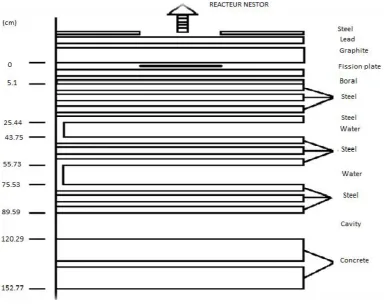
The benchmark NESDIP contains three configurations to simulate different parts of a reactor of the type LWR (Light Water Reactor): the protection radial, cavity and the nozzle assembly, we consider in the calculation only the first part. The protection radial, has a square section of 177.8 x 177.8 cm2, contains a succession stainless steel plates and mild steel submerged in water, two water gap of thickness respectively 18.31 cm and 19.8 cm, it contains also a cavity of thickness 30.7cm. The NESDIP shielding array is shown schematically in Fig. 1. The neutrons are produced in the NESTOR reactor (30 kW max power); they are normalized by a graphite plate and entering in the fission-plate; a fission plate is located within the experimental shield array. The loaded tank is moved into the cave where thermal neutrons leaking from the outer graphite reflector of NESTOR are used to drive the fission plate to provide a well defined neutron source for penetration measurements, the neutron source in the plate of fission is measured, and the fission neutrons then traverse the different thicknesses of the shield. The fissile part (2.9 cm thick with 0.2 cm for fissile material), consisting of an alloy of 1200 grams of aluminum and enriched uranium (93% 235U), is placed between two aluminum plates and back of the graphite plate, The fissile part placed in the center of the plate fission with a radius equal to 56.1 cm. The threshold detector Rh103(n,n')Rh103m are placed at different positions between the steel plates and the two water gap gave the integral measurements (reaction rates) at different depth in a water/iron shield reproducing the ex-core radial geometry of a PWR. The energy threshold of this detector is 1 Mev.
[image:2.595.110.495.454.759.2]and jendl-4 iron and water cross sections
MCNP modeling of NESDIP benchmark
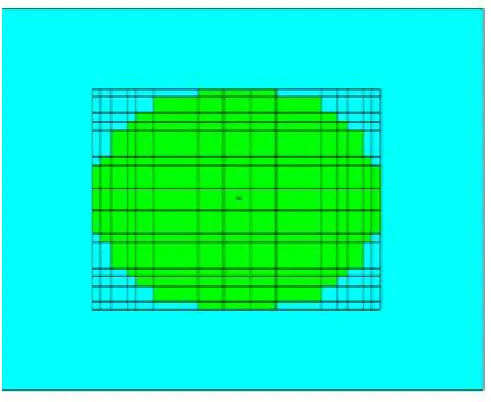
[image:3.595.313.555.48.268.2]This experiment is modelled in 3-D with the maximum of detail of the geometry and the materials composition, and with little uncertainty using the Monte Carlo code MCNP. This model guarantees high level of fidelity in the description of the various features for all the components of the shield and the fission plate. Figure 4and 5 illustrates our model for this shield the axial section of protections benchmark and the plate of fission. Figs. 2 and 3 represent the radial shield and the source plate modelled with MCNPX, respectively.
[image:3.595.42.281.201.443.2]Fig. 2. MCNP model for the radial shield of benchmark NESDIP
Fig. 3. MCNP model for the source plate geometry
Continuous Cross-Section Library Generation
The NJOY Nuclear Data Processing System is a modular computer code designed to construct the continuous cross-section data libraries from the data source files. In this study,
the NJOY99 system with its latest update file ‘‘up364’’ has
[image:3.595.311.555.298.461.2]been used to process the source evaluated nuclear data files
Fig. 4. Density distribution of the neutron flux according XZ in the shield of the benchmark NESDIP
Fig. 5. Density distribution of the neutron flux according XZ in the fission plate of the benchmark NESDIP
Fig. 6. The NJOY modules adopted in the generation of continuous-energy cross section libraries for MCNP code
[image:3.595.42.288.465.666.2] [image:3.595.325.534.502.681.2]using input and output files, plus a very few common variables. The NJOY processing modules used in this study are listed in Fig. 6. The principal advantage of NJOY is its most general-purpose applicability and comprehensive capability to process data in the recent ENDF (the Evaluated Nuclear Data Files) format. It takes the basic data from the nuclear data library and converts them into forms needed for applications. Resonance cross-sections are constructed using a method of choosing the energy grid that incorporates control over the number of grid points generated for some materials. Summation cross-sections are reconstructed from their parts. The resulting point-wise cross-sections are written onto a
‘‘point-ENDF’’ (PENDF) file for future use. BROADR reads a
PENDF file and Doppler-broadens the data. After broadening and thinning, the summation cross-sections are again reconstructed from their parts. The results are written onto a new PENDF file for future use. HEATR computes energy-balance heating and damages energy using reaction kinematics or applying conservation of energy. The ENDF photon production files can be used in this step, when available. GASPR module goes through all of the reactions given in an ENDF-format evaluation, determines which charged particles would be produced by the reaction, and adds up the particle yield times the reaction cross-section to produce the desired gas production cross-sections. THERMR produces point-wise cross- section in the thermal range. Energy-to-energy incoherent inelastic scattering matrices can be computed for free-gas scattering or for bound scattering using a precomputed scattering law in ENDF file. PURR is used to prepare unresolved-region probability tables. To prepares the cross-sections and scattering laws in ACE format (a compact ENDF format) for the MCNP computer code we used the ACER module. All the cross-sections are represented on a union grid for linear interpolation by taking advantage of the representation used in RECONR and BROADR. Finally, the
S(α,β) thermal scattering cross-sections of bound nuclei (H in H2O, C in graphite, the Aluminum and56Fe in the steel) were taken directly from the standard MCNP cross-section library respecting the shielding characteristics of NESDIP. These thermal scattering data are essential to accurately model the neutron interactions at energies below ~4 eV (D. B. Pelowitz, 2005; Sunny et al., 2008).
Overview of Variance Reductions Techniques
The VR techniques are important elements of any Monte Carlo code and may be different for various applications and geometries. These techniques reduce enormously the computing time to obtain results of sufficient precision.
There are four main categories of variance reduction techniques, detailed in the following paragraph.
Truncation Methods: They speed up calculations by truncating parts of space that do not contribute significantly to the solution. The simplest example concerns geometry truncation in which unimportant parts of the geometry are simply not modelled. The energy cutoff, weight cutoff and time cutoff are the specific truncation methods available in MCNPX. In this work, we are interested in energy cutoff (CUT card) as we have threshold detectors.
Population Control Methods: These methods artificially increase the number of particles in spatial or energy regions
that are important or decrease this number in the case it doesn’t
contribute to the score tally. In MCNPX, Geometry splitting and Russian roulette (IMP card) are the specific methods of population control that we used.
Modified Sampling Methods: These methods artificially increase the likelihood of events increasing the particle of interest probability to reach the tally region.
Partially-Deterministic Methods: Are the most complicated class of VR methods. They circumvent the normal random walk process by using deterministic-like techniques, such as next event estimators, or by controlling the random number sequence (Shultis and Faw, 2011).
An excellent overview of classic MCNP VR techniques was given by Booth (Booth, 1985). In our calculation the statistical errors obtained are found to be acceptable in all positions of measurement even for the points which are far from the source, through the use of some VR techniques such as: the phase space , energy cut-off (CUT card) as we have threshold detector and the Geometry splitting and Russian roulette (IMP card).
RESULTS AND DISCUSSION
The reaction rates for the103Rh (n ,n’)103mRh detector and for different nuclear data files of the 56Fe, 16O and 1H isotopes have been calculated with the MCNP code for several positions in the Stainless Steel and the Water constituent the shield of the experiment. Table 1 show the calculated-to-measured (C/M) reaction rates ratios calculated for the different positions in the Stainless Steel and the Water also the average values obtained for the threshold detector used in the NESDIP benchmark experiment, for each nuclear data library used in this study.
and jendl-4 iron and water cross sections
103Rh(n,nᶦ)103mRh
Reference Distance from Fission plate (cm)
ENDF/B-VII.0 56Fe from JENDL.4
56Fe from JEFF-3.1
1H from JENDL.4
1H from JEFF-3.1
16o from JENDL.4
16o from JEFF-3.1
STEEL
5.1
0.87 (±0.4)(a) 0.85(±0.4) 0.86 (±0.39) 0.87 (±0.4) 0.85 (±0.4) 0.86(±0.38) 0.87 (±0.4) 10.18 0.95 (±0.5) 0.92 (±0.51) 0.96 (±0.5) 0.95 (±0.5) 0.95 (±0.0.52) 0.94 (±0.5) 0.96 (±0.51) 15.96 0.93 (±0.7) 0.90 (±0.67) 0.95 (±0.69) 0.93 (±0.69) 0.90 (±0.7) 0.92(±0.7) 0.95 (±0.69) 21.74 0.92 (±0.8) 0.91 (±0.76) 0.93 (±0.75) 0.92 (±0.75) 0.91 (±0.76) 0.92 (±0.8) 0.92 (±0.8)
Water
25.44 0.91 (±1.01) 0.9 (±1.01) 0.94 (±1.00) 0.91 (±0.98) 0.90 (±1.00) 0.92 (±1.01) 0.94 (±0.99) 32.94 0.88 (±1.01) 0.88 (±1.01) 0.92 (±1.01) 0.88 (±1.01) 0.88(±1.01) 0.89 (±1.02) 0.92 (±1.01) 40.04 0.79 (±0.3) 0.78 (±0.3) 0.83 (±0.31) 0.79(±0.3) 0.80(±0.3) 0.80 (±0.3) 0.83 (±0.3)
STEEL
46.75 0.83 (±0.5) 0.80 (±0.51) 0.85 (±0.51) 0.83 (±0.50) 0.81(±0.50) 0.81 (±0.51) 0.84 (±0.51) 52.53 0.82 (±0.7) 0.79 (±0.7) 0.84 (±0.71) 0.82 (±0.72) 0.80(±0.70) 0.80 (±0.73) 0.83 (±0.7)
Average 0.88 0.86 0.90 0.88 0.87 0.87 0.90
) (a
The average C/M dosimetry reaction rates using the cross section of the56Fe and the16O from the JEFF3.1 nuclear data file clearly give s improved results compared with those derived from JENDL.4, while the calculated results using the 1H from JEFF-3.1 and JENDL.4 showed a large similar, within slight discrepancies of 1%, among the two different nuclear data libraries. The103Rh(n, n’)103mRh calculated reaction rates (Table 1) are below experimental values for all the data files this underestimation is more important for the last point of each water gap. The C/M ratios of the dosimetry reaction rates evaluated at all the detector positions of the NESDIP shield with the ENDFB/VII.0 library are similar of those with 1H from JENDL-4, while the results using 56Fe from JENDL-4 showed a tendency to under-predict when compared with the other libraries, with maximum underprediction of 22% in the last point of the water gap obtained for the 56Fe from JENDL.4. As illustrated in Table 1 the calculation results in iron the Steel are significantly better than those calculated in the water, this last point means that the cross sections of the water must be tested, which will be the subject of, a particular benchmark in water.
Conclusion
The calculations of NESDIP experiment performed in the ASPIS shielding facility of the UK, showed us that calculation method (Monte Carlo) is effective for the protection study of the REP. Generally in the NESDIP benchmark, the average C/M ratios obtained for the 103Rh(n, n’)103mRh detector are reasonably good when the uncertainties of the measurements are taken into account, and the effects of using different evaluated nuclear data files were relatively high for 56Fe and 16O data
Acknowledgment
The authors would like to thank the team of Radiation and Nuclear System especially the Professor Tarek El Bardouni for their great scientific advices.
REFERENCES
Armishaw, MJ, et al. "NESTOR Shielding and Dosimetry Improvement Programme," Cavity Nozzle and Coolant Duct Benchmark Blind Test Edition, AEEW-M2334, Reactor Physics Division, AEE Winfrith, July 1986.
Bersillon O., L.R. Greenwood, P.J. Griffin, W. Mannhart, H.J. Nolthenius, R. Paviotti-Corcuera, K.I. Zolotarev, E.M. Zsolnay, P.K. McLaughlin, A. Trkov, International Reactor Dosimetry File 2002 (IRDF-2002), 2006, International Atomic Energy Agency, Vienna, Austria, Technical Reports Series No. 452, ISBN 92-0-105106-9, December 2006.
Booth T.E., “A Sample Problem in VR in MCNP,” Los
Alamos National Laboratory, LA-10363-MS (1985). Butler J., M.D. Carter, I.J. Curl, P.C. Miller, A. Packwood,
S.Power, Review of the NESTOR Shielding and Dosimetry Improvement Programme (NESDIP), Reactor Dosimetry: Methods, Applications, and Standardization, ASTM STP 1001, Harry Farrar IV and E.P. Lippincott Editors, ASTM, Philadelphia 1989, pp. 295-307.
Carter N.D., I. J. Curl, NESTOR Shielding and Dosimetry Improvement Programme. The ASPIS-PCA Slab Geometry Benchmarks. Blind Test Edition. AEEW-W 2329, UKAEA, Winfrith, June 1986 (Corrigenda).
MacFarlane, R.E., 2000. Understanding NJOY, Trieste, 13 March–14 April.
MacFarlane, R.E., 2002. NJOY-99 Nuclear Data Processing System. Los Alamos National Laboratory, Los Alamos, USA.
Pelowitz D. B., “MCNPXTM User’s Manual Version 2.5.0,”
2005.
RICHARD H. OLSHER, 2006. A practical look at Monte Carlo VR methods in radiation shielding. Health Physics Measurements Group, Los Alamos National Laboratory77, 94.
Shultis J. K. and R. E. Faw, “An MCNP Primer,” Kansas State
University, Manhattan, 2011.
Song Hui Zheng : « qualification des méthodes de calculs de fluence dans les réacteurs à eau pressurisées. Amélioration du traitement des sections efficaces par la méthode des tables de probabilité». Thèse de l’Université de Paris-Sud,
numéro d’ordre 2887, Note CEA-N-2745, 1993.
Sunny, C.S., et al. 2008. KAMINI reactor benchmark analysis. Annals of Nuclear Energy 35.