147
Modeling Paths for Explainable Knowledge Base Completion
Josua Stadelmaier and Sebastian Pad´o
Institut f¨ur Maschinelle Sprachverarbeitung University of Stuttgart, Germany
{josua.stadelmaier,sebastian.pado}@ims.uni-stuttgart.de
Abstract
A common approach in knowledge base com-pletion (KBC) is to learn representations for entities and relations in order to infer missing facts by generalizing existing ones. A short-coming of standard models is that they do not
explaintheir predictions to make them verifi-able easily to human inspection.
In this paper, we propose the context path model (CPM) which generates explanations for new facts in KBC by providing sets of
context pathsas supporting evidence for these triples. For example, a new triple (Theresa May, nationality, Britain)may be explained by the path(Theresa May, born in, Eastbourne, contained in, Britain). The CPM is formu-lated as a wrapper that can be applied on top of various existing KBC models. We evaluate it for the well-established TransE model. We ob-serve that its performance remains very close despite the added complexity, and that most of the paths proposed as explanations provide meaningful evidence to assess the correctness.
1 Introduction
Knowledge bases (KBs), such as Freebase ( Bol-lacker et al., 2008), Wikidata (Vrandeˇci´c and Kr¨otzsch,2014) or Yago (Suchanek et al.,2007), are structured representations of knowledge in form of entities and their respective relationships. For example, KBs can comprise facts about persons like their family relations and their occupation or facts about places like the region or country they are located in. A common application of knowl-edge bases is question answering systems (Bordes et al.,2014;Berant et al.,2013). KBs are also used by Google to better understand search queries, to present fact boxes and to provide explorative search suggestions (Steiner et al.,2012).
The major contemporary construction mode for KBs is collaborative, which is both a major advan-tage (as long as community interest persists, KBs
grow over time) and a major shortcoming, since development is not directed. As a result, collabora-tive KBs tend to beincomplete.Min et al.(2013) show that in Freebase 93.8% of persons have no place of birth assigned and for 78.5% of persons, the nationality is missing. This motivates the task of knowledge base completion (KBC), i.e., the ad-dition of correct but missing facts to existing KBs. A common approach for KBC is to learn dis-tributed representations for entities and relations that enable the generalization of existing connec-tions in the KB to predict missing facts (Nickel et al.,2011;Bordes et al.,2013;Yang et al.,2015). A connection could be that the country of birth is highly correlated to the nationality of a given person. A fact about the country of birth could therefore be used as evidence when predicting a missing fact about the nationality. Such represen-tation learning methods typically perform rather well and are simple to train. However, they cru-cially lack in theexplainabilitythat often comes with more symbolic systems: they do not justify the facts that they propose in a way that is transparent to human reviewers of the system output. Explain-ability of system outputs is increasingly recognized as an important component in the practical use of NLP, and more generally, AI systems (Holzinger et al.,2017;Ras et al.,2018;Ribeiro et al.,2018). In this paper, we propose a new KBC model, the Context Path Model (CPM), which pro-vides a path-based explanation for newly pro-posed facts. For example, the path (e1,
city of birth,contained by, e2) states the country the person e1 was born in. This path is in-formative to assess the correctness of the triple
rele-vanceto identify those paths that provide the most convincing evidence for or against the correctness of the fact. The CPM is formulated as a wrapper that can be applied on top of various KBC models that learn a scoring function for individual facts.
We evaluate the CPM instantiated with the estab-lished TransE model as fact scorer on the FB15K dataset. We find that CPM, despite the added com-plexity, performs almost as well as vanilla TransE on scoring facts. The majority of paths assigned a high relevance for a given fact are either equivalent to the fact or provide strong evidence regarding its correctness.1
2 Background and Related Work
2.1 Knowledge Base Completion (KBC)
Knowledge bases are often formalized as a directed graph with labeled edges, here called knowledge graph. A knowledge graphGis a set ofnfacts, or edges, where each edge is defined as a tripletof the form(e1, r, e2)with entitiese1ande2and relation r,G = {ti}ni=1. We denote the set of entities as Eand the set of relations asR. The task of KBC can then be formalized asassessing the correctness
of a triplet /∈G. As usual in studies of KBC, we concentrate on the case wheree1ande2are known, i.e., we add edges, but not nodes, to the graph.
2.2 Representation Learning for KBC
An important current approach to KBC is to learn distributed representations (vectors, matrices, ten-sors) for entities and relations and define algebraic combination operations to score the correctness of novel triplest= (e1, r, e2). This includes models like NTM (Socher et al., 2013), TransE (Bordes et al., 2013), Bilinear (Nickel et al., 2011) and Bilinear-diag (Yang et al.,2015).
For instance, TransE represents relations in the same vector space as entities and models relations as translation frome1toe2. Given respective vector representationse1,e2,r∈Rd, TransE predicts the
entity that stands in relationrtoe1ase1+r. The representations are learned using a max-margin objective which minimizes the distance between e2’s predicted and actual positions,ke1+r−e2k, for correct facts, and maximizes it otherwise.
Research on novel neural architectures for KBC is ongoing.Schlichtkrull et al.(2018) replace
sim-1The model and its annotated predictions for
FB15K are available at https://github.com/ JosuaStadelmaier/CPM
ple embedding lookups byRelational Graph Con-volutional Networkswhich are used as an encoder to learn globally optimized knowledge graph repre-sentations. Shen et al.(2017) propose a dynamic memory architecture that learns to perform infer-ence and represents the current state of the art.
2.3 Modeling Paths for KBC
Several previous studies considered paths as infor-mation sources.Lao and Cohen(2010) use random walk probabilities for paths that connect e1 and e2as features for scoring the correctness of facts
(e1, r, e2).Gardner et al.(2014) generalize the ran-dom walk approach with a relevance-based com-ponent. Unlike the “full” KBC models discussed above, however, these models do not represent enti-ties as vectors, which prevents them from capturing entity specific information and from letting entities directly interact with relations.
Guu et al.(2015) show how vector space models like TransE (Bordes et al.,2013), Bilinear (Nickel et al.,2011) and Bilinear-diag (Yang et al.,2015) can be generalized to not only scoring the correct-ness of edgest = (e1, r, e2)but also the correct-ness of paths p = (e1, r1, ..., rk, e2). They pro-pose a training objective that incorporates paths and demonstrate that it improves the performance of KBC models on predicting paths and on predict-ing spredict-ingle edges as well. In the case of TransE, the relationsr1, ..., rk of a pathpcan be represented
by their composition rp = r1 +...+rk. The
distance computed by TransE can then be gener-alized to paths aske1+rp−e2k. The objective proposed byGuu et al. encourages thate1+rp
is learned to be close to the set of entities that are reached when traversing the knowledge graph over the edgesr1, ..., rk, starting frome1.
efficient algorithm to incorporate paths.
2.4 Providing Explanations for KBC
One possibility to provide explanations for KBC predictions is to generate logical rules. In the lit-erature, these rules are often formalized as Horn rules (Gusm˜ao et al.,2018) such as(e1, r1, e2)∧
(e2, r2, e3) → (e1, r3, e3). This rule claims that the path with the relation sequencer1, r2between e1 ande2 implies the presence of the relationr3 between the two entities.
Gal´arraga et al.(2013) propose the system AMIE which mines such rules. Their approach is to adapt association rule mining to incomplete knowledge bases. Rules are assigned confidence values that state how likely the conclusion of the rule is a cor-rect triple. While this can be used to predict and explain new facts based on a single rule, there is no clear way of combining several rules that all have the same triple as conclusion. Furthermore, these rules only make a statement about triples that actually occur in the conclusion of a rule. The rules found byGal´arraga et al. always have a pos-itive conclusion and therefore cannot provide ev-idence for refuting triples. In contrast, represen-tation learning can capture the characteristics of individual entities and can take arbitrary triples as input, provided that the involved entities and rela-tions occur in the training set.
There are several studies that analyze learned representations of neural KBC models like TransE or Bilinear-diag to find Horn rules (Yang et al., 2015) or paths in the knowledge graph (Zhang et al., 2019). While similar in motivation to our model, these approaches share the disadvantage of using a pipeline approach: The rules or paths are extracted
post hocand cannot be used by the representation learning step to improve the consistency of its pre-dictions, as would be desirable.
Xie et al.(2017) propose a neural KBC model that provides an alternative kind of explainability: it learns sparse attention vectors which capture ab-stract concepts shared by multiple relations. Due to the sparsity of attention vectors, the connections can be visualized and interpreted.
3 Context Path Model
As stated in the introduction, the main idea of our Context Path Model (CPM) is to capture the context of a triplet= (e1, r, e2)in the shape of the paths surroundingt. The role of the paths is as a data
source for estimating the correctness oftas well as providing explanations for the estimate.
3.1 Motivation
Formally, we define a path of length k as a sequence of the form(e1, r1, ..., rk, e2). Our fundamental
in-tuition is that the correctness of triples and paths in their context can show differentdegrees of correla-tion, as the following examples illustrate.
Example 1: The triple t1 = (e1,country of birth, e2) and the pathp1 = (e1,city of birth,
contained by, e2)are logically equivalent. Thus, any KBC model of correctness should assign the same score to p1 and t1: If a KB containsp1, it should also containt1. Conversely, the absence of p1can be taken as evidence againstt1.
Example 2: The path p2 = (e1,
lived in country,neighboring country, e2) has a weak connection witht1: it is not unlikely to have lived in a country that adjoins the country of birth. However, as countries very often have several neighboring countries, p2 cannot provide strong evidence either for or against the correctness oft1.
We currently concentrate on cases of positive correlation, like Ex. 1, where either the presence ofpis evidence in favor oft, or the absence ofpis evidence againstt. 2 Even though negative corre-lation (e.g., the presence ofpproviding evidence againstt) is in principle also informative, it is more difficult to capture empirically, since it requires learning exclusion relationships among paths.
3.2 Definition of the Context Path Model
To capture those connections, a KBC model needs to score thecorrectnessof paths as well as deter-mine theirrelevanceas indicator for the correctness of triplest, that is, the strength of the correlation of the correctness scores ofpandt.
We denote the set of paths that are used to model the context of a triplet, itscontext pathsasPt(see
Section 3.4for details). Based on Pt, the CPM
estimates the correctness oft,c(t, Pt), as follows:
c(t, Pt) =
X
p∈Pt
ρ(t, p)
Z(t, Pt)
·c(p), (1)
Z(t, Pt) =
X
p∈Pt
ρ(t, p). (2)
2Absence of paths from a KB is a weaker indicator than
Thus, the correctness of a triple t is a weighted average of thecorrectness scoresc(p)of its context paths, with the weights given by the normalized
relevance scoresρ(t, p)of pathspfort, that is, the correlation between the correctness oftandp.
Since we want c(p) to be interpretable as the probability ofpbeing correct, we restrict the range of c(p) to [0,1]. We only require ρ(t, p) to be non-negative, since the division by Z(t, Pt)
di-rectly yields normalized relevance scores. The property ofc(p)being normalized carries over to c(t, Pt)which also has a range of[0,1].
Appropri-ate choices forc(p)andρ(t, p)are discussed in the following subsubsections.
Applied to Ex. 1 from above, the path p1 = (e1,city of birth,contained by, e2) should be as-signed a high relevance score ρ(t1, p1). If p1 is correct, c(p1) should be close to 1. A high rel-evance score combined with a high correctness scores pushesc(t1, Pt1)towards1. Ifp1is not
cor-rect,c(p1)should be close to 0. In this case a high relevance score is combined with a low correctness score, which pushesc(t1, Pt1)towards0. Both
ef-fects match the intended meaning ofc(t1, Pt1)to
represent the correctness oft1. In Ex. 2, the pathp2 has a low relevance fort1and should be assigned a low relevance scoreρ(t1, p2). Since correctness scores are restricted to[0,1], the effect ofc(p2)on c(t1, Pt1) is small, whetherc(p2) is high or low.
This properly models that the correctness ofp2has little effect on the correctness oft1.
The CPM can serve as a source of explanations for its predictions by considering the context paths that have the highest relevance scores for a triple t. By normalizing relevance scores by Z(t, Pt)
(Equation2), we obtain the normalized weight with which the correctness of a context path contributes to the correctness score of the triple. Furthermore, ifc(p) ≈1,prepresents evidence in favor of the correctness of t, and if c(p) ≈ 0, p is evidence against the correctness oft.
3.2.1 Estimating Context Paths Correctness
The first major parameter of the CPM is the context path correctness scorec(p), which is required to have two properties: It needs to be able to model paths and its output has to lie in [0,1]. The first property is fulfilled by allcomposableKBC models like TransE (Bordes et al.,2013), Bilinear (Nickel et al.,2011) and Bilinear-diag (Yang et al.,2015), that is, models which can produce a functional representationrpfor a pathpas a function of the
representation of its edges. Regarding the second property, models that are distance-based and do not directly fulfill it, can be adapted as follows. Since they are composable, we can compute the distance between the end of the path,e2, and the path representation applied to the start of the path, asdist(e2, f(e1,rp)), and map it to [0,1]via a
logistic transformationσof the negated distance. For the example of the TransE model (Bordes et al.,2014), the path representation is simply a translation defined by the addition of the relation vectors, rp = Pri∈pri and f = λx, y . x+y.
The correctness score for a path is then defined as a transformation of the distance:
c(p) =σ(−ke1+rp−e2k22+b|1rp) (3)
whereb1 ∈ Rdis a path-specific bias parameter.
This model hasd·(|R|+|E|+ 1)parameters.
3.2.2 Estimating Context Path Relevance
The second major parameter of the CPM is the con-text path relevance scoreρ(t, p). To our knowledge, no such models have been proposed in the litera-ture, so we propose a simple model which is again inspired by the translation-based TransE model. To estimateρfor a pathp= (e1, r1, ..., rk, e2)and a triplet, we represent the path as sequence of rela-tionsr1, ..., rkin order to abstract away from the
entitiese1ande2 and learn general regularities.3 We represent each relationrby one vectorar ∈Rd
in order to recognize patterns in the compositional path representationrpthat indicate how relevant
the pathp is for the relationr. The exponential function is applied to obtain non-negative scores:
ρ(t, p) = exp(a|rrp+b|2r) (4)
whereb2 ∈ Rd is a bias parameter to enable
re-lation specific scaling of a|rrp. This model has
d·(|R|+ 1)parameters.
3.3 Training the Context Path Model
We split the training process into two steps to first learn the parameters ofc(p)and then the param-eters ofρ(t, p). Learningρ(t, p)andc(p)jointly could lead toc(p)being influenced by the relevance ofpfort, which is undesirable since we want to guarantee thatc(p)is interpretable in terms of the correctness ofp.
Trainingc(p). Following the training regimen of Guu et al.(2015), we first trainc(p)on the edges of the knowledge graphGbefore training it on longer paths. This gives the model the opportunity to build up paths from meaningful edges.
We train c(p) on a standard contrastive cross-entropy loss that provides a good fit for the proba-bilistic interpretation ofc(p)that we aim for:
−X
p∈P
logc(p)
|P| −
X
p0∈P0
log(1−c(p0))
|P0| (5)
whereP is the set of correct paths andP0 a set of corrupted paths. For single edge training, we use P =G. In the subsequent path training, we sample a set of positive informative pathsP as described below in Section3.4.
We also need to generate a set of negative sam-ples P0, which we generate in the same way as Guu et al. (2015) by type-matched corruption– see Section 4.2 for a discussion. Given a path p= (e1, r1, . . . , rk, e2), letF(p)be the set offinal entitiesofpthat can be reached when traversingG via the relationsr1, . . . , rkstarting frome1. We are guaranteed to corruptpif we replacee2with any entitye02 ∈ F/ (p)but matches the type ofrk, i.e.,
e02∈D2(rk), with theright domainD2(r)defined as:
D2(r) = {e2 | ∃e1 : (e1, r, e2)∈G} (6)
Analogously, we define I(p)as the set of initial entitiesof p. We corrupte1 by replacing it with an entity in D1(r1) \ I(p), where D1(r) is the analogousleft domainofr. In the case of TransE, the parameters to be updated are allei,rjas well
asb1(cf. Equation (3)).
Training ρ(t, p). The relevance scores ρ(t, p)
use a similar cross-entropy loss based onc(t, Pt):
−X
t∈G
logc(t, Pt)
|G| −
X
t0∈G0
log(1−c(t0, Pt0))
|G0| (7)
whereG, the KB, is the set of correct triples and G0is a set of triples with eithere1ore2corrupted as above. The objective aims to assign correct triples a score of 1 and incorrect triples a score of 0, which, together with the fixed semantics of c(p), encouragesρ(t, p)to estimate the relevance of pathspfort. Only the parameters ofρ, namely
arandb2(compare Equation (4)) are updated.
3.4 Selecting Context Paths
The final part of the Context Path Model (CPM) is theselection of informative context paths. Since the number of paths grows exponentially in the path length, it is infeasible to include all paths in the CPM. We now propose several criteria to limit the set of informative context pathsPtfor a given
triplet= (e1, r, e2)to keep the model tractable.
Closed paths. Paths that connect the two entities of a triple express a semantic relation between them. We therefore restrict paths to start withe1and end withe2, i.e., to be closed paths.
Limited length. We limit path lengths tok≤3. This effectively reduces the number of potential paths and keeps the paths betweene1ande2 rela-tively easy to understand.
Filtering redundant paths. To be able to tra-verse edges of the knowledge graph in both direc-tions, we need to add the inverse edge(e2, r−1, e1)
for each edge(e1, r, e2) ∈ G to the knowledge graph G. This has the unwanted consequence that we obtain redundant paths which comprise two successive, mutually inverse relations like(e1,
country of birth,contains,contains−1, e2) which is judged to be highly relevant forcountry of birth
but for trivial reasons.
We consider the domains D1(ri) and D2(ri)
(compare Equation (6)) to filter out trivial paths effectively. A path(e1, r1, ..., rk, e2)is defined as
trivial ife1occurs in any domain of r1, ..., rk
ex-ceptD1(r1)ore2in any domain exceptD2(rk).
This general definition has the benefit of cap-turing cases of redundant paths caused by rela-tions in the KB that are semantically, but not for-mally, inverses – such as the relationscontainsand
contained by. It can also be too strict: E.g., the context pathp = (e1,mother of,mother of, e2)
for the triplet = (e1,grandmother of, e2) is ex-cluded if the mother ofe2participates in the rela-tiongrandmother of. This does however not pose a major problem in practice.
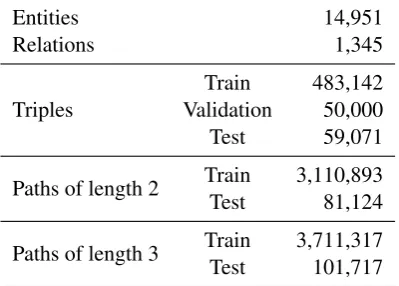
Entities 14,951
Relations 1,345
Triples
Train 483,142
Validation 50,000
Test 59,071
Paths of length 2 Train 3,110,893
Test 81,124
Paths of length 3 Train 3,711,317
[image:6.595.82.282.64.207.2]Test 101,717
Table 1: Statistics on the FB15K dataset
Assuming the first three criteria described above, letPrbe the set of correct context paths
correspond-ing to all triples(e1, r, e2)for a fixed relationr. Let furthermoreSrbe the set of relation sequences
oc-curring in pathsp = (e1, r1, ..., rk, e2)∈ Pr. We
can then define the set of context pathsPt:
Pt={p|(r1, ..., rk)∈Sr∧I(p)∪F(p)6=∅} (8)
In addition to the positive informative paths de-scribed so far,Ptcontains incorrect paths that
con-necte1 ande2 by corrupted relation sequences that conform to the criteria described above. The use of relation sequences that occur in context paths of other facts about the same relation makes it more likely that incorrect paths are relevant fort.
4 Experimental Evaluation
4.1 Dataset
We evaluate our approach on the FB15K dataset extracted byBordes et al.(2013) from the FreeBase knowledge base. Table 1 shows the statistics of this dataset, including the number of context paths according to the definition in Section3.4.
4.2 Experimental Setup
We instantiate the edge scoring model of CPM with the TransE model (Bordes et al.,2013), as shown in Eq. (3). We follow the two-step training regimen as described in Section3.3. We train100-dimensional vectors for all representations learned by the model (cf. Section3.2). Optimization proceeds by apply-ing the gradient-based optimizer Adam (Kingma and Ba,2015) to minibatches of size 300. We use the learning rate of 0.001 for all parts of the model with the exception of c(p) during path training, where we use 0.0001 based on performance on the validation set.
Choice of negative samples. Since KBs ideally contain only correct information, KBC methods generally need to generate incorrect samples syn-thetically. This is generally done by corrupting either the first entitye1 or the last entitye2 in a pathpto obtain negative samplesN(p). Negative samples are used as parts of the ranking problems both at train time (cf. Section3.3) and at test time. The generation of negative samples is therefore a crucial part of the experimental setup. Unfortu-nately, there is little consensus on the details of the process in the literature. We discuss the two major approaches below.
The first approach,random corruption, corrupts paths by replacinge1ore2by random entities from the KB (Bordes et al.,2013;Yang et al.,2015). The advantage of this approach is that a large number of negative samples can be generated easily – at the same time, most corrupted paths are arguably not particularly plausible confounders, as when a person is replaced by a country or a record. An al-ternative approach,type-matched corruption(Guu et al.,2015), employs only confounders seen with the same sequence of relations as the original entity (cf. Section3.3for a formal definition). This gen-erally ensures that the confounders are plausible. On the downside, there are typically fewer such confounders.
For our study, we adopt the type-matching cor-ruption setup, which we find more appropriate in the context of explainable KBC. For negative sam-ples with incorrect types, the most natural reason for rejection is simply the domain mismatch, while the type-matching setting requires the models to capture fine-grained semantics within domains.
As a result, the evaluation numbers that we re-port are not directly comparable to numbers ob-tained with the random corruption approach, and tend to be higher. This is because the smaller num-bers of negative samples lead to simpler ranking problems. The average size ofN(t)for FB15k test triplestis 1,738 in the type-matching setting and 29,543 in the setting without type-matching. As negative samples from the training can end up in
N(t)for test triplest, the average number of un-seen negative samples inN(t)is 765 in our setup.
Model Training H@10 MQ
TransE Edges 90.2 97.5
TransE Paths 84.2 (-6.7%) 97.1 (-0.4%)
CPM Paths 83.1 (-7.9%) 96.7 (-0.8%)
[image:7.595.322.512.63.147.2]CPM\t Paths 80.0 (-11.3%) 96.2 (-1.3%)
Table 2: Results for Evaluation 1 (fact correctness). Numbers in brackets give relative deterioration com-pared to TransE (edge). CPM\tis the CPM ignoring all information about the target triple itself.
4.3 Evaluation 1: Fact Correctness
We carry out three evaluations. We start with the traditional task of predicting individual facts (edges). We directly define the evaluation metrics for paths rather than facts for re-use in Evaluation 2 at the path level. The metrics apply to edges be-cause they are paths of length 1.
Evaluation metric. We apply the commonly used ranking metrichits at 10(H@10), which is defined as the percentage of correct paths that are ranked within the top 10 of their respective neg-ative samples. Additionally, we use the metric
mean quantile(MQ), proposed byGuu et al.(2015), which computes the share of incorrect paths ranked lower than the correct path:
M Q= 1
|P|
X
p∈P
|{p0 ∈ N(p)|c(p0)< c(p)}| |N(p)| (9)
In contrast to H@10, MQ accounts for the size of
N(p). For1≤ |N(p)| ≤9, H@10 always outputs
1. In the fact correctness evaluation, this is the case for 1.5% of used test facts. We exclude 1143 facts with |N(p)| = 0 from the test set because both H@10 and MQ always output 1 in these cases.
Results. Table2presents the results of the rank-ing evaluation for fact prediction. We compare the full CPM model against TransE, the edge scorer “inside” our CPM (cf. Section4.2), in both its edge-trained and path-edge-trained versions4(cf. Section3.3). We also consider CPM\t, a variant of the CPM that excludestfrom Pt, that is, does not use any
information about the predicted triple. This model examines to which degree the correctness of triples tcan be predicted purely on the basis of its KB context. This gives us four models to compare.
4TransE can be seen as a special case of the CPM when all
paths except for the triple itself are assigned a relevance of 0. The reported TransE scores are measured on the instantiation ofc(·)with TransE.
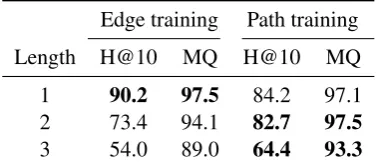
Edge training Path training
Length H@10 MQ H@10 MQ
1 90.2 97.5 84.2 97.1
2 73.4 94.1 82.7 97.5
[image:7.595.72.294.64.142.2]3 54.0 89.0 64.4 93.3
Table 3: Results for Evaluation 2 (path correctness), varying path length and training regimen. Best results for each length shown in boldface.
We find that the CPM performs somewhat worse than the best model overall, the edge-trained TransE, for both metrics: the drop is noticeable for H@10, and mild for MQ. We believe that the drop is primarily due to two factors: First, path training gives rise to a different optimization prob-lem from edge training, which appears to be more difficult on the FB15K dataset.5 In fact, as the second row shows, training the original TransE on paths leads to a comparable drop in H@10. Second, the bad results for CPM\t, which are still substan-tially worse than for the plain CPM, indicate that, unsurprisingly, the most important source of infor-mation for the prediction of a single triple is the semantics of the triple itself. In other words, the contextual component that CPM adds does not pro-vide additional support to single edge prediction at the technical level (we consider the produced justifications in the third evaluation).
In sum, CPM introduces a mild loss of quality in the prediction of individual facts. Given that the CPM has a more complex objective – modeling the correctness of facts/paths as well as modeling justi-fications – we see this nevertheless as a promising first evaluation result.
4.4 Evaluation 2: Path Correctness
The second evaluation concentrates on the CPM and its performance on the task it is designed for, namely predicting the correctness of longer paths. Table 3 shows results separated by path length (1 through 3). The results for path length 1 are, by definition, identical to the corresponding conditions in Evaluation 1, with an advantage for single-edge training. This effect reverses for the longer paths: while the edge-trained model loses substantially in quality because it fails to capture dependencies among edges, the path-trained model holds up well
5Path training appears to be beneficial on other datasets,
for longer paths. We see these results as valida-tion of our choice of a path-based training regimen (Section3.3).
4.5 Evaluation 3: Path Relevance
Our third evaluation focuses on relevance, that is, the relation between paths and the triples that they are supposed to provide evidence for or against. Since our goal is to use these paths as human-interpretable justifications for the triples, we per-form a small annotation study of the CPM output.
Dataset. We manually select 24 relations for an-notation whose relevance can arguably be judged without in-depth expertise of specific domains. The selected relations account for 13.2% of the facts in the test set. For each relation, we randomly sam-ple two correct facts from the test set and obtain incorrect facts by corrupting eithere1ore2. This results in 48 positive and 48 negative facts. We furthermore exclude 17 triples for which no path (other than the trivial t itself) was found with a normalized relevance score of at least 10%. For the remaining 79 triples, we annotate all paths with a normalized relevance score of at least 5% – again, with the exception oftitself. We also do not con-sider paths with relations from the FB15K domains
dataworldandcommonsbecause they encode only KB-specific meta information. This results in on average 2.45 context paths annotated per triple, ac-counting for 80% of the assigned relevance scores.
Annotation. As motivated in Section3.1, the rel-evance of context pathsPtdescribes how strongly
their correctness is correlated with the correctness oft. In the annotation we distinguish between three levels (categories) of relevance:
1. Equivalent:The correctness ofpis logically equivalent to the correctness oft.
2. Probable: The path p being correct makes the correctness oftsignificantly more likely, orpbeing incorrect makes the correctness oft significantly less likely. However,pprovides no guarantee for the (in-)correctness oft.
3. Unrelated:The correctness ofpandtare not strongly correlated. This class comprises all cases that are not in category 1 or 2.
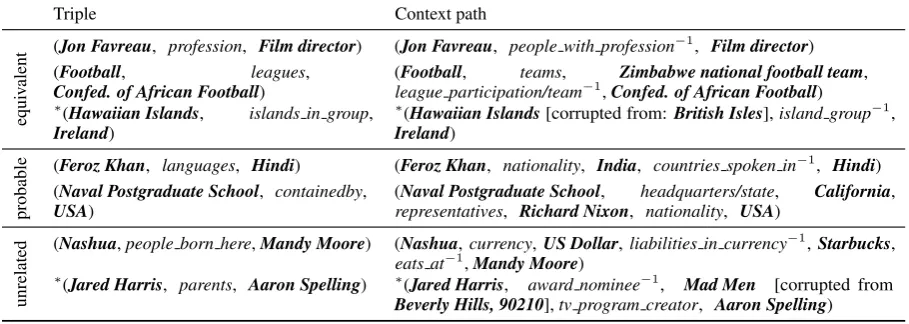
Qualitative Analysis. Table4shows examples of the three annotated categories, both for positive cases (presence ofpsupportst) and negative cases
(absence ofpcasts doubt int). Negative cases are marked with asterisks (∗), and since all absent paths are corrupted versions of paths in the KB, the point of corruption is marked as well.
The ’equivalent’ category shows two cases of equivalence between two Freebase relations – one positive (profession is supported by
peo-ple with profession−1) and one negative ( is-lands in groupis implausible if not accompanied byisland group−1) – as well as one case of mu-tual entailment (the CAF has a football league iff there is a team that is a football team and plays in the CAF). The ’probable’ category contains cases of defeasible inferences – e.g., Hindi is the most widely spoken language in India, but only by just over half of the population. The ’unrelated’ cat-egory, finally, shows some paths that are largely irrelevant for their facts (e.g., someone is born in a place vs. someone often eats at a restaurant that uses the same currency as the birth place). The examples demonstrate that CPM is indeed capable of capturing meaningful relations between triples and the paths in its context.
Quantitative Analysis. Table5shows that just over half of all pairs we consider falls into the ’equivalent’ category. These pairs are assigned a mean relevance of 0.47, and their share of the total sum of relevance scores is 72%. Another quarter of the annotated pairs falls into the ’probable’ cate-gory, with a considerably lower mean relevance of 0.15, and a share of 15% of the relevance scores. The final quarter of pairs makes up the ’unrelated’ category, with similar mean relevance and share of relevance scores.
We see this outcome as rather positive: about half of the paths identified by the CPM are equiva-lent to the triple in question, with another quarter providing probable evidence. Furthermore, the rel-evance scores manage very well to separate the ’equivalent’ and ’probable’ categories. The
sepa-ration between ’probable’ and ’unrelated’ is weak, but may be due to our exclusion of the lowest-relevance paths from annotation (see above): these would arguably mostly be mostly ’unrelated’ and thus decrease the mean relevance for this category.
5 Conclusion
Triple Context path
equi
v
alent
(Jon Favreau, profession, Film director) (Jon Favreau, people with profession−1, Film director)
(Football, leagues,
Confed. of African Football)
(Football, teams, Zimbabwe national football team, league participation/team−1,Confed. of African Football) ∗
(Hawaiian Islands, islands in group,
Ireland)
∗
(Hawaiian Islands[corrupted from: British Isles],island group−1,
Ireland)
probable
(Feroz Khan, languages, Hindi) (Feroz Khan, nationality, India, countries spoken in−1, Hindi) (Naval Postgraduate School, containedby,
USA)
(Naval Postgraduate School, headquarters/state, California, representatives, Richard Nixon, nationality, USA)
unrelated
(Nashua,people born here,Mandy Moore) (Nashua,currency,US Dollar,liabilities in currency−1, Starbucks, eats at−1,Mandy Moore)
∗
(Jared Harris, parents, Aaron Spelling) ∗(Jared Harris, award nominee−1, Mad Men [corrupted from
[image:9.595.71.526.64.226.2]Beverly Hills, 90210],tv program creator, Aaron Spelling)
Table 4: Examples of triple–path pairs, with entities in boldface, and simplified freebase relations. Incorrect triples/paths marked with∗, and point of corruption marked.
Annotation category equiv. prob. unrel.
Number of pairs 98 49 47
Share of pairs 51% 25% 24%
Mean Relevanceρ 0.47 0.15 0.12
Share of totalP
ρ 72% 15% 13%
Table 5: Statistics for annotated triple–path pairs
by identifying context paths which are highly corre-lated with the fact: if the path is in the KB, then the triple should be as well; conversely, if the path is not in the KB, then the triple should not be either. We demonstrate the usefulness of our model by instantiating its fact scorer with a simple but ef-fective KBC model, TransE (Bordes et al.,2013). We find that the performance of the CPM is close to TransE, and manual evaluation confirms that most of the paths the model uses as explanation are meaningful and provide evidence for assessing the correctness of facts. This shows the potential of using paths as explanations for KBC predictions.
Beyond the KBC setting, the output of the CPM can also arguably be useful for a structural analysis of knowledge bases, for example the systematic identification of equivalences among relations or between relations and paths, to improve the consis-tency of the KB, e.g., by replacing equivalent paths by a canonical version.
The current study has three main limitations. First, we only apply the CPM to TransE. Future work should investigate the practical usefulness of the CPM for other composable KBC models like Bilinear-diag. Second, we use strong heuristics to limit the set of paths under consideration;
fu-ture work should attempt to relax these. Third, the current CPM can only capture paths that are sym-metrically (cor-)related with the fact in question, corresponding to strict or probabilistic entailment. A promising avenue for future work is to general-ize the model to asymmetrical relations, i.e., find paths that represent (just) necessary or sufficient conditions for a fact, in order to enable a more com-prehensive analysis of the inferential structures in KBs (Hitzler et al.,2009).
References
Jonathan Berant, Andrew Chou, Roy Frostig, and Percy Liang. 2013. Semantic parsing on Freebase from question-answer pairs. InProceedings of the Con-ference on Empirical Methods in Natural Language Processing, pages 1533–1544, Seattle, WA.
Kurt Bollacker, Colin Evans, Praveen Paritosh, Tim Sturge, and Jamie Taylor. 2008. Freebase: A col-laboratively created graph database for structuring human knowledge. InProceedings of the ACM SIG-MOD International Conference on Management of Data, pages 1247–1250, Vancouver, Canada.
Antoine Bordes, Nicolas Usunier, Alberto Garcia-Duran, Jason Weston, and Oksana Yakhnenko. 2013. Translating embeddings for modeling multi-relational data. InProceedings of the International Conference on Neural Information Processing Sys-tems, pages 2787–2795.
Luis Antonio Gal´arraga, Christina Teflioudi, Katja Hose, and Fabian Suchanek. 2013. Amie: Associ-ation rule mining under incomplete evidence in on-tological knowledge bases. In Proceedings of the International Conference on World Wide Web, pages 413–422, Rio de Janeiro, Brazil.
Matt Gardner, Partha Talukdar, Jayant Krishnamurthy, and Tom Mitchell. 2014. Incorporating vector space similarity in random walk inference over knowledge bases. InProceedings of the Conference on Empiri-cal Methods in Natural Language Processing, pages 397–406, Doha, Qatar.
Arthur Colombini Gusm˜ao, Alvaro Henrique Chaim Correia, Glauber De Bona, and F´abio Gagliardi Cozman. 2018. Interpreting embedding models of knowledge bases: A pedagogical approach. In Pro-ceedings of the ICML Workshop on Human Inter-pretability in Machine Learning.
Kelvin Guu, John Miller, and Percy Liang. 2015. Traversing knowledge graphs in vector space. In
Proceedings of the Conference on Empirical Meth-ods in Natural Language Processing, pages 318– 327, Lisbon, Portugal.
Pascal Hitzler, Markus Krotzsch, and Sebastian Rudolph. 2009. Foundations of semantic web tech-nologies. CRC Press.
Andreas Holzinger, Chris Biemann, Constantinos S. Pattichis, and Douglas B. Kell. 2017. What do we need to build explainable AI systems for the medi-cal domain? CoRR, abs/1712.09923.
Diederik P. Kingma and Jimmy Ba. 2015. Adam: A method for stochastic optimization. InProceedings of the International Conference on Learning Repre-sentations, San Diego, CA.
Ni Lao and William W. Cohen. 2010. Relational re-trieval using a combination of path-constrained ran-dom walks.Machine Learning, 81(1):53–67.
Yankai Lin, Zhiyuan Liu, Huanbo Luan, Maosong Sun, Siwei Rao, and Song Liu. 2015. Modeling rela-tion paths for representarela-tion learning of knowledge bases. InProceedings of the Conference on Empiri-cal Methods in Natural Language Processing, pages 705–714, Lisbon, Portugal.
Bonan Min, Ralph Grishman, Li Wan, Chang Wang, and David Gondek. 2013. Distant supervision for re-lation extraction with an incomplete knowledge base. InProceedings of the Conference of the North Amer-ican Chapter of the Association for Computational Linguistics, pages 777–782, Atlanta, GA.
Maximilian Nickel, Volker Tresp, and Hans-Peter Kriegel. 2011. A three-way model for collective learning on multi-relational data. InProceedings of the International Conference on Machine Learning, pages 809–816, Bellevue, WA.
Gabri¨elle Ras, Marcel van Gerven, and Pim Haselager. 2018. Explanation methods in deep learning: Users, values, concerns and challenges. InExplainable and Interpretable Models in Computer Vision and Ma-chine Learning, pages 19–36. Springer.
Marco Tulio Ribeiro, Sameer Singh, and Carlos Guestrin. 2018. Anchors: High-precision model-agnostic explanations. InProceedings of the AAAI Conference on Artificial Intelligence, New Orleans, LA.
Michael Schlichtkrull, Thomas N. Kipf, Peter Bloem, Rianne van den Berg, Ivan Titov, and Max Welling. 2018. Modeling relational data with graph convolu-tional networks. InThe Semantic Web, pages 593– 607. Springer.
Yelong Shen, Po-Sen Huang, Ming-Wei Chang, and Jianfeng Gao. 2017. Modeling large-scale struc-tured relationships with shared memory for knowl-edge base completion. In Proceedings of the 2nd Workshop on Representation Learning for NLP, pages 57–68, Vancouver, Canada.
Richard Socher, Danqi Chen, Christopher D. Manning, and Andrew Y. Ng. 2013. Reasoning with neural tensor networks for knowledge base completion. In
Proceedings of the International Conference on Neu-ral Information Processing Systems, pages 926–934.
Thomas Steiner, Ruben Verborgh, Rapha¨el Troncy, Joaquim Gabarro, and Rik Van De Walle. 2012. Adding realtime coverage to the google knowledge graph. InProceedings of the International Semantic Web Conference, pages 65–68.
Fabian M. Suchanek, Gjergji Kasneci, and Gerhard Weikum. 2007. Yago: A core of semantic knowl-edge. InProceedings of the 16th International Con-ference on World Wide Web, pages 697–706, New York, NY.
Kristina Toutanova, Victoria Lin, Wen-tau Yih, Hoi-fung Poon, and Chris Quirk. 2016. Compositional learning of embeddings for relation paths in knowl-edge base and text. In Proceedings of the Annual Meeting of the Association for Computational Lin-guistics, pages 1434–1444, Berlin, Germany.
Denny Vrandeˇci´c and Markus Kr¨otzsch. 2014. Wiki-data: A free collaborative knowledge base. Commu-nications of the ACM, 57:78–85.
Qizhe Xie, Xuezhe Ma, Zihang Dai, and Eduard Hovy. 2017. An interpretable knowledge transfer model for knowledge base completion. InProceedings of the Annual Meeting of the Association for Computa-tional Linguistics, pages 950–962, Vancouver, BC.