217
Enhancing PIO Element Detection in Medical Text Using Contextualized
Embedding
Hichem Mezaoui
IMRSV Data Labs Ottawa, Canada
Aleksandr Gontcharov
IMRSV Data Labs Ottawa, Canada
Isuru Gunasekara
IMRSV Data Labs Ottawa, Canada
Abstract
In this paper, we investigate a new approach to Population, Intervention and Outcome (PIO) element detection, a common task in Evidence Based Medicine (EBM). The purpose of this study is two-fold: to build a training dataset for PIO element detection with minimum redun-dancy and ambiguity and to investigate pos-sible options in utilizing state of the art em-bedding methods for the task of PIO element detection. For the former purpose, we build a new and improved dataset by investigating the shortcomings of previously released datasets. For the latter purpose, we leverage the state of the art text embedding, Bidirectional Encoder Representations from Transformers (BERT), and build a multi-label classifier. We show that choosing a domain specific pre-trained embedding further optimizes the performance of the classifier. Furthermore, we show that the model could be enhanced by using ensem-ble methods and boosting techniques provided that features are adequately chosen.
1 Introduction
Evidence-based medicine (EBM) is of primary importance in the medical field. Its goal is to present statistical analyses of issues of clinical fo-cus based on retrieving and analyzing numerous papers in the medical literature (Haynes et al.,
1997). The PubMed database is one of the most commonly used databases in EBM (Sackett et al.,
1996).
Biomedical papers, describing randomized con-trolled trials in medical intervention, are published at a high rate every year. The volume of these pub-lications makes it very challenging for physicians to find the best medical intervention for a given patient group and condition (Borah et al., 2017). Computational methods and natural language pro-cessing (NLP) could be adopted in order to expe-dite the process of biomedical evidence synthesis. Specifically, NLP tasks applied to well structured
documents and queries can help physicians extract appropriate information to identify the best avail-able evidence in the context of medical treatment. Clinical questions are formed using the PIO framework, where clinical issues are broken down into four components: Population/Problem (P), Intervention (I), Comparator (C), and Outcome (O). We will refer to these categories as PIO el-ements, by using the common practice of merging the C and I categories. In (Rathbone et al.,2017) a literature screening performed in 10 systematic reviews was studied. It was found that using the PIO framework can significantly improve litera-ture screening efficacy. Therefore, efficient extrac-tion of PIO elements is a key feature of many EBM applications and could be thought of as a multi-label sentence classification problem.
Previous works on PIO element extraction fo-cused on classical NLP methods, such as Naive Bayes (NB), Support Vector Machines (SVM) and Conditional Random Fields (CRF) (Chung,2009;
Boudin et al., 2010). These models are shallow and limited in terms of modeling capacity. Fur-thermore, most of these classifiers are trained to extract PIO elements one by one which is sub-optimal since this approach does not allow the use of shared structure among the individual classi-fiers.
Deep neural network models have increased in popularity in the field of NLP. They have pushed the state of the art of text representation and in-formation retrieval. More specifically, these tech-niques enhanced NLP algorithms through the use of contextualized text embeddings at word, sen-tence, and paragraph levels (Mikolov et al.,2013;
Le and Mikolov,2014;Peters et al.,2017;Devlin et al.,2018;Logeswaran and Lee,2018;Radford et al.,2018).
components from PubMed abstracts. To our knowledge, that study was the first in which a deep learning framework was used to extract PIO ele-ments from PubMed abstracts.
In the present paper, we build a dataset of PIO elements by improving the methodology found in (Jin and Szolovits, 2018). Furthermore, we built a multi-label PIO classifier, along with a boost-ing framework, based on the state of the art text embedding, BERT. This embedding model has been proven to offer a better contextualization compared to a bidirectional LSTM model (Devlin et al.,2018).
2 Datasets
In this study, we introduce PICONET, a multi-label dataset consisting of sequences with multi-labels Population/Problem (P), Intervention (I), and Out-come (O). This dataset was created by collecting structured abstracts from PubMed and carefully choosing abstract headings representative of the desired categories. The present approach is an im-provement over a similar approach used in (Jin and Szolovits,2018).
Our aim was to perform automatic labeling while removing as much ambiguity as possible. We performed a search on April 11, 2019 on PubMed for 363,078 structured abstracts with the following filters: Article Types (Clinical Trial), Species (Humans), and Languages (En-glish). Structured abstract sections from PubMed have labels such as introduction, goals, study de-sign, findings, or discussion; however, the major-ity of these labels are not useful for P, I, and O ex-traction since most are general (e.g. methods) and do not isolate a specific P, I, O sequence. There-fore, in order to narrow down abstract sections that correspond to the P label, for example, we needed to find a subset of labels such as, but not limited to
population,patients, andsubjects. We performed a lemmatization of the abstract section labels in order to cluster similar categories such assubject
and subjects. Using this approach, we carefully chose candidate labels for each P, I, and O, and manually looked at a small number of samples for each label to determine if text was representative.
Since our goal was to collect sequences that are uniquely representative of a description of Pop-ulation, Intervention, and Outcome, we avoided a keyword-based approach such as in (Jin and Szolovits,2018). For example, using a
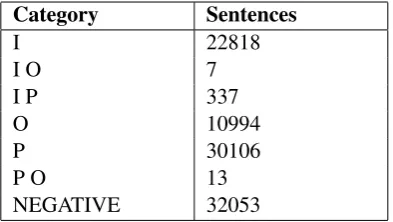
keyword-Category Sentences
I 22818
I O 7
I P 337
O 10994
P 30106
P O 13
[image:2.595.319.516.62.173.2]NEGATIVE 32053
Table 1: Number of occurrences of each category P, I and O in abstracts.
based approach would yield a sequence labeled
population and methodswith the label P, but such abstract sections were not purely about the popu-lation and contained information about the inter-ventions and study design making them poor can-didates for a P label. Thus, we were able to ex-tract portions of absex-tracts pertaining to P, I, and O categories while minimizing ambiguity and re-dundancy. Moreover, in the dataset from (Jin and Szolovits,2018), a section labeled as P that con-tained more than one sentence would be split into multiple P sentences to be included in the dataset. We avoided this approach and kept the full abstract sections. The full abstracts were kept in conjunc-tion with our belief that keeping the full secconjunc-tion retains more feature-rich sequences for each se-quence, and that individual sentences from long abstract sections can be poor candidates for the corresponding label.
For sections with labels such aspopulation and intervention, we created a mutli-label. We also included negative examples by taking sentences from sections with headings such asaim. Further-more, we cleaned the remaining data with various approaches including, but not limited to, language identification, removal of missing values, cleaning unicode characters, and filtering for sequences be-tween 5 and 200 words, inclusive.
3 BERT-Based Classification Model
3.1 Background
language model, BERT can be pre-trained on dif-ferent contexts. A contextualized representation is generally optimized for downstream NLP tasks.
Since its release, BERT has been pre-trained on a multitude of corpora. In the following, we de-scribe different BERT embedding versions used for our classification problem. The first version is based on the original BERT release (Devlin et al.,
2018). This model is pre-trained on the BooksCor-pus (800M words) (Zhu et al., 2015) and En-glish Wikipedia (2,500M words). For Wikipedia, text passages were extracted while lists were ig-nored. The second version is BioBERT (Lee et al.,
2019), which was trained on biomedical corpora: PubMed (4.5B words) and PMC (13.5B words).
3.2 The Model
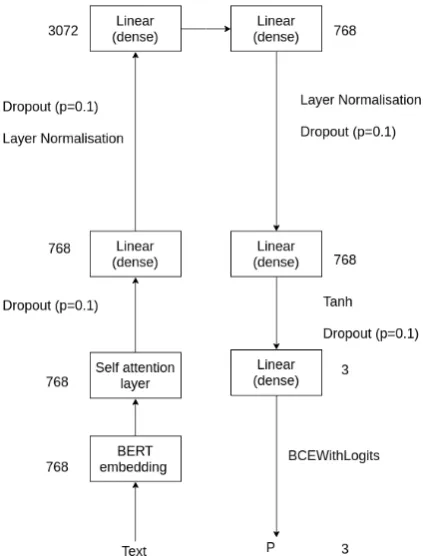
The classification model is built on top of the BERT representation by adding a dense layer cor-responding to the multi-label classifier with three output neurons corresponding to PIO labels. In order to insure that independent probabilities are assigned to the labels, as a loss function we have chosen the binary cross entropy with logits (BCE-WithLogits) defined by
E =−
n
X
i=1
(tilog(yi) + (1−ti)log(1−yi)); (1)
wheretandyare the target and output vectors, re-spectively;nis the number of independent targets (n=3). The outputs are computed by applying the logistic function to the weighted sums of the last hidden layer activations, s,
yi = 1
1 +e−si, (2)
si =
X
j=1
hjwji. (3)
For the original BERT model, we have cho-sen the smallest uncased model, Bert-Base. The model has 12 attention layers and all texts are con-verted to lowercase by the tokenizer (Devlin et al.,
2018). The architecture of the model is illustrated in Figure1.
Using this framework, we trained the model using the two pretrained embedding models de-scribed in the previous section. It is worth to men-tion that the embedding is contextualized during the training phase. For both models, the pretrained embedding layer is frozen during the first epoch
[image:3.595.307.519.167.447.2](the embedding vectors are not updated). After the first epoch, the embedding layer is unfrozen and the vectors are fine-tuned for the classifica-tion task during training. The advantage of this approach is that few parameters need to be learned from scratch (Howard and Ruder, 2018;Radford et al.,2018;Devlin et al.,2018).
Figure 1: Structure of the classifier.
4 Results
4.1 Performance Comparison
In order to quantify the performance of the clas-sification model, we computed the precision and recall scores. On average, it was found that the model leads to better results when trained using the BioBERT embedding. In addition, the perfor-mance of the PIO classifier was measured by av-eraging the three Area Under Receiver Operating Characteristic Curve (ROC AUC) scores for P, I, and O. The ROC AUC score of 0.9951 was ob-tained by the model using the general BERT em-bedding. This score was improved to 0.9971 when using the BioBERT model pre-trained on medical context. The results are illustrated in Figure2.
4.2 Model Boosting
combin-(a) BERT (ROC AUC: 0.9951)
[image:4.595.69.291.60.323.2](b) BioBERT (ROC AUC: 0.9971)
[image:4.595.312.523.62.124.2]Figure 2: ROC AUC scores and confusion matrices.
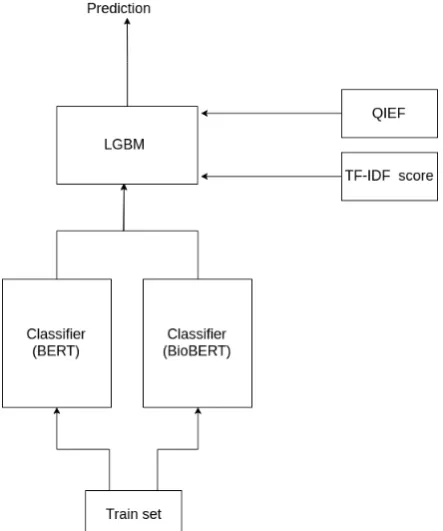
Figure 3: An illustration of the LGBM framework: : combining the two base models and the TF-IDF and QIEF features.
ing predictions from base classifiers with features of the input data to increase the accuracy of the model (Merz,1999).
We investigate an important family of ensemble methods known as boosting, and more specifically
Model ROC AUC F1
BERT 0.9951 0.9666
BioBERT 0.9971 0.9697
BERT + TF-IDF + QIEF 0.9981 0.9784
BioBERT + TF-IDF + QIEF 0.9996 0.9793
[image:4.595.71.293.359.625.2]BERT + BioBERT + TF-IDF + QIEF 0.9998 0.9866
Table 2: Performance of the classifiers in terms of ROC AUC and F1 scores.
a Light Gradient Boosting Machine (LGBM) al-gorithm, which consists of an implementation of fast gradient boosting on decision trees. In this study, we use a library implemented by Microsoft (Ke et al.,2017). In our model, we learn a linear combination of the prediction given by the base classifiers and the input text features to predict the labels. As features, we consider the average term frequency-inverse document frequency (TF-IDF) score for each instance and the frequency of occur-rence of quantitative information elements (QIEF) (e.g. percentage, population, dose of medicine). Finally, the output of the binary cross entropy with logits layer (predicted probabilities for the three classes) and the feature information are fed to the LGBM.
We train the base classifier using the original training dataset, using 60% of the whole data as training dataset, and use a five-fold cross-validation framework to train the LGBM on the remaining40% of the data to avoid any informa-tion leakage. We train the LGBM on four folds and test on the excluded one and repeat the pro-cess for all five folds.
The results of the LGBM classifier for the dif-ferent boosting frameworks and the scores from the base classifiers are illustrated in Table2. The highest average ROC AUC score of 0.9998 is ob-tained in the case of combining the two base learn-ers along with the TF-IDF and QIEF features.
5 Discussion and Conclusion
embedding contextualization in subsequent classi-fication tasks in this specific context.
In order to enhance the accuracy of the model, we investigated an ensemble method based on the LGBM algorithm. We trained the LGBM model, with the above models as base learners, to opti-mize the classification by learning a linear combi-nation of the predicted probabilities, for the three classes, with the TF-IDF and QIEF scores. The results indicate that these text features were ade-quate for boosting the contextualized classification model. We compared the performance of the clas-sifier when using the features with one of the base learners and the case where we combine the base learners along with the features. We obtained the best performance in the latter case.
The present work resulted in the creation of a PIO elements dataset, PICONET, and a classifi-cation tool. These constitute an important compo-nent of our system of automatic mining of medical abstracts. We intend to extend the dataset to full medical articles. The model will be modified to take into account the higher complexity of full text data and more efficient features for model boost-ing will be investigated.
References
Rohit Borah, Andrew W Brown, Patrice L Capers, and Kathryn A Kaiser. 2017. Analysis of the time and workers needed to conduct systematic reviews of medical interventions using data from the prospero registry. BMJ open, 7(2):e012545.
Florian Boudin, Jian-Yun Nie, Joan C Bartlett, Roland Grad, Pierre Pluye, and Martin Dawes. 2010. Com-bining classifiers for robust pico element detec-tion. BMC medical informatics and decision mak-ing, 10(1):29.
Grace Y Chung. 2009. Sentence retrieval for abstracts of randomized controlled trials. BMC medical infor-matics and decision making, 9(1):10.
Jacob Devlin, Ming-Wei Chang, Kenton Lee, and Kristina Toutanova. 2018. Bert: Pre-training of deep bidirectional transformers for language understand-ing. arXiv preprint arXiv:1810.04805.
R Brian Haynes, David L Sackett, W Scott Richard-son, William Rosenberg, and G Ross Langley. 1997. Evidence-based medicine: How to practice & teach ebm. Canadian Medical Association. Journal, 157(6):788.
Jeremy Howard and Sebastian Ruder. 2018. Universal language model fine-tuning for text classification.
arXiv preprint arXiv:1801.06146.
Di Jin and Peter Szolovits. 2018. Pico element detec-tion in medical text via long short-term memory neu-ral networks. In Proceedings of the BioNLP 2018 workshop, pages 67–75.
Guolin Ke, Qi Meng, Thomas Finley, Taifeng Wang, Wei Chen, Weidong Ma, Qiwei Ye, and Tie-Yan Liu. 2017. Lightgbm: A highly efficient gradient boost-ing decision tree. In Advances in Neural Informa-tion Processing Systems, pages 3146–3154.
Quoc Le and Tomas Mikolov. 2014. Distributed repre-sentations of sentences and documents. In Interna-tional conference on machine learning, pages 1188– 1196.
Jinhyuk Lee, Wonjin Yoon, Sungdong Kim, Donghyeon Kim, Sunkyu Kim, Chan Ho So, and Jaewoo Kang. 2019. Biobert: pre-trained biomed-ical language representation model for biomedbiomed-ical text mining. arXiv preprint arXiv:1901.08746.
Lajanugen Logeswaran and Honglak Lee. 2018. An efficient framework for learning sentence represen-tations.arXiv preprint arXiv:1803.02893.
Christopher J Merz. 1999. Using correspondence anal-ysis to combine classifiers. Machine Learning, 36(1-2):33–58.
Tomas Mikolov, Ilya Sutskever, Kai Chen, Greg S Cor-rado, and Jeff Dean. 2013. Distributed representa-tions of words and phrases and their compositional-ity. InAdvances in neural information processing systems, pages 3111–3119.
Matthew E Peters, Waleed Ammar, Chandra Bhagavat-ula, and Russell Power. 2017. Semi-supervised se-quence tagging with bidirectional language models.
arXiv preprint arXiv:1705.00108.
Alec Radford, Karthik Narasimhan, Time Salimans, and Ilya Sutskever. 2018. Improving language un-derstanding with unsupervised learning. Technical report, Technical report, OpenAI.
John Rathbone, Loai Albarqouni, Mina Bakhit, Elaine Beller, Oyungerel Byambasuren, Tammy Hoffmann, Anna Mae Scott, and Paul Glasziou. 2017. Expe-diting citation screening using pico-based title-only screening for identifying studies in scoping searches and rapid reviews. Systematic reviews, 6(1):233.
David L Sackett, William MC Rosenberg, JA Muir Gray, R Brian Haynes, and W Scott Richardson. 1996. Evidence based medicine: what it is and what it isn’t.